- Market Value (2025): USD 87.2 Bn
- Estimated Value (2026): USD 92.6 Bn
- Forecast Value (2036): USD 168.4 Bn
- CAGR (2026-2036): 6.2%
What is the Electronic Manufacturing Services for Industrial Device Market forecast to be worth by 2036?
USD 92.6 billion in 2026 to USD 168.4 billion by 2036 at a 6.2% CAGR.
- The market was worth approximately USD 87.2 billion in 2025, calculated from the 2026 value and the stated 6.2% CAGR.
- Demand is projected to increase from USD 92.6 billion in 2026 to USD 168.4 billion by 2036.
- The market is forecast to create an absolute opportunity of USD 75.8 billion between 2026 and 2036.
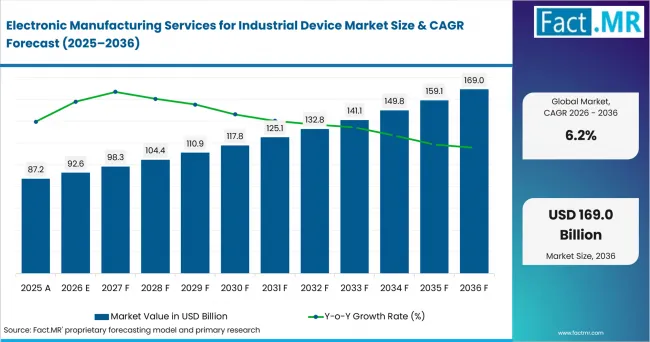
Electronic Manufacturing Services For Industrial Device Market Value Analysis | Source: Fact.MR
What are the defining numbers behind market growth?
The market is projected to add USD 75.8 billion over the forecast period. Growth reflects a larger installed base of connected industrial equipment, higher electronic content within machinery and greater outsourcing of design, production, testing and lifecycle support.
- Demand Drivers in the Market
- Factory automation is increasing the volume and complexity of electronic assemblies used in sensors, motor controls, programmable controllers, machine-vision systems and industrial computers. The International Federation of Robotics recorded 542,000 industrial robot installations in 2024, more than double the level ten years earlier. Each new automated cell expands demand for control boards, power modules and communication hardware that EMS providers can design and manufacture at scale.
- Industrial customers are adding connected monitoring to equipment in order to track production, energy use and maintenance requirements. Connected devices require compact electronics, secure communications and dependable operation in demanding environments. EMS suppliers support this transition through printed-circuit-board assembly, enclosure integration, firmware loading and functional testing.
- Product lifecycles are becoming harder to manage as industrial OEMs face component obsolescence, supply disruption and tighter traceability requirements. Outsourcing allows OEMs to use the purchasing scale and multi-site sourcing networks of EMS providers while retaining control of product architecture and intellectual property.
- Industrial electronics require more rigorous validation than many consumer products because equipment may operate continuously and under vibration, dust or temperature variation. Demand therefore extends beyond assembly to automated optical inspection, functional testing, environmental screening and documented quality control.
- Nearshoring and regional supply-chain diversification are encouraging industrial OEMs to qualify manufacturing partners closer to end markets. EMS companies with engineering support and production capacity across North America, Europe and Asia can help customers transfer products between sites without rebuilding the entire supplier base.
- Key Segments Analyzed
- Manufacturing & Assembly Services account for 43.0% of Service Type in 2026 because industrial OEMs outsource labour-intensive board assembly and system integration while retaining product ownership.
- Industrial Automation Devices hold 41.0% of Device Category in 2026, supported by rising use of controllers, drives, sensors and machine-interface electronics in automated plants.
- Industrial Manufacturing represents 44.0% of End-use Industry in 2026 as factories require high volumes of durable control and monitoring electronics.
- Original Equipment Manufacturers account for 42.0% of Customer Category in 2026 because they use EMS partners to scale production without building equivalent in-house capacity.
- Surface Mount Technology (SMT) holds 39.0% of Manufacturing Technology in 2026 due to its suitability for compact, repeatable and automated circuit-board assembly.
- Analyst Opinion at Fact.MR
- Shambhu Nath Jha, Principal Consultant at Fact.MR, states, “Industrial-device OEMs are outsourcing a wider portion of the product lifecycle, but supplier selection remains demanding. Buyers need manufacturing partners that can protect intellectual property, manage component risk and produce consistent quality over long equipment lifecycles. EMS providers that combine engineering support with automated production and traceable testing are better placed to secure repeat programmes as the market expands from USD 92.6 billion in 2026 to USD 168.4 billion by 2036.”
- Strategic Implications
- EMS providers should organize their industrial offering around product families such as controls, sensing, power electronics and communication equipment. This makes engineering capability easier for OEM buyers to assess.
- Suppliers should strengthen component-lifecycle management and approved-alternative processes. Industrial products remain in service for long periods, so obsolescence planning can influence contract renewal.
- Manufacturers should connect inspection and functional-test data with unit-level traceability. Buyers use this evidence to evaluate field reliability and investigate failures.
- Regional production options can reduce transfer risk for customers seeking dual sourcing. Providers should standardize tooling and process documentation so programmes can move between plants with limited requalification.
How does the market break down by segment?
The market is segmented by Service Type, Device Category, End-use Industry, Customer Category and Manufacturing Technology.
Why do Manufacturing & Assembly Services lead Service Type?
Manufacturing & Assembly Services are projected to account for a 43.0% share in 2026.
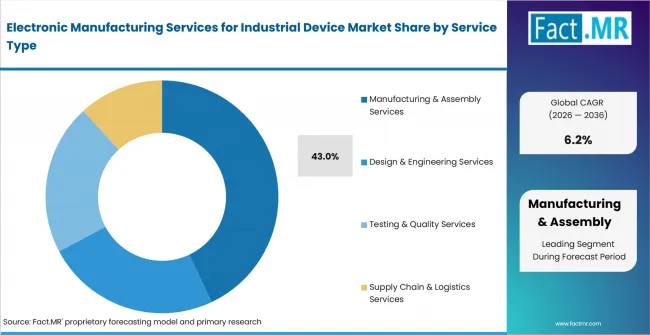
Electronic Manufacturing Services For Industrial Device Market Analysis By Service Type | Source: Fact.MR
Industrial-device OEMs often retain product design and customer ownership while outsourcing printed-circuit-board assembly, box build and final integration. This structure reduces the fixed cost of production lines and allows output to change with equipment demand.
The segment also benefits from repeat production. Once an EMS provider has qualified materials, tooling and test procedures for an industrial product, changing suppliers can require new validation and supply-chain approvals. This encourages longer manufacturing relationships when quality and delivery remain stable.
Why do Industrial Automation Devices lead Device Category?
Industrial Automation Devices are projected to account for a 41.0% share in 2026.
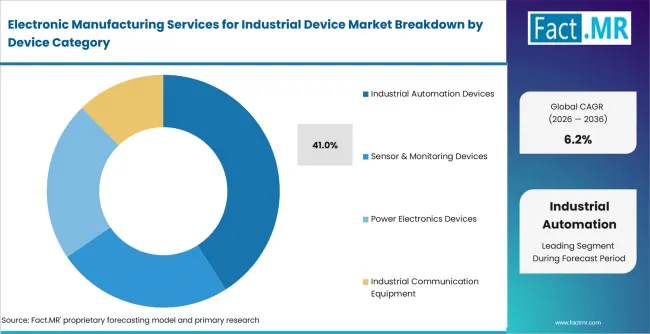
Electronic Manufacturing Services For Industrial Device Market Analysis By Device Category | Source: Fact.MR
Automation systems use electronic controls across motion, sensing, safety and communication functions. The IFR reported that 542,000 industrial robots were installed in 2024, with annual installations remaining above 500,000 for a fourth consecutive year. This installed base supports continuing production of controllers, drives and interface equipment.
Automation devices also require frequent product variants for different machines and operating environments. EMS partners can manage common board platforms while adjusting connectors, firmware and enclosures for each OEM programme.
Why does Industrial Manufacturing lead End-use Industry?
Industrial Manufacturing is projected to account for a 44.0% share in 2026.
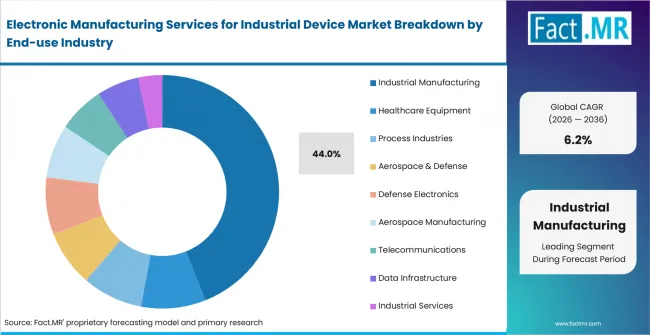
Electronic Manufacturing Services For Industrial Device Market Analysis By End Use Industry | Source: Fact.MR
Manufacturing plants use electronic equipment across production control, quality inspection and predictive maintenance. These systems must operate reliably for long shifts and remain serviceable over extended equipment lifecycles, creating demand for controlled assembly and documented testing.
Factory digitalization further increases electronic content per production line. UNIDO identifies digital technologies and advanced manufacturing as major forces reshaping industrial production, supporting demand for connected devices and the outsourced manufacturing capacity behind them.
Why do Original Equipment Manufacturers lead Customer Category?
Original Equipment Manufacturers are projected to account for a 42.0% share in 2026.
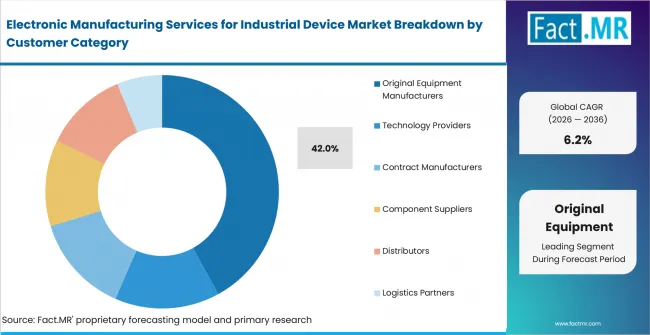
Electronic Manufacturing Services For Industrial Device Market Analysis By Customer Category | Source: Fact.MR
OEMs lead because they own the product specification and typically select the manufacturing partner before commercial production. They use EMS suppliers to access engineering resources, procurement scale and production capacity without investing in a complete electronics factory.
The relationship extends beyond unit assembly. OEMs require design-for-manufacture reviews, component qualification, change control and after-sales support. Providers that can manage these activities become integrated into the customer’s product-release workflow.
Why does Surface Mount Technology lead Manufacturing Technology?
Surface Mount Technology (SMT) is projected to account for a 39.0% share in 2026.
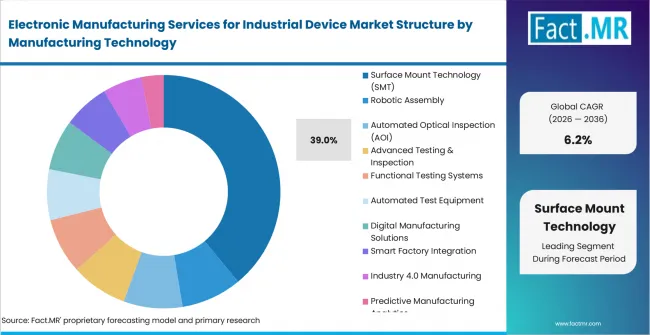
Electronic Manufacturing Services For Industrial Device Market Analysis By Manufacturing Technology | Source: Fact.MR
SMT supports automated placement of compact components at high speed and is used across control boards, sensor modules and communication devices. It enables greater component density than conventional through-hole assembly and supports repeatable production across medium and large volumes.
Automated optical inspection and in-line process data strengthen its value for industrial work. Manufacturers can identify placement or solder defects early and maintain traceability across production batches. Through-hole and mixed-technology processes remain important where products require high mechanical strength or large power components.
What is accelerating adoption, and what is holding it back?
Drivers Impact Analysis
| Factor | (~) % Impact on CAGR | Geographic Relevance | Impact Timeline |
|---|---|---|---|
| Industrial automation and connected equipment | +1.6% | Global | Short term (≤ 2 years) |
| Regulatory and quality requirements | +1.4% | USA; Germany; UK | Short term (≤ 2 years) |
| Regional manufacturing capacity expansion | +1.1% | Global | Medium term (2–4 years) |
| Traceability and lifecycle documentation | +0.9% | USA; UK; Canada | Medium term (2–4 years) |
| Scale and production-efficiency gains | +0.6% | Global | Long term (≥ 4 years) |
Source: Fact.MR analysis. Updated Aug 7, 2026
Opportunity Impact Analysis
| Factor | (~) % Impact on CAGR | Geographic Relevance | Impact Timeline |
|---|---|---|---|
| Industrial IoT and edge-device programmes | +1.0% | Global | Medium term (2–4 years) |
| High-reliability specialist manufacturing | +0.8% | USA; UK; Germany | Medium term (2–4 years) |
| Regional design and manufacturing partnerships | +0.7% | Global | Long term (≥ 4 years) |
| Standards and compliance alignment | +0.5% | USA; Canada; Singapore | Long term (≥ 4 years) |
Source: Fact.MR analysis. Updated Aug 7, 2026
Restraints Impact Analysis
| Factor | (~) % Impact on CAGR | Geographic Relevance | Impact Timeline |
|---|---|---|---|
| Programme-transfer cost and complexity | -1.1% | Global | Short term (≤ 2 years) |
| Qualification and compliance checks | -0.9% | USA; UK; Germany | Short term (≤ 2 years) |
| Competition from lower-cost manufacturing locations | -0.7% | Import-dependent markets | Medium term (2–4 years) |
| Component supply and pricing pressure | -0.5% | Global | Long term (≥ 4 years) |
Source: Fact.MR analysis. Updated Aug 7, 2026
Which countries are scaling fastest?
- USA: Demand is supported by renewed factory automation and domestic investment in advanced electronics. IFR preliminary data show U.S. industrial robot installations increased 11% to 38,000 units in 2025, expanding the installed base of control and sensing hardware.
- Germany: Germany combines a large machinery sector with high factory automation. Its robot density reached 449 units per 10,000 manufacturing employees in 2024, supporting sustained demand for industrial controllers and power electronics.
- China: China accounted for 54% of global industrial robot installations in 2024. The scale of automation deployment and electronics production supports high-volume EMS demand for industrial devices.
- Japan: Japan remains a major industrial robot market and manufacturing-equipment producer. Its focus on connected manufacturing and machine-parts competitiveness creates demand for compact, high-reliability electronic assemblies.
- UK: The Made Smarter Adoption programme supports manufacturing SMEs with digital roadmaps and grant-backed technology adoption. This creates opportunities for industrial devices used in monitoring, automation and process control.
- Canada: Canada is using its Advanced Manufacturing Cluster to support commercialization and scaling of manufacturing technologies. Regional production and resource-industry applications support demand for rugged industrial electronics.
- South Korea: South Korea has the world’s highest industrial robot density at 1,220 units per 10,000 manufacturing employees. Its electronics and automotive industries create a strong base for outsourced production of industrial controls and power systems.
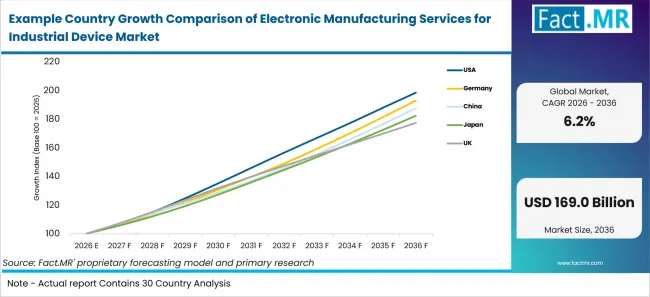
Example Country Growth Comparison Of Electronic Manufacturing Services For Industrial Device Market | Source: Fact.MR
| Country | CAGR, 2026–2036 |
|---|---|
| USA | 7.1% |
| Germany | 6.8% |
| China | 6.5% |
| Japan | 6.2% |
| UK | 5.9% |
| Canada | 5.6% |
| South Korea | 5.3% |
Source: Fact.MR analysis. Updated Aug 7, 2026
What is driving USA growth through 2036?
The USA is forecast to expand at a 7.1% CAGR from 2026 to 2036.
Growth is supported by investment in factory automation, semiconductor capacity and domestic manufacturing resilience. IFR reported 38,000 industrial robot installations in 2025, up 11% from the prior year. Each automated production system requires controls, sensors and communication electronics that can be supplied through EMS relationships.
The U.S. market also has a large network of system integrators and industrial OEMs. EMS providers with local engineering and low-to-medium volume manufacturing can serve programmes that require frequent design changes or secure regional production.
What is driving Germany growth through 2036?
Germany is forecast to expand at a 6.8% CAGR from 2026 to 2036.
Germany’s machinery, automotive and process industries use high levels of factory automation. IFR measured 449 industrial robots per 10,000 manufacturing employees in 2024, placing Germany among the most automated economies. This creates a broad installed base for control, sensing and power electronics.
Customers also place strong emphasis on documented quality and long product support. EMS suppliers that maintain traceability and manage engineering changes can support industrial OEMs across equipment generations.
What is driving China growth through 2036?
China is forecast to expand at a 6.5% CAGR from 2026 to 2036.
China installed 295,000 industrial robots in 2024, equal to 54% of global installations. This scale supports demand for industrial electronic assemblies across robotics, machine tools and automated logistics.
The country also combines component supply, PCB manufacturing and system assembly within dense production clusters. This shortens sourcing cycles and supports large-volume programmes, although customers continue to assess intellectual-property protection and supply concentration.
What is driving Japan growth through 2036?
Japan is forecast to expand at a 6.2% CAGR from 2026 to 2036.
Japan remains the second-largest industrial robot market and has a large installed base of precision machinery and factory equipment. METI policy promotes digital technologies across machine-parts and tooling industries, supporting demand for controllers and monitoring devices.
Japanese industrial buyers often require long product support and consistent process control. EMS providers with engineering depth and strong supplier management are positioned to serve these requirements.
What is driving UK growth through 2036?
The UK is forecast to expand at a 5.9% CAGR from 2026 to 2036.
The Made Smarter Adoption programme helps manufacturing SMEs adopt industrial digital technologies through advice, transformation roadmaps and grant support. This expands the addressable base for connected sensors, automation controls and production-monitoring equipment.
The UK also has specialized aerospace, medical and industrial-technology clusters. EMS providers can compete through low-volume, high-mix production and compliance-focused testing rather than pure scale.
What is driving Canada growth through 2036?
Canada is forecast to expand at a 5.6% CAGR from 2026 to 2036.
Canada’s Advanced Manufacturing Cluster supports commercialization and scale-up of manufacturing technologies. Demand comes from automotive, aerospace and resource-processing applications that require durable electronic controls.
Geographic proximity to U.S. customers also supports regional supply-chain strategies. EMS companies with North American facilities can offer customers a second production location while retaining common engineering and quality systems.
What is driving South Korea growth through 2036?
South Korea is forecast to expand at a 5.3% CAGR from 2026 to 2036.
South Korea recorded 1,220 industrial robots per 10,000 manufacturing employees, the highest robot density worldwide. Its electronics and automotive sectors create continuing demand for control boards, power modules and automated test systems.
Local technical capability in semiconductors and batteries also supports advanced industrial-device design. EMS providers must compete with strong in-house manufacturing capabilities by offering flexible capacity, specialist processes or access to overseas production sites.
Who leads the Electronic Manufacturing Services for Industrial Device Market?
Flex Ltd. is positioned as the leading company, supported by its global manufacturing footprint and experience across industrial products. Jabil Inc. and Foxconn Industrial Internet Co., Ltd. compete through scale, supply-chain reach and automated production. Benchmark Electronics, TTM Technologies, Sanmina, Plexus and Creation Technologies have strong positions in complex, regulated or high-mix manufacturing programmes.
ASE Technology Holding contributes semiconductor assembly and test capability, while Kimball Electronics and Venture Corporation serve industrial and other long-lifecycle electronics programmes. Competition depends on engineering support, manufacturing quality, component sourcing and the ability to maintain production over extended product lifecycles.
Industrial customers also assess whether a supplier can transfer a programme between plants, protect design data and provide failure-analysis support. Large providers benefit from geographic coverage and procurement scale. Specialist providers compete through responsiveness and expertise in lower-volume products with complex testing requirements.
Which companies are the key providers?
- Flex Ltd.
- Jabil Inc.
- Foxconn Industrial Internet Co., Ltd.
- Benchmark Electronics, Inc.
- TTM Technologies, Inc.
- ASE Technology Holding Co., Ltd.
- Creation Technologies LP
- Sanmina Corporation
- Kimball Electronics Inc.
- Plexus Corp.
- Venture Corporation Limited
Bibliography
- International Federation of Robotics. (2025). World Robotics 2025: Industrial Robots. International Federation of Robotics.
- International Federation of Robotics. (2026). US Robot Industry Returns to Double Digit Growth. International Federation of Robotics.
- International Federation of Robotics. (2026). Robot Density Surges in Europe, Asia, and Americas. International Federation of Robotics.
- United Nations Industrial Development Organization. (2026). Industrial Development Report 2026. United Nations.
- Ministry of Economy, Trade and Industry, Japan. (2025). FY2025 Vision for the Machine Parts and Tooling Industries. Government of Japan.
- Department for Business and Trade. (2026). Made Smarter Adoption: Impact and Process Evaluation. Government of the United Kingdom.
- Innovation, Science and Economic Development Canada. (2026). Global Innovation Clusters: Advanced Manufacturing Cluster. Government of Canada.
- European Commission, Eurostat. (2022). Use of Internet of Things in Enterprises. European Commission.
This Report Answers
- How large the market is in 2026 and how it is projected to develop through 2036.
- Which service, device, end-use, customer and manufacturing-technology segments lead in 2026.
- Which listed countries are expected to record the fastest growth and the mechanisms supporting demand.
- How industrial automation, connected equipment and supply-chain strategy influence EMS purchasing.
- Which companies compete in the market and which capabilities shape supplier selection.
What does the market cover?
The market covers contracted electronics services used to design, manufacture, assemble, test and support industrial devices. Included products range from automation controllers and sensor modules to power electronics and industrial communication equipment. Revenue is counted when an EMS provider performs a defined service for an industrial-device customer.
What is included in the scope?
The scope includes printed-circuit-board assembly, system integration, design support, product testing, supply-chain management and related lifecycle services. It includes work performed for industrial OEMs, technology providers and other listed customer categories across the supplied segmentation.
What is excluded from the scope?
The scope excludes consumer-electronics manufacturing, standalone component distribution and general logistics services that are not tied to an EMS programme. It also excludes industrial machinery revenue where the electronics manufacturing service cannot be separated from the finished equipment sale. Adjacent semiconductor fabrication and pure software services are outside the market unless supplied as part of the covered EMS engagement.
How Was the Analysis Built?
The analysis draws on more than 120 sources, over 35 company portfolios and more than 20 industry interviews across at least 25 countries.
- Primary Research: Interviews with EMS executives, industrial OEM sourcing teams, electronics engineers, component suppliers and quality managers examine outsourcing decisions, production transfer, pricing and supplier qualification.
- Desk Research: The review covers industrial production, automation investment, electronics supply chains, company filings, technical standards and government manufacturing programmes. Every external source used in the article is listed in the bibliography.
- Market Sizing and Forecasting: Estimates combine industrial-device production, outsourced manufacturing penetration, service revenue per programme, technology mix and country-level demand. The model distinguishes engineering, assembly, testing and supply-chain services.
- Data Validation and Update Cycle: Findings are cross-checked against company activity and public industrial indicators. Updates account for factory investment, outsourcing changes, component availability and shifts in regional manufacturing capacity.
Segmentation
What is the report's scope and coverage?
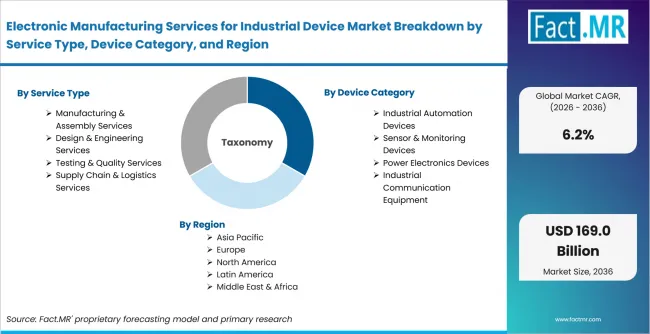
Electronic Manufacturing Services For Industrial Device Market Breakdown By Service Type, Device Category, And Region | Source: Fact.MR
| Attribute | Details |
|---|---|
| Quantitative Units | USD billion |
| Market Definition | Outsourced electronics design, manufacturing, assembly, testing and lifecycle support for industrial devices |
| Segments Covered | Service Type; Device Category; End-use Industry; Customer Category; Manufacturing Technology |
| Regions Covered | North America; Latin America; Europe; East Asia; South Asia and Pacific; Middle East and Africa |
| Countries Covered | USA; Germany; China; Japan; UK; Canada; South Korea |
| Key Companies Profiled | Flex Ltd.; Jabil Inc.; Foxconn Industrial Internet Co., Ltd.; Benchmark Electronics, Inc.; TTM Technologies, Inc.; and others |
| Forecast Period | 2026 to 2036 |
| Approach | Hybrid top-down and bottom-up approach using industrial-device production, outsourcing penetration, service mix, country demand and company portfolio review |
Source: Fact.MR analysis. Updated Aug 7, 2026
How is the market segmented?
-
By Service Type
- Manufacturing & Assembly Services
- PCB Assembly Services
- Electronic Assembly Services
- Design & Engineering Services
- Product Design Support
- Prototype Development
- Testing & Quality Services
- Functional Testing
- Reliability Testing
- Supply Chain & Logistics Services
- Component Procurement
- Inventory Management
- Manufacturing & Assembly Services
-
By Device Category
- Industrial Automation Devices
- Industrial Controllers
- Programmable Logic Controllers (PLCs)
- Sensor & Monitoring Devices
- Industrial IoT Sensors
- Remote Monitoring Systems
- Power Electronics Devices
- Industrial Power Supplies
- Energy Management Systems
- Industrial Communication Equipment
- Industrial Networking Devices
- Rugged Communication Devices
- Industrial Automation Devices
-
By End-use Industry
- Industrial Manufacturing
- Automotive Manufacturing
- Energy & Utilities
- Healthcare Equipment
- Manufacturing Facilities
- Process Industries
- Aerospace & Defense
- Defense Electronics
- Aerospace Manufacturing
- Telecommunications
- Data Infrastructure
- Industrial Services
- Industrial Manufacturing
-
By Customer Category
- Original Equipment Manufacturers
- Global OEMs
- Industrial Equipment Brands
- Technology Providers
- Engineering Companies
- System Integrators
- Contract Manufacturers
- Design Houses
- Value-added Resellers
- Component Suppliers
- Distributors
- Logistics Partners
- Original Equipment Manufacturers
-
By Manufacturing Technology
- Surface Mount Technology (SMT)
- Automated SMT Lines
- High-density Interconnect Assembly
- Robotic Assembly
- Automated Optical Inspection (AOI)
- Advanced Testing & Inspection
- Functional Testing Systems
- Automated Test Equipment
- Digital Manufacturing Solutions
- Smart Factory Integration
- Industry 4.0 Manufacturing
- Predictive Manufacturing Analytics
- Surface Mount Technology (SMT)
-
By Region
- North America
- Latin America
- Western Europe
- Eastern Europe
- East Asia
- South Asia and Pacific
- Middle East & Africa
Frequently Asked Questions
Which Service Type leads the market?
Which Device Category leads the market?
Which End-use Industry leads the market?
Which Customer Category leads the market?
Which Manufacturing Technology leads the market?
Which country records the highest listed CAGR?
What is the primary driver in this market?
What is the main restraint?
Which companies are included in the market assessment?
Who worked on this report


Preview the report firsthand - request a free sample
Free SampleGet the brochure for pricing and purchase details
Download PDF