- Base Value(2025): 1.4 Bn
- Forecast Value (2036): 2.5 Bn
- CAGR (2036): 5.2%
Embolization Coils Market Forecast and Outlook by Fact.MR
- The embolization coils market reached USD 1.4 billion in 2025.
- The market is estimated at USD 1.5 billion in 2026 and projected to reach USD 2.5 billion by 2036.
- Growth is projected at 5.2% CAGR from 2026 to 2036.
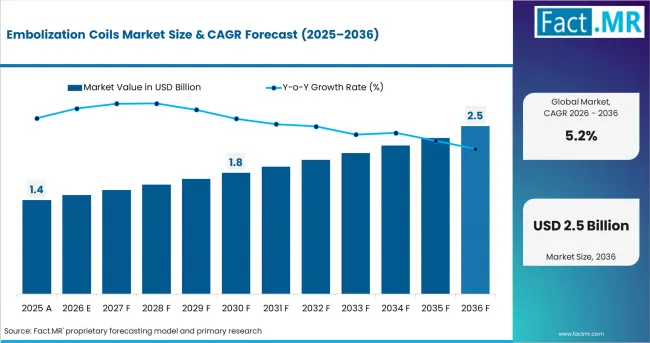
Embolization Coils Market Value Analysis | Source: Fact.MR
| Metric | Value |
|---|---|
| Estimated Value in 2026 | USD 1.5 billion |
| Forecast Value in 2036 | USD 2.5 billion |
| Forecast CAGR (2026 to 2036) | 5.2% |
Source: Fact.MR analysis. Updated May 26, 2026
Summary of the Embolization Coils Market
- Demand Drivers
- Rising stroke and cerebrovascular disease cases are increasing aneurysm and AVM embolization procedures across major hospitals. Neurovascular treatment programs are strengthening embolization coil demand across Asia and North America.
- China and India are increasing investment in interventional radiology infrastructure across public hospitals. Expanding cath lab capacity is improving access to detachable coil procedures beyond metro cities.
- Oncology embolization procedures are increasing demand for platinum coil systems across cancer treatment centers. Liver and renal tumor intervention volumes are rising across Asia Pacific and Europe.
- Key Segments Analyzed
- By Type: Detachable coils account for 65% share in 2026 due to higher deployment precision and repositioning flexibility during neurovascular procedures.
- By Application: Neurology accounts for 40% share in 2026 driven by rising cerebral aneurysm and AVM treatment procedures.
- By End User: Hospitals account for 60% share in 2026 as embolization procedures require angiography imaging systems and specialist intervention teams.
- By Material: Platinum coils account for 45% share in 2026 supported by strong radiopacity and reliable vessel occlusion performance.
- By Procedure Type: Aneurysm embolization holds 40% share in 2026 due to high neurovascular intervention volume across specialist hospitals.
- Analyst Opinion at Fact.MR
- Shambhu Nath Jha, Principal Consultant at Fact.MR, opines, "The embolization coils market is moving toward premium detachable coil systems with higher procedural precision and clinical control. Rising neurovascular intervention programs across Asia are increasing demand for detachable embolization systems."
- Strategic Implications
- Device manufacturers should expand detachable coil product portfolios and strengthen clinical training programs across tertiary hospitals in China and India. Neurovascular infrastructure investment is increasing demand for detachable embolization systems.
- Companies should improve clinical evidence support for hospitals and purchasing committees. Procedure success rates and complication reduction data strongly influence premium coil purchase decisions.
- Suppliers should strengthen platinum sourcing agreements to reduce raw material pricing risk. Stable device supply and predictable pricing remain important for long-term hospital contracts.
The market is projected to create an absolute dollar opportunity of nearly USD 1.0 billion between 2026 and 2036. Demand is increasing due to rising stroke incidence and growing use of minimally invasive neurovascular procedures. Hospitals across Asia Pacific are increasing investment in interventional radiology and neurology infrastructure. High pricing for detachable coils and complex endovascular procedures is supporting stable market revenue across developed countries. Platinum price fluctuations and lengthy medical device approval timelines are limiting faster market expansion.
China records 6.2% CAGR through 2036 supported by rising neuro-intervention procedures and expanding tertiary hospital infrastructure. India follows at 6.0% CAGR due to increasing cerebrovascular disease burden and stronger public hospital investment in interventional radiology. The United States grows at 5.8% CAGR driven by adoption of detachable coil systems and expansion of stroke care programs. Germany expands at 5.1% CAGR supported by favorable reimbursement for complex endovascular procedures. Japan advances at 4.9% CAGR as hospitals upgrade angiography systems and increase adoption of neurovascular intervention technologies.
Segmental Analysis
Embolization Coils Market Analysis by Type
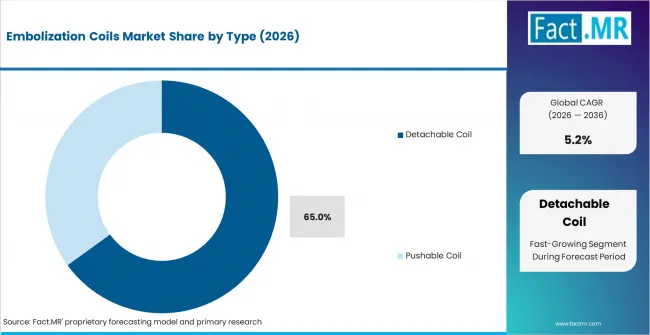
Embolization Coils Market Analysis By Type | Source: Fact.MR
Detachable coils account for 65% share in 2026 due to higher deployment precision and repositioning flexibility during neurovascular procedures. Specialist hospitals increasingly prefer detachable systems for complex aneurysm treatment. Boston Scientific received CE Mark approval for its EMBOLD detachable coil system, expanding availability across Europe, the Middle East, and Africa. [1] The fully retractable embolization coils are designed to improve procedural control, versatility, and efficiency in peripheral vascular embolization procedures.
- Premium Coil Investment: Manufacturers are expanding detachable coil portfolios for specialist neurovascular intervention programs.
- Pushable Coil Utility: Pushable coils remain widely used across peripheral vascular and oncology embolization procedures.
- Hybrid System Adoption: Hospitals are increasing sourcing of combined detachable and pushable coil inventories.
Embolization Coils Market Analysis by Application
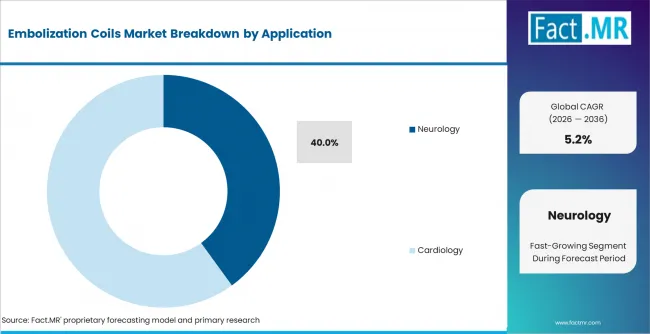
Embolization Coils Market Analysis By Application | Source: Fact.MR
Neurology accounts for 40% share in 2026 driven by rising cerebral aneurysm and AVM treatment procedures. Neurovascular centers generate the leading embolization coil procedure volume globally.
- Oncology Embolization Growth: Tumor embolization procedures are increasing coil demand across cancer treatment hospitals.
- Cardiology Coil Demand: Cardiac intervention centers are increasing embolization procedures for structural heart conditions.
- Peripheral Vascular Application: Outpatient vascular embolization procedures are supporting coil demand across ambulatory centers.
Embolization Coils Market Analysis by End User

Embolization Coils Market Analysis By End User | Source: Fact.MR
Hospitals account for 60% share in 2026 as embolization procedures require angiography imaging systems and specialist intervention teams. Large hospital networks remain the primary users of neurovascular coil systems. Kaneka Corporation began European sales of its i-ED COIL brain aneurysm embolization coil in 2025 after receiving EC certification under EU Medical Device Regulation standards. [2] The company stated that the coil’s enhanced flexibility and dense packing capability support treatment of irregular aneurysms and strengthen its neurovascular device portfolio expansion.
- Ambulatory Centers Adoption: Outpatient centers are increasing peripheral embolization procedure capacity.
- Cardiology Center Investment: Cardiology centers are expanding embolization inventory for structural heart interventions.
- Hospital Network Contracts: Hospital groups are increasing long-term purchase agreements with coil manufacturers.
Embolization Coils Market Analysis by Material
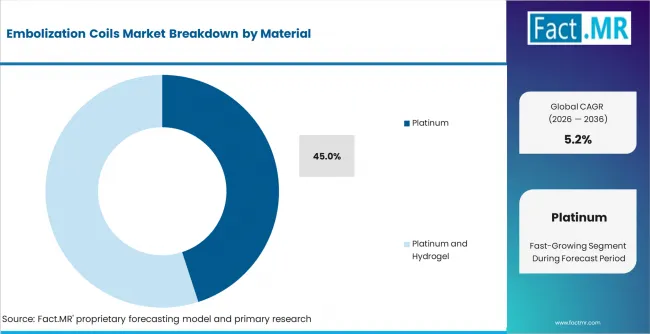
Embolization Coils Market Analysis By Material | Source: Fact.MR
Platinum coils hold 45% share in 2026 supported by strong radiopacity and reliable vessel occlusion performance. Interventional radiologists prefer platinum-based systems for neurovascular procedures. Penumbra launched the SwiftSET™ Coil in 2025, a complex neurovascular embolization coil designed for adaptive vessel wall apposition and controlled deployment in small and tortuous vessels. [4] The company stated that the device expands the capabilities of its Swift Coil System for treating intracranial aneurysms, arteriovenous malformations, and arteriovenous fistulae.
- Hydrogel Composite Expansion: Platinum and hydrogel coils are gaining demand for improved aneurysm packing density.
- Alloy Material Development: Platinum tungsten alloy coils are gaining use across peripheral embolization procedures.
- Material Cost Management: Manufacturers are developing alloy formulations to reduce platinum material cost exposure.
Embolization Coils Market Analysis by Procedure Type

Embolization Coils Market Analysis By Procedure Type | Source: Fact.MR
Aneurysm embolization accounts for 40% share in 2026 due to high neurovascular intervention volume across specialist hospitals. Cerebral aneurysm treatment remains the leading application area for embolization coils.
- Tumor Embolization Demand: Cancer treatment centers are increasing embolization procedures for liver and renal tumors.
- AVM Treatment Growth: Academic neurovascular hospitals are increasing AVM embolization procedures before surgery.
- GI Bleeding Embolization: Emergency radiology departments are increasing use of embolization procedures for gastrointestinal bleeding management.
Drivers, Restraints, and Opportunities
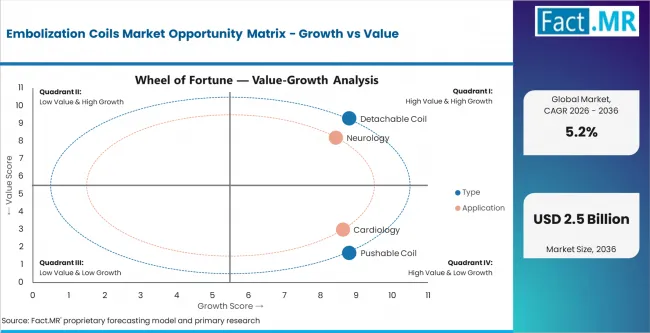
Embolization Coils Market Opportunity Matrix Growth Vs Value | Source: Fact.MR
The embolization coils market is expanding steadily due to rising use of minimally invasive neurovascular procedures. Hospitals are increasingly preferring endovascular treatment over open surgery for aneurysm and AVM management. Wallaby Medical and phenox expanded the European commercialization of the Avenir™ neurovascular coil platform, including the Avenir™ Pico series, for intracranial aneurysm embolization procedures. [5] The coil technology was developed to provide enhanced framing stability, ultra-soft finishing capability, and dense aneurysm packing performance in complex neurovascular anatomies.
Demand is shifting from standard pushable coils toward premium detachable coil systems. Interventional radiologists increasingly prefer detachable coils for better deployment control during complex procedures. Oncology embolization programs are also increasing demand for coil systems across cancer treatment hospitals.
- Neurovascular Procedure Growth: Rising stroke and aneurysm treatment volumes are increasing embolization coil demand across tertiary hospitals.
- Asia Pacific Hospital Investment: China and India are increasing investment in interventional radiology infrastructure and neurovascular treatment programs.
- Platinum Price Pressure: Platinum price fluctuations are increasing manufacturing cost pressure for embolization coil producers.
Regional Analysis
The embolization coils market is assessed across North America, Europe, Asia Pacific, Latin America, and the Middle East and Africa, covering 40+ country-level demand by type, material, application, end user, and procedure type. The full report includes market assessment by region and country.
.webp "Top Country Growth Comparison Embolization Coils Market Cagr (2026 2036)")
Top Country Growth Comparison Embolization Coils Market Cagr (2026 2036) | Source: Fact.MR
| Country | CAGR (2026 to 2036) |
|---|---|
| China | 6.2% |
| India | 6.0% |
| United States | 5.8% |
| Germany | 5.1% |
| Japan | 4.9% |
Source: Fact.MR analysis. Updated May 26, 2026
Source: Fact.MR analysis and primary research
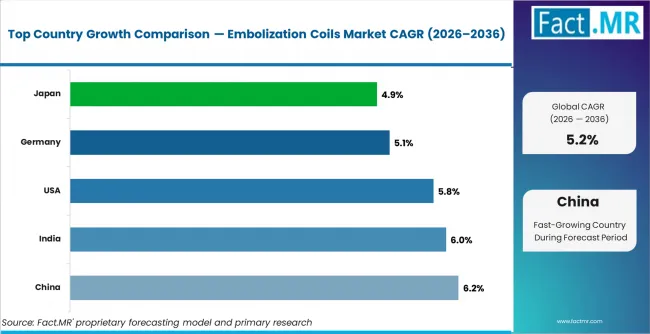
Embolization Coils Market Cagr Analysis By Country | Source: Fact.MR
Asia Pacific Embolization Coils Market Analysis
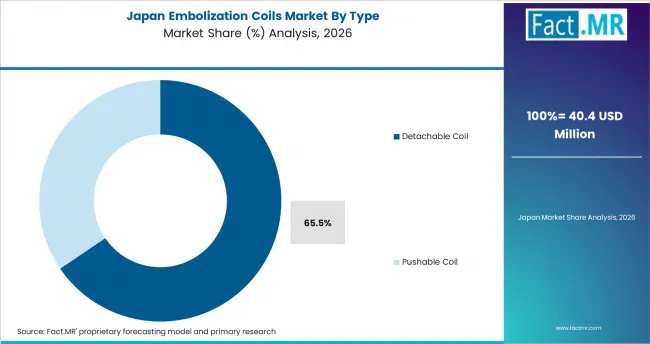
Embolization Coils Market Japan Market Share Analysis By Type | Source: Fact.MR
Asia Pacific records the fastest growth in the embolization coils market due to rising neurovascular treatment capacity and expanding hospital infrastructure. Public healthcare investment is increasing access to interventional radiology procedures across major countries.
- China: China grows at 6.2% CAGR through 2036 supported by expanding tertiary hospital infrastructure and rising stroke intervention procedures. Provincial hospitals are increasing installation of angiography systems across neurovascular departments. Government healthcare investment is also improving access to endovascular aneurysm treatment. Domestic manufacturers are strengthening hospital supply relationships across major cities.
- India: India advances at 6.0% CAGR driven by rising cerebrovascular disease burden and expanding interventional radiology programs. Government hospitals are increasing neurovascular treatment capacity across large states. Medical colleges are also strengthening specialist neurology and radiology training programs. Demand for embolization procedures is increasing across public healthcare networks.
- Japan: Japan grows at 4.9% CAGR through 2036 supported by rising cerebrovascular disease incidence across the aging population. Regional hospitals are upgrading angiography infrastructure and neurovascular treatment capability. Specialist intervention programs are also expanding beyond large metropolitan centers. Hospitals continue prioritizing high-quality embolization systems with strong clinical performance.
North America Embolization Coils Market Analysis
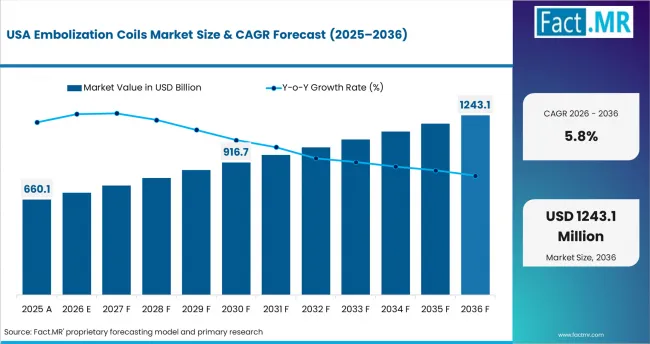
Embolization Coils Market Country Value Analysis | Source: Fact.MR
North America remains the leading high-value market for embolization coil systems due to strong hospital spending and stroke care infrastructure. Large hospital groups are increasing investment in detachable coil technologies and neurovascular treatment programs.
- United States: The United States records 5.8% CAGR through 2036 supported by rising adoption of detachable coil systems. Stroke centers are increasing neurovascular intervention capacity across hospital networks. Hospitals are also accelerating sourcing of next-generation embolization technologies. MicroPort NeuroScientific received U.S. FDA clearance for its NUMEN™ Silk Coil Embolization System in October 2024, expanding the company’s neurovascular embolization portfolio into the U.S. market. [3] The ultra-soft detachable coil system is designed for treatment of small, micro-sized, and ruptured intracranial aneurysms with improved conformability and procedural safety.
Europe Embolization Coils Market Analysis
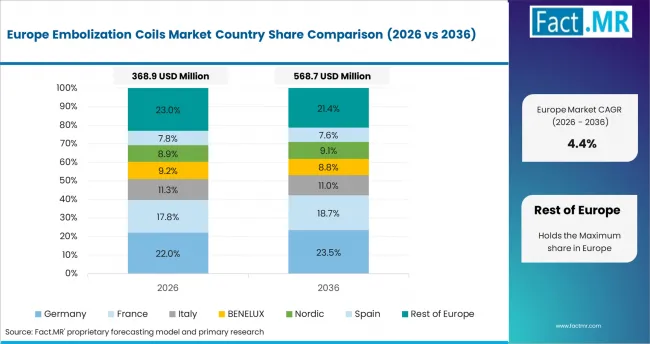
Embolization Coils Market Europe Country Market Share Analysis, 2026 & 2036 | Source: Fact.MR
Europe maintains stable growth supported by reimbursement coverage and strong neurovascular treatment guidelines. Hospitals continue increasing investment in minimally invasive stroke and aneurysm treatment procedures.
- Germany: Germany expands at 5.1% CAGR due to growing reimbursement support for complex neurovascular procedures. University hospitals are using more detachable coil technologies across stroke centers. Updated treatment protocols are also supporting wider endovascular procedure adoption. Demand remains strong across large hospital networks.
Competitive Analysis for Market Players
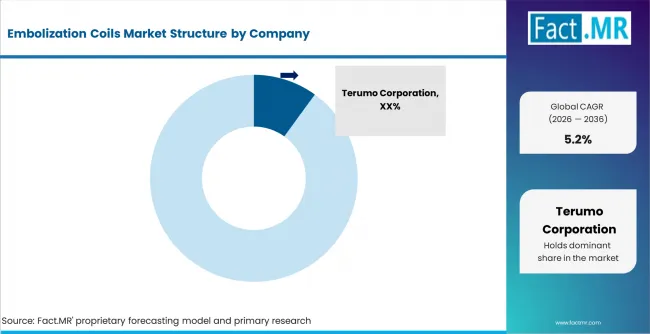
Embolization Coils Market Analysis By Company | Source: Fact.MR
The embolization coils market remains concentrated among a limited number of global neurovascular device manufacturers. Competition is focused on detachable coil performance and hospital relationships. Clinical reliability and physician confidence remain major purchasing factors across specialist neurovascular centers.
Manufacturers are increasing development of detachable coil systems with better deployment precision and procedural control. Hospitals increasingly prefer technologies that improve aneurysm treatment accuracy and reduce complication risk. Product quality is becoming more important than pricing across complex neurovascular procedures.
Clinical training support remains an important competitive factor. Device companies are strengthening partnerships with interventional radiologists and stroke centers to improve physician familiarity with detachable embolization systems. Hospitals also prefer suppliers that provide technical guidance during difficult procedures.
Asia Pacific is becoming a major growth region due to rising hospital investment and expanding neurovascular treatment capacity. Companies with localized manufacturing and stronger hospital supply relationships are improving market penetration across China and India. Public healthcare infrastructure programs are also supporting higher embolization procedure volume. Raw material pricing and regulatory approvals remain important operational challenges. Platinum price fluctuations are affecting manufacturing cost stability across the market. Companies with stronger supply chain management and broader regulatory experience are expected to maintain stronger hospital partnerships and stable product availability over the forecast period.
Key Players
- Terumo Corporation
- Medtronic plc
- Boston Scientific Corporation
- Stryker Corporation
- KANEKA CORPORATION
- MicroPort Scientific Corporation
Bibliography
- Boston Scientific. (2026). Boston Scientific’s EMBOLD detachable coil system gains CE mark approval. EV Today.
- KANEKA CORPORATION. (2025). Expansion of neurovascular business and hospital supply activities. KANEKA CORPORATION.
- MicroPort Scientific Corporation. (2024). MicroPort NeuroScientific receives FDA clearance for its NUMEN SILK in the USA. MicroPort Scientific Corporation.
- Penumbra, Inc. (2025). Penumbra launches SwiftSet Coil for adaptive neurovascular embolization. EV Today.
- Wallaby Medical. (2026). Avenir Pico receives European full market release. NeuroNews International.
This Report Addresses
- Strategic analysis of embolization coil demand across aneurysm treatment, AVM embolization, oncology, and peripheral vascular procedures.
- Market forecast from USD 1.5 billion in 2026 to USD 2.5 billion by 2036 at 5.2% CAGR.
- Opportunity assessment across China, India, the United States, Germany, and Japan.
- Segment analysis by coil type, application, end user, material, and procedure type through 2036.
- Competitive analysis of Terumo Corporation, Medtronic, Boston Scientific, Stryker, KANEKA CORPORATION, and MicroPort Scientific.
- Analysis of regulatory approvals, stroke treatment guidelines, and reimbursement trends across key markets.
- Report delivery in PDF, Excel, and presentation formats supported by hospital data and specialist interviews.
Embolization Coils Market Definition
The embolization coils market covers platinum-based coil devices deployed by interventional radiologists and neurovascular surgeons to block blood flow through targeted vessels. These coils are delivered via catheter and used to treat cerebral aneurysms, arteriovenous malformations, tumor feeding vessels, and peripheral vascular bleeding.
Embolization Coils Market Inclusions
Covers global and regional market forecasts from 2026 to 2036 by type, application, end user, material, and procedure type. Includes detachable and pushable coil formats across platinum and platinum alloy materials for neurology, cardiology, oncology, urology, and peripheral vascular disease indications across hospital systems, cardiac centers, and ambulatory facilities.
Embolization Coils Market Exclusions
Excludes liquid embolic agents, embolization microspheres, and vascular plugs not classified as coil devices. Omits guidewire catheters and delivery systems unless sold as integrated coil assembly revenue. Excludes downstream hospital procedure billing revenue and reimbursement flows. Diagnostic imaging services and procedures are outside scope.
Embolization Coils Market Research Methodology
- Primary Research
- Interviews with interventional radiologists, neurovascular surgeons, hospital purchase departments, cardiology center device managers, and ambulatory surgery center administrators across the United States, Germany, China, India, and Japan.
- Desk Research
- Analysis of Terumo Corporation, Medtronic, Boston Scientific, and Stryker public filings and product launch announcements. Supplemented by FDA 510(k) clearance databases, CE marking records, national stroke program reports, and hospital capital expenditure data from health ministry publications.
- Market-Sizing and Forecasting
- Hybrid model combining top-down neurovascular device revenue disclosures from major manufacturers with bottom-up procedure volume estimates by indication and end-user setting. Average selling prices by coil type and material are modeled independently across all regions.
- Data Validation and Update Cycle
- Validated through FDA and EMA device approval databases, hospital interventional suite purchase records, interventional radiology society procedure volume data, and manufacturer earnings-disclosed neurovascular revenue. Updated annually with regulatory clearance cycles and pricing data.
Segmentation
Scope of the Report
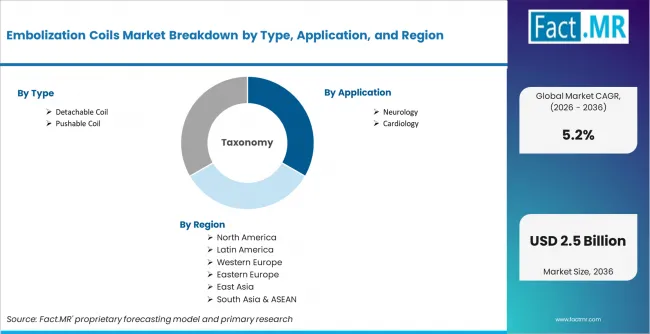
Embolization Coils Market Breakdown By Type, Application, And Region | Source: Fact.MR
| Attribute | Details |
|---|---|
| Quantitative Units | USD 1.5 billion (2026) to USD 2.5 billion (2036), at a CAGR of 5.2% |
| Market Definition | Platinum-based coil devices deployed by interventional radiologists and neurovascular surgeons to occlude target vessels across cerebral aneurysm, AVM, tumor, and peripheral vascular embolization indications at hospital and ambulatory settings globally. |
| Type Segmentation | Detachable Coil, Pushable Coil |
| Application Segmentation | Neurology, Cardiology, Urology, Oncology, Peripheral Vascular Disease, Others |
| End User Segmentation | Hospitals, Cardio Center, Ambulatory Center, Others |
| Material Segmentation | Platinum, Platinum and Hydrogel, Platinum Tungsten Alloy |
| Procedure Type Segmentation | Aneurysm Embolization, Tumor Embolization, AVM Embolization, Peripheral Embolization, Gastrointestinal Bleeding Embolization |
| Application Coverage | Cerebral aneurysm treatment, AVM embolization, tumor embolization, peripheral vascular occlusion, GI bleeding management, and cardiology structural embolization at hospital and ambulatory settings. |
| Regions Covered | North America, Europe, Asia Pacific, Latin America, Middle East and Africa |
| Countries Covered | USA, Germany, China, India, Japan, UK, France, Italy, Canada, South Korea, Brazil, Australia, GCC, South Africa, Rest of MEA |
| Key Companies Profiled | Terumo Corporation, Medtronic plc, Boston Scientific Corporation, Stryker Corporation, KANEKA CORPORATION, MicroPort Scientific Corporation |
| Forecast Period | 2026 to 2036 |
| Approach | Hybrid top-down and bottom-up model using manufacturer neurovascular device revenue disclosures, procedure volume estimates by indication, FDA and EMA device approval records, and primary interviews with interventional radiologists and hospital sourcing departments. |
Source: Fact.MR analysis. Updated May 26, 2026
Embolization Coils Market by Segment
-
By Type
- Detachable Coil
- Pushable Coil
-
By Application
- Neurology
- Cardiology
- Urology
- Oncology
- Peripheral Vascular Disease
- Others
-
By End User
- Hospitals
- Cardiology Centers
- Ambulatory Centers
- Others
-
By Material
- Platinum
- Platinum and Hydrogel
- Platinum Tungsten Alloy
-
By Procedure Type
- Aneurysm Embolization
- Tumor Embolization
- AVM Embolization
- Peripheral Embolization
- Gastrointestinal Bleeding Embolization
-
By Region
- North America
- United States
- Canada
- Mexico
- Latin America
- Brazil
- Argentina
- Colombia
- Rest of Latin America
- Western Europe
- Germany
- United Kingdom
- France
- Italy
- Spain
- Netherlands
- Nordic Countries
- BENELUX
- Rest of Western Europe
- Eastern Europe
- Poland
- Hungary
- Balkan and Baltic
- Rest of Eastern Europe
- East Asia
- China
- Japan
- South Korea
- South Asia and Pacific
- India
- ASEAN
- Australia and New Zealand
- Rest of South Asia and Pacific
- Middle East and Africa
- Kingdom of Saudi Arabia
- Other GCC Countries
- Turkey
- South Africa
- Rest of Middle East and Africa
- North America
Frequently Asked Questions
How large is the global embolization coils market in 2025?
What will the market size be in 2026?
What is the projected market size by 2036?
What is the expected CAGR from 2026 to 2036?
Which type segment leads the embolization coils market?
Which application segment holds the leading share in the embolization coils market?
Which end user generates the leading revenue in the embolization coils market?
Which country shows the fastest growth in the embolization coils market?
Who worked on this report


Preview the report firsthand - request a free sample
Free SampleGet the brochure for pricing and purchase details
Download PDF