- Market Value (2025): USD 716.8 Mn
- Estimated Value (2026): USD 810.0 Mn
- Forecast Value (2036): USD 2750.0 Mn
- CAGR (2026-2036): 13.0%
What is the Energy-Efficient Hydrocolloids Market forecast to be worth by 2036?
USD 810.0 million in 2026 to USD 2,750.0 million by 2036, implying a 13.0% CAGR.
- The energy-efficient hydrocolloids market reached USD 716.8 million in 2025.
- Demand is projected to rise from USD 810.0 million in 2026 to USD 2,750.0 million by 2036.
- The market is forecast to record 13.0% CAGR from 2026 to 2036 as brands use pectin and gums for controlled texture.
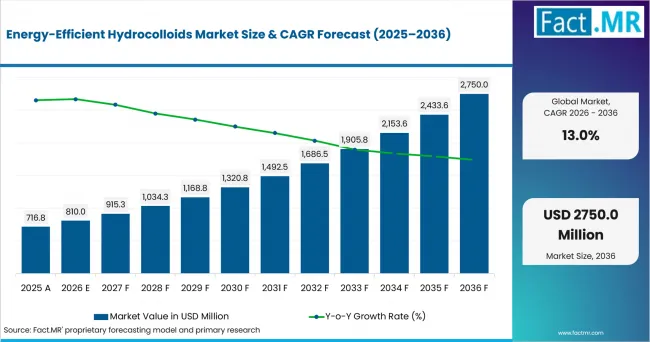
Energy Efficient Hydrocolloids Market Value Analysis | Source: Fact.MR
What are the defining numbers behind Energy-Efficient Hydrocolloids Market growth?
USD 1,940.0 million absolute opportunity by 2036, led by low-methoxyl pectin, gelling and dairy alternatives.
- Demand Drivers in the Market
- Food brands need pectin and gum systems that deliver viscosity under shorter heating windows.
- Dairy-alternative developers need low-dose gelling systems that protect mouthfeel from plant-protein graininess.
- Confectionery manufacturers value pectin systems that reduce setting variation while supporting reduced-sugar recipes and clean-label texture claims.
- USDA ERS reported that U.S. food spending reached $2.51 trillion in 2025, including $1.10 trillion in food-at-home expenditures.
- Key Segments Analyzed
- By Product: Low-methoxyl pectin is expected to hold 39.0% share in 2026 owing to calcium-set gelling and lower-sugar formulation fit.
- By Function: Gelling is projected to account for 37.0% share in 2026 as controlled gels remain central to dairy alternatives and confectionery.
- By Application: Dairy alternatives are anticipated to capture 34.0% share in 2026 due to plant-protein formulation challenges and neutral-pH texture needs.
- By Grade: Food grade is estimated to represent 44.0% share in 2026, supported by allergen files, batch traceability and lot consistency requirements.
- Analyst Opinion at Fact.MR
- Shambhu Nath Jha, Principal Consultant at Fact.MR, states, "Hydrocolloid choice is moving from recipe adjustment toward process economics. Brands are expected to compare texture performance with energy exposure and yield loss before switching suppliers. Resilient portfolios combine pectin, specialty gums and application labs that solve mouthfeel problems while keeping the process simple."
- Strategic Implications
- Ingredient manufacturers should document viscosity and gel strength in low-heat windows.
- Application labs should create dairy-alternative models for pectin and gum blends with plant proteins.
- Sourcing teams should compare energy exposure, dosage cost and rework risk before judging price.
- Food brands should require allergen files, compliance support and batch traceability before qualifying new grades.
The USA is projected to record 14.3% CAGR through 2036, led by food spending scale and processed-food texture needs. Germany is estimated to post 13.7% CAGR through food processing and organic formulation demand. Japan is forecast to advance at 12.7% CAGR as health foods and soft drinks support texture systems. France is anticipated to reach 12.2% CAGR as agri-food output supports formulation work. Brazil is expected to hold 11.7% CAGR, supported by food processing revenue and citrus-linked pectin relevance.
How does the Energy-Efficient Hydrocolloids Market break down by segment?
Low-methoxyl pectin leads Product at 39.0%; Food grade leads Grade at 44.0%.
Which Product dominates?
Low-methoxyl pectin is expected to hold 39.0% share in 2026.
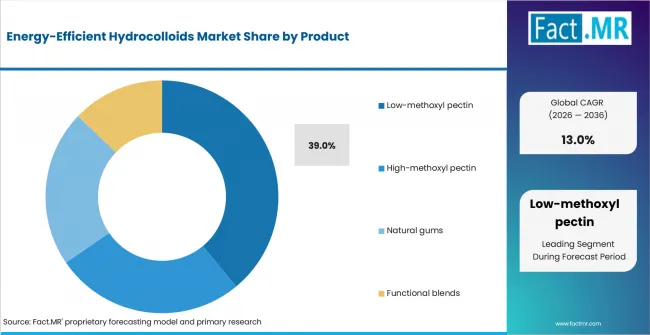
Energy Efficient Hydrocolloids Market Analysis By Product | Source: Fact.MR
Low-methoxyl pectin leads because it forms gels through calcium interaction and has a strong fit with reduced-sugar fruit systems. The role overlaps with citrus pectin use in fruit preparations and lower-sugar formats.
Tate & Lyle showcased GENU® Pectin and GENUTINE® Carrageenan in prototypes at IFT FIRST in July 2025, following its combination with CP Kelco. The same event highlighted gellan gum, pectin and modified starches for textural formats including aeration, suspension and multi-layered systems.
What leads the Function segment?
Gelling is projected to account for 37.0% share in 2026.
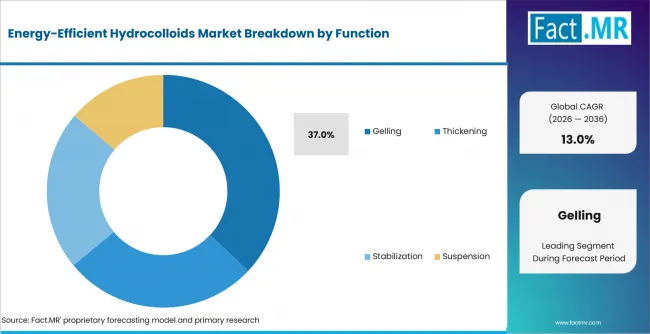
Energy Efficient Hydrocolloids Market Analysis By Function | Source: Fact.MR
Gelling leads because it gives formulators a measurable texture endpoint. A gel either sets within the line target or creates waste, so food-grade pectin and gum systems are evaluated closely during plant trials.
Energy-efficient gelling systems carry extra value when brands lower heating time or reformulate sugar levels. The category connects with natural gelling agents used in gelatin-free confectionery and fruit systems.
How does Application shape demand?
Dairy alternatives are anticipated to capture 34.0% share in 2026.
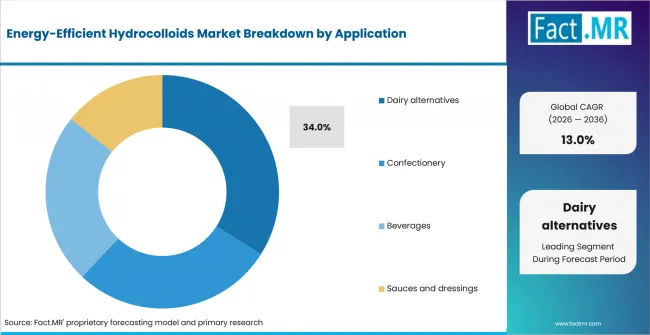
Energy Efficient Hydrocolloids Market Analysis By Application | Source: Fact.MR
Dairy alternatives lead as plant proteins often need hydrocolloids to control body, suspension and creaminess. These systems help brands keep texture stable when fat, sugar or stabilizer declarations change.
USDA FAS reported on April 1, 2026 that Japan’s food processing sector recorded growth in soft drinks, health foods, frozen foods and shelf-stable products.
What supports Food grade within Grade?
Food grade is estimated to represent 44.0% share in 2026.
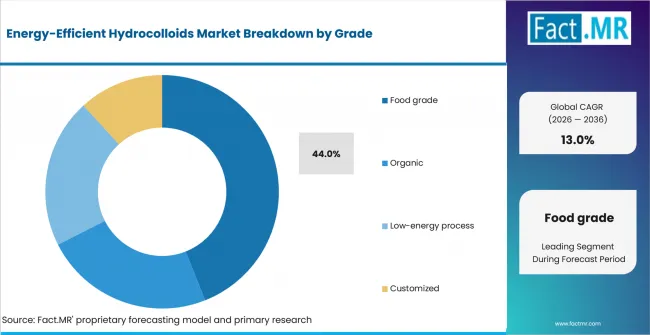
Energy Efficient Hydrocolloids Market Analysis By Grade | Source: Fact.MR
Food grade leads because ingredient teams need traceability, microbiological control and label documentation before a hydrocolloid enters a commercial recipe. These requirements become stricter when the ingredient controls mouthfeel and finished-product stability.
Ashland Inc. appointed Tilley Distribution in October 2025 as its exclusive U.S. distribution partner for food and beverage ingredients. The agreement covers cellulosic hydrocolloids including CMC and methylcellulose.
What is accelerating Energy-Efficient Hydrocolloids Market adoption, and what is holding it back?
Demand is expected to rise through texture reformulation, lower-energy processing and food-grade documentation needs.
Drivers Impact Analysis
| DRIVER | (~) % IMPACT ON CAGR | GEOGRAPHIC RELEVANCE | IMPACT TIMELINE |
|---|---|---|---|
| Low-energy texture processing | +1.9% | North America, Europe | Medium term (2-4 years) |
| Dairy-alternative formulation needs | +1.6% | USA, Japan, France | Short term (<= 2 years) |
| Clean-label pectin and gum use | +1.1% | Europe, Japan | Medium term (2-4 years) |
| Food-grade documentation requirements | +0.8% | Global | Long term (>= 4 years) |
Source: Fact.MR analysis. Updated Aug 31, 2026
- Low-energy texture processing: Processors are using texturants that work under shorter heating windows and lower rework risk.
- Dairy-alternative formulation needs: Plant-based systems require viscosity control and protein suspension. Hydrocolloids help maintain body and mouthfeel when brands reduce fat, sugar or stabilizer load.
- Clean-label pectin and gum use: Pectin, gellan gum, xanthan gum and cellulose derivatives give formulators recognizable texture tools while helping them reduce processing steps.
Opportunity Impact Analysis
| OPPORTUNITY | (~) % IMPACT ON CAGR | GEOGRAPHIC RELEVANCE | IMPACT TIMELINE |
|---|---|---|---|
| Low-energy process positioning | +1.2% | Europe, North America | Medium term (2-4 years) |
| Functional blends for dairy alternatives | +1.0% | Global | Short term (<= 2 years) |
| Co-development with application labs | +0.7% | USA, Germany, Japan | Long term (>= 4 years) |
Source: Fact.MR analysis. Updated Aug 31, 2026
- Low-energy process positioning: Suppliers separate their grades by showing how texture sets under lower heat or shorter hydration cycles.
- Functional blends for dairy alternatives: Blends reduce formulation work for brands that need body, suspension and gel structure in one system.
- Co-development with application labs: Joint trials help brands move from bench recipes to plant settings while reducing failed batches.
Restraints Impact Analysis
| RESTRAINT | (~) % IMPACT ON CAGR | GEOGRAPHIC RELEVANCE | IMPACT TIMELINE |
|---|---|---|---|
| Raw-material and performance variation | -0.6% | Global | Short term (<= 2 years) |
| Energy and processing-cost exposure | -0.5% | Europe, Brazil | Medium term (2-4 years) |
| Novel-ingredient approval complexity | -0.3% | Brazil, Japan, Europe | Long term (>= 4 years) |
Source: Fact.MR analysis. Updated Aug 31, 2026
- Raw-material and performance variation: Hydrocolloids from plant or fermentation routes vary in viscosity and gel strength. Buyers therefore need supplier data across several conditions.
- Energy and processing-cost exposure: Extraction, drying and milling remain energy-sensitive steps. Higher utility costs narrow the margin for specialty grades.
Which countries are scaling the Energy-Efficient Hydrocolloids Market through 2036?
- The country comparison spans 2.6 percentage points across the listed markets.
- The USA remains 0.6 percentage point above Germany through a larger processed-food base and higher reformulation activity.
- Germany remains 1.0 percentage point above Japan as organic formulation demand supports pectin and gum selection.
- Japan remains 0.5 percentage point above France through processed exports and health-food applications.
- Brazil closes the displayed range through citrus-linked pectin relevance and expanding processed-food revenue.
- Comparable CAGRs create different entry conditions because each country has a different mix of food manufacturing scale, ingredient approval needs, energy costs and application demand.
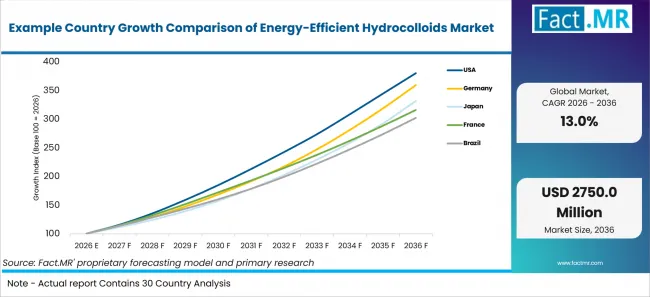
Example Country Growth Comparison Of Energy Efficient Hydrocolloids Market | Source: Fact.MR
| Country | CAGR (2026-2036) |
|---|---|
| United States | 14.3% |
| Germany | 13.7% |
| Japan | 12.7% |
| France | 12.2% |
| Brazil | 11.7% |
Source: Fact.MR analysis. Updated Aug 31, 2026
What supports USA adoption?
14.3% CAGR, supported by food-spending scale and reformulation pressure.
A large processed-food base gives U.S. formulators room to trial pectin and gum systems across sauces, dairy alternatives and prepared foods. USDA ERS reported total U.S. food spending of USD 2.51 trillion in 2025. Within this environment, food manufacturers are expected to favor hydrocolloids that preserve mouthfeel, suspension and heat stability as recipes are reformulated.
How is Germany scaling demand?
13.7% CAGR, driven by a large food processing base and organic formulation needs.
Germany combines substantial food-manufacturing activity with strong demand for organic and plant-based formulations. USDA FAS reported in March 2026 that Germany produced an estimated USD 270.1 billion in processed food and beverages in 2024. This creates a favorable setting for pectin and gum suppliers offering consistent texture, clear traceability and reliable performance across beverages, spoonable products and alternative foods.
What supports Japan’s growth?
12.7% CAGR, backed by health foods, soft drinks and export-oriented processed foods.
Demand in Japan is being shaped by categories where texture and shelf stability are closely controlled. USDA FAS reported in April 2026 that Japan’s food processing sector was valued at USD 174 billion in 2025, with soft drinks, health foods, frozen foods and shelf-stable products among the expanding areas. These applications create room for pectin and gum systems that manage suspension, mouthfeel and formulation stability.
How is France developing demand?
12.2% CAGR, supported by agri-food production and dairy-alternative texture needs.
France offers a broad processing base for hydrocolloid use across beverages, sauces, dairy products and plant-based formulations. INSEE reported agri-food production of EUR 203.464 billion in 2024. As manufacturers adjust sugar, fat and protein systems, pectin and gums are expected to remain important for maintaining viscosity, texture and product consistency.
What supports Brazil adoption?
11.7% CAGR, supported by food processing revenue and citrus-linked pectin relevance.
Brazil’s position is strengthened by the combination of a large food-processing industry and a substantial fruit-processing base. USDA FAS reported in March 2026 that Brazil’s food processing sector revenue reached approximately USD 248 billion in 2025, up 8% from the previous year. Pectin remains relevant to beverages, fruit preparations and sauces, while functional gums support texture control and formulation performance across domestic and regional product lines.
Who leads the Energy-Efficient Hydrocolloids Market?
Tate & Lyle PLC (CP Kelco), Cargill, Incorporated, Ingredion Incorporated, Ashland Inc. and Kerry Group plc.
CP Kelco participates through its pectin, gellan gum, xanthan gum and specialty gum portfolio, with the business integrated into Tate & Lyle following the 2024 combination. Cargill, Incorporated competes through pectin, carrageenan, xanthan gum and technical application support for food manufacturers.
Ingredion Incorporated participates through texture systems, with its 2025 Indianapolis investment expanding specialty starch-based texturizer capacity while improving operational efficiency. Ashland Inc. is active through cellulosic hydrocolloids used in food and beverage formulations. Kerry Group plc participates through texture and functional systems designed to support stability, texture and mouthfeel.
Competition is shaped by application proof and documentation quality. Suppliers that explain energy exposure and finished texture are better placed during reformulation cycles.
Which companies are the key providers?
Key companies include Tate & Lyle PLC (CP Kelco); Cargill, Incorporated; Ingredion Incorporated; Ashland Inc.; and Kerry Group plc.
- Tate & Lyle PLC (CP Kelco)
- Cargill, Incorporated
- Ingredion Incorporated
- Ashland Inc.
- Kerry Group plc
Bibliography
- Zeballos, E., & Sinclair, W. (2026, June 11). Total U.S. food spending reached $2.51 trillion in 2025. U.S. Department of Agriculture, Economic Research Service.
- U.S. Department of Agriculture, Foreign Agricultural Service. (n.d.). Trade data. Retrieved August 28, 2026.
- U.S. Bureau of Labor Statistics. (2026, August 12). Consumer Price Index—July 2026.
- Loeser, J. (2026, March 30). Food processing ingredients annual: Germany (GAIN Report No. GM2026-0007). U.S. Department of Agriculture, Foreign Agricultural Service.
- von Witzke, K. (2026, January 29). Large retail chains support record year for German organic sales (GAIN Report No. GM2026-0003). U.S. Department of Agriculture, Foreign Agricultural Service.
- Max Rubner-Institut. (2025, August 15). Nationales Ernährungsmonitoring – nemo.
- Federal Statistical Office (Destatis). (2026, May 18). Nach jahrelangem Anstieg: Fleischersatz-Produktion sinkt 2025 um 1,2 % gegenüber dem Vorjahr.
- Aoki, S. (2026, April 1). Food processing ingredients annual: Japan (GAIN Report No. JA2026-0012). U.S. Department of Agriculture, Foreign Agricultural Service.
- Institut national de la statistique et des études économiques. (2026, July 21). Indicateurs macroéconomiques de l’industrie agroalimentaire : Données annuelles de 2010 à 2024.
- Renaud, A. (2025, December 17). Productions commercialisées des industries agroalimentaires 2024 : léger recul des ventes mais un niveau toujours élevé. Agreste.
- Institut national de la statistique et des études économiques. (2026, April 30). Household consumption of goods rebounded in March 2026 (+0.7% after -1.4%).
- Vendemiatti, A., Jr. (2026, March 31). Food processing ingredients annual: Brazil (GAIN Report No. BR2026-0011). U.S. Department of Agriculture, Foreign Agricultural Service.
- Brazilian Institute of Geography and Statistics. (2025, November 13). IBGE: Harvest estimate for 2026 is 332.7 million tonnes, 3.7% lower than in 2025. IBGE News Agency.
- Brazilian Institute of Geography and Statistics. (2026, March 6). Industrial production up 1.8% in January. IBGE News Agency.
- Agência Nacional de Vigilância Sanitária. (2023, December 20). Anvisa atualiza regras para comprovar segurança de novos alimentos e ingredientes.
- Ingredion Incorporated. (2025, February 4). Ingredion invests $100 million in Indianapolis plant to improve efficiency and enable future texture solutions growth.
- Ashland Inc. (2025, October 6). Ashland announces new U.S. food and beverage ingredient distributor.
- Cargill. (2025, March 4). Cargill showcases full range of innovative food solutions at AAHAR 2025.
- Kerry Group plc. (2026, March 19). Annual Report 2025.
This Report Addresses
- The report explains where energy-efficient hydrocolloids are used across product, function, application and grade.
- Segment analysis identifies the leading subsegments and the formulation reasons behind their share positions.
- Country analysis reviews the five listed markets and the food-processing factors shaping hydrocolloid use.
- Competitive analysis reviews current providers across pectin, gums, functional blends and cellulosic hydrocolloids.
- Application analysis assesses how dairy alternatives, confectionery, beverages and sauces influence product qualification.
What does the Energy-Efficient Hydrocolloids Market cover?
The Energy-Efficient Hydrocolloids Market covers pectin, natural gums, cellulosic hydrocolloids and functional systems used to manage texture with lower processing burden. These ingredients help brands control gelling, thickening and stabilization while reducing failed batches.
The assessment is adjacent to gum hydrocolloid systems and food stabilizers where brands need consistent viscosity and shelf stability.
What is included in the scope?
The scope includes food-grade hydrocolloids sold as single ingredients or functional blends when energy exposure or low-temperature performance is part of the value proposition. It covers pectin grades, natural gums and custom stabilizer systems used in finished foods.
Related coverage includes alternative hydrocolloids and plant hydrocolloids when these ingredients address texture, mouthfeel and clean-label formulation needs.
What is excluded from the scope?
The scope excludes pharmaceutical excipients, drilling-fluid gums, cosmetic thickeners and industrial binders sold outside food or beverage use. Commodity starches are outside scope unless sold within a functional hydrocolloid blend.
General food additives are outside scope when they deliver color, sweetness or preservation without gelling, thickening or stabilization. Processing equipment is outside scope when sold separately.
Adjacent categories include food thickening agents and food binders where viscosity and structure are the primary purchase reasons.
How Was the Analysis Built?
The analysis draws on 120+ sources, 35+ company portfolios, 25+ countries, and more than 20 industry interviews.
- Primary Research: Primary research includes discussions with manufacturers, service providers, technology developers, distributors, end users, and subject-matter experts. These conversations examine purchasing priorities, product adoption, operational challenges, approval requirements, competitive positioning, and the factors that influence wider market acceptance.
- Desk Research: Desk research covers government statistics, regulatory publications, company filings, trade data, technical studies, industry associations, standards, public policy, and other authoritative sources. Every source used in the analysis is documented in the bibliography.
- Market Sizing and Forecasting: Market estimates combine historical performance, demand indicators, pricing and volume trends, segment shares, company participation, country-level growth, adoption patterns, investment activity, and barriers to market expansion.
- Data Validation and Update Cycle: Findings are validated by comparing primary interviews with public data, company activity, regulatory changes, trade patterns, and industry developments. Regular updates review new product launches, capacity changes, partnerships, approvals, and shifts in commercial adoption.
Segmentation
What is the report’s scope and coverage?
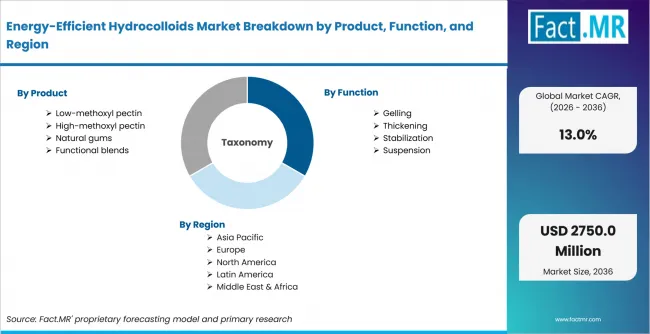
Energy Efficient Hydrocolloids Market Breakdown By Product, Function, And Region | Source: Fact.MR
| Attribute | Details |
|---|---|
| Quantitative Units | USD million |
| Market Definition | Hydrocolloid ingredients and functional systems designed to deliver gelling, thickening, stabilization or suspension while reducing energy exposure during hydration, extraction, processing or formulation. |
| Product | Low-methoxyl pectin; High-methoxyl pectin; Natural gums; Functional blends |
| Function | Gelling; Thickening; Stabilization; Suspension |
| Application | Dairy alternatives; Confectionery; Beverages; Sauces and dressings |
| Grade | Food grade; Organic; Low-energy process; Customized |
| Regions Covered | North America; Latin America; Western Europe; Eastern Europe; East Asia; South Asia & Pacific; Middle East & Africa |
| Countries Covered | United States; Germany; Japan; France; Brazil |
| Key Companies Profiled | Tate & Lyle PLC (CP Kelco); Cargill, Incorporated; Ingredion Incorporated; Ashland Inc.; Kerry Group plc |
| Forecast Period | 2026 to 2036 |
| Approach | Hybrid top-down and bottom-up approach using historical values, forecast values, segment shares, country growth indicators and provider portfolio review. |
Source: Fact.MR analysis. Updated Aug 31, 2026
How is the market segmented?
-
By Product:
- Low-methoxyl pectin
- High-methoxyl pectin
- Natural gums
- Functional blends
-
By Function:
- Gelling
- Thickening
- Stabilization
- Suspension
-
By Application:
- Dairy alternatives
- Confectionery
- Beverages
- Sauces and dressings
-
By Grade:
- Food grade
- Organic
- Low-energy process
- Customized
-
By Region:
- North America
- Latin America
- Western Europe
- Eastern Europe
- East Asia
- South Asia & Pacific
- Middle East & Africa
Frequently Asked Questions
How big is the energy-efficient hydrocolloids market in 2026?
What is the CAGR of the energy-efficient hydrocolloids market from 2026 to 2036?
Which product leads the energy-efficient hydrocolloids market?
Which function leads the energy-efficient hydrocolloids market?
Who are the leading companies in the energy-efficient hydrocolloids market?
Who worked on this report


Preview the report firsthand - request a free sample
Free SampleGet the brochure for pricing and purchase details
Download PDF