- Forecast Value (2035): 5278 Mn
- CAGR (2035): 15.6%
Engineered Spider Silk Market Outlook 2025 to 2035
The global engineered spider silk market is expected to reach USD 5,278 Million by 2035, up from estimated value of USD 1,260 Million in 2025. During the forecast period 2025 to 2035, the industry is projected to expand at a CAGR of 15.4%.
The main driver of the engineered spider silk market is the emergence of the need to use sustainable and bio-digestible materials, the development of synthetic biology and recombinant protein manufacturing, the expansion of its use in textiles, medicine, and industry, and the development of a closer partnership between biotech innovators and final markets. All these contribute to the greater scalability, performance and commercialization of high-strength eco-friendly spider silk products.
Quick Stats for Engineered Spider Silk Market
- Industry Value (2025): USD 1,260 Million
- Projected Value (2035): USD 5,278 Million
- Forecast CAGR (2025 to 2035): 15.4%
- Leading Segment (2025): Recombinant Spider Silk Proteins (35% Market Share)
- Fastest Growing Country (2025-2035): Japan (14.9% CAGR)
- Top Key Players: are Bolt Threads, Inc., Spiber Inc., AMSilk GmbH, Kraig Biocraft Laboratories, Inc., Seevix Material Sciences Ltd., Spintex Engineering Ltd., Xampla Ltd., and Inspidere B.V.
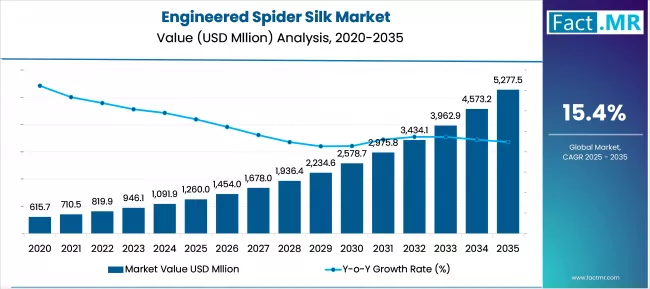
Engineered Spider Silk Market Market Value Analysis | Source: Fact.MR
What are the key factors driving growth in the Engineered Spider Silk Market?
The main push is the increasing need for sustainable, biodegradable and high-performance material. The industries are also in need of finding a substitute for synthetic fibers that will not affect the environment, but they will be as strong, elastic and versatile. The development of synthetic biology and production of recombinant proteins allows low-cost and scalable production of engineered spider silk, which means that engineered spider silk can be commercially used.
Increasing demand for consumers, corporate sustainability programs and government support for eco-friendly materials are also driving adoption. The high-value usage in textile, medical devices, and industrial applications creates a high motivation to invest in the sector, creating a stimulus to conduct research, product development, and strategic alliances throughout the global market.
What are the key trends driving growth in the Engineered Spider Silk market?
The most important ones are the incorporation of synthetic biology into large-scale production, the creation of hybrid silk composites, and the creation of smart and functional fibers. The rate of commercialization is rising through partnerships between biotech companies and end-use markets including fashion, medical and aerospace.
Product design is being affected by customizable mechanical properties, biodegradability, and the lightweight performance. Further, emphasis on the principles of a circular economy, renewable feedstock/source, and sustainable manufacturing are influencing material development. The use of fibers and yarns as the main formats, advances in finishes, scaffolds, and non-woven fabrics, are changing the use and positioning in the market in the world.
What factors hinder the growth of the Engineered Spider Silk market?
The difficulties are high production expenses, complicated manufacturing procedures, and technical obstacles linked with the scaling production of recombinant or transgenic spider silk. Market penetration may be delayed by limited awareness and adoption in some industries, as well as very strict regulatory approvals to medical or textile applications.
The limitation of supply chain, reliance on specialized raw materials as well as technological complexity of producing uniform quality of fiber may be a limitation of the wide use. Also, there is the risk that competition by traditional synthetic fibers and other biomaterials would limit growth. All these challenges make it hard on both the manufacturers and the end-users to speed up commercialization and its widespread use even with high market potential.
What are the key regional trends driving the Engineered Spider Silk Market growth?
North America
The North American market has powerful R&D, developed bio-fabrication infrastructure, and sustainability industries. In response to this, companies are producing high-performance spider silk to be used in textiles, medical devices, and industrial composites, which is being enabled by partnerships with environmentally-friendly brands and government subsidies on biodegradable and high-strength materials.
East Asia
East Asia is on top in terms of industrial level production and technological advancement where such countries as Japan and China have made heavy investments in the recombinant protein of silk and in hybrid composites. Its adoption is on the rise in the fashion domain, healthcare segment, and industry, with the government initiatives and collaboration with other sustainability focused market players.
Western Europe
Western Europe enjoys high-level environmental policies, sustainability requirements, and the closed economy. Germany and neighboring nations put emphasis on high-performance, biodegradable spider silk in the textile, medical and industrial industries, with a concept to focus on R&D, modular manufacturing and working in collaboration with environment-friendly brands, as the driving force to initiate innovation and adoption in the market.
Country-wise Outlook
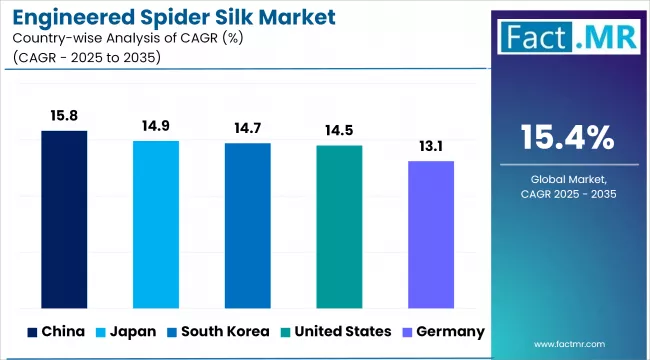
Engineered Spider Silk Market Cagr Analysis By Country | Source: Fact.MR
Innovation and Sustainability Drive the United States’ Engineered Spider Silk Market
The US engineered spider silk market is growing at a dominant rate because the consumers are demanding the use of eco-friendly, high-performance, and biodegradable materials. High-end research and development and mass-produced production technologies enable companies to produce spider silk fibers, yarns and composites in the textile, medical devices, and industrial sectors. Firms are concentrating on personalized material characteristics, greater strength as well as versatile functionality.
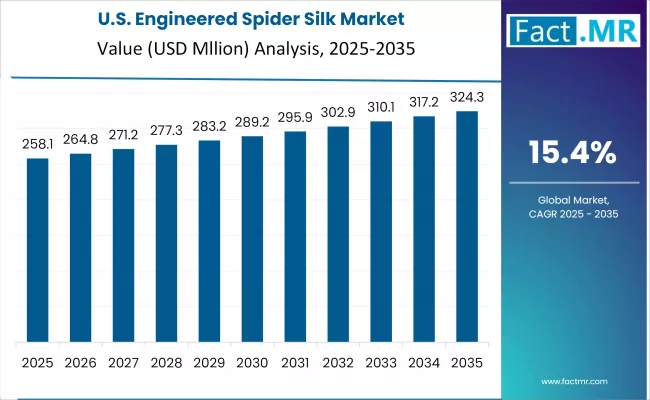
Engineered Spider Silk Market Country Value Analysis | Source: Fact.MR
Partnerships with sustainability-focused companies, and incorporation of the principles of the circular economy also enhance the position of the US as a top engineered spider silk innovator.
Environmental Policies and High-Performance Focus Boost Germany’s Engineered Spider Silk Market
The market of engineered spider silk, designed by Germany, is increasing in size steadily because of the severe environmental policies, the culture of sustainability, and the focus on innovative materials. Textile, medical and industrial manufacturers are working on high strength biodegradable spider silk fibers and composites.
Collaboration with environmentally friendly brands and the introduction of effective and modular production methods make it possible to innovate the performance and customization. The willingness of the country to the practices of the circular economy and to the production, which is resource efficient, makes Germany one of the most effective centers of the development of sustainable engineered spider silk in Europe.
Technological Advancements and Sustainability Initiatives Propel Japan’s Engineered Spider Silk Market
The spider silk market in Japan is developed through engineered activities based on the high-investment in the biofabrication, synthetic biology, and high-performance materials. Manufacturers are targeting recombinant silk proteins, hybrid composites and scalable production towards their use in the fashion, medical and industrial industries.
Innovation and adoption are improved by collaboration with companies that have global sustainability orientation, research institutions and emphasis on environmentally friendly practices. Government involvement in the use of sustainable materials and new production methods makes Japan a major force in the Asia-Pacific landscape of engineered spider silk.
Category-Wise Market Outlook
Recombinant Spider Silk Proteins Lead Product Type Growth
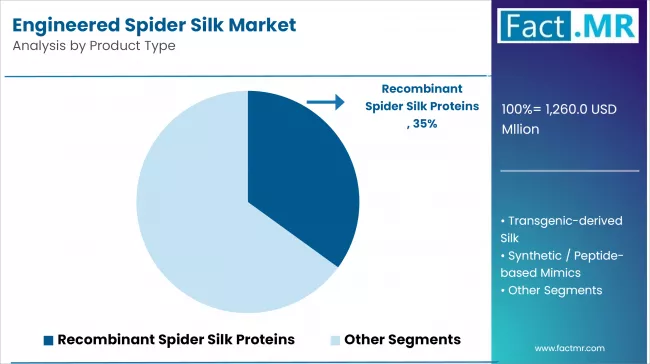
Engineered Spider Silk Market Analysis By Product Type | Source: Fact.MR
The dominantly-growing type of product is recombinant spider silk proteins because it is characterized by high tensile strength, biodegradability, and scalability. These proteins are produced through microbial or cell-based systems and in this way can be engineered with precision to meet the target uses, like in textiles, medical scaffolds, and industrial composites.
The ease of modification, their versatility and capability to satisfy regulatory and performance needs render them desired in preference over transgenic or synthetic mimics which have been actively employed in various industries with the aim of producing high-performance and sustainable materials.
Bacteria-Based Production Drives Source Segment Growth
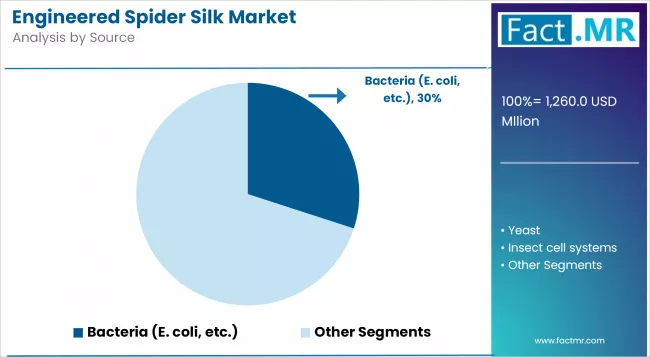
Engineered Spider Silk Market Analysis By Source | Source: Fact.MR
The swiftly growing segment in spider silk production engineered is the bacterial expression systems. Bacteria such as E. coli facilitate low cost and high yield protein synthesis, which is facilitated by industrial scalability. Bacterial cultivation is easy and combined with sophisticated genetic engineering enables the ability to control the specific sequences of silk protein, functionality and post-processing. This approach will improve uniform quality, reduce the time-to-market, and decrease the cost of production, which is why bacteria-based silk is also chosen by manufacturers who need to find efficient and sustainable silk material sources.
Fibers & Yarns Lead Form Segment Growth
The rapidly expanding form is fibers and yarns which directly convert the strength and elasticity of spider silk into wearable, industrial, and medical forms. They can be easily incorporated into textiles, medical sutures and composite and continue to be effectively functional. It is made more adoptable by the versatility of the form, which is supplemented by the possibility to create properties, including stretch, durability, and biodegradability. The ease of processing, compatibility with currently available equipment as well as the capacity to satisfy sustainability and high-performance material requirements are what makes manufacturers prefer fibers and yarns.
Competitive Analysis
Competitive Outlook: Engineered Spider Silk Market
The market of the engineered spider silk is very competitive with other market players like Bolt Threads, Spiber Inc., AMSilk GmbH, Kraig Biocraft Laboratories, Inc., Seevix Material Sciences Ltd., Incredible Skin (Spintex Engineering Ltd.), Xampla Ltd., SynBioBeta collaborators, EntoGenetics Inc. and Inspidere B.V being on the forefront in developing high-performance and sustainable silk-based materials. These firms concentrate on production that can be scaled, developing tensile strength, elasticity, and functional versatility, and applications that include textiles, on medical devices, aerospace and industrial composites. Their strong research and development, proprietary technology, and established supply chain enable them to provide strong, biodegradable, and value-added options to their traditional synthetic fibers to meet the increasing sustainability requirements and environmentally-friendly industrial needs.
Simultaneously, niche innovations in the market, such as hybrid silk composites, recombinant protein engineering and functionalized silk materials in niche applications are being propelled by agile innovators in the market. These players can easily adjust to the market needs, experiment new production technologies, and cooperate with brands that demand sustainable biomaterials. Existing leaders and agile newcomers are combined to create a dynamic, innovation-driven and very competitive engineered spider silk market which is driving adoption of bio-based fibers to be used in the world market.
Key players in the Engineered Spider Silk market are Bolt Threads, Inc., Spiber Inc., AMSilk GmbH, Kraig Biocraft Laboratories, Inc., Seevix Material Sciences Ltd., Spintex Engineering Ltd., Xampla Ltd., SynBioBeta Collaborators, EntoGenetics Inc., Inspidere B.V.
Recent Development
- In March 2025, Kraig Biocraft Laboratories produced the largest single batch of BAM-1 recombinant spider silk in its history, surpassing all of 2024's output. This milestone demonstrates significant progress in scaling up production to meet commercial demands.
- In August 2024, AMSilk and Evonik extended their partnership to produce high-performance yarns from silk protein powder. These yarns offer premium production quality and regulatory compliance, supporting the development of sustainable textile materials.
Fact.MR has provided detailed information about the price points of key manufacturers of Engineered Spider Silk market positioned across regions, sales growth, production capacity, and speculative technological expansion, in the recently published report.
Methodology and Industry Tracking Approach
The survey conducted by Fact.MR on the Engineered Spider Silk Market is part of Fact.MR 2025, involving over 10,000 participants across surveyed countries, with at least 250 representatives per region. One-third of respondents comprised industry stakeholders, including biotech innovators, textile and medical device manufacturers, sustainability experts, regulatory professionals, and market consultants, while the remaining two-thirds were end users, such as apparel brands, healthcare providers, industrial manufacturers, and research institutions. Conducted between September 2024 and August 2025, the survey examined adoption patterns of engineered spider silk, integration of sustainable biomaterials, performance across textiles, medical, and industrial applications, and innovations shaping the next-generation materials market.
The study leveraged advanced modeling and predictive analytics, drawing on over 250 secondary sources, including patent filings, product launches, industry standards, sustainability reports, and market research. Data on production scalability, material innovations, functional performance, and adoption trends since 2018 were analyzed to provide actionable insights.
The 2025 report equips industry players with strategies to capitalize on emerging opportunities, address market challenges, and strengthen their positioning in the rapidly expanding Engineered Spider Silk Market.
Segmentation of Engineered Spider Silk Market Research
-
By Product Type :
- Recombinant Spider Silk Proteins
- Transgenic-derived Silk
- Synthetic / Peptide-based Mimics
- Blends & Composites
-
By Source :
- Bacteria (E. coli, etc.)
- Yeast
- Insect cell systems
- Plant-based (transgenic plants)
- Mammalian cell systems
- Cell-free / in vitro synthesis
-
By Form :
- Fibers & Yarns
- Films & Sheets
- Hydrogels & Scaffolds
- Coatings & Adhesives
- Non-woven fabrics / Mats
- Powder / Resin concentrates
-
By Application :
- Medical & Healthcare
- Textiles & Apparel
- Industrial & Composites
- Electronics & Wearables
- Filtration & Membranes
- Cosmetics & Personal Care
- Research & Biotech Tools
-
By Performance :
- Medical-grade (sterile, certified)
- High-tenacity / Structural
- Elastic / Stretchable
- Biodegradable / Compostable
- Cost-optimized / Commodity-grade
-
By End-user :
- Medical device manufacturers
- Apparel & technical textile brands
- Automotive & aerospace OEMs and Tier-1 suppliers
- Electronics manufacturers
- Filtration & membrane producers
- Academic & industrial R&D labs
-
By Sales :
- Direct B2B contracts
- Distributors & Materials suppliers
- OEM integration contracts
- E-commerce / small-batch suppliers (for research/SMEs)
-
By Region :
- North America
- Latin America
- Western Europe
- Eastern Europe
- East Asia
- South Asia & Pacific
- Middle East & Africa