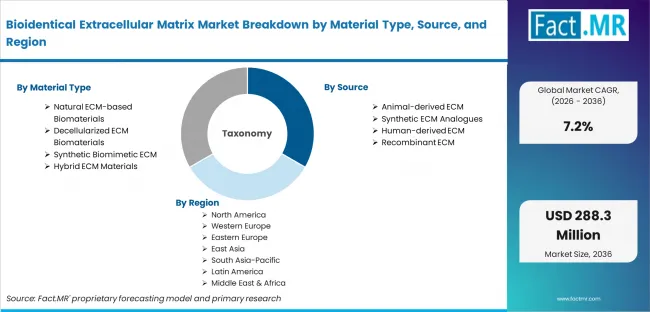
Bioidentical Extracellular Matrix Market Size, Share, Growth and Forecast (2026 - 2036)
The Global Bioidentical Extracellular Matrix Market is segmented by Material Type, Product Type, Source, Technology, and Application, and Region, with forecasts covering the period from 2025 to 2036.
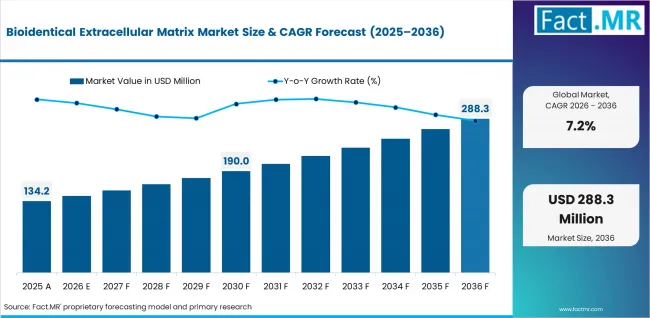
According to market estimates, the global bioidentical extracellular matrix market stood at approximately USD 134.2 million in 2025. The market is projected to reach around USD 143.9 million in 2026 and is expected to grow to approximately USD 288.3 million by 2036, progressing at a CAGR of 7.2% during the forecast period. ECM Scaffolds are anticipated to account for nearly 22.80% share by 2026, driven by their widespread use in providing structural support for cell attachment, migration, and differentiation in tissue engineering and regenerative medicine applications.
Bioidentical Extracellular Matrix Market Overview, Growth Outlook, and Forecast by Fact.MR
- In 2025, the global bioidentical extracellular matrix market was valued at approximately USD 134.2 million.
- Based on Fact.MR analysis, demand for bioidentical extracellular matrix products is estimated to grow to around USD 143.9 million in 2026 and USD 288.3 million by 2036.
- The market is projected to expand at a CAGR of around 7.2% during the forecast period.
Summary of the Bioidentical Extracellular Matrix Market
- Market Snapshot
- In 2025, the global bioidentical extracellular matrix market was valued at approximately USD 134.2 million.
- The market is estimated to reach around USD 143.9 million in 2026 and is projected to attain nearly USD 288.3 million by 2036.
- The Bioidentical Extracellular Matrix Market is expected to expand at a CAGR of approximately 7.2% during the forecast period.
- The market is anticipated to create an absolute dollar opportunity of approximately USD 144.4 million between 2026 and 2036.
- In terms of product type, ECM Scaffolds hold the largest share of approximately 22.80% in 2026, driven by their widespread use in providing structural support for cell attachment, migration, and differentiation in tissue engineering and regenerative medicine applications.
- Based on source, Animal‑derived ECM represents approximately 42.50% share in 2026, driven by the high availability of porcine and bovine tissues, established decellularization protocols, and cost‑effectiveness compared to human‑derived or recombinant ECM.
- Demand and Growth Drivers
- As regenerative medicine, tissue engineering, and 3D bioprinting rapidly develop, there is a growing need for biomimetic ECM platforms to form the basis of newly developed lab-grown tissues as well as treatment applications of the future.
- Increased investment in personalized medicine and bio-based biomaterials is providing fuel for innovation of decellularized and tissue-specific ECM products, to assist with developing more targeted and patient-specific regenerative therapies.
- Increasing clinical evidence that supports natural ECM's superiority to synthetic scaffolds will result in increased cell adhesion, proliferation, and regeneration of tissue, stimulating further adoption by researchers and commercial users.
- Product and Segment View
- ECM Scaffolds hold a 22.80% share, driven by their essential role in providing a natural three-dimensional framework that supports cell attachment, and differentiation, making them the preferred platform for tissue engineering and regenerative medicine applications.
- Regenerative Medicine accounts for a 24.60% share, supported by the increasing clinical adoption of ECM‑based therapies for repairing, replacing, or regenerating damaged tissues and organs, including applications in orthopedics, and soft tissue reconstruction.
- Decellularization Technology commands a 25.40% share, owing to its ability to effectively remove cellular components while preserving the native ECM architecture, which is critical for producing biocompatible and non‑immunogenic bioidentical ECM products.
- Animal‑derived ECM represents a 42.50% share, driven by the widespread availability of porcine and bovine tissues, well‑established decellularization protocols, cost‑effectiveness compared to human‑derived alternatives, surgical mesh, and orthopedic applications.
- Geography and Competitive Outlook
- North America is the largest market because of the widespread adoption of regenerative medicine, advanced surgical infrastructure and the presence of some of the leading ECM and biotech companies.
- Europe is a continually expanding market with promising clinical research, ageing population and rising demand for new and improved wound healing and reconstructive products.
- Asia-Pacific leads in the fastest growth, as the region is witnessing a growing chronic disease burden, extensive healthcare initiatives and an increased reliance on the use of advanced biomaterials in key economies such as China and India.
- The global Bioidentical Extracellular Matrix market includes key players such as MiMedx Group, BioLamina, Advanced BioMatrix, Humacyte, DSM Biomedical, and others.
- Analyst Opinion
- Shambhu Nath Jha, Principal Consultant at Fact.MR, says, “The market for bioidentical extracellular matrix products is experiencing significant growth due to the shift in regenerative medicine towards biological and tissue mimicking scaffolds for improved results. Growing use in applications like wound care, orthopedics, and reconstructive surgeries has fueled the need for ECM-based products that mimic native tissues.
Bioidentical Extracellular Matrix Market — At a Glance
| Metric | Value |
|---|---|
| Market Value 2025 | USD 134.2 Million |
| Market Value 2026 | USD 143.9 Million |
| Market Value 2036 | USD 288.3 Million |
| Absolute Dollar Opportunity | USD 144.4 Million |
| CAGR | 7.20% |
| Growth Multiple | 2.1x |
| Key Demand Theme | Rising global prevalence of chronic wounds, sports injuries, and degenerative diseases, increasing adoption of ECM‑based scaffolds in regenerative medicine and tissue engineering; technological advancements in decellularization and 3D bioprinting, and growing demand for bioidentical ECM in surgical reconstruction and wound care |
| Leading Product Type | ECM Scaffolds |
| Product Type Share | 22.80% |
| Leading Source | Animal‑derived ECM |
| Source Share | 42.50% |
| Leading Technology | Decellularization Technology |
| Technology Share | 25.40% |
| Leading Application | Regenerative Medicine |
| Application Share | 24.60% |
| Key Growth Regions | USA, Germany, Japan, China, UK |
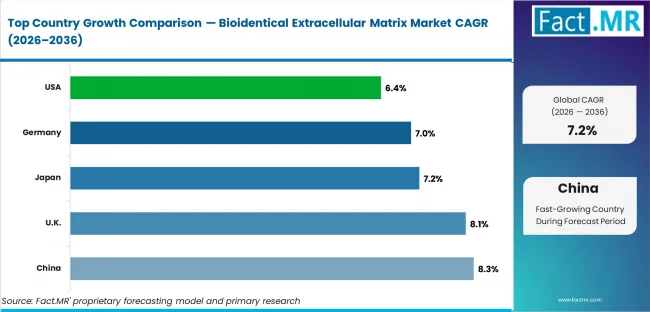
| Fastest Growing Countries | China (8.3% CAGR), UK (8.1% CAGR), Japan (7.2% CAGR), Germany (7.0% CAGR), USA (6.4% CAGR) |
| Key Companies | MiMedx Group, BioLamina, Advanced BioMatrix, Humacyte, DSM Biomedical, and others |
| Product Type Segmentation | ECM Scaffolds, ECM Hydrogels, Injectable ECM Matrices, Bioactive ECM Sheets & Membranes, 3D Bioprinting ECM Bioinks, ECM‑coated Cell Culture Systems, ECM Nanofibers, ECM Sponges & Foams, ECM Microparticles & Microcarriers, ECM‑based Wound Dressings |
| Source Segmentation | Human‑derived ECM, Animal‑derived ECM, Plant‑derived Biomimetic ECM, Recombinant ECM, Synthetic ECM Analogues |
| Technology Segmentation | Decellularization Technology, Tissue Engineering Technology, Biomimetic Engineering, Electrospinning Technology, 3D Bioprinting Technology, Hydrogel Engineering, Nanotechnology‑enabled ECM, Others |
| Application Segmentation | Regenerative Medicine, Tissue Engineering, Wound Healing & Advanced Wound Care, Stem Cell Research, 3D Cell Culture, Drug Discovery & Toxicology Testing, Cosmetic & Aesthetic Regeneration, Dental Regeneration, Ophthalmic Tissue Repair, Surgical Reconstruction |
| Region Segmentation | North America, Latin America, Western Europe, Eastern Europe, East Asia, South Asia & Pacific, Middle East & Africa |
Key Growth Drivers, Constraints, and Opportunities
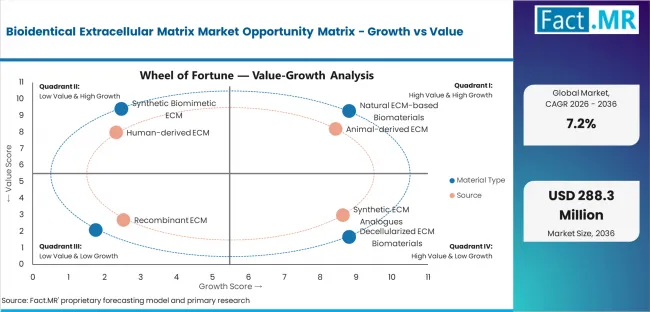
Key Factors Driving Growth
- Regenerative Medicine and Tissue Engineering are increasingly driving the demand for biologically based extracellular matrices (ECM) as healthcare systems globally shift from traditional methods of repairing and restoring tissue to those that utilize biologically based tissue repair and restoration therapies.
- At present there is an increased prevalence of chronic wounds as a result of TRAUMATIC INJURIES AND Degenerative diseases, thus creating a greater need for advanced biomaterials that will actively promote tissue regeneration and will thus help improve healing rates
- Clinically the focus has grown to improving the outcomes of surgery in orthopedics, cardiovascular surgery, and reconstructive surgery; the increased focus on these surgical disciplines is driving the increased demand for biomimetic scaffolds that closely mimic the structure and function of normal human tissues.
| Growth Driver | Demand Impact | Time Horizon | Key Impact Area | Fact.MR Insight |
|---|---|---|---|---|
| Increasing adoption of GLP-1 therapies for obesity and diabetes | High | Short–Mid Term | Adoption acceleration | Rapid rise in the use of GLP-1 treatments is significantly increasing demand for companion products that enhance adherence and overall treatment outcomes |
| Expansion of integrated patient support ecosystems | High | Short–Mid Term | System deployment & scaling | Growing collaboration between pharmaceutical, nutrition, and digital health providers is driving the development of bundled companion solutions at scale |
| Rising need for side-effect management and nutritional support | High | Mid Term | Product effectiveness | Patients undergoing GLP-1 therapy require targeted solutions to manage side effects and maintain nutritional balance, boosting demand for specialized products |
| Advancements in personalized healthcare and digital health platforms | High | Mid–Long Term | Technology advancement | Innovations in AI-driven coaching, monitoring tools, and personalized nutrition are enhancing patient engagement and improving treatment success rates |
| Shift toward holistic and long-term weight management solutions | High | Mid–Long Term | Patient-centric care | Increasing focus on sustainable weight management is driving adoption of comprehensive companion solutions that integrate lifestyle, nutrition, and behavioral support |
Key Market Constraints
- Advanced biomaterials technologies and complex manufacturing techniques are costly, which restricts their use, especially in healthcare systems where they are less expensive and emerging markets.
- There is a lack of understanding and knowledge of advanced Regenerative biomaterials in clinical practice, which is impeding the wider clinical implementation, particularly in non-specialist settings.
- High regulations and a lack of clinical validation are major hurdles for new market entrants, leading to lengthier development periods and slower product commercialization.
Key Opportunity Areas
- Expanding applications in regenerative medicine, wound healing, and surgical repair are driving strong opportunities for bioidentical extracellular matrix solutions as demand for tissue restoration therapies increases globally.
- Growing collaboration between biomaterials companies, medical device firms, and research institutions is enabling the development of integrated regenerative solutions and opening new commercial pathways.
- Rising demand for personalized and precision medicine is creating opportunities for tissue-specific, patient-adapted biomaterials, including advanced scaffolds, engineered hydrogels, and next-generation regenerative platforms.
Segment-wise Analysis of the Bioidentical Extracellular Matrix Market
- ECM Scaffolds hold a 22.80% share in the product type segment, driven by their essential role in providing a natural three-dimensional framework that supports cell attachment, migration, making them the preferred platform for tissue engineering and regenerative medicine applications.
- Regenerative Medicine accounts for a 24.60% share in the application segment, supported by the increasing clinical adoption of ECM‑based therapies for repairing, replacing, tissues and organs, including applications in orthopedics, cardiology, and soft tissue reconstruction.
- Animal‑derived ECM commands a 42.50% share in the source segment, driven by the widespread availability of porcine and bovine tissues, established decellularization protocols, and regulatory acceptance in wound care, and orthopedic applications.
The Global Bioidentical Extracellular Matrix Market is segmented by material type, product type, source, technology, application, and region.
Which Material Type Segment Dominates the Market?
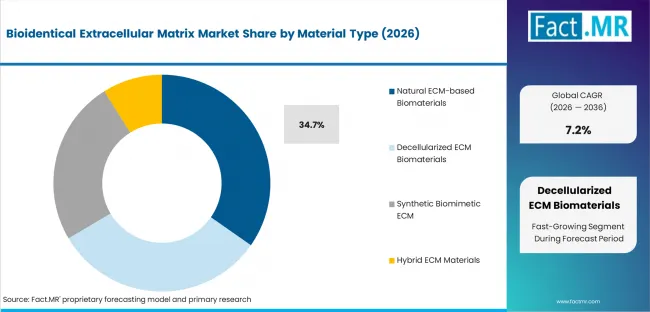
The Natural ECM-based Biomaterials market segment can sustain its market position owing to its market share that is expected to exceed 34.7%. The capability of these biomaterials to resemble the native extracellular matrix structure, exhibit bioactivity, and allow for natural cellular behavior in addition to being readily available from animals and humans has enabled them to dominate the market.
Which Product Type Segment Dominates the Market?
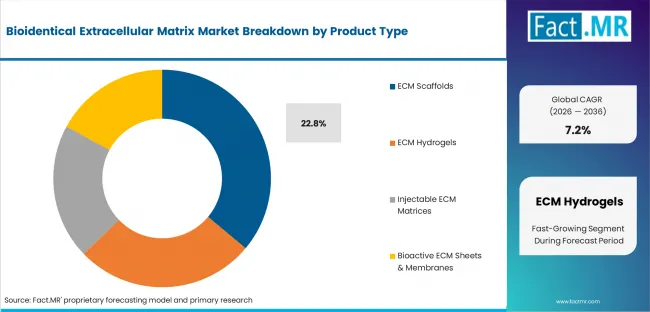
Category ECM Scaffolds is expected to maintain its market position owing to the market share that is estimated to exceed 22.8%. The capacity of these products to offer a natural three-dimensional structure that enables cell adhesion, movement, multiplication, and differentiation, besides their significance in the field of tissue engineering and regenerative medicine, have enabled them to dominate the market.
Which Source Segment Dominates the Market?
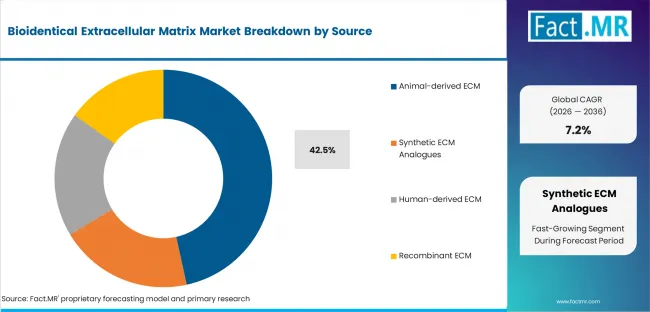
Animal-Derived ECM will continue to maintain their market share because they have a high market share, and it is expected to be above 42.5%. It is due to their capability to provide abundant and cheap extracellular matrix from porcine and bovine tissues, together with the decellularization process that maintains the native ECM structure without immunogenicity.
Which Technology Segment Dominates the Market?
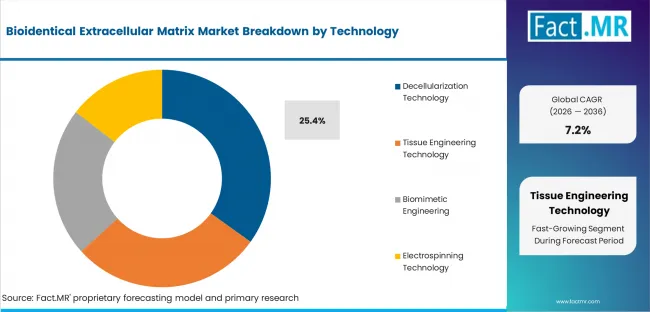
The Decellularization Technology segment will be able to maintain its dominance in the market owing to its market share that is forecasted to be more than 25.4%. The capability of the technology to efficiently remove cells and nuclei from the donor tissue without altering the structure, chemistry, and integrity of the ECM, as well as its importance in manufacturing non-immunogenic and biocompatible bioidentical ECM products, has helped it gain supremacy in the market.
Which Application Segment Dominates the Market?
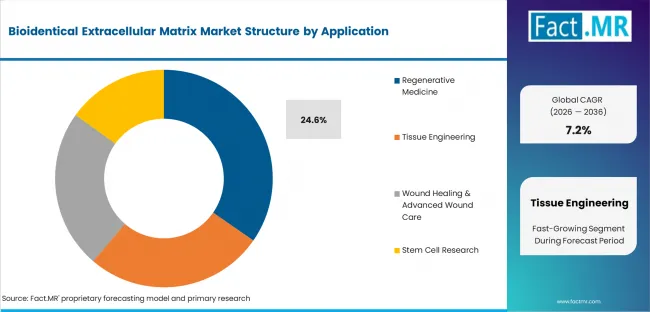
Regenerative Medicine will have an assured market share because it will have a market share of more than 24.6%. This has happened because of the capability of these applications in the use of bioidentical ECM for restoration, regeneration or replacement of damaged tissue or organs. The rising use of ECM-based therapies in orthopedics, cardiology, soft tissue reconstruction, and chronic wounds has led to dominance of this market segment.
Regional Outlook Across Key Markets
The market analysis covers key global regions, including South Asia and Pacific, Middle East & Africa, North America, Latin America, Western Europe, and Eastern Europe. It is segmented geographically, with specific market dynamics for each region. The full report provides a detailed market attractiveness analysis.
.webp)
CAGR Table
| Country | CAGR (%) |
|---|---|
| U.S. | 6.4% |
| Germany | 7.0% |
| Japan | 7.2% |
| China | 8.3% |
| U.K. | 8.1% |
| South Korea | 8.2% |
| India | 8.6% |
Source: Fact.MR (FMR) analysis, based on proprietary forecasting model and primary research.
North America – The Bioidentical Extracellular Matrix Hub
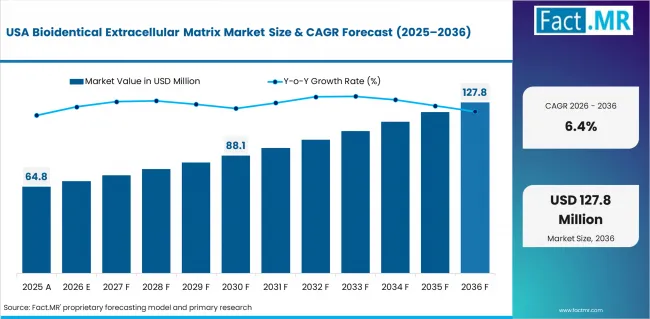
The North America market is anticipated to witness stable growth rates in the short-, medium-, and long-term periods based on the increasing incidence of chronic wounds, sports injuries, and degenerative diseases, along with rising use of ECM-based scaffolds in regenerative medicine.
- U.S.: Demand for bioidentical extracellular matrix products in the U.S. is projected to grow at around 6.4% CAGR, supported by rising FDA clearances for ECM‑based medical devices, increasing utilization of decellularized ECM in wound care and orthopedic applications, growing investments in 3D bioprinting and tissue engineering technologies.
Western Europe – The Bioidentical Extracellular Matrix Hub
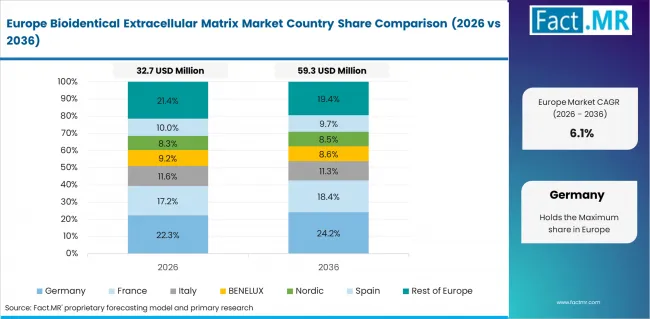
The Western Europe market is forecasted to grow steadily in the short-, medium-, and long-term periods based on the rising usage of advanced wound care solutions, increasing government support for regenerative medicine research, and rising clinical applications of ECM-based products.
- Germany: Demand for bioidentical extracellular matrix products in Germany is projected to grow at around 7.0% CAGR, supported by a robust medical device industry, increasing preference for decellularized ECM scaffolds in tissue engineering, rising number of clinical studies evaluating ECM hydrogels for chronic wounds.
East Asia – The Emerging Powerhouse for Bioidentical ECM in Regenerative Medicine
The market for bioidentical extracellular matrix products in East Asia is growing at a rapid rate owing to the modernization of the health care industry infrastructure, growth of the biotech industry in the region, and the rising demand for regenerative medicine.
- China: Demand for bioidentical extracellular matrix products in China is projected to grow at around an 8.3% CAGR through 2036, supported by the increasing adoption of ECM-based biomaterials in wound healing and tissue repair, rising investments in ECM-focused research and development.
South Asia & Pacific – The Rapidly Growing Bioidentical Extracellular Matrix Expansion Region
The market in South Asia and the Pacific Region is seeing early stage growth due to increased spending on advanced wound care and regenerative medicine, increased medical tourism in orthopedic and soft tissue reconstruction surgeries, and increased awareness about ECM products among doctors and surgeons, along with better regulatory processes for biological medical devices.
- India: Demand for bioidentical extracellular matrix products in India is projected to grow at around a 8.6% CAGR through 2036.
Latin America – The Next Horizon for Bioidentical ECM Adoption
The Latin America market has a very good growth outlook owing to the increased prevalence of chronic wounds and diabetic ulcers and also increasing usage of wound care and regenerative medicine therapies.
- Brazil: Demand for bioidentical extracellular matrix products in Brazil is projected to grow at around an 8.2% CAGR through 2036, supported by expanding patient population requiring soft tissue repair and hernia mesh procedures.
Middle East & Africa – The Emerging Bioidentical Extracellular Matrix Expansion Zone
The Middle East & Africa market is expected to see continued growth trends during the forecast period owing to increased investment in advanced wound care and regenerative medicine as well as increased usage of ECM scaffolds in surgical and chronic wound applications.
- KSA: Demand for bioidentical extracellular matrix products in Saudi Arabia is projected to grow at around an 8.1% CAGR through 2036, supported by improving healthcare infrastructure under Vision 2030, increasing government initiatives to localize medical device manufacturing.
Fact.MR analysis of the Bioidentical Extracellular Matrix Market provides a comprehensive regional outlook covering North America, Latin America, Western Europe, Eastern Europe, East Asia, South Asia & Pacific, and Middle East & Africa. Readers can access country‑wise insights, growth trends, and adoption patterns across both developed and emerging markets.
Competitive Benchmarking and Company Positioning
Leading Companies Shaping the Bioidentical Extracellular Matrix Market
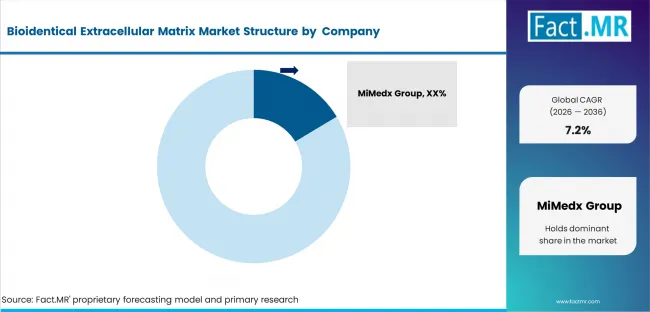
Global market structure of bioidentical extracellular matrix products is quite fragmented in nature. This market is made up of a blend of conventional biotech and medical devices firms alongside tissue engineering and regenerative medicine startups. It has been noticed that some of the major firms in this market place focus on the development of integrated ECM platforms, thereby ensuring effective tissue repair as well as surgical reconstruction. The major players such as MiMedx Group, BioLamina, Advanced BioMatrix, Humacyte, and DSM Biomedical contribute around 35-40% of the total market share.
Key Players of the Bioidentical Extracellular Matrix Market
- Thermo Fisher Scientific
- Corning Incorporated
- MiMedx Group
- Advanced BioMatrix
- FUJIFILM Holdings Corporation
- BioLamina
- Aroa Biosurgery
- Humacyte
- DSM Biomedical
- Cook Biotech
Recent Industry Developments
- Novel engineered extracellular matrix developed by team from Chongqing Medical University (2025), Cartilage injuries are a common clinical issue, often caused by trauma, severe infections, or degenerative joint diseases. (Chongqing Medical) [1]
- BASF ushers in a new era of collagen science with precision peptide (2026): SkinNexus Collag3n offers next-generation collagen banking through advanced biotechnology. Produced through biotechnology by vegan yeast fermentation, the new ingredient stands apart from traditional collagen offerings through its 100% human-identical sequence and biomimetic effects supporting the skin’s extracellular matrix. (BASF) [2]
- Stimlabs LLC Announces Launch of Allacor P (2026): StimLabs, a leading regenerative medicine company, announces the launch of Allacor P, the first medical device derived from human umbilical cord extracellular matrix (StimLabs) [3]
- Kolosis BIO Expands Surgical Biologics Portfolio with Launch of APEXecm (2026): Kolosis, the industry's leading pure-play surgical biologics company, today announced the addition of APEXecm. (Kolosis) [4]
- Engitix Announces $25 Million Series A Extension Financing (2025): Company has built one of the largest proprietary extracellular matrix (ECM) datasets spanning fibrosis and solid tumors. (Engitix) [5]
Sources and Research References
- [1] “Novel engineered extracellular matrix developed by team from Chongqing Medical University aids cartilage repair”, 2025
- [2] “BASF introduces a recombinant Collagen III fragment, produced through biotechnology by vegan yeast fermentation, apart from traditional collagen offerings through its 100% human-identical sequence supporting the extracellular matrix.”, 2026
- [3] “Stimlabs® LLC Announces Launch of Allacors”, 2026
- [4] “Kolosis BIO Expands Surgical Biologics Portfolio with Launch of APEXecm”, 2026
- [5] “Engitix Announces $25 Million Series A Extension Financing by Existing Investor Mike Platt”, 2025
Bioidentical Extracellular Matrix Market Definition
Bioidentical Extracellular Matrix (ECM) Market encompasses a group of scaffold materials of biologically derived and highly biomimetic to mimic the structure and function of native human extracellular matrix in tissue engineering and regenerative medicine. These products range from decellularized ECM, tissue-specific scaffolds, hydrogels, and hybrid biomaterials for cell attachment, growth, and tissue regeneration.
Bioidentical Extracellular Matrix Market Inclusions
Bioidentical extracellular matrix market means the aggregate of all those biomaterials which have been produced using biological materials and are biomimetically designed to mimic the natural human tissues in terms of their structure and function. Some of the key components of the market include decellularized tissue scaffolds, tissue-derived matrices, hydrogels, and hybrid biomaterials.
Bioidentical Extracellular Matrix Market Exclusions
The market for bioidentical extracellular matrix does not include any synthetic biomaterials or purely mechanical scaffold materials that do not mimic natural human tissue structure and biology. Also, any pharmaceutical products, cell therapy, or gene therapy is not considered part of this market as they fall under their respective treatment or biological product markets.
Bioidentical Extracellular Matrix Market Research Methodology
- Primary Research
- Synthetic biomaterials and purely mechanical scaffold materials, which do not mimic the biological function or structure of human tissue, are not part of the market. It also excludes standalone pharmaceutical drugs, cell therapies and gene therapies, which are part of different therapeutic and biologics markets to tissue-derived regenerative materials.
- Desk Research
- Secondary research was done through the analysis of the annual reports, technical publications, and investor presentations of companies that work in tissue engineering, biomaterials development, and regenerative medicine that are involved in the Bioidentical Extracellular Matrix Market.
- Market-Sizing and Forecasting
- Bioidentical extracellular matrix market size and forecast are determined by the revenue of biologically derived tissue scaffolds and biomimetic materials for regenerative medicine applications. The key product categories that are seen as include decellularized tissue scaffolds, tissue-specific biomaterials, hydrogels and hybrid matrices that are used in the wound healing and 3D bioprinting applications.
- Data Validation and Update Cycle
- The data validation protocol for the market is comprehensive and ensures that all information is collected from industry sources and key industry stakeholders is cross validated for accuracy and reliability.
Scope of Analysis

| Parameter | Details |
|---|---|
| Quantitative Units | USD 134.2 million in 2025 to USD 288.3 million in 2036, at a CAGR of 7.2% |
| Market Definition | The Bioidentical Extracellular Matrix Market comprises biomaterials derived from natural, decellularized, synthetic, or hybrid sources that mimic the native extracellular environment to support cell growth, tissue repair, and regeneration. |
| Regions Covered | North America, Latin America, Western Europe, Eastern Europe, East Asia, South Asia & Pacific, Middle East & Africa |
| Countries Covered | USA, China, Germany, UK, Japan, India, Brazil, KSA, and 30+ countries |
| Key Companies | MiMedx Group, BioLamina, Advanced BioMatrix, Humacyte, DSM Biomedical, and others |
| Forecast Period | 2026 to 2036 |
| Approach | Hybrid demand‑side and top‑down methodology based on increasing prevalence of chronic wounds and degenerative diseases, growing adoption of ECM‑based scaffolds in regenerative medicine, rising FDA clearances and regulatory approvals for decellularized ECM devices, advancements in 3D bioprinting and hydrogel engineering technologies. |
Analysis by Material Type, by Product Type, by Source, by Technology, by Application, and by Region
-
Bioidentical Extracellular Matrix Market By Material Type
- Natural ECM-based Biomaterials
- Collagen-based ECM
- Elastin-based ECM
- Laminin-based ECM
- Fibronectin-based ECM
- Hyaluronic Acid-based ECM
- Proteoglycan-based ECM
- Decellularized ECM Biomaterials
- Human-derived ECM
- Porcine-derived ECM
- Bovine-derived ECM
- Marine-derived ECM
- Tissue-specific ECM
- Synthetic Biomimetic ECM
- Peptide-engineered ECM
- Polymer-based ECM Mimics
- Nanofiber ECM Structures
- Hydrogel-based Synthetic ECM
- Self-assembling Biomimetic Matrices
- Hybrid ECM Materials
- Natural ECM-based Biomaterials
-
Bioidentical Extracellular Matrix Market By Product Type
- ECM Scaffolds
- ECM Hydrogels
- Injectable ECM Matrices
- Bioactive ECM Sheets & Membranes
- 3D Bioprinting ECM Bioinks
- ECM-coated Cell Culture Systems
- ECM Nanofibers
- ECM Sponges & Foams
- ECM Microparticles & Microcarriers
- ECM-based Wound Dressings
-
Bioidentical Extracellular Matrix Market By Source
- Human-derived ECM
- Animal-derived ECM
- Porcine
- Bovine
- Equine
- Marine
- Plant-derived Biomimetic ECM
- Recombinant ECM
- Synthetic ECM Analogues
-
Bioidentical Extracellular Matrix Market By Technology
- Decellularization Technology
- Tissue Engineering Technology
- Biomimetic Engineering
- Electrospinning Technology
- 3D Bioprinting Technology
- Hydrogel Engineering
- Nanotechnology-enabled ECM
- Others
-
Bioidentical Extracellular Matrix Market By Application
- Regenerative Medicine
- Orthopedic Regeneration
- Cardiac Tissue Repair
- Neural Regeneration
- Tissue Engineering
- Wound Healing & Advanced Wound Care
- Stem Cell Research
- 3D Cell Culture
- Drug Discovery & Toxicology Testing
- Cosmetic & Aesthetic Regeneration
- Dental Regeneration
- Ophthalmic Tissue Repair
- Surgical Reconstruction
- Regenerative Medicine
-
Bioidentical Extracellular Matrix Market By Region
- North America
- USA
- Canada
- Mexico
- Latin America
- Brazil
- Chile
- Rest of LATAM
- East Asia
- China
- Japan
- South Korea
- Western Europe
- Germany
- Italy
- France
- U.K.
- Spain
- BENELUX
- Nordic
- Rest of W. Europe
- Eastern Europe
- Russia
- Hungary
- Poland
- Balkan & Baltics
- Rest of E. Europe
- Middle East and Africa
- Kingdom of Saudi Arabia
- United Arab Emirates
- South Africa
- Rest of Middle East and Africa
- North America
- Frequently Asked Questions -
How large is the demand for Bioidentical Extracellular Matrix products in the global market in 2025?
Demand for Bioidentical Extracellular Matrix products in the global market is estimated to be valued at USD 134.2 million in 2025.
What will be the market size of Bioidentical Extracellular Matrix products in the global market by 2036?
The market size for Bioidentical Extracellular Matrix products is projected to reach USD 288.3 million by 2036.
What is the expected demand growth for Bioidentical Extracellular Matrix products in the global market between 2026 and 2036?
Demand for Bioidentical Extracellular Matrix products in the global market is expected to grow at a CAGR of 7.2% between 2026 and 2036.
Which product type segment is expected to dominate the Bioidentical Extracellular Matrix Market?
ECM Scaffolds are expected to dominate the market, accounting for 22.80% share in 2026, driven by their ability to provide a natural three‑dimensional framework that supports cell attachment, migration, proliferation, and differentiation, making them the preferred platform for tissue engineering and regenerative medicine applications.
How significant is the growth outlook for the USA in this market?
USA is expected to grow at a CAGR of 6.4% through 2036, supported by rising FDA clearances for ECM‑based medical devices, increasing utilization of decellularized ECM in wound care and orthopedic applications, growing investments in 3D bioprinting and tissue engineering technologies, and the presence of leading companies such as MiMedx, StimLabs, and Acera Surgical.
Which company is identified as a leading player in the Bioidentical Extracellular Matrix Market?
MiMedx is identified as a leading player in the market, supported by its strong portfolio of advanced ECM‑based products including wound dressings, flowable ECM formulations, and placental‑derived allografts, and global presence across wound healing, and regenerative medicine programs.
Table of Content
- Bioidentical Extracellular Matrix Market – Executive Summary
- Market Overview
- Market Definition & Introduction
- Market Taxonomy & Research Scope
- Global Bioidentical Extracellular Matrix Market Demand Analysis 2021-2025 and Forecast, 2026–2036
- Historical Market Volume (Tons) Analysis, 2021-2025
- Current and Future Market Volume (Tons) Projections, 2026–2036
- Y-o-Y Growth Trend Analysis
- Global Bioidentical Extracellular Matrix Market - Pricing Analysis
- Product Category and Country-Level Pricing Analysis
- Region Average Pricing Analysis Benchmark
- Price Trends and Forecasts
- Historical price trends
- Future price forecasts
- Factors Influencing Pricing
- Competitive Pricing Strategies
- Cost Structure Analysis
- Global Bioidentical Extracellular Matrix Market Demand (in Value or Size in US$ Mn) Analysis 2021-2025 and Forecast, 2026–2036
- Historical Market Value (US$ Mn) Analysis, 2021-2025
- Current and Future Market Value (US$ Mn) Projections, 2026–2036
- Y-o-Y Growth Trend Analysis
- Absolute $ Opportunity Analysis
- Market Background and Foundational Data Points
- Bioidentical tissue scaffold penetration rate in regenerative medicine procedures (%)
- Annual growth rate of regulatory approvals for biomimetic and decellularized tissue products (%)
- Average market price per unit of bioactive scaffold materials (USD)
- Clinical adoption rate of tissue-derived regenerative biomaterials (%)
- Manufacturing yield efficiency in biomaterial processing facilities (%)
- Sterility failure / rejection rate in tissue scaffold production (%)
- Average processing time per batch of decellularized tissue scaffolds (days)
- R&D expenditure intensity in regenerative biomaterials industry (% of revenue)
- Number of active clinical trials involving biomimetic tissue scaffolds (count)
- Average reimbursement coverage rate for regenerative biomaterial procedures (%)
- Supply chain dependency index for biologically derived raw materials (0–100)
- Surgeon preference index for bioidentical scaffolds vs synthetic alternatives (0–100)
- Bioidentical Extracellular Matrix Market Opportunity Assessment
- Total Available Market (US$ Mn)
- Serviceable Addressable Market (US$ Mn)
- Serviceable Obtainable Market (US$ Mn)
- Porter’s Five Forces and PESTEL Analysis
- Investment Feasibility Analysis
- Macro-Economic Factors & Forecast Factors - Relevance & Impact
- Industry Value and Supply Chain Analysis
- List of Key Channel Partners
- Profit Margin & Operating Margin at Each Node of Supply Chain.
- Notes on Value Added at Each Node in the Value Chain
- Factors Influencing Value Chain
- Market Dynamics
- Drivers
- Restraints
- Opportunity
- Trend Analysis
- Key Regulations & Certifications
- Bioidentical Extracellular Matrix Market Analysis 2021-2025 and Forecast 2026–2036, By Material Type
- Introduction / Key Findings
- Historical Market Size (US$ Mn) & Volume (Tons) Trend Analysis By Material Type, 2021-2025
- Current and Future Market Size (US$ Mn) & Volume (Tons) Analysis and Forecast By Material Type, 2026-2036
- Natural ECM-based Biomaterials
- Collagen-based ECM
- Elastin-based ECM
- Laminin-based ECM
- Fibronectin-based ECM
- Hyaluronic Acid-based ECM
- Proteoglycan-based ECM
- Decellularized ECM Biomaterials
- Human-derived ECM
- Porcine-derived ECM
- Bovine-derived ECM
- Marine-derived ECM
- Tissue-specific ECM
- Synthetic Biomimetic ECM
- Peptide-engineered ECM
- Polymer-based ECM Mimics
- Nanofiber ECM Structures
- Hydrogel-based Synthetic ECM
- Self-assembling Biomimetic Matrices
- Hybrid ECM Materials
- Natural ECM-based Biomaterials
- Market Attractiveness Analysis By Material Type
- Bioidentical Extracellular Matrix Market Analysis 2021-2025 and Forecast 2026–2036, By Product Type
- Introduction / Key Findings
- Historical Market Size (US$ Mn) & Volume (Tons) Trend Analysis By Product Type, 2021-2025
- Current and Future Market Size (US$ Mn) & Volume (Tons) Analysis and Forecast By Product Type, 2026-2036
- ECM Scaffolds
- ECM Hydrogels
- Injectable ECM Matrices
- Bioactive ECM Sheets & Membranes
- 3D Bioprinting ECM Bioinks
- ECM-coated Cell Culture Systems
- ECM Nanofibers
- ECM Sponges & Foams
- ECM Microparticles & Microcarriers
- ECM-based Wound Dressings
- Market Attractiveness Analysis By Product Type
- Bioidentical Extracellular Matrix Market Analysis 2021-2025 and Forecast 2026–2036, By Source
- Introduction / Key Findings
- Historical Market Size (US$ Mn) & Volume (Tons) Trend Analysis By Source, 2021-2025
- Current and Future Market Size (US$ Mn) & Volume (Tons) Analysis and Forecast By Source, 2026-2036
- Human-derived ECM
- Animal-derived ECM
- Porcine
- Bovine
- Equine
- Marine
- Plant-derived Biomimetic ECM
- Recombinant ECM
- Synthetic ECM Analogues
- Market Attractiveness Analysis By Source
- Bioidentical Extracellular Matrix Market Analysis 2021-2025 and Forecast 2026–2036, By Technology
- Introduction / Key Findings
- Historical Market Size (US$ Mn) & Volume (Tons) Trend Analysis By Technology, 2021-2025
- Current and Future Market Size (US$ Mn) & Volume (Tons) Analysis and Forecast By Technology, 2026-2036
- Decellularization Technology
- Tissue Engineering Technology
- Biomimetic Engineering
- Electrospinning Technology
- 3D Bioprinting Technology
- Hydrogel Engineering
- Nanotechnology-enabled ECM
- Others
- Market Attractiveness Analysis By Technology
- Bioidentical Extracellular Matrix Market Analysis 2021-2025 and Forecast 2026–2036, By Application
- Introduction / Key Findings
- Historical Market Size (US$ Mn) & Volume (Tons) Trend Analysis By Application, 2021-2025
- Current and Future Market Size (US$ Mn) & Volume (Tons) Analysis and Forecast By Application, 2026-2036
- Regenerative Medicine
- Orthopedic Regeneration
- Cardiac Tissue Repair
- Neural Regeneration
- Tissue Engineering
- Wound Healing & Advanced Wound Care
- Stem Cell Research
- 3D Cell Culture
- Drug Discovery & Toxicology Testing
- Cosmetic & Aesthetic Regeneration
- Dental Regeneration
- Ophthalmic Tissue Repair
- Surgical Reconstruction
- Regenerative Medicine
- Market Attractiveness Analysis By Application
- Global Bioidentical Extracellular Matrix Market Analysis and Forecast, by Region
- Introduction / Key Findings
- Historical Market Size (US$ Mn) & Volume (Tons) Trend Analysis by Region, 2021-2025
- Current and Future Market Size (US$ Mn) & Volume (Tons) Analysis and Forecast by Region, 2026-2036
- North America
- Latin America
- Western Europe
- Eastern Europe
- East Asia
- South Asia & Pacific
- Middle East & Africa
- Market Attractiveness Analysis by Region
- North America Bioidentical Extracellular Matrix Market Analysis and Forecast
- Introduction / Key Findings
- Pricing Analysis
- Historical Market Size (US$ Mn) & Volume (Tons) Trend Analysis by Market Taxonomy, 2021-2025
- Current and Future Market Size (US$ Mn) and Volume (Tons) Analysis & Forecast by Market Taxonomy, 2026-2036
- By Country
- United States
- Canada
- Mexico
- By Taxonomy
- Market Attractiveness Analysis By Country & Taxonomy
- Market Trends
- Key Market Participants – Intensity Mapping
- Drivers and Restraints - Impact Analysis
- Latin America Bioidentical Extracellular Matrix Market Analysis and Forecast
- Introduction / Key Findings
- Pricing Analysis
- Historical Market Size (US$ Mn) & Volume (Tons) Trend Analysis by Market Taxonomy, 2021-2025
- Current and Future Market Size (US$ Mn) and Volume (Tons) Analysis & Forecast by Market Taxonomy, 2026-2036
- By Country
- Brazil
- Chile
- Rest of LATAM
- By Taxonomy
- Market Attractiveness Analysis By Country & Taxonomy
- Market Trends
- Key Market Participants – Intensity Mapping
- Drivers and Restraints - Impact Analysis
- Western Europe Bioidentical Extracellular Matrix Market Analysis and Forecast
- Introduction / Key Findings
- Pricing Analysis
- Historical Market Size (US$ Mn) & Volume (Tons) Trend Analysis by Market Taxonomy, 2021-2025
- Current and Future Market Size (US$ Mn) and Volume (Tons) Analysis & Forecast by Market Taxonomy, 2026-2036
- By Country
- Germany
- Italy
- France
- United Kingdom
- Spain
- BENELUX
- Nordics
- Rest of Western Europe
- By Taxonomy
- Market Attractiveness Analysis By Country & Taxonomy
- Market Trends
- Key Market Participants – Intensity Mapping
- Drivers and Restraints - Impact Analysis
- Eastern Europe Bioidentical Extracellular Matrix Market Analysis and Forecast
- Introduction / Key Findings
- Pricing Analysis
- Historical Market Size (US$ Mn) & Volume (Tons) Trend Analysis by Market Taxonomy, 2021-2025
- Current and Future Market Size (US$ Mn) and Volume (Tons) Analysis & Forecast by Market Taxonomy, 2026-2036
- By Country
- Russia
- Hungary
- Poland
- Balkan & Baltics
- Rest of Eastern Europe
- By Taxonomy
- Market Attractiveness Analysis By Country & Taxonomy
- Market Trends
- Key Market Participants – Intensity Mapping
- Drivers and Restraints - Impact Analysis
- East Asia Bioidentical Extracellular Matrix Market Analysis and Forecast
- Introduction / Key Findings
- Pricing Analysis
- Historical Market Size (US$ Mn) & Volume (Tons) Trend Analysis by Market Taxonomy, 2021-2025
- Current and Future Market Size (US$ Mn) and Volume (Tons) Analysis & Forecast by Market Taxonomy, 2026-2036
- By Country
- China
- Japan
- South Korea
- By Taxonomy
- Market Attractiveness Analysis By Country & Taxonomy
- Market Trends
- Key Market Participants – Intensity Mapping
- Drivers and Restraints - Impact Analysis
- South Asia & Pacific Bioidentical Extracellular Matrix Market Analysis and Forecast
- Introduction / Key Findings
- Pricing Analysis
- Historical Market Size (US$ Mn) & Volume (Tons) Trend Analysis by Market Taxonomy, 2021-2025
- Current and Future Market Size (US$ Mn) and Volume (Tons) Analysis & Forecast by Market Taxonomy, 2026-2036
- By Country
- India
- ASEAN
- Australia & New Zealand
- Rest of South Asia & Pacific
- By Taxonomy
- Market Attractiveness Analysis By Country & Taxonomy
- Market Trends
- Key Market Participants – Intensity Mapping
- Drivers and Restraints - Impact Analysis
- Middle East & Africa Bioidentical Extracellular Matrix Market Analysis and Forecast
- Introduction / Key Findings
- Pricing Analysis
- Historical Market Size (US$ Mn) & Volume (Tons) Trend Analysis by Market Taxonomy, 2021-2025
- Current and Future Market Size (US$ Mn) and Volume (Tons) Analysis & Forecast by Market Taxonomy, 2026-2036
- By Country
- Kingdom of Saudi Arabia
- Other GCC Countries
- Turkiye
- South Africa
- Other African Union
- By Taxonomy
- Market Attractiveness Analysis By Country & Taxonomy
- Market Trends
- Key Market Participants – Intensity Mapping
- Drivers and Restraints - Impact Analysis
- Country-level Bioidentical Extracellular Matrix Market Analysis and Forecast
- Introduction
- Market Value Proportion Analysis, By Key Countries
- Global Vs. Country Growth Comparison
- United States Bioidentical Extracellular Matrix Market Analysis
- Market Size (US$ Mn) & Volume (Tons) Analysis by Market Taxonomy, 2021–2036
- By Technology
- By Product Type
- By Source
- By Material Type
- By Application
- United States Bioidentical Extracellular Matrix Market Analysis
-
-
- Canada Bioidentical Extracellular Matrix Market Analysis
- Mexico Bioidentical Extracellular Matrix Market Analysis
- Brazil Bioidentical Extracellular Matrix Market Analysis
- Chile Bioidentical Extracellular Matrix Market Analysis
- Germany Bioidentical Extracellular Matrix Market Analysis
- France Bioidentical Extracellular Matrix Market Analysis
- Italy Bioidentical Extracellular Matrix Market Analysis
- Spain Bioidentical Extracellular Matrix Market Analysis
- United Kingdom Bioidentical Extracellular Matrix Market Analysis
- BENELUX Bioidentical Extracellular Matrix Market Analysis
- Nordics Bioidentical Extracellular Matrix Market Analysis
- Poland Bioidentical Extracellular Matrix Market Analysis
- Russia Bioidentical Extracellular Matrix Market Analysis
- Hungary Bioidentical Extracellular Matrix Market Analysis
- Balkan & Baltics Bioidentical Extracellular Matrix Market Analysis
- China Bioidentical Extracellular Matrix Market Analysis
- Japan Bioidentical Extracellular Matrix Market Analysis
- South Korea Bioidentical Extracellular Matrix Market Analysis
- India Bioidentical Extracellular Matrix Market Analysis
- ASEAN Bioidentical Extracellular Matrix Market Analysis
- ANZ Bioidentical Extracellular Matrix Market Analysis
- KSA Bioidentical Extracellular Matrix Market Analysis
- Other GCC Countries Bioidentical Extracellular Matrix Market Analysis
- South Africa Bioidentical Extracellular Matrix Market Analysis
- Turkiye Bioidentical Extracellular Matrix Market Analysis
-
- Bioidentical Extracellular Matrix Market Structure Analysis
- Market Analysis by Tier of Companies
- Market Concentration
- Market Share Analysis of Top Players
- Market Space for New Brands and Dollar Opportunity
- Market Presence Analysis
- Regional Footprint of Players
- Product Footprint by Players
- Bioidentical Extracellular Matrix Competition Analysis
- Competition Dashboard
- Pricing Analysis by Competition
- Competition Benchmarking
- Competition Deep Dive
- Corning Incorporated
- Overview
- Product Portfolio
- Sales Footprint
- Key Developments
- SWOT Analysis
- Strategy Overview
- Key Financials
- MiMedx Group
- Advanced BioMatrix
- FUJIFILM Holdings Corporation
- BioLamina
- Aroa Biosurgery
- Humacyte
- DSM Biomedical
- Cook Biotech
- Thermo Fisher Scientific
- Other Prominent Players
- Corning Incorporated
- Primary insights
- Assumptions & Acronyms Used
- Research Methodology & Data Sources
List Of Table
- Table 1: Global Market Value (USD Mn) Forecast by Region, 2021 to 2036
- Table 2: Global Market Volume (Tons) Forecast by Region, 2021 to 2036
- Table 3: Global Market Value (USD Mn) Forecast by Material Type, 2021 to 2036
- Table 4: Global Market Volume (Tons) Forecast by Material Type, 2021 to 2036
- Table 5: Global Market Value (USD Mn) Forecast by Product Type, 2021 to 2036
- Table 6: Global Market Volume (Tons) Forecast by Product Type, 2021 to 2036
- Table 7: Global Market Value (USD Mn) Forecast by Source, 2021 to 2036
- Table 8: Global Market Volume (Tons) Forecast by Source, 2021 to 2036
- Table 9: Global Market Value (USD Mn) Forecast by Technology, 2021 to 2036
- Table 10: Global Market Volume (Tons) Forecast by Technology, 2021 to 2036
- Table 11: Global Market Value (USD Mn) Forecast by Application, 2021 to 2036
- Table 12: Global Market Volume (Tons) Forecast by Application, 2021 to 2036
- Table 13: North America Market Value (USD Mn) Forecast by Country, 2021 to 2036
- Table 14: North America Market Volume (Tons) Forecast by Country, 2021 to 2036
- Table 15: North America Market Value (USD Mn) Forecast by Material Type, 2021 to 2036
- Table 16: North America Market Volume (Tons) Forecast by Material Type, 2021 to 2036
- Table 17: North America Market Value (USD Mn) Forecast by Product Type, 2021 to 2036
- Table 18: North America Market Volume (Tons) Forecast by Product Type, 2021 to 2036
- Table 19: North America Market Value (USD Mn) Forecast by Source, 2021 to 2036
- Table 20: North America Market Volume (Tons) Forecast by Source, 2021 to 2036
- Table 21: North America Market Value (USD Mn) Forecast by Technology, 2021 to 2036
- Table 22: North America Market Volume (Tons) Forecast by Technology, 2021 to 2036
- Table 23: North America Market Value (USD Mn) Forecast by Application, 2021 to 2036
- Table 24: North America Market Volume (Tons) Forecast by Application, 2021 to 2036
- Table 25: Latin America Market Value (USD Mn) Forecast by Country, 2021 to 2036
- Table 26: Latin America Market Volume (Tons) Forecast by Country, 2021 to 2036
- Table 27: Latin America Market Value (USD Mn) Forecast by Material Type, 2021 to 2036
- Table 28: Latin America Market Volume (Tons) Forecast by Material Type, 2021 to 2036
- Table 29: Latin America Market Value (USD Mn) Forecast by Product Type, 2021 to 2036
- Table 30: Latin America Market Volume (Tons) Forecast by Product Type, 2021 to 2036
- Table 31: Latin America Market Value (USD Mn) Forecast by Source, 2021 to 2036
- Table 32: Latin America Market Volume (Tons) Forecast by Source, 2021 to 2036
- Table 33: Latin America Market Value (USD Mn) Forecast by Technology, 2021 to 2036
- Table 34: Latin America Market Volume (Tons) Forecast by Technology, 2021 to 2036
- Table 35: Latin America Market Value (USD Mn) Forecast by Application, 2021 to 2036
- Table 36: Latin America Market Volume (Tons) Forecast by Application, 2021 to 2036
- Table 37: Western Europe Market Value (USD Mn) Forecast by Country, 2021 to 2036
- Table 38: Western Europe Market Volume (Tons) Forecast by Country, 2021 to 2036
- Table 39: Western Europe Market Value (USD Mn) Forecast by Material Type, 2021 to 2036
- Table 40: Western Europe Market Volume (Tons) Forecast by Material Type, 2021 to 2036
- Table 41: Western Europe Market Value (USD Mn) Forecast by Product Type, 2021 to 2036
- Table 42: Western Europe Market Volume (Tons) Forecast by Product Type, 2021 to 2036
- Table 43: Western Europe Market Value (USD Mn) Forecast by Source, 2021 to 2036
- Table 44: Western Europe Market Volume (Tons) Forecast by Source, 2021 to 2036
- Table 45: Western Europe Market Value (USD Mn) Forecast by Technology, 2021 to 2036
- Table 46: Western Europe Market Volume (Tons) Forecast by Technology, 2021 to 2036
- Table 47: Western Europe Market Value (USD Mn) Forecast by Application, 2021 to 2036
- Table 48: Western Europe Market Volume (Tons) Forecast by Application, 2021 to 2036
- Table 49: Eastern Europe Market Value (USD Mn) Forecast by Country, 2021 to 2036
- Table 50: Eastern Europe Market Volume (Tons) Forecast by Country, 2021 to 2036
- Table 51: Eastern Europe Market Value (USD Mn) Forecast by Material Type, 2021 to 2036
- Table 52: Eastern Europe Market Volume (Tons) Forecast by Material Type, 2021 to 2036
- Table 53: Eastern Europe Market Value (USD Mn) Forecast by Product Type, 2021 to 2036
- Table 54: Eastern Europe Market Volume (Tons) Forecast by Product Type, 2021 to 2036
- Table 55: Eastern Europe Market Value (USD Mn) Forecast by Source, 2021 to 2036
- Table 56: Eastern Europe Market Volume (Tons) Forecast by Source, 2021 to 2036
- Table 57: Eastern Europe Market Value (USD Mn) Forecast by Technology, 2021 to 2036
- Table 58: Eastern Europe Market Volume (Tons) Forecast by Technology, 2021 to 2036
- Table 59: Eastern Europe Market Value (USD Mn) Forecast by Application, 2021 to 2036
- Table 60: Eastern Europe Market Volume (Tons) Forecast by Application, 2021 to 2036
- Table 61: East Asia Market Value (USD Mn) Forecast by Country, 2021 to 2036
- Table 62: East Asia Market Volume (Tons) Forecast by Country, 2021 to 2036
- Table 63: East Asia Market Value (USD Mn) Forecast by Material Type, 2021 to 2036
- Table 64: East Asia Market Volume (Tons) Forecast by Material Type, 2021 to 2036
- Table 65: East Asia Market Value (USD Mn) Forecast by Product Type, 2021 to 2036
- Table 66: East Asia Market Volume (Tons) Forecast by Product Type, 2021 to 2036
- Table 67: East Asia Market Value (USD Mn) Forecast by Source, 2021 to 2036
- Table 68: East Asia Market Volume (Tons) Forecast by Source, 2021 to 2036
- Table 69: East Asia Market Value (USD Mn) Forecast by Technology, 2021 to 2036
- Table 70: East Asia Market Volume (Tons) Forecast by Technology, 2021 to 2036
- Table 71: East Asia Market Value (USD Mn) Forecast by Application, 2021 to 2036
- Table 72: East Asia Market Volume (Tons) Forecast by Application, 2021 to 2036
- Table 73: South Asia and Pacific Market Value (USD Mn) Forecast by Country, 2021 to 2036
- Table 74: South Asia and Pacific Market Volume (Tons) Forecast by Country, 2021 to 2036
- Table 75: South Asia and Pacific Market Value (USD Mn) Forecast by Material Type, 2021 to 2036
- Table 76: South Asia and Pacific Market Volume (Tons) Forecast by Material Type, 2021 to 2036
- Table 77: South Asia and Pacific Market Value (USD Mn) Forecast by Product Type, 2021 to 2036
- Table 78: South Asia and Pacific Market Volume (Tons) Forecast by Product Type, 2021 to 2036
- Table 79: South Asia and Pacific Market Value (USD Mn) Forecast by Source, 2021 to 2036
- Table 80: South Asia and Pacific Market Volume (Tons) Forecast by Source, 2021 to 2036
- Table 81: South Asia and Pacific Market Value (USD Mn) Forecast by Technology, 2021 to 2036
- Table 82: South Asia and Pacific Market Volume (Tons) Forecast by Technology, 2021 to 2036
- Table 83: South Asia and Pacific Market Value (USD Mn) Forecast by Application, 2021 to 2036
- Table 84: South Asia and Pacific Market Volume (Tons) Forecast by Application, 2021 to 2036
- Table 85: Middle East & Africa Market Value (USD Mn) Forecast by Country, 2021 to 2036
- Table 86: Middle East & Africa Market Volume (Tons) Forecast by Country, 2021 to 2036
- Table 87: Middle East & Africa Market Value (USD Mn) Forecast by Material Type, 2021 to 2036
- Table 88: Middle East & Africa Market Volume (Tons) Forecast by Material Type, 2021 to 2036
- Table 89: Middle East & Africa Market Value (USD Mn) Forecast by Product Type, 2021 to 2036
- Table 90: Middle East & Africa Market Volume (Tons) Forecast by Product Type, 2021 to 2036
- Table 91: Middle East & Africa Market Value (USD Mn) Forecast by Source, 2021 to 2036
- Table 92: Middle East & Africa Market Volume (Tons) Forecast by Source, 2021 to 2036
- Table 93: Middle East & Africa Market Value (USD Mn) Forecast by Technology, 2021 to 2036
- Table 94: Middle East & Africa Market Volume (Tons) Forecast by Technology, 2021 to 2036
- Table 95: Middle East & Africa Market Value (USD Mn) Forecast by Application, 2021 to 2036
- Table 96: Middle East & Africa Market Volume (Tons) Forecast by Application, 2021 to 2036
List Of Figures
- Figure 1: Global Market Volume (Tons) Forecast 2021–2036
- Figure 2: Global Market Pricing Analysis
- Figure 3: Global Market Value (USD Mn) Forecast 2021–2036
- Figure 4: Global Market Value Share and BPS Analysis by Material Type, 2026 and 2036
- Figure 5: Global Market Y-o-Y Growth Comparison by Material Type, 2026 to 2036
- Figure 6: Global Market Attractiveness Analysis by Material Type
- Figure 7: Global Market Value Share and BPS Analysis by Product Type, 2026 and 2036
- Figure 8: Global Market Y-o-Y Growth Comparison by Product Type, 2026 to 2036
- Figure 9: Global Market Attractiveness Analysis by Product Type
- Figure 10: Global Market Value Share and BPS Analysis by Source, 2026 and 2036
- Figure 11: Global Market Y-o-Y Growth Comparison by Source, 2026 to 2036
- Figure 12: Global Market Attractiveness Analysis by Source
- Figure 13: Global Market Value Share and BPS Analysis by Technology, 2026 and 2036
- Figure 14: Global Market Y-o-Y Growth Comparison by Technology, 2026 to 2036
- Figure 15: Global Market Attractiveness Analysis by Technology
- Figure 16: Global Market Value Share and BPS Analysis by Application, 2026 and 2036
- Figure 17: Global Market Y-o-Y Growth Comparison by Application, 2026 to 2036
- Figure 18: Global Market Attractiveness Analysis by Application
- Figure 19: Global Market Value (USD Mn) Share and BPS Analysis by Region, 2026 and 2036
- Figure 20: Global Market Y-o-Y Growth Comparison by Region, 2026 to 2036
- Figure 21: Global Market Attractiveness Analysis by Region
- Figure 22: North America Market Incremental $ Opportunity, 2026 to 2036
- Figure 23: Latin America Market Incremental $ Opportunity, 2026 to 2036
- Figure 24: Western Europe Market Incremental $ Opportunity, 2026 to 2036
- Figure 25: Eastern Europe Market Incremental $ Opportunity, 2026 to 2036
- Figure 26: East Asia Market Incremental $ Opportunity, 2026 to 2036
- Figure 27: South Asia and Pacific Market Incremental $ Opportunity, 2026 to 2036
- Figure 28: Middle East & Africa Market Incremental $ Opportunity, 2026 to 2036
- Figure 29: North America Market Value Share and BPS Analysis by Country, 2026 and 2036
- Figure 30: North America Market Value Share and BPS Analysis by Material Type, 2026 and 2036
- Figure 31: North America Market Y-o-Y Growth Comparison by Material Type, 2026 to 2036
- Figure 32: North America Market Attractiveness Analysis by Material Type
- Figure 33: North America Market Value Share and BPS Analysis by Product Type, 2026 and 2036
- Figure 34: North America Market Y-o-Y Growth Comparison by Product Type, 2026 to 2036
- Figure 35: North America Market Attractiveness Analysis by Product Type
- Figure 36: North America Market Value Share and BPS Analysis by Source, 2026 and 2036
- Figure 37: North America Market Y-o-Y Growth Comparison by Source, 2026 to 2036
- Figure 38: North America Market Attractiveness Analysis by Source
- Figure 39: North America Market Value Share and BPS Analysis by Technology, 2026 and 2036
- Figure 40: North America Market Y-o-Y Growth Comparison by Technology, 2026 to 2036
- Figure 41: North America Market Attractiveness Analysis by Technology
- Figure 42: North America Market Value Share and BPS Analysis by Application, 2026 and 2036
- Figure 43: North America Market Y-o-Y Growth Comparison by Application, 2026 to 2036
- Figure 44: North America Market Attractiveness Analysis by Application
- Figure 45: Latin America Market Value Share and BPS Analysis by Country, 2026 and 2036
- Figure 46: Latin America Market Value Share and BPS Analysis by Material Type, 2026 and 2036
- Figure 47: Latin America Market Y-o-Y Growth Comparison by Material Type, 2026 to 2036
- Figure 48: Latin America Market Attractiveness Analysis by Material Type
- Figure 49: Latin America Market Value Share and BPS Analysis by Product Type, 2026 and 2036
- Figure 50: Latin America Market Y-o-Y Growth Comparison by Product Type, 2026 to 2036
- Figure 51: Latin America Market Attractiveness Analysis by Product Type
- Figure 52: Latin America Market Value Share and BPS Analysis by Source, 2026 and 2036
- Figure 53: Latin America Market Y-o-Y Growth Comparison by Source, 2026 to 2036
- Figure 54: Latin America Market Attractiveness Analysis by Source
- Figure 55: Latin America Market Value Share and BPS Analysis by Technology, 2026 and 2036
- Figure 56: Latin America Market Y-o-Y Growth Comparison by Technology, 2026 to 2036
- Figure 57: Latin America Market Attractiveness Analysis by Technology
- Figure 58: Latin America Market Value Share and BPS Analysis by Application, 2026 and 2036
- Figure 59: Latin America Market Y-o-Y Growth Comparison by Application, 2026 to 2036
- Figure 60: Latin America Market Attractiveness Analysis by Application
- Figure 61: Western Europe Market Value Share and BPS Analysis by Country, 2026 and 2036
- Figure 62: Western Europe Market Value Share and BPS Analysis by Material Type, 2026 and 2036
- Figure 63: Western Europe Market Y-o-Y Growth Comparison by Material Type, 2026 to 2036
- Figure 64: Western Europe Market Attractiveness Analysis by Material Type
- Figure 65: Western Europe Market Value Share and BPS Analysis by Product Type, 2026 and 2036
- Figure 66: Western Europe Market Y-o-Y Growth Comparison by Product Type, 2026 to 2036
- Figure 67: Western Europe Market Attractiveness Analysis by Product Type
- Figure 68: Western Europe Market Value Share and BPS Analysis by Source, 2026 and 2036
- Figure 69: Western Europe Market Y-o-Y Growth Comparison by Source, 2026 to 2036
- Figure 70: Western Europe Market Attractiveness Analysis by Source
- Figure 71: Western Europe Market Value Share and BPS Analysis by Technology, 2026 and 2036
- Figure 72: Western Europe Market Y-o-Y Growth Comparison by Technology, 2026 to 2036
- Figure 73: Western Europe Market Attractiveness Analysis by Technology
- Figure 74: Western Europe Market Value Share and BPS Analysis by Application, 2026 and 2036
- Figure 75: Western Europe Market Y-o-Y Growth Comparison by Application, 2026 to 2036
- Figure 76: Western Europe Market Attractiveness Analysis by Application
- Figure 77: Eastern Europe Market Value Share and BPS Analysis by Country, 2026 and 2036
- Figure 78: Eastern Europe Market Value Share and BPS Analysis by Material Type, 2026 and 2036
- Figure 79: Eastern Europe Market Y-o-Y Growth Comparison by Material Type, 2026 to 2036
- Figure 80: Eastern Europe Market Attractiveness Analysis by Material Type
- Figure 81: Eastern Europe Market Value Share and BPS Analysis by Product Type, 2026 and 2036
- Figure 82: Eastern Europe Market Y-o-Y Growth Comparison by Product Type, 2026 to 2036
- Figure 83: Eastern Europe Market Attractiveness Analysis by Product Type
- Figure 84: Eastern Europe Market Value Share and BPS Analysis by Source, 2026 and 2036
- Figure 85: Eastern Europe Market Y-o-Y Growth Comparison by Source, 2026 to 2036
- Figure 86: Eastern Europe Market Attractiveness Analysis by Source
- Figure 87: Eastern Europe Market Value Share and BPS Analysis by Technology, 2026 and 2036
- Figure 88: Eastern Europe Market Y-o-Y Growth Comparison by Technology, 2026 to 2036
- Figure 89: Eastern Europe Market Attractiveness Analysis by Technology
- Figure 90: Eastern Europe Market Value Share and BPS Analysis by Application, 2026 and 2036
- Figure 91: Eastern Europe Market Y-o-Y Growth Comparison by Application, 2026 to 2036
- Figure 92: Eastern Europe Market Attractiveness Analysis by Application
- Figure 93: East Asia Market Value Share and BPS Analysis by Country, 2026 and 2036
- Figure 94: East Asia Market Value Share and BPS Analysis by Material Type, 2026 and 2036
- Figure 95: East Asia Market Y-o-Y Growth Comparison by Material Type, 2026 to 2036
- Figure 96: East Asia Market Attractiveness Analysis by Material Type
- Figure 97: East Asia Market Value Share and BPS Analysis by Product Type, 2026 and 2036
- Figure 98: East Asia Market Y-o-Y Growth Comparison by Product Type, 2026 to 2036
- Figure 99: East Asia Market Attractiveness Analysis by Product Type
- Figure 100: East Asia Market Value Share and BPS Analysis by Source, 2026 and 2036
- Figure 101: East Asia Market Y-o-Y Growth Comparison by Source, 2026 to 2036
- Figure 102: East Asia Market Attractiveness Analysis by Source
- Figure 103: East Asia Market Value Share and BPS Analysis by Technology, 2026 and 2036
- Figure 104: East Asia Market Y-o-Y Growth Comparison by Technology, 2026 to 2036
- Figure 105: East Asia Market Attractiveness Analysis by Technology
- Figure 106: East Asia Market Value Share and BPS Analysis by Application, 2026 and 2036
- Figure 107: East Asia Market Y-o-Y Growth Comparison by Application, 2026 to 2036
- Figure 108: East Asia Market Attractiveness Analysis by Application
- Figure 109: South Asia and Pacific Market Value Share and BPS Analysis by Country, 2026 and 2036
- Figure 110: South Asia and Pacific Market Value Share and BPS Analysis by Material Type, 2026 and 2036
- Figure 111: South Asia and Pacific Market Y-o-Y Growth Comparison by Material Type, 2026 to 2036
- Figure 112: South Asia and Pacific Market Attractiveness Analysis by Material Type
- Figure 113: South Asia and Pacific Market Value Share and BPS Analysis by Product Type, 2026 and 2036
- Figure 114: South Asia and Pacific Market Y-o-Y Growth Comparison by Product Type, 2026 to 2036
- Figure 115: South Asia and Pacific Market Attractiveness Analysis by Product Type
- Figure 116: South Asia and Pacific Market Value Share and BPS Analysis by Source, 2026 and 2036
- Figure 117: South Asia and Pacific Market Y-o-Y Growth Comparison by Source, 2026 to 2036
- Figure 118: South Asia and Pacific Market Attractiveness Analysis by Source
- Figure 119: South Asia and Pacific Market Value Share and BPS Analysis by Technology, 2026 and 2036
- Figure 120: South Asia and Pacific Market Y-o-Y Growth Comparison by Technology, 2026 to 2036
- Figure 121: South Asia and Pacific Market Attractiveness Analysis by Technology
- Figure 122: South Asia and Pacific Market Value Share and BPS Analysis by Application, 2026 and 2036
- Figure 123: South Asia and Pacific Market Y-o-Y Growth Comparison by Application, 2026 to 2036
- Figure 124: South Asia and Pacific Market Attractiveness Analysis by Application
- Figure 125: Middle East & Africa Market Value Share and BPS Analysis by Country, 2026 and 2036
- Figure 126: Middle East & Africa Market Value Share and BPS Analysis by Material Type, 2026 and 2036
- Figure 127: Middle East & Africa Market Y-o-Y Growth Comparison by Material Type, 2026 to 2036
- Figure 128: Middle East & Africa Market Attractiveness Analysis by Material Type
- Figure 129: Middle East & Africa Market Value Share and BPS Analysis by Product Type, 2026 and 2036
- Figure 130: Middle East & Africa Market Y-o-Y Growth Comparison by Product Type, 2026 to 2036
- Figure 131: Middle East & Africa Market Attractiveness Analysis by Product Type
- Figure 132: Middle East & Africa Market Value Share and BPS Analysis by Source, 2026 and 2036
- Figure 133: Middle East & Africa Market Y-o-Y Growth Comparison by Source, 2026 to 2036
- Figure 134: Middle East & Africa Market Attractiveness Analysis by Source
- Figure 135: Middle East & Africa Market Value Share and BPS Analysis by Technology, 2026 and 2036
- Figure 136: Middle East & Africa Market Y-o-Y Growth Comparison by Technology, 2026 to 2036
- Figure 137: Middle East & Africa Market Attractiveness Analysis by Technology
- Figure 138: Middle East & Africa Market Value Share and BPS Analysis by Application, 2026 and 2036
- Figure 139: Middle East & Africa Market Y-o-Y Growth Comparison by Application, 2026 to 2036
- Figure 140: Middle East & Africa Market Attractiveness Analysis by Application
- Figure 141: Global Market – Tier Structure Analysis
- Figure 142: Global Market – Company Share Analysis