- Base Value(2025): 1.4 Bn
- Estimated Value(2026): 1.5 Bn
- Forecast Value (2036): 3.5 Bn
- CAGR (2026 - 2036): 8.8%
Fluoro Enzymatic Assays Market Analysis and Forecast by Fact.MR
- The Fluoro Enzymatic Assays Market is expected to grow from USD 1.5 billion in 2026 to USD 3.5 billion by 2036, at an 8.8% CAGR.
- Driven by expanding pharmaceutical and biotechnology drug discovery programs and increasing adoption of fluorometric enzyme activity detection in clinical diagnostics. Growth is further supported by demand for high-throughput assay formats that reduce reagent consumption and accelerate screening timelines. Enzyme activity assay kits account for 44.9% of product segment value while drug discovery applications contribute 39.6% of application demand.
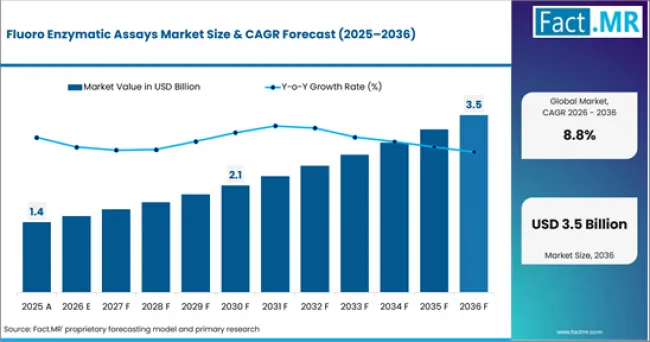
Fluoro Enzymatic Assays Market Value Analysis | Source: Fact.MR
Summary of Fluoro Enzymatic Assays Market
- Market Snapshot
- In 2025, the global Fluoro Enzymatic Assays Market was valued at approximately USD 1.4 billion.
- The market is estimated to reach USD 1.5 billion in 2026 and is projected to attain USD 3.5 billion by 2036.
- The fluoro enzymatic assays market is likely to expand at a CAGR of 8.8% during the forecast period.
- The market is anticipated to create an absolute dollar opportunity of USD 2 billion between 2026 and 2036.
- Enzyme Activity Assay Kits accounts for 44.9% of product segment share in 2026.
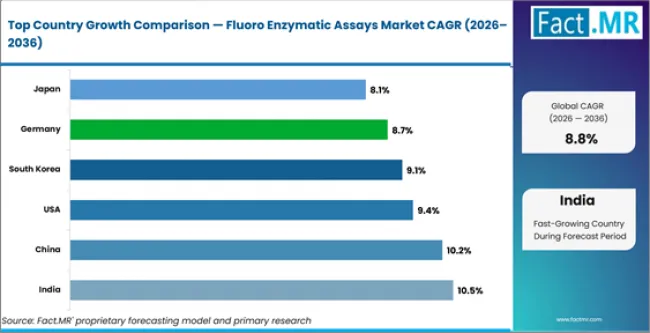
- India (10.5%) and China (10.2%) are the key growth markets during the forecast period.
- Demand and Growth Drivers
- The growth in pharmaceutical drug discovery is driving a continuous demand for fluoro enzymatic assays in target validation, lead optimization and selectivity profiling for kinase, protease and phosphatase targets.
- The use of fluorometric enzyme detection methods for the quantification of biomarker and companion diagnostics for clinical diagnostics is expanding the market scope from the pure research applications.
- Miniaturization and automation of microplates are enabling higher throughput screening at lower per well reagent costs, thereby improving the economics of largescale enzyme activity profiling.
- Academic research funding for studies in enzyme biology, metabolomics and signal transduction pathways leads to a constant demand for fluorescent substrate kits and detection reagents.
- Enzyme-based fluorometric detection is expanding the non-pharmaceutical demand base for applications in food safety and environmental monitoring.
- Product and Segment View
- The enzyme activity assay kits’ product share is anticipated to be 44.9% in 2026, demonstrating the demand for ready-to-use fluorometric detection systems from pharmaceutical and academic sectors.
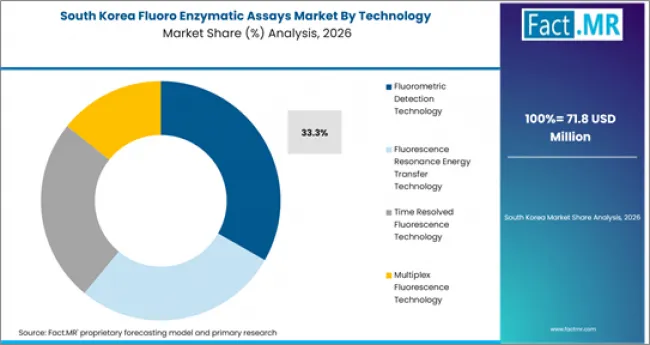
- Fluorometric detection technology accounts for 34.1% of the technology share, which is due to the sensitivity and specificity of fluorescence-based enzyme measurement.
- Key segmentation includes:
- Product: Enzyme Activity Assay Kits, Fluorescent Substrates, Detection Equipment, Assay Reagent Sets
- Applications: Drug Discovery Applications, Clinical Diagnostics, Food Safety Testing, Academic Research
- Detection Mode: Continuous Monitoring, Endpoint, Kinetic Rate
- These assays enable:
- Real-time monitoring of the conversion of fluorogenic substrates for measuring the catalytic activity of enzymes
- High-throughput drug screening against enzymatic targets in 384- and 1536-well microplate formats
- Detection of Quantitative Biomarkers in Clinical Samples Using Enzyme-Linked Fluorometric Immunoassay Platforms
- Geography and Competitive Outlook
- India is leading the way at 10.5% driven by growth in pharma CROs, academic research funding and increased adoption of clinical diagnostics.
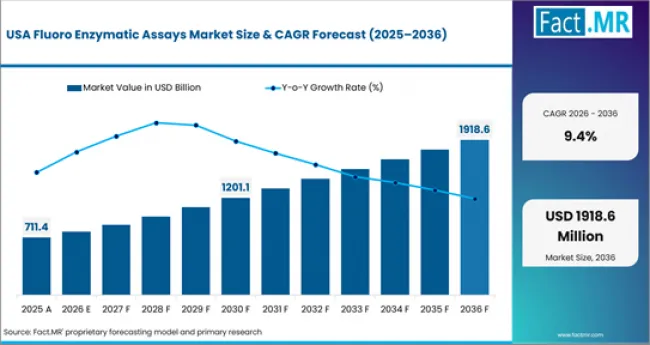
- Strong demand in drug discovery, large laboratory infrastructure and installed base of fluorometric detection platform are the reasons behind China 10.2% and USA 9.4%.
- South Korea (9.1%) is driven by pharmaceutical and biotechnology R&D investment.
- The main players are Thermo Fisher Scientific, Roche Diagnostics, Danaher, Abbott Laboratories, and Siemens Healthineers.
- Analyst Opinion
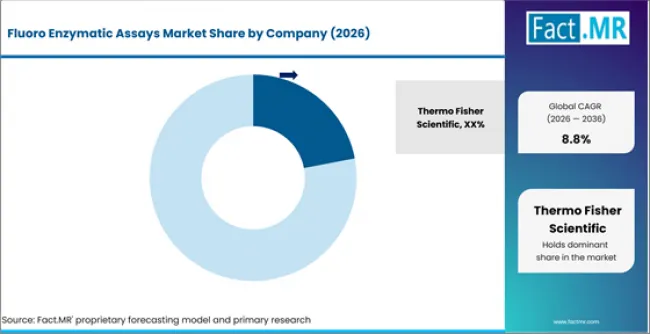
- Shambhu Nath Jha, Principal Consultant at Fact.MR, says "The fluoro enzymatic assays market is growing at nearly 9% CAGR because fluorescence-based detection offers the sensitivity, specificity, and throughput combination that pharmaceutical drug discovery requires. Thermo Fisher controls 22% of the market through its Invitrogen fluorescent substrate portfolio and instrument platforms. The growth opportunity is expanding as clinical diagnostics increasingly adopt fluorometric enzyme detection for companion diagnostics and point-of-care biomarker quantification, creating demand beyond the traditional drug discovery research base. Assay miniaturization to 1536-well formats is the primary cost reduction trend, enabling larger screening campaigns within fixed budgets."
Key Growth Drivers, Constraints, and Opportunities
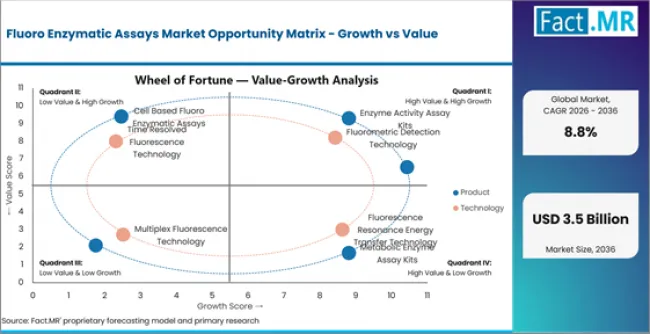
Fluoro Enzymatic Assays Market Opportunity Matrix Growth Vs Value | Source: Fact.MR
Key Factors Driving Growth
- Pharmaceutical R&D spending growth is expanding high-throughput screening campaigns that consume fluorescent enzyme assay kits and substrates at scale.
- Clinical companion diagnostics development using enzyme-based fluorometric biomarker quantification is creating a regulated, higher-value application channel.
- Assay miniaturization to 1536-well formats reduces per-well reagent costs by 75% compared to 96-well formats, enabling larger screening campaigns within fixed budgets.
Key Market Constraints
- Fluorescent substrate IP protection creates proprietary sourcing requirements that limit competitive alternatives for specific enzyme targets.
- Fluorescent compound libraries interfere with assays and give false positives in drug screening. Orthogonal confirmation testing is required which adds time and cost.
- The variability of laboratory equipment between different microplate reader platforms creates a problem for kit makers who need to optimize their assays for a range of detection systems.
Key Opportunity Areas
- Point-of-care fluorometric enzyme diagnostics for metabolic disease screening represents a high-growth application at the intersection of clinical diagnostics and enzyme detection.
- Multiplexed fluorometric assays that measure multiple enzyme activities simultaneously in a single well are improving screening efficiency and reducing reagent consumption.
- Emerging market CRO and pharmaceutical laboratory expansion is creating new kit and reagent procurement demand in regions scaling drug discovery capability.
Segment-wise Analysis of the Fluoro Enzymatic Assays Market
- Enzyme activity assay kits are expected to hold 44.9% of product share in 2026, reflecting the demand for validated, ready-to-use fluorometric detection systems.
- Pharmaceutical screening volumes across kinase, protease and phosphatase enzyme targets are driving drug discovery applications, which have a 39.6% share.
- Blood based samples have the sample type share of 42.3%, which are used in clinical diagnostics and biomarker research applications.
The market is segmented by product, technology, application, detection mode, sample type, and region. Enzyme activity kits lead on validated convenience, while fluorescent substrates grow on custom assay development demand. Continuous monitoring accounts for 44.8% of detection mode share.
Which Product Segment Dominates the Fluoro Enzymatic Assays Market?
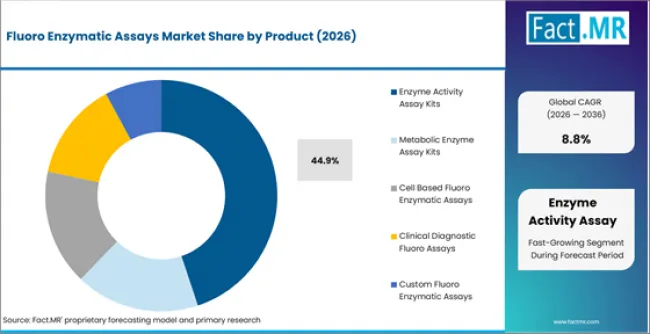
Fluoro Enzymatic Assays Market Analysis By Product | Source: Fact.MR
Enzyme activity assay kits account for 44.9% of product segment value in 2026. Their leadership reflects pharmaceutical and academic researcher preference for validated, ready-to-use detection systems that include optimized substrates, buffers, and controls in a single package.
Fluorescent substrates sold individually serve custom assay development and high-volume screening applications where researchers optimize reaction conditions for specific enzyme targets. Detection instruments and assay reagent sets serve complementary roles in the assay workflow.
Which Application Segment Dominates the Fluoro Enzymatic Assays Market?
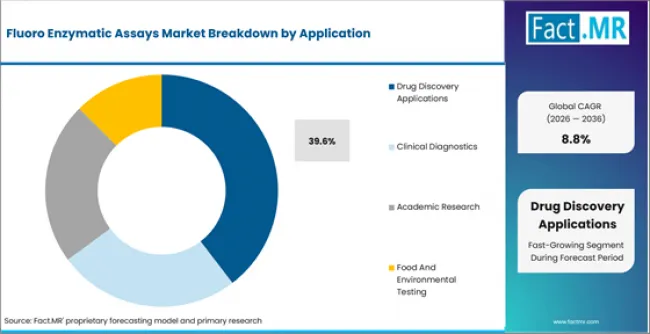
Fluoro Enzymatic Assays Market Analysis By Application | Source: Fact.MR
Drug discovery accounts for 39.6% of application segment value in 2026. Target validation, compound screening, selectivity profiling, and mechanism-of-action studies across kinase, protease, phosphatase, and metabolic enzyme programs generate the highest kit and substrate consumption.
Clinical diagnostics is the second-largest application, with enzyme-based fluorometric detection supporting biomarker quantification, metabolic disease screening, and companion diagnostics development. Academic research and food safety testing serve additional demand channels.
Which Product Trend is Shaping the Next Phase of Growth in the Fluoro Enzymatic Assays Market?
Multiplexed fluorometric assays that measure multiple enzyme activities simultaneously in a single microplate well are the primary product trend reshaping high-throughput screening economics. By combining orthogonal fluorescent substrates with spectrally resolved detection, these assays reduce per-target screening costs while providing selectivity information within the primary screen.
This trend is supported by pharmaceutical company demand for more information per screening campaign, driven by the need to identify selective compounds earlier in the drug discovery process. Companies that develop spectrally compatible fluorescent substrate combinations with validated multiplexing protocols are positioned to capture premium pricing in the drug discovery consumables market.
Regional Outlook Across Key Markets
- India leads at 10.5%, driven by pharmaceutical CRO expansion, academic research funding, and clinical diagnostics growth.
- China at 10.2% and USA at 9.4% reflect strong drug discovery demand and large laboratory infrastructure.
- South Korea at 9.1% is supported by pharmaceutical and biotechnology R&D investment and advanced laboratory infrastructure.
.webp "Top Country Growth Comparison Fluoro Enzymatic Assays Market Cagr (2026 2036)")
Top Country Growth Comparison Fluoro Enzymatic Assays Market Cagr (2026 2036) | Source: Fact.MR
CAGR Table
| Country | CAGR (%) |
|---|---|
| India | 10.5% |
| China | 10.2% |
| USA | 9.4% |
| South Korea | 9.1% |
| Germany | 8.7% |
| Japan | 8.1% |
Source: Fact.MR analysis. Updated Jun 17, 2026
Source: Fact.MR analysis, based on proprietary forecasting model and primary research.
Fluoro Enzymatic Assays Market Cagr Analysis By Country | Source: Fact.MR
India Fluoro Enzymatic Assays Market Growth Outlook
The India Fluoro Enzymatic Assays Market is projected to grow at a CAGR of 10.5% through 2036. Ayushman Bharat and private healthcare investment are expanding clinical diagnostics adoption. Pharmaceutical CRO industry growth and cost-effectiveness of Indian research operations are scaling drug discovery assay consumption.
- Pharmaceutical CRO expansion in India generates growing demand for drug discovery assay kits and fluorometric substrates.
- Cost-effective research operations attract global pharmaceutical screening campaigns to Indian contract laboratories.
- Academic research funding growth supports demand for enzyme activity assay kits across university research programs.
China Fluoro Enzymatic Assays Demand Trends
The China Fluoro Enzymatic Assays Market is projected to grow at a CAGR of 10.2% through 2036. Domestic pharmaceutical development under self-sufficiency policies and expanding CRO capacity are driving fluoro enzymatic assay procurement. Hospital clinical laboratory expansion supports diagnostic fluorometric testing adoption.
- Domestic pharmaceutical R&D investment generates growing demand for drug discovery screening consumables.
- CRO capacity expansion in Beijing, Shanghai, and Suzhou creates high-volume assay kit procurement demand.
- Hospital laboratory expansion supports clinical diagnostics adoption of fluorometric enzyme detection platforms.
Market Outlook for Fluoro Enzymatic Assays in USA
Fluoro Enzymatic Assays Market Country Value Analysis | Source: Fact.MR
The USA Fluoro Enzymatic Assays Market is projected to grow at a CAGR of 9.4% through 2036. FDA companion diagnostics requirements and the largest pharmaceutical R&D spending base drive fluoro enzymatic assay consumption. NIH research funding supports academic demand for enzyme activity detection kits and substrates.
- Pharmaceutical R&D spending generates the largest single-country demand for drug discovery fluorometric assay consumables.
- FDA companion diagnostics development pathways create demand for validated enzyme-based fluorometric detection systems.
- NIH research funding supports sustained academic demand for enzyme activity assay kits across university research programs.
Market Outlook for Fluoro Enzymatic Assays in South Korea
Fluoro Enzymatic Assays Market South Korea Market Share Analysis By Technology | Source: Fact.MR
The South Korea Fluoro Enzymatic Assays Market is projected to grow at a CAGR of 9.1% through 2036. Pharmaceutical and biotechnology R&D investment and advanced laboratory infrastructure support premium assay kit procurement. Government research funding strengthens domestic drug discovery capability.
- Government biotechnology R&D support drives domestic pharmaceutical screening and enzyme assay consumption.
- Advanced laboratory infrastructure supports rapid adoption of automated high-throughput fluorometric assay platforms.
- Pharmaceutical industry quality standards shape procurement toward validated international assay kit brands.
Fluoro Enzymatic Assays Demand Analysis in Germany
The Germany Fluoro Enzymatic Assays Market is projected to grow at a CAGR of 8.5% through 2036. EU pharmaceutical manufacturing and academic research infrastructure drive fluoro enzymatic assay demand. EMA regulatory pathways for companion diagnostics create demand for validated fluorometric detection systems.
- EU pharmaceutical R&D and companion diagnostics development pathways support validated fluorometric assay demand.
- University research programs in enzymology and drug discovery generate steady academic assay kit consumption.
- DIN/EU laboratory quality standards shape assay kit procurement specifications toward documented performance validation.
Competitive Benchmarking and Company Positioning
Fluoro Enzymatic Assays Market Analysis By Company | Source: Fact.MR
Fluoro Enzymatic Assays Market Analysis By Company
- Thermo Fisher Scientific leads with approximately 22.0% market share through its Invitrogen fluorescent substrate portfolio, microplate reader instrument platforms, and integrated drug discovery consumable distribution.
- Roche Diagnostics and Danaher Corporation compete through clinical diagnostics fluorometric platforms and research reagent portfolios that serve both pharmaceutical and clinical laboratory customers.
- Abbott Laboratories and Siemens Healthineers serve the clinical diagnostics segment through established laboratory analyzer platforms incorporating fluorometric enzyme detection modules.
The competitive landscape is shaped by the dual channel of drug discovery research and clinical diagnostics. Thermo Fisher leads the research segment through its Invitrogen brand and comprehensive fluorescent substrate catalog. Roche and Abbott lead the clinical diagnostics segment through established laboratory analyzer platforms.
Danaher (through Beckman Coulter and Molecular Devices) serves both segments through microplate readers and laboratory automation platforms. Competition is increasingly shaped by assay kit validation documentation, instrument compatibility, and technical application support that reduces customer assay development time.
Key Companies in the Fluoro Enzymatic Assays Market
- Thermo Fisher Scientific, Roche Diagnostics, Danaher Corporation, Abbott Laboratories, Siemens Healthineers, Bio-Rad Laboratories, bioMérieux, Sysmex Corporation, QuidelOrtho Corporation, Merck KGaA are the leading companies.
Recent Industry Developments
Promega Engineers New Enzyme to Significantly Reduce Stutter in Forensic DNA Analysis (2024)
- Promega announced a novel engineered polymerase enzyme that reduces stutter artifacts in DNA analysis and will be incorporated into future STR analysis kits. The development advances enzyme-based fluorescence detection assays used in molecular biology and forensic testing.
Bio-Techne Begins Shipping Leo™ Next-Generation High-Throughput Simple Western System (2025)
- Bio-Techne commercialized the Leo™ platform, an automated protein analysis system that supports high-throughput assay workflows and quantitative protein detection. The platform expands automated assay capabilities used alongside fluorescence-based enzyme and biomarker assays.
BioPhase 8800 System Harnesses New Native Fluorescence Detection for Protein-Based CE Assays (2025)
- SCIEX introduced native fluorescence detection on its BioPhase 8800 platform. The technology improves sensitivity and signal quality in protein characterization assays, strengthening fluorescence-based analytical testing and enzymatic assay applications in biopharmaceutical development.
Source: Fact.MR analysis. Updated Jun 17, 2026
Source: Fact.MR analysis. Updated Jun 17, 2026
Leading Companies Shaping the Fluoro Enzymatic Assays Market
- Thermo Fisher Scientific
- Roche Diagnostics
- Danaher Corporation
- Abbott Laboratories
- Siemens Healthineers
- Bio-Rad Laboratories
- bioMérieux
- Sysmex Corporation
- QuidelOrtho Corporation
- Merck KGaA
Sources and Research References
- Promega Corporation. (2024). Promega engineers new enzyme to advance fluorescence-based research applications. Promega Corporation.
- Bio-Techne Corporation. (2025). Bio-Techne begins shipping Leo™, a next-generation high-throughput Simple Western system. PR Newswire.
- Manufacturing Chemist. (2025). The SCIEX BioPhase 8800 uses native fluorescence detection. Manufacturing Chemist.
This bibliography is provided for reader reference and is not exhaustive. The full report contains the complete reference list and detailed citations.
Key Questions This Report Addresses
- What is the estimated size of the global Fluoro Enzymatic Assays Market in 2026, and how is it projected to grow through 2036?
- What incremental revenue opportunity is the market expected to create between 2026 and 2036?
- Which product segment holds the largest share in 2026, and what convenience factors support enzyme activity assay kit leadership?
- How is the balance between drug discovery and clinical diagnostics applications expected to shift?
- Which detection mode is projected to generate the most incremental revenue through 2036?
- Which countries are projected to register the highest CAGR, and what pharmaceutical R&D factors accelerate growth?
- How do demand patterns in India compare with the U.S. and China in terms of CRO activity and laboratory infrastructure?
- What assay interference and substrate IP constraints could limit competitive dynamics in specific enzyme target categories?
- Who are the leading companies, and how are they differentiating through substrate portfolios, instrument platforms, and validation support?
- What recent portfolio developments in 2025 are shaping competitive positioning in the fluoro enzymatic assays market?
- Which multiplexing or miniaturization trend is driving the next phase of growth?
- How is companion diagnostics development creating new demand for validated fluorometric enzyme detection systems?
- What role are assay miniaturization, automation compatibility, and multiplexed detection playing in reshaping screening economics?
- What demand-side drivers sustain growth, and how do they vary between pharmaceutical and clinical diagnostics applications?
Fluoro Enzymatic Assays Market Definition
The fluoro enzymatic assays market covers fluorescence-based enzyme activity detection kits, reagents, and instrument systems used in drug discovery, clinical diagnostics, food safety testing, and academic research across continuous monitoring and endpoint measurement formats for kinase, protease, phosphatase, and metabolic enzyme analysis.
Fluoro Enzymatic Assays Market Inclusions
- Global and regional market size and forecasts for 2026 to 2036 across product, technology, application, detection mode, sample type, and region.
- Demand analysis based on drug discovery screening volumes, clinical diagnostics adoption, laboratory instrument installed base, and research funding trends.
- Competitive landscape including assay kit portfolios, detection instrument platforms, and distribution strategies of leading companies.
Fluoro Enzymatic Assays Market Exclusions
- Colorimetric and luminescent enzyme assays not using fluorometric detection methodology.
- Immunoassay platforms (ELISA) not specifically classified as fluoro enzymatic detection systems.
- Flow cytometry and cell-based assays that measure cellular rather than enzymatic activity.
Fluoro Enzymatic Assays Market Research Methodology
- Methodology combines secondary research from analytical chemistry journals, drug discovery databases, and laboratory consumable tracking services with primary validation.
- Market sizing covers 30+ countries with inputs including pharmaceutical R&D spending, laboratory instrument installed base, and clinical diagnostics test volumes.
- Primary validation includes 15+ interviews across pharmaceutical companies, CROs, diagnostics manufacturers, and laboratory consumable distributors.
Segmentation
Scope of Analysis
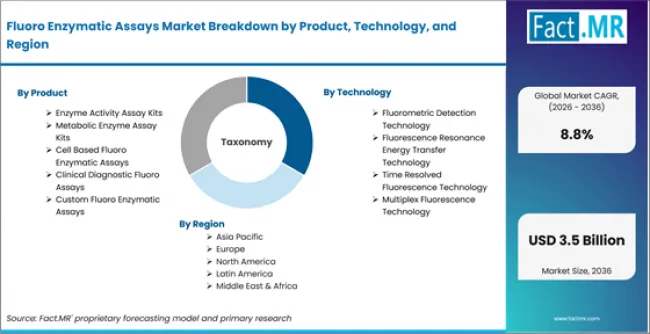
Fluoro Enzymatic Assays Market Breakdown By Product, Technology, And Region | Source: Fact.MR
| Parameter | Details |
|---|---|
| Quantitative Units | USD 1.5 billion to USD 3.5 billion, at a CAGR of 8.8% |
| Market Definition | The fluoro enzymatic assays market covers fluorescence-based enzyme activity detection kits, reagents, and instrument systems used in drug discovery, clinical diagnostics, food safety testing, and academic research across continuous monitoring and endpoint measurement formats for kinase, protease, phosphatase, and metabolic enzyme analysis. |
| Regions Covered | North America, Latin America, Europe, East Asia, South Asia and Pacific, Middle East and Africa |
| Countries Covered | India, China, USA, South Korea, Germany, Japan, 30 plus countries |
| Key Companies | Thermo Fisher Scientific, Roche Diagnostics, Danaher Corporation, Abbott Laboratories, Siemens Healthineers, Bio-Rad Laboratories, bioMérieux, Sysmex Corporation |
| Forecast Period | 2026 to 2036 |
| Approach | Hybrid demand-side and top-down methodology built on pharmaceutical R&D spending, laboratory instrument installed base, clinical diagnostics adoption, and primary interviews |
Source: Fact.MR analysis. Updated Jun 17, 2026
Fluoro Enzymatic Assays Market Segmentation
-
Fluoro Enzymatic Assays Market Segmented by Product:
- Enzyme Activity Assay Kits
- Protease Activity Assays
- Drug Discovery Applications
- Biochemical Analysis Products
- Kinase Activity Assays
- Cell Signaling Applications
- Molecular Biology Systems
- Protease Activity Assays
- Metabolic Enzyme Assay Kits
- Glucose Metabolism Assays
- Diabetes Research Applications
- Clinical Diagnostic Products
- Lipid Metabolism Assays
- Metabolic Disorder Applications
- Biomedical Research Systems
- Glucose Metabolism Assays
- Cell Based Fluoro Enzymatic Assays
- Live Cell Enzyme Assays
- Cytotoxicity Testing Applications
- Cell Biology Products
- High Content Screening Assays
- Pharmaceutical Screening Applications
- Automated Research Systems
- Live Cell Enzyme Assays
- Clinical Diagnostic Fluoro Assays
- Biomarker Detection Assays
- Disease Diagnosis Applications
- Clinical Laboratory Products
- Pathogen Detection Assays
- Infectious Disease Applications
- Diagnostic Screening Systems
- Biomarker Detection Assays
- Custom Fluoro Enzymatic Assays
- Multiplex Assay Systems
- High Throughput Applications
- Advanced Research Products
- Target Specific Assay Kits
- Precision Medicine Applications
- Specialized Diagnostic Systems
- Multiplex Assay Systems
- Enzyme Activity Assay Kits
-
Fluoro Enzymatic Assays Market Segmented by Technology:
- Fluorometric Detection Technology
- Microplate Fluorescence Systems
- Clinical Laboratory Applications
- Research Analysis Products
- Spectrofluorometric Detection Systems
- Quantitative Analysis Applications
- Laboratory Testing Systems
- Microplate Fluorescence Systems
- Fluorescence Resonance Energy Transfer Technology
- Real Time Enzyme Detection Systems
- Drug Screening Applications
- Molecular Interaction Products
- High Sensitivity Detection Technology
- Biochemical Research Applications
- Advanced Assay Systems
- Real Time Enzyme Detection Systems
- Time Resolved Fluorescence Technology
- Long Lifetime Fluorescence Systems
- High Precision Applications
- Diagnostic Research Products
- Background Reduction Detection Systems
- Low Signal Applications
- Advanced Screening Systems
- Long Lifetime Fluorescence Systems
- Multiplex Fluorescence Technology
- Multi Analyte Detection Systems
- Companion Diagnostic Applications
- Biomarker Screening Products
- High Throughput Multiplex Assays
- Large Scale Research Applications
- Automated Testing Systems
- Multi Analyte Detection Systems
- Fluorometric Detection Technology
-
Fluoro Enzymatic Assays Market Segmented by Application:
- Drug Discovery Applications
- Enzyme Inhibitor Screening
- Pharmaceutical Development Applications
- Preclinical Research Products
- Target Validation Assays
- Molecular Drug Applications
- Biotech Screening Systems
- Enzyme Inhibitor Screening
- Clinical Diagnostics
- Cancer Biomarker Detection
- Oncology Applications
- Diagnostic Assay Products
- Infectious Disease Testing
- Pathogen Detection Applications
- Clinical Screening Systems
- Cancer Biomarker Detection
- Academic Research
- Cell Biology Research
- University Laboratory Applications
- Experimental Assay Products
- Molecular Pathway Analysis
- Biomedical Research Applications
- Life Science Systems
- Cell Biology Research
- Food And Environmental Testing
- Food Safety Enzyme Assays
- Contaminant Detection Applications
- Analytical Testing Products
- Environmental Monitoring Assays
- Water Quality Applications
- Biochemical Detection Systems
- Food Safety Enzyme Assays
- Drug Discovery Applications
-
Fluoro Enzymatic Assays Market Segmented by Detection Mode:
- Continuous Monitoring Assays
- Real Time Fluorescence Detection
- Kinetic Analysis Applications
- Dynamic Assay Products
- Live Reaction Monitoring Systems
- Enzyme Activity Applications
- Research Analysis Systems
- Real Time Fluorescence Detection
- Endpoint Detection Assays
- Single Time Point Detection
- Routine Laboratory Applications
- Diagnostic Testing Products
- High Throughput Endpoint Systems
- Screening Applications
- Automated Analysis Systems
- Single Time Point Detection
- Multiparameter Detection Assays
- Multi Signal Analysis Systems
- Complex Biomarker Applications
- Advanced Assay Products
- Integrated Detection Platforms
- Large Scale Screening Applications
- Precision Analytical Systems
- Multi Signal Analysis Systems
- Continuous Monitoring Assays
-
Fluoro Enzymatic Assays Market Segmented by Sample Type:
- Blood Based Samples
- Plasma Enzyme Assays
- Clinical Chemistry Applications
- Diagnostic Laboratory Products
- Serum Analysis Assays
- Biomarker Detection Applications
- Healthcare Testing Systems
- Plasma Enzyme Assays
- Cell And Tissue Samples
- Live Cell Analysis Assays
- Drug Toxicity Applications
- Cell Biology Products
- Tissue Homogenate Assays
- Research Applications
- Experimental Analysis Systems
- Live Cell Analysis Assays
- Microbial Samples
- Bacterial Enzyme Assays
- Microbiology Applications
- Diagnostic Screening Products
- Fungal Enzyme Analysis
- Environmental Applications
- Biochemical Testing Systems
- Bacterial Enzyme Assays
- Blood Based Samples
-
Fluoro Enzymatic Assays Market by Region:
- North America
- USA
- Canada
- Mexico
- Latin America
- Brazil
- Chile
- Rest of Latin America
- Western Europe
- Germany
- UK
- Italy
- Spain
- France
- Nordic
- BENELUX
- Rest of Western Europe
- Eastern Europe
- Russia
- Poland
- Hungary
- Balkan & Baltic
- Rest of Eastern Europe
- East Asia
- China
- Japan
- South Korea
- South Asia and Pacific
- India
- ASEAN
- Australia & New Zealand
- Rest of South Asia and Pacific
- Middle East & Africa
- Kingdom of Saudi Arabia
- Other GCC Countries
- Turkiye
- South Africa
- Other African Union
- Rest of Middle East & Africa
- North America
Frequently Asked Questions
How big is the fluoro enzymatic assays market in 2026?
What will be the size of the fluoro enzymatic assays market in 2036?
How much will the fluoro enzymatic assays market grow between 2026 and 2036?
What are the key products in the fluoro enzymatic assays market?
Which technology segment is expected to contribute a significant share in the fluoro enzymatic assays market in 2026?
Who worked on this report


Preview the report firsthand - request a free sample
Free SampleGet the brochure for pricing and purchase details
Download PDF