- Market Value (2025): USD 1.36 Bn
- Estimated Value (2026): USD 1.44 Bn
- Forecast Value (2036): USD 2.54 Bn
- CAGR (2026-2036): 5.8%
What is the Fine Filter Cartridges Market forecast to be worth by 2036?
USD 1.4 billion in 2026 to USD 2.5 billion by 2036 at a 5.8% CAGR.
- Global fine filter cartridge demand was worth USD 1.36 billion in 2025, with industrial plants and water treatment duties accounting for most of that spend.
- By 2036 the market will reach USD 2.54 billion, up from USD 1.44 billion in 2026, as purity rules and sterile production standards bring fine filtration into more plants.
- Revenue will compound at 5.8% CAGR from 2026 to 2036, since scheduled cartridge replacement turns each installed housing into a recurring order.
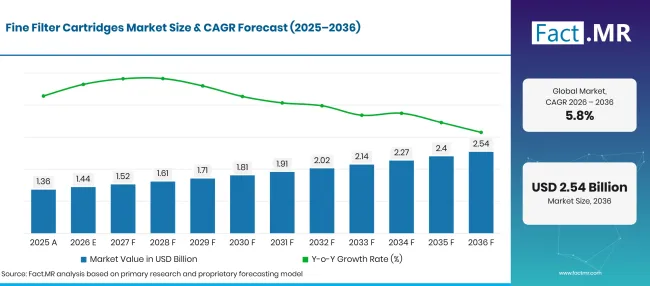
Fine Filter Cartridges Market Forecast Global | Source: Fact.MR
| Year | Basis | Market Value (USD billion) |
|---|---|---|
| 2025 | Actual | 1.36 |
| 2026 | Estimate | 1.44 |
| 2036 | Forecast | 2.54 |
| CAGR 2026 to 2036 | Forecast period | 5.8% |
Source: Fact.MR analysis. Updated Oct 26, 2026
What are the defining numbers behind Fine Filter Cartridges Market growth?
The 2026 to 2036 window adds USD 1.1 billion in new value, led by industrial users and water treatment duties.
- Demand Drivers in the Market
- Safe water access still lags across much of the world. WHO and UNICEF reported in August 2025 that 2.1 billion people lack safely managed drinking water, including 106 million who drink untreated surface water [1]. Every new treatment plant built to close that gap needs cartridges at several stages.
- Sterile drug production runs on validated membrane cartridges that are integrity tested and changed on fixed schedules. Japan’s Ministry of Health, Labour and Welfare reported that domestic output of finished pharmaceuticals reached JPY 10.25 trillion in 2024, a 2.1% rise on the prior year [2]. Drug makers keep specifying fine filtration even when wider industrial spending slows.
- Beverage and food plants use fine cartridges to pull yeast, haze and particles from drinks, syrups and process water before filling. Lines run continuously and quality specifications tie directly to shelf life. Cartridge changes therefore happen at set intervals regardless of capital budgets.
- Chemical plants running at reduced output still swap spent cartridges on cycle. Reordering the same part numbers through a maintenance plan protects supplier revenue in ways that new-installation demand cannot.
- Material choice is widening with duty. Polypropylene covers most water-related service at low cost, while PTFE and nylon handle aggressive chemicals and high-purity lines in chip fabs.
- Key Segments Analyzed
- By Product Type: Pleated Filter Cartridges will hold 38.2% share in 2026, since folded media packs a large filtration area into a compact housing.
- By Application: Water Treatment will account for 37.1% share in 2026 as utilities and plants filter feed water, process water and effluent.
- By Material: Polypropylene will capture 45.5% share in 2026, owing to its low cost and broad chemical compatibility.
- By End-User: Industrial will command 69.2% share in 2026, given the number of plants that run filtration around the clock.
- Analyst Opinion at Fact.MR
- Shambhu Nath Jha, Principal Consultant at Fact.MR, states, “Industrial buyers now look well past unit price when they evaluate fine filter cartridges. Retention accuracy, validation records and total cost of ownership drive the decision, and filter selection is turning into a compliance call as water and drug rules tighten. Producers that back their media with consistent performance data and dependable supply will gain ground through 2036.”
- Strategic Implications
- Cartridge producers should extend into membrane and high-purity grades, since pharmaceutical and electronics buyers now treat validation files and lot traceability as entry requirements.
- Distributors should build scheduled replacement programs, as industrial users will generate 69.2% of 2026 sales across drug, food and chemical plants.
- Sales teams serving utilities, drug plants and food manufacturers should keep compliance certificates, test data and technical support ready. These accounts are won on documentation as much as on product performance.
- Manufacturers should qualify more than one source of polypropylene, polyester and PTFE media to protect margins when polymer prices swing.
Brazil heads the five-country group at 7.2% CAGR, with public sanitation investment bringing new treatment plants into service. Germany follows at 6.7%, where pharmaceutical output holds firm and replacement cycles offset softer chemicals activity. The United Kingdom comes in at 6.1%, running ahead of the global 5.8% pace as water companies lift spending. Japan advances at 5.0%, with semiconductor investment adding demand to a well-served base. Growth in the United States reaches 4.4%, held back by a large installed base and an open PFAS timeline.
How does the Fine Filter Cartridges Market break down by segment?
Pleated Filter Cartridges will lead Product Type at 38.2%; Water Treatment will head Application at 37.1%; Polypropylene will top Material at 45.5%; Industrial will take first place in End-User at 69.2%.
Which product format leads demand?
Pleated Filter Cartridges take 38.2% of 2026 sales.
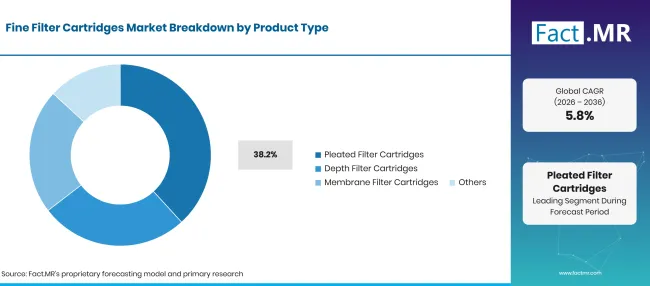
Fine Filter Cartridges Market Breakdown Product Type | Source: Fact.MR
| Product Type | Share (2026) |
|---|---|
| Pleated Filter Cartridges (Leading segment) | 38.2% |
| Other segments combined | 61.8%* |
| Total | 100.0% |
Source: Fact.MR analysis. Updated Oct 26, 2026
Folding the media is a simple idea with a large practical payoff. More surface area fits inside the same housing, so one cartridge captures more particulate and runs longer before change-out. Plant operators see fewer shutdowns and lower replacement frequency. The design slots into standard housings and industrial valve skids, which keeps retrofit costs manageable. Grades are offered for water, food and drug duty. Depth and membrane formats serve specific roles well but cover narrower ground, so neither has closed the volume gap with pleated designs.
What supports Water Treatment within Application?
Water Treatment accounts for 37.1% of 2026 revenue.
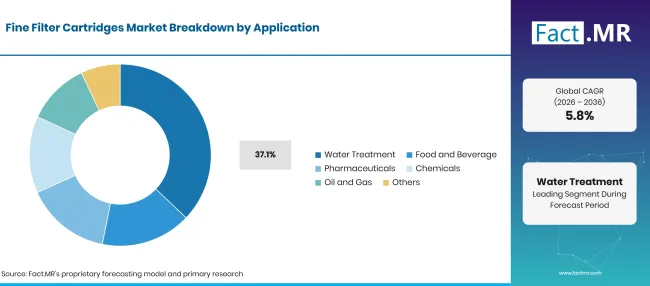
Fine Filter Cartridges Market Breakdown Application | Source: Fact.MR
| Application | Share (2026) |
|---|---|
| Water Treatment (Leading segment) | 37.1% |
| Other segments combined | 62.9%* |
| Total | 100.0% |
Source: Fact.MR analysis. Updated Oct 26, 2026
Treatment plants filter around the clock, and cartridges appear at every stage from intake screening through reverse osmosis protection to final polishing. That layered, continuous consumption keeps this application ahead. The U.S. Environmental Protection Agency expects its PFAS drinking water rule to prevent exposure for about 100 million people over time [3], which adds treatment stages at many utilities. Desalination, wastewater reuse and sanitation projects keep bringing new installations online. Drug, food and electronics duties demand precision but consume far fewer cartridges in total.
How does Material shape demand?
Polypropylene represents 45.5% of the 2026 market.
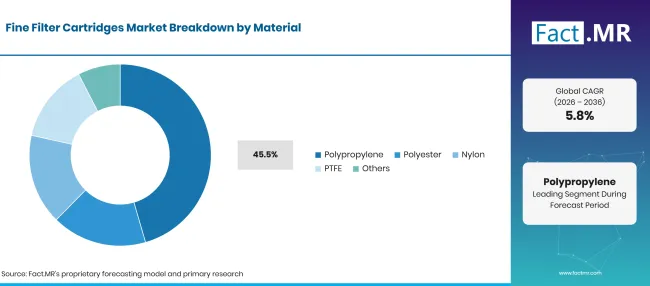
Fine Filter Cartridges Market Breakdown Material | Source: Fact.MR
| Material | Share (2026) |
|---|---|
| Polypropylene (Leading segment) | 45.5% |
| Other segments combined | 54.5%* |
| Total | 100.0% |
Source: Fact.MR analysis. Updated Oct 26, 2026
Most industrial filtration tasks need no specialty upgrade, and that favors a resin that resists the acids, alkalis and aqueous streams found in water, food and general process duty. It processes easily by melt-blowing and pleating. Unit costs and supply stay stable across a wide range of micron ratings. Low extractables make polypropylene acceptable to food and drug buyers, and disposal is simple. Nylon media and polyester cover tougher roles, while fluoropolymer membranes such as PTFE handle hot solvents and strong acids. Their price limits how widely they spread.
What leads the End-User segment?
Industrial buyers generate 69.2% of 2026 demand.
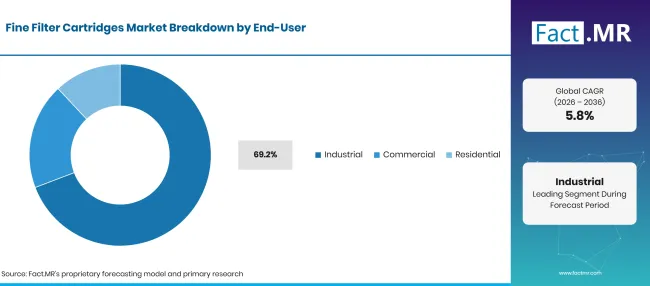
Fine Filter Cartridges Market Breakdown End User | Source: Fact.MR
| End-User | Share (2026) |
|---|---|
| Industrial (Leading segment) | 69.2% |
| Other segments combined | 30.8%* |
| Total | 100.0% |
Source: Fact.MR analysis. Updated Oct 26, 2026
Factories run filtration as a core part of the process, not an optional add-on. Drug plants, chemical operations, food lines, electronics fabs and power stations depend on cartridges to protect product quality, shield pumps and membranes, and meet discharge limits. Large sites run many housings at once, which multiplies replacement volume. Contract plants in biologics manufacturing change sterile cartridges batch by batch. Commercial and municipal buyers run fewer systems at lighter duty, and residential demand is mostly point-of-use units.
What is accelerating Fine Filter Cartridges Market adoption, and what is holding it back?
Stricter water rules, sterile production mandates and fixed replacement cycles keep cartridge orders flowing. Polymer cost swings, competing filtration formats and slow regulatory timelines in some markets limit the pace.
Drivers Impact Analysis
| DRIVER | (~) % IMPACT ON CAGR | GEOGRAPHIC RELEVANCE | IMPACT TIMELINE |
|---|---|---|---|
| Tighter water quality rules pushing utilities and plants to add filtration stages | +2.1% | Global | Short term (<= 2 years) |
| Sterile production and filter integrity testing rules requiring validated cartridges in drug plants | +1.4% | North America, Western Europe, East Asia | Medium term (2-4 years) |
| Fixed maintenance cycles in continuous plants creating demand independent of capital spending | +1.0% | Global | Short term (<= 2 years) |
| Higher food and beverage output with stricter quality control at processing sites | +0.6% | Global | Medium term (2-4 years) |
Source: Fact.MR analysis. Updated Oct 26, 2026
Opportunity Impact Analysis
| OPPORTUNITY | (~) % IMPACT ON CAGR | GEOGRAPHIC RELEVANCE | IMPACT TIMELINE |
|---|---|---|---|
| Biopharmaceutical and high-purity chemical lines needing validated membrane cartridges | +0.6% | Global | Medium term (2-4 years) |
| Semiconductor plant expansion requiring ultrapure water and chemical filtration | +0.4% | East Asia, North America, Western Europe | Medium term (2-4 years) |
| Public sanitation programs in Brazil bringing first-time cartridge demand online | +0.3% | Latin America | Medium term (2-4 years) |
| Managed replacement and service agreements adding recurring revenue | +0.2% | Global | Long term (>= 4 years) |
Source: Fact.MR analysis. Updated Oct 26, 2026
Restraints Impact Analysis
| RESTRAINT | (~) % IMPACT ON CAGR | GEOGRAPHIC RELEVANCE | IMPACT TIMELINE |
|---|---|---|---|
| Polymer and energy cost volatility squeezing producer margins and buyer budgets | -0.4% | Global | Short term (<= 2 years) |
| Bag filters and modular systems proving adequate for some coarse duties | -0.3% | Global | Medium term (2-4 years) |
| Slow water rule updates and lower plant investment in parts of Europe and North America | -0.1% | North America, Western Europe | Long term (>= 4 years) |
Source: Fact.MR analysis. Updated Oct 26, 2026
Which countries are scaling the Fine Filter Cartridges Market through 2036?
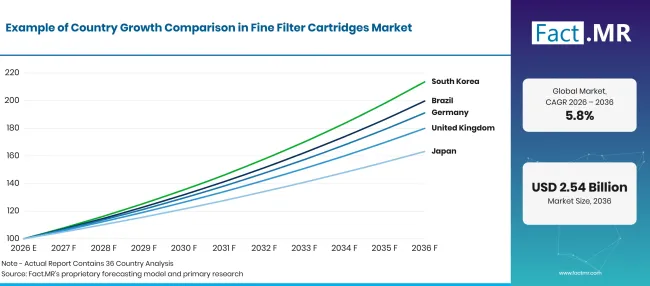
Fine Filter Cartridges Market Growth Index 1 | Source: Fact.MR
| Country | CAGR (2026 to 2036) |
|---|---|
| Brazil | 7.2% |
| Germany | 6.7% |
| United Kingdom | 6.1% |
| Japan | 5.0% |
| United States | 4.4% |
Source: Fact.MR analysis. Updated Oct 26, 2026
What supports Brazil adoption?
7.2% CAGR, driven by sanitation expansion and new treatment plants.
Public investment in water and sewage is bringing new plants online, and each one uses cartridges from intake to final polishing. The Ministry of Cities gave municipalities and service providers until 3 September 2026 to report sanitation data to Sinisa under the 2020 sanitation framework law [4]. IBGE reported that national industrial production grew 0.6% in 2025 [5], which adds steady replacement demand from factories.
What is supporting Germany’s adoption?
6.7% CAGR, backed by firm pharmaceutical output and consistent cartridge replacement.
Pharmaceutical manufacturing anchors German filtration demand, with sterile lines using validated membrane cartridges that are integrity tested and changed on schedule. Destatis reported that health spending rose 7.6% to EUR 538.2 billion in 2024 [6]. Weaker chemicals activity has not broken replacement cycles at running plants. A strong regulatory culture keeps favoring traceable, documented filtration.
How is the United Kingdom developing demand?
6.1% CAGR, helped by water sector programs and tighter drinking water oversight.
The Drinking Water Inspectorate reported 99.97% compliance for England in 2025, with companies running more than 635,000 individual PFAS analyses [7]. The Environment Agency counted 75 serious pollution incidents from water and sewerage companies in 2024, up from 47 in 2023 [8]. Pressure on both fronts pushes operators toward finer, more reliable grades. Food, drug and chemical plants add a recurring industrial layer.
How is Japan scaling demand?
5.0% CAGR, reflecting chip fab investment within a mature installed base.
Japan’s filtration base is well established, so new demand comes mainly from semiconductor plants. METI said in November 2025 it would invest JPY 100 billion from the fiscal 2025 budget in Rapidus [9]. Rapidus started its front-end pilot line in Chitose in April 2025 and targets mass production in 2027 [10]. Such fabs need ultrapure water and chemical filtration with high-purity, chemically resistant media, a need that also feeds silicon wafer production.
How does the United States perform?
4.4% CAGR, as a large installed base and an open PFAS timeline temper growth.
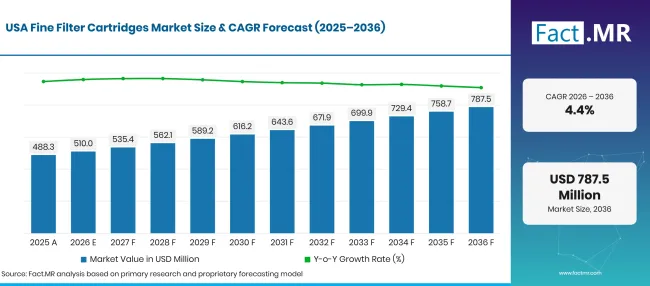
Fine Filter Cartridges Market Forecast Usa | Source: Fact.MR
Most U.S. demand comes from routine replacement across a large installed base, with fewer greenfield projects. In May 2026, the EPA proposed keeping the 4.0 parts per trillion limits for PFOA and PFOS while letting qualifying systems request extra time to April 2031 [11]. That delay keeps some treatment spending on hold. Drug, food and electronics plants still provide a reliable demand floor.
Who leads the Fine Filter Cartridges Market?
Competition splits by the buyer each company serves first. Pall Corporation, Parker Hannifin Corporation and Donaldson Company, Inc. win on portfolio breadth, global service and a large installed base across process, food and industrial duty. Sartorius AG, Meissner Filtration Products and Entegris, Inc. focus on validated membranes for drug and chip makers, where a filter is bought together with its validation file.
Graver Technologies serves industrial liquid and power plant users. Water specialists take another route: Veolia won a contract in May 2025 to design, build and run a water and wastewater plant for a U.S. Midwest chip fab [12], while Pentair reaches homes and food service through point-of-use cartridges. Retention accuracy, validation support and reliable supply will separate the stronger suppliers through 2036.
Which companies are the key providers?
Key companies include Pall Corporation; Parker Hannifin Corporation; Donaldson Company, Inc.; Sartorius AG; Meissner Filtration Products; Entegris, Inc.; Graver Technologies; Veolia; and Pentair.
- Pall Corporation
- Parker Hannifin Corporation
- Donaldson Company, Inc.
- Sartorius AG
- Meissner Filtration Products
- Entegris, Inc.
- Graver Technologies
- Veolia
- Pentair
Bibliography
- [1] World Health Organization. (2025, August 26). 1 in 4 people globally still lack access to safe drinking water: WHO, UNICEF.
- [2] Ministry of Health, Labour and Welfare, Japan. (2025, December 24). 薬事工業生産動態統計年報の概要(令和6年) [Overview of the 2024 Annual Report on Pharmaceutical Industry Production Statistics].
- [3] U.S. Environmental Protection Agency. (2026, May 18). Per- and Polyfluoroalkyl Substances (PFAS).
- [4] Ministério das Cidades, Brazil. (2026, August 3). Último mês para coleta de dados do Sinisa [Last month for Sinisa data collection].
- [5] Instituto Brasileiro de Geografia e Estatística (IBGE). (2026, February 10). Produção industrial fecha 2025 com avanço em 10 dos 18 locais pesquisados [Industrial production closes 2025 with gains in 10 of 18 surveyed locations].
- [6] Statistisches Bundesamt (Destatis). (2026, July 21). Gesundheitsausgaben 2024 preisbereinigt um 3,9 % gestiegen [Price-adjusted health expenditure rose 3.9% in 2024].
- [7] Drinking Water Inspectorate. (2026, July 7). Drinking Water Inspectorate: Chief Inspector’s Annual Report 2025 England.
- [8] Environment Agency. (2025, October 23). Water and sewerage companies in England: environmental performance report for 2024.
- [9] Ministry of Economy, Trade and Industry, Japan. (2025, November 21). Press Conference by Minister Akazawa (Excerpt).
- [10] Rapidus Corporation. (2026, April 11). NEDO Approves Rapidus’ FY2026 Plan and Budget for 2nm Semiconductor Projects.
- [11] U.S. Environmental Protection Agency. (2026, May 18). Proposed PFOA and PFOS Compliance Extension Rule.
- [12] Veolia. (2025, May 7). $750M of new flagship contracts for Veolia in water technologies for energy and semiconductors, reflecting the success of its strategic positioning.
This Report Answers
- Cartridge sales are split by product type, application, material and end-user.
- Readers see which subsegment leads each segment and the plant needs behind its 2026 share.
- Water rules, sterile production standards and plant investment frame the five-country comparison.
- Filtration groups, membrane specialists and water companies are profiled by the buyers they serve.
- Media, validation and replacement trends show where cartridge use goes next.
Segmentation
What is the report’s scope and coverage?
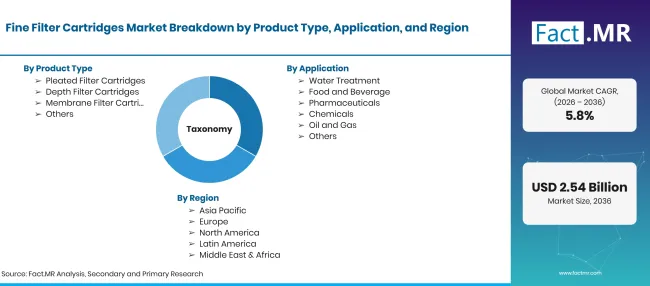
Fine Filter Cartridges Market Taxonomy | Source: Fact.MR
| Attribute | Details |
|---|---|
| Quantitative Units | USD billion in 2026 to USD billion by 2036 at CAGR |
| Market Definition | Replaceable cartridge elements with fine micron ratings that remove particles and microorganisms from liquids and gases, including pleated, depth and membrane designs, sold for industrial, commercial and residential use. |
| Product Type | Pleated Filter Cartridges; Depth Filter Cartridges; Membrane Filter Cartridges; Others |
| Application | Water Treatment; Food and Beverage; Pharmaceuticals; Chemicals; Oil and Gas; Others |
| Material | Polypropylene; Polyester; Nylon; PTFE; Others |
| End-User | Industrial; Commercial; Residential |
| Regions Covered | North America; Latin America; Western Europe; Eastern Europe; East Asia; South Asia & Pacific; Middle East & Africa |
| Countries Covered | Brazil; Germany; United Kingdom; Japan; United States |
| Companies Profiled | Pall Corporation; Parker Hannifin Corporation; Donaldson Company, Inc.; Sartorius AG; Meissner Filtration Products; Entegris, Inc.; Graver Technologies; Veolia; Pentair |
| Forecast Period | 2026 to 2036 |
| Approach | Top-down and bottom-up approach using cartridge shipments and average selling prices by product type; application and material split; industrial, commercial and residential adoption by country; and company portfolio review. |
Source: Fact.MR analysis. Updated Oct 26, 2026
How is the market segmented?
-
By Product Type
- Pleated Filter Cartridges
- Depth Filter Cartridges
- Membrane Filter Cartridges
- Others
-
By Application
- Water Treatment
- Food and Beverage
- Pharmaceuticals
- Chemicals
- Oil and Gas
- Others
-
By Material
- Polypropylene
- Polyester
- Nylon
- PTFE
- Others
-
By End-User
- Industrial
- Commercial
- Residential
-
By Region
- North America
- Latin America
- Western Europe
- Eastern Europe
- East Asia
- South Asia & Pacific
- Middle East & Africa
Frequently Asked Questions
How large is the fine filter cartridges market in 2026?
What growth rate will the fine filter cartridges market record from 2026 to 2036?
Which product type leads the fine filter cartridges market?
Which application holds the greatest share of the fine filter cartridges market?
Which material is most used in fine filter cartridges?
Which end-user contributes the most to the fine filter cartridges market?
Which country will record the strongest growth in the fine filter cartridges market?
Who are the main companies in the fine filter cartridges market?
Who worked on this report


Preview the report firsthand - request a free sample
Free SampleGet the brochure for pricing and purchase details
Download PDF