- Market Value (2025): USD 185.2 Bn
- Estimated Value (2026): USD 196.3 Bn
- Forecast Value (2036): USD 351.4 Bn
- CAGR (2026-2036): 6.0%
What is the Fixed Wing Transport Aircraft Market forecast to be worth by 2036?
USD 196.3 billion in 2026 to USD 351.4 billion by 2036, at a 6.00% CAGR.
- As per Fact.MR analysis, the fixed wing transport aircraft market reached USD 185.2 billion in 2025.
- Demand will increase from USD 196.3 billion in 2026 to USD 351.4 billion in 2036.
- The market is forecast to grow at 6.0% CAGR from 2026 to 2036, as airline fleet renewal and funded military airlift programmes lead to deliveries of different fixed-wing aircraft types.
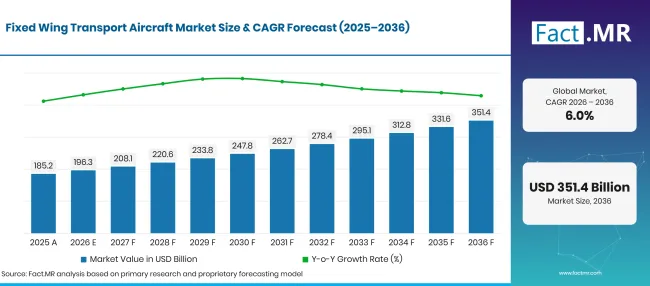
Factmr Fixed Wing Transport Aircraft Market Forecast Global | Source: Fact.MR
| Year | Basis | Market Value (USD billion) |
|---|---|---|
| 2025 | Actual | 185.2 |
| 2026 | Estimate | 196.3 |
| 2036 | Forecast | 351.4 |
| CAGR 2026 to 2036 | Forecast period | 6.0% |
Source: Fact.MR analysis. Updated Oct 15, 2026
What are the defining numbers behind Fixed Wing Transport Aircraft Market growth?
USD 155.13 billion absolute opportunity between 2026 and 2036, with military transport aircraft and turbofan-powered platforms holding the largest specified shares in their respective categories.
- Demand Drivers in the Market
- Aircraft revenue becomes tangible at delivery. Airbus reported 793 commercial deliveries in 2025 and Boeing reported 600. These totals give the production base more substance than an order announcement alone. For suppliers, the key questions are which orders are firm, when the aircraft will be accepted and where production capacity is available. [2] [3]
- Military airlift has requirements that scheduled passenger aircraft are not designed to meet. The RAF's Atlas A400M, for example, carries personnel and large equipment on tactical or strategic transport missions. The related aircraft engines decision follows payload, runway and operating needs. Top speed alone cannot determine the right platform. [11]
- Cargo operators select aircraft around payload access, capacity and economics. Demand for air cargo services can influence their fleet plans, but freight revenue is not the same as revenue from aircraft purchases. Leonardo's C-27J illustrates how cargo loading and the ability to use difficult airfields affect a transport platform's appeal. [8]
- Aircraft need parts and maintenance arrangements before entering service. Embraer and LATAM announced an E195-E2 component-pool agreement in October 2026 ahead of the airline's planned fleet introduction. The agreement demonstrates the support preparation involved in a new aircraft programme. Its service value belongs outside the new-aircraft sales total. [6]
- Key Segments Analyzed
- By Aircraft Type: Military Transport Aircraft account for 42.3% of 2026 revenue, reflecting sizeable mission-specific purchases.
- By Application: Military use likewise represents 42.3% in 2026. It is a separate classification of the same aircraft sales base.
- By Engine Type: Turbofan aircraft contribute 54.7% of revenue in 2026, ahead of turboprop and piston-powered types.
- By Maximum Takeoff Weight: Heavy platforms generate 63.4% of 2026 revenue. High unit values influence this share as well as deliveries.
- Analyst Opinion at Fact.MR
- Shambhu Nath Jha, Senior Consultant, Fact.MR says, “Order books provide visibility, but deliveries determine the revenue profile. A large contract may run for years and can bundle training or support with the aircraft. Manufacturers should report production and customer acceptance separately. Buyers, meanwhile, need to weigh mission suitability and lifetime operating needs alongside the purchase price.”
- Strategic Implications
- Airframe makers should distinguish firm orders from optional purchases. LATAM's agreement provides an example, with 24 firm E195-E2 aircraft and options for 50 more. Production planners can work from the committed portion while keeping the options visible as potential later demand. [6]
- Aircraft production requires the right parts to arrive in step with the assembly programme. Capacity across aerospace parts manufacturing is therefore important only where it supports a particular delivery configuration. Airbus' reported backlog signals future work, but aircraft must still be built, completed and accepted to become sales. [2]
- Military customers also budget for training and operational readiness. Lockheed Martin's April 2026 C-130J training-system award shows continuing spending around a transport fleet. That support is important, but it is not another aircraft purchase and should be kept outside aircraft revenue. [10]
- New-aircraft pricing should be kept distinct from subsequent aerospace and defense MRO commitments. Support can run for many years after an aircraft is delivered. A buyer needs to know which training, maintenance and spare-parts items are included in the acquisition contract and which will require separate budgets. [10]
The United States leads the country forecast at 7.62%, ahead of the United Kingdom at 7.12% and Germany at 6.65%. Brazil records 5.74%, while Japan reaches 4.93%. The rates depend on the timing of civil purchases and government airlift programmes. An existing fleet or a completed contract is not evidence of future deliveries on its own.
How does the Fixed Wing Transport Aircraft Market break down by segment?
Military Transport Aircraft 42.3%; Military 42.3%; Turbofan 54.7%; Heavy 63.4% in 2026.
Which Aircraft Type leads the market?
The Military Transport Aircraft segment holds 42.3% share in 2026.
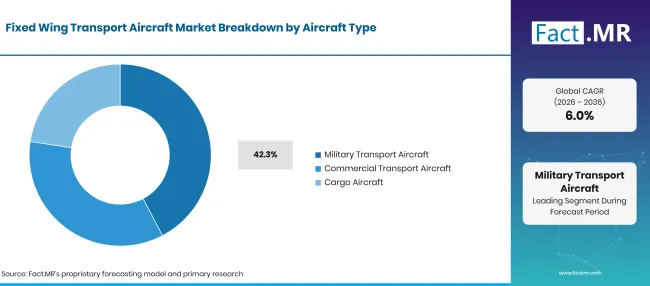
Factmr Fixed Wing Transport Aircraft Market Breakdown Aircraft Type | Source: Fact.MR
| Aircraft Type | Share (2026) |
|---|---|
| Military Transport Aircraft (Leading segment) | 42.3% |
| Other segments combined | 57.7%* |
| Total | 100.0% |
Source: Fact.MR analysis. Updated Oct 15, 2026
Military transport aircraft account for 42.3% of the aircraft-type split. Platforms such as Lockheed Martin's C-130J and Leonardo's C-27J are designed around military airlift tasks, while commercial and cargo aircraft meet other buyers' needs. An aircraft can perform several missions without creating several separate aircraft sales in the market figures. [8] [9]
Which Application accounts for the largest share?
The Military segment holds 42.3% share in 2026.
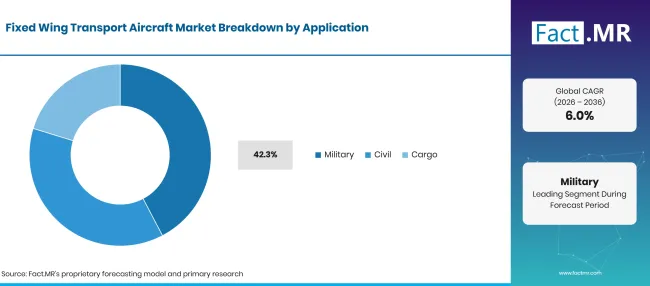
Factmr Fixed Wing Transport Aircraft Market Breakdown Application | Source: Fact.MR
| Application | Share (2026) |
|---|---|
| Military (Leading segment) | 42.3% |
| Other segments combined | 57.7%* |
| Total | 100.0% |
Source: Fact.MR analysis. Updated Oct 15, 2026
Military transport includes moving personnel, equipment and supplies for defence users. The RAF's Atlas can perform several airlift tasks, which makes it useful to its operator. For market accounting, that one aircraft still appears once. The military shares shown under aircraft type and application are separate classifications of the same sales base. [11]
What leads the Engine Type segment?
The Turbofan segment holds 54.7% share in 2026.
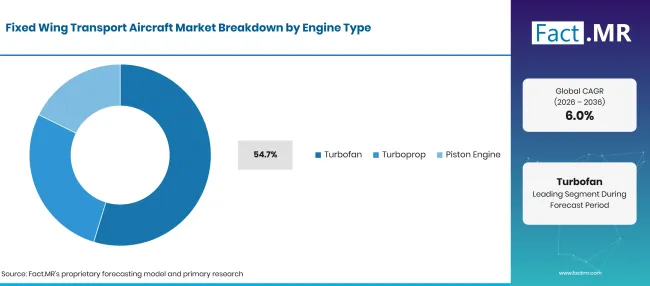
Factmr Fixed Wing Transport Aircraft Market Breakdown Engine Type | Source: Fact.MR
| Engine Type | Share (2026) |
|---|---|
| Turbofan (Leading segment) | 54.7% |
| Other segments combined | 45.3%* |
| Total | 100.0% |
Source: Fact.MR analysis. Updated Oct 15, 2026
Turbofan aircraft contribute the largest engine-type share at 54.7%, but turboprops are essential on a number of military routes. The RAF's four-engine turboprop Atlas and Japan's C-2 represent different design choices. Aircraft buyers match propulsion to mission, distance and operating conditions. Piston-engine platforms serve still another size of transport requirement. [11] [1]
Which Maximum Takeoff Weight category dominates?
The Heavy segment holds 63.4% share in 2026.
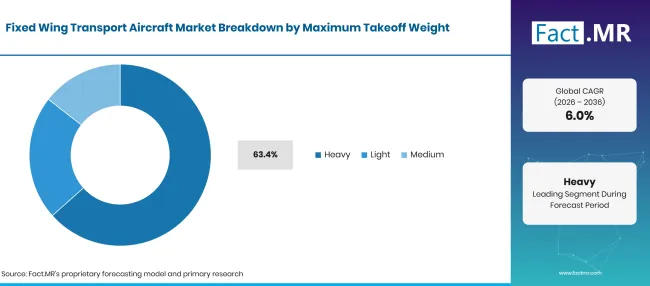
Factmr Fixed Wing Transport Aircraft Market Breakdown Maximum Takeoff Weight | Source: Fact.MR
| Maximum Takeoff Weight | Share (2026) |
|---|---|
| Heavy (Leading segment) | 63.4% |
| Other segments combined | 36.6%* |
| Total | 100.0% |
Source: Fact.MR analysis. Updated Oct 15, 2026
Heavy aircraft account for 63.4% of revenue in the weight classification, reflecting the value of large platforms as well as unit sales. Light and medium aircraft remain appropriate for smaller loads and airfields with limited access. Leonardo's C-27J shows why cargo access and runway conditions can matter more than choosing the heaviest available aircraft. [8]
What is accelerating Fixed Wing Transport Aircraft Market adoption, and what is holding it back?
Airline fleet replacement and military airlift procurement sustain the order pipeline. Revenue, however, depends on production and customer delivery schedules. Firm contracts, options and support for fleets already in service must be treated separately when assessing demand for new aircraft. [2] [11] [6]
Drivers Impact Analysis
| DRIVER | (~) % IMPACT ON CAGR | GEOGRAPHIC RELEVANCE | IMPACT TIMELINE |
|---|---|---|---|
| Funded commercial fleet renewal | +1.2% | Global | Medium term (2 to 4 years) |
| Military airlift replacement | +0.7% | Selected defence programmes | Long term (4 years or more) |
| Mission-specific cargo capacity | +0.5% | Global | Medium term (2 to 4 years) |
| Firm-order conversion to deliveries | +1.0% | Established aircraft programmes | Medium term (2 to 4 years) |
| Multi-mission transport requirements | +0.4% | Military and government buyers | Long term (4 years or more) |
Source: Fact.MR analysis. Updated Oct 15, 2026
Opportunity Impact Analysis
| OPPORTUNITY | (~) % IMPACT ON CAGR | GEOGRAPHIC RELEVANCE | IMPACT TIMELINE |
|---|---|---|---|
| Right-sized regional transport | +0.5% | Civil operators | Medium term (2 to 4 years) |
| Improved cargo handling capability | +0.4% | Cargo and military operators | Long term (4 years or more) |
| Entry-into-service readiness | +0.4% | New fleet operators | Short term (up to 2 years) |
| Replacement of ageing platforms | +0.7% | Funded renewal programmes | Long term (4 years or more) |
Source: Fact.MR analysis. Updated Oct 15, 2026
Restraints Impact Analysis
| RESTRAINT | (~) % IMPACT ON CAGR | GEOGRAPHIC RELEVANCE | IMPACT TIMELINE |
|---|---|---|---|
| Delivery and acceptance delays | -1.0% | Global | Short term (up to 2 years) |
| Budget and financing constraints | -0.7% | Civil and defence buyers | Medium term (2 to 4 years) |
| Unexercised purchase options | -0.3% | Optional order positions | Medium term (2 to 4 years) |
| Long programme and training cycles | -0.5% | Complex fleet introductions | Long term (4 years or more) |
Source: Fact.MR analysis. Updated Oct 15, 2026
Which countries are scaling the Fixed Wing Transport Aircraft Market through 2036?
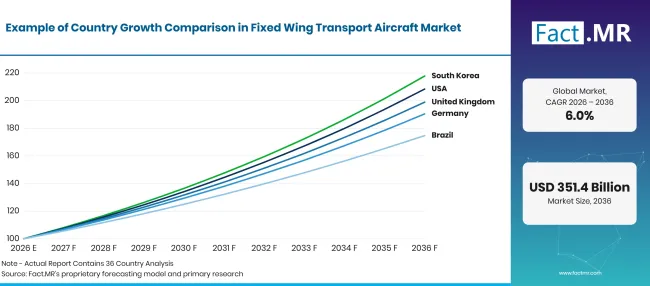
Factmr Fixed Wing Transport Aircraft Market Growth Index | Source: Fact.MR
| Country | CAGR (2026 to 2036) |
|---|---|
| Germany | 6.65% |
| Brazil | 5.74% |
| United States | 7.62% |
| United Kingdom | 7.12% |
| Japan | 4.93% |
Source: Fact.MR analysis. Updated Oct 15, 2026
How should Germany's transport-aircraft outlook be read?
6.65% CAGR. The completed A400M programme provides a fleet base, not an automatic repeat order.
Germany's Bundeswehr received its 53rd A400M in April 2026, completing the original order. That confirms a substantial existing fleet, not another sequence of aircraft deliveries under the same contract. Growth beyond this point depends on fresh funded purchases and civil aircraft requirements. Maintenance and upgrades to the A400M fleet should not be counted as new-aircraft sales. [4]
What supports Brazil's transport-aircraft position?
5.74% CAGR. Domestic airlift requirements and an established manufacturing programme provide distinct evidence.
Embraer delivered the seventh C-390 to Brazil's air force in September 2024, demonstrating an active domestic transport programme. The company also participates in the LATAM E195-E2 fleet agreement. Sales must be assigned to the country purchasing or receiving the aircraft; manufacturing an aircraft in Brazil does not make every export a Brazilian market sale. [6] [5]
Why does the United States lead the growth comparison?
7.62% CAGR. A broad commercial and military aircraft base supports multiple procurement routes.
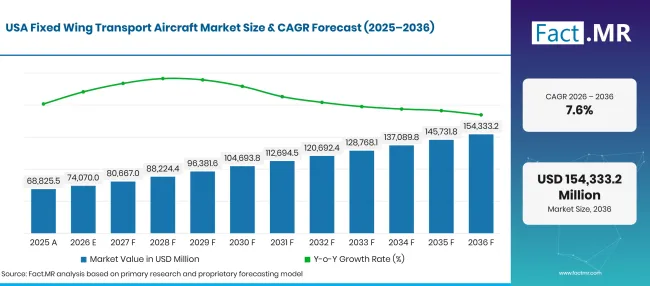
Factmr Fixed Wing Transport Aircraft Market Forecast Usa | Source: Fact.MR
Boeing delivered 600 commercial aircraft in 2025, while Lockheed Martin's C-130J provides a separate U.S. military transport example. Boeing's global delivery total cannot be assigned wholly to American buyers. The 7.62% U.S. market forecast depends on aircraft purchased for that market, not all aircraft built by companies based there. [3] [9]
What determines the United Kingdom's next phase?
7.12% CAGR. Future aircraft buying must be distinguished from sustaining the completed Atlas fleet.
The RAF took delivery of its 22nd Atlas in May 2023, completing that fleet phase. The aircraft still provides tactical and oversize airlift capability, but its continued operation does not create a fresh sale. The UK's growth forecast will depend on new funded acquisitions and civil purchases, with maintenance and training accounted for separately. [11] [12]
Why is Japan's market centred on specific platforms?
4.93% CAGR. Transport capability is assessed against national deployment and response requirements.
Japan developed the C-2 to replace the C-1 in airlift and rapid-response roles, according to its Acquisition, Technology and Logistics Agency. Kawasaki documents the country's production capability. Those sources show a real aircraft programme; they do not specify how many additional units will be ordered each year to 2036. Future demand remains tied to procurement decisions. [1] [7]
Who leads the Fixed Wing Transport Aircraft Market?
Airbus and Boeing are the commercial aircraft reference points, with published annual delivery totals. Lockheed Martin and Leonardo supply military airlifters, while Embraer participates in both military and civil transport. The C-130J, C-27J, C-390 and E195-E2 address different missions and customers. Competitor comparisons therefore need to be made within the relevant aircraft class. [2] [3] [8] [6] [9] [5]
The wider company set includes business-jet manufacturers and aerospace suppliers whose roles differ from those of large commercial airframe makers. Northrop Grumman and Saab, for example, cannot be treated as direct equivalents to Airbus or Boeing across the commercial transport market. The comparison needs to identify who delivers the aircraft and who supplies technology or supporting services.
Which companies are the key providers?
Documented transport-platform examples include Airbus, Boeing, Lockheed Martin, Embraer and Leonardo. The broader company coverage below spans different aircraft classes and aerospace roles rather than a single interchangeable supplier group. [2] [3] [8] [9] [5]
- Airbus
- Boeing
- Lockheed Martin
- Northrop Grumman
- Embraer
- Bombardier
- Textron Aviation
- Dassault Aviation
- Saab AB
- Leonardo S.p.A.
Bibliography
- [1] Acquisition, Technology and Logistics Agency. (n.d.). C-2 transport aircraft. Ministry of Defense, Japan.
- [2] Airbus. (2026, January 12). Airbus reports 793 commercial aircraft deliveries in 2025.
- [3] Boeing. (2026, January 13). Boeing announces fourth quarter deliveries.
- [4] Bundeswehr. (2026, April 28). Übergabe des vorerst letzten A400M in Wunstorf.
- [5] Embraer. (2024, September 27). Embraer delivers the seventh C-390 Millennium to the Brazilian Air Force.
- [6] Embraer. (2026, October 13). Embraer and LATAM sign component pool program agreement for the E195-E2 fleet ordered by the airline.
- [7] Kawasaki Heavy Industries. (n.d.). C-2 transport aircraft.
- [8] Leonardo. (n.d.). C-27J Spartan Next Generation.
- [9] Lockheed Martin. (n.d.). C-130J Super Hercules.
- [10] Lockheed Martin. (2026, April 14). Pentagon awards Lockheed Martin up to $1.9 billion to continue C-130J maintenance and aircrew training system program.
- [11] Royal Air Force. (n.d.). Atlas C.1 (A400M).
- [12] Royal Air Force. (2023, May 22). Atlas transport aircraft delivered to RAF Brize Norton.
This Report Answers
- How military, commercial and cargo aircraft differ in purchasing requirements.
- Why deliveries and customer acceptance matter more than a headline order backlog.
- How aircraft type and application represent separate views without double counting platforms.
- What engine and weight categories reveal about transport mission requirements.
- How completed country procurement programmes differ from future aircraft opportunities.
What does the Fixed Wing Transport Aircraft Market cover?
The market covers fixed-wing aircraft acquired for transport missions. It includes military airlifters and relevant civil passenger and cargo platforms. Aircraft type and application describe separate dimensions of the same market. Helicopters and aircraft whose primary purpose falls outside transport are not included merely because they can carry personnel.
What is included in the scope?
Included revenue relates to the supply of transport aircraft across the stated propulsion and weight categories.
An aircraft with multiple transport tasks is counted once. Military and commercial contracts are assessed at aircraft level so that separately priced support and service packages are not automatically added to the platform value.
What is excluded from the scope?
The scope excludes airline ticket revenue and freight-service charges.
Aircraft leasing payments and secondary resale transactions are not added to new-aircraft sales. Standalone MRO and training contracts are also excluded, as are rotary-wing platforms and combat or surveillance aircraft whose primary mission is outside the transport boundary.
How Was the Analysis Built?
The analysis draws on 120+ sources, 35+ company portfolios, 25+ countries, and more than 20 industry interviews.
- Primary Research: Primary research includes discussions with manufacturers, service providers, technology developers, distributors, end users, and subject-matter experts. These conversations examine purchasing priorities, product adoption, operational challenges, approval requirements, competitive positioning, and the factors that influence wider market acceptance.
- Desk Research: Desk research covers government statistics, regulatory publications, company filings, trade data, technical studies, industry associations, standards, public policy, and other authoritative sources. Every source used in the analysis is documented in the bibliography.
- Market Sizing and Forecasting: Market estimates combine historical performance, demand indicators, pricing and volume trends, segment shares, company participation, country-level growth, adoption patterns, investment activity, and barriers to market expansion.
- Data Validation and Update Cycle: Findings are validated by comparing primary interviews with public data, company activity, regulatory changes, trade patterns, and industry developments. Regular updates review new product launches, capacity changes, partnerships, approvals, and shifts in commercial adoption.
Segmentation
What is the report’s scope and coverage?
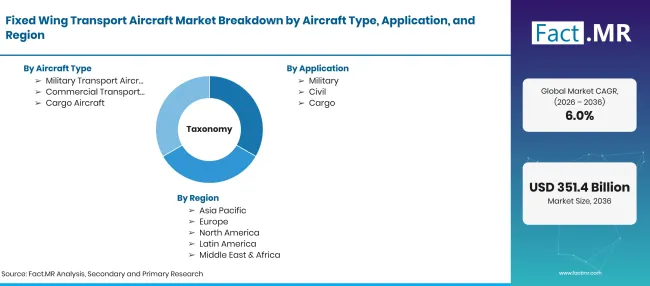
Factmr Fixed Wing Transport Aircraft Market Taxonomy | Source: Fact.MR
| Attribute | Details |
|---|---|
| Quantitative Units | USD billion |
| Market Definition | Fixed-wing aircraft supplied primarily for military, civil passenger or cargo transport missions. |
| Aircraft Type | Military Transport Aircraft; Commercial Transport Aircraft; Cargo Aircraft |
| Application | Military; Civil; Cargo |
| Engine Type | Turbofan; Turboprop; Piston Engine |
| Maximum Takeoff Weight | Heavy; Light; Medium |
| Regions Covered | North America; Latin America; Western Europe; Eastern Europe; East Asia; South Asia & Pacific; Middle East & Africa |
| Countries Covered | Germany; Brazil; United States; United Kingdom; Japan |
| Companies Profiled | Airbus; Boeing; Lockheed Martin; Northrop Grumman; Embraer; Bombardier; Textron Aviation; Dassault Aviation; Saab AB; Leonardo S.p.A. |
| Forecast Period | 2026 to 2036 |
| Approach | Aircraft-platform and mission analysis, disclosed orders and deliveries, national procurement evidence and supplier-role comparison. |
Source: Fact.MR analysis. Updated Oct 15, 2026
How is the market segmented?
-
By Aircraft Type:
- Military Transport Aircraft
- Commercial Transport Aircraft
- Cargo Aircraft
-
By Application:
- Military
- Civil
- Cargo
-
By Engine Type:
- Turbofan
- Turboprop
- Piston Engine
-
By Maximum Takeoff Weight:
- Heavy
- Light
- Medium
-
By Region:
- North America
- Latin America
- Western Europe
- Eastern Europe
- East Asia
- South Asia & Pacific
- Middle East & Africa
Frequently Asked Questions
How big is the fixed wing transport aircraft market in 2026?
What is the CAGR from 2026 to 2036?
Which aircraft type leads?
Which application leads?
Which companies participate in transport aircraft supply?
Who worked on this report


Preview the report firsthand - request a free sample
Free SampleGet the brochure for pricing and purchase details
Download PDF