- Market Value (2025): USD 789.0 Mn
- Estimated Value (2026): USD 890.0 Mn
- Forecast Value (2036): USD 2968.1 Mn
- CAGR (2026-2036): 12.8%
What is the Fonio Grain Flours Market forecast to be worth by 2036?
USD 890.0 million in 2026 to USD 2,968.1 million by 2036 at a 12.8% CAGR.
- The Fonio Grain Flours Market crossed a valuation of USD 789.0 million in 2025.
- Demand is projected to increase from USD 890.0 million in 2026 to USD 2,968.1 million by 2036.
- The market is forecast to record 12.8% CAGR from 2026 to 2036 as bakery brands and cereal manufacturers test fonio in gluten-free recipes and premium grain blends.
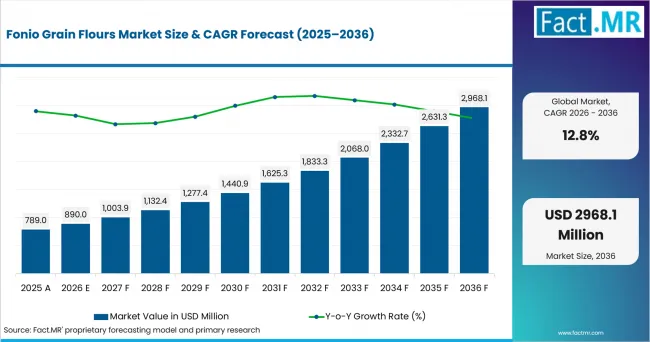
Fonio Grain Flours Market Value Analysis | Source: Fact.MR
What are the defining numbers behind Fonio Grain Flours Market growth?
An absolute opportunity of USD 2,078.1 million is expected between 2026 and 2036.
- Demand Drivers in the Market
- Bakery formulators need naturally gluten-free flour options that add mild flavor and fine texture without forcing heavy masking work in breads and pancakes.
- Ingredient distributors need traceable West African grain supply because specialty retailers ask for origin stories and consistent quality before accepting premium flour packs.
- Food brands need a bridge between ancient-grain claims and everyday baking use. USDA ERS estimated U.S. per capita wheat flour use at 126.6 pounds in 2025 on its Wheat Sector at a Glance page, updated April 8, 2026.
- Millers need reliable dehulling and cleaning before flour conversion because fonio’s small grain size makes stones, sand and bran removal central to export-ready quality.
- Gluten-free and heritage positioning also places fonio beside adjacent gluten-free food and ancient-grain categories where brands use ingredient identity to stand out on retail shelves.
- Key Segments Analyzed
- By Flour Type: Whole-grain fonio flour is expected to hold 37.00% share in 2026 because it preserves the grain identity that shoppers connect with ancient-grain and high-fiber claims.
- By Processing: Stone and traditional milling is projected to account for 34.00% share in 2026 as small-batch producers retain a craft positioning while scaling quality checks.
- By Application: Bakery is anticipated to capture 31.00% share in 2026 since pancakes, breads and cookies give consumers a simple route to try fonio flour.
- By Commercial Positioning: Gluten-free is estimated to represent 39.00% share in 2026 owing to clear dietary use and a stronger fit with specialty retail shelves.
- Analyst Opinion at Fact.MR
- Shambhu Nath Jha, Principal Consultant at Fact.MR, states, “Fonio flour is drawing attention because it combines an origin story with a real formulation question. The market is expected to move faster where brands can prove milling quality, traceability and gluten-free handling. Suppliers that join farmer sourcing with clean processing and recipe guidance are likely to win more repeat business.”
- Strategic Implications
- Millers should document grain cleaning, particle size and moisture control so bakeries can test fonio flour without changing every recipe step.
- Exporters should prepare traceability records for origin, lot control and food-safety checks because premium retail buyers examine paperwork before expanding shelf space.
- Brand owners should position whole-grain fonio flour close to adjacent whole-grain claims. The French Ministry of Agriculture’s infographic on 2024 organic-sector figures, published May 28, 2026, reports 25,105 certified downstream organic enterprises.
- Application teams should test fonio flour in pancakes, brownies and snack bases before moving into wider gluten-free bakery products where texture and taste claims are compared closely.
Mali leads at 14.5% CAGR through local fonio identity and cereal supply depth. Senegal follows at 13.7% as formal agricultural survey coverage supports better production planning. Nigeria records 12.8% through acha familiarity and urban cereal use. France posts 12.2% through organic retail and gluten-free specialty shelves. The USA reaches 11.5% as brands test fonio in bakery mixes and specialty grocery formats.
How does the Fonio Grain Flours Market break down by segment?
Whole-grain fonio flour leads Flour Type at 37.0% share in 2026; Gluten-free leads Commercial Positioning at 39.0% share.
Which Flour Type dominates?
Whole-grain fonio flour is expected to hold 37.0% share in 2026.
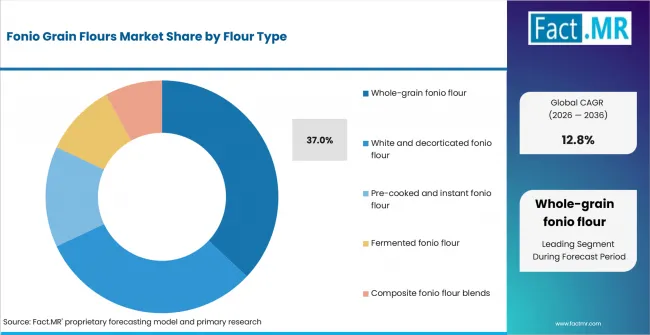
Fonio Grain Flours Market Analysis By Flour Type | Source: Fact.MR
Whole-grain fonio flour leads because it keeps the cereal identity visible in finished packs and recipe claims. White and decorticated flour serves products that need lighter color. Instant flour helps brands shorten preparation for porridge and cereal cups. The position links naturally with whole grain and high fiber foods where the product story remains tied to grain integrity.
What leads the Processing segment?
Stone and traditional milling is projected to account for 34.0% share in 2026.
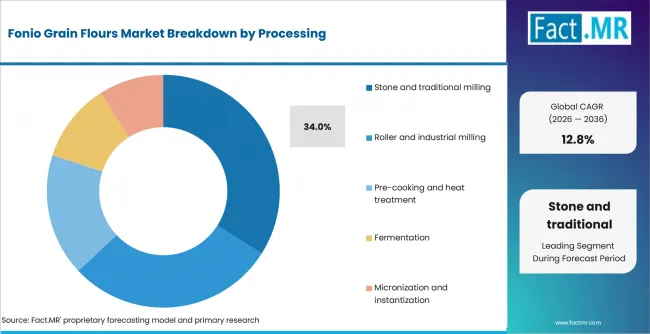
Fonio Grain Flours Market Analysis By Processing | Source: Fact.MR
Stone and traditional milling holds share because it matches the craft language used by premium flour sellers. Industrial milling is expected to expand where brands require tighter particle size control. Heat treatment supports instant formats for porridge cups. CAA’s Findi platform describes a fully automated fonio processing unit with an annual capacity of 2,400 tonnes, supporting large-scale production of pre-cooked fonio.
How does Application shape demand?
Bakery is anticipated to capture 31.0% share in 2026.
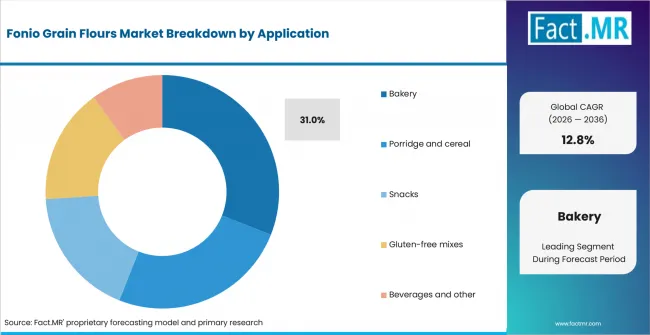
Fonio Grain Flours Market Analysis By Application | Source: Fact.MR
Bakery leads because fonio flour can enter familiar products such as pancakes, breads and brownies. Porridge applications remain close to traditional fonio use, so education costs are lower. Snacks use fonio where grain identity is visible. The segment also touches gluten-free baking mixes because flour performance must hold across home and commercial recipes.
What supports Gluten-free within Commercial Positioning?
Gluten-free is estimated to represent 39.0% share in 2026.
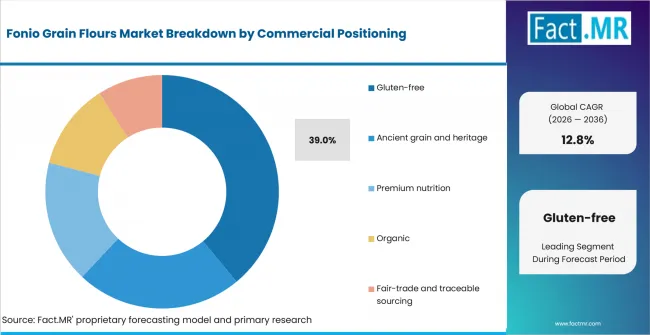
Fonio Grain Flours Market Analysis By Commercial Positioning | Source: Fact.MR
Gluten-free positioning leads because fonio gives brands a simple claim and a clear consumer use case. Heritage positioning adds story value when brands explain Sahel origins and milling. Premium nutrition supports smaller packs and specialty pricing. Organic and fair-trade positioning can strengthen trust where certification and traceable sourcing are presented clearly.
What is accelerating Fonio Grain Flours Market adoption, and what is holding it back?
Gluten-free bakery trials drive it; milling complexity restrains it.
Drivers Impact Analysis
| DRIVER | (~) % IMPACT ON CAGR | GEOGRAPHIC RELEVANCE | IMPACT TIMELINE |
|---|---|---|---|
| Gluten-free bakery formulation | +2.1% | North America, Europe | Short term (<= 2 years) |
| Traceable West African grain sourcing | +1.7% | West Africa, Europe | Medium term (2-4 years) |
| Premium ancient-grain positioning | +1.3% | Global | Medium term (2-4 years) |
| Commercial milling and cleaning upgrades | +1.0% | West Africa | Long term (>= 4 years) |
Source: Fact.MR analysis. Updated Sep 4, 2026
- Gluten-free bakery formulation: Fonio flour can gain use where brands need alternatives to conventional cereal flours. Bakery applications provide a practical entry point because the flour can be incorporated into breads, pancakes, cookies, and related products while supporting clean-label and gluten-free positioning.
- Traceable West African grain sourcing: Retailers and ingredient buyers increasingly value suppliers that connect farmer sourcing with consistent quality control and traceability. Strong sourcing documentation can help flour buyers simplify supplier qualification and support broader use of fonio in specialty retail and commercial food manufacturing.
- Premium ancient-grain positioning: Fonio flour benefits from product stories that combine its West African heritage with familiar everyday applications. Brands can use this positioning across small retail packs, bakery mixes, and breakfast products, particularly when packaging explains functional characteristics and practical recipe uses.
- Commercial milling and cleaning upgrades: Improved cleaning, milling, and bran-removal systems can strengthen fonio flour quality by reducing foreign material and improving consistency. More controlled processing also supports food-safety documentation and export readiness, helping the grain move from traditional processing toward larger-scale ingredient applications.
Opportunity Impact Analysis
| OPPORTUNITY | (~) % IMPACT ON CAGR | GEOGRAPHIC RELEVANCE | IMPACT TIMELINE |
|---|---|---|---|
| B2B flour formats for bakery and snacks | +1.4% | USA, France, UK | Short term (<= 2 years) |
| Pre-cooked and instant fonio flour | +1.0% | West Africa, North America | Medium term (2-4 years) |
| Composite flour blends | +0.8% | Global | Medium term (2-4 years) |
| Diaspora and specialty retail channels | +0.6% | Europe, North America | Long term (>= 4 years) |
Source: Fact.MR analysis. Updated Sep 4, 2026
- B2B flour formats for bakery and snacks: Ingredient suppliers can expand commercial use by offering fonio as flour, puffed grain, crisps, and other ready-to-formulate formats. These options help food manufacturers test fonio across bakery, snack, foodservice, and beverage applications without creating entirely new grain-processing workflows.
- Pre-cooked and instant fonio flour: Instant and pre-cooked formats can reduce preparation barriers for porridge, cereal cups, and convenience meals. Controlled heat treatment can shorten cooking time while retaining the grain’s identity, supporting easier adoption across retail and foodservice applications.
- Composite flour blends: Fonio can be blended with familiar alternative flours to broaden its use across batters, crackers, bakery products, and snacks. Established categories such as pulse flour demonstrate how specialty flours can enter mainstream formulations when taste, texture, and processing performance remain manageable.
- Diaspora and specialty retail channels: African grocery stores, specialty retailers, and natural-food outlets can support early adoption of fonio flour. Diaspora consumers already familiar with the grain provide a foundation for repeat purchases, while recipes, cooking guidance, and accessible packaging can help attract new shoppers.
Restraints Impact Analysis
| RESTRAINT | (~) % IMPACT ON CAGR | GEOGRAPHIC RELEVANCE | IMPACT TIMELINE |
|---|---|---|---|
| Small grain cleaning and dehulling complexity | -0.9% | West Africa | Short term (<= 2 years) |
| Premium pricing versus common flours | -0.7% | North America, Europe | Medium term (2-4 years) |
| Limited consumer recipe familiarity | -0.5% | Global | Medium term (2-4 years) |
| Certification and origin documentation burden | -0.4% | Europe, North America | Long term (>= 4 years) |
Source: Fact.MR analysis. Updated Sep 4, 2026
- Small grain cleaning and dehulling complexity: Fonio’s very small grain size makes cleaning, dehulling, and milling more demanding than for common cereal grains. Processors need controlled equipment to remove sand, stones, and other foreign material while maintaining consistent flour quality for commercial and export applications.
- Premium pricing versus common flours: Fonio flour can face price resistance when consumers compare it with wheat, rice, millet, and other familiar flours. Smaller pack sizes, targeted positioning, and clear usage guidance can help reduce the trial barrier and support adoption in specialty retail channels.
- Limited consumer recipe familiarity: Adoption can slow when shoppers are unfamiliar with how fonio flour behaves in dough, batter, porridge, and other preparations. Brands need clear guidance on hydration, flavor, texture, and cooking methods, making recipe-led packaging important for repeat use.
- Certification and origin documentation burden: Export-oriented fonio suppliers must manage documentation covering origin, traceability, organic status, gluten-free handling, and buyer-specific quality requirements. Smaller processors may need stronger documentation systems and commercial partners to translate farm-level records into formats accepted by retailers and ingredient buyers.
Which countries are scaling the Fonio Grain Flours Market through 2036?
- The country comparison spans 2.94 percentage points and forms three practical growth bands across the forecast period.
- Mali remains 0.76 percentage point above Senegal due to local fonio identity and stronger origin-led flour positioning.
- Nigeria remains 0.64 percentage point above France because acha familiarity gives fonio a domestic consumption base before premium export positioning.
- France remains 0.64 percentage point above the USA through organic retail, specialty stores and gluten-free baking interest.
- The USA closes the displayed range as specialty food brands test fonio flour in baking mixes and foodservice trials.
Comparable CAGRs can create different entry conditions due to crop familiarity, milling capacity, organic channels and consumer recipe education. Full report coverage includes North America, Latin America, Western Europe, Eastern Europe, East Asia, South Asia & Pacific, Middle East & Africa.
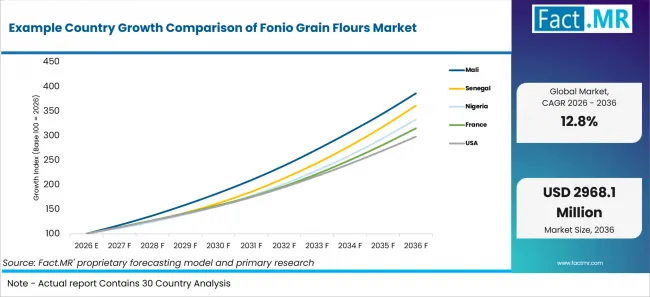
Example Country Growth Comparison Of Fonio Grain Flours Market | Source: Fact.MR
| Country | CAGR (2026-2036) |
|---|---|
| Mali | 14.5% |
| Senegal | 13.7% |
| Nigeria | 12.8% |
| France | 12.2% |
| USA | 11.5% |
Source: Fact.MR analysis. Updated Sep 4, 2026
What supports Mali adoption?
14.5% CAGR, supported by local fonio identity and cereal supply depth.
Mali gives fonio flour a clear origin link through Sahel cereal culture and Dogon heritage claims. FAO GIEWS estimated Mali’s aggregate 2024 cereal production at 10.4 million tonnes in its May 28, 2025 country brief.
How is Senegal scaling demand?
13.7% CAGR, with formal agricultural data providing country-analysis context.
Senegal combines local cereal-processing know-how with formal national farm data. DAPSA’s 2024-2025 Annual Agricultural Survey, available through FAO’s Microdata Catalogue in July 2026, reports a 95% first-phase response rate, with 6,947 of 7,278 selected households successfully surveyed.
What supports Nigeria demand?
12.8% CAGR, backed by acha familiarity and urban cereal use.
Nigeria’s local familiarity with acha gives fonio flour a clearer consumer education path than new imported grains. FAO GIEWS estimated Nigeria’s aggregate 2024 cereal production at about 28.5 million tonnes.
How is France developing demand?
12.2% CAGR, led by organic retail and gluten-free specialty shelves.
France offers a structured route into organic shops and specialty bakery trials. France to record a 12.2% CAGR through 2036. Agence Bio’s current national observatory lists 24,679 downstream enterprises engaged in organic activities in France in 2025, providing organic-channel context for the analysis.
What underpins USA growth?
11.5% CAGR, supported by specialty retail and bakery substitution.
Specialty groceries and ingredient brands make the USA a visible testing ground for fonio flour. The USA to record an 11.5% CAGR through 2036. USDA ERS reported in June 2026 that total U.S. food spending reached USD 2.51 trillion in 2025, providing food-channel context for the analysis.
Who leads the Fonio Grain Flours Market?
Direct public fonio-flour evidence is strongest for Yolélé and Aga’s Wholesome Foods. Yolélé’s ingredient platform lists fonio flour and other commercial formats.
Amaati Company Limited remain profiled as fonio-market participants, with company-specific flour claims reserved for product pages that explicitly identify a fonio-flour offering. Competition is expected to be shaped by milling consistency, origin documentation and export-ready supply.
Which companies are the key providers?
Key companies include Yolélé, Terra Ingredients, Aga’s Wholesome Foods, Organic Trade & Investments (OTI), Talmond Ltd., and Amaati Company Limited.
- Yolélé
- Terra Ingredients
- Aga’s Wholesome Foods
- Organic Trade & Investments (OTI)
- Talmond Ltd.
- Amaati Company Limited
Bibliography
- Food and Agriculture Organization of the United Nations. (2025, May 28). FAO GIEWS country brief on Mali.
- Food and Agriculture Organization of the United Nations. (2025, April 7). FAO GIEWS country brief on Nigeria.
- Directorate for Agricultural Analysis, Forecasting and Statistics. (2026, July 2). Annual Agricultural Survey 2024–2025 [Data set]. FAO Microdata Catalogue.
- Zeballos, E., & Sinclair, W. (2026, June 11). Total U.S. food spending reached $2.51 trillion in 2025. Economic Research Service, U.S. Department of Agriculture.
- Economic Research Service, U.S. Department of Agriculture. (2026, April 8). Wheat sector at a glance.
- Baker, Q., & Zachary, J. C. (2026, March 10). Many industry groups contribute value to the U.S. food system. Economic Research Service, U.S. Department of Agriculture.
- Ministère de l’Agriculture, de l’Agro-alimentaire et de la Souveraineté alimentaire. (2026, May 28). Infographie - L'agriculture biologique (chiffres 2024) [Infographic - Organic agriculture (2024 figures)].
This Report Answers
- The report explains fonio flour use across flour type, processing, application and positioning.
- Segment analysis explains why whole-grain flour and gluten-free positioning lead.
- Country analysis examines Mali, Senegal, Nigeria, France and the USA across supply, processing and specialty retail.
- Competitive analysis reviews ingredient suppliers, retail packs and West African cereal distributors.
- Application analysis covers bakery, porridge, snacks and gluten-free mixes.
What does the Fonio Grain Flours Market cover?
The Fonio Grain Flours Market covers milled and processed flour products made from fonio grain. It includes whole-grain flour, white decorticated flour, instant flour, fermented flour and composite blends for bakery, porridge and snacks. Adjacent coverage of functional flour helps frame how brands treat flour as a performance ingredient.
The assessment is narrower than the wider flour market because it focuses on fonio-based inputs. Wheat, rice, maize and pulse flour are outside the boundary unless they appear inside a composite fonio blend.
What is included in the scope?
The scope includes retail and B2B fonio flour formats used by food brands, bakeries, cereal makers and snack producers. It covers stone-milled flour, industrially milled flour, heat-treated flour and fermented flour.
Adjacent millets and pre-cooked flour categories support comparisons for channel behavior and processing expectations.
What is excluded from the scope?
Whole fonio grain, ready meals, restaurant dishes and non-food fonio uses are outside the scope.
Regular wheat flour, rice flour and pulse flour are outside the scope unless they are part of a composite blend where fonio remains the named flour base.
How Was the Analysis Built?
The analysis draws on 120+ sources, 35+ company portfolios, 25+ countries, and more than 20 industry interviews.
- Primary Research: Primary research includes discussions with manufacturers, service providers, technology developers, distributors, end users, and subject-matter experts. These conversations examine purchasing priorities, product adoption, operational challenges, approval requirements, competitive positioning, and the factors that influence wider market acceptance.
- Desk Research: Desk research covers government statistics, regulatory publications, company filings, trade data, technical studies, industry associations, standards, public policy, and other authoritative sources. Every source used in the analysis is documented in the bibliography.
- Market Sizing and Forecasting: Market estimates combine historical performance, demand indicators, pricing and volume trends, segment shares, company participation, country-level growth, adoption patterns, investment activity, and barriers to market expansion.
- Data Validation and Update Cycle: Findings are validated by comparing primary interviews with public data, company activity, regulatory changes, trade patterns, and industry developments. Regular updates review new product launches, capacity changes, partnerships, approvals, and shifts in commercial adoption.
Segmentation
What is the report’s scope and coverage?
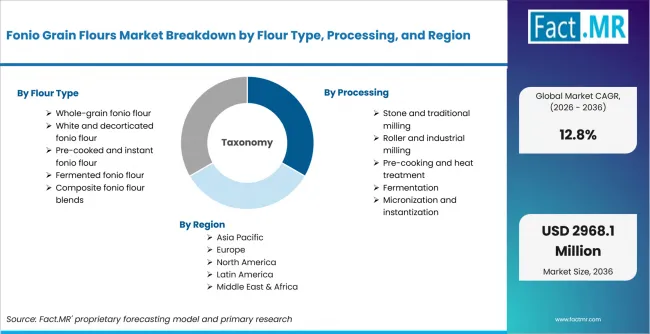
Fonio Grain Flours Market Breakdown By Flour Type, Processing, And Region | Source: Fact.MR
| Attribute | Details |
|---|---|
| Quantitative Units | USD million |
| Market Definition | Flours made from fonio grain for bakery, porridge, cereal, snack, beverage and blended flour applications. |
| Flour Type | Whole-grain fonio flour; White and decorticated fonio flour; Pre-cooked and instant fonio flour; Fermented fonio flour; Composite fonio flour blends |
| Processing | Stone and traditional milling; Roller and industrial milling; Pre-cooking and heat treatment; Fermentation; Micronization and instantization |
| Application | Bakery; Porridge and cereal; Snacks; Gluten-free mixes; Beverages and other |
| Commercial Positioning | Gluten-free; Ancient grain and heritage; Premium nutrition; Organic; Fair-trade and traceable sourcing |
| Regions Covered | North America; Latin America; Western Europe; Eastern Europe; East Asia; South Asia & Pacific; Middle East & Africa |
| Countries Covered | Mali; Senegal; Nigeria; France; USA |
| Key Companies Profiled | Yolélé; Terra Ingredients; Aga’s Wholesome Foods; Organic Trade & Investments (OTI); Talmond Ltd.; Amaati Company Limited |
| Forecast Period | 2026 to 2036 |
| Approach | Hybrid top-down and bottom-up approach using cereal supply indicators, flour applications, retail channel mapping, country adoption and provider portfolio review. |
Source: Fact.MR analysis. Updated Sep 4, 2026
How is the market segmented?
-
By Flour Type:
- Whole-grain fonio flour
- White and decorticated fonio flour
- Pre-cooked and instant fonio flour
- Fermented fonio flour
- Composite fonio flour blends
-
By Processing:
- Stone and traditional milling
- Roller and industrial milling
- Pre-cooking and heat treatment
- Fermentation
- Micronization and instantization
-
By Application:
- Bakery
- Porridge and cereal
- Snacks
- Gluten-free mixes
- Beverages and other
-
By Commercial Positioning:
- Gluten-free
- Ancient grain and heritage
- Premium nutrition
- Organic
- Fair-trade and traceable sourcing
-
By Region:
- North America
- Latin America
- Western Europe
- Eastern Europe
- East Asia
- South Asia & Pacific
- Middle East & Africa
Frequently Asked Questions
How big is the fonio grain flours market in 2026?
What is the CAGR of the fonio grain flours market from 2026 to 2036?
Which flour type leads the fonio grain flours market?
Which processing method leads the fonio grain flours market?
Who are the leading companies in the fonio grain flours market?
Who worked on this report


Preview the report firsthand - request a free sample
Free SampleGet the brochure for pricing and purchase details
Download PDF