- Market Value (2025): USD 595.4 Mn
- Estimated Value (2026): USD 653.0 Mn
- Forecast Value (2036): USD 1,645.1 Mn
- CAGR (2026-2036): 9.7%
What is the Fragrance-Free Polymer Odor Controllers Market forecast to be worth by 2036?
USD 653.0 million in 2026 to USD 1,645.1 million by 2036 at a 9.7% CAGR.
- The Fragrance-Free Polymer Odor Controllers Market crossed a valuation of USD 595.4 million in 2025.
- Demand is projected to increase from USD 653.0 million in 2026 to USD 1,645.1 million by 2036.
- The market is forecast to record a 9.7% CAGR from 2026 to 2036 as compounders and converters seek odor control without added fragrance.
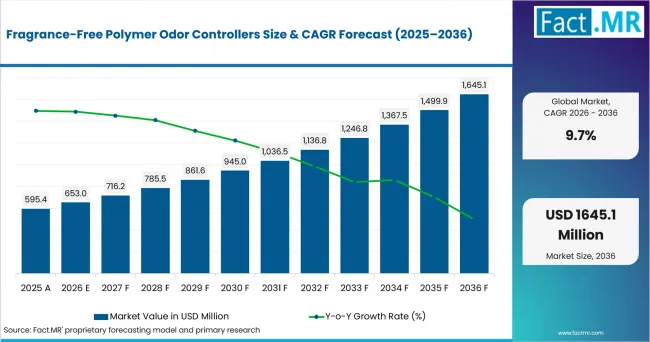
Fragrance Free Polymer Odor Controllers Value Analysis | Source: Fact.MR
What are the defining numbers behind Fragrance-Free Polymer Odor Controllers Market growth?
USD 992.1 million absolute opportunity by 2036; mineral adsorbents and PP lead alongside automotive interiors.
- Demand Drivers in the Market
- Automotive interior compounders need odor reduction that works within PP and TPO formulations without replacing one smell with another. Low-emission cabins make residual aldehydes and amines easier to detect. Sulfur compounds and mixed interior odor are equally visible to occupants and OEM test protocols.
- Recycled-polymer processors need additives that manage odor carried in post-consumer feedstock. Odor can come from absorbed food residues or oxidation products. Contamination and repeated heat history create further odor sources; adsorbent and reactive systems can widen higher-value PCR use.
- Packaging converters need fragrance-free control when sensory neutrality matters around food and beverages. Household products create another sensory-sensitive application. Scavenger chemistry is expected to reduce odor-forming volatiles while preserving the intended sensory profile of the packaged product.
- Formaldehyde is used in products including plastics and resins and may be released from products over time. On January 2, 2025, the U.S. EPA stated that 58 of 63 TSCA conditions of use for formaldehyde significantly contribute to its unreasonable-risk determination. The contributing conditions include several processing uses in plastic material and resin manufacturing.
- Key Segments Analyzed
- By Odor-Control Chemistry: Mineral adsorbent is expected to hold 28.0% share in 2026 because porous mineral surfaces can capture a broad mix of low-molecular-weight odor compounds without adding perfume.
- By Target Odor: VOC / aldehyde is projected to account for 26.0% share in 2026. Polymer oxidation and recycled feedstock support this position; enclosed interiors add another use case.
- By Polymer: PP is anticipated to capture 34.0% share in 2026 owing to wide automotive and packaging use. Consumer products and recycled-polyolefin streams add further volume.
- By Application: Automotive interiors are estimated to represent 43.0% share in 2026 because enclosed cabins expose odor and fogging performance directly to OEM qualification teams. Volatile-emission performance is assessed alongside these criteria.
- Analyst Opinion at Fact.MR
- Fact.MR Principal Consultant Shambhu Nath Jha states, “The commercial issue extends beyond initial odor reduction. Buyers need a fragrance-free result that survives compounding and avoids a new sensory signature. Suppliers are expected to gain preference when polymer-specific dosing guidance is paired with measurable odor performance.”
- Strategic Implications
- Masterbatch producers should document odor reduction by polymer grade and contamination profile instead of relying on a single general-purpose dosage recommendation.
- Automotive material suppliers should connect odor-control claims with cabin-material test conditions so OEM engineering teams can compare formulations on a repeatable basis.
- Packaging converters should separate true odor scavenging from fragrance masking. Additives should fit food-contact and organoleptic requirements; recycling compatibility must suit the intended structure.
- Recycled-resin compounders should evaluate odor controllers alongside stabilization because oxidation during processing can recreate volatile compounds after initial deodorization. The formulation review should track odor after extrusion and aging rather than only on incoming pellets.
Japan is forecast to record 11.4% CAGR through 2036 as automotive output supports odor qualification. The USA is projected at 10.3% with a large plastics-processing base. France is anticipated at 9.9% through vehicle and packaging applications. Germany is estimated at 8.7% as automotive production supports material testing. Sweden is forecast at 8.1% through vehicle and recycled-material applications.
How does the Fragrance-Free Polymer Odor Controllers Market break down by segment?
Automotive interiors lead Application at 43.0%; PP leads Polymer at 34.0%.
Which Odor-Control Chemistry leads?
Mineral adsorbent is expected to hold 28.0% share in 2026.
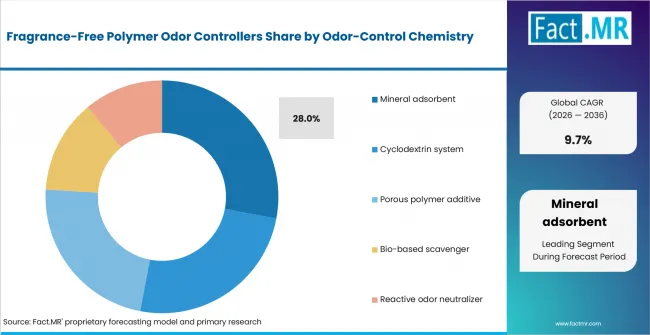
Fragrance Free Polymer Odor Controllers Analysis By Odor Control Chemistry | Source: Fact.MR
Mineral adsorbents are suited to fragrance-free formulations because they can physically capture volatile molecules within pores or on active surfaces. They can be introduced through masterbatch or compounding routes without adding a masking scent, which fits applications where the finished polymer needs a neutral sensory profile. Selection still depends on particle size and dispersion. Loading level and the odor species present in the resin stream shape final formulation choice.
The chemistry is particularly relevant to recycled polyolefins because odor profiles can vary by feedstock batch. A broad adsorption window gives compounders a practical first line of control. Selective reactive or complexing chemistries can be added when one known odor species dominates the problem.
What leads the Target Odor segment?
VOC / aldehyde is projected to account for 26.0% share in 2026.
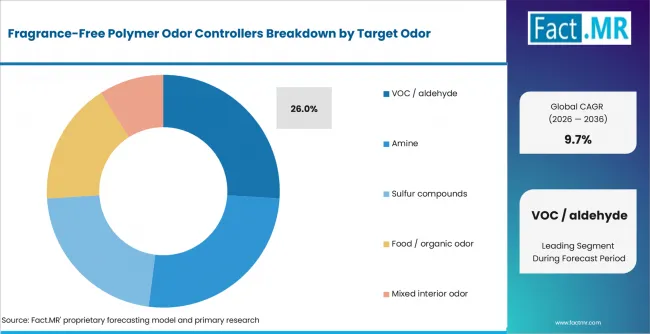
Fragrance Free Polymer Odor Controllers Analysis By Target Odor | Source: Fact.MR
VOC and aldehyde control is central to material qualification in automotive interiors and recycled plastics. Oxidation and thermal history can create volatile compounds that remain noticeable after molding. Adhesives and residual process chemicals create additional sources; contamination can intensify the odor profile. Fragrance-free controllers need to bind or react with these compounds without creating a new odor profile.
VOC and aldehyde control requires chemistry that remains effective after compounding and heat exposure. Formulators therefore compare adsorption capacity and reaction selectivity before approving a system. Dosing window and any effect on color or surface quality remain part of qualification.
How does Polymer shape demand?
PP is anticipated to capture 34.0% share in 2026.
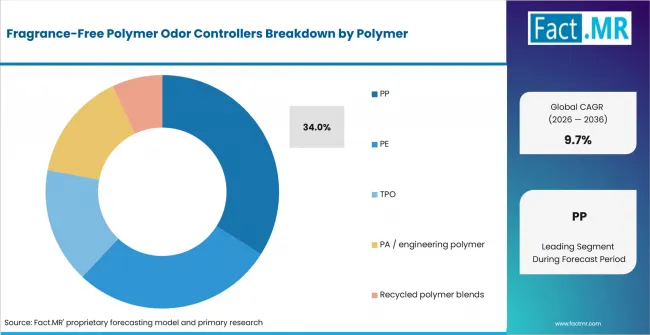
Fragrance Free Polymer Odor Controllers Analysis By Polymer | Source: Fact.MR
PP appears across vehicle trim and rigid packaging. Consumer products and nonwoven structures extend its use base. Its large installed base means odor problems can emerge in both virgin and recycled formulations, especially where repeated heat exposure generates oxidation products. Fragrance-free odor controllers therefore compete on dispersion and thermal stability. Practical let-down ratios influence commercial fit.
Recycled PP creates a demanding qualification environment because incoming material can carry mixed contamination. Broad adsorbents suit variable streams, while reactive neutralizers are expected to fit applications where the dominant odor species is known and repeatable.
What supports Automotive interiors within Application?
Automotive interiors are estimated to represent 43.0% share in 2026.
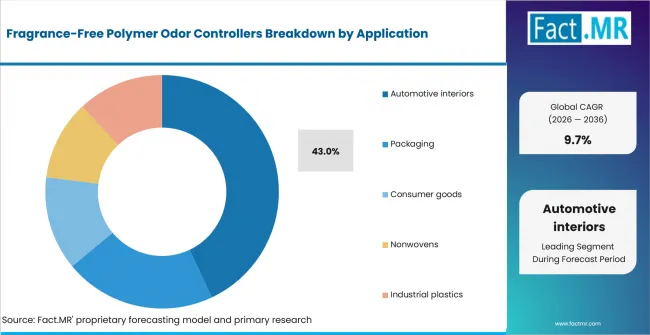
Fragrance Free Polymer Odor Controllers Analysis By Application | Source: Fact.MR
Door panels and consoles share the same enclosed cabin with trim parts and carpets. Nonwovens and seating-adjacent polymers add more potential odor sources. A weak odor contribution from one material can therefore affect the perceived quality of the whole interior. OEM qualification gives suppliers an incentive to control volatile and sensory emissions before a compound reaches final molding.
Eurostat reported on October 6, 2025 that the EU produced 12.1 million cars in 2024, of which 3.9 million were hybrid or electric cars, representing almost one-third of total production.
What is accelerating Fragrance-Free Polymer Odor Controllers Market adoption, and what is holding it back?
Demand is expected to rise through recycled-polymer quality needs and low-emission material requirements. Adoption is constrained by variable odor chemistry and additive loading. Qualification costs create another limitation.
Drivers Impact Analysis
| DRIVER | (~) % IMPACT ON CAGR | GEOGRAPHIC RELEVANCE | IMPACT TIMELINE |
|---|---|---|---|
| Higher PCR use in polyolefin compounds | +1.6% | North America, Europe, East Asia | Medium term (2-4 years) |
| Automotive cabin odor and VOC qualification | +1.3% | Europe, North America, Japan | Short term (<= 2 years) |
| Fragrance-free sensory requirements in packaging | +1.0% | Global | Medium term (2-4 years) |
| Broader use of odor-scavenging masterbatch | +0.8% | Global | Long term (>= 4 years) |
Source: Fact.MR analysis. Updated Sep 19, 2026
Opportunity Impact Analysis
| OPPORTUNITY | (~) % IMPACT ON CAGR | GEOGRAPHIC RELEVANCE | IMPACT TIMELINE |
|---|---|---|---|
| Odor control for recycled PP and PE | +1.4% | Europe, North America | Medium term (2-4 years) |
| Aldehyde-focused scavenging in packaging | +1.0% | Global | Short term (<= 2 years) |
| Low-emission compounds for vehicle interiors | +0.9% | Germany, Japan, USA, France, Sweden | Medium term (2-4 years) |
Source: Fact.MR analysis. Updated Sep 19, 2026
Restraints Impact Analysis
| RESTRAINT | (~) % IMPACT ON CAGR | GEOGRAPHIC RELEVANCE | IMPACT TIMELINE |
|---|---|---|---|
| Variable odor composition in recycled feedstock | -0.8% | Global | Short term (<= 2 years) |
| Risk of property change at higher additive loading | -0.6% | Global | Medium term (2-4 years) |
| Application-specific qualification and compliance work | -0.5% | North America, Europe, Japan | Long term (>= 4 years) |
Source: Fact.MR analysis. Updated Sep 19, 2026
Which countries are scaling the Fragrance-Free Polymer Odor Controllers Market through 2036?
- The displayed country range spans 3.3 percentage points from Japan at 11.4% to Sweden at 8.1%.
- Japan remains 1.1 percentage points above the USA as automotive and plastics production keep low-odor formulation work active.
- The USA stands 0.4 percentage point above France, supported by the scale of plastics processing and transport-equipment manufacturing.
- France remains 1.2 percentage points above Germany as automotive renewal and packaging regulation sustain material-quality work.
- Germany stays 0.6 percentage point above Sweden, where recycled-plastic quality and vehicle applications continue to support odor-control demand.
Comparable growth rates can still produce different entry conditions because the odor source and polymer mix vary by country. Recycled-content level and qualification practice create further differences. Full report coverage includes North America; Latin America; Western Europe; Eastern Europe; East Asia; South Asia & Pacific; and Middle East & Africa.
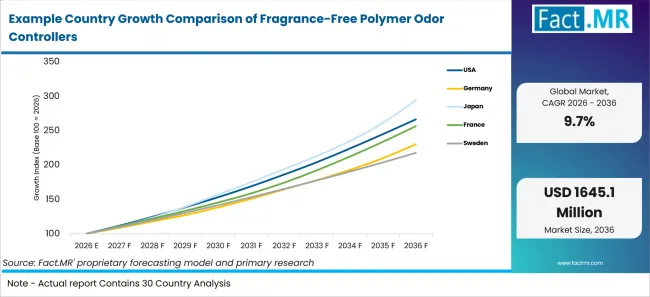
Example Country Growth Comparison Of Fragrance Free Polymer Odor Controllers | Source: Fact.MR
| Country | CAGR (2026-2036) |
|---|---|
| Japan | 11.4% |
| United States | 10.3% |
| France | 9.9% |
| Germany | 8.7% |
| Sweden | 8.1% |
Source: Fact.MR analysis. Updated Sep 19, 2026
What supports Japan adoption?
11.4% CAGR, supported by automotive material qualification and recycled-plastic quality needs.
METI reported that Japan’s industrial production rose 2.2% month over month in January 2026, with motor vehicles contributing most to the increase, followed by plastic products. This manufacturing momentum supports recycled-polymer qualification where automotive suppliers require low-odor materials, consistent processing performance and dependable quality for interior and technical components.
What supports United States adoption?
10.3% CAGR, led by a large plastics-processing base and low-odor material requirements.
U.S. Bureau of Labor Statistics data show 689,100 employees in plastics and rubber products manufacturing in August 2026 on a seasonally adjusted basis. This large processing base supports demand for recycled polymers with low-odor performance, consistent quality and reliable conversion behavior across automotive, packaging and other demanding applications.
What supports France adoption?
9.9% CAGR, backed by vehicle programs and packaging circularity.
France’s Service des données et études statistiques reported 1,664,700 new passenger-car registrations in 2025. This sizable vehicle market supports recycled-polymer qualification for automotive applications, while packaging circularity initiatives encourage converters to evaluate materials that combine lower odor, consistent processing behavior and dependable performance across consumer-facing plastic products.
What supports Germany adoption?
8.7% CAGR, driven by automotive production and material-performance requirements.
Destatis reported that German automotive production increased 3.6% month over month in May 2026 after seasonal and calendar adjustment, making it the main contributor to industrial production growth. This manufacturing strength supports demand for recycled polymers that meet odor, processing consistency and material-performance requirements in automotive applications.
What supports Sweden adoption?
8.1% CAGR, shaped by vehicle applications and recycled-material quality requirements.
The Swedish Transport Agency reported 257,778 type-approved passenger cars registered in Sweden during 2025. This vehicle base supports continued qualification of recycled polymers for automotive components, where suppliers must control odor, material consistency and processing behavior while meeting quality requirements linked to greater recycled-material use in vehicle applications.
Who leads the Fragrance-Free Polymer Odor Controllers Market?
Ampacet, Evonik and Tosaf have directly documented polymer odor-control offerings. Ampacet markets OdorClear™ odor-absorbing masterbatches for post-consumer recycled materials. Evonik offers TEGO® Sorb odor absorbers for masterbatch, compounding and recycling applications and identifies polyolefins and recycled materials among suitable uses. Tosaf lists OdorSeal™ as an odor-control solution whose odor scavengers absorb and eliminate rancid odor associated with recycled materials.
Competitive differentiation includes odor-reduction performance at practical dosage levels, polymer compatibility, thermal stability, color impact and application-specific technical documentation. Laboratory testing and technical support under relevant processing conditions can also support converter and compounder qualification activities.
Which companies are the key providers?
The report profiles Avient; Ampacet; Evonik; and Tosaf.
- Avient
- Ampacet
- Evonik
- Tosaf
Bibliography
- U.S. Environmental Protection Agency. (2025, January 2). EPA finalizes TSCA risk evaluation for formaldehyde.
- Eurostat. (2025, October 6). EU trade of electric and hybrid cars remains stable.
- Ministry of Economy, Trade and Industry. (2026, February 27). Indices of industrial production: Preliminary report for January 2026.
- Service des données et études statistiques. (2026, January 5). Immatriculations de voitures particulières neuves en décembre 2025 [Registrations of new passenger cars in December 2025].
- Federal Statistical Office (Destatis). (2026, July 7). Production in May 2026: +0.9% on the previous month.
- Transportstyrelsen. (2026, February 12). Utsläppen från den nya personbilsflottan fortsätter att minska [Emissions from the new passenger car fleet continue to decrease].
This Report Answers
- The report explains fragrance-free odor control in virgin and recycled polymers. Related analysis covers recycled polymer odor-scavenging additives and polyolefin odor neutralizers where residual odor affects material acceptance.
- Segmentation compares additive chemistry and delivery form. Adjacent coverage of odor-scavenging masterbatches and masterbatch technologies helps frame dosing and dispersion choices during compounding.
- Recycled-content analysis connects feedstock odor variability with recycled plastics and recycling compatibilizer additives where material quality depends on polymer-stream condition and formulation fit.
- Automotive analysis links enclosed-cabin sensory requirements with automotive upholstery and polyolefin compounds used across interior trim and molded polymer components.
- Competitive analysis considers odor formation and recycled-resin quality alongside plastic antioxidants and recycled-content performance modifiers used to support processing stability and performance retention.
What does the Extended-Life Battery Coatings Market cover?
The market covers polymer additives that reduce or neutralize unwanted odor without added fragrance. It includes adsorption, molecular complexing, porous capture, bio-based scavenging, and reactive neutralization when the odor-control function is incorporated into the polymer formulation.
Coverage spans PP, PE, TPO, PA and engineering polymers, and recycled polymer blends across automotive interiors, packaging, consumer goods, nonwovens, and industrial plastics.
What is included in the scope?
The scope includes powders, concentrates, masterbatches, and formulation components whose primary function is to adsorb, bind, neutralize, or react with odor-causing compounds in polymers.
Qualification covers heat stability, dosing window, dispersion, appearance effects, and recycling or food-contact compatibility where these factors shape odor-control use.
What is excluded from the scope?
The scope excludes perfumes used only for masking, stand-alone air fresheners, cabin fragrances, deodorizing sprays, and external devices outside the polymer formulation.
General antioxidants, antimicrobials, compatibilizers, and process aids fall outside the boundary when their defined function is separate from odor control. Resin-washing and thermal-deodorization equipment are treated separately from additive systems.
How Was the Analysis Built?
The analysis draws on 120+ sources, 35+ company portfolios, 25+ countries, and more than 20 industry interviews.
- Primary Research: Primary research includes discussions with manufacturers, service providers, technology developers, distributors, end users, and subject-matter experts. These conversations examine purchasing priorities, product adoption, operational challenges, approval requirements, competitive positioning, and the factors that influence wider market acceptance.
- Desk Research: Desk research covers government statistics, regulatory publications, company filings, trade data, technical studies, industry associations, standards, public policy, and other authoritative sources. Every source used in the analysis is documented in the bibliography.
- Market Sizing and Forecasting: Market estimates combine historical performance, demand indicators, pricing and volume trends, segment shares, company participation, country-level growth, adoption patterns, investment activity, and barriers to market expansion.
- Data Validation and Update Cycle: Findings are validated by comparing primary interviews with public data, company activity, regulatory changes, trade patterns, and industry developments. Regular updates review new product launches, capacity changes, partnerships, approvals, and shifts in commercial adoption.
Segmentation
What is the report’s scope and coverage?
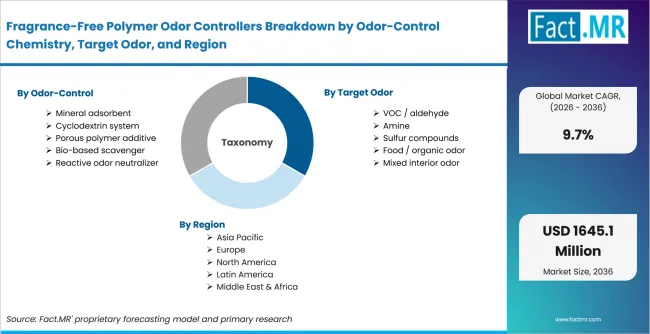
Fragrance Free Polymer Odor Controllers Breakdown By Odor Control Chemistry, Target Odor, And Region | Source: Fact.MR
| Attribute | Details |
|---|---|
| Quantitative Units | USD million |
| Market Definition | Fragrance-free additives and masterbatch systems used in polymers to adsorb, bind, react with, or otherwise reduce unwanted odor compounds without introducing a masking fragrance. |
| Odor-Control Chemistry | Mineral adsorbent; Cyclodextrin system; Porous polymer additive; Bio-based scavenger; Reactive odor neutralizer |
| Target Odor | VOC / aldehyde; Amine; Sulfur compounds; Food / organic odor; Mixed interior odor |
| Polymer | PP; PE; TPO; PA / engineering polymer; Recycled polymer blends |
| Application | Automotive interiors; Packaging; Consumer goods; Nonwovens; Industrial plastics |
| Regions Covered | North America; Latin America; Western Europe; Eastern Europe; East Asia; South Asia & Pacific; Middle East & Africa |
| Countries Covered | United States; Germany; Japan; France; Sweden |
| Key Companies Profiled | Avient; Ampacet; Evonik; Tosaf |
| Forecast Period | 2026 to 2036 |
| Approach | Hybrid top-down and bottom-up assessment using polymer conversion activity, recycled-content use, odor-control chemistry fit, application qualification, country demand indicators, and provider portfolio review. |
Source: Fact.MR analysis. Updated Sep 19, 2026
How is the market segmented?
-
By Odor-Control Chemistry
- Mineral adsorbent
- Cyclodextrin system
- Porous polymer additive
- Bio-based scavenger
- Reactive odor neutralizer
-
By Target Odor
- VOC / aldehyde
- Amine
- Sulfur compounds
- Food / organic odor
- Mixed interior odor
-
By Polymer
- PP
- PE
- TPO
- PA / engineering polymer
- Recycled polymer blends
-
By Application
- Automotive interiors
- Packaging
- Consumer goods
- Nonwovens
- Industrial plastics
-
By Region
- North America
- Latin America
- Western Europe
- Eastern Europe
- East Asia
- South Asia & Pacific
- Middle East & Africa
Frequently Asked Questions
How big is the Fragrance-Free Polymer Odor Controllers Market in 2026?
What is the CAGR of the Fragrance-Free Polymer Odor Controllers Market from 2026 to 2036?
Which odor-control chemistry leads the market?
Which application leads the market?
Which companies are profiled in the market?
Who worked on this report


Preview the report firsthand - request a free sample
Free SampleGet the brochure for pricing and purchase details
Download PDF