- Market Value (2025): USD 2.4 Bn
- Estimated Value (2026): USD 2.6 Bn
- Forecast Value (2036): USD 4.8 Bn
- CAGR (2026-2036): 6.4%
What is the Fruit-Based Food Inclusions Market forecast to be worth by 2036?
USD 2.6 billion in 2026 to USD 4.8 billion by 2036, at a 6.4% CAGR.
- The fruit-based food inclusions market reached USD 2.4 billion in 2025 as bakery, dairy, frozen dessert, cereal, snack and confectionery manufacturers used fruit ingredients to add taste, texture and visible product differentiation.
- Demand is projected to increase from USD 2.6 billion in 2026 to USD 4.8 billion by 2036, at a 6.4% CAGR.
- The market is forecast to record a 6.4% CAGR from 2026 to 2036 as food manufacturers increase the use of fruit pieces, fillings and stable processed fruit formats in applications where sensory impact has to survive commercial processing.
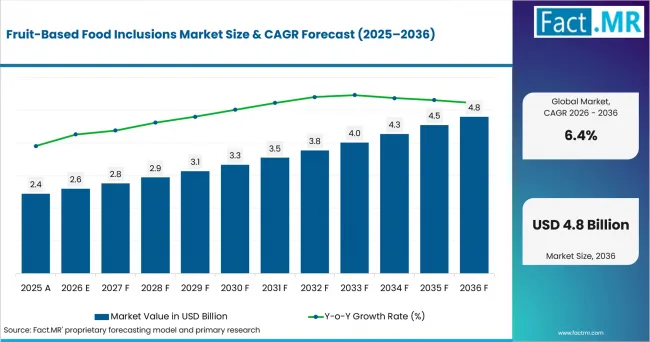
Fruit Based Food Inclusions Market Value Analysis | Source: Fact.MR
What are the defining numbers behind Fruit-Based Food Inclusions Market growth?
- Market Defination
- USD 2.235 billion absolute opportunity is expected between 2026 and 2036.
- Fruit pieces/dices account for 34.0% of Inclusion Type in 2026, equivalent to USD 884 million.
- Berries account for 31.0% of Fruit in 2026.
- Bakery represents 33.0% of Application in 2026.
- IQF/frozen accounts for 44.0% of Processing in 2026.
- Demand Drivers in the Market
- Recognizable fruit content is becoming a formulation tool rather than a garnish. Suppliers increasingly design pieces, flakes and fillings around moisture control, bake stability and shelf-life performance so manufacturers can maintain visible fruit identity after processing.
- Bakery is a central demand route because fruit inclusions can be used in fillings, bars, cakes, pastries and cereal-based products. The buying decision depends on whether the ingredient holds flavor, color and distribution through the production line.
- IQF and dehydrated formats improve sourcing flexibility by reducing dependence on immediate fresh-fruit use. For processors, this supports production planning across harvest cycles while retaining fruit identity in the finished product.
- Dairy and ice cream manufacturers use fruit preparations, sauces and inclusions to create flavor contrast and texture. The supplier advantage comes from controlling viscosity, fruit-piece integrity and freeze-thaw behavior at scale.
- Key Segments Analyzed
- By Inclusion Type: Fruit pieces/dices are projected to hold 34.0% share in 2026. The format leads because visible fruit pieces support texture and product recognition across bakery, cereal, confectionery, dairy and frozen dessert applications.
- By Fruit: Berries are projected to hold 31.0% share in 2026. Strawberry, raspberry, blueberry and related berry profiles work across sweet applications and are available in multiple processed forms, including pieces, purees, fillings and IQF ingredients.
- By Application: Bakery is projected to hold 33.0% share in 2026. Fruit fillings and inclusions can be built into doughs, batters, pastries and bars, but commercial adoption depends on process stability and controlled moisture migration.
- By Processing: IQF/frozen is projected to hold 44.0% share in 2026. Rapid freezing after harvest helps preserve fruit texture and creates a practical ingredient format for industrial food and beverage formulation.
- Analyst Opinion at Fact.MR
- Shambhu Nath Jha, Principal Consultant at Fact.MR, states, "Fruit inclusions gain value when they remain recognizable after processing. Buyers are evaluating the fruit format together with moisture behavior, line stability and the sensory role it has to perform in the finished product."
- Strategic Implications
- Suppliers should organize portfolios around application performance, especially bake stability, freeze-thaw behavior and moisture migration.
- Bakery customers should qualify fruit pieces and fillings against the actual heat profile and water activity of the finished product.
- IQF and dried formats should be positioned around sourcing continuity and process compatibility rather than only around fruit origin.
- Commercial teams should separate visual inclusions from flavor-only systems because buyers use them for different product claims and sensory outcomes.
How does the Fruit-Based Food Inclusions Market break down by segment?
Why do Fruit Pieces/Dices lead Inclusion Type?
Fruit pieces/dices are projected to account for a 34.0% share in 2026.
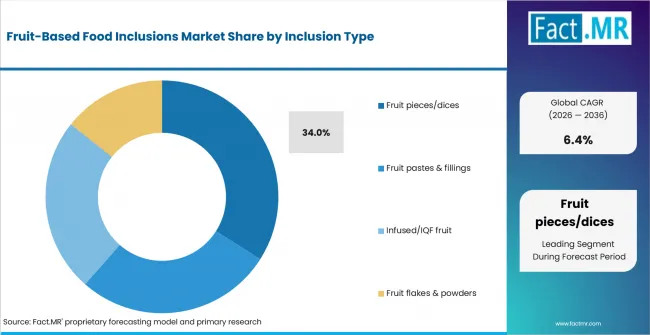
Fruit Based Food Inclusions Market Analysis By Inclusion Type | Source: Fact.MR
The format leads because it provides a direct visual and textural signal that consumers can identify as fruit. AGRANA offers fruit preparations with inclusions across dairy, ice cream and bakery, while TAURA by IFF supplies fruit pieces designed for snacks, cereal, chocolate and baked goods. The breadth of these application routes supports the role of recognizable pieces as a core inclusion format.
For manufacturers, the technical requirement is consistency. Piece size, moisture level and distribution have to remain controlled through dosing and processing. A visible inclusion that breaks down, bleeds excessively or migrates moisture can affect both product appearance and line performance.
Why do Berries lead Fruit?
Berries are projected to account for a 31.0% share in 2026.
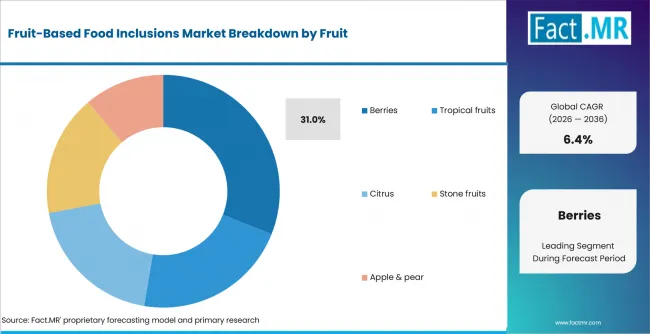
Fruit Based Food Inclusions Market Analysis By Fruit | Source: Fact.MR
Berries lead because they translate across several finished-food categories without requiring the same formulation logic in each one. Strawberry, raspberry and blueberry profiles can be supplied as pieces, fillings, purees, flakes or IQF ingredients for bakery, dairy, ice cream, cereal and confectionery products.
The category also benefits from strong color and flavor recognition. The processing challenge is to preserve the intended berry character while controlling acidity, water activity and texture. This increases the value of application-specific formats rather than undifferentiated fruit input.
Why does Bakery lead Application?
Bakery is projected to account for a 33.0% share in 2026.
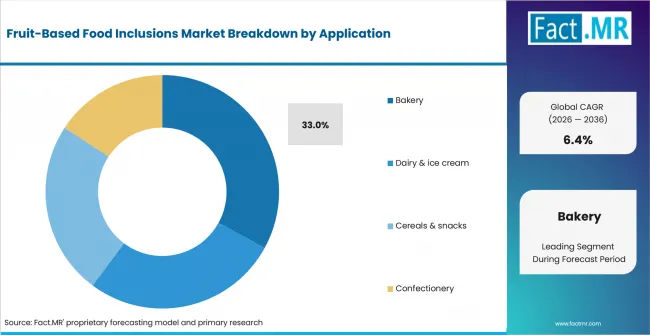
Fruit Based Food Inclusions Market Analysis By Application | Source: Fact.MR
Bakery leads because fruit inclusions can be built into multiple product architectures, from filled pastries and cakes to bars, cookies and cereal-based snacks. Puratos markets fruit fillings with high fruit content and process stability, while TAURA by IFF positions fruit inclusions for baked goods around taste, texture and shelf-life performance.
The purchasing decision is therefore tied to process conditions. A bakery inclusion has to tolerate mixing and heat while retaining enough fruit identity to justify its sensory role. This creates repeat demand for formats already qualified against industrial baking conditions.
Why does IQF/Frozen lead Processing?
IQF/frozen is projected to account for a 44.0% share in 2026.
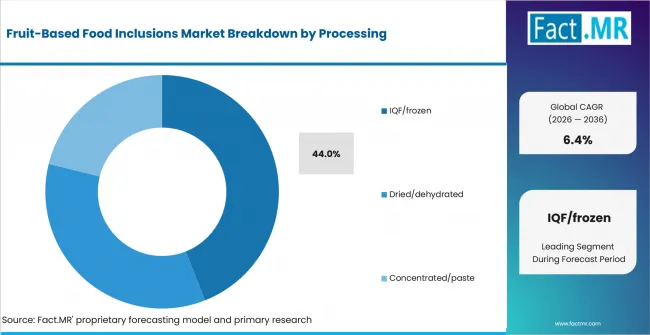
Fruit Based Food Inclusions Market Analysis By Processing | Source: Fact.MR
IQF/frozen leads because it creates a practical bridge between seasonal fruit supply and year-round food manufacturing. SVZ describes IQF fruit as frozen immediately after harvest to preserve taste and texture, while USDA commodity specifications recognize IQF frozen fruit formats for manufacturing and institutional procurement.
For buyers, the advantage is operational. Frozen formats can support standardized recipes, controlled inventory and repeatable fruit quality across production cycles. Dried and concentrated formats remain important where lower water activity, compact storage or different processing behavior is required.
What is accelerating Fruit-Based Food Inclusions Market adoption, and what is holding it back?
Drivers Impact Analysis
| Driver | (~) % Impact on CAGR | Geographic Relevance | Impact Timeline |
|---|---|---|---|
| Demand for visible fruit identity and texture in finished foods | +1.2% | Global | Near to medium term |
| Expansion of bakery, snack and cereal applications using stable fruit inclusions | +1.0% | North America and Europe | Near to medium term |
| Use of IQF and dried formats to support year-round manufacturing | +0.9% | Global | Medium term |
| Application-specific fruit preparations for dairy and frozen desserts | +0.7% | Europe and North America | Medium term |
Source: Fact.MR analysis. Updated Aug 14, 2026
Opportunity Impact Analysis
| Opportunity | (~) % Impact on CAGR | Geographic Relevance | Impact Timeline |
|---|---|---|---|
| Clean-label fruit pieces and fillings with controlled process stability | +0.8% | Global | Medium term |
| Low-water-activity inclusions for bars, cereal and ambient snacks | +0.6% | USA and Europe | Medium term |
| Sourcing systems that combine multiple origins and processing formats | +0.4% | Global | Medium to long term |
Source: Fact.MR analysis. Updated Aug 14, 2026
Restraints Impact Analysis
| Restraint | (~) % Impact on CAGR | Geographic Relevance | Impact Timeline |
|---|---|---|---|
| Seasonal raw-fruit variability and crop-quality swings | -1.0% | Global | Near term |
| Moisture migration, color bleed and texture loss during processing | -0.8% | Global | Near to medium term |
| Cost pressure from cold-chain, energy and fruit-input volatility | -0.7% | Global | Medium term |
Source: Fact.MR analysis. Updated Aug 14, 2026
Which countries are scaling the Fruit-Based Food Inclusions Market fastest?
- United States: Commercial demand is supported by a large processed-food base and established specifications for frozen fruit ingredients. USDA commodity standards cover IQF berries and fruit puree formats used in manufacturing, supporting repeatable procurement and processing.
- Germany: Germany has an established orchard-fruit and bush-berry supply base, including organic production reported by the Federal Statistical Office. This gives processors access to locally relevant fruit categories alongside imported ingredients.
- France: French agriculture policy is actively assessing the resilience of fruit and vegetable sectors through 2040. For processors, climate adaptation and supply continuity increase the value of flexible sourcing and preserved fruit formats.
- United Kingdom: Defra reported a soft-fruit production value of GBP 776 million in 2025. Berry demand and domestic horticulture support bakery, dessert and snack applications that use fruit pieces, fillings and frozen ingredients.
- Netherlands: The Netherlands remains a major agricultural trade hub. Growth in agricultural export value reinforces its role in sourcing, handling and distributing fruit raw materials and processed ingredients across European food manufacturing.
- Italy: ISTAT reported an 8.8% increase in the value of fruit production in 2025 even as volumes declined slightly. Higher fruit value increases the incentive to use processing formats that protect yield, shelf life and application value.
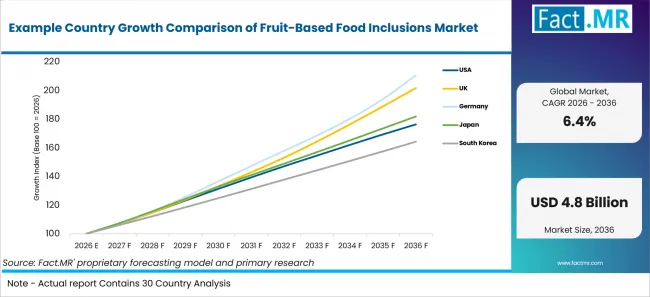
Example Country Growth Comparison Of Fruit Based Food Inclusions Market | Source: Fact.MR
| Country | 2026 Share | CAGR (2026-2036) |
|---|---|---|
| United States | 28.0% | 8.2% |
| Germany | 16.0% | 6.6% |
| France | 14.0% | 7.3% |
| United Kingdom | 13.0% | 8.1% |
| Netherlands | 11.0% | 6.6% |
| Italy | 18.0% | 5.6% |
Source: Fact.MR analysis. Updated Aug 14, 2026
What is driving United States's growth through 2036?
United States is forecast to expand at a 8.2% CAGR from 2026 to 2036.
US food manufacturers have access to standardized frozen-fruit formats and a large application base across bakery, dairy, cereal, snacks and confectionery. USDA specifications for frozen fruit reduce ambiguity around grades and ingredient handling, supporting repeat procurement for industrial production.
What is driving Germany's growth through 2036?
Germany is forecast to expand at a 6.6% CAGR from 2026 to 2036.
Germany combines a developed food-processing sector with domestic orchard and bush-berry production. The purchasing opportunity is strongest where suppliers can provide stable berry and fruit formats that work across bakery, dairy and snack lines while reducing seasonal variability.
What is driving France's growth through 2036?
France is forecast to expand at a 7.3% CAGR from 2026 to 2036.
France is planning for long-term changes in fruit and vegetable production linked to climate and regional growing conditions. Food manufacturers therefore have a stronger reason to diversify fruit origins and qualify frozen, dried and concentrated formats that can stabilize availability.
What is driving United Kingdom's growth through 2036?
United Kingdom is forecast to expand at a 8.1% CAGR from 2026 to 2036.
The UK retains meaningful soft-fruit production and a broad bakery and snack manufacturing base. Fruit-inclusion demand benefits when suppliers can combine recognizable berry content with processing stability and year-round availability.
What is driving Netherlands's growth through 2036?
Netherlands is forecast to expand at a 6.6% CAGR from 2026 to 2036.
The Netherlands functions as a sourcing and distribution gateway for agricultural goods moving into European food manufacturing. This supports ingredient businesses that can consolidate fruit origins, processing formats and logistics for regional customers.
What is driving Italy's growth through 2036?
Italy is forecast to expand at a 5.6% CAGR from 2026 to 2036.
Italy has a large fruit and food-processing ecosystem, while recent fruit-value gains increase focus on preserving raw-material value through processing. Fillings, pastes, frozen fruit and pieces can help manufacturers extend fruit use beyond immediate fresh-market windows.
Who leads the Fruit-Based Food Inclusions Market?
AGRANA Fruit S.A.S. is positioned as a leading supplier through fruit preparations and fruit specialities used across dairy, ice cream and bakery. Its portfolio includes preparations with fruit inclusions and multiple fruit families, giving manufacturers a route from raw-fruit sourcing to application-ready systems.
International Flavors & Fragrances Inc. competes through TAURA by IFF, which supplies real-fruit inclusions, flakes and pastes for baked goods, cereal, nutritional bars, snacks and chocolate. Kerry Group plc participates through taste and ingredient systems used in bars, cereals and other food applications where fruit, fillings and flavor systems are combined.
Puratos Group NV competes through fruit fillings designed for bakery and patisserie, including products with visible fruit pieces and process stability. SVZ International B.V. supplies purees, concentrates, NFC juices and IQF fruit ingredients, while Balchem Corporation offers inclusion technologies for bakery and frozen dessert applications.
Competition is shaped by fruit sourcing, process stability and format breadth. Buyers also assess piece integrity, water activity, color retention, freeze-thaw behavior and the ability to move from development samples to repeat commercial supply.
Which companies are the key providers?
Key companies include AGRANA Fruit S.A.S.; International Flavors & Fragrances Inc. (TAURA by IFF); Kerry Group plc; Puratos Group NV; SVZ International B.V.; and Balchem Corporation.
- AGRANA Fruit S.A.S.
- International Flavors & Fragrances Inc. (TAURA by IFF)
- Kerry Group plc
- Puratos Group NV
- SVZ International B.V.
- Balchem Corporation
Bibliography
- AGRANA. (2026). Fruit: fruit preparations and fruit specialities for dairy, ice cream and bakery. Source
- AGRANA. (2026). Fruit solutions for the food and beverage industry. Source
- International Flavors & Fragrances Inc. (2026). TAURA by IFF: real fruit inclusions for innovative food applications. Source
- International Flavors & Fragrances Inc. (2025). IFF announces expansion of Cedar Rapids, Iowa ingredients facility for TAURA capacity. Source
- Kerry Group plc. (2026). Nutritional bars and cereals: ingredient systems including fruits and fillings. Source
- Puratos Group NV. (2025). Fruit fillings with real fruit content and process stability. Source
- SVZ International B.V. (2026). Conventional fruit: purees, concentrates, NFCs and IQF ingredients. Source
- SVZ International B.V. (2026). IQF fruit ingredients. Source
- Balchem Corporation. (2026). Inclusions for bakery and frozen dessert applications. Source
- U.S. Department of Agriculture, Agricultural Marketing Service. (2026). Commodity specification for frozen fruit. Source
- German Federal Statistical Office. (2026). Organic farming: orchard fruit and bush berries, 2025. Source
- Ministry of Agriculture, Agrifood and Food Sovereignty, France. (2025). What futures for the French fruit and vegetable sectors by 2040? Source
- Department for Environment, Food & Rural Affairs, United Kingdom. (2026). Horticulture statistics 2025. Source
- Statistics Netherlands and Wageningen Economic Research. (2026). Value of agricultural exports up by over 8 percent in 2025. Source
- Italian National Institute of Statistics. (2026). Economic accounts for agriculture - Year 2025. Source
This Report Answers
- The report explains how fruit-based food inclusions differ by physical format and processing route.
- It assesses demand across berry, tropical, citrus, stone-fruit, apple and pear ingredient systems.
- It evaluates application requirements across bakery, dairy and ice cream, cereals and snacks, and confectionery.
- Country analysis explains the production, processing and sourcing factors shaping demand in the listed markets.
- Competitive analysis compares fruit-ingredient suppliers on application capability, processing formats and commercial supply support.
What does the Fruit-Based Food Inclusions Market cover?
The market covers fruit pieces, dices, pastes, fillings, infused or IQF fruit, flakes and powders supplied as ingredients for processed foods. The products are purchased for one or more sensory functions, including visible fruit identity, texture, flavor, color or filling performance.
The assessment follows the segmentation by Inclusion Type, Fruit, Application and Processing. It includes fruit ingredients used in bakery, dairy and ice cream, cereals and snacks, and confectionery when they are supplied as part of the finished-food formulation rather than sold only as fresh produce.
What is included in the scope?
The scope includes application-ready fruit inclusions and intermediate fruit ingredients used by food manufacturers. Included processing formats are IQF or frozen fruit, dried or dehydrated fruit, and concentrated or paste formats when the product is used as an inclusion, filling or fruit system in a processed food.
Products can include visible pieces, low-water-activity fruit formats, bakery fillings, fruit preparations and other fruit-based systems designed for industrial handling and repeatable formulation.
What is excluded from the scope?
Fresh fruit sold primarily for direct retail consumption is excluded. Finished jams, desserts, bakery products, dairy products, cereals, snacks and confectionery are also outside the market because they are downstream applications rather than fruit-inclusion revenue.
Fruit juices sold as finished beverages, processing equipment, packaging and unrelated flavor-only systems without a fruit-inclusion or fruit-ingredient function are excluded from market revenue.
How Was the Analysis Built?
The analysis combines supplier portfolio review, public agricultural statistics, food-processing evidence and market modelling for size, growth, country CAGRs and segment shares.
- Primary Research: Relevant respondent groups include fruit-ingredient suppliers, food product developers, bakery and dairy formulators, procurement teams and processors that specify fruit inclusions for commercial production.
- Desk Research: The review uses official agriculture statistics, government horticulture sources and current supplier documentation on fruit formats, processing methods and application performance.
- Market Sizing and Forecasting: The sizing framework combines application demand with inclusion penetration, processing format, fruit mix and country-level growth.
- Data Validation and Update Cycle: Company identities and current product portfolios are checked against official company sources. Market values, segment shares and country growth assumptions are checked for internal consistency before publication.
Segmentation
What is the report's scope and coverage?
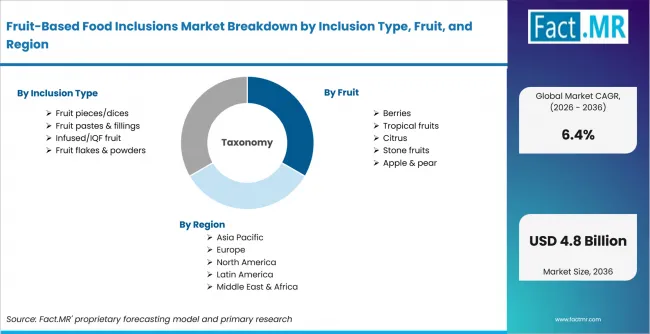
Fruit Based Food Inclusions Market Breakdown By Inclusion Type, Fruit, And Region | Source: Fact.MR
| Attribute | Details |
|---|---|
| Quantitative Units | USD Million |
| Market Definition | Fruit-based inclusions and intermediate fruit ingredients formulated to add recognizable fruit taste, texture, color and visual identity to processed food applications. |
| Segments Covered | Inclusion Type; Fruit; Application; Processing |
| Geographic Coverage | Global market with country analysis for the listed countries |
| Countries Covered | United States; Germany; France; United Kingdom; Netherlands; Italy |
| Key Companies Profiled | AGRANA Fruit S.A.S.; International Flavors & Fragrances Inc. (TAURA by IFF); Kerry Group plc; Puratos Group NV; SVZ International B.V.; Balchem Corporation |
| Forecast Period | 2026 to 2036 |
| Approach | Bottom-up and top-down assessment using application demand, segment shares, country growth, supplier portfolios and processing requirements for fruit inclusions. |
Source: Fact.MR analysis. Updated Aug 14, 2026
How is the market segmented?
-
By Inclusion Type
- Fruit pieces/dices
- Fruit pastes & fillings
- Infused/IQF fruit
- Fruit flakes & powders
-
By Fruit
- Berries
- Tropical fruits
- Citrus
- Stone fruits
- Apple & pear
-
By Application
- Bakery
- Dairy & ice cream
- Cereals & snacks
- Confectionery
-
By Processing
- IQF/frozen
- Dried/dehydrated
- Concentrated/paste
-
By Region
- North America
- Latin America
- Western Europe
- Eastern Europe
- East Asia
- South Asia and Pacific
- Middle East & Africa
Frequently Asked Questions
How large is the Fruit-Based Food Inclusions Market in 2026?
Which Inclusion Type leads the market?
Which Fruit leads the market?
Which Application leads the market?
Which Processing format leads the market?
Which country is forecast to grow fastest among the listed markets?
Who are the key providers in the Fruit-Based Food Inclusions Market?
What is the main commercial restraint?
What should food manufacturers evaluate before buying?
Who worked on this report


Preview the report firsthand - request a free sample
Free SampleGet the brochure for pricing and purchase details
Download PDF