Gesture Control Market (2026 - 2036)

Gesture Control Market is segmented by Input Devices (Wearable-based, Vision-based, Infrared-based, Electric Field-based, and Ultrasonic-based), Dimension (2-Dimension and 3-Dimension), Application (Consumer Electronics, Automotive, Gaming and Entertainment, Healthcare, Defense, and Others) and Region. Forecast for 2026 to 2036.

Core Findings

    Gesture Control Market Forecast and Outlook By Fact. MR

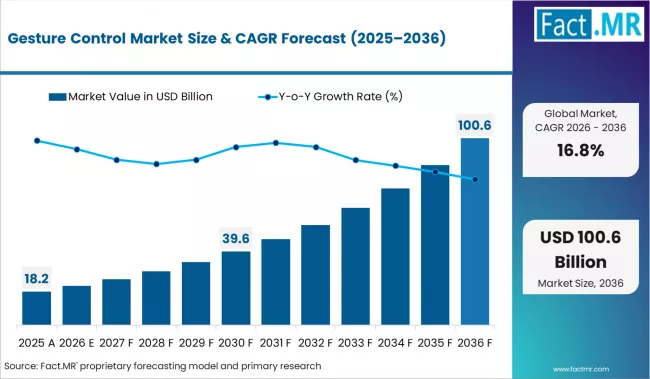
    In 2025, the gesture control market was valued at USD 18.3 billion. Based on Fact.MR analysis, demand for gesture control solutions is estimated to grow to USD 21.3 billion in 2026 and USD 100.6 billion by 2036. FACT.MR projects a CAGR of 16.8% during the forecast period.

    Fact.MR opines the market is expected to generate an absolute dollar opportunity of USD 82.3 billion between 2026 and 2036. This represents transformational growth, supported by AR/VR ecosystem expansion, automotive touchless interface adoption, and healthcare demand for sterile interaction systems. Growth is moderated by high integration costs in industrial applications and accuracy limitations in low-cost sensor systems.

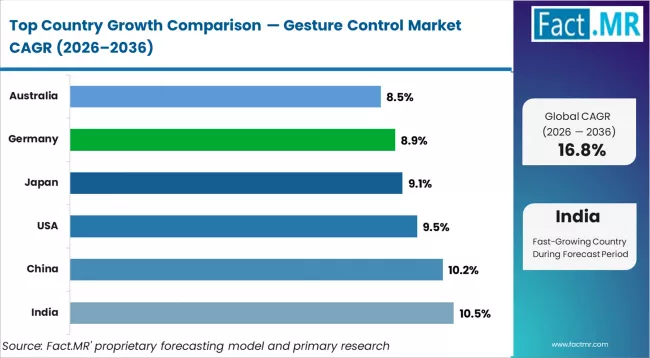
    Country growth varies based on technology adoption and automotive digitalisation. India leads at 10.5% CAGR driven by consumer electronics expansion and automotive electronics growth. China follows at 10.2% supported by AR/VR and smart device adoption. The USA grows at 9.5% driven by gaming, healthcare, and automotive innovation. Japan registers 9.1% supported by robotics and automotive integration. Germany grows at 8.9% driven by automotive engineering demand, while Australia grows at 8.5% with adoption in healthcare and defense sectors.
    Gesture Control Market Market Value Analysis

    Metric Value
    Estimated Value in 2026 USD 21.3 billion
    Forecast Value in 2036 USD 100.6 billion
    Forecast CAGR (2026 to 2036) 16.8%

    Gesture Control Market Definition

    The gesture control market includes technologies that enable users to interact with devices using physical movements such as hand gestures, body motion, or facial expressions without physical contact. These systems use sensors, cameras, and software algorithms to interpret motion into digital commands. Gesture control is widely used in consumer electronics, automotive infotainment systems, gaming, healthcare devices, and industrial automation to improve user experience, safety, and hygiene.

    Gesture Control Market Inclusions

    The report covers global and regional market size forecasts from 2026 to 2036 across input devices, dimension types, and application segments. It includes gesture recognition hardware, software platforms, and integrated solutions across consumer electronics, automotive, healthcare, defense, and entertainment industries, along with adoption trends and technology evolution.

    Gesture Control Market Exclusions

    The scope excludes traditional touch-based interfaces, voice-only control systems, and standalone computer vision solutions not integrated with gesture recognition functionality. It also excludes industrial robotics systems without human gesture interface layers and general-purpose AI vision platforms not specifically designed for gesture-based interaction.

    Gesture Control Market Research Methodology

    • Primary Research: Interviews with OEM product managers, AR/VR developers, automotive HMI engineers, and healthcare device manufacturers.
    • Desk Research: Sources include company filings, AR/VR market reports, automotive electronics data, and government digitalisation initiatives.
    • Market Sizing and Forecasting: Hybrid model using device adoption rates, sensor integration volumes, and software revenue benchmarks.
    • Data Validation and Update Cycle: Validated using company disclosures, industry adoption data, and expert interviews.

    Summary Of Gesture Control Market

    • Market Definition
      • The market includes sensor-based and vision-based technologies enabling touchless human-machine interaction across devices and industries.
    • Demand Drivers
      • AR/VR adoption is increasing demand for immersive gesture-based interfaces.
      • Automotive touchless infotainment systems are improving safety and driving adoption.
      • Healthcare demand for sterile, contactless interfaces is expanding use cases.
    • Key Segments Analyzed
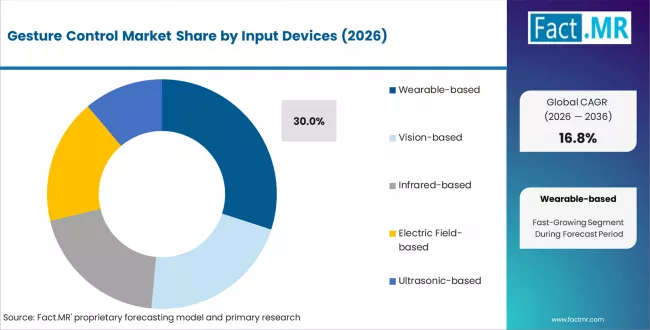
      • By Input Devices: Wearable-based holds about 30% share in 2026 due to integration in AR/VR and smart devices.
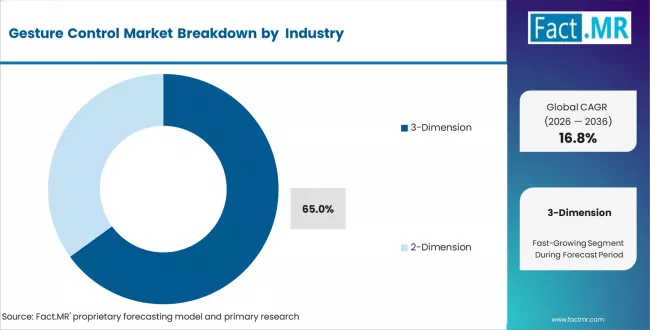
      • By Dimension: 3D gesture control holds about 65% share in 2026 due to higher accuracy and immersive interaction.
      • By Application: Consumer electronics leads with about 38% share in 2026 driven by smartphones and smart devices.
    • Analyst Opinion at FACT.MR
      • Shambhu Nath Jha, Principal Consultant at Fact.MR opines, that CXOs will find this report helpful in understanding how AR/VR expansion, automotive digital interfaces, and healthcare sterilisation needs are shaping long-term demand for gesture control technologies.
    • Strategic Implications
      • Companies should invest in 3D sensing and AI-based gesture recognition to improve accuracy.
      • OEMs should integrate gesture control into automotive and AR/VR ecosystems.
      • Vendors should develop cost-effective solutions for mass-market consumer electronics.
    • Methodology
      • Market sizing used device adoption and sensor integration data validated with company disclosures.
      • Industry reports and government digital initiatives supported demand analysis.
      • Forecasts incorporated AR/VR growth, automotive electronics trends, and primary interviews.

    Segmental Analysis

    Gesture Control Market Analysis by Input Devices
    Gesture Control Market Analysis By Input Devices

    Based on FACT.MR's gesture control market report, consumption of wearable-based devices is estimated to hold 30% share in 2026. Wearable devices dominate due to integration in AR/VR headsets, smartwatches, and fitness devices enabling intuitive interaction without physical touch.

    • Ultraleap AR Integration: Ultraleap expanded its hand tracking technology integration into AR/VR devices in 2025, enabling more precise and responsive gesture recognition. This improves user interaction in immersive environments where controller-free navigation is essential [1]
    • Apple Vision System Development: Apple introduced gesture-based controls in its Vision Pro platform in 2024, allowing users to interact with digital content using hand and eye movements. This has accelerated adoption of wearable gesture interfaces in premium consumer ecosystems [2]
    • Wearable Adoption Trend: Global wearable shipments increased significantly in 2024, supporting wider adoption of gesture-enabled interfaces across devices. Growth in smartwatches, fitness trackers, and AR headsets is creating a strong foundation for gesture control integration [3]

    Gesture Control Market Analysis by Dimension
    Gesture Control Market Analysis By Dimension

    Based on FACT.MR's gesture control market report, consumption of 3-dimension systems is estimated to hold 65% share in 2026. 3D systems dominate due to their ability to capture depth and motion accurately, enabling complex gesture recognition in automotive and gaming applications.

    • Intel RealSense Expansion: Intel expanded its RealSense 3D sensing technology in 2024, targeting automotive and robotics applications where accurate depth perception is critical. This supports advanced gesture recognition capabilities in autonomous systems and smart machines [4]
    • NVIDIA AI Vision Development: NVIDIA advanced its AI-based vision systems in 2025 to enhance gesture recognition accuracy across gaming and automotive use cases. These systems leverage deep learning to interpret complex hand and body movements in real time [5]
    • ADAS Integration Trend: Automotive OEMs increased the integration of gesture-based controls into infotainment and cockpit systems in 2024. This trend supports safer, hands-free interaction while driving and complements broader ADAS feature expansion [6]

    Drivers, Restraints, and Opportunities
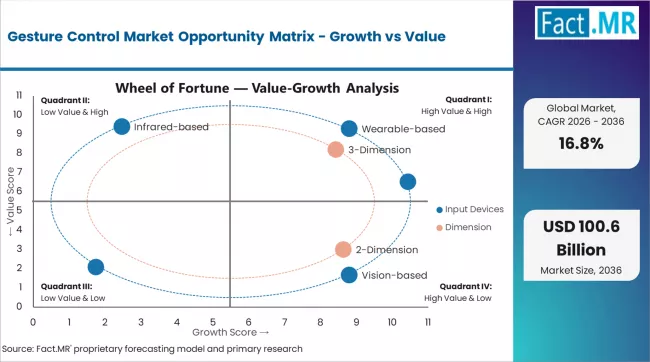
    Gesture Control Market Opportunity Matrix Growth Vs Value

    FACT.MR analysts observe that the gesture control market has evolved from niche gaming interfaces to mainstream human-machine interaction technology. Growth is closely linked to digitalisation, AR/VR expansion, and automotive electronics integration.

    The market is shifting toward AI-enabled, sensor-driven interaction systems. Traditional touch interfaces are facing gradual replacement, while advanced gesture recognition systems command higher pricing due to improved accuracy and user experience.

    • AR/VR Expansion: Rapid growth in AR/VR ecosystems is driving demand for immersive, touchless interaction systems. Gesture control enables natural user movement tracking in gaming, training, and enterprise simulation environments, reducing reliance on handheld controllers and improving user experience.
    • Automotive Safety Integration: Increasing focus on driver safety and regulatory pressure to reduce distraction is accelerating adoption of gesture-based controls in vehicles. Automakers are integrating gesture interfaces into infotainment and dashboard systems to allow hands-free operation and minimize physical interaction while driving.
    • Healthcare Hygiene Demand: Hospitals and clinical facilities are adopting gesture control systems to maintain sterile environments and reduce cross-contamination risks. Touchless interfaces are increasingly used in operating rooms, diagnostic systems, and medical imaging equipment where physical contact must be minimized.

    Regional Analysis

    The gesture control market is analysed across Asia Pacific, North America, Europe, Latin America, and Middle East and Africa, covering 40+ country-level demand patterns shaped by AR/VR adoption, automotive electronics growth, and digital interface innovation. The full report offers market attractiveness analysis based on technology adoption and industry demand trends.

    Top Country Growth Comparison Gesture Control Market Cagr (2026 2036)

    Country CAGR (2026 to 2036)
    India 10.5%
    China 10.2%
    USA 9.5%
    Japan 9.1%
    Germany 8.9%
    Australia 8.5%

    Source: Fact.MR(FACT.MR) analysis, based on proprietary forecasting model and primary research
    Gesture Control Market Cagr Analysis By Country

    Asia Pacific Gesture Control Market Analysis

    Asia Pacific is the fastest-growing region driven by consumer electronics manufacturing and AR/VR adoption. Companies such as Ultraleap and domestic OEMs are expanding presence across the region.

    • India: Demand for gesture control in India is projected to rise at 10.5% CAGR through 2036. Consumer electronics demand is increasing with smartphone and wearable adoption. Government digital initiatives and manufacturing programs are supporting technology adoption. Automotive sector expansion is increasing gesture-based interface integration.
    • China: Demand for gesture control in China is projected to rise at 10.2% CAGR through 2036. AR/VR and gaming industries are expanding rapidly. Domestic manufacturers are investing in smart device innovation. Government support for digital technologies is accelerating adoption.

    FACT.MR's analysis of the gesture control market in Asia Pacific includes India, China, Japan, South Korea, Australia and New Zealand, and ASEAN. Readers can find AR/VR adoption trends, device demand data, and country-level forecasts.

    North America Gesture Control Market Analysis
    Gesture Control Market Country Value Analysis

    North America is a technology innovation hub with strong adoption in gaming, healthcare, and automotive sectors.

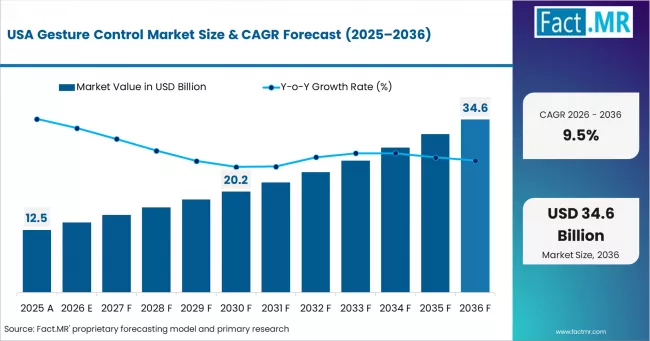
    • USA: Demand for gesture control in the United States is projected to rise at 9.5% CAGR through 2036. Gaming and AR/VR industries are driving adoption. Healthcare sector is using gesture interfaces for sterile environments. Technology companies are investing heavily in AI-based gesture systems.

    FACT.MR's analysis of the gesture control market in North America includes the United States, Canada, and Mexico. Readers can find technology adoption trends and market forecasts.

    Europe Gesture Control Market Analysis
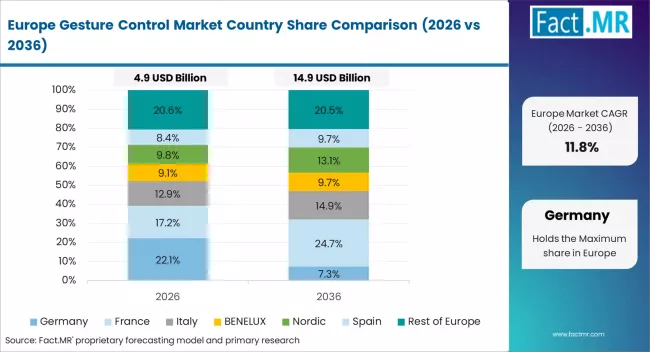
    Gesture Control Market Europe Country Market Share Analysis, 2026 & 2036

    Europe is a mature but innovation-driven market with strong automotive and industrial applications.

    • Germany: Demand for gesture control in Germany is projected to rise at 8.9% CAGR through 2036. Automotive OEMs are integrating gesture systems in vehicles. Industrial automation is supporting adoption. Engineering companies are investing in advanced HMI technologies.
    • Australia: Demand for gesture control in Australia is projected to rise at 8.5% CAGR through 2036. Healthcare and defense sectors are adopting gesture interfaces. Government funding supports advanced technology deployment.

    FACT.MR's analysis of the gesture control market in Europe includes Germany, France, the UK, Italy, Spain, Nordic countries, and BENELUX. Readers can find adoption trends and regulatory insights.

    Competitive Aligners for Market Players
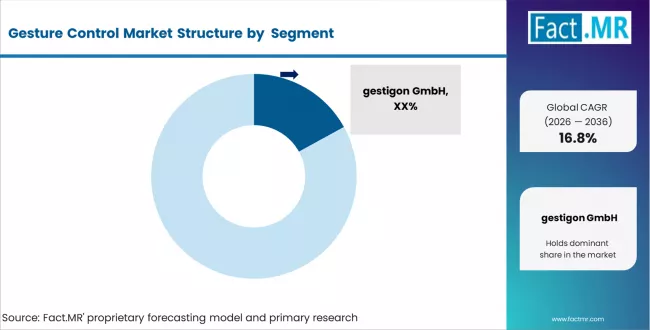
    Gesture Control Market Analysis By Company

    Competition in the gesture control market is spread across both focused innovation-led firms and established global electronics and chip manufacturers, each targeting different use cases and customer segments. While no single company dominates the entire value chain, firms focusing on advanced sensing and software integration are gaining a stronger position. The main competition is no longer just about hardware capability, but about how well gesture systems integrate with broader ecosystems such as AR/VR, automotive platforms, and smart devices.

    Companies like Ultraleap and gestigon focus on precision tracking and software algorithms, giving them an edge in high-performance applications such as VR and industrial systems. Large players such as Intel and Apple benefit from ecosystem control, embedding gesture technologies into broader hardware and software platforms. This allows them to scale faster and lock users into their environments. Meanwhile, mid-sized firms compete by offering cost-effective solutions tailored for specific industries like automotive or healthcare.

    Large OEMs tend to work with multiple vendors to reduce dependency, especially in automotive and consumer electronics. However, once a gesture platform is integrated into a device ecosystem, switching becomes difficult due to software compatibility and user experience constraints. This creates moderate pricing power for established vendors, particularly those offering integrated hardware and software solutions.

    Key Players

    • gestigon GmbH
    • Ultraleap
    • Cipla
    • 4tiitoo GmbH
    • Logbar
    • PointGrab
    • Nimble VR
    • Intel Corporation
    • Apple Inc.
    • ArcSoft Inc.

    Scope of Report

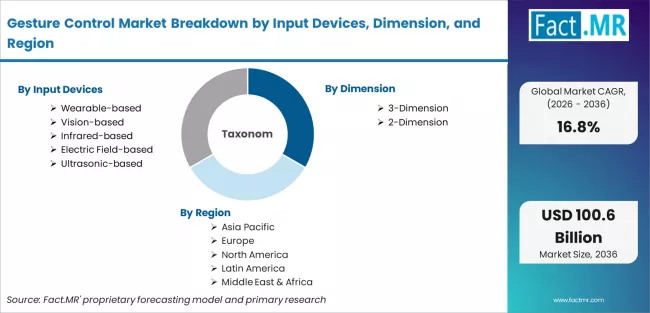
    Gesture Control Market Breakdown By Input Devices, Dimension, And Region

    Attribute Details
    Quantitative Units USD 21.3 billion (2026) to USD 100.6 billion (2036), at a CAGR of 16.8%
    Market Definition Gesture-based human-machine interface technologies enabling touchless interaction using sensors, cameras, and AI-driven motion recognition across consumer, automotive, healthcare, and industrial applications.
    Input Device Segmentation Wearable-based, Vision-based, Infrared-based, Electric Field-based, Ultrasonic-based
    Dimension Segmentation 2-Dimension, 3-Dimension
    Application Segmentation Consumer Electronics, Automotive, Gaming and Entertainment, Healthcare, Defense, Others
    Regions Covered North America, Europe, Asia Pacific, Latin America, Middle East and Africa
    Countries Covered USA, Canada, Mexico, UK, Germany, France, Italy, Spain, Nordic, BENELUX, Japan, South Korea, China, India, ASEAN, Australia and New Zealand, Brazil, Argentina, Chile, KSA, GCC, Turkey, South Africa, Rest of MEA
    Key Companies Profiled gestigon GmbH, Ultraleap, Cipla, 4tiitoo GmbH, Logbar, PointGrab, Nimble VR, Intel Corporation, Apple Inc., ArcSoft Inc.
    Forecast Period 2026 to 2036
    Approach Hybrid top-down and bottom-up model using device integration rates, sensor adoption trends, AR/VR penetration, automotive interface deployment, pricing benchmarks, and primary interviews with OEMs and technology providers

    Gesture Control Market by Segments

    • By Input Devices :

      • Wearable-based
      • Vision-based
      • Infrared-based
      • Electric Field-based
      • Ultrasonic-based
    • By Dimension :

      • 2-Dimension
      • 3-Dimension
    • By Application :

      • Consumer Electronics
      • Automotive
      • Gaming and Entertainment
      • Healthcare
      • Defense
      • Others
    • By Region :

      • North America
        • United States
        • Canada
        • Mexico
      • Latin America
        • Brazil
        • Mexico
        • Argentina
        • Chile
        • Rest of Latin America
      • Western Europe
        • Germany
        • United Kingdom
        • France
        • Italy
        • Spain
        • Nordic Countries
        • BENELUX
        • Rest of Western Europe
      • Eastern Europe
        • Russia
        • Poland
        • Hungary
        • Balkan and Baltic
        • Rest of Eastern Europe
      • East Asia
        • China
        • Japan
        • South Korea
      • South Asia and Pacific
        • India
        • ASEAN
        • Australia and New Zealand
        • Rest of South Asia and Pacific
      • Middle East and Africa
        • Kingdom of Saudi Arabia
        • Other GCC Countries
        • Turkey
        • South Africa
        • Rest of Middle East and Africa

    Bibliography

    • [1] Ultraleap. Hand Tracking Technology Update and XR Integration Developments. January 2025.
    • [2] Apple Inc. Apple Vision Pro Launch and Spatial Computing Interface Announcement. June 2024.
    • [3] International Data Corporation (IDC). Worldwide Wearable Device Market Forecast and Shipment Analysis 2024. November 2024.
    • [4] Intel Corporation. Intel RealSense Depth Camera and 3D Sensing Technology Update. March 2024.
    • [5] NVIDIA Corporation. AI Vision and Automotive Platform Developments for Edge Computing. January 2025.
    • [6] European Commission. Vehicle Safety Regulation and ADAS Integration Framework Update. April 2024.

    This Report Addresses

    • Market intelligence on gesture-based human-machine interface adoption across consumer electronics, automotive, healthcare, and industrial applications, highlighting how touchless interaction is reshaping user experience and device design
    • Market forecast from USD 21.3 billion in 2026 to USD 100.6 billion by 2036 at a CAGR of 16.8%, supported by detailed analysis of technology adoption cycles and industry-specific demand trends
    • Growth opportunities across AR/VR, automotive, healthcare, and gaming sectors, with insights into emerging use cases such as immersive training, autonomous driving interfaces, and sterile medical environments
    • Country-level growth analysis covering India, China, USA, Japan, Germany, and Australia, with evaluation of local demand drivers, policy support, and industry expansion trends
    • Competitive analysis of key players and technology providers, focusing on innovation strategies, ecosystem integration, and partnerships shaping market positioning
    • Technology tracking including AI-based vision systems, 3D sensing technologies, and wearable gesture interfaces driving next-generation human-machine interaction
    • Regulatory and safety impact assessment, including automotive safety standards, healthcare hygiene requirements, and digital interface compliance influencing adoption
    • Report delivery in PDF, Excel datasets, and presentation formats, enabling easy access to forecasts, segment data, and strategic insights for decision-making.

    Table of Content

    1. Executive Summary
      • Global Market Outlook
      • Demand to side Trends
      • Supply to side Trends
      • Technology Roadmap Analysis
      • Analysis and Recommendations
    2. Market Overview
      • Market Coverage / Taxonomy
      • Market Definition / Scope / Limitations
    3. Research Methodology
      • Chapter Orientation
      • Analytical Lens and Working Hypotheses
        • Market Structure, Signals, and Trend Drivers
        • Benchmarking and Cross-market Comparability
        • Market Sizing, Forecasting, and Opportunity Mapping
      • Research Design and Evidence Framework
        • Desk Research Programme (Secondary Evidence)
          • Company Annual and Sustainability Reports
          • Peer-reviewed Journals and Academic Literature
          • Corporate Websites, Product Literature, and Technical Notes
          • Earnings Decks and Investor Briefings
          • Statutory Filings and Regulatory Disclosures
          • Technical White Papers and Standards Notes
          • Trade Journals, Industry Magazines, and Analyst Briefs
          • Conference Proceedings, Webinars, and Seminar Materials
          • Government Statistics Portals and Public Data Releases
          • Press Releases and Reputable Media Coverage
          • Specialist Newsletters and Curated Briefings
          • Sector Databases and Reference Repositories
          • Fact.MR Internal Proprietary Databases and Historical Market Datasets
          • Subscription Datasets and Paid Sources
          • Social Channels, Communities, and Digital Listening Inputs
          • Additional Desk Sources
        • Expert Input and Fieldwork (Primary Evidence)
          • Primary Modes
            • Qualitative Interviews and Expert Elicitation
            • Quantitative Surveys and Structured Data Capture
            • Blended Approach
          • Why Primary Evidence is Used
          • Field Techniques
            • Interviews
            • Surveys
            • Focus Groups
            • Observational and In-context Research
            • Social and Community Interactions
          • Stakeholder Universe Engaged
            • C-suite Leaders
            • Board Members
            • Presidents and Vice Presidents
            • R&D and Innovation Heads
            • Technical Specialists
            • Domain Subject-matter Experts
            • Scientists
            • Physicians and Other Healthcare Professionals
          • Governance, Ethics, and Data Stewardship
            • Research Ethics
            • Data Integrity and Handling
        • Tooling, Models, and Reference Databases
      • Data Engineering and Model Build
        • Data Acquisition and Ingestion
        • Cleaning, Normalisation, and Verification
        • Synthesis, Triangulation, and Analysis
      • Quality Assurance and Audit Trail
    4. Market Background
      • Market Dynamics
        • Drivers
        • Restraints
        • Opportunity
        • Trends
      • Scenario Forecast
        • Demand in Optimistic Scenario
        • Demand in Likely Scenario
        • Demand in Conservative Scenario
      • Opportunity Map Analysis
      • Product Life Cycle Analysis
      • Supply Chain Analysis
      • Investment Feasibility Matrix
      • Value Chain Analysis
      • PESTLE and Porter’s Analysis
      • Regulatory Landscape
      • Regional Parent Market Outlook
      • Production and Consumption Statistics
      • Import and Export Statistics
    5. Global Market Analysis 2021 to 2025 and Forecast, 2026 to 2036
      • Historical Market Size Value (USD Million) Analysis, 2021 to 2025
      • Current and Future Market Size Value (USD Million) Projections, 2026 to 2036
        • Y to o to Y Growth Trend Analysis
        • Absolute $ Opportunity Analysis
    6. Global Market Pricing Analysis 2021 to 2025 and Forecast 2026 to 2036
    7. Global Market Analysis 2021 to 2025 and Forecast 2026 to 2036, By Input Devices
      • Introduction / Key Findings
      • Historical Market Size Value (USD Million) Analysis By Input Devices, 2021 to 2025
      • Current and Future Market Size Value (USD Million) Analysis and Forecast By Input Devices, 2026 to 2036
        • Wearable-based
        • Vision-based
        • Infrared-based
        • Electric Field-based
        • Ultrasonic-based
      • Y to o to Y Growth Trend Analysis By Input Devices, 2021 to 2025
      • Absolute $ Opportunity Analysis By Input Devices, 2026 to 2036
    8. Global Market Analysis 2021 to 2025 and Forecast 2026 to 2036, By Dimension
      • Introduction / Key Findings
      • Historical Market Size Value (USD Million) Analysis By Dimension, 2021 to 2025
      • Current and Future Market Size Value (USD Million) Analysis and Forecast By Dimension, 2026 to 2036
        • 3-Dimension
        • 2-Dimension
      • Y to o to Y Growth Trend Analysis By Dimension, 2021 to 2025
      • Absolute $ Opportunity Analysis By Dimension, 2026 to 2036
    9. Global Market Analysis 2021 to 2025 and Forecast 2026 to 2036, By Region
      • Introduction
      • Historical Market Size Value (USD Million) Analysis By Region, 2021 to 2025
      • Current Market Size Value (USD Million) Analysis and Forecast By Region, 2026 to 2036
        • North America
        • Latin America
        • Western Europe
        • Eastern Europe
        • East Asia
        • South Asia and Pacific
        • Middle East & Africa
      • Market Attractiveness Analysis By Region
    10. North America Market Analysis 2021 to 2025 and Forecast 2026 to 2036, By Country
      • Historical Market Size Value (USD Million) Trend Analysis By Market Taxonomy, 2021 to 2025
      • Market Size Value (USD Million) Forecast By Market Taxonomy, 2026 to 2036
        • By Country
          • USA
          • Canada
          • Mexico
        • By Input Devices
        • By Dimension
      • Market Attractiveness Analysis
        • By Country
        • By Input Devices
        • By Dimension
      • Key Takeaways
    11. Latin America Market Analysis 2021 to 2025 and Forecast 2026 to 2036, By Country
      • Historical Market Size Value (USD Million) Trend Analysis By Market Taxonomy, 2021 to 2025
      • Market Size Value (USD Million) Forecast By Market Taxonomy, 2026 to 2036
        • By Country
          • Brazil
          • Chile
          • Rest of Latin America
        • By Input Devices
        • By Dimension
      • Market Attractiveness Analysis
        • By Country
        • By Input Devices
        • By Dimension
      • Key Takeaways
    12. Western Europe Market Analysis 2021 to 2025 and Forecast 2026 to 2036, By Country
      • Historical Market Size Value (USD Million) Trend Analysis By Market Taxonomy, 2021 to 2025
      • Market Size Value (USD Million) Forecast By Market Taxonomy, 2026 to 2036
        • By Country
          • Germany
          • UK
          • Italy
          • Spain
          • France
          • Nordic
          • BENELUX
          • Rest of Western Europe
        • By Input Devices
        • By Dimension
      • Market Attractiveness Analysis
        • By Country
        • By Input Devices
        • By Dimension
      • Key Takeaways
    13. Eastern Europe Market Analysis 2021 to 2025 and Forecast 2026 to 2036, By Country
      • Historical Market Size Value (USD Million) Trend Analysis By Market Taxonomy, 2021 to 2025
      • Market Size Value (USD Million) Forecast By Market Taxonomy, 2026 to 2036
        • By Country
          • Russia
          • Poland
          • Hungary
          • Balkan & Baltic
          • Rest of Eastern Europe
        • By Input Devices
        • By Dimension
      • Market Attractiveness Analysis
        • By Country
        • By Input Devices
        • By Dimension
      • Key Takeaways
    14. East Asia Market Analysis 2021 to 2025 and Forecast 2026 to 2036, By Country
      • Historical Market Size Value (USD Million) Trend Analysis By Market Taxonomy, 2021 to 2025
      • Market Size Value (USD Million) Forecast By Market Taxonomy, 2026 to 2036
        • By Country
          • China
          • Japan
          • South Korea
        • By Input Devices
        • By Dimension
      • Market Attractiveness Analysis
        • By Country
        • By Input Devices
        • By Dimension
      • Key Takeaways
    15. South Asia and Pacific Market Analysis 2021 to 2025 and Forecast 2026 to 2036, By Country
      • Historical Market Size Value (USD Million) Trend Analysis By Market Taxonomy, 2021 to 2025
      • Market Size Value (USD Million) Forecast By Market Taxonomy, 2026 to 2036
        • By Country
          • India
          • ASEAN
          • Australia & New Zealand
          • Rest of South Asia and Pacific
        • By Input Devices
        • By Dimension
      • Market Attractiveness Analysis
        • By Country
        • By Input Devices
        • By Dimension
      • Key Takeaways
    16. Middle East & Africa Market Analysis 2021 to 2025 and Forecast 2026 to 2036, By Country
      • Historical Market Size Value (USD Million) Trend Analysis By Market Taxonomy, 2021 to 2025
      • Market Size Value (USD Million) Forecast By Market Taxonomy, 2026 to 2036
        • By Country
          • Kingdom of Saudi Arabia
          • Other GCC Countries
          • Turkiye
          • South Africa
          • Other African Union
          • Rest of Middle East & Africa
        • By Input Devices
        • By Dimension
      • Market Attractiveness Analysis
        • By Country
        • By Input Devices
        • By Dimension
      • Key Takeaways
    17. Key Countries Market Analysis
      • USA
        • Pricing Analysis
        • Market Share Analysis, 2025
          • By Input Devices
          • By Dimension
      • Canada
        • Pricing Analysis
        • Market Share Analysis, 2025
          • By Input Devices
          • By Dimension
      • Mexico
        • Pricing Analysis
        • Market Share Analysis, 2025
          • By Input Devices
          • By Dimension
      • Brazil
        • Pricing Analysis
        • Market Share Analysis, 2025
          • By Input Devices
          • By Dimension
      • Chile
        • Pricing Analysis
        • Market Share Analysis, 2025
          • By Input Devices
          • By Dimension
      • Germany
        • Pricing Analysis
        • Market Share Analysis, 2025
          • By Input Devices
          • By Dimension
      • UK
        • Pricing Analysis
        • Market Share Analysis, 2025
          • By Input Devices
          • By Dimension
      • Italy
        • Pricing Analysis
        • Market Share Analysis, 2025
          • By Input Devices
          • By Dimension
      • Spain
        • Pricing Analysis
        • Market Share Analysis, 2025
          • By Input Devices
          • By Dimension
      • France
        • Pricing Analysis
        • Market Share Analysis, 2025
          • By Input Devices
          • By Dimension
      • India
        • Pricing Analysis
        • Market Share Analysis, 2025
          • By Input Devices
          • By Dimension
      • ASEAN
        • Pricing Analysis
        • Market Share Analysis, 2025
          • By Input Devices
          • By Dimension
      • Australia & New Zealand
        • Pricing Analysis
        • Market Share Analysis, 2025
          • By Input Devices
          • By Dimension
      • China
        • Pricing Analysis
        • Market Share Analysis, 2025
          • By Input Devices
          • By Dimension
      • Japan
        • Pricing Analysis
        • Market Share Analysis, 2025
          • By Input Devices
          • By Dimension
      • South Korea
        • Pricing Analysis
        • Market Share Analysis, 2025
          • By Input Devices
          • By Dimension
      • Russia
        • Pricing Analysis
        • Market Share Analysis, 2025
          • By Input Devices
          • By Dimension
      • Poland
        • Pricing Analysis
        • Market Share Analysis, 2025
          • By Input Devices
          • By Dimension
      • Hungary
        • Pricing Analysis
        • Market Share Analysis, 2025
          • By Input Devices
          • By Dimension
      • Kingdom of Saudi Arabia
        • Pricing Analysis
        • Market Share Analysis, 2025
          • By Input Devices
          • By Dimension
      • Turkiye
        • Pricing Analysis
        • Market Share Analysis, 2025
          • By Input Devices
          • By Dimension
      • South Africa
        • Pricing Analysis
        • Market Share Analysis, 2025
          • By Input Devices
          • By Dimension
    18. Market Structure Analysis
      • Competition Dashboard
      • Competition Benchmarking
      • Market Share Analysis of Top Players
        • By Regional
        • By Input Devices
        • By Dimension
    19. Competition Analysis
      • Competition Deep Dive
        • gestigon GmbH
          • Overview
          • Product Portfolio
          • Profitability by Market Segments (Product/Age /Sales Channel/Region)
          • Sales Footprint
          • Strategy Overview
            • Marketing Strategy
            • Product Strategy
            • Channel Strategy
        • Ultraleap
        • Cipla
        • 4tiitoo GmbH
        • Logbar
        • PointGrab
        • Nimble VR
        • Intel Corporation
        • Apple Inc.
        • ArcSoft Inc.
    20. Assumptions & Acronyms Used

    List Of Table

    • Table 1: Global Market Value (USD Million) Forecast by Region, 2021 to 2036
    • Table 2: Global Market Value (USD Million) Forecast by Input Devices, 2021 to 2036
    • Table 3: Global Market Value (USD Million) Forecast by Dimension, 2021 to 2036
    • Table 4: North America Market Value (USD Million) Forecast by Country, 2021 to 2036
    • Table 5: North America Market Value (USD Million) Forecast by Input Devices, 2021 to 2036
    • Table 6: North America Market Value (USD Million) Forecast by Dimension, 2021 to 2036
    • Table 7: Latin America Market Value (USD Million) Forecast by Country, 2021 to 2036
    • Table 8: Latin America Market Value (USD Million) Forecast by Input Devices, 2021 to 2036
    • Table 9: Latin America Market Value (USD Million) Forecast by Dimension, 2021 to 2036
    • Table 10: Western Europe Market Value (USD Million) Forecast by Country, 2021 to 2036
    • Table 11: Western Europe Market Value (USD Million) Forecast by Input Devices, 2021 to 2036
    • Table 12: Western Europe Market Value (USD Million) Forecast by Dimension, 2021 to 2036
    • Table 13: Eastern Europe Market Value (USD Million) Forecast by Country, 2021 to 2036
    • Table 14: Eastern Europe Market Value (USD Million) Forecast by Input Devices, 2021 to 2036
    • Table 15: Eastern Europe Market Value (USD Million) Forecast by Dimension, 2021 to 2036
    • Table 16: East Asia Market Value (USD Million) Forecast by Country, 2021 to 2036
    • Table 17: East Asia Market Value (USD Million) Forecast by Input Devices, 2021 to 2036
    • Table 18: East Asia Market Value (USD Million) Forecast by Dimension, 2021 to 2036
    • Table 19: South Asia and Pacific Market Value (USD Million) Forecast by Country, 2021 to 2036
    • Table 20: South Asia and Pacific Market Value (USD Million) Forecast by Input Devices, 2021 to 2036
    • Table 21: South Asia and Pacific Market Value (USD Million) Forecast by Dimension, 2021 to 2036
    • Table 22: Middle East & Africa Market Value (USD Million) Forecast by Country, 2021 to 2036
    • Table 23: Middle East & Africa Market Value (USD Million) Forecast by Input Devices, 2021 to 2036
    • Table 24: Middle East & Africa Market Value (USD Million) Forecast by Dimension, 2021 to 2036

    List Of Figures

    • Figure 1: Global Market Pricing Analysis
    • Figure 2: Global Market Value (USD Million) Forecast 2021 to 2036
    • Figure 3: Global Market Value Share and BPS Analysis by Input Devices, 2026 and 2036
    • Figure 4: Global Market Y-o-Y Growth Comparison by Input Devices, 2026 to 2036
    • Figure 5: Global Market Attractiveness Analysis by Input Devices
    • Figure 6: Global Market Value Share and BPS Analysis by Dimension, 2026 and 2036
    • Figure 7: Global Market Y-o-Y Growth Comparison by Dimension, 2026 to 2036
    • Figure 8: Global Market Attractiveness Analysis by Dimension
    • Figure 9: Global Market Value (USD Million) Share and BPS Analysis by Region, 2026 and 2036
    • Figure 10: Global Market Y-o-Y Growth Comparison by Region, 2026 to 2036
    • Figure 11: Global Market Attractiveness Analysis by Region
    • Figure 12: North America Market Incremental Dollar Opportunity, 2026 to 2036
    • Figure 13: Latin America Market Incremental Dollar Opportunity, 2026 to 2036
    • Figure 14: Western Europe Market Incremental Dollar Opportunity, 2026 to 2036
    • Figure 15: Eastern Europe Market Incremental Dollar Opportunity, 2026 to 2036
    • Figure 16: East Asia Market Incremental Dollar Opportunity, 2026 to 2036
    • Figure 17: South Asia and Pacific Market Incremental Dollar Opportunity, 2026 to 2036
    • Figure 18: Middle East & Africa Market Incremental Dollar Opportunity, 2026 to 2036
    • Figure 19: North America Market Value Share and BPS Analysis by Country, 2026 and 2036
    • Figure 20: North America Market Value Share and BPS Analysis by Input Devices, 2026 and 2036
    • Figure 21: North America Market Y-o-Y Growth Comparison by Input Devices, 2026 to 2036
    • Figure 22: North America Market Attractiveness Analysis by Input Devices
    • Figure 23: North America Market Value Share and BPS Analysis by Dimension, 2026 and 2036
    • Figure 24: North America Market Y-o-Y Growth Comparison by Dimension, 2026 to 2036
    • Figure 25: North America Market Attractiveness Analysis by Dimension
    • Figure 26: Latin America Market Value Share and BPS Analysis by Country, 2026 and 2036
    • Figure 27: Latin America Market Value Share and BPS Analysis by Input Devices, 2026 and 2036
    • Figure 28: Latin America Market Y-o-Y Growth Comparison by Input Devices, 2026 to 2036
    • Figure 29: Latin America Market Attractiveness Analysis by Input Devices
    • Figure 30: Latin America Market Value Share and BPS Analysis by Dimension, 2026 and 2036
    • Figure 31: Latin America Market Y-o-Y Growth Comparison by Dimension, 2026 to 2036
    • Figure 32: Latin America Market Attractiveness Analysis by Dimension
    • Figure 33: Western Europe Market Value Share and BPS Analysis by Country, 2026 and 2036
    • Figure 34: Western Europe Market Value Share and BPS Analysis by Input Devices, 2026 and 2036
    • Figure 35: Western Europe Market Y-o-Y Growth Comparison by Input Devices, 2026 to 2036
    • Figure 36: Western Europe Market Attractiveness Analysis by Input Devices
    • Figure 37: Western Europe Market Value Share and BPS Analysis by Dimension, 2026 and 2036
    • Figure 38: Western Europe Market Y-o-Y Growth Comparison by Dimension, 2026 to 2036
    • Figure 39: Western Europe Market Attractiveness Analysis by Dimension
    • Figure 40: Eastern Europe Market Value Share and BPS Analysis by Country, 2026 and 2036
    • Figure 41: Eastern Europe Market Value Share and BPS Analysis by Input Devices, 2026 and 2036
    • Figure 42: Eastern Europe Market Y-o-Y Growth Comparison by Input Devices, 2026 to 2036
    • Figure 43: Eastern Europe Market Attractiveness Analysis by Input Devices
    • Figure 44: Eastern Europe Market Value Share and BPS Analysis by Dimension, 2026 and 2036
    • Figure 45: Eastern Europe Market Y-o-Y Growth Comparison by Dimension, 2026 to 2036
    • Figure 46: Eastern Europe Market Attractiveness Analysis by Dimension
    • Figure 47: East Asia Market Value Share and BPS Analysis by Country, 2026 and 2036
    • Figure 48: East Asia Market Value Share and BPS Analysis by Input Devices, 2026 and 2036
    • Figure 49: East Asia Market Y-o-Y Growth Comparison by Input Devices, 2026 to 2036
    • Figure 50: East Asia Market Attractiveness Analysis by Input Devices
    • Figure 51: East Asia Market Value Share and BPS Analysis by Dimension, 2026 and 2036
    • Figure 52: East Asia Market Y-o-Y Growth Comparison by Dimension, 2026 to 2036
    • Figure 53: East Asia Market Attractiveness Analysis by Dimension
    • Figure 54: South Asia and Pacific Market Value Share and BPS Analysis by Country, 2026 and 2036
    • Figure 55: South Asia and Pacific Market Value Share and BPS Analysis by Input Devices, 2026 and 2036
    • Figure 56: South Asia and Pacific Market Y-o-Y Growth Comparison by Input Devices, 2026 to 2036
    • Figure 57: South Asia and Pacific Market Attractiveness Analysis by Input Devices
    • Figure 58: South Asia and Pacific Market Value Share and BPS Analysis by Dimension, 2026 and 2036
    • Figure 59: South Asia and Pacific Market Y-o-Y Growth Comparison by Dimension, 2026 to 2036
    • Figure 60: South Asia and Pacific Market Attractiveness Analysis by Dimension
    • Figure 61: Middle East & Africa Market Value Share and BPS Analysis by Country, 2026 and 2036
    • Figure 62: Middle East & Africa Market Value Share and BPS Analysis by Input Devices, 2026 and 2036
    • Figure 63: Middle East & Africa Market Y-o-Y Growth Comparison by Input Devices, 2026 to 2036
    • Figure 64: Middle East & Africa Market Attractiveness Analysis by Input Devices
    • Figure 65: Middle East & Africa Market Value Share and BPS Analysis by Dimension, 2026 and 2036
    • Figure 66: Middle East & Africa Market Y-o-Y Growth Comparison by Dimension, 2026 to 2036
    • Figure 67: Middle East & Africa Market Attractiveness Analysis by Dimension
    • Figure 68: Global Market - Tier Structure Analysis
    • Figure 69: Global Market - Company Share Analysis

    - FAQs -

    How large is the gesture control market in 2025?

    The gesture control market was valued at USD 18.3 billion in 2025.

    What is the estimated market size in 2026?

    The market is estimated to reach USD 21.3 billion in 2026.

    What will be the market size by 2036?

    The market is projected to reach USD 100.6 billion by 2036.

    What is the expected CAGR for the forecast period?

    FACT.MR projects a CAGR of 16.8% from 2026 to 2036.

    Which input device segment leads the market?

    Wearable-based devices lead with around 30% share in 2026.

    Which dimension segment dominates the market?

    3D gesture control dominates with about 65% share in 2026.

    Which application segment holds the largest share?

    Consumer electronics leads with approximately 38% share in 2026.

    What is the key growth driver for the market?

    Rapid expansion of AR/VR ecosystems is a major growth driver.

    How is the automotive sector contributing to growth?

    Automotive OEMs are integrating gesture control for safer, touchless infotainment systems.

    What role does healthcare play in this market?

    Healthcare is adopting gesture control to maintain sterile and contactless environments.

    Which region shows the fastest growth?

    Asia Pacific shows the fastest growth driven by consumer electronics and AR/VR adoption.

    What is a major restraint in the market?

    High implementation costs and accuracy limitations in low-cost systems remain key restraints.

    What opportunity exists for market players?

    Opportunities lie in AI-driven gesture recognition and integration into smart devices and vehicles.

    Gesture Control Market