- Market Value (2025): USD 317.1 Mn
- Estimated Value (2026): USD 390.0 Mn
- Forecast Value (2036): USD 3091.0 Mn
- CAGR (2026-2036): 23.0%
What is the Graphene ESD Additives Market forecast to be worth by 2036?
USD 390.0 million in 2026 to USD 3,091.0 million by 2036, at a 23.0% CAGR.
- The graphene ESD additives market crossed a valuation of USD 317.1 million in 2025.
- Demand is projected to increase from USD 390.0 million in 2026 to USD 3,091.0 million by 2036.
- The market is forecast to record a 23.0% CAGR from 2026 to 2036 as electronics packagers and automotive compounders specify lower-loading static-control materials.
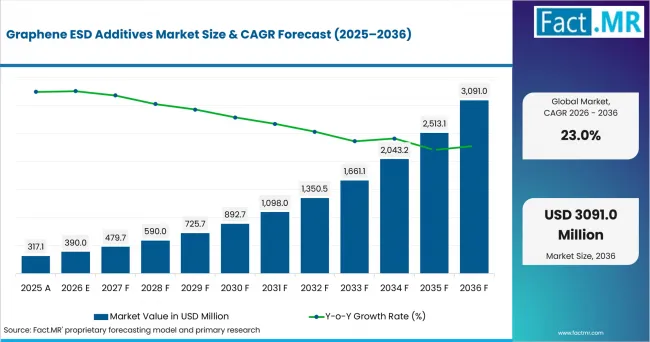
Graphene Esd Additives Market Value Analysis | Source: Fact.MR
What are the defining numbers behind Graphene ESD Additives Market growth?
USD 2,701.0 million absolute opportunity by 2036, led by nanoplatelets, thermoplastics and conductivity functions.
- Demand Drivers in the Market
- Electronics packaging engineers need stable surface resistivity for trays, shipping boxes and cleanroom parts around sensitive semiconductor devices.
- Polymer compounders need conductive performance at lower filler loading so molded housings keep strength and weight targets.
- Automotive material teams need antistatic plastics as electric drivetrains increase the number of connectors, sensors and battery electronics.
- Industrial product developers need dispersible graphene grades because uneven distribution can leave conductive gaps after extrusion or molding.
- Key Segments Analyzed
- By Graphene Form: Nanoplatelets are expected to hold 36.0% share in 2026 due to their balance of conductivity and compatibility with masterbatch production.
- By Carrier Matrix: Thermoplastics are projected to account for 41.0% share in 2026 since extrusion and injection molding remain common ESD-part routes.
- By Function: Conductivity is anticipated to capture 44.0% share in 2026 because surface-resistivity control is the direct buying reason.
- By Application: Automotive is estimated to represent 32.0% share in 2026 owing to electronic content around batteries, sensors and connector assemblies.
- Analyst Opinion at Fact.MR
- Shambhu Nath Jha, Principal Consultant at Fact.MR, states, “The commercial issue has moved beyond basic conductivity. Procurement teams ask whether a grade can disperse predictably, pass ESD testing and keep molded-part strength intact. Suppliers are expected to win more qualification work when they combine graphene purity, masterbatch support and lot-level documentation.”
- Strategic Implications
- Graphene producers should document purity, surface area and lot-level conductivity so compounders can shorten customer validation cycles.
- Automotive compounders should connect ESD claims with EMI shielding and weight reduction where battery housings require multi-function plastics.
- Electronics packaging suppliers should test molded parts under cleanroom and humidity conditions since surface resistivity can shift after storage.
The UK is projected to record 27.4% CAGR through 2036, supported by electronics output and EV-material qualification. Japan is forecast to advance at 25.3% as machinery orders sustain component-handling demand. The USA is expected to post 24.7% through semiconductor packaging and automotive electronics. Germany is anticipated to record 24.1% as EV sales and automotive production support thermoplastic compounds. South Korea is estimated to reach 22.8% through semiconductor, display and eco-friendly vehicle exports.
How does the Graphene ESD Additives Market break down by segment?
Nanoplatelets lead Graphene Form at 36.0%; thermoplastics lead Carrier Matrix at 41.0%.
Which Graphene Form dominates?
Nanoplatelets are expected to hold 36.0% share in 2026.
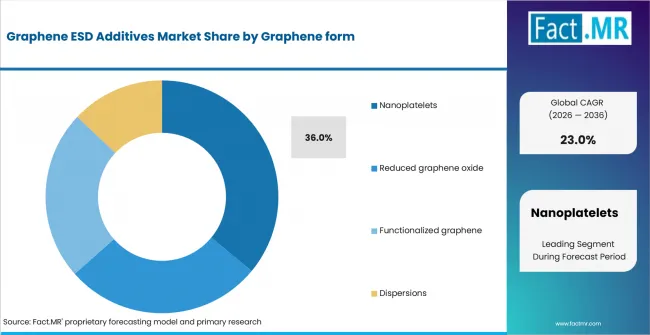
Graphene Esd Additives Market Analysis By Graphene Form | Source: Fact.MR
Nanoplatelets lead because they provide a practical conductive network inside molded plastics. Their plate-like structure helps compounders reach ESD performance with lower loading than many conventional carbon systems.
SIA reported in February 2026 that global semiconductor sales reached USD 791.7 billion in 2025, up 25.6% from 2024. The scale of semiconductor activity provides a substantial application base for ESD-protective packaging and handling formats, including trays used to protect electrostatic-discharge-sensitive devices during production, transport and storage.
What leads the Carrier Matrix segment?
Thermoplastics are projected to account for 41.0% share in 2026.
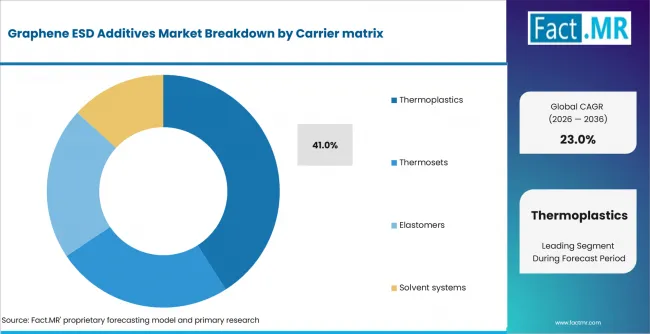
Graphene Esd Additives Market Analysis By Carrier Matrix | Source: Fact.MR
Thermoplastics lead because ESD additives are often compounded into pellets before molding, extrusion or film conversion.
NanoXplore and Techmer PM launched GrapheneBlack xGnP Masterbatch in June 2026 for high-performance plastic films. Techmer PM reported more than 70% improvement in mechanical strength and possible thickness reduction of up to 20%.
How does Function shape demand?
Conductivity is anticipated to lead with 44.0% share in 2026.
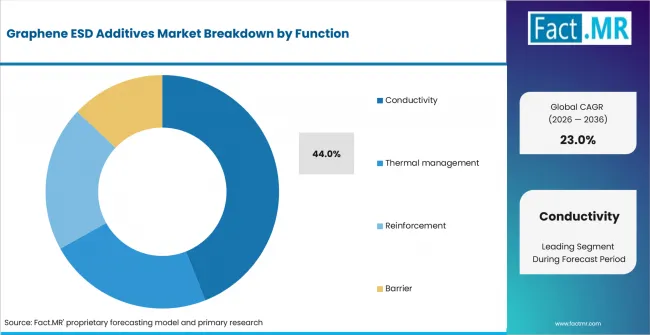
Graphene Esd Additives Market Analysis By Function | Source: Fact.MR
Conductivity leads because ESD protection requires a measurable electrical result. Product teams assess surface resistivity, volume resistivity and process stability before approving an additive for packaging or component housings. Adjacent development in electromagnetic shielding polymers raises attention on conductive polymer performance.
Conductive grades also support thermal management in compact electronics. The same material-selection discussion often touches thermal conductive sheet applications where heat movement and electrical behavior affect component reliability.
What supports Automotive within Application?
Automotive is estimated to represent 32.0% share in 2026.
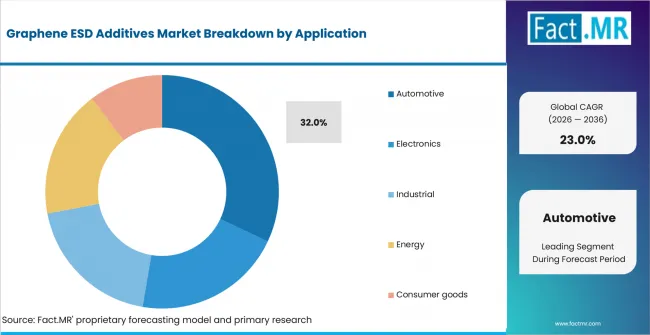
Graphene Esd Additives Market Analysis By Application | Source: Fact.MR
Automotive leads the application split because electric vehicles carry more sensors, connectors and battery electronics than conventional platforms. Static-control materials can protect housings and handling components during assembly, which places this market near graphene auto thermoplastics.
IEA reported in April 2026 that global electric car sales increased by more than 20% year over year in 2025, reaching 21 million units. Higher electric content raises the value of lightweight conductive polymers in vehicle electronics supply chains.
What is accelerating Graphene ESD Additives Market adoption, and what is holding it back?
Demand is expected to rise through electronics ESD control and conductive thermoplastics, while adoption is constrained by dispersion, price and qualification risk.
Drivers Impact Analysis
| DRIVER | (~) % IMPACT ON CAGR | GEOGRAPHIC RELEVANCE | IMPACT TIMELINE |
|---|---|---|---|
| ESD-safe electronics packaging | +2.3% | Global | Short term (<= 2 years) |
| Conductive thermoplastic masterbatch demand | +1.8% | North America, Europe and East Asia | Medium term (2-4 years) |
| Electric vehicle electronics content | +1.5% | USA, Germany, Japan and South Korea | Medium term (2-4 years) |
| Lower filler loading versus conventional carbon systems | +1.0% | Global | Long term (>= 4 years) |
Source: Fact.MR analysis. Updated Aug 25, 2026
- ESD-safe electronics packaging: Semiconductor devices remain sensitive during handling. Graphene additives are expected to help packaging manufacturers specify controlled conductivity in trays, boxes and cleanroom parts.
- Conductive thermoplastic masterbatch demand: Pre-dispersed graphene is expected to lower formulation risk. It supports faster trials when processors use established extrusion and injection-molding equipment.
- Electric vehicle electronics content: EV platforms are anticipated to increase the number of electronic modules in each vehicle. Automotive material teams examine conductive plastics for housings and connector-side parts.
Opportunity Impact Analysis
| OPPORTUNITY | (~) % IMPACT ON CAGR | GEOGRAPHIC RELEVANCE | IMPACT TIMELINE |
|---|---|---|---|
| Validated graphene masterbatch platforms | +1.4% | North America and Europe | Short term (<= 2 years) |
| ESD-safe additive manufacturing materials | +1.0% | Europe, North America and Japan | Medium term (2-4 years) |
| Conductive film and packaging formulations | +0.8% | Global | Medium term (2-4 years) |
Source: Fact.MR analysis. Updated Aug 25, 2026
- Validated graphene masterbatch platforms: Compounders are expected to move faster when additive suppliers provide a carrier grade, dosing guidance and repeatable dispersion data.
- ESD-safe additive manufacturing materials: Graphene-filled filaments create a path for lower-volume fixtures, nests and prototype parts that still need static control.
- Conductive film and packaging formulations: Film converters are projected to use graphene where strength retention and downgauging support the business case for premium additives.
Restraints Impact Analysis
| RESTRAINT | (~) % IMPACT ON CAGR | GEOGRAPHIC RELEVANCE | IMPACT TIMELINE |
|---|---|---|---|
| Dispersion inconsistency across polymer systems | -0.8% | Global | Short term (<= 2 years) |
| Qualification cost versus carbon black | -0.6% | Global | Medium term (2-4 years) |
| Limited public grade language for graphene ESD additives | -0.4% | North America and Europe | Long term (>= 4 years) |
Source: Fact.MR analysis. Updated Aug 25, 2026
- Dispersion inconsistency across polymer systems: Poor distribution can create local non-conductive zones. Processors retest parts after resin, temperature or equipment changes.
- Qualification cost versus conductive carbon black: Established ESD parts already use carbon black or carbon fibers. Graphene must justify reformulation through lower loading or cleaner processing.
- Limited public grade language for graphene ESD additives: Buyers still compare grades through supplier data sheets and customer trials. Common terminology would ease substitution across qualified suppliers.
Which countries are scaling the Graphene ESD Additives Market through 2036?
- The country comparison spans 4.6 percentage points and forms three practical growth bands across the forecast period.
- The UK remains 2.1 percentage points above Japan as electronics output and EV packaging requirements support conductive polymer trials.
- Japan remains 0.6 percentage point above the USA as machinery investment supports component-handling and automation demand.
- The USA remains 0.6 percentage point above Germany through semiconductor packaging and automotive electronics qualification.
- Germany remains 1.3 percentage points above South Korea as EV sales and vehicle production support thermoplastic specifications.
- South Korea closes the displayed range through semiconductor, display and eco-friendly vehicle exports.
Comparable CAGRs create different entry conditions due to resin preferences, local qualification habits, electronics output and automotive program timing. Full report coverage includes North America, Latin America, Western Europe, Eastern Europe, East Asia, South Asia & Pacific, Middle East & Africa.
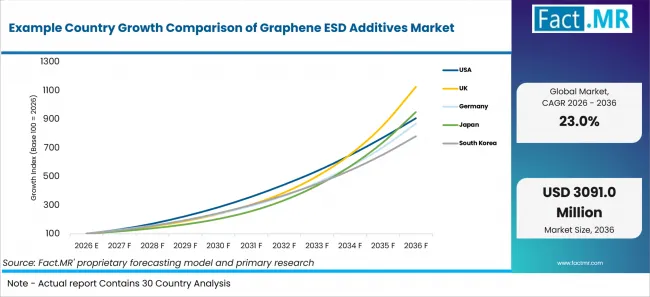
Example Country Growth Comparison Of Graphene Esd Additives Market | Source: Fact.MR
| Country | CAGR (2026-2036) |
|---|---|
| United Kingdom | 27.4% |
| Japan | 25.3% |
| United States | 24.7% |
| Germany | 24.1% |
| South Korea | 22.8% |
Source: Fact.MR analysis. Updated Aug 25, 2026
How is the United Kingdom scaling demand?
27.4% CAGR, driven by electronics output and EV-linked material qualification.
The UK has a useful mix of electronics output and vehicle electrification for graphene ESD additives. ONS reported in April 2026 that February 2026 output increased 6.3% in the manufacture of electrical equipment and 1.6% in computer, electronic and optical manufacturing from the previous month. IEA also reported in May 2026 that UK electric car sales accounted for over one in three new cars in 2025.
What supports Japan adoption?
25.3% CAGR, supported by machinery orders and electronics-material specialization.
Japan benefits from precision manufacturing programs where static control and quality documentation carry weight in supplier selection. The Cabinet Office reported in May 2026 that seasonally adjusted machinery orders received by 280 manufacturers operating in Japan increased 4.3% in March 2026 from the previous month. IEA reported in May 2026 that Japan electric car sales were just above 100,000 in 2025. That hybrid-heavy vehicle mix keeps graphene ESD additives focused on high-value control modules and component-handling materials.
What supports USA adoption?
24.7% CAGR, supported by semiconductor packaging and automotive electronics demand.
The USA has a direct demand route through chip handling, cleanroom packaging and EV electronics. Graphene ESD suppliers are expected to target trays, boxes and molded housings where conductivity must be balanced with part strength.
What is supporting Germany adoption?
24.1% CAGR, supported by automotive output and EV thermoplastic demand.
Germany remains attractive for ESD additive trials because automotive suppliers combine resin qualification with electrical-performance testing. IEA reported in May 2026 that electric car sales in Germany increased 50% in 2025 to a record 850,000 units. VDA reported in January 2026 that 4.15 million passenger cars rolled off German assembly lines in 2025.
How does South Korea perform?
22.8% CAGR, led by semiconductor exports and eco-friendly vehicle programs.
South Korea links graphene ESD demand to semiconductors, displays and vehicle export programs. MOTIR and MSIT reported in August 2026 that Korea ICT exports reached USD 53.36 billion in July 2026, up 140.6% year over year. MOTIR also reported in August 2026 that automobile exports rose 7.0% to USD 6.24 billion in July 2026. These export channels support demand for ESD trays, carriers and molded electronic housings.
Who leads the Graphene ESD Additives Market?
NanoXplore is active in graphene powders and graphene-enhanced plastics. Its May 2026 xGnP D500-HP launch gives compounders a high-purity conductive additive positioned against specialty carbon black, while the Techmer PM collaboration extends the route into masterbatch and film conversion.
Graphmatech competes through graphene-enhanced conductive polymers and ESD-capable additive manufacturing materials. Its product language aligns with surface resistivity control, which makes it relevant for fixtures, nests and component-handling applications.
First Graphene participates through PureGRAPH masterbatch and dispersion options for polyolefins and other polymer systems. Directa Plus supplies graphene nanoplatelets for industrial markets, while Avanzare supports additive and masterbatch routes for polymers, rubber and packaging.
Competition is shaped by dispersion reliability, batch documentation and support for the customer's chosen carrier matrix.
Which companies are the key providers?
Key companies include NanoXplore Inc., Graphmatech AB, First Graphene Ltd., Directa Plus plc, and Haydale Graphene Industries plc.
- NanoXplore Inc.
- Graphmatech AB
- First Graphene Ltd.
- Directa Plus plc
- Haydale Graphene Industries plc
Bibliography
- Cabinet Office, Economic and Social Research Institute. (2026, May 21). Machinery orders in March, 2026 and forecast for Apr.-Jun. 2026.
- International Energy Agency. (2026, May 20). Global EV Outlook 2026: Trends in electric cars.
- International Energy Agency. (2026, April 20). Global Energy Review 2026: Technology: Electric vehicles.
- Ministry of Trade, Industry and Resources. (2026, August 14). Automobile exports hit record high for July; government and industry join forces on future-vehicle transition and mutual growth.
- Ministry of Trade, Industry and Resources, & Ministry of Science and ICT. (2026, August 14). Korea’s ICT exports reach record $53.36 billion for July.
- NanoXplore Inc. (2026, May 5). NanoXplore launches xGnP™ D500-HP, high-purity graphene to replace conventional conductive additives.
- Office for National Statistics. (2026, April 16). GDP monthly estimate, UK: February 2026.
- Semiconductor Industry Association. (2026, February 6). Global annual semiconductor sales increase 25.6% to $791.7 billion in 2025.
- Verband der Automobilindustrie. (2026, January 5). Passenger car production in 2025 slightly above previous year's level.
This Report Answers
- The report explains where graphene ESD additives are used across graphene form, carrier matrix, function and application.
- Segment analysis identifies the leading subsegments and the operational reasons compounders prioritize them.
- Country analysis examines the listed markets and the electronics or automotive mechanisms supporting material qualification.
- Competitive analysis reviews current providers across graphene powders, masterbatches, dispersions and polymer formulations.
- Application analysis assesses how static-control needs influence additive selection in automotive, electronics and industrial uses.
What does the Graphene ESD Additives Market cover?
The Graphene ESD Additives Market covers graphene-based additives used to provide ESD protection, controlled conductivity and related static-control performance in polymers or coatings. It overlaps with EMI shielding materials when molded parts need both static control and electromagnetic protection.
The assessment covers nanoplatelets, reduced graphene oxide, functionalized graphene and dispersions. Demand is assessed across thermoplastics, thermosets, elastomers and solvent systems, together with automotive, electronics, industrial, energy and consumer goods applications.
What is included in the scope?
The scope includes graphene powders, graphene masterbatches and dispersions that are sold for electrostatic discharge protection or controlled conductivity. Related material platforms connect with the wider graphene market where industrial-grade supply and application testing shape adoption.
It includes additive packages used in injection molding, extrusion, films, packaging parts, trays and component housings. The scope also captures material platforms where conductivity is part of the performance requirement.
What is excluded from the scope?
The scope excludes base graphene sold only for research use, carbon black additives without graphene content and finished electronic devices. Pure shielding products are excluded unless the material is sold as a graphene ESD additive or conductive polymer input.
Graphene electrodes, battery active materials and structural composites are outside the scope when ESD or controlled conductivity in a polymer matrix is outside the buying reason. Separate analysis is available for conductive silicone rubber where elastomer conductivity is the main material requirement.
How Was the Analysis Built?
The analysis draws on 120+ sources, 35+ company portfolios, 25+ countries, and more than 20 industry interviews.
- Primary Research: Primary research includes discussions with graphene producers, compounders, technology developers, distributors, electronics packaging suppliers, automotive material teams and subject-matter experts. These conversations examine qualification rules, product adoption, processing challenges, commercial positioning and barriers to wider acceptance.
- Desk Research: Desk research covers government statistics, company releases, trade data, technical studies, standards, public policy and authoritative industry sources. The bibliography documents the materials used in the analysis.
- Market Sizing and Forecasting: Market estimates combine historical performance, demand indicators, pricing and volume trends, segment shares, company participation, country-level growth, adoption patterns, investment activity and barriers to expansion.
- Data Validation and Update Cycle: Findings are validated by comparing primary interviews with public data, company activity, regulatory changes, trade patterns and industry developments. Updates review product launches, capacity changes, partnerships, approvals, procurement trends and shifts in commercial adoption.
Segmentation
What is the report’s scope and coverage?
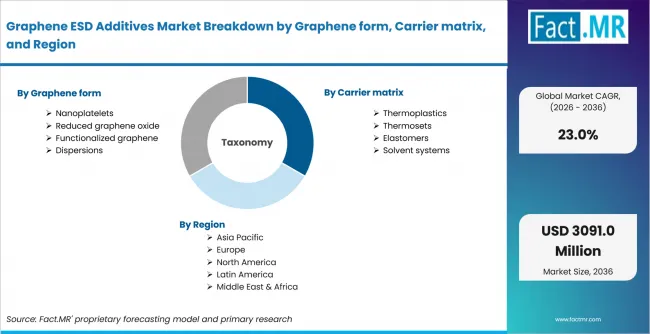
Graphene Esd Additives Market Breakdown By Graphene Form, Carrier Matrix, And Region | Source: Fact.MR
| Attribute | Details |
|---|---|
| Quantitative Units | USD million |
| Market Definition | Additives based on graphene materials that provide electrostatic discharge protection, controlled conductivity or related static-control performance when compounded into polymers, coatings or dispersions. |
| Graphene Form | Nanoplatelets; Reduced graphene oxide; Functionalized graphene; Dispersions. |
| Carrier Matrix | Thermoplastics; Thermosets; Elastomers; Solvent systems. |
| Function | Conductivity; Thermal management; Reinforcement; Barrier. |
| Application | Automotive; Electronics; Industrial; Energy; Consumer goods. |
| Regions Covered | North America; Latin America; Western Europe; Eastern Europe; East Asia; South Asia & Pacific; Middle East & Africa. |
| Countries Covered | United States; United Kingdom; Germany; Japan; South Korea. |
| Key Companies Profiled | NanoXplore Inc.; Graphmatech AB; First Graphene Ltd.; Directa Plus plc; Haydale Graphene Industries plc. |
| Forecast Period | 2026 to 2036. |
| Approach | Hybrid top-down and bottom-up approach using electronics packaging demand, conductive polymer formulations, automotive electronics programs, graphene supplier portfolios, country adoption and application-level qualification barriers. |
Source: Fact.MR analysis. Updated Aug 25, 2026
How is the market segmented?
-
By Graphene Form:
- Nanoplatelets
- Reduced graphene oxide
- Functionalized graphene
- Dispersions
-
By Carrier Matrix:
- Thermoplastics
- Thermosets
- Elastomers
- Solvent systems
-
By Function:
- Conductivity
- Thermal management
- Reinforcement
- Barrier
-
By Application:
- Automotive
- Electronics
- Industrial
- Energy
- Consumer goods
-
By Region:
- North America
- Latin America
- Western Europe
- Eastern Europe
- East Asia
- South Asia & Pacific
- Middle East & Africa
Frequently Asked Questions
How big is the graphene ESD additives market in 2026?
What is the CAGR of the graphene ESD additives market from 2026 to 2036?
Which graphene form leads the graphene ESD additives market?
Which carrier matrix leads the graphene ESD additives market?
Who are the leading companies in the graphene ESD additives market?
Who worked on this report


Preview the report firsthand - request a free sample
Free SampleGet the brochure for pricing and purchase details
Download PDF