- Market Value (2025): USD 7.9 Bn
- Estimated Value (2026): USD 8.6 Bn
- Forecast Value (2036): USD 21.0 Bn
- CAGR (2026-2036): 9.3%
What is the Grease-Proof Molded Packaging Market forecast to be worth by 2036?
USD 8.6 billion in 2026 to USD 21.0 billion by 2036 at a 9.3% CAGR.
- The Grease-Proof Molded Packaging Market reached USD 7.9 billion in 2025.
- Demand is projected to increase from USD 8.6 billion in 2026 to USD 21.0 billion by 2036.
- The market is forecast to record 9.3% CAGR from 2026 to 2036 as meal-service users replace grease-resistant plastic and coated paper formats with formed fiber packs.
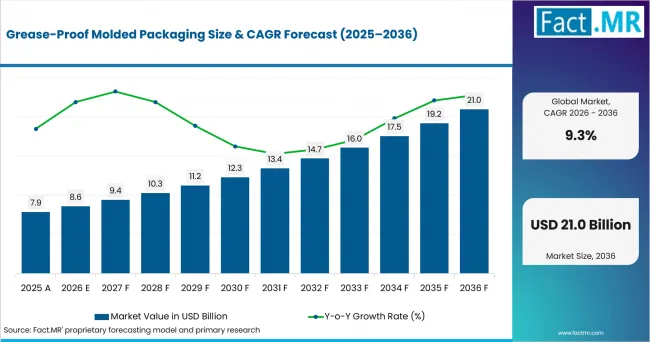
Grease Proof Molded Packaging Value Analysis | Source: Fact.MR
What are the defining numbers behind Grease-Proof Molded Packaging Market growth?
An absolute opportunity of USD 12.3 billion is expected between 2026 and 2036.
- Demand Drivers in the Market
- Meal-service teams need molded containers that control oil during takeaway and delivery while keeping their shape under heat and moisture. USDA Economic Research Service reported in June 2026 that inflation-adjusted U.S. food-away-from-home spending reached USD 1.41 trillion in 2025, expressed in 2025 dollars.
- Pack makers need PFAS-free grease barriers as food-contact rules move away from PFAS grease proofers. In January 2025, the FDA determined that 35 PFAS-related food-contact notifications for grease-proofing paper and paperboard were no longer effective.
- School and site kitchens need stackable trays and hinged packs that move efficiently through serving lines while preserving grease resistance and structural strength during filled-food handling.
- Brands using fiber packs need clear disposal claims and traceable materials because recycling and composting statements depend on the full pack design and local recovery route.
- Key Segments Analyzed
- By Fiber Platform: Wood-pulp fiber is expected to hold 34.0% share in 2026 because controlled fiber quality supports steady forming, surface treatment, and safe food contact.
- By Barrier Technology: Aqueous grease-resistant barrier is projected to account for 37.0% share in 2026 as converters seek water-based systems that limit oil migration and use PFAS-free chemistry.
- By Format: Hinged containers are anticipated to capture 33.0% share in 2026 owing to their one-piece design for burgers, sandwiches, prepared meals, and takeaway portions.
- By End-use: Foodservice and takeaway is estimated to represent 36.0% share in 2026 because hot meals and fried foods create frequent grease, heat, and handling stress.
- Analyst Opinion at Fact.MR
- Shambhu Nath Jha, Principal Consultant at Fact.MR, states, “Grease resistance is becoming a testing issue that extends beyond coating choice. Meal-service accounts want fiber packs that hold oil during use and fit their food-contact and disposal rules. Providers are expected to compete on formed-part strength, coat consistency, and clear end-of-life records.”
- Strategic Implications
- Fiber-pack producers should test grease resistance against the food temperature and holding time used by restaurant and site customers during routine service. Routine filled-pack tests should use the same oil load and holding period that foodservice customers expect during normal meal service.
- Barrier makers should record food-contact fit and forming results. The European Commission states that the PPWR requires all packaging to be recyclable by 2030.
- Pack distributors should separate home-compostable and commercial-composting claims from recyclable or reusable claims so customer teams can assess each end-of-life route on its own rules.
- Brand owners should test filled-pack leakage and stack compression before moving high-oil menu items into molded fiber because service temperature and holding time affect barrier use.
China is projected to post 9.8% CAGR through 2036 driven by high-volume catering use. The USA is expected to record 9.3% as grease-barrier changes advance. Japan is anticipated to reach 9.3% owing to collection planning and meal-service demand. Germany is forecast at 9.1% supported by recycling rules. France is estimated at 8.6% as restaurant activity supports takeaway packs.
How does the Grease-Proof Molded Packaging Market break down by segment?
Aqueous grease-resistant barrier leads Barrier Technology at 37.0% share in 2026; Foodservice and takeaway leads End-use at 36.0% share.
Which Fiber Platform dominates?
Wood-pulp fiber is expected to hold 34.0% share in 2026.
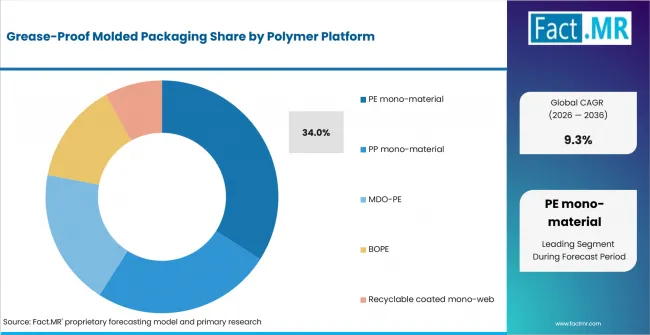
Grease Proof Molded Packaging Analysis By Polymer Platform | Source: Fact.MR
Wood-pulp fiber is expected to hold 34.0% share in 2026 because controlled furnish supports repeatable forming and coat use. Bagasse and recycled fiber remain relevant where food-contact quality and stiffness can be maintained. Germany’s UBA and ZSVR reported in January 2026 that roughly 5.5 million tonnes of pack waste from dual systems were recovered in 2024. Fiber choice is expected to remain linked to grease use and realistic recovery paths.
What leads the Barrier Technology segment?
Aqueous grease-resistant barrier is projected to account for 37.0% share in 2026.
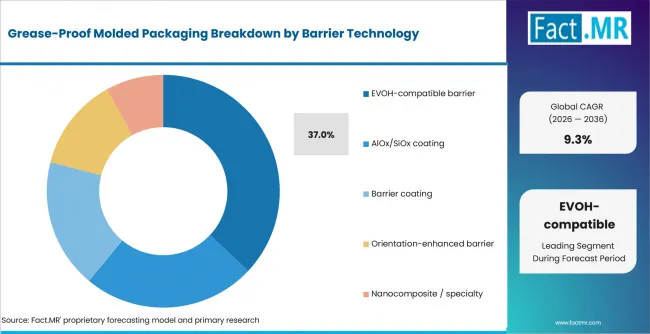
Grease Proof Molded Packaging Analysis By Barrier Technology | Source: Fact.MR
Aqueous grease-resistant barriers are projected to account for 37.0% share in 2026 because converters need oil holdout with steady forming results. Water-based systems can cover molded structures while preserving the fiber body and keeping the coat even. Selection is expected to depend on food-contact fit, heat exposure, oil contact time, and the recovery path used by each customer program.
How does Format shape demand?
Hinged containers are anticipated to capture 33.0% share in 2026.
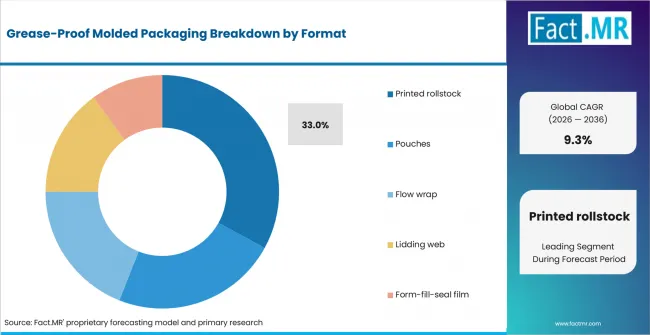
Grease Proof Molded Packaging Analysis By Format | Source: Fact.MR
Hinged containers are anticipated to capture 33.0% share in 2026 because the formed base and lid simplify counter handling for takeaway meals. Trays support plated food and site service, while bowls suit sauced foods that need depth during transport. Plates serve cafeteria and event programs where sturdy molded fiber supports simple handling during meal service. Specialty formed packs cover portioned items and meal shapes where tooling follows the food form and serving method.
What supports Foodservice and takeaway within End-use?
Foodservice and takeaway is estimated to represent 36.0% share in 2026.
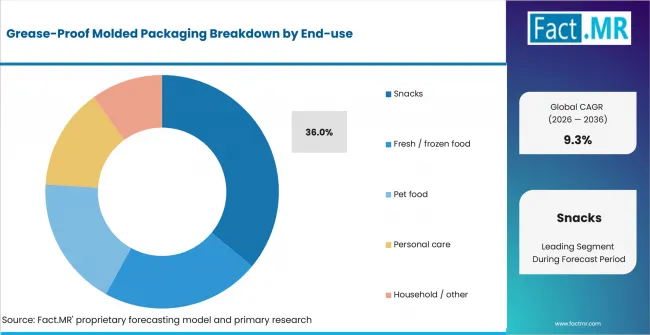
Grease Proof Molded Packaging Analysis By End Use | Source: Fact.MR
Foodservice and takeaway is estimated to represent 36.0% share in 2026 because hot meals and fried foods place direct grease loads on packs. Fresh and frozen food uses favor trays that balance rigidity with controlled moisture exposure. Site catering values predictable nesting and serving-line handling during repeated meal-service cycles across institutional kitchens. Retail prepared food adds use where the same pack moves from display into transport or immediate consumption.
What is accelerating Grease-Proof Molded Packaging Market adoption, and what is holding it back?
Foodservice substitution and PFAS-free barrier rules support adoption; reuse mandates and barrier testing constrain some single-use formats.
Drivers Impact Analysis
| DRIVER | (~) % IMPACT ON CAGR | GEOGRAPHIC RELEVANCE | IMPACT TIMELINE |
|---|---|---|---|
| Food-away-from-home packaging volumes | +1.7% | North America, East Asia | Short term (<= 2 years) |
| PFAS-free grease barrier conversion | +1.4% | North America, Europe | Short term (<= 2 years) |
| Plastic-to-fiber format substitution | +1.1% | Europe, East Asia | Medium term (2-4 years) |
| Institutional and school meal packaging | +0.8% | North America, Europe | Medium term (2-4 years) |
| Recyclability and compostability programs | +0.6% | Global | Long term (>= 4 years) |
Source: Fact.MR analysis. Updated Sep 24, 2026
Opportunity Impact Analysis
| OPPORTUNITY | (~) % IMPACT ON CAGR | GEOGRAPHIC RELEVANCE | IMPACT TIMELINE |
|---|---|---|---|
| High-oil meal barrier systems | +1.0% | Global | Short term (<= 2 years) |
| Heat-tolerant molded fiber bowls and trays | +0.8% | North America, East Asia | Medium term (2-4 years) |
| Certified compostable foodservice formats | +0.7% | North America, Europe | Medium term (2-4 years) |
| Tooling for custom meal geometries | +0.5% | Global | Long term (>= 4 years) |
Source: Fact.MR analysis. Updated Sep 24, 2026
Restraints Impact Analysis
| RESTRAINT | (~) % IMPACT ON CAGR | GEOGRAPHIC RELEVANCE | IMPACT TIMELINE |
|---|---|---|---|
| Reuse requirements for on-site service | -0.8% | Europe | Short term (<= 2 years) |
| Barrier and food-contact qualification cost | -0.6% | Global | Short term (<= 2 years) |
| Moisture and grease performance variability | -0.5% | Global | Medium term (2-4 years) |
| Collection-route differences for fiber packs | -0.4% | Europe, East Asia | Long term (>= 4 years) |
Source: Fact.MR analysis. Updated Sep 24, 2026
Who leads the Grease-Proof Molded Packaging Market?
Huhtamaki supplies molded-fiber plates, bowls, containers, and trays for restaurants, catering, takeaway, and other foodservice applications, while Sabert offers molded-fiber pulp containers, bowls, platters, and plates for dine-in, takeout, and delivery.
Dart Container supplies molded-fiber dinnerware, hinged trays, bowls, portion containers, and related foodservice products. In May 2025, Dart reported that its molded-fiber products were manufactured with a minimum of 96% renewable resources and were grease resistant and PFAS free.
Novolex offers molded-fiber tableware, hinged containers, and fiber-based food trays, while Genpak supplies Harvest® Fiber molded-fiber trays, containers, and tableware for foodservice applications. Supplier positioning is expected to depend on grease resistance, forming consistency, food-contact suitability, product performance, and clearly supported end-of-life claims. Company market shares are omitted so that the comparison remains focused on verified supplier participation and product fit.
Which companies are the key providers?
Key companies include Huhtamaki; Novolex; Dart Container; Sabert; and Genpak.
- Huhtamaki
- Novolex
- Dart Container
- Sabert
- Genpak
Bibliography
- Zeballos, E., & Sinclair, W. (2026, June 11). Total U.S. food spending reached $2.51 trillion in 2025. U.S. Department of Agriculture, Economic Research Service.
- Directorate-General for Environment. (2026, August 11). New EU packaging rules start to apply, including restrictions on PFAS in food-contact packaging. European Commission.
- Zentrale Stelle Verpackungsregister, & German Environment Agency. (2026, January 27). Fighting myths with facts – recycling packaging waste in Germany works: The German Environment Agency and ZSVR dispel common misconceptions about plastic and glass recycling.
- National Bureau of Statistics of China. (2026, January 20). Total retail sales of consumer goods in December 2025.
- U.S. Food and Drug Administration. (2025, January 3). FDA determines authorization for 35 food contact notifications related to PFAS are no longer effective.
- Statistisches Bundesamt (Destatis). (2026, February 19). Gastgewerbeumsatz 2025 real 2,1 % niedriger als im Vorjahr [Hospitality turnover in 2025 was 2.1% lower in real terms than in the previous year].
- Beretti, P.-A., & Pereira, É. (2026, June 16). Household consumption in 2025: Household consumption slowed despite a sharp deceleration in prices. Institut national de la statistique et des études économiques.
- Dart Container Corporation. (2025, May 12). Dart products earn sustainability recognition.
- Huhtamaki. (2025, February 14). Huhtamaki to separate Fiber Foodservice business segment into two distinct segments: Fiber Packaging and Foodservice Europe-Asia-Oceania.
- Sabert Corporation. (2025, November 19). Sabert Corporation’s Pulp Ultra® wins 2025 U.S. Plastics Pact Packaging Innovation Award for Compostability.
- Novolex. (2026, January). School lunch tray [Product specification sheet].
This Report Answers
- The report explains where grease-proof molded packaging is used across fiber platform, barrier technology, format, and end use.
- Segment analysis identifies the leading 2026 shares and explains why meal-service users select formed fiber packs.
- Country analysis examines China, the United States, Japan, Germany, and France using current official evidence.
- Competitive analysis reviews active molded-fiber and meal-pack providers through verified product fit and current company activity.
- Use analysis considers grease exposure, heat, moisture, nesting, delivery handling, and end-of-life routes when teams assess pack choices.
- Rule analysis covers PFAS-related food-contact changes, recycling design rules, collection systems, and reuse duties that shape the market boundary.
What does the Grease-Proof Molded Packaging Market cover?
The Grease-Proof Molded Packaging Market covers formed fiber food packs built to resist oil during filling, serving, transport, or short holding periods. Formats include trays, bowls, hinged containers, plates, portion packs, and other molded shapes where oil holdout is a core use need.
The scope falls within the wider high-performance molded fiber category where grease and moisture resistance are planned design traits. It also connects with sustainable food packaging when fiber formats serve prepared-food and takeaway use.
What is included in the scope?
The scope includes wood-pulp, bagasse, recycled-fiber, and specialty plant-fiber packs used in takeaway, catering, retail prepared food, and packaged-food use.
Coated and surface-treated formats remain in scope when fiber forms the main structure. Adjacent material demand is tracked through paper packaging materials where molded pulp forms part of the wider fiber pack base.
What is excluded from the scope?
Flexible rollstock, stand-up pouches, flow-wrap films, standalone lidding films, and folding cartons fall outside the core boundary.
The wider foodservice packaging category gives channel context because it covers materials beyond molded fiber. Compostable trays are included when fiber forms the main structure and grease resistance is an intended use trait.
How Was the Analysis Built?
The analysis draws on 120+ sources, 35+ company portfolios, 25+ countries, and more than 20 industry interviews.
- Primary Research: Primary research includes discussions with manufacturers, service providers, technology developers, distributors, end users, and subject-matter experts. These conversations examine purchasing priorities, product adoption, operational challenges, approval requirements, competitive positioning, and the factors that influence wider market acceptance.
- Desk Research: Desk research covers government statistics, regulatory publications, company filings, trade data, technical studies, industry associations, standards, public policy, and other authoritative sources. Every source used in the analysis is documented in the bibliography.
- Market Sizing and Forecasting: Market estimates combine historical performance, demand indicators, pricing and volume trends, segment shares, company participation, country-level growth, adoption patterns, investment activity, and barriers to market expansion.
- Data Validation and Update Cycle: Findings are validated by comparing primary interviews with public data, company activity, regulatory changes, trade patterns, and industry developments. Regular updates review new product launches, capacity changes, partnerships, approvals, and shifts in commercial adoption.
Segmentation
Which countries are scaling the Grease-Proof Molded Packaging Market through 2036?
- The country comparison spans 1.2 percentage points across the five profiled markets.
- China remains 0.5 percentage point above the USA as restaurant and delivery activity sustains high container volumes.
- The USA and Japan both record 9.3% CAGR, but regulation and channel structure create different adoption routes.
- Germany remains 0.2 percentage point below the USA as reuse and recycling rules shape pack design choices.
- France closes the displayed range at 8.6% as reuse rules narrow some on-site single-use uses.
Comparable growth rates can mask different rules for grease resistance, recycling fit, composting fit, and reuse. Full report coverage includes North America, Latin America, Western Europe, Eastern Europe, East Asia, South Asia & Pacific, Middle East & Africa.
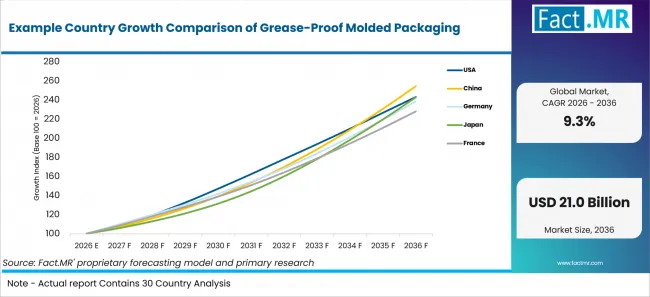
Example Country Growth Comparison Of Grease Proof Molded Packaging | Source: Fact.MR
| Country | CAGR (2026-2036) |
|---|---|
| China | 9.8% |
| United States | 9.3% |
| Japan | 9.3% |
| Germany | 9.1% |
| France | 8.6% |
Source: Fact.MR analysis. Updated Sep 24, 2026
What supports China adoption?
9.8% CAGR, supported by restaurant activity and tighter food-contact packaging controls.
China’s catering channel gives the market a broad meal-service base. The National Bureau of Statistics reported in January 2026 that catering revenue reached 5,798.2 billion yuan in 2025. Demand is projected to record 9.8% CAGR through 2036 as takeaway meals and prepared foods require oil-resistant formed packs for high-volume service.
What supports United States adoption?
9.3% CAGR, supported by food-away-from-home spending and PFAS-related barrier reformulation.
U.S. foodservice converters are changing grease barriers around current food-contact rules. The FDA reported in January 2025 that 35 food contact notifications related to PFAS-containing substances used as grease-proofers in paper and paperboard food packaging were no longer effective. The market is expected to record 9.3% CAGR by 2036 as other barrier systems move into formed-fiber meal-service programs.
What supports Japan adoption?
9.3% CAGR, supported by household spending, packaging collection planning, and material-design policy.
Japan’s municipal collection planning keeps paper-container recovery visible when fiber formats are selected for meal use. The Ministry of the Environment reported in March 2026 that 904 municipalities planned separate collection of paper containers and packaging for fiscal 2026. Demand is anticipated to reach 9.3% CAGR from 2026 to 2036 as fiber packs combine grease resistance with locally understood disposal routes.
What supports Germany adoption?
9.1% CAGR, supported by packaging recycling infrastructure and EU design rules.
Germany’s meal-service base supports recurring use of trays and takeaway packs while pack rules place greater weight on recovery. Destatis reported in February 2026 that nominal hospitality revenue increased 1.4% in 2025. Demand is forecast to expand at 9.1% CAGR through 2036 as formed-fiber formats pair grease control with clear recycling results.
How does France perform?
8.6% CAGR, supported by restaurant spending while reuse rules narrow some single-use uses.
France’s restaurant and accommodation activity keeps takeaway packs relevant alongside on-site reuse programs. Insee reported in June 2026 that spending on restaurants and accommodation in 2025 stood more than 20% above the 2019 level. Demand is estimated to advance at 8.6% CAGR from 2026 to 2036 as grease-proof molded formats serve transport and prepared-food occasions.
What is the report’s scope and coverage?
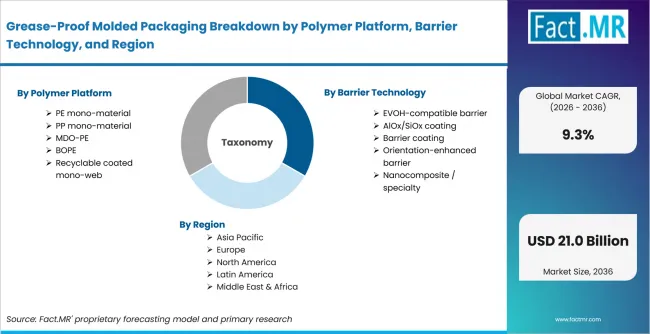
Grease Proof Molded Packaging Breakdown By Polymer Platform, Barrier Technology, And Region | Source: Fact.MR
| Attribute | Details |
|---|---|
| Quantitative Units | USD billion |
| Market Definition | Molded fiber trays, bowls, hinged containers, plates, portion packs, and related formed food packaging designed to resist grease and oil during food contact and service. |
| Fiber Platform | Wood-pulp fiber; Bagasse fiber; Recycled fiber; Bamboo or grass fiber; Blended specialty fiber |
| Barrier Technology | Aqueous grease-resistant barrier; Bio-based coating; Mineral or silica barrier; Polymer-free surface treatment; Hybrid barrier |
| Format | Hinged containers; Trays; Bowls; Plates; Specialty formed packs |
| End-use | Foodservice and takeaway; Fresh and frozen food; Bakery and snacks; Institutional catering; Retail prepared food |
| Regions Covered | North America; Latin America; Western Europe; Eastern Europe; East Asia; South Asia & Pacific; Middle East & Africa |
| Countries Covered | China; United States; Japan; Germany; France |
| Key Companies Profiled | Huhtamaki; Novolex; Dart Container; Sabert; Genpak |
| Forecast Period | 2026 to 2036 |
| Approach | Hybrid top-down and bottom-up approach using foodservice activity, molded-fiber product portfolios, barrier regulation, packaging policy, country adoption, and supplier validation. |
Source: Fact.MR analysis. Updated Sep 24, 2026
How is the market segmented?
-
By Fiber Platform:
- Wood-pulp fiber
- Bagasse fiber
- Recycled fiber
- Bamboo or grass fiber
- Blended specialty fiber
-
By Barrier Technology:
- Aqueous grease-resistant barrier
- Bio-based coating
- Mineral or silica barrier
- Polymer-free surface treatment
- Hybrid barrier
-
By Format:
- Hinged containers
- Trays
- Bowls
- Plates
- Specialty formed packs
-
By End-use:
- Foodservice and takeaway
- Fresh and frozen food
- Bakery and snacks
- Institutional catering
- Retail prepared food
-
By Region:
- North America
- Latin America
- Western Europe
- Eastern Europe
- East Asia
- South Asia & Pacific
- Middle East & Africa
Frequently Asked Questions
How big is the grease-proof molded packaging market in 2026?
What is the CAGR of the grease-proof molded packaging market from 2026 to 2036?
Which barrier technology leads the grease-proof molded packaging market?
Which end use leads the grease-proof molded packaging market?
Who are the leading companies in the grease-proof molded packaging market?
Who worked on this report


Preview the report firsthand - request a free sample
Free SampleGet the brochure for pricing and purchase details
Download PDF