Athlete Sleep Technology Market Size, Share, Growth and Forecast (2026 - 2036)
The Athlete Sleep Technology Market is segmented by Product Type, by Technology Layer, by Buyer Type, by Application, by Sales Channel, by Price Tier, by Deployment Mode, and Region. Forecast for 2026 to 2036.
What is the athlete sleep technology market forecast to be worth by 2036?
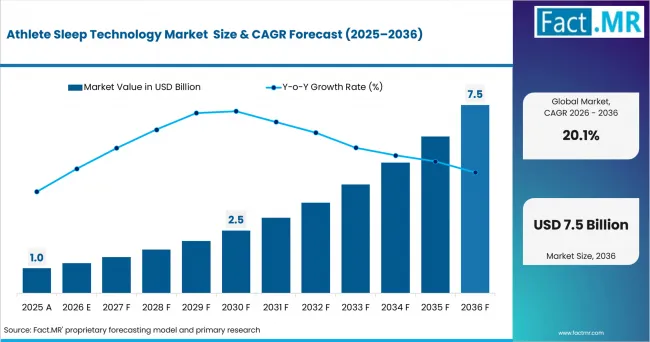
USD 1.2 billion in 2026 to USD 7.5 billion by 2036, at 20.1% CAGR.
- The athlete sleep technology market crossed a valuation of USD 1.0 billion in 2025.
- Demand is expected to increase from USD 1.2 billion in 2026 to USD 7.5 billion by 2036.
- The market is forecast to record 20.1% CAGR during 2026 to 2036 as sleep data becomes part of recovery planning, travel management and training-load decisions.
What are the defining numbers behind athlete sleep technology growth?
USD 6.3 billion absolute opportunity by 2036. China, the United States and South Korea lead the country view.
- Demand Drivers in the Market
- Athletes need sleep data that helps coaches adjust training load after travel and high-volume training blocks.
- Teams are adding sleep inputs to readiness dashboards since recovery decisions need a clearer overnight signal.
- Thermoregulation products are gaining buyer attention owing to heat management problems during travel and congested schedules.
- Consumer rings and wrist devices support the category by making daily sleep scores familiar to younger athletes.
- Key Segments Analyzed
- By Technology Layer: Sensor Tracking is expected to account for 49.0% of the market share in 2026, reflecting buyer preference for simple nightly metrics before deeper coaching workflows.
- By Sales Channel: Direct Online is projected to capture 47.0% of the market in 2026, supported by subscription buying and self-serve device upgrades.
- By Buyer Type: Individual Athletes are estimated to hold 46.0% share in 2026, driven by direct purchases from runners, triathletes and gym users.
- By Product Type: Sleep Wearables are forecast to represent 44.0% share in 2026, owing to lower entry prices and easier travel use.
- By Application: Recovery Monitoring is anticipated to secure 41.0% share in 2026, given that athletes use sleep as a readiness signal.
- By Price Tier: Premium Systems are expected to contribute 39.0% of revenue in 2026, supported by thermoregulation pods and connected mattresses.
- By Deployment Mode: Consumer Subscription is likely to hold 37.0% share in 2026, reflecting recurring access to scoring, coaching and history dashboards.
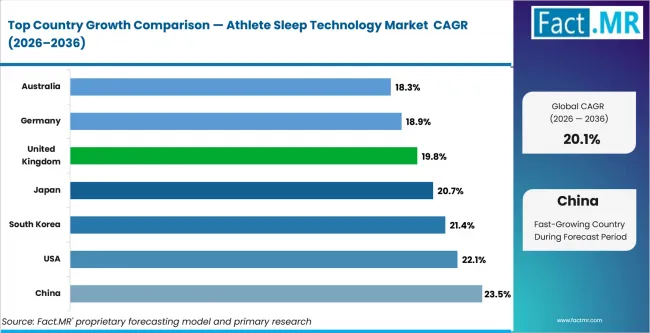
- By Geography: China is projected to record a CAGR of 23.5% through 2036, supported by sports industry scale and local wearable supply depth.
- Analyst Opinion
- Shambhu Nath Jha, Principal Analyst at Fact.MR states, "I see sleep moving from a private wellness habit into a visible recovery input inside sport. The real tension is not whether athletes value sleep. The question is which data point changes a coach decision at 6 a.m. Teams ask whether the device is comfortable, whether the metric is stable and whether staff can trust the output across travel weeks. The winning supplier will connect sleep and training load without making the athlete manage another complicated tool. It is the one that connects sleep, temperature and training load without making the athlete manage another complicated tool."
- Strategic Implications
- Device makers should prove comfort during overnight wear before adding more recovery metrics.
- Sports teams need data rules that separate useful sleep signals from noisy consumer scores.
- Recovery clinics can package thermoregulation and sleep coaching into return-to-training programs.
- Hospitality buyers should test athlete sleep suites around travel fatigue rather than general wellness claims.
Sleep wearables, thermal systems and team recovery platforms form the core of this market. Samsung Electronics said in February 2024 that its Galaxy Watch sleep apnea feature received De Novo authorization from the United States Food and Drug Administration. This supports demand for athlete sleep products that combine clear measurement, credible validation and careful health-feature boundaries.
China is projected to record 23.5% CAGR through 2036 as sports industry scale and local wearable supply support faster adoption. The United States is expected to expand at 22.1% CAGR because premium recovery spending and sleep difficulty evidence support paid sleep technology. South Korea is forecast to grow at 21.4% CAGR as Samsung wearable depth and high sport participation support local awareness. Japan is expected to advance at 20.7% CAGR as compact devices and travel recovery routines fit urban athlete needs. The United Kingdom is projected to rise at 19.8% CAGR as active adults and elite teams test sleep tools for recovery planning.
How does the athlete sleep technology market break down by segment?
Sensor Tracking leads at 49.0%. Direct Online follows with 47.0% share in 2026.
Which technology layer leads?
Sensor Tracking holds 49.0% share in 2026.
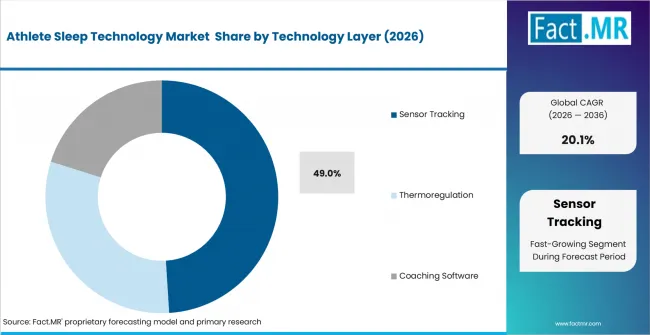
Sensor Tracking is expected to hold 49.0% share in 2026 since athletes first buy the nightly score before buying a full coaching stack. Thermoregulation still holds ground in premium recovery rooms where temperature control is the main pain point. This route links athlete products with sleep tracking and optimization products used by consumers who want sleep feedback without a lab visit.
Which sales channel leads?
Direct Online holds 47.0% share in 2026.
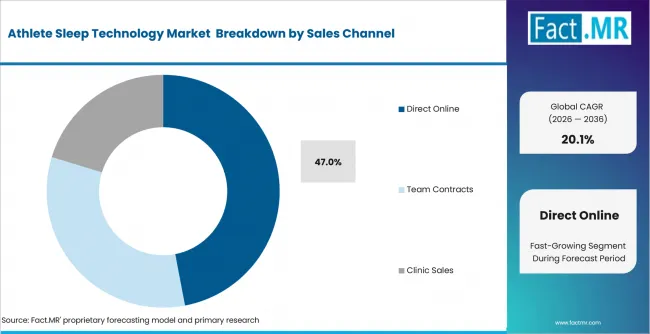
Direct Online is projected to account for 47.0% share in 2026 owing to subscription upgrades and frequent product launches. Team contracts remain important where coaches need shared dashboards and roster-level access. The same buying habit supports wearable sleep trackers that move from general wellness use into training routines.
Which buyer type leads?
Individual Athletes hold 46.0% share in 2026.
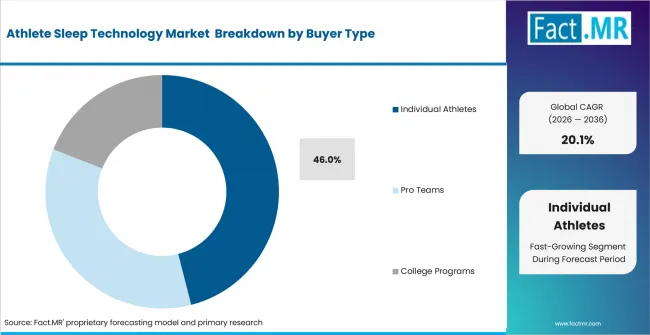
Individual Athletes are forecast to hold 46.0% share in 2026 since runners, triathletes and strength athletes can buy without team approval. Pro teams spend more per account but need evidence before changing staff workflows. This creates a bridge to sports wearables that already track training load and recovery.
Which product type leads?
Sleep Wearables hold 44.0% share in 2026.
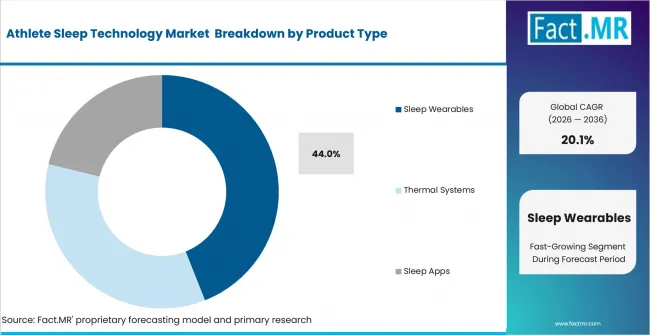
Sleep Wearables are anticipated to represent 44.0% share in 2026 due to lower entry cost and easier travel use. Connected mattresses remain a premium route for athletes who control their home sleep setting. Thermoregulation products also connect to smart mattress buying where comfort and sensor feedback are sold together.
Which application leads?
Recovery Monitoring holds 41.0% share in 2026.
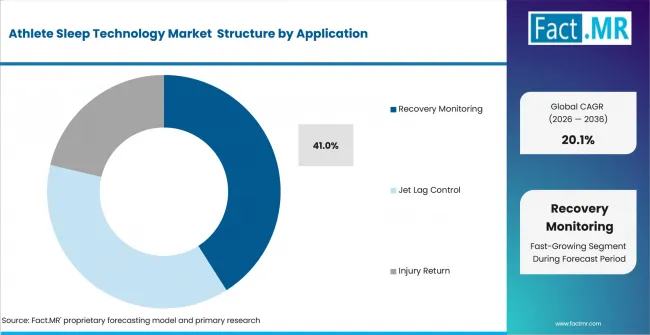
Recovery Monitoring is estimated to secure 41.0% share in 2026 since sleep becomes useful when it changes tomorrow’s training decision. Jet lag management holds a clear role for teams with heavy travel schedules. Clubs also connect sleep scores with sports analytics when staff merge readiness, workload and performance data.
Which price tier leads?
Premium Systems hold 39.0% share in 2026.
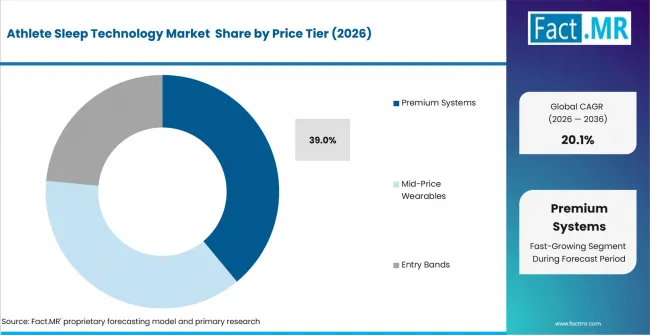
Premium Systems are expected to contribute 39.0% of revenue in 2026 since connected mattresses and thermal pods lift average selling price. Mid-price wearables still ship more units but generate lower revenue per user. This value layer connects with luxury mattress purchases where sleep comfort is positioned as a performance asset.
Which deployment mode leads?
Consumer Subscription holds 37.0% share in 2026.
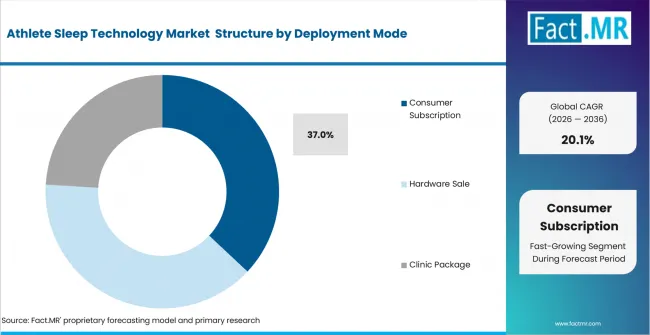
Consumer Subscription is likely to hold 37.0% share in 2026 as athletes pay for score history, coaching prompts and recovery context. Team licenses are expected to expand when staff need roster dashboards. The next step connects these workflows with AI-enabled sleep technologies that interpret patterns across nights.
What is accelerating athlete sleep technology demand, and what is holding it back?
Recovery-led training workflows support demand. Comfort, validation and data reliability restrain wider use.
Athlete sleep technology is moving from personal tracking into decisions made by coaches and recovery staff. Sleep affects readiness, soreness and travel adaptation, which gives teams a reason to track it alongside training load. That sleep difficulty base supports consumer interest, while WHOOP and Oura show how recovery scoring can turn nightly data into a paid service.
Expansion is limited when devices are uncomfortable, metrics vary or athletes do not want another subscription. Rings and wrist devices can miss data when they are removed during charging or competition periods. The restraint is visible in medical-adjacent features, where Samsung limits its authorized sleep apnea function to adults 22 years and older over a two-night monitoring period. Suppliers need clearer validation and simpler staff workflows before larger team contracts expand beyond pilots.
Where do the biggest athlete sleep technology opportunities sit?
Team recovery dashboards, thermal sleep systems and travel fatigue programs.
- Team Recovery Dashboards: Providers can sell roster-level sleep feeds to pro teams and college programs that already track workload. The sale works when coaches can compare sleep with readiness without asking athletes to manage more manual inputs.
- Thermal Sleep Systems: Connected pods can target athletes who struggle with heat and travel fatigue. The same need supports non-wearable sleep tracker products that remove nighttime wear discomfort.
- Travel Fatigue Programs: Teams and hotels can sell sleep protocols around time-zone changes and competition schedules.
Which countries are scaling athlete sleep technology fastest?
China 23.5% CAGR, United States 22.1% CAGR, South Korea 21.4% CAGR, Japan 20.7% CAGR, United Kingdom 19.8% CAGR, Germany 18.9% CAGR, Australia 18.3% CAGR.
Based on regional analysis, the athlete sleep technology market is segmented into North America and Western Europe. East Asia and South Asia and Pacific are also covered. Latin America and Middle East and Africa complete the regional scope.
.webp)
| Country | CAGR |
|---|---|
| China | 23.5% |
| United States | 22.1% |
| South Korea | 21.4% |
| Japan | 20.7% |
| United Kingdom | 19.8% |
| Germany | 18.9% |
| Australia | 18.3% |

What powers China's lead?
23.5% CAGR, supported by national sports industry scale and local wearable supply.
China has a large sports economy and a domestic electronics base that can reduce device cost. The National Bureau of Statistics of China reported in January 2026 that national sports industry output reached 3.8421 trillion yuan in 2024. That figure gives wearable and sleep-device suppliers a large pool of fitness buyers. Local brands should gain when they combine sleep scoring with Mandarin app support and affordable hardware.
Why does the United States matter?
22.1% CAGR, driven by sleep difficulty and premium recovery spending.
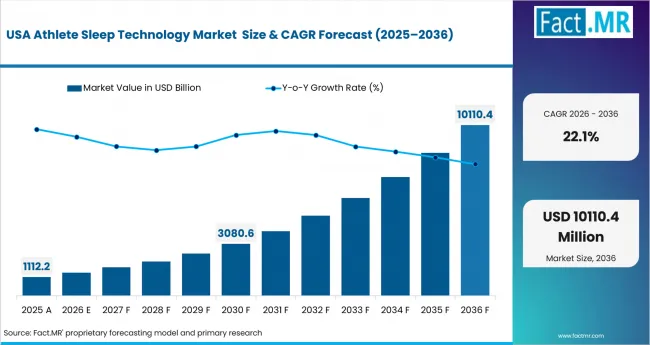
United States buyers compare sleep products through recovery proof, comfort and subscription value. The Centers for Disease Control and Prevention reported in April 2026 that 15.4% of adults had trouble falling asleep most days or every day in 2024. That condition supports premium sleep tracking and thermoregulation purchases among athletes. Suppliers should win when they connect sleep metrics to training load rather than wellness advice alone.
What supports the South Korea outlook?
21.4% CAGR, supported by high sport participation and Samsung wearables depth.

South Korea combines consumer electronics strength with a fitness population that already uses connected devices. The Ministry of Culture, Sports and Tourism reported in January 2026 that the 2025 national sports participation rate reached 62.9%. Samsung also gives the country a local wearable reference point through Galaxy Ring and Galaxy Watch. Providers can compete by linking sleep feedback with mobile health ecosystems used by Korean consumers.
How is Japan scaling athlete sleep technology demand?
20.7% CAGR, driven by active urban users and travel recovery needs.

Japan has a buyer base that values compact devices and sleep routines that fit dense urban life. The Tokyo Metropolitan Government reported in January 2024 that 72.8% of surveyed adult residents had been involved in sports or exercise. That active base creates room for rings, wrist devices and sleep coaching apps. Suppliers should localize coaching language and focus on fatigue from commuting, training and tournament travel.
What makes the United Kingdom important?
19.8% CAGR, backed by active adults and elite-team recovery use.
United Kingdom demand is shaped by active adults and professional sport teams that test recovery tools before wider use. Sport England reported in April 2026 that 64.6% of adults in England met weekly activity guidelines during November 2024 to November 2025. Aston Martin Aramco added Eight Sleep as a partner in February 2026. Suppliers can use elite sport proof to reach premium consumer buyers.
Why is Germany a relevant commercial market?
18.9% CAGR, led by organized sport memberships and compliance-minded buyers.
Germany offers a club-based route for athlete sleep technology rather than only a direct consumer route. The German Olympic Sports Confederation reported 29.3 million memberships in organized sport as of January 1, 2025. This club base can support recovery education and pooled buying for teams. Suppliers need clear privacy handling and conservative performance claims to fit German buyer expectations.
How does Australia create an early-adopter role?
18.3% CAGR, backed by sport participation and recovery clinic demand.
Australia has a sport culture that supports recovery products in clubs, gyms and endurance communities. The Australian Government states that around 84% of adults aged 15 and over participate in sport or physical activity at least once a year. That active population gives suppliers a broad consumer base. Providers should pair sleep tracking with heat management and travel recovery for athletes moving across large distances.
Who leads the athlete sleep technology landscape?
Eight Sleep, WHOOP and Oura Health lead through thermoregulation, recovery subscriptions and ring-based sleep data. Electronics brands add another competitive route.
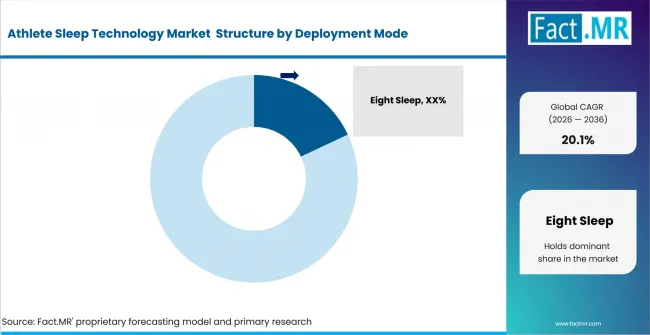
Competition is split between specialist sleep systems, athlete wearables and large electronics brands. Buyers compare suppliers on night comfort, data continuity, battery life and how clearly the score changes training decisions. Team buyers also look for staff dashboards, exportable data and privacy controls. The field is not won by hardware alone, since the recurring value sits in interpretation and coaching. This makes subscriptions and team licenses more important than one-time device sales through 2036.
Eight Sleep leads the temperature-control lane through Pod systems and sports partnerships. Aston Martin Aramco announced in February 2026 that it partnered with Eight Sleep for driver and team performance. WHOOP leads through athlete recovery subscriptions, while Oura Health broadened ring accuracy with Oura Ring 4 in October 2024.
Garmin adds team workflow through Firstbeat Sports and its February 2026 sleep data integration. Samsung Electronics and Apple create pressure on specialist players because their watches and rings make sleep health features mainstream. Bryte Labs competes in connected mattresses where pressure relief and sleep architecture matter.
Which companies are the key players?
Eight Sleep, WHOOP and Oura Health are key players. Garmin, Samsung Electronics and Apple are also profiled. Bryte Labs completes the company set.
- Eight Sleep
- WHOOP
- Oura Health Oy / Oura Ring
- Garmin Ltd.
- Samsung Electronics Co., Ltd.
- Apple Inc.
- Bryte
Bibliography
- [1] Centers for Disease Control and Prevention. (2026, April 29). Use of sleep aids among adults age 18 and older: United States, 2024. Centers for Disease Control and Prevention.
- [2] Apple Inc. (2024, September 9). Apple introduces health features to support conditions impacting billions of people. Apple Inc.
- [3] Samsung Electronics Co., Ltd. (2024, February 9). Samsung sleep apnea feature on Galaxy Watch first of its kind authorized by United States Food and Drug Administration. Samsung Electronics Co., Ltd.
- [4] Samsung Electronics Co., Ltd. (2024, July 10). Samsung expanded wearables portfolio unlocks intelligent health experiences for all. Samsung Electronics Co., Ltd.
- [5] WHOOP Inc. (2025, May 8). Introducing WHOOP 5.0 and WHOOP MG. WHOOP Inc.
- [6] Oura Health Oy. (2024, October 3). Discover the brand-new Oura Ring 4. Oura Health Oy.
- [7] Firstbeat Technologies Oy. (2026, February 5). Firstbeat Sports announces integration of Garmin sleep data to enhance recovery insights for athletes. Firstbeat Technologies Oy.
- [8] Garmin Ltd. (2025, March 15). How well do you sleep? New data examines quality of Garmin users’ sleep. Garmin Ltd.
- [9] Aston Martin Aramco Formula One Team. (2026, February 10). Aston Martin Aramco turns to Eight Sleep to support competitive edge. Aston Martin Aramco Formula One Team.
- [10] Sport England. (2026, April 23). Active Lives Adult Survey November 2024-25 report. Sport England.
- [11] National Bureau of Statistics of China. (2026, January 1). Announcement on total scale and value-added data of the national sports industry in 2024. National Bureau of Statistics of China.
- [12] Ministry of Culture, Sports and Tourism of the Republic of Korea. (2026, January 23). 2025 National Sports Participation Survey. Ministry of Culture, Sports and Tourism of the Republic of Korea.
- [13] Tokyo Metropolitan Government. (2024, January 26). Results of surveys on Tokyo residents’ involvement in sports activities. Tokyo Metropolitan Government.
- [14] German Olympic Sports Confederation. (2025, January 1). Inventory survey. German Olympic Sports Confederation.
- [15] Australian Government Department of Health and Aged Care. (2024, December 20). Over 600 sports available to participate in. Australian Government Department of Health and Aged Care.
This Report Address
- Strategic intelligence on athlete sleep technology across Product Type, Technology Layer, Buyer Type and Application.
- Segment analysis covering Sensor Tracking, Direct Online, Individual Athletes, Sleep Wearables and Recovery Monitoring.
- Regional outlook covering China, United States, South Korea, Japan, United Kingdom, Germany and Australia.
- Competitive analysis covers Eight Sleep, WHOOP and Oura Health as key players. Garmin, Samsung Electronics and Apple are also profiled. Bryte Labs completes the company set.
- Product assessment covering Sleep Wearables, Thermal Systems, Connected Mattresses, Sleep Apps and Team Platforms.
- Regulatory assessment covering United States Food and Drug Administration sleep apnea authorizations and consumer sleep screening boundaries.
- Source-led market sizing using consumer sleep-tracking bases, sport participation evidence, device pricing, subscription uptake and company validation.
What does the athlete sleep technology market cover?
Sleep tracking, temperature control and recovery guidance products used by athletes and sport performance teams.
The athlete sleep technology market covers paid products that measure sleep and convert the result into a recovery decision. It includes rings, wrist devices and connected mattress systems. It also includes thermoregulation pods, coaching apps and team dashboards when sleep is used to guide performance decisions.
What is included in the scope?
Wearable sleep tracking and thermoregulation systems. Team software and recovery protocols are also included.
The scope includes sleep wearables and connected sleep surfaces used by athletes at home or during travel. It covers thermal control products, recovery analytics and software subscriptions used by coaches. Sleep coaching protocols, clinic packages and hotel sleep suites are included when they are sold for athletic recovery.
What is excluded from the scope?
General mattresses, medical sleep studies and fitness wearables without a recovery sleep use case.
The scope excludes ordinary bedding and mattresses that do not measure or adjust sleep conditions. It excludes clinical polysomnography when the service is sold only for diagnosis. General activity trackers are excluded unless the product includes sleep metrics used for athlete recovery or training decisions.
How was the analysis built?
120+ sources and 55+ company or regulator pages. 28 countries were checked with 24 interviews.
- Primary Research:
- Interviews covered strength coaches, sports science leads, recovery clinic buyers and performance product distributors.
- Desk Research:
- Research reviewed government health pages, sport participation datasets, company newsrooms and official product materials.
- Market-Sizing and Forecasting:
- The top-down model combined sleep-tracking consumer bases, athlete participation pools, premium device pricing and team software penetration.
- Data Validation and Update Cycle:
- Estimates were checked against WHOOP 5.0, Oura Ring 4, Galaxy Ring, Garmin sleep data integration and Eight Sleep sports partnerships.
What is the report’s scope and coverage?

| Attribute | Details |
|---|---|
| Quantitative Units | USD Billion in 2026 to USD Billion by 2036 at CAGR |
| Market Definition | Sleep tracking, thermoregulation and recovery guidance products used by athletes and performance teams |
| Product Type | Sleep Wearables, Thermal Systems, Connected Mattresses, Sleep Apps, Team Platforms |
| Technology Layer | Sensor Tracking, Thermoregulation, Coaching Software, Recovery Analytics, Sleep Diagnostics |
| Buyer Type | Individual Athletes, Pro Teams, College Programs, Recovery Clinics, Hospitality Buyers |
| Application | Recovery Monitoring, Jet Lag Control, Injury Return, Sleep Coaching, Heat Stress Recovery |
| Sales Channel | Direct Online, Team Contracts, Specialty Retail, Clinic Sales, Hotel Procurement |
| Price Tier | Premium Systems, Mid-Price Wearables, Entry Bands, Software Plans, Team Licenses |
| Deployment Mode | Consumer Subscription, Hardware Sale, Team License, Clinic Package, Hotel Suite |
| Regions Covered | North America, Western Europe, East Asia, South Asia and Pacific, Latin America, Middle East and Africa |
| Countries Covered | China, United States, South Korea, Japan, United Kingdom, Germany and Australia |
| Key Companies Profiled | Eight Sleep, WHOOP, Oura Health, Garmin, Samsung Electronics, Apple and Bryte Labs |
| Forecast Period | 2026 to 2036 |
| Approach | Hybrid top-down and bottom-up approach using sleep-tracking consumer bases, sports participation pools, device pricing, subscription uptake, regulation timing and company validation |
How is the athlete sleep technology market segmented?
-
By Product Type:
- Sleep Wearables
- Thermal Systems
- Connected Mattresses
- Sleep Apps
- Team Platforms
-
By Technology Layer:
- Sensor Tracking
- Thermoregulation
- Coaching Software
- Recovery Analytics
- Sleep Diagnostics
-
By Buyer Type:
- Individual Athletes
- Pro Teams
- College Programs
- Recovery Clinics
- Hospitality Buyers
-
By Application:
- Recovery Monitoring
- Jet Lag Control
- Injury Return
- Sleep Coaching
- Heat Stress Recovery
-
By Sales Channel:
- Direct Online
- Team Contracts
- Specialty Retail
- Clinic Sales
- Hotel Procurement
-
By Price Tier:
- Premium Systems
- Mid-Price Wearables
- Entry Bands
- Software Plans
- Team Licenses
-
By Deployment Mode:
- Consumer Subscription
- Hardware Sale
- Team License
- Clinic Package
- Hotel Suite
-
By Region:
- North America
- United States
- Canada
- Mexico
- Latin America
- Brazil
- Argentina
- Rest of Latin America
- Western Europe
- Germany
- United Kingdom
- France
- Italy
- Spain
- Rest of Western Europe
- East Asia
- China
- Japan
- South Korea
- South Asia & Pacific
- India
- ASEAN
- Australia
- Middle East & Africa
- GCC Countries
- South Africa
- UAE
- Rest of Middle East & Africa
- North America
- Frequently Asked Questions -
How large is the Athlete Sleep Technology Market expected to be in the near term?
The market is expanding as sleep tracking moves into athlete recovery planning, travel management and training-load decisions.
What is the long-term outlook for the Athlete Sleep Technology Market?
The outlook remains strong as teams, athletes and recovery clinics use sleep data to guide readiness decisions.
What is the main driver of athlete sleep technology demand?
Demand is driven by athletes and teams seeking clearer overnight recovery signals after travel and heavy training.
Which technology layer leads the market?
Sensor Tracking leads because athletes first adopt simple nightly sleep metrics before deeper coaching workflows.
Which countries are key markets for athlete sleep technology?
China, the United States, South Korea, Japan, the United Kingdom, Germany and Australia are key markets.
Who are the leading companies in the Athlete Sleep Technology Market?
Leading companies include Eight Sleep, WHOOP, Oura Health, Garmin, Samsung Electronics, Apple and Bryte Labs.
Where do future opportunities in this market lie?
Opportunities lie in team recovery dashboards, thermal sleep systems and travel fatigue programs.
Table of Content
- Key Takeaways
- Market Size and CAGR
- Top Growth Driver
- Fastest Growing Segment
- Leading Region
- Key Companies
- Emerging Opportunities
- Executive Summary
- Global Market Outlook
- Demand-side Trends
- Supply-side Trends
- Technology Roadmap Analysis
- Analysis and Recommendations
- Analyst Perspective (What is happening? Why now? What should investors know?)
- Key Questions Answered
- How large is the market?
- What is the CAGR?
- What are key trends?
- Which region dominates?
- Who are the leaders?
- Market Overview
- Market Coverage / Taxonomy
- Market Definition / Scope / Limitations
- Research Methodology
- Chapter Orientation
- Analytical Lens and Working Hypotheses
- Market Structure, Signals, and Trend Drivers
- Benchmarking and Cross-market Comparability
- Market Sizing, Forecasting, and Opportunity Mapping
- Research Design and Evidence Framework
- Desk Research Programme (Secondary Evidence)
- Expert Input and Fieldwork (Primary Evidence)
- Tooling, Models, and Reference Databases
- Data Engineering and Model Build
- Quality Assurance and Audit Trail
- Market Background
- Market Dynamics (Drivers, Restraints, Opportunity, Trends)
- Scenario Forecast (Optimistic, Likely, Conservative)
- Impact Analysis
- AI Impact
- Sustainability Impact
- Regulatory Impact
- Technology Impact
- Consumer / Buyer Analysis
- Purchase Drivers
- Adoption Barriers
- Buyer Journey
- Opportunity Map Analysis
- Product Life Cycle Analysis
- Supply Chain Analysis
- Investment Feasibility Matrix
- Value Chain Analysis
- PESTLE and Porter's Analysis
- Regulatory Landscape
- Regional Parent Market Outlook
- Production and Consumption Statistics
- Import and Export Statistics
- Global Market Analysis and Forecast, 2021 to 2036
- Historical Market Size Value (USD Million) Analysis, 2021 to 2025
- Current and Future Market Size Value (USD Million) Projections, 2026 to 2036
- Y-o-Y Growth Trend Analysis
- Absolute $ Opportunity Analysis
- Global Market Pricing Analysis, 2021 to 2036
- Global Market Analysis and Forecast, By Technology Layer, 2021 to 2036
- Introduction / Key Findings
- Historical Market Size Value (USD Million) Analysis By Technology Layer, 2021 to 2025
- Current and Future Market Size Value (USD Million) Analysis and Forecast By Technology Layer, 2026 to 2036
- Sensor Tracking
- Thermoregulation
- Coaching Software
- Sensor Tracking
- Y-o-Y Growth Trend Analysis By Technology Layer, 2021 to 2025
- Absolute $ Opportunity Analysis By Technology Layer, 2026 to 2036
- Global Market Analysis and Forecast, By Sales Channel, 2021 to 2036
- Introduction / Key Findings
- Historical Market Size Value (USD Million) Analysis By Sales Channel, 2021 to 2025
- Current and Future Market Size Value (USD Million) Analysis and Forecast By Sales Channel, 2026 to 2036
- Direct Online
- Team Contracts
- Clinic Sales
- Direct Online
- Y-o-Y Growth Trend Analysis By Sales Channel, 2021 to 2025
- Absolute $ Opportunity Analysis By Sales Channel, 2026 to 2036
- Global Market Analysis and Forecast, By Buyer Type, 2021 to 2036
- Introduction / Key Findings
- Historical Market Size Value (USD Million) Analysis By Buyer Type, 2021 to 2025
- Current and Future Market Size Value (USD Million) Analysis and Forecast By Buyer Type, 2026 to 2036
- Individual Athletes
- Pro Teams
- College Programs
- Individual Athletes
- Y-o-Y Growth Trend Analysis By Buyer Type, 2021 to 2025
- Absolute $ Opportunity Analysis By Buyer Type, 2026 to 2036
- Global Market Analysis and Forecast, By Product Type, 2021 to 2036
- Introduction / Key Findings
- Historical Market Size Value (USD Million) Analysis By Product Type, 2021 to 2025
- Current and Future Market Size Value (USD Million) Analysis and Forecast By Product Type, 2026 to 2036
- Sleep Wearables
- Thermal Systems
- Sleep Apps
- Sleep Wearables
- Y-o-Y Growth Trend Analysis By Product Type, 2021 to 2025
- Absolute $ Opportunity Analysis By Product Type, 2026 to 2036
- Global Market Analysis and Forecast, By Application, 2021 to 2036
- Introduction / Key Findings
- Historical Market Size Value (USD Million) Analysis By Application, 2021 to 2025
- Current and Future Market Size Value (USD Million) Analysis and Forecast By Application, 2026 to 2036
- Recovery Monitoring
- Jet Lag Control
- Injury Return
- Recovery Monitoring
- Y-o-Y Growth Trend Analysis By Application, 2021 to 2025
- Absolute $ Opportunity Analysis By Application, 2026 to 2036
- Global Market Analysis and Forecast, By Price Tier
- Introduction / Key Findings
- Historical Market Size Value (USD Million) Analysis By Price Tier, 2021 to 2025
- Current and Future Market Size Value (USD Million) Analysis and Forecast By Price Tier, 2026 to 2036
- Premium Systems
- Mid-Price Wearables
- Entry Bands
- Premium Systems
- Y-o-Y Growth Trend Analysis By Price Tier, 2021 to 2025
- Absolute $ Opportunity Analysis By Price Tier, 2026 to 2036
- Global Market Analysis and Forecast, By Deployment Mode
- Introduction / Key Findings
- Historical Market Size Value (USD Million) Analysis By Deployment Mode, 2021 to 2025
- Current and Future Market Size Value (USD Million) Analysis and Forecast By Deployment Mode, 2026 to 2036
- Consumer Subscription
- Hardware Sale
- Clinic Package
- Consumer Subscription
- Y-o-Y Growth Trend Analysis By Deployment Mode, 2021 to 2025
- Absolute $ Opportunity Analysis By Deployment Mode, 2026 to 2036
- Global Market Analysis and Forecast, By Region, 2021 to 2036
- Introduction
- Historical Market Size Value (USD Million) Analysis By Region, 2021 to 2025
- Current Market Size Value (USD Million) Analysis and Forecast By Region, 2026 to 2036
- North America
- Latin America
- Western Europe
- Eastern Europe
- East Asia
- South Asia and Pacific
- Middle East & Africa
- Market Attractiveness Analysis By Region
- North America Market Analysis and Forecast, By Country, 2021 to 2036
- Historical Market Size Value (USD Million) Trend Analysis By Market Taxonomy, 2021 to 2025
- Market Size Value (USD Million) Forecast By Market Taxonomy, 2026 to 2036
- By Country
- USA
- Canada
- Mexico
- By Technology Layer
- By Sales Channel
- By Buyer Type
- By Product Type
- By Application
- By Price Tier
- By Deployment Mode
- By Country
- Market Attractiveness Analysis
- By Country
- By Technology Layer
- By Sales Channel
- By Buyer Type
- By Product Type
- By Application
- By Price Tier
- By Deployment Mode
- Key Takeaways
- Latin America Market Analysis and Forecast, By Country
- Historical Market Size Value (USD Million) Trend Analysis By Market Taxonomy, 2021 to 2025
- Market Size Value (USD Million) Forecast By Market Taxonomy, 2026 to 2036
- By Country
- Brazil
- Chile
- Rest of Latin America
- By Technology Layer
- By Sales Channel
- By Buyer Type
- By Product Type
- By Application
- By Price Tier
- By Deployment Mode
- By Country
- Market Attractiveness Analysis
- By Country
- By Technology Layer
- By Sales Channel
- By Buyer Type
- By Product Type
- By Application
- By Price Tier
- By Deployment Mode
- Key Takeaways
- Western Europe Market Analysis and Forecast, By Country
- Historical Market Size Value (USD Million) Trend Analysis By Market Taxonomy, 2021 to 2025
- Market Size Value (USD Million) Forecast By Market Taxonomy, 2026 to 2036
- By Country
- Germany
- UK
- Italy
- Spain
- France
- Nordic
- BENELUX
- Rest of Western Europe
- By Technology Layer
- By Sales Channel
- By Buyer Type
- By Product Type
- By Application
- By Price Tier
- By Deployment Mode
- By Country
- Market Attractiveness Analysis
- By Country
- By Technology Layer
- By Sales Channel
- By Buyer Type
- By Product Type
- By Application
- By Price Tier
- By Deployment Mode
- Key Takeaways
- Eastern Europe Market Analysis and Forecast, By Country
- Historical Market Size Value (USD Million) Trend Analysis By Market Taxonomy, 2021 to 2025
- Market Size Value (USD Million) Forecast By Market Taxonomy, 2026 to 2036
- By Country
- Russia
- Poland
- Hungary
- Balkan & Baltic
- Rest of Eastern Europe
- By Technology Layer
- By Sales Channel
- By Buyer Type
- By Product Type
- By Application
- By Price Tier
- By Deployment Mode
- By Country
- Market Attractiveness Analysis
- By Country
- By Technology Layer
- By Sales Channel
- By Buyer Type
- By Product Type
- By Application
- By Price Tier
- By Deployment Mode
- Key Takeaways
- East Asia Market Analysis and Forecast, By Country
- Historical Market Size Value (USD Million) Trend Analysis By Market Taxonomy, 2021 to 2025
- Market Size Value (USD Million) Forecast By Market Taxonomy, 2026 to 2036
- By Country
- China
- Japan
- South Korea
- By Technology Layer
- By Sales Channel
- By Buyer Type
- By Product Type
- By Application
- By Price Tier
- By Deployment Mode
- By Country
- Market Attractiveness Analysis
- By Country
- By Technology Layer
- By Sales Channel
- By Buyer Type
- By Product Type
- By Application
- By Price Tier
- By Deployment Mode
- Key Takeaways
- South Asia and Pacific Market Analysis and Forecast, By Country
- Historical Market Size Value (USD Million) Trend Analysis By Market Taxonomy, 2021 to 2025
- Market Size Value (USD Million) Forecast By Market Taxonomy, 2026 to 2036
- By Country
- India
- ASEAN
- Australia & New Zealand
- Rest of South Asia and Pacific
- By Technology Layer
- By Sales Channel
- By Buyer Type
- By Product Type
- By Application
- By Price Tier
- By Deployment Mode
- By Country
- Market Attractiveness Analysis
- By Country
- By Technology Layer
- By Sales Channel
- By Buyer Type
- By Product Type
- By Application
- By Price Tier
- By Deployment Mode
- Key Takeaways
- Middle East & Africa Market Analysis and Forecast, By Country
- Historical Market Size Value (USD Million) Trend Analysis By Market Taxonomy, 2021 to 2025
- Market Size Value (USD Million) Forecast By Market Taxonomy, 2026 to 2036
- By Country
- Kingdom of Saudi Arabia
- Other GCC Countries
- Turkiye
- South Africa
- Other African Union
- Rest of Middle East & Africa
- By Technology Layer
- By Sales Channel
- By Buyer Type
- By Product Type
- By Application
- By Price Tier
- By Deployment Mode
- By Country
- Market Attractiveness Analysis
- By Country
- By Technology Layer
- By Sales Channel
- By Buyer Type
- By Product Type
- By Application
- By Price Tier
- By Deployment Mode
- Key Takeaways
- Key Countries Market Analysis
- USA
- Pricing Analysis
- Market Share Analysis, 2025
- By Technology Layer
- By Sales Channel
- By Buyer Type
- By Product Type
- By Application
- By Price Tier
- By Deployment Mode
- Canada
- Pricing Analysis
- Market Share Analysis, 2025
- By Technology Layer
- By Sales Channel
- By Buyer Type
- By Product Type
- By Application
- By Price Tier
- By Deployment Mode
- Mexico
- Pricing Analysis
- Market Share Analysis, 2025
- By Technology Layer
- By Sales Channel
- By Buyer Type
- By Product Type
- By Application
- By Price Tier
- By Deployment Mode
- Brazil
- Pricing Analysis
- Market Share Analysis, 2025
- By Technology Layer
- By Sales Channel
- By Buyer Type
- By Product Type
- By Application
- By Price Tier
- By Deployment Mode
- Chile
- Pricing Analysis
- Market Share Analysis, 2025
- By Technology Layer
- By Sales Channel
- By Buyer Type
- By Product Type
- By Application
- By Price Tier
- By Deployment Mode
- Germany
- Pricing Analysis
- Market Share Analysis, 2025
- By Technology Layer
- By Sales Channel
- By Buyer Type
- By Product Type
- By Application
- By Price Tier
- By Deployment Mode
- UK
- Pricing Analysis
- Market Share Analysis, 2025
- By Technology Layer
- By Sales Channel
- By Buyer Type
- By Product Type
- By Application
- By Price Tier
- By Deployment Mode
- Italy
- Pricing Analysis
- Market Share Analysis, 2025
- By Technology Layer
- By Sales Channel
- By Buyer Type
- By Product Type
- By Application
- By Price Tier
- By Deployment Mode
- Spain
- Pricing Analysis
- Market Share Analysis, 2025
- By Technology Layer
- By Sales Channel
- By Buyer Type
- By Product Type
- By Application
- By Price Tier
- By Deployment Mode
- France
- Pricing Analysis
- Market Share Analysis, 2025
- By Technology Layer
- By Sales Channel
- By Buyer Type
- By Product Type
- By Application
- By Price Tier
- By Deployment Mode
- India
- Pricing Analysis
- Market Share Analysis, 2025
- By Technology Layer
- By Sales Channel
- By Buyer Type
- By Product Type
- By Application
- By Price Tier
- By Deployment Mode
- ASEAN
- Pricing Analysis
- Market Share Analysis, 2025
- By Technology Layer
- By Sales Channel
- By Buyer Type
- By Product Type
- By Application
- By Price Tier
- By Deployment Mode
- Australia & New Zealand
- Pricing Analysis
- Market Share Analysis, 2025
- By Technology Layer
- By Sales Channel
- By Buyer Type
- By Product Type
- By Application
- By Price Tier
- By Deployment Mode
- China
- Pricing Analysis
- Market Share Analysis, 2025
- By Technology Layer
- By Sales Channel
- By Buyer Type
- By Product Type
- By Application
- By Price Tier
- By Deployment Mode
- Japan
- Pricing Analysis
- Market Share Analysis, 2025
- By Technology Layer
- By Sales Channel
- By Buyer Type
- By Product Type
- By Application
- By Price Tier
- By Deployment Mode
- South Korea
- Pricing Analysis
- Market Share Analysis, 2025
- By Technology Layer
- By Sales Channel
- By Buyer Type
- By Product Type
- By Application
- By Price Tier
- By Deployment Mode
- Russia
- Pricing Analysis
- Market Share Analysis, 2025
- By Technology Layer
- By Sales Channel
- By Buyer Type
- By Product Type
- By Application
- By Price Tier
- By Deployment Mode
- Poland
- Pricing Analysis
- Market Share Analysis, 2025
- By Technology Layer
- By Sales Channel
- By Buyer Type
- By Product Type
- By Application
- By Price Tier
- By Deployment Mode
- Hungary
- Pricing Analysis
- Market Share Analysis, 2025
- By Technology Layer
- By Sales Channel
- By Buyer Type
- By Product Type
- By Application
- By Price Tier
- By Deployment Mode
- Kingdom of Saudi Arabia
- Pricing Analysis
- Market Share Analysis, 2025
- By Technology Layer
- By Sales Channel
- By Buyer Type
- By Product Type
- By Application
- By Price Tier
- By Deployment Mode
- Turkiye
- Pricing Analysis
- Market Share Analysis, 2025
- By Technology Layer
- By Sales Channel
- By Buyer Type
- By Product Type
- By Application
- By Price Tier
- By Deployment Mode
- South Africa
- Pricing Analysis
- Market Share Analysis, 2025
- By Technology Layer
- By Sales Channel
- By Buyer Type
- By Product Type
- By Application
- By Price Tier
- By Deployment Mode
- USA
- Market Structure Analysis
- Competition Dashboard
- Competition Benchmarking
- Market Share Analysis of Top Players
- By Regional
- By Technology Layer
- By Sales Channel
- By Buyer Type
- By Product Type
- By Application
- By Price Tier
- By Deployment Mode
- Emerging Startups
- Innovation Benchmarking
- Competition Analysis
- Competition Deep Dive
- Eight Sleep
- Overview
- Product Portfolio
- Profitability by Market Segments (Product/Age /Sales Channel/Region)
- Sales Footprint
- Strategy Overview
- Marketing Strategy
- Product Strategy
- Channel Strategy
- WHOOP
- Oura Health Oy / Oura Ring
- Garmin Ltd.
- Samsung Electronics Co., Ltd.
- Apple Inc.
- Bryte
- Eight Sleep
- Competition Deep Dive
- Case Studies
- Success Stories
- Recent Developments
- Assumptions & Acronyms Used
List Of Table
- Table 1: Global Market Value (USD Million) Forecast by Region, 2021 to 2036
- Table 2: Global Market Value (USD Million) Forecast by Technology Layer, 2021 to 2036
- Table 3: Global Market Value (USD Million) Forecast by Sales Channel, 2021 to 2036
- Table 4: Global Market Value (USD Million) Forecast by Buyer Type, 2021 to 2036
- Table 5: Global Market Value (USD Million) Forecast by Product Type, 2021 to 2036
- Table 6: Global Market Value (USD Million) Forecast by Application, 2021 to 2036
- Table 7: Global Market Value (USD Million) Forecast by Price Tier, 2021 to 2036
- Table 8: Global Market Value (USD Million) Forecast by Deployment Mode, 2021 to 2036
- Table 9: Global Market rma_anu Forecast by Deployment Mode, 2021 to 2036
- Table 10: North America Market Value (USD Million) Forecast by Country, 2021 to 2036
- Table 11: North America Market Value (USD Million) Forecast by Technology Layer, 2021 to 2036
- Table 12: North America Market Value (USD Million) Forecast by Sales Channel, 2021 to 2036
- Table 13: North America Market Value (USD Million) Forecast by Buyer Type, 2021 to 2036
- Table 14: North America Market Value (USD Million) Forecast by Product Type, 2021 to 2036
- Table 15: North America Market Value (USD Million) Forecast by Application, 2021 to 2036
- Table 16: North America Market Value (USD Million) Forecast by Price Tier, 2021 to 2036
- Table 17: North America Market Value (USD Million) Forecast by Deployment Mode, 2021 to 2036
- Table 18: Latin America Market Value (USD Million) Forecast by Country, 2021 to 2036
- Table 19: Latin America Market Value (USD Million) Forecast by Technology Layer, 2021 to 2036
- Table 20: Latin America Market Value (USD Million) Forecast by Sales Channel, 2021 to 2036
- Table 21: Latin America Market Value (USD Million) Forecast by Buyer Type, 2021 to 2036
- Table 22: Latin America Market Value (USD Million) Forecast by Product Type, 2021 to 2036
- Table 23: Latin America Market Value (USD Million) Forecast by Application, 2021 to 2036
- Table 24: Latin America Market Value (USD Million) Forecast by Price Tier, 2021 to 2036
- Table 25: Latin America Market Value (USD Million) Forecast by Deployment Mode, 2021 to 2036
- Table 26: Western Europe Market Value (USD Million) Forecast by Country, 2021 to 2036
- Table 27: Western Europe Market Value (USD Million) Forecast by Technology Layer, 2021 to 2036
- Table 28: Western Europe Market Value (USD Million) Forecast by Sales Channel, 2021 to 2036
- Table 29: Western Europe Market Value (USD Million) Forecast by Buyer Type, 2021 to 2036
- Table 30: Western Europe Market Value (USD Million) Forecast by Product Type, 2021 to 2036
- Table 31: Western Europe Market Value (USD Million) Forecast by Application, 2021 to 2036
- Table 32: Western Europe Market Value (USD Million) Forecast by Price Tier, 2021 to 2036
- Table 33: Western Europe Market Value (USD Million) Forecast by Deployment Mode, 2021 to 2036
- Table 34: Eastern Europe Market Value (USD Million) Forecast by Country, 2021 to 2036
- Table 35: Eastern Europe Market Value (USD Million) Forecast by Technology Layer, 2021 to 2036
- Table 36: Eastern Europe Market Value (USD Million) Forecast by Sales Channel, 2021 to 2036
- Table 37: Eastern Europe Market Value (USD Million) Forecast by Buyer Type, 2021 to 2036
- Table 38: Eastern Europe Market Value (USD Million) Forecast by Product Type, 2021 to 2036
- Table 39: Eastern Europe Market Value (USD Million) Forecast by Application, 2021 to 2036
- Table 40: Eastern Europe Market Value (USD Million) Forecast by Price Tier, 2021 to 2036
- Table 41: Eastern Europe Market Value (USD Million) Forecast by Deployment Mode, 2021 to 2036
- Table 42: East Asia Market Value (USD Million) Forecast by Country, 2021 to 2036
- Table 43: East Asia Market Value (USD Million) Forecast by Technology Layer, 2021 to 2036
- Table 44: East Asia Market Value (USD Million) Forecast by Sales Channel, 2021 to 2036
- Table 45: East Asia Market Value (USD Million) Forecast by Buyer Type, 2021 to 2036
- Table 46: East Asia Market Value (USD Million) Forecast by Product Type, 2021 to 2036
- Table 47: East Asia Market Value (USD Million) Forecast by Application, 2021 to 2036
- Table 48: East Asia Market Value (USD Million) Forecast by Price Tier, 2021 to 2036
- Table 49: East Asia Market Value (USD Million) Forecast by Deployment Mode, 2021 to 2036
- Table 50: South Asia and Pacific Market Value (USD Million) Forecast by Country, 2021 to 2036
- Table 51: South Asia and Pacific Market Value (USD Million) Forecast by Technology Layer, 2021 to 2036
- Table 52: South Asia and Pacific Market Value (USD Million) Forecast by Sales Channel, 2021 to 2036
- Table 53: South Asia and Pacific Market Value (USD Million) Forecast by Buyer Type, 2021 to 2036
- Table 54: South Asia and Pacific Market Value (USD Million) Forecast by Product Type, 2021 to 2036
- Table 55: South Asia and Pacific Market Value (USD Million) Forecast by Application, 2021 to 2036
- Table 56: South Asia and Pacific Market Value (USD Million) Forecast by Price Tier, 2021 to 2036
- Table 57: South Asia and Pacific Market Value (USD Million) Forecast by Deployment Mode, 2021 to 2036
- Table 58: Middle East & Africa Market Value (USD Million) Forecast by Country, 2021 to 2036
- Table 59: Middle East & Africa Market Value (USD Million) Forecast by Technology Layer, 2021 to 2036
- Table 60: Middle East & Africa Market Value (USD Million) Forecast by Sales Channel, 2021 to 2036
- Table 61: Middle East & Africa Market Value (USD Million) Forecast by Buyer Type, 2021 to 2036
- Table 62: Middle East & Africa Market Value (USD Million) Forecast by Product Type, 2021 to 2036
- Table 63: Middle East & Africa Market Value (USD Million) Forecast by Application, 2021 to 2036
- Table 64: Middle East & Africa Market Value (USD Million) Forecast by Price Tier, 2021 to 2036
- Table 65: Middle East & Africa Market Value (USD Million) Forecast by Deployment Mode, 2021 to 2036
List Of Figures
- Figure 1: Global Market Pricing Analysis
- Figure 2: Global Market Value (USD Million) Forecast 2021-2036
- Figure 3: Global Market Value Share and BPS Analysis by Technology Layer, 2026 and 2036
- Figure 4: Global Market Y-o-Y Growth Comparison by Technology Layer, 2026-2036
- Figure 5: Global Market Attractiveness Analysis by Technology Layer
- Figure 6: Global Market Value Share and BPS Analysis by Sales Channel, 2026 and 2036
- Figure 7: Global Market Y-o-Y Growth Comparison by Sales Channel, 2026-2036
- Figure 8: Global Market Attractiveness Analysis by Sales Channel
- Figure 9: Global Market Value Share and BPS Analysis by Buyer Type, 2026 and 2036
- Figure 10: Global Market Y-o-Y Growth Comparison by Buyer Type, 2026-2036
- Figure 11: Global Market Attractiveness Analysis by Buyer Type
- Figure 12: Global Market Value Share and BPS Analysis by Product Type, 2026 and 2036
- Figure 13: Global Market Y-o-Y Growth Comparison by Product Type, 2026-2036
- Figure 14: Global Market Attractiveness Analysis by Product Type
- Figure 15: Global Market Value Share and BPS Analysis by Application, 2026 and 2036
- Figure 16: Global Market Y-o-Y Growth Comparison by Application, 2026-2036
- Figure 17: Global Market Attractiveness Analysis by Application
- Figure 18: Global Market Value Share and BPS Analysis by Price Tier, 2026 and 2036
- Figure 19: Global Market Y-o-Y Growth Comparison by Price Tier, 2026-2036
- Figure 20: Global Market Attractiveness Analysis by Price Tier
- Figure 21: Global Market Value Share and BPS Analysis by Deployment Mode, 2026 and 2036
- Figure 22: Global Market Y-o-Y Growth Comparison by Deployment Mode, 2026-2036
- Figure 23: Global Market Attractiveness Analysis by Deployment Mode
- Figure 24: Global Market Value (USD Million) Share and BPS Analysis by Region, 2026 and 2036
- Figure 25: Global Market Y-o-Y Growth Comparison by Region, 2026-2036
- Figure 26: Global Market Attractiveness Analysis by Region
- Figure 27: North America Market Incremental Dollar Opportunity, 2026-2036
- Figure 28: Latin America Market Incremental Dollar Opportunity, 2026-2036
- Figure 29: Western Europe Market Incremental Dollar Opportunity, 2026-2036
- Figure 30: Eastern Europe Market Incremental Dollar Opportunity, 2026-2036
- Figure 31: East Asia Market Incremental Dollar Opportunity, 2026-2036
- Figure 32: South Asia and Pacific Market Incremental Dollar Opportunity, 2026-2036
- Figure 33: Middle East & Africa Market Incremental Dollar Opportunity, 2026-2036
- Figure 34: North America Market Value Share and BPS Analysis by Country, 2026 and 2036
- Figure 35: North America Market Value Share and BPS Analysis by Technology Layer, 2026 and 2036
- Figure 36: North America Market Y-o-Y Growth Comparison by Technology Layer, 2026-2036
- Figure 37: North America Market Attractiveness Analysis by Technology Layer
- Figure 38: North America Market Value Share and BPS Analysis by Sales Channel, 2026 and 2036
- Figure 39: North America Market Y-o-Y Growth Comparison by Sales Channel, 2026-2036
- Figure 40: North America Market Attractiveness Analysis by Sales Channel
- Figure 41: North America Market Value Share and BPS Analysis by Buyer Type, 2026 and 2036
- Figure 42: North America Market Y-o-Y Growth Comparison by Buyer Type, 2026-2036
- Figure 43: North America Market Attractiveness Analysis by Buyer Type
- Figure 44: North America Market Value Share and BPS Analysis by Product Type, 2026 and 2036
- Figure 45: North America Market Y-o-Y Growth Comparison by Product Type, 2026-2036
- Figure 46: North America Market Attractiveness Analysis by Product Type
- Figure 47: North America Market Value Share and BPS Analysis by Application, 2026 and 2036
- Figure 48: North America Market Y-o-Y Growth Comparison by Application, 2026-2036
- Figure 49: North America Market Attractiveness Analysis by Application
- Figure 50: North America Market Value Share and BPS Analysis by Price Tier, 2026 and 2036
- Figure 51: North America Market Y-o-Y Growth Comparison by Price Tier, 2026-2036
- Figure 52: North America Market Attractiveness Analysis by Price Tier
- Figure 53: North America Market Value Share and BPS Analysis by Deployment Mode, 2026 and 2036
- Figure 54: North America Market Y-o-Y Growth Comparison by Deployment Mode, 2026-2036
- Figure 55: North America Market Attractiveness Analysis by Deployment Mode
- Figure 56: Latin America Market Value Share and BPS Analysis by Country, 2026 and 2036
- Figure 57: Latin America Market Value Share and BPS Analysis by Technology Layer, 2026 and 2036
- Figure 58: Latin America Market Y-o-Y Growth Comparison by Technology Layer, 2026-2036
- Figure 59: Latin America Market Attractiveness Analysis by Technology Layer
- Figure 60: Latin America Market Value Share and BPS Analysis by Sales Channel, 2026 and 2036
- Figure 61: Latin America Market Y-o-Y Growth Comparison by Sales Channel, 2026-2036
- Figure 62: Latin America Market Attractiveness Analysis by Sales Channel
- Figure 63: Latin America Market Value Share and BPS Analysis by Buyer Type, 2026 and 2036
- Figure 64: Latin America Market Y-o-Y Growth Comparison by Buyer Type, 2026-2036
- Figure 65: Latin America Market Attractiveness Analysis by Buyer Type
- Figure 66: Latin America Market Value Share and BPS Analysis by Product Type, 2026 and 2036
- Figure 67: Latin America Market Y-o-Y Growth Comparison by Product Type, 2026-2036
- Figure 68: Latin America Market Attractiveness Analysis by Product Type
- Figure 69: Latin America Market Value Share and BPS Analysis by Application, 2026 and 2036
- Figure 70: Latin America Market Y-o-Y Growth Comparison by Application, 2026-2036
- Figure 71: Latin America Market Attractiveness Analysis by Application
- Figure 72: Latin America Market Value Share and BPS Analysis by Price Tier, 2026 and 2036
- Figure 73: Latin America Market Y-o-Y Growth Comparison by Price Tier, 2026-2036
- Figure 74: Latin America Market Attractiveness Analysis by Price Tier
- Figure 75: Latin America Market Value Share and BPS Analysis by Deployment Mode, 2026 and 2036
- Figure 76: Latin America Market Y-o-Y Growth Comparison by Deployment Mode, 2026-2036
- Figure 77: Latin America Market Attractiveness Analysis by Deployment Mode
- Figure 78: Western Europe Market Value Share and BPS Analysis by Country, 2026 and 2036
- Figure 79: Western Europe Market Value Share and BPS Analysis by Technology Layer, 2026 and 2036
- Figure 80: Western Europe Market Y-o-Y Growth Comparison by Technology Layer, 2026-2036
- Figure 81: Western Europe Market Attractiveness Analysis by Technology Layer
- Figure 82: Western Europe Market Value Share and BPS Analysis by Sales Channel, 2026 and 2036
- Figure 83: Western Europe Market Y-o-Y Growth Comparison by Sales Channel, 2026-2036
- Figure 84: Western Europe Market Attractiveness Analysis by Sales Channel
- Figure 85: Western Europe Market Value Share and BPS Analysis by Buyer Type, 2026 and 2036
- Figure 86: Western Europe Market Y-o-Y Growth Comparison by Buyer Type, 2026-2036
- Figure 87: Western Europe Market Attractiveness Analysis by Buyer Type
- Figure 88: Western Europe Market Value Share and BPS Analysis by Product Type, 2026 and 2036
- Figure 89: Western Europe Market Y-o-Y Growth Comparison by Product Type, 2026-2036
- Figure 90: Western Europe Market Attractiveness Analysis by Product Type
- Figure 91: Western Europe Market Value Share and BPS Analysis by Application, 2026 and 2036
- Figure 92: Western Europe Market Y-o-Y Growth Comparison by Application, 2026-2036
- Figure 93: Western Europe Market Attractiveness Analysis by Application
- Figure 94: Western Europe Market Value Share and BPS Analysis by Price Tier, 2026 and 2036
- Figure 95: Western Europe Market Y-o-Y Growth Comparison by Price Tier, 2026-2036
- Figure 96: Western Europe Market Attractiveness Analysis by Price Tier
- Figure 97: Western Europe Market Value Share and BPS Analysis by Deployment Mode, 2026 and 2036
- Figure 98: Western Europe Market Y-o-Y Growth Comparison by Deployment Mode, 2026-2036
- Figure 99: Western Europe Market Attractiveness Analysis by Deployment Mode
- Figure 100: Eastern Europe Market Value Share and BPS Analysis by Country, 2026 and 2036
- Figure 101: Eastern Europe Market Value Share and BPS Analysis by Technology Layer, 2026 and 2036
- Figure 102: Eastern Europe Market Y-o-Y Growth Comparison by Technology Layer, 2026-2036
- Figure 103: Eastern Europe Market Attractiveness Analysis by Technology Layer
- Figure 104: Eastern Europe Market Value Share and BPS Analysis by Sales Channel, 2026 and 2036
- Figure 105: Eastern Europe Market Y-o-Y Growth Comparison by Sales Channel, 2026-2036
- Figure 106: Eastern Europe Market Attractiveness Analysis by Sales Channel
- Figure 107: Eastern Europe Market Value Share and BPS Analysis by Buyer Type, 2026 and 2036
- Figure 108: Eastern Europe Market Y-o-Y Growth Comparison by Buyer Type, 2026-2036
- Figure 109: Eastern Europe Market Attractiveness Analysis by Buyer Type
- Figure 110: Eastern Europe Market Value Share and BPS Analysis by Product Type, 2026 and 2036
- Figure 111: Eastern Europe Market Y-o-Y Growth Comparison by Product Type, 2026-2036
- Figure 112: Eastern Europe Market Attractiveness Analysis by Product Type
- Figure 113: Eastern Europe Market Value Share and BPS Analysis by Application, 2026 and 2036
- Figure 114: Eastern Europe Market Y-o-Y Growth Comparison by Application, 2026-2036
- Figure 115: Eastern Europe Market Attractiveness Analysis by Application
- Figure 116: Eastern Europe Market Value Share and BPS Analysis by Price Tier, 2026 and 2036
- Figure 117: Eastern Europe Market Y-o-Y Growth Comparison by Price Tier, 2026-2036
- Figure 118: Eastern Europe Market Attractiveness Analysis by Price Tier
- Figure 119: Eastern Europe Market Value Share and BPS Analysis by Deployment Mode, 2026 and 2036
- Figure 120: Eastern Europe Market Y-o-Y Growth Comparison by Deployment Mode, 2026-2036
- Figure 121: Eastern Europe Market Attractiveness Analysis by Deployment Mode
- Figure 122: East Asia Market Value Share and BPS Analysis by Country, 2026 and 2036
- Figure 123: East Asia Market Value Share and BPS Analysis by Technology Layer, 2026 and 2036
- Figure 124: East Asia Market Y-o-Y Growth Comparison by Technology Layer, 2026-2036
- Figure 125: East Asia Market Attractiveness Analysis by Technology Layer
- Figure 126: East Asia Market Value Share and BPS Analysis by Sales Channel, 2026 and 2036
- Figure 127: East Asia Market Y-o-Y Growth Comparison by Sales Channel, 2026-2036
- Figure 128: East Asia Market Attractiveness Analysis by Sales Channel
- Figure 129: East Asia Market Value Share and BPS Analysis by Buyer Type, 2026 and 2036
- Figure 130: East Asia Market Y-o-Y Growth Comparison by Buyer Type, 2026-2036
- Figure 131: East Asia Market Attractiveness Analysis by Buyer Type
- Figure 132: East Asia Market Value Share and BPS Analysis by Product Type, 2026 and 2036
- Figure 133: East Asia Market Y-o-Y Growth Comparison by Product Type, 2026-2036
- Figure 134: East Asia Market Attractiveness Analysis by Product Type
- Figure 135: East Asia Market Value Share and BPS Analysis by Application, 2026 and 2036
- Figure 136: East Asia Market Y-o-Y Growth Comparison by Application, 2026-2036
- Figure 137: East Asia Market Attractiveness Analysis by Application
- Figure 138: East Asia Market Value Share and BPS Analysis by Price Tier, 2026 and 2036
- Figure 139: East Asia Market Y-o-Y Growth Comparison by Price Tier, 2026-2036
- Figure 140: East Asia Market Attractiveness Analysis by Price Tier
- Figure 141: East Asia Market Value Share and BPS Analysis by Deployment Mode, 2026 and 2036
- Figure 142: East Asia Market Y-o-Y Growth Comparison by Deployment Mode, 2026-2036
- Figure 143: East Asia Market Attractiveness Analysis by Deployment Mode
- Figure 144: South Asia and Pacific Market Value Share and BPS Analysis by Country, 2026 and 2036
- Figure 145: South Asia and Pacific Market Value Share and BPS Analysis by Technology Layer, 2026 and 2036
- Figure 146: South Asia and Pacific Market Y-o-Y Growth Comparison by Technology Layer, 2026-2036
- Figure 147: South Asia and Pacific Market Attractiveness Analysis by Technology Layer
- Figure 148: South Asia and Pacific Market Value Share and BPS Analysis by Sales Channel, 2026 and 2036
- Figure 149: South Asia and Pacific Market Y-o-Y Growth Comparison by Sales Channel, 2026-2036
- Figure 150: South Asia and Pacific Market Attractiveness Analysis by Sales Channel
- Figure 151: South Asia and Pacific Market Value Share and BPS Analysis by Buyer Type, 2026 and 2036
- Figure 152: South Asia and Pacific Market Y-o-Y Growth Comparison by Buyer Type, 2026-2036
- Figure 153: South Asia and Pacific Market Attractiveness Analysis by Buyer Type
- Figure 154: South Asia and Pacific Market Value Share and BPS Analysis by Product Type, 2026 and 2036
- Figure 155: South Asia and Pacific Market Y-o-Y Growth Comparison by Product Type, 2026-2036
- Figure 156: South Asia and Pacific Market Attractiveness Analysis by Product Type
- Figure 157: South Asia and Pacific Market Value Share and BPS Analysis by Application, 2026 and 2036
- Figure 158: South Asia and Pacific Market Y-o-Y Growth Comparison by Application, 2026-2036
- Figure 159: South Asia and Pacific Market Attractiveness Analysis by Application
- Figure 160: South Asia and Pacific Market Value Share and BPS Analysis by Price Tier, 2026 and 2036
- Figure 161: South Asia and Pacific Market Y-o-Y Growth Comparison by Price Tier, 2026-2036
- Figure 162: South Asia and Pacific Market Attractiveness Analysis by Price Tier
- Figure 163: South Asia and Pacific Market Value Share and BPS Analysis by Deployment Mode, 2026 and 2036
- Figure 164: South Asia and Pacific Market Y-o-Y Growth Comparison by Deployment Mode, 2026-2036
- Figure 165: South Asia and Pacific Market Attractiveness Analysis by Deployment Mode
- Figure 166: Middle East & Africa Market Value Share and BPS Analysis by Country, 2026 and 2036
- Figure 167: Middle East & Africa Market Value Share and BPS Analysis by Technology Layer, 2026 and 2036
- Figure 168: Middle East & Africa Market Y-o-Y Growth Comparison by Technology Layer, 2026-2036
- Figure 169: Middle East & Africa Market Attractiveness Analysis by Technology Layer
- Figure 170: Middle East & Africa Market Value Share and BPS Analysis by Sales Channel, 2026 and 2036
- Figure 171: Middle East & Africa Market Y-o-Y Growth Comparison by Sales Channel, 2026-2036
- Figure 172: Middle East & Africa Market Attractiveness Analysis by Sales Channel
- Figure 173: Middle East & Africa Market Value Share and BPS Analysis by Buyer Type, 2026 and 2036
- Figure 174: Middle East & Africa Market Y-o-Y Growth Comparison by Buyer Type, 2026-2036
- Figure 175: Middle East & Africa Market Attractiveness Analysis by Buyer Type
- Figure 176: Middle East & Africa Market Value Share and BPS Analysis by Product Type, 2026 and 2036
- Figure 177: Middle East & Africa Market Y-o-Y Growth Comparison by Product Type, 2026-2036
- Figure 178: Middle East & Africa Market Attractiveness Analysis by Product Type
- Figure 179: Middle East & Africa Market Value Share and BPS Analysis by Application, 2026 and 2036
- Figure 180: Middle East & Africa Market Y-o-Y Growth Comparison by Application, 2026-2036
- Figure 181: Middle East & Africa Market Attractiveness Analysis by Application
- Figure 182: Middle East & Africa Market Value Share and BPS Analysis by Price Tier, 2026 and 2036
- Figure 183: Middle East & Africa Market Y-o-Y Growth Comparison by Price Tier, 2026-2036
- Figure 184: Middle East & Africa Market Attractiveness Analysis by Price Tier
- Figure 185: Middle East & Africa Market Value Share and BPS Analysis by Deployment Mode, 2026 and 2036
- Figure 186: Middle East & Africa Market Y-o-Y Growth Comparison by Deployment Mode, 2026-2036
- Figure 187: Middle East & Africa Market Attractiveness Analysis by Deployment Mode
- Figure 188: Global Market - Tier Structure Analysis
- Figure 189: Global Market - Company Share Analysis