- Market Value (2025): USD 2.5 Bn
- Estimated Value (2026): USD 2.8 Bn
- Forecast Value (2036): USD 7.9 Bn
- CAGR (2026-2036): 10.9%
What is the Health Economics and Outcomes Research Services Market forecast to be worth by 2036?
USD 2.8 billion in 2026 to USD 7.9 billion by 2036 at 10.9% CAGR.
- The Health Economics and Outcomes Research Services market reached USD 2.5 billion in 2025 as sponsors planned evidence needs before launch and reimbursement review.
- Demand is forecast to increase from USD 2.8 billion in 2026 to USD 7.9 billion by 2036.
- The market is projected to expand at a CAGR of 10.9% from 2026 to 2036.
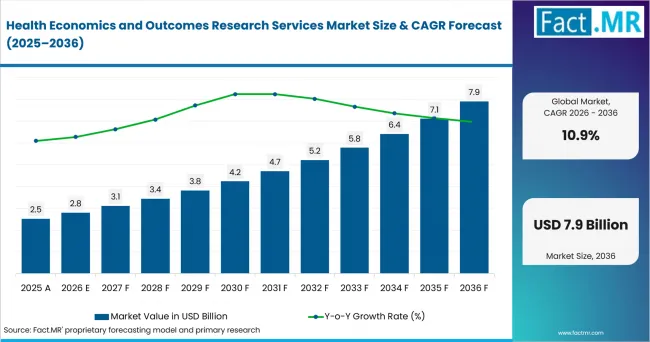
Health Economics And Outcomes Research Services Market Value Analysis | Source: Fact.MR
What are the defining numbers behind Health Economics and Outcomes Research Services Market growth?
USD 5.1 billion absolute opportunity by 2036.
- Demand Drivers in the Market
- Payer review raises demand for economic evidence that explains treatment value and budget impact. In January 2026, the Centers for Medicare & Medicaid Services selected 15 high-cost Medicare Part B and Part D drugs for the third negotiation cycle; those drugs were used by about 1.8 million Medicare beneficiaries from November 2024 to October 2025 and accounted for about USD 27 billion in Medicare spending.
- Pharmaceutical sponsors need earlier evidence planning because launch teams must prepare cost-effectiveness models before pricing discussions begin. The Organisation for Economic Co-operation and Development reported in 2025 that OECD countries spent 9.3% of GDP on health in 2024, keeping value-for-money questions prominent in health-system planning.
- Real-world evidence programs can expand HEOR work when sponsors compare treatment value after clinical trials close.
- Digital evidence tools can shorten literature review and model-testing cycles when research teams screen studies and test assumptions.
- Key Segments Analyzed
- By Service Offering: Health Economics Studies is expected to hold 39.0% share in 2026 because payer-facing evidence remains the core buyer requirement.
- By Application: Cost-effectiveness Analysis is projected to account for 36.0% share in 2026 as reimbursement teams compare therapy value with care costs.
- By End User: Pharmaceutical Companies are anticipated to capture 41.0% share in 2026 given their need for launch evidence and pricing support.
- By Delivery Model: Project-based Services is estimated to represent 48.0% share in 2026 due to study-specific budgets and defined reimbursement milestones.
- By Research Methodology: Decision Analytic Modeling is forecast to hold 44.0% share in 2026 because HTA submissions require model-based comparisons.
- Analyst Opinion at Fact.MR
- Shambhu Nath Jha, Sr. Consultant at Fact.MR, opines: "HEOR must be planned alongside clinical development when a sponsor expects payer scrutiny at launch. Evidence packages that connect trial endpoints, real-world outcomes and budget impact to a specific reimbursement setting are more useful than generic value claims."
- Strategic Implications
- Sponsors should begin HEOR planning before pivotal trial readouts so economic endpoints support launch and reimbursement work.
- Service providers can improve selection chances by combining literature review with economic modeling inside one payer evidence workflow.
- Pharmaceutical teams should align HEOR vendors with market access groups because payer questions often shape the final evidence package.
- Investors should separate providers with direct HEOR capability from wider clinical outsourcing firms that support adjacent evidence needs.
The USA is projected to expand at 11.8% CAGR from 2026 to 2036. Germany is projected at 11.4%, followed by the UK at 10.9%, Canada at 10.5%, France at 10.0%, Japan at 9.6%, and Australia at 9.2%.
How does the Health Economics and Outcomes Research Services Market break down by segment?
Health Economics Studies leads Service Offering at 39.0% share in 2026. Cost-effectiveness Analysis leads Application at 36.0% share in 2026.
Why does Health Economics Studies lead Service Offering?
Health Economics Studies is projected to account for 39.0% share in 2026.
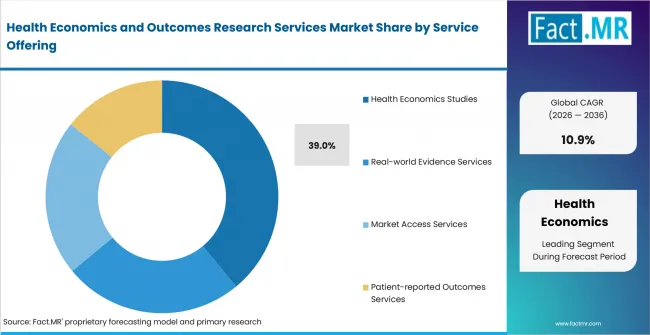
Health Economics And Outcomes Research Services Market Analysis By Service Offering | Source: Fact.MR
This service area leads because reimbursement decisions require evidence on value and affordability. Healthcare business intelligence work reinforces the need for clean evidence views before pricing decisions.
Why does Cost-effectiveness Analysis lead Application?
Cost-effectiveness Analysis is expected to hold 36.0% share in 2026.
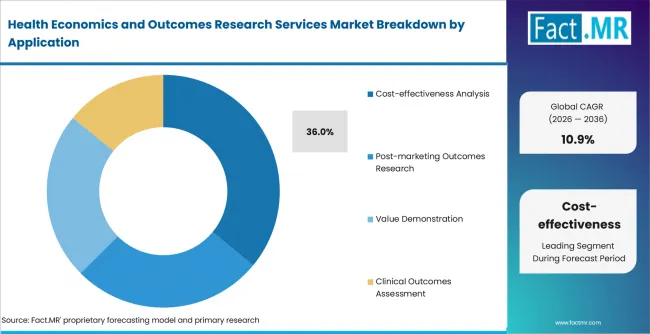
Health Economics And Outcomes Research Services Market Analysis By Application | Source: Fact.MR
Payers use this application to compare therapy value with existing care costs before coverage decisions are made. It fits value-based healthcare service models where reimbursement depends on measurable outcomes.
Why do Pharmaceutical Companies lead End User?
Pharmaceutical Companies are anticipated to account for 41.0% share in 2026.
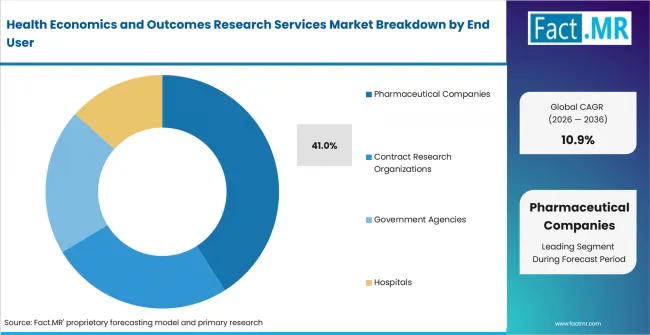
Health Economics And Outcomes Research Services Market Analysis By End User | Source: Fact.MR
Pharmaceutical sponsors carry the largest evidence burden because they need payer dossiers and access arguments before launch. The pharmaceuticals portfolio keeps this buyer group central to HEOR service spending. EMA's 2025 annual report shows that the agency recommended 104 medicines for marketing authorisation in 2025, including 38 with new active substances, giving pharmaceutical sponsors a steady need for access evidence after approval.
Why do Project-based Services lead Delivery Model?
Project-based Services is estimated to represent 48.0% share in 2026.
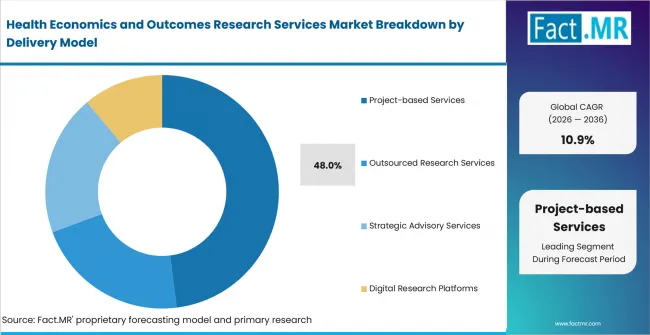
Health Economics And Outcomes Research Services Market Analysis By Delivery Model | Source: Fact.MR
Sponsors often commission HEOR work around a therapy or reimbursement milestone. Geography can shape the same project when local payer rules change the evidence package. Biopharmaceutical contract research organizations can provide specialist support when buyers do not need a permanent in-house team.
Why does Decision Analytic Modeling lead Research Methodology?
Decision Analytic Modeling is forecast to capture 44.0% share in 2026.
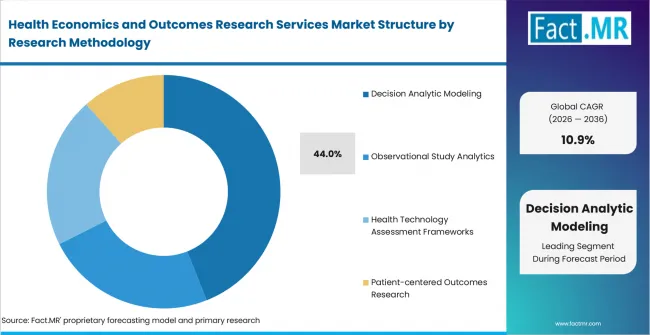
Health Economics And Outcomes Research Services Market Analysis By Research Methodology | Source: Fact.MR
Modeling is used when reimbursement decisions need structured comparisons of treatment pathways and cost consequences. It can draw on clinical trial management system inputs when trial evidence must support economic models.
What is accelerating Health Economics and Outcomes Research Services Market adoption, and what is holding it back?
Demand can increase as payers seek clearer evidence on treatment value and budget impact. Data access, model transparency and country-specific requirements remain important constraints.
Drivers Impact Analysis
| Driver | Relative Impact | Geographic Relevance | Impact Timeline |
|---|---|---|---|
| Payer evidence requirements | High | North America and Europe | Short term |
| Launch-stage value planning | High | USA, Germany and UK | Short term |
| Real-world evidence use | Medium | Global pharmaceutical sponsors | Medium term |
| Digital evidence workflows | Medium | Developed healthcare systems | Medium term |
| HTA submission complexity | Medium | Europe, Japan and Australia | Long term |
Source: Fact.MR analysis. Updated Aug 10, 2026
- Payer evidence requirements: Coverage teams seek clear proof that treatment benefits justify reimbursement and budget impact.
- Launch-stage value planning: Sponsors begin HEOR work earlier when pricing and market-access teams prepare payer dossiers.
- Real-world evidence use: Post-trial data can strengthen value arguments when clinical outcomes must be observed in routine care.
Opportunity Impact Analysis
| Opportunity | Relative Impact | Geographic Relevance | Impact Timeline |
|---|---|---|---|
| AI-assisted evidence synthesis | Medium | USA, UK and Germany | Medium term |
| Local payer dossier adaptation | Medium | Europe and Japan | Medium term |
| RWE model updates | Medium | North America and Europe | Long term |
| Integrated market-access support | Medium | Pharmaceutical launch markets | Long term |
Source: Fact.MR analysis. Updated Aug 10, 2026
- AI-assisted evidence synthesis: Research teams can use digital tools to screen studies faster and improve review consistency.
- Local payer dossier adaptation: Providers with country-specific reimbursement knowledge can gain more work from global launch teams.
- RWE model updates: Sponsors may refresh economic models when routine-care outcomes change the payer evidence base.
Restraints Impact Analysis
| Restraint | Relative Impact | Geographic Relevance | Impact Timeline |
|---|---|---|---|
| Data access limits | High | Global | Short term |
| Model transparency concerns | Medium | HTA-led markets | Short term |
| Country-specific payer rules | Medium | Europe, Japan and Australia | Medium term |
| Specialist talent constraints | Medium | Emerging service markets | Long term |
Source: Fact.MR analysis. Updated Aug 10, 2026
- Data access limits: HEOR projects can slow when claims data and registries are difficult to access. Patient-reported outcomes can add collection barriers.
- Model transparency concerns: Payers can challenge submissions when assumptions are unclear or sensitivity testing is weak.
- Country-specific payer rules: Service providers need local reimbursement knowledge before adapting one evidence package across several markets.
Which countries are scaling Health Economics and Outcomes Research Services Market fastest?
- The country comparison covers a 2.6 percentage point range between the USA at 11.8% and Australia at 9.2% CAGR from 2026 to 2036.
- USA, Germany, the UK and Canada form the higher-growth group in the comparison.
- France, Japan and Australia form the next group, with projected CAGRs from 10.0% to 9.2%.
Comparable CAGRs can create different entry conditions because payer rules differ by country. HTA processes and sponsor evidence budgets shape local entry conditions. Full report coverage includes North America, Latin America, Europe, Asia Pacific, and Middle East and Africa.
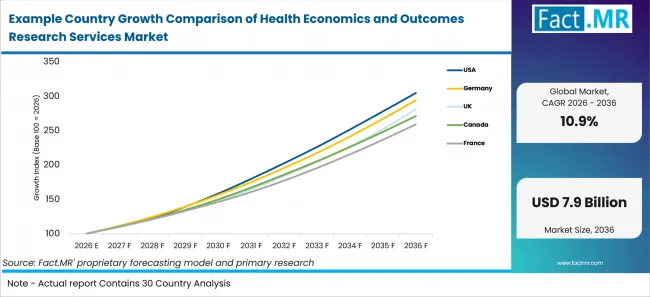
Example Country Growth Comparison Of Health Economics And Outcomes Research Services Market | Source: Fact.MR
| Country | CAGR (2026-2036) |
|---|---|
| USA | 11.8% |
| Germany | 11.4% |
| UK | 10.9% |
| Canada | 10.5% |
| France | 10.0% |
| Japan | 9.6% |
| Australia | 9.2% |
Source: Fact.MR analysis. Updated Aug 10, 2026
What supports USA adoption?
USA is projected to expand at 11.8% CAGR from 2026 to 2036.
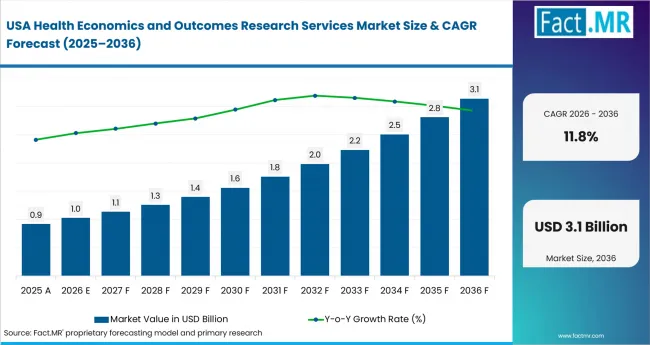
Health Economics And Outcomes Research Services Market Country Value Analysis | Source: Fact.MR
Large payer networks make the USA a demand center for HEOR services. Sponsors need budget-impact arguments before broad coverage decisions progress. Vendors that can explain value in payer language can have an advantage. CMS also reported that 2024 U.S. health spending equaled USD 15,474 per person and 18.0% of GDP.
How is Germany scaling demand?
Germany is projected to expand at 11.4% CAGR from 2026 to 2036.
Germany's reimbursement reviews place weight on comparative evidence and economic reasoning. Local adaptation matters because a global value model rarely answers every payer question without country-specific assumptions.
What is driving UK growth from 2026 to 2036?
UK is projected to expand at 10.9% CAGR from 2026 to 2036.
The UK requires clear cost-effectiveness reasoning before many access decisions mature. Sponsors therefore need economic models that fit national review expectations and explain where a therapy improves outcomes at an acceptable cost.
How is Canada developing demand?
Canada is projected to expand at 10.5% CAGR from 2026 to 2036.
Canada's payer reviews examine clinical value and affordability across public plans. Pharmaceutical companies need submissions that translate trial outcomes into budget terms for local access decisions.
How does France perform?
France is projected to expand at 10.0% CAGR from 2026 to 2036.
France requires evidence that can compare new therapies with established treatment pathways. HEOR vendors support sponsors by adapting outcomes and cost assumptions to the country's access review environment.
What supports Japan's growth?
Japan is projected to expand at 9.6% CAGR from 2026 to 2036.
Japan's market reflects the need to connect clinical evidence with care-cost pressure across mature healthcare settings. Sponsors require local interpretation before pricing and reimbursement reviews progress.
What supports Australia's growth?
Australia is projected to expand at 9.2% CAGR from 2026 to 2036.
Australia's market favors clear clinical and economic reasoning before access decisions advance. HEOR services can support submissions that balance patient outcomes with payer affordability.
Who leads the Health Economics and Outcomes Research Services Market?
IQVIA Holdings Inc., ICON plc, Syneos Health, Inc., Parexel International Corporation, Cytel Inc., RTI Health Solutions, Oracle Corporation (Oracle Life Sciences), Costello Medical, and Axtria Inc. provide directly relevant HEOR, real-world evidence, health-economic modelling, or market-access services.
The competitive field is service-led. Providers compete on HEOR design, health-economic modelling, and local market-access knowledge. Buyers look for evidence plans that connect clinical data, patient outcomes, and reimbursement requirements.
Which companies are the key providers?
Key companies include IQVIA Holdings Inc.; ICON plc; Syneos Health, Inc.; Parexel International Corporation; Cytel Inc.; RTI Health Solutions; Oracle Corporation (Oracle Life Sciences); Costello Medical; Axtria Inc.
- IQVIA Holdings Inc.
- ICON plc
- Syneos Health, Inc.
- Parexel International Corporation
- Cytel Inc.
- RTI Health Solutions
- Oracle Corporation (Oracle Life Sciences)
- Costello Medical
- Axtria Inc.
Bibliography
- Centers for Medicare & Medicaid Services. (2026, June 24). NHE fact sheet.
- Centers for Medicare & Medicaid Services. (2026, January 27). CMS announces selection of drugs for third cycle of Medicare Drug Price Negotiation Program, including first-ever Part B drugs.
- Organisation for Economic Co-operation and Development. (2025, November 13). Healthcare quality improving, but financial pressures rise.
- National Institute for Health and Care Excellence. (2025, July 7). NICE annual report and accounts: 2024 to 2025.
- European Medicines Agency. (2026, June 11). 2025 annual report of the European Medicines Agency.
- Canadian Institute for Health Information. (2025, November 27). NHEX trends, 2025 - Snapshot.
This Report Answers
- The report provides strategic intelligence on service and application choices that shape payer evidence planning.
- Segment analysis covers Health Economics Studies and Cost-effectiveness Analysis as the share leaders within the 2026 market.
- Country outlook evaluates the USA and Germany alongside the UK and Canada. France, Japan and Australia complete the growth comparison.
- Competitive analysis profiles the listed HEOR service providers without assigning company share estimates.
- Evidence workflow assessment covers decision analytic modeling and project-based delivery.
What does the Health Economics and Outcomes Research Services Market cover?
Health economics and outcomes research services evaluate the economic and humanistic value of healthcare interventions. The work supports payer review and reimbursement evidence when access decisions require structured analysis.
The Health Economics and Outcomes Research Services Market covers outsourced research and specialist consulting used to connect clinical evidence, economic value, patient outcomes, reimbursement needs, and payer decision support.
What is included in the scope?
The scope includes HEOR services and specialist consulting used to support health-economic evaluation, evidence generation, value demonstration, market access, and payer-facing submissions.
Coverage includes Health Economics Studies, Real-world Evidence Services, Market Access Services, and Patient-reported Outcomes Services. Applications include Cost-effectiveness Analysis, Post-marketing Outcomes Research, Value Demonstration, and Clinical Outcomes Assessment. End-user, delivery-model, research-methodology, and regional coverage follow the defined market taxonomy.
What is excluded from the scope?
General consulting without a defined HEOR, outcomes-research, market-access, or payer-evidence deliverable remains outside the scope of this market.
The scope excludes unrelated management consulting and general clinical-trial execution. Pure medical writing without economic or outcomes analysis is outside scope. Standalone data software is excluded unless it is delivered as part of a defined HEOR service engagement.
How Was the Analysis Built?
The analysis considers published payer, regulatory, health-system, company, and industry material relevant to the defined market.
- Market context: Reimbursement requirements, health technology assessment practices, and evidence-generation needs are considered across the forecast period.
- Service coverage: The review considers health-economic studies, real-world evidence, market-access services, and patient-reported outcomes services.
- Provider landscape: The company review focuses on organizations with directly relevant HEOR, modelling, real-world evidence, or market-access capabilities.
- Regional perspective: The assessment considers the defined regional structure and country-level payer environments.
Segmentation
What is the report’s scope and coverage?
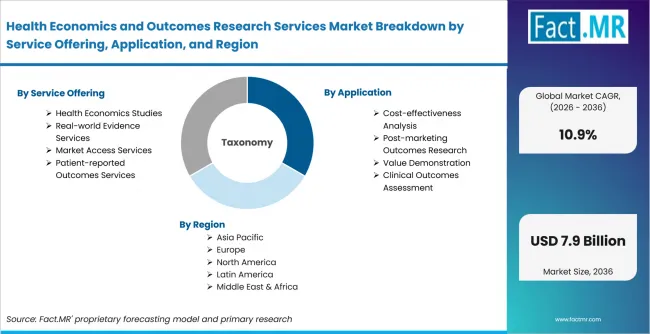
Health Economics And Outcomes Research Services Market Breakdown By Service Offering, Application, And Region | Source: Fact.MR
| Attribute | Details |
|---|---|
| Quantitative Units | USD 2.8 billion in 2026 to USD 7.9 billion by 2036 at 10.9% CAGR |
| Market Definition | Outsourced and specialized research services that connect clinical evidence, economic value, patient outcomes, reimbursement needs, and payer decision support |
| Service Offering | Health Economics Studies; Real-world Evidence Services; Market Access Services; Patient-reported Outcomes Services |
| Application | Cost-effectiveness Analysis; Post-marketing Outcomes Research; Value Demonstration; Clinical Outcomes Assessment |
| End User | Pharmaceutical Companies; Contract Research Organizations; Government Agencies; Hospitals |
| Delivery Model | Project-based Services; Outsourced Research Services; Strategic Advisory Services; Digital Research Platforms |
| Research Methodology | Decision Analytic Modeling; Observational Study Analytics; Health Technology Assessment Frameworks; Patient-centered Outcomes Research |
| Regions Covered | North America; Latin America; Europe; Asia Pacific; Middle East & Africa |
| Countries Covered | USA; Germany; UK; Canada; France; Japan; Australia |
| Key Companies Profiled | IQVIA Holdings Inc.; ICON plc; Syneos Health, Inc.; Parexel International Corporation; Cytel Inc.; RTI Health Solutions; Oracle Corporation (Oracle Life Sciences); Costello Medical; Axtria Inc. |
| Forecast Period | 2026-2036 |
| Approach | Market assessment considers publicly available health-system and payer material, company disclosures, industry evidence, and market conditions across the defined segments, regions, and forecast period. |
Source: Fact.MR analysis. Updated Aug 10, 2026
How is the market segmented?
-
By Service Offering
- Health Economics Studies
- Cost-effectiveness Modeling
- Budget Impact Analysis
- Real-world Evidence Services
- Patient Registry Studies
- Claims Database Analysis
- Market Access Services
- Pricing & Reimbursement Strategy
- Health Technology Assessment Dossiers
- Patient-reported Outcomes Services
- PRO Instrument Development
- PRO Validation Studies
- Health Economics Studies
-
By Application
- Cost-effectiveness Analysis
- Health Technology Assessment
- Reimbursement Submission
- Post-marketing Outcomes Research
- Patient Safety Evaluation
- Comparative Effectiveness Research
- Value Demonstration
- Payer Evidence Generation
- Reimbursement Negotiation Support
- Clinical Outcomes Assessment
- Quality of Life Assessment
- Treatment Satisfaction Assessment
- Cost-effectiveness Analysis
-
By End User
- Pharmaceutical Companies
- Originator Pharmaceutical Companies
- Generic Pharmaceutical Companies
- Contract Research Organizations
- Full-service CROs
- Specialist CROs
- Government Agencies
- Health Technology Assessment Agencies
- Public Health Authorities
- Hospitals
- Integrated Health Systems
- Research Hospitals
- Pharmaceutical Companies
-
By Delivery Model
- Project-based Services
- Launch Evidence Projects
- Reimbursement Submission Projects
- Outsourced Research Services
- Functional Service Provision
- Dedicated Research Teams
- Strategic Advisory Services
- Pricing & Reimbursement Advisory
- Evidence Strategy Advisory
- Digital Research Platforms
- Evidence Management Platforms
- Cloud-based Collaboration
- Project-based Services
-
By Research Methodology
- Decision Analytic Modeling
- Markov Modeling
- Discrete Event Simulation
- Observational Study Analytics
- Registry-based Research
- Health Data Analytics
- Health Technology Assessment Frameworks
- Evidence Synthesis
- Systematic Literature Review
- Patient-centered Outcomes Research
- Quality-adjusted Life Year Analysis
- Patient Preference Studies
- Decision Analytic Modeling
-
By Region
- North America
- Latin America
- Europe
- Asia Pacific
- Middle East & Africa
Frequently Asked Questions
How big is the health economics and outcomes research services market in 2026?
What is the CAGR of the health economics and outcomes research services market from 2026 to 2036?
Which service offering leads the health economics and outcomes research services market?
Which application leads the health economics and outcomes research services market?
Who are the leading companies in the health economics and outcomes research services market?
Who worked on this report


Preview the report firsthand - request a free sample
Free SampleGet the brochure for pricing and purchase details
Download PDF