- Market Value (2025): USD 4.9 Bn
- Estimated Value (2026): USD 5.3 Bn
- Forecast Value (2036): USD 12.8 Bn
- CAGR (2026-2036): 9.1%
What is the Intelligent Motor Controllers Market forecast to be worth by 2036?
USD 5.3 billion in 2026 to USD 12.8 billion by 2036 at a 9.1% CAGR.
- The Intelligent Motor Controllers Market reached USD 4.9 billion in 2025.
- Demand is projected to increase from USD 5.3 billion in 2026 to USD 12.8 billion by 2036.
- The market is forecast to record 9.1% CAGR from 2026 to 2036 as plant operators specify connected starters, intelligent MCCs and variable-speed controllers.
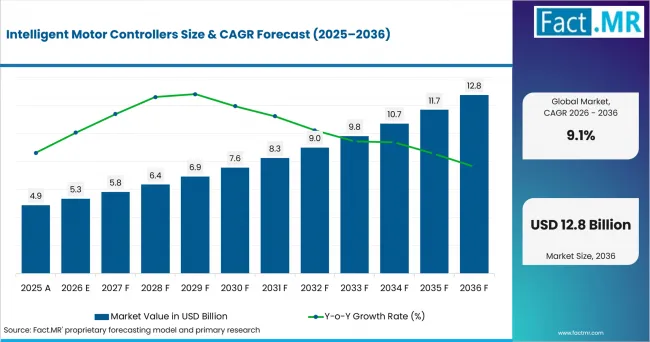
Intelligent Motor Controllers Value Analysis | Source: Fact.MR
What are the defining numbers behind Intelligent Motor Controllers Market growth?
An absolute opportunity of USD 7.4 billion is expected between 2026 and 2036.
- Demand Drivers in the Market
- Plant maintenance teams need faster motor-fault diagnosis. IFR reported in September 2025 that 4,664,000 industrial robots were in operational use worldwide in 2024.
- Panel builders need compact starter hardware that reduces cabinet work. France’s DGE reported in March 2026 that 158 significant factory extensions were recorded in 2025.
- Machine builders need Ethernet-ready drive control for flexible machinery. Schneider Electric launched TeSys Tera in April 2026 with predictive diagnostics, energy monitoring and connectivity.
- Key Segments Analyzed
- By Controller Type: Smart motor starters are expected to hold 31.0% share in 2026 owing to demand for safer starting and lower panel complexity.
- By Motor Class: Induction motors are projected to account for 42.0% share in 2026 because they remain widely used across pumps and conveyors.
- By Connectivity: Industrial Ethernet is anticipated to capture 36.0% share in 2026, supported by controller data moving into PLC and SCADA systems.
- By End-use: Process industries are estimated to represent 29.0% share in 2026 as continuous operations require motor protection and load visibility.
- Analyst Opinion at Fact.MR
- Shambhu Nath Jha, Principal Consultant at Fact.MR, states, “Motor-control selection is becoming less about switching a motor on and more about protecting production assets. The market is expected to reward suppliers that combine safe starting, drive control and diagnostics. Vendors with clear links to PLCs, SCADA and energy platforms have the stronger case with plant engineers.”
- Strategic Implications
- Controller vendors should document how starters, drives and protection relays exchange status data with plant networks; ABB’s July 2025 ACS380-E launch demonstrates the integration of embedded Ethernet as a standard feature in its next-generation machinery drive, with dual Ethernet ports and selectable industrial protocols included without separate option modules.
- Panel builders should standardize around modular devices that reduce cabinet wiring; Rockwell Automation’s March 2025 M100 Electronic Motor Starter launch demonstrates the integration of motor-control and protection functions into a compact starter platform, including overload, phase-loss, phase-imbalance and contact-weld protection.
- Channel partners should train service teams on drive diagnostics and motion control; Siemens connected SIMATIC S7-1200 G2 with SINAMICS drive technology in May 2026.
Japan is projected to record 11.3% CAGR through 2036, led by machinery-order recovery and factory robotics use. Germany is anticipated to post 10.8% CAGR, supported by industrial robotics depth and EU motor-efficiency requirements. France is forecast to advance at 10.4% CAGR as factory expansion supports automation upgrades. The UK is expected to hold 8.0% CAGR, shaped by manufacturing AI policy and infrastructure modernization. The USA is estimated to record 7.6% CAGR, attributable to installed automation capacity and machinery replacement cycles.
How does the Intelligent Motor Controllers Market break down by segment?
Smart motor starters lead at 31.0%; induction motors lead at 42.0%.
Which Controller Type dominates?
Smart motor starters are expected to hold 31.0% share in 2026.
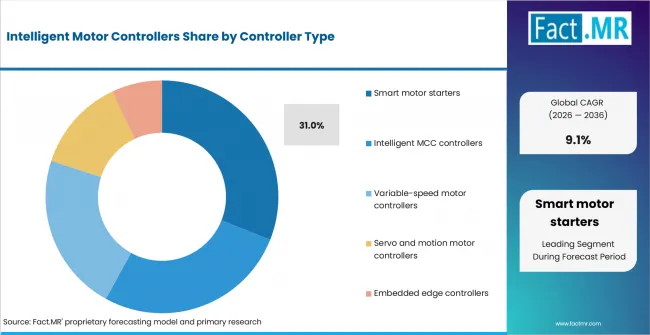
Intelligent Motor Controllers Analysis By Controller Type | Source: Fact.MR
Smart motor starters lead Controller Type because they add electronic protection while avoiding a full drive on every motor. Their fit is strongest in pumps, fans and conveyors where soft starting and overload protection protect uptime. The segment benefits from starter designs that combine switching, overload protection and status visibility inside compact control panels.
What leads the Motor Class segment?
Induction motors are projected to account for 42.0% share in 2026.
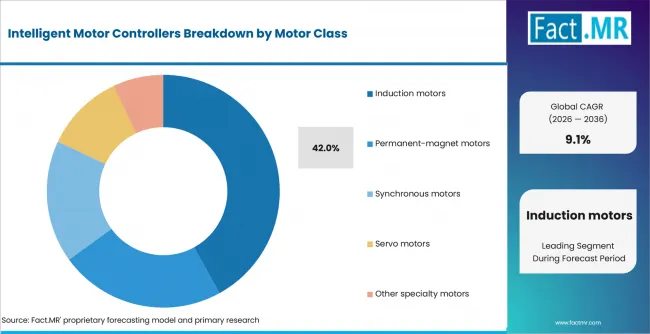
Intelligent Motor Controllers Analysis By Motor Class | Source: Fact.MR
Induction motors remain the main control target across process plants, building equipment and industrial machinery. Their installed base keeps controller demand steady across pumps, fans and compressors where uptime and speed control influence the payback case.
How does Connectivity shape demand?
Industrial Ethernet is anticipated to capture 36.0% share in 2026.
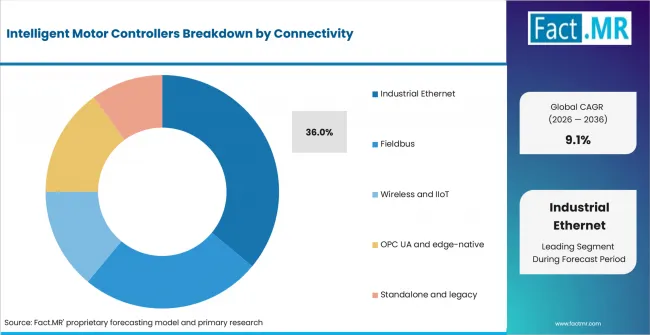
Intelligent Motor Controllers Analysis By Connectivity | Source: Fact.MR
Industrial Ethernet leads Connectivity because engineers want motor status and alarms inside plant networks. Connected drive and starter designs reduce add-on communication modules and help maintenance teams trace motor faults faster.
What supports Process Industries within End-use?
Process industries are estimated to represent 29.0% share in 2026.
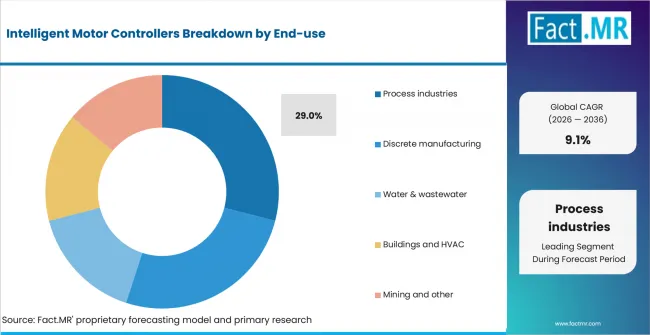
Intelligent Motor Controllers Analysis By End Use | Source: Fact.MR
Process industries lead End-use because rotating equipment runs inside continuous production lines. These sites favor controllers that combine protection, control and monitoring for clearer fault diagnosis and motor-load visibility.
What is accelerating Intelligent Motor Controllers Market adoption, and what is holding it back?
Demand is expected to rise through connected motor protection and energy-efficiency requirements. Adoption is constrained by legacy panels, skills gaps and retrofit cost.
Drivers Impact Analysis
| DRIVER | (~) % IMPACT ON CAGR | GEOGRAPHIC RELEVANCE | IMPACT TIMELINE |
|---|---|---|---|
| Energy control in motor-driven loads | +1.8% | Europe, North America, Japan | Medium term (2-4 years) |
| Connected motor protection in process plants | +1.5% | Global | Short term (<= 2 years) |
| Industrial Ethernet integration in MCCs and drives | +1.2% | North America, Europe, East Asia | Medium term (2-4 years) |
| Automation replacement in machinery and robotics cells | +0.9% | Japan, Germany, USA | Long term (>= 4 years) |
Source: Fact.MR analysis. Updated Sep 4, 2026
- Energy control in motor-driven loads: Variable speed drives control motor speed under variable loads. The European Commission opened a 2025 ecodesign review that covers motors and variable speed drives.
- Connected motor protection in process plants: Facilities want trip history and overload settings close to the motor. That need favors intelligent starters and motor-management relays.
- Industrial Ethernet integration in MCCs and drives: Ethernet-connected controllers help maintenance teams see motor faults inside the control network. Connected-drive launches from major automation suppliers show the same direction.
Opportunity Impact Analysis
| OPPORTUNITY | (~) % IMPACT ON CAGR | GEOGRAPHIC RELEVANCE | IMPACT TIMELINE |
|---|---|---|---|
| Retrofit kits for installed MCCs | +1.0% | North America, Europe | Short term (<= 2 years) |
| Motor-control data for energy platforms | +0.8% | Europe, Japan | Medium term (2-4 years) |
| Integrated starter and drive packages for OEMs | +0.7% | Global | Medium term (2-4 years) |
Source: Fact.MR analysis. Updated Sep 4, 2026
- Retrofit kits for installed MCCs: Packaged replacement designs are expected to shorten shutdown work for plants that retain older cabinets but need better diagnostics.
- Motor-control data for energy platforms: Controller-level current, voltage and load data are expected to support energy programs where motors run variable loads.
- Integrated starter and drive packages for OEMs: Machine builders are expected to value pre-tested combinations that reduce design time and simplify service documentation.
Restraints Impact Analysis
| RESTRAINT | (~) % IMPACT ON CAGR | GEOGRAPHIC RELEVANCE | IMPACT TIMELINE |
|---|---|---|---|
| Legacy cabinet space and wiring limits | -0.6% | North America, Europe | Short term (<= 2 years) |
| Cybersecurity review for connected motor data | -0.5% | Europe, USA, Japan | Medium term (2-4 years) |
| Shortage of technicians trained on smart motor systems | -0.4% | Global | Long term (>= 4 years) |
Source: Fact.MR analysis. Updated Sep 4, 2026
- Legacy cabinet space and wiring limits: Older panels slow upgrades when heat, terminal space and shutdown windows restrict installation work.
- Cybersecurity review for connected motor data: Networked drives and starters require IT and OT review before motor data enters plant monitoring systems.
- Technician training needs: Smart relays and Ethernet drives require setup skills beyond basic starters, making service training central to adoption pace.
Which countries are scaling the Intelligent Motor Controllers Market through 2036?
- The country comparison spans 3.69 percentage points and forms three practical growth bands across the forecast period.
- Japan remains 0.50 percentage point above Germany through machinery-order recovery and factory robotics use.
- Germany remains 0.38 percentage point above France through industrial robotics depth and EU motor-efficiency requirements.
- France remains 2.39 percentage points above the UK as factory expansion and electrical equipment output support automation upgrades.
- The UK remains 0.42 percentage point above the USA through manufacturing AI policy and infrastructure modernization.
- The USA closes the displayed range through installed automation capacity and machinery replacement cycles.
Comparable CAGRs create different entry conditions due to installed motor fleets, automation maturity, labor availability and energy policy. Full report coverage includes North America, Latin America, Western Europe, Eastern Europe, East Asia, South Asia & Pacific, Middle East & Africa.
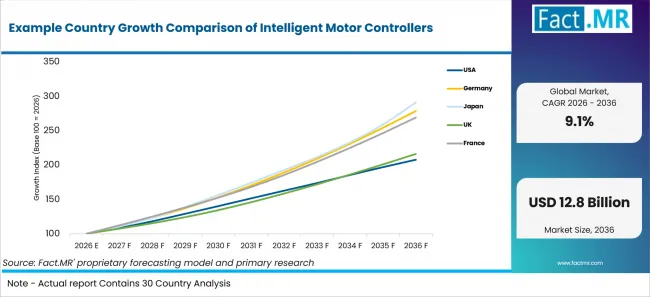
Example Country Growth Comparison Of Intelligent Motor Controllers | Source: Fact.MR
| Country | CAGR (2026-2036) |
|---|---|
| United States | 7.6% |
| Germany | 10.8% |
| Japan | 11.3% |
| United Kingdom | 8.0% |
| France | 10.4% |
Source: Fact.MR analysis. Updated Sep 4, 2026
What supports USA adoption?
7.6% CAGR, supported by industrial investment and automation replacement demand.
U.S. factory automation demand is anchored in a large installed base of machinery and motor-driven equipment. BEA reported in July 2026 that the foreign direct investment position in U.S. manufacturing was USD 2.51 trillion at the end of 2025. That capital base supports controller replacement where plants need safer starters, drive diagnostics and Ethernet-ready monitoring.
What supports Germany’s adoption?
10.8% CAGR, supported by robotics depth and EU motor-efficiency requirements.
Germany’s position rests on dense robotics use and strict equipment engineering. Germany Trade & Invest reported in September 2025 that Germany reached 449 industrial robots per 10,000 manufacturing employees. That automation base strengthens demand for controllers that combine protection, drive communication and precise motor control.
How does Japan perform?
11.3% CAGR, led by machinery-order recovery and factory automation demand.
Japan’s production machinery cycle gives motor-control suppliers a direct route into automated cells. ESRI reported in February 2026 that the total value of machinery orders received by 280 manufacturers operating in Japan increased 23.8% in December 2025 from the previous month on a seasonally adjusted basis. Controller demand is expected to track upgrades for compact panels, servo axes and equipment diagnostics.
What supports the United Kingdom’s growth?
8.0% CAGR, supported by manufacturing AI policy and infrastructure modernization.
The UK is connecting factory AI policy with equipment modernization. The Department for Science, Innovation and Technology stated in June 2026 that manufacturing contributes around GBP 234 billion annually to the UK economy. Motor controllers are expected to benefit where plants link drives, sensors and control data inside repeatable automation projects.
How is France developing demand?
10.4% CAGR, supported by factory expansion and electrical equipment output.
France is building demand through plant expansion and electrical equipment activity. INSEE reported in February 2026 that French electrical equipment output rose 2.2% year on year in December 2025. Factory projects create installation points for smart starters, drive panels and motor-management relays.
Who leads the Intelligent Motor Controllers Market?
Rockwell Automation, Siemens, Schneider Electric, ABB, Eaton and WEG.
Rockwell Automation leads the competitive discussion through low-voltage motor-control hardware, intelligent motor-control centers and starter protection. Its portfolio supports plants that want starter control, drive coordination and asset diagnostics from one automation supplier.
Siemens participates through SIMOCODE motor management, SINAMICS drives and SIMATIC automation links. The company is relevant where plant engineers connect motor protection, motion control and PLC data in one control architecture.
Schneider Electric competes through TeSys motor management, Altivar drives and EcoStruxure integration. Its position is tied to low-voltage motor protection and controller data that can be used across industrial sites and infrastructure facilities.
ABB is active through machinery drives, softstarters, motor-control hardware and industrial automation integration. The company fits machine-builder and process-plant requirements where drive performance and network communication are evaluated together.
Eaton and WEG complete the supplier set through starters, drives, motor protection and panel hardware. Eaton is relevant for soft-start and controlgear needs, while WEG brings motor and drive breadth to industrial and commercial applications.
Competition centers on proven motor protection, communication depth and retrofit support. Suppliers with starter, drive and MCC portfolios can serve brownfield upgrades and new machinery programs from one controls architecture.
Which companies are the key providers?
Key companies include Rockwell Automation; Siemens; Schneider Electric; ABB; Eaton; and WEG.
- Rockwell Automation
- Siemens
- Schneider Electric
- ABB
- Eaton
- WEG
Bibliography
- Rockwell Automation. (2025, March 31). Rockwell Automation revolutionizes motor controls with smarter and safer M100 Electronic Motor Starter.
- ABB. (2025, July 8). ABB launches next-gen machinery drive built for performance, connectivity, and cybersecurity.
- Schneider Electric. (2026, April 27). Schneider Electric launches next-generation motor management system for industrial applications.
- Thoma, C., & Chery, M. (2026, May 5). SIMATIC S7-1200 G2 – The intelligent answer to increasing requirements. Siemens.
- Eaton. (2025, June). Product announcements.
- WEG Electric. (2025, October 15). The advanced control of WEG Electric’s CFW900 high-performance drive family is now available in higher HP sizes!
- European Commission, Directorate-General for Energy. (2025, August 25). Reviewing ecodesign requirements for electric motors and variable speed drives.
- International Federation of Robotics. (2025, September 25). Global robot demand in factories doubles over 10 years.
- Germany Trade & Invest. (2025, September 29). Germany is Europe’s leading robotics nation.
- U.S. Bureau of Economic Analysis. (2026, July 21). Direct investment by country and industry, 2025.
- Economic and Social Research Institute, Cabinet Office, Government of Japan. (2026, February 19). Machinery orders in December, 2025 and forecast for Jan.–Mar. 2026.
- Dungey, C. (2026, June 8). AI Adoption Plan: Advanced Manufacturing. Department for Science, Innovation and Technology.
- Institut national de la statistique et des études économiques. (2026, February 5). In December 2025, manufacturing output fell back sharply (-0.8%).
- Direction générale des Entreprises. (2026, March 29). Baromètre industriel de l’État : En 2025, les extensions d’usines portent la réindustrialisation avec un solde positif malgré un contexte international dégradé.
This Report Answers
- The report explains where intelligent motor controllers are used across controller type and motor class. It also covers connectivity and end use.
- Segment analysis identifies the leading subsegments and the operating reasons plant engineers prioritize them.
- Country analysis examines the listed markets and the automation or policy mechanisms supporting controller deployment.
- Competitive analysis reviews current providers across smart starters, drives, MCCs, motor-management relays and connected control platforms.
- Application analysis assesses how uptime, energy control and retrofit limits influence controller selection.
What does the Intelligent Motor Controllers Market cover?
The Intelligent Motor Controllers Market covers devices and embedded control functions used to start, protect, monitor and control industrial motors. It includes smart starters, intelligent MCC controllers, variable-speed motor controllers and servo or motion control devices used in factory and process environments.
The assessment covers controller use in process industries, discrete manufacturing, water and wastewater, buildings and HVAC, and mining applications. Related automation context includes industrial automation controls and motor protection devices where motor monitoring and control functions overlap.
What is included in the scope?
The scope includes connected motor starters, intelligent motor-control center controllers, drive-based motor controllers, motion controllers and embedded edge controllers. It also includes software features packaged with the controller when those features support protection, monitoring, diagnostics or communication.
Scope links to robot control systems, industrial robot components and smart factory investments where motor-control demand is linked to automated machinery. It also considers virtual commissioning tools and machine condition monitoring when they influence how controllers are specified.
What is excluded from the scope?
The scope excludes bare electric motors, raw contactors, basic overload relays and general switchgear sold as hardware separate from intelligent control or communication functions. General PLCs are outside the scope when they control wider automation processes separately from motor-management functions.
Power converters used only for grid assets, building-only power distribution hardware and pure software analytics are outside the scope. Servo motors and gearboxes are covered only when the revenue is tied to the intelligent controller or motion-control unit.
How Was the Analysis Built?
The analysis draws on 120+ sources, 35+ company portfolios, 25+ countries, and more than 20 industry interviews.
- Primary Research: Primary research includes discussions with manufacturers, service providers, technology developers, distributors, end users, and subject-matter experts. These conversations examine purchasing priorities, product adoption, operational challenges, approval requirements, competitive positioning, and the factors that influence wider market acceptance.
- Desk Research: Desk research covers government statistics, regulatory publications, company filings, trade data, technical studies, industry associations, standards, public policy, and other authoritative sources. Every source used in the analysis is documented in the bibliography.
- Market Sizing and Forecasting: Market estimates combine historical performance, demand indicators, pricing and volume trends, segment shares, company participation, country-level growth, adoption patterns, investment activity, and barriers to market expansion.
- Data Validation and Update Cycle: Findings are validated by comparing primary interviews with public data, company activity, regulatory changes, trade patterns, and industry developments. Regular updates review new product launches, capacity changes, partnerships, approvals, and shifts in commercial adoption.
Segmentation
What is the report’s scope and coverage?
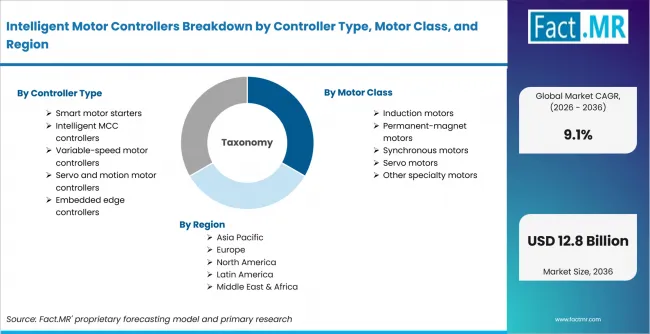
Intelligent Motor Controllers Breakdown By Controller Type, Motor Class, And Region | Source: Fact.MR
| Attribute | Details |
|---|---|
| Quantitative Units | USD Billion in 2026 to USD Billion by 2036 at a CAGR |
| Market Definition | Connected motor-control hardware and software used to start, protect, monitor and control industrial motors. Coverage includes smart motor starters, intelligent MCC controllers, variable-speed controllers, servo and motion controllers, and embedded edge controllers. |
| Controller Type | Smart motor starters; Intelligent MCC controllers; Variable-speed motor controllers; Servo and motion motor controllers; Embedded edge controllers |
| Motor Class | Induction motors; Permanent-magnet motors; Synchronous motors; Servo motors; Other specialty motors |
| Connectivity | Industrial Ethernet; Fieldbus; Wireless and IIoT; OPC UA and edge-native; Standalone and legacy |
| End-use | Process industries; Discrete manufacturing; Water and wastewater; Buildings and HVAC; Mining and other |
| Regions Covered | North America; Latin America; Western Europe; Eastern Europe; East Asia; South Asia & Pacific; Middle East & Africa |
| Countries Covered | United States; Germany; Japan; United Kingdom; France |
| Key Companies Profiled | Rockwell Automation; Siemens; Schneider Electric; ABB; Eaton; WEG |
| Forecast Period | 2026 to 2036 |
| Approach | Hybrid top-down and bottom-up approach using industrial motor installed base, automation replacement cycles, controller type mix, motor-class use, connectivity adoption, country-level growth and provider portfolio review. |
Source: Fact.MR analysis. Updated Sep 4, 2026
How is the market segmented?
-
By Controller Type
- Smart motor starters
- Intelligent MCC controllers
- Variable-speed motor controllers
- Servo and motion motor controllers
- Embedded edge controllers
-
By Motor Class
- Induction motors
- Permanent-magnet motors
- Synchronous motors
- Servo motors
- Other specialty motors
-
By Connectivity
- Industrial Ethernet
- Fieldbus
- Wireless and IIoT
- OPC UA and edge-native
- Standalone and legacy
-
By End-use
- Process industries
- Discrete manufacturing
- Water and wastewater
- Buildings and HVAC
- Mining and other
-
By Region
- North America
- Latin America
- Western Europe
- Eastern Europe
- East Asia
- South Asia & Pacific
- Middle East & Africa
Frequently Asked Questions
How big is the intelligent motor controllers market in 2026?
What is the CAGR of the intelligent motor controllers market from 2026 to 2036?
Which controller type leads the intelligent motor controllers market?
Which motor class leads the intelligent motor controllers market?
Who are the leading companies in the intelligent motor controllers market?
Who worked on this report


Preview the report firsthand - request a free sample
Free SampleGet the brochure for pricing and purchase details
Download PDF