- Market Value (2025): USD 407.1 Mn
- Estimated Value (2026): USD 460.0 Mn
- Forecast Value (2036): USD 1562.0 Mn
- CAGR (2026-2036): 13.0%
What is the Label-Friendly LM Pectins Market forecast to be worth by 2036?
USD 460.0 million in 2026 to USD 1,562.0 million by 2036 at a 13.0% CAGR.
- The Label-Friendly LM Pectins Market reached USD 407.1 million in 2025.
- Demand is projected to increase from USD 460.0 million in 2026 to USD 1,562.0 million by 2036.
- The market is forecast to record 13.0% CAGR from 2026 to 2036 as clean-label dairy alternatives and low-sugar fruit systems need reliable gelling performance.
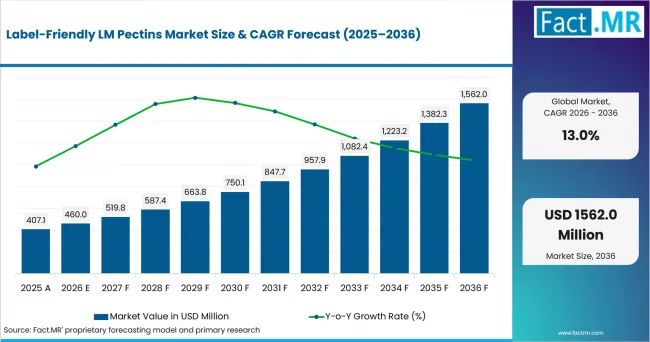
Label Friendly Lm Pectins Market Value Analysis | Source: Fact.MR
What are the defining numbers behind Label-Friendly LM Pectins Market growth?
USD 1,102.0 million absolute opportunity is expected between 2026 and 2036.
- Demand Drivers in the Market
- Formulators need calcium-set gel systems as low-methoxyl pectin supports texture in lower-sugar recipes without relying on high soluble solids. This is useful in fruit spreads, jellies and fillings where sweetness reduction changes the way water is held inside the recipe.
- Dairy-alternative brands need clean texture support since plant proteins often require stabilization to keep fruit preparations and spoonable products consistent. LM pectin helps these brands manage syneresis risk while preserving the familiar eating texture expected in yogurt-style products.
- U.S. FDA proposed a front-of-package Nutrition Info box in January 2025 covering saturated fat, sodium and added sugars, potentially increasing reformulation pressure across packaged foods.
- Citrus processors and apple processors need higher by-product value, so peel and pomace streams are expected to support pectin and fiber ingredient portfolios. Ingredient producers gain more flexibility when extraction planning is linked to juice, puree and fruit-processing residue streams.
- Key Segments Analyzed
- By Product: Low-methoxyl pectin is expected to hold 39.0% share in 2026 due to its role in calcium-set gels for reduced-sugar and dairy-alternative formats.
- By Function: Gelling is projected to account for 37.0% share in 2026 due to the need for controlled set and spoonable texture.
- By Application: Dairy alternatives are anticipated to capture 34.0% share in 2026 as yogurt and dessert developers need familiar plant-based stabilizers.
- By Grade: Food grade is estimated to represent 44.0% share in 2026 owing to direct use in regulated food and beverage formulation.
- Analyst Opinion at Fact.MR
- Shambhu Nath Jha, Principal Consultant at Fact.MR, states, “LM pectin is drawing attention by solving a practical formulation problem: texture has to remain stable while sugar levels come down. Demand is expected to move toward suppliers that document calcium reactivity, batch consistency and application support. Strong portfolios combine food-grade compliance, clean-label positioning and recipe-specific technical guidance.”
- Strategic Implications
- Pectin suppliers should document calcium sensitivity and gel strength by application so formulators shorten validation work. The documentation should match real recipe types such as fruit prep, dairy alternatives and low-sugar confectionery.
- Dairy-alternative brands should test LM pectin with fruit systems early since stability issues often appear after processing. Early pilot trials help teams adjust calcium levels and heat treatment before commercial launch timelines tighten.
- Food manufacturers should connect pectin selection with sugar-reduction plans as front-label and nutrition-label pressure becomes more visible. Recipe teams gain a clearer route when sweetness, texture and label claims are evaluated in the same trial cycle.
The USA is expected to post 14.3% CAGR through 2036, led by packaged-food reformulation and dairy-alternative development. Germany is projected to record 13.7% CAGR as food manufacturers combine organic sourcing with precise texturizer use. Japan is anticipated to advance at 12.7% CAGR due to export-oriented food development. France is estimated to hold 12.2% CAGR as moderate food inflation keeps formulation efficiency in focus. Brazil is forecast to record 11.7% CAGR due to citrus processing and local pectin raw-material relevance. These country differences are tied less to a single end product and more to how each market balances clean-label language, texture validation and raw-material access.
How does the Label-Friendly LM Pectins Market break down by segment?
Low-methoxyl pectin leads Product at 39.0%; Food grade leads Grade at 44.0%.
Which Product leads demand?
Low-methoxyl pectin is expected to hold 39.0% share in 2026.
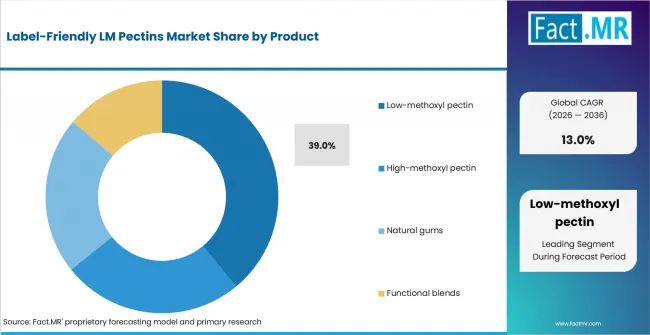
Label Friendly Lm Pectins Market Analysis By Product | Source: Fact.MR
Low-methoxyl pectin leads due to gel formation through calcium interaction. This supports reduced-sugar jams, fruit preparations and dairy-alternative systems. It is especially useful where product developers reduce sugar and then need a separate route to rebuild texture.
What leads the Function segment?
Gelling is projected to account for 37.0% share in 2026.
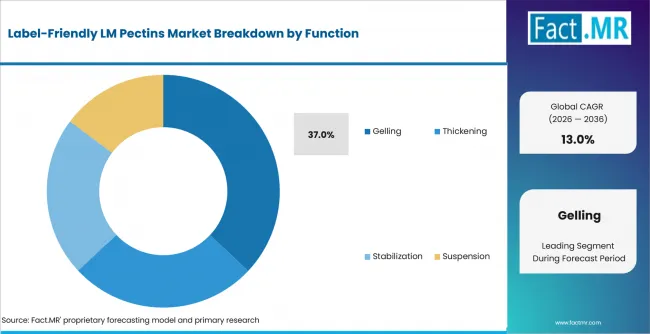
Label Friendly Lm Pectins Market Analysis By Function | Source: Fact.MR
Gelling carries the leading function share since LM pectin is selected when the final product needs a controlled set at lower sugar levels. The function is closely linked with recipes that must pass both sensory and shelf-life checks before launch. Natural gelling agents coverage places pectin within the broader group of plant and natural gel-forming systems.
How does Application shape demand?
Dairy alternatives are anticipated to lead with 34.0% share in 2026.
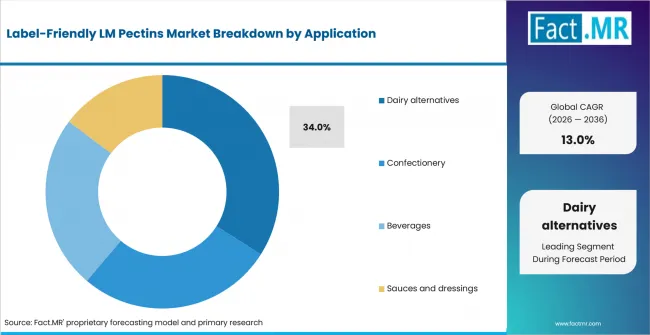
Label Friendly Lm Pectins Market Analysis By Application | Source: Fact.MR
Dairy alternatives lead as plant proteins and fruit systems often need stabilizers that manage water release and protein interaction. Brands in this segment often test several hydrocolloid systems before choosing the one that gives stable mouthfeel. The same texture route appears in plant-based dairy and plant-based beverages applications where mouthfeel is a purchase screen.
What supports Grade selection?
Food grade is estimated to represent 44.0% share in 2026.
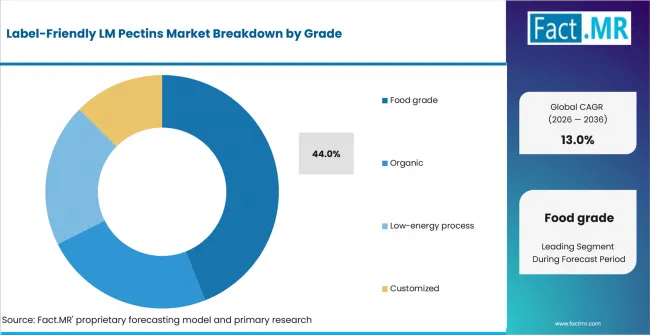
Label Friendly Lm Pectins Market Analysis By Grade | Source: Fact.MR
Food grade leads due to direct use in finished food and beverage recipes. Food-grade selection also reflects documentation needs around purity, labeling and application suitability. Food stabilizers coverage shows how pectin competes with other systems when brands balance texture, shelf-life and label fit.
What is accelerating Label-Friendly LM Pectins Market adoption, and what is holding it back?
Demand is expected to rise through sugar reduction and dairy-alternative texture needs. Growth is constrained by price sensitivity, raw-material variability and validation time.
| DRIVER | (~) % IMPACT ON CAGR | GEOGRAPHIC RELEVANCE | IMPACT TIMELINE |
|---|---|---|---|
| Reduced-sugar fruit and confectionery recipes | +1.6% | North America, Europe | Short term (<= 2 years) |
| Dairy-alternative stabilization requirements | +1.3% | North America, East Asia | Medium term (2-4 years) |
| Cleaner ingredient labels in packaged foods | +1.1% | Global | Medium term (2-4 years) |
| Fruit and citrus by-product valorization | +0.8% | Europe, Latin America | Long term (>= 4 years) |
Source: Fact.MR analysis. Updated Aug 28, 2026
- Reduced-sugar recipes: LM pectin helps product developers maintain gel structure where high sugar solids are lowered and traditional high-methoxyl systems lose part of their formulation advantage.
- Dairy-alternative stabilization: Pectin supports fruit preparations and acidified systems that need controlled viscosity after processing, storage and chilled distribution.
- Cleaner labels: Brands position pectin as a familiar fruit-derived ingredient when reformulating away from less recognized additives and when they need a label line that consumers can understand.
| OPPORTUNITY | (~) % IMPACT ON CAGR | GEOGRAPHIC RELEVANCE | IMPACT TIMELINE |
|---|---|---|---|
| Customized calcium-reactive grades | +1.2% | Global | Short term (<= 2 years) |
| Organic and food-grade differentiation | +0.9% | Europe, North America | Medium term (2-4 years) |
| Citrus fiber and pectin co-products | +0.7% | Brazil, Europe | Long term (>= 4 years) |
Source: Fact.MR analysis. Updated Aug 28, 2026
- Customized calcium-reactive grades: Suppliers gain repeat business by helping formulators tune gel strength and processing tolerance for each recipe family.
- Organic and food-grade differentiation: Certification gives procurement teams a clear screen where end-label claims influence buying and where audit files need to move quickly through approval.
- Citrus fiber and pectin co-products: Processors extract more value from peel streams when pectin and fiber portfolios are developed together.
| RESTRAINT | (~) % IMPACT ON CAGR | GEOGRAPHIC RELEVANCE | IMPACT TIMELINE |
|---|---|---|---|
| Raw-material variability in citrus and apple streams | -0.6% | Global | Short term (<= 2 years) |
| Higher formulation cost versus starches and gums | -0.5% | Price-sensitive markets | Medium term (2-4 years) |
| Validation time in acidified and protein-rich recipes | -0.4% | Europe, North America | Medium term (2-4 years) |
Source: Fact.MR analysis. Updated Aug 28, 2026
- Raw-material variability: Citrus peel and apple pomace quality changes affect pectin yield and performance, adding control work for suppliers before the ingredient reaches food formulators.
- Cost pressure: LM pectin must compete with starches, gums and blends that offer lower cost in less demanding applications where calcium-set gel behavior is less central.
- Validation time: Food teams need pilot trials before switching stabilizer systems since texture and heat response can change after heat treatment and storage.
Which countries are scaling the Label-Friendly LM Pectins Market through 2036?
- The country comparison spans 2.6 percentage points and forms a steady growth band across the forecast period.
- The USA remains 0.6 percentage point above Germany through packaged-food reformulation and a large food spending base.
- Germany remains 1.0 percentage point above Japan as organic food production and structured manufacturing support label-friendly ingredient trials.
- Japan remains 0.5 percentage point above France through export-oriented food development and shelf-life needs.
- France remains 0.5 percentage point above Brazil as food manufacturing breadth supports cost-aware reformulation.
- Brazil closes the displayed range through citrus processing depth and local peel-stream relevance.
Comparable CAGRs create different entry conditions due to food manufacturing scale and ingredient certification. Citrus supply, application support and retail label pressure also shape market access. Full report coverage includes North America; Latin America; Western Europe; Eastern Europe; East Asia; South Asia & Pacific; Middle East & Africa.
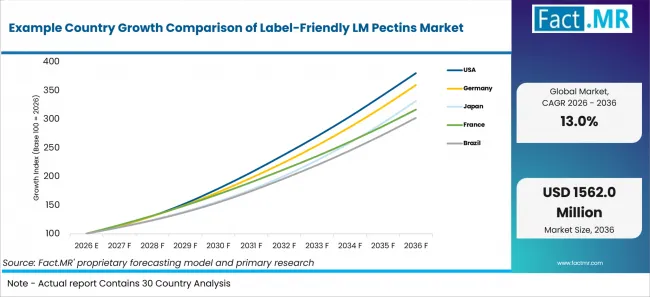
Example Country Growth Comparison Of Label Friendly Lm Pectins Market | Source: Fact.MR
| Country | CAGR (2026-2036) |
|---|---|
| United States | 14.3% |
| Germany | 13.7% |
| Japan | 12.7% |
| France | 12.2% |
| Brazil | 11.7% |
Source: Fact.MR analysis. Updated Aug 28, 2026
What supports USA adoption?
14.3% CAGR, supported by packaged-food reformulation and dairy-alternative texture demand.
U.S. food and beverage brands have a broad reformulation base. USDA ERS reported in June 2026 that total U.S. food spending reached USD 2.51 trillion in 2025. That spending base gives LM pectin suppliers room to target reduced-sugar fruit systems and dairy-alternative launches where texture and ingredient familiarity guide approval. Supplier selection is expected to depend on documentation quality and trial support as large brands need reproducible performance across several product lines.
What supports Germany adoption?
13.7% CAGR, led by organic formulation depth and structured food manufacturing.
Germany benefits from food manufacturing depth and local organic sourcing cues. Destatis reported in February 2026 that vegetable area expanded 3.9% to 131,700 hectares in 2025. Formulators in dairy, fruit preparations and desserts are expected to screen LM pectin where organic positioning and stable texture have to work together. Local technical service is expected to carry weight since German food brands often require clear application data before changing stabilizer systems.
How does Japan perform?
12.7% CAGR, led by export-oriented food development and texture consistency needs.
Japan has a quality-focused processed-food base with high attention to texture. MAFF reported in February 2026 that exports of agricultural, forestry and fishery products and food reached JPY 1.7005 trillion in 2025, up 12.8% year over year. Export exposure is expected to favor LM pectin systems that protect mouthfeel and shelf-life consistency across distribution routes. Adoption is likely to remain application-led as dessert, beverage and fruit-preparation formats each need different gel behavior.
What supports France growth?
12.2% CAGR, backed by food manufacturing breadth and moderate price conditions.
French formulation activity is shaped by careful cost control in packaged foods and desserts. INSEE reported in January 2026 that food prices rose 1.2% on average in 2025. LM pectin demand is expected to benefit where brands need clean-label texture while keeping recipe economics manageable. The market is expected to favor grades that support reduced-sugar fruit preparations and dairy alternatives without adding long validation cycles.
How is Brazil developing demand?
11.7% CAGR, supported by citrus processing depth and food-sector activity.
Brazil is linked closely to citrus peel streams that support pectin extraction. IBGE reported in November 2025 that its October estimate placed Brazilian orange production at 13.9 million tonnes in 2025. Local pectin demand is expected to develop around citrus processing, fruit systems and sauce applications where peel valorization and texture design overlap. Export-oriented ingredient suppliers are expected to benefit when they can show stable specifications from variable peel inputs.
Who leads the Label-Friendly LM Pectins Market?
Cargill, Incorporated participates through its UniPECTINE portfolio and broader texturizer capabilities across fruit, dairy and confectionery applications. At AAHAR 2025 in March, Cargill, Incorporated showcased a cost-effective pectin replacer for gummies and jellies alongside functional ingredient systems designed to balance product performance and cost.
Herbstreith & Fox GmbH & Co. KG contributes specialist expertise in apple and citrus pectins, while JRS JRS Silvateam Ingredients S.r.l. Ingredients supplies pectin systems produced from citrus raw materials. Competitive positioning is likely to depend on consistent functional performance, including calcium response where relevant, together with technical documentation and application support during formulation and scale-up.
Which companies are the key providers?
Key companies include Cargill, Incorporated; Herbstreith & Fox GmbH & Co. KG; JRS Silvateam Ingredients S.r.l.; and Tate & Lyle PLC (including CP Kelco).
- Cargill, Incorporated
- Herbstreith & Fox GmbH & Co. KG
- JRS Silvateam Ingredients S.r.l.
- Tate & Lyle PLC (including CP Kelco)
Bibliography
- Cargill. (2025, March 4). Cargill showcases full range of innovative food solutions at AAHAR 2025.
- Federal Statistical Office (Destatis). (2026, February 26). Gemüseernte erreicht 2025 neuen Höchststand [Vegetable harvest reaches a new record high in 2025].
- U.S. Food and Drug Administration. (2025, January 14). FDA proposes requiring at-a-glance nutrition information on the front of packaged foods.
- Institut national de la statistique et des études économiques. (2026, January 15). Further slowdown in annual average consumer prices in 2025.
- Brazilian Institute of Geography and Statistics. (2025, November 13). IBGE: Harvest estimate for 2026 is 332.7 million tonnes, 3.7% lower than in 2025. IBGE News Agency.
- U.S. Bureau of Labor Statistics. (2026, January 13). Consumer Price Index—December 2025.
- Zeballos, E., & Sinclair, W. (2026, June 11). Total U.S. food spending reached $2.51 trillion in 2025. U.S. Department of Agriculture, Economic Research Service.
This Report Addresses
- The report explains where label-friendly LM pectin is used across product, function, application and grade.
- Segment analysis identifies the main subsegments and the formulation reasons brands prioritize them.
- Country analysis examines the listed markets and the food-processing mechanisms supporting adoption.
- Competitive analysis reviews current suppliers across pectin, hydrocolloids and natural texturizer portfolios.
- Application analysis assesses how calcium setting, sugar reduction and protein stabilization shape purchase decisions.
What does the Label-Friendly LM Pectins Market cover?
The Label-Friendly LM Pectins Market covers food-grade low-methoxyl pectin systems used to create texture in reduced-sugar and clean-label foods. The market includes ingredients that help formulators set gels, manage water release and stabilize fruit or protein systems. It is adjacent to citrus peel fibre and fruit pomace pectin ingredient coverage.
The assessment includes pectin use in dairy alternatives, confectionery, beverages and sauces. The analysis focuses on commercial ingredient demand rather than finished packaged food sales. Texture systems include gum hydrocolloid systems and alternative hydrocolloids where formulators compare label fit and performance.
What is included in the scope?
The scope includes commercial LM pectin grades, food-grade blends and application-specific systems used in fruit, dairy-alternative and beverage recipes. It covers standard and customized grades where suppliers provide formulation support. It also considers use cases adjacent to dairy stabilizers where texture and stability guide supplier approval.
It includes suppliers that provide pectin, hydrocolloid blends and technical support for gelling, thickening, stabilization and suspension. The scope covers food processors, dairy-alternative brands, confectionery manufacturers and beverage developers. Contract manufacturers are included where they influence ingredient choice for customer recipes.
What is excluded from the scope?
The scope excludes pharmaceutical-only pectin use, cosmetic-only grades, commodity gums sold without LM pectin functionality and raw citrus peel traded without extraction or food-ingredient processing.
General sweeteners, flavor systems and starches fall outside scope when they are sold without pectin functionality. Finished food products are outside scope when the supplier sells no pectin or pectin-containing formulation system.
How Was the Analysis Built?
The analysis draws on 120+ sources, 35+ company portfolios, 25+ countries, and more than 20 industry interviews.
- Primary Research: Primary research includes discussions with manufacturers, service providers, technology developers, distributors, end users, and subject-matter experts. These conversations examine purchasing priorities, product adoption, operational challenges, approval requirements, competitive positioning, and the factors that influence wider market acceptance.
- Desk Research: Desk research covers government statistics, regulatory publications, company filings, trade data, technical studies, industry associations, standards, public policy, and other authoritative sources. Every source used in the analysis is documented in the bibliography.
- Market Sizing and Forecasting: Market estimates combine historical performance, demand indicators, pricing and volume trends, segment shares, company participation, country-level growth, adoption patterns, investment activity, and barriers to market expansion.
- Data Validation and Update Cycle: Findings are validated by comparing primary interviews with public data, company activity, regulatory changes, trade patterns, and industry developments. Regular updates review new product launches, capacity changes, partnerships, approvals, and shifts in commercial adoption.
Segmentation
What is the report’s scope and coverage?
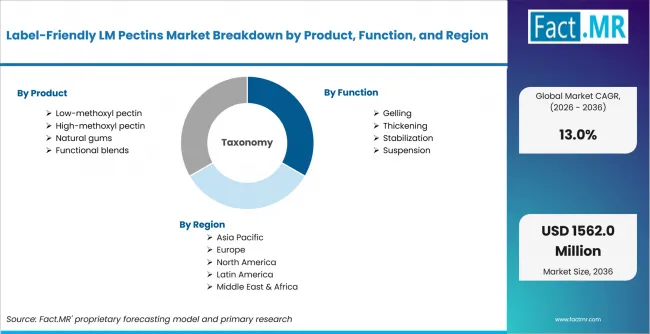
Label Friendly Lm Pectins Market Breakdown By Product, Function, And Region | Source: Fact.MR
| Attribute | Details |
|---|---|
| Quantitative Units | USD million |
| Market Definition | Food-grade low-methoxyl pectin systems used to provide calcium-set gelling, thickening, stabilization and suspension in label-friendly food and beverage formulations. |
| Product | Low-methoxyl pectin; High-methoxyl pectin; Natural gums; Functional blends |
| Function | Gelling; Thickening; Stabilization; Suspension |
| Application | Dairy alternatives; Confectionery; Beverages; Sauces and dressings |
| Grade | Food grade; Organic; Low-energy process; Customized |
| Regions Covered | North America; Latin America; Western Europe; Eastern Europe; East Asia; South Asia & Pacific; Middle East & Africa |
| Countries Covered | United States; Germany; Japan; France; Brazil |
| Key Companies Profiled | Cargill, Incorporated; Herbstreith & Fox GmbH & Co. KG; JRS Silvateam Ingredients S.r.l.; Tate & Lyle PLC (including CP Kelco) |
| Forecast Period | 2026 to 2036 |
| Approach | Hybrid top-down and bottom-up approach using ingredient revenue, application demand, grade mix, country adoption and supplier portfolio review. |
Source: Fact.MR analysis. Updated Aug 28, 2026
How is the market segmented?
-
By Product:
- Low-methoxyl pectin
- High-methoxyl pectin
- Natural gums
- Functional blends
-
By Function:
- Gelling
- Thickening
- Stabilization
- Suspension
-
By Application:
- Dairy alternatives
- Confectionery
- Beverages
- Sauces and dressings
-
By Grade:
- Food grade
- Organic
- Low-energy process
- Customized
-
By Region:
- North America
- Latin America
- Western Europe
- Eastern Europe
- East Asia
- South Asia & Pacific
- Middle East & Africa
Frequently Asked Questions
How big is the label-friendly LM pectins market in 2026?
What is the CAGR of the label-friendly LM pectins market from 2026 to 2036?
Which product leads the label-friendly LM pectins market?
Which function leads the label-friendly LM pectins market?
Who are the leading companies in the label-friendly LM pectins market?
Who worked on this report


Preview the report firsthand - request a free sample
Free SampleGet the brochure for pricing and purchase details
Download PDF