Fertility Preservation Concierge Services Market Size, Share, Growth and Forecast (2026 - 2036)
The Fertility Preservation Concierge Services Market is segmented by Service Type, by Preservation Pathway, by Buyer Type, by Delivery Model, by End Use, by Pricing Model and Region. Forecast for 2026 to 2036.
What is the fertility preservation concierge services market forecast to be worth by 2036?
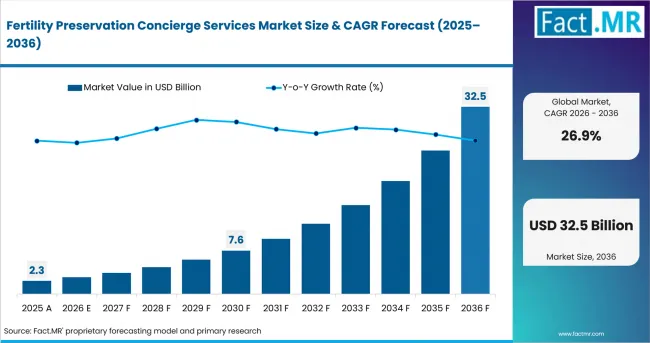
USD 3.0 billion in 2026 to USD 32.50 billion by 2036, at 26.9% CAGR.
- The fertility preservation concierge services market crossed an estimated USD 2.36 billion in 2025. Demand is expected to increase from USD 3.0 billion in 2026 to USD 32.50 billion by 2036.
- The market is forecast to record 26.9% CAGR during 2026 to 2036 as employer benefit platforms, oncology referral teams and clinic-linked navigation providers handle more preservation cases.
- Service revenue from navigation, benefit administration, counseling coordination and preservation planning forms the core of this market. The Centers for Disease Control and Prevention reported 435,426 assisted reproductive technology cycles at 457 reporting United States clinics in 2022.
- This supports service demand because 184,423 cycles were egg or embryo banking cycles where material was frozen for future use.
What are the defining numbers behind fertility preservation concierge services growth?
USD 29.50 billion absolute opportunity by 2036, led by India and China.
- Demand Drivers in the Market
- Employer benefit sponsors need navigation because fertility preservation claims require eligibility checks, clinic routing and member education.
- Cancer-care teams need fast referral coordination because counseling must happen before chemotherapy, surgery or radiation begins.
- Self-pay patients need financial guidance because procedure fees, medicine costs and storage fees are usually billed separately.
- Regulated storage consent creates service demand because patients must understand ownership, renewal and disposition choices before cryopreservation.
- Key Segments Analyzed
- By Service Type: Benefit Management is expected to hold 34.0% share in 2026 because employers and health plans need claims review, member support and clinic network control.
- By Preservation Pathway: Egg Freezing leads because elective preservation requires counseling before medication starts. The segment is projected to capture 38.0% share in 2026.
- By Buyer Type: Employers are likely to account for 46.0% share in 2026 since fertility access is increasingly funded through contracted benefit programs.
- By Delivery Model: Virtual Concierge is projected to hold 41.0% share in 2026 as intake, cost checks and clinic matching often begin before a facility visit.
- By End Use: Elective Preservation is expected to hold 42.0% share in 2026 due to delayed parenthood planning creates repeat counseling and cost-comparison needs.
- By Geography: India is projected to record 15.8% CAGR through 2036 as clinic registration and urban self-pay pathways expand.
- Analyst Opinion at Fact.MR
- Shambhu Nath Jha, Senior Analyst at Fact.MR, states, “Fertility preservation concierge services are becoming the planning layer between a patient, a clinic and a payer. I see the clearest advantage with providers that explain cost, storage choices and timing before a patient starts medication. Clients are paying for more than clinic access. They are paying for fewer delays, clearer decisions and stronger documentation around preserved reproductive material.”
- Strategic Implications
- Benefit platforms should separate preservation navigation from broader family-building support because timing and storage decisions are more time-sensitive.
- Fertility clinics need clearer concierge intake workflows before patients start medication or oncology treatment.
- Employers should define preservation eligibility, storage limits and claims rules before program launch.
- Self-pay channels need transparent cost guidance that explains procedure, pharmacy and storage bills separately.
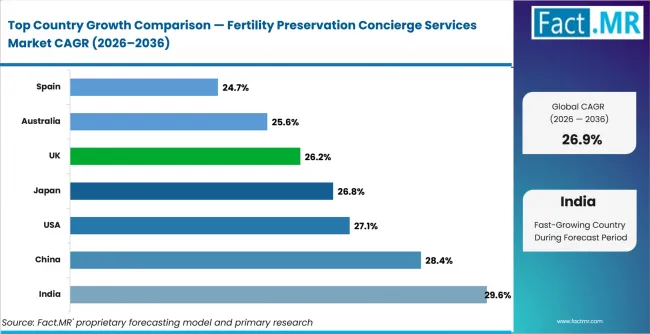
India is projected to record 29.6% CAGR through 2036 as formal clinic registration improves referral visibility. China is expected to expand at 28.4% CAGR because treatment volumes create stronger clinic-routing needs. The United States is forecast to advance at 27.1% CAGR as employer-funded benefits and state preservation mandates create more eligibility checks. Japan is expected to advance at 26.8% CAGR as older maternal age and reimbursement-linked access shape preservation counseling. The United Kingdom is projected to rise at 26.2% CAGR because regulated storage rules make patient education more important.
How does the fertility preservation concierge services market break down by segment?
Benefit management leads at 34.0%; egg freezing leads at 38.0%.
Which service type leads?
Benefit Management holds 34.0% share in 2026.
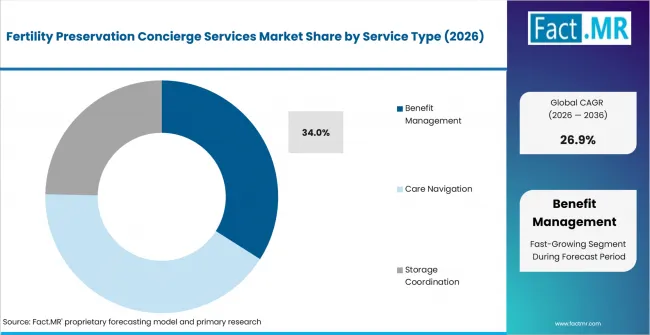
Benefit Management is expected to hold 34.0% share in 2026 because employers and health plans need eligibility checks, claims support, care routing and reporting. Progyny reported 555 fertility and family-building clients as of December 31, 2025. That client base shows why service revenue is concentrated where employers need contracted administration and care management.
Which preservation pathway leads?
Egg Freezing holds 38.0% share in 2026.
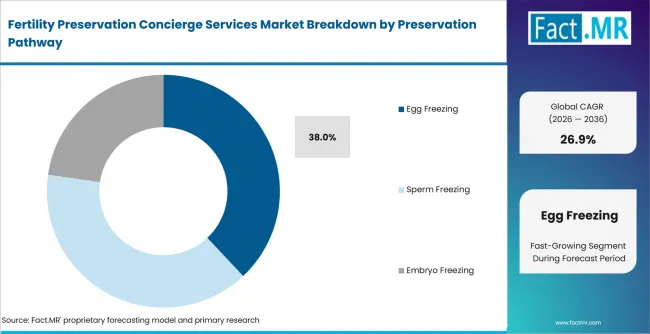
Egg Freezing leads because elective preservation needs age counseling, cost explanation, medication planning and storage guidance before treatment starts. The pathway also connects concierge teams with IVF devices because clinical procedures shape patient cost estimates and referral decisions.
Which buyer type leads?
Employers hold 46.0% share in 2026.
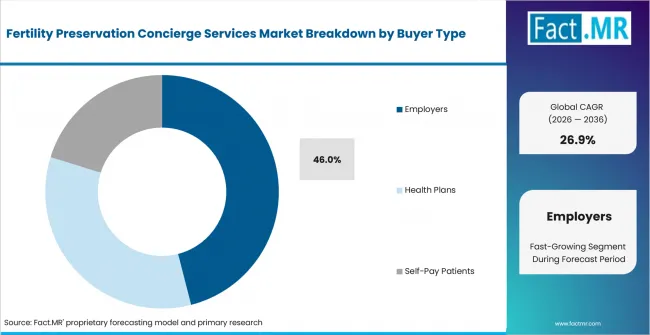
Employers lead because fertility preservation support is often purchased through workforce benefits. Carrot states that it provides care in 195+ countries and has 17,000+ eligible providers. This type of network scale helps employers offer fertility navigation without building their own provider-management teams.
Which delivery model leads?
Virtual Concierge holds 41.0% share in 2026.
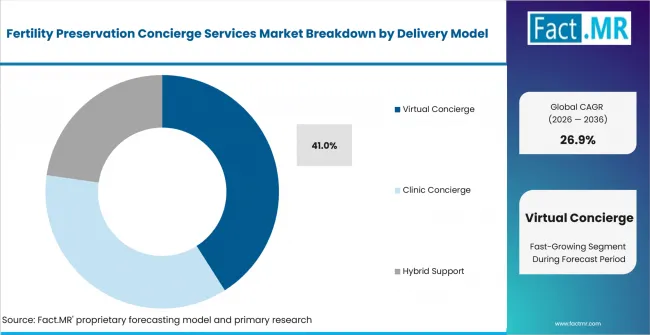
Virtual Concierge leads because first questions usually involve timing, cost and eligibility rather than clinical procedures. Remote intake also links to home diagnostics when programs use at-home testing or pre-clinic health screening to move patients toward the right care pathway.
Which end use leads?
Elective Preservation holds 42.0% share in 2026.
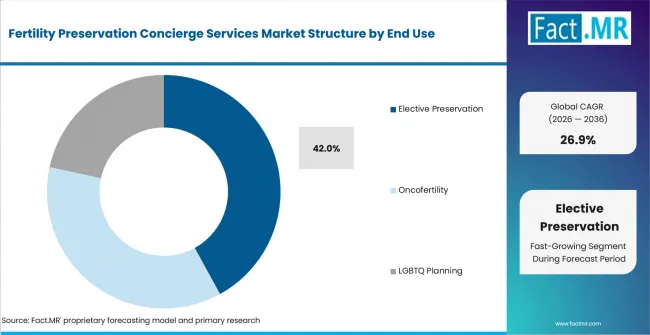
Elective Preservation leads early service revenue because patients need help deciding whether age, treatment goals and storage cost justify freezing. Oncofertility has smaller volume but higher urgency because referral must occur before gonadotoxic therapy begins.
Which pricing model leads?
Per-Member Fee pricing holds 37.0% share in 2026.
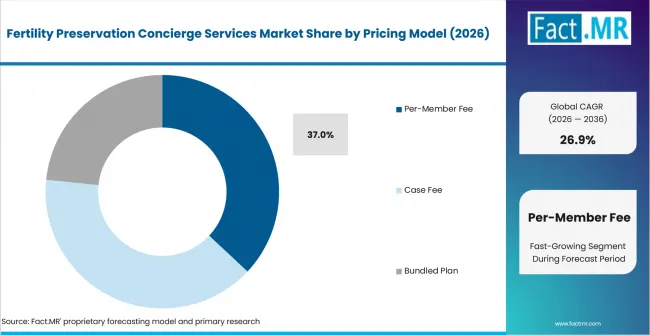
Per-Member Fee pricing leads because employers prefer predictable spending before member claims occur. Case-fee and bundled-plan models remain useful in self-pay channels where patients enter active preservation support after a clinical inquiry.
What is accelerating fertility preservation concierge services demand, and what is holding it back?
Assisted reproduction volume and benefit administration drive it; affordability and counseling capacity restrain it.
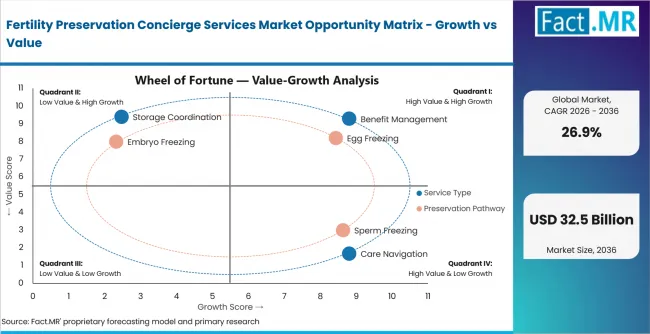
The main driver is treatment complexity. Assisted reproductive technology involves medical timing, laboratory handling, consent forms, payment choices and storage decisions. Concierge demand rises because a patient needs one route through these steps rather than separate conversations with a clinic, employer, insurer and storage provider. Concierge services sit around assisted reproductive technology because the service layer converts procedure decisions into benefit rules, clinic options and storage choices.
Another driver is preservation urgency. The American Society for Reproductive Medicine states that patients receiving treatment that may affect gonads should be informed about fertility preservation before treatment starts. This makes oncofertility referral coordination a practical service need rather than a general education task.
The main restraint is affordability. Concierge support can reduce confusion, but it does not remove procedure fees, medication costs or storage charges. Adoption is also constrained by counseling capacity because professional guidance may need physicians, nurses, mental health professionals and financial counselors in the same pathway.
Where do the biggest fertility preservation concierge opportunities sit?
Oncofertility referral, employer benefit administration and storage lifecycle support.
- Oncofertility Referral: Providers can build fast pathways between oncology teams and fertility clinics before treatment begins.
- Employer Benefits: Platforms can add preservation-specific eligibility checks, storage counseling and claims support to existing family-building programs.
- Storage Lifecycle: Clinics and benefits providers can support renewal, consent updates and disposition decisions after the original preservation cycle.
- Treatment Planning: Concierge teams can explain sperm processing media and preimplantation genetic testing when patients ask how stored material may be used in later treatment.
Which countries are scaling fertility preservation concierge services fastest?
India 29.6%, China 28.4%, United States 27.1%, Japan 26.8%, United Kingdom 26.2%, Australia 25.6%, Spain 24.7%.
Based on regional analysis, the fertility preservation concierge services market is segmented into North America, Europe, Asia Pacific, Latin America and Middle East and Africa.
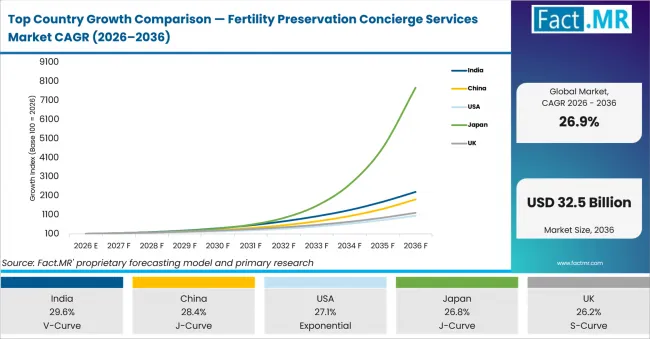
.webp)
| Country | CAGR |
|---|---|
| India | 29.6% |
| China | 28.4% |
| United States | 27.1% |
| Japan | 26.8% |
| United Kingdom | 26.2% |
| Australia | 25.6% |
| Spain | 24.7% |

What is powering India's lead?
29.6% CAGR, supported by formal clinic registration and self-pay care navigation.
India is projected to record 29.6% CAGR through 2036 as formal clinic registration improves referral screening and patient confidence. The Government of India reported 2,574 registered assisted reproductive technology clinics and 632 registered banks in August 2025. This creates a visible clinic base that helps concierge providers explain clinic status, price pathways and preservation rules. Birla Fertility and IVF, Nova IVF Fertility, Indira IVF and Oasis Fertility are active local providers. Demand favors services that translate regulation into simple patient routing. [12]
How is China scaling service demand?
28.4% CAGR, supported by treatment volume and coordinated clinic referral needs.
China is expected to expand at 28.4% CAGR through 2036 because fertility treatment volume creates a service gap between hospital capacity and patient decision-making. A peer-reviewed 2024 analysis reported 536 assisted reproductive technology institutions connected to National Health Commission records. That base supports demand for clinic matching, timing guidance and payment explanation. Jinxin Fertility Group, United Family Healthcare and regional reproductive centers are active providers. Growth is constrained when patients outside large cities face limited access to specialist counseling. [14]
What supports the United States outlook?
27.1% CAGR, supported by employer benefit funding and state preservation mandates.
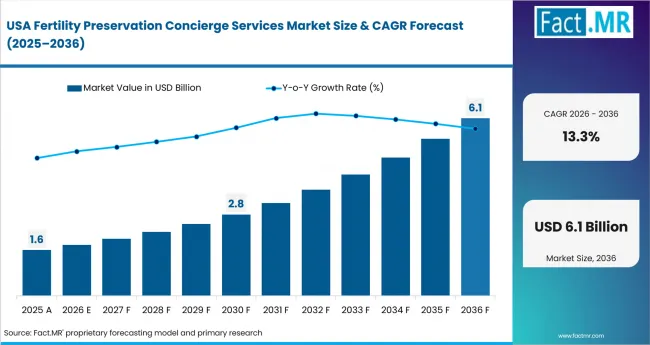
The United States is forecast to advance at 27.1% CAGR through 2036 because employer-funded fertility benefits and state preservation mandates create recurring service work. The Centers for Disease Control and Prevention reported 435,426 assisted reproductive technology cycles at 457 reporting clinics in 2022. Benefit vendors such as Progyny, Carrot Fertility, Maven Clinic, Kindbody, WIN and ARC Fertility compete by guiding members through clinic choice and payment rules. Employer benefit platforms also connect preservation planning with home DNA testing when programs include reproductive risk discussion. [2]
Why is Japan an important service market?
26.8% CAGR, supported by older maternal age and reimbursement-linked treatment access.
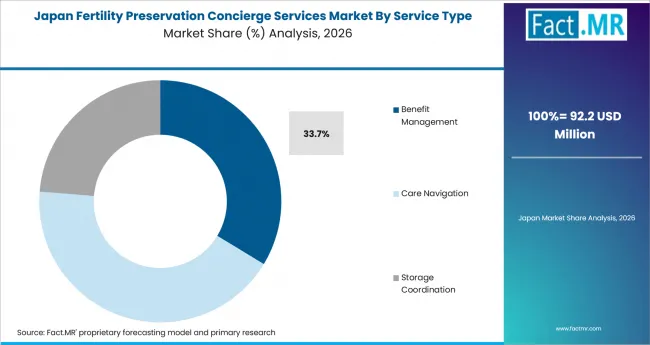
Japan is expected to advance at 26.8% CAGR through 2036 as older maternal age and formal treatment access increase counseling needs. Reproductive Medicine and Biology reported 561,664 assisted reproductive technology cycles and 85,048 newborns in Japan for 2023. Kato Ladies Clinic, Sugiyama Clinic, IVF Japan Group and Oak Clinic are active local providers. Buyers in Japan value clear clinical explanation, age-linked expectations and cautious storage guidance before preservation starts. [15]
What underpins the United Kingdom's growth?
26.2% CAGR, backed by regulated storage counseling and egg freezing demand.
The United Kingdom is projected to rise at 26.2% CAGR through 2036 because regulated storage rules and egg freezing growth create patient education needs. The Human Fertilisation and Embryology Authority reported that egg freezing cycles increased from 2,567 in 2019 to 6,932 in 2023. TFP Fertility, Bourn Hall, CARE Fertility and The Evewell are active local providers. Self-pay patients need help comparing clinic prices, storage renewal rules and return-to-use expectations before paying for a cycle. [5]
What shapes Australia's role?
25.6% CAGR, supported by corporate clinic networks and frozen embryo pathways.
Australia is forecast at 25.6% CAGR through 2036 as corporate clinic networks and frozen embryo pathways keep storage planning central to patient care. The University of New South Wales reported that vitrification was used in 98.1% of thaw blastocyst transfers in 2023. Monash IVF, Virtus Health, Genea and City Fertility are active local providers. Concierge services gain value when patients need one explanation across thaw planning, finance and travel logistics. [10]
How does Spain support cross-border concierge work?
24.7% CAGR, supported by cross-border care and private clinic capacity.
Spain is expected to post 24.7% CAGR through 2036 because private fertility capacity and cross-border patient flows create documentation needs. The Spanish national registry workshop for 2023 activity was scheduled by the Ministry of Health for December 2025. Sociedad Espanola de Fertilidad also reported high assisted reproduction activity across in vitro fertilization and insemination services for 2023. IVI RMA, Instituto Bernabeu, Clinica Tambre and Ginemed are active local providers. Demand favors multilingual guidance, storage consent support and travel-timing coordination. [16]
Who leads the fertility preservation concierge services landscape?
Progyny, Carrot Fertility and Maven Clinic lead through benefit administration, member guidance and employer relationships.
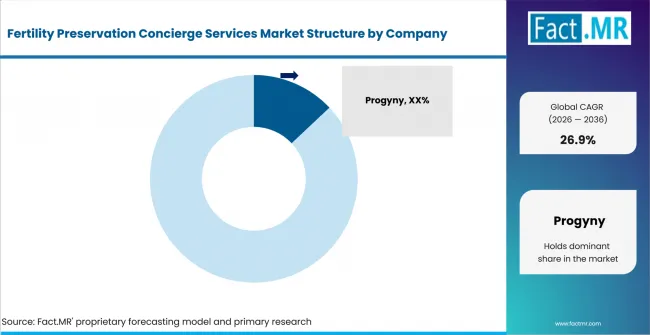
Fertility preservation concierge services are used by employers, health plans, fertility clinics and self-pay patients that need guided decisions before a preservation cycle starts. Progyny competes through fertility benefit services and care management. Carrot Fertility competes through global benefit access, provider networks and payment support. Maven Clinic competes through virtual reproductive health and family-building programs.
Kindbody links employer benefits with owned and affiliated fertility care. WIN supports employers, health plans and consumers through fertility benefit management. ARC Fertility focuses on bundled treatment packages, financing and benefit navigation. Inception Fertility brings clinic network depth through its fertility-care ecosystem.
Competition through 2036 is expected to depend on coverage administration, clinical network quality, patient guidance and storage documentation. Providers with strong intake workflows and outcome reporting are better placed as employers ask for measurable use, lower member confusion and fewer delayed treatment starts.
Adjacent artificial insemination and fertility tracking tools categories matter because concierge providers increasingly sit before, during and after the clinical treatment decision.
Which companies are the key players?
Progyny, Carrot Fertility, Maven Clinic, Kindbody, WIN, ARC Fertility and Inception Fertility.
- Progyny
- Carrot Fertility
- Maven Clinic
- Kindbody
- WIN
- ARC Fertility
- Inception Fertility
Bibliography
- Centers for Disease Control and Prevention. (2024, December 10). ART surveillance.
- Centers for Disease Control and Prevention. (2024, December 10). National ART summary.
- Human Fertilisation and Embryology Authority. (2025, June 26). Fertility treatment 2023: Trends and figures.
- Human Fertilisation and Embryology Authority. (2025, July 31). Egg freezing: A factsheet.
- De Nutte, A. (2025, June 30). IVF and IUI pregnancy rates remain stable across Europe, despite an increasing uptake of single embryo transfer. Focus on Reproduction.
- American Society for Reproductive Medicine. (2026, February 1). Fertility preservation in patients with medical indications: A committee opinion.
- American Society for Reproductive Medicine. (2026, February 1). Fertility preservation and reproduction in patients facing gonadotoxic therapies or gonadectomy: An Ethics Committee opinion.
- RESOLVE: The National Infertility Association. (2025, December 1). About insurance coverage.
- University of New South Wales, National Perinatal Epidemiology and Statistics Unit. (2025, September). Assisted reproductive technology in Australia and New Zealand 2023.
- Australian Government Department of Health, Disability and Ageing. (2025, September 26). Rapid Review of Assisted Reproductive Technology and In Vitro Fertilisation Regulation and Accreditation in Australia.
- Government of India, Ministry of Health and Family Welfare. (2025, August 5). Increase in fertility and ART centres across the country. Rajya Sabha.
- Government of India, Department of Health Research. (n.d.). National ART & Surrogacy Registry.
- Huang, R., Fang, C., Xu, S., et al. (2024). Feasibility analysis of China’s medical insurance coverage for assisted reproductive technology. Scientific Reports, 14, 7027.
- Katagiri, Y., Jwa, S. C., Kuwahara, A., Iwasa, T., Ono, M., Kato, K., Kishi, H., Kuwabara, Y., Taniguchi, F., Harada, M., Iwase, A., & Sugino, N. (2026). Assisted Reproductive Technology in Japan: A summary report for 2023 by the Committee on Professional Scientific Conduct and Clinical Ethics of the Japan Society of Obstetrics and Gynecology. Reproductive Medicine and Biology, 25(1), e70008.
- Comisión Nacional de Reproducción Humana Asistida. (2025, December 17). XVII Workshop Registro Nacional de Actividad 2023 – Registro SEF. Ministerio de Sanidad.
- Sociedad Española de Fertilidad. (2025). La reproducción asistida en España: Una década de datos que consolidan eficacia, seguridad y compromiso social.
- United Nations Department of Economic and Social Affairs. (2025, May 6). World fertility 2024. United Nations.
- Progyny, Inc. (2026, February 26). Progyny, Inc. announces fourth quarter 2025 results.
- Progyny, Inc. (2025, January 28). Progyny, Inc. enhances suite of services with acquisition of BenefitBump.
- Maven Team. (2024, April 17). Maven Clinic expands award-winning Fertility & Family Building solution with focus on natural conception. Maven Clinic.
- Carrot Fertility, Inc. (2024, October 18). Carrot partners with WTW to expand access to fertility and family-building benefits for employers.
- Carrot Fertility, Inc. (2025, July 7). Introducing Sprints: The first — and only — metabolic-fertility program.
This Report Address
- Strategic intelligence on fertility preservation concierge services across service type, preservation pathway and buyer type.
- Segment analysis covering Benefit Management, Egg Freezing, Employers, Virtual Concierge and Elective Preservation.
- Regional outlook covering the United States, India, China, Japan, United Kingdom, Australia and Spain.
- Competitive analysis of Progyny, Carrot Fertility, Maven Clinic, Kindbody, WIN, ARC Fertility and Inception Fertility.
- Service assessment covering care navigation, benefit administration, oncology referral, storage coordination and financial counseling.
- Primary interviews, provider checks, official source review and assisted reproduction data validation support the forecast.
What does the fertility preservation concierge services market cover?
Navigation and benefit administration services for egg, sperm, embryo, ovarian tissue and testicular tissue preservation.
The fertility preservation concierge services market covers structured support that helps individuals and buyers plan, fund and coordinate reproductive material preservation. It differs from fertility treatment because the paid service is navigation and administration. It includes intake, clinic matching, benefit explanation, oncology referral routing, storage choice education and reimbursement support.
What is included in the scope?
Care navigation, preservation planning, benefit administration and referral coordination.
The scope includes care navigation for egg, sperm, embryo, ovarian tissue and testicular tissue preservation. It includes employer and health-plan benefit administration tied to preservation access. It also includes oncofertility referral coordination, storage consent support, financial counseling and claims assistance when the service fee is separate from the clinical procedure.
What is excluded from the scope?
Clinical procedure revenue, medication revenue, laboratory storage fees and fertility devices.
The scope excludes retrieval, thawing, transfer, laboratory work and pharmacy revenue. It excludes long-term cryostorage fees charged directly by laboratories. It also excludes fertility devices, media, instruments and consumables unless they are referenced only as adjacent value-chain categories.
How was the analysis built?
100+ sources, 45+ company portfolios, 28+ countries, 24+ expert checks.
- Primary Research:
- Primary research includes interviews and structured checks with benefit consultants, fertility clinic operators, employer benefits teams and reproductive health service providers.
- Desk Research:
- Desk research reviews government fertility registries, professional society guidance, fertility authority publications, company investor filings and official company newsrooms.
- Market-Sizing and Forecasting:
- Forecasting uses assisted reproduction cycle volume, employer benefits penetration, clinic network capacity and estimated service revenue per covered case.
- Data Validation and Update Cycle:
- Forecasts are validated through clinic-capacity checks, company disclosure review and country-level assisted reproduction activity. Public service-revenue splits are limited, so segment shares are analyst estimates where direct disclosure is unavailable.
What is the report's scope and coverage?
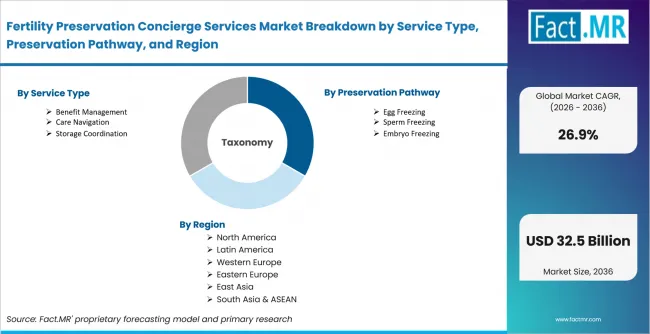
| Attribute | Details |
|---|---|
| Quantitative Units | USD Billion in 2026 to USD Billion by 2036 at CAGR |
| Market Definition | Navigation, benefit administration and care coordination services for fertility preservation planning |
| Service Type | Care Navigation, Benefit Management, Oncology Referral, Storage Coordination, Financial Counseling |
| Preservation Pathway | Egg Freezing, Sperm Freezing, Embryo Freezing, Ovarian Tissue, Testicular Tissue |
| Buyer Type | Employers, Health Plans, Self-Pay Patients, Oncology Centers, Fertility Clinics |
| Delivery Model | Virtual Concierge, Clinic Concierge, Hybrid Support, Managed Wallet, Referral Network |
| End Use | Elective Preservation, Oncofertility, Delayed Parenthood, LGBTQ Planning, Donor Planning |
| Pricing Model | Per-Member Fee, Case Fee, Bundled Plan, Subscription Access, Reimbursement Wallet |
| Regions Covered | North America, Latin America, Europe, Asia Pacific, Middle East and Africa |
| Countries Covered | United States, India, China, Japan, United Kingdom, Australia and Spain |
| Key Companies Profiled | Progyny, Carrot Fertility, Maven Clinic, Kindbody, WIN, ARC Fertility and Inception Fertility |
| Forecast Period | 2026 to 2036 |
| Approach | Hybrid top-down and bottom-up approach using treatment cycles, clinic base, benefit penetration and provider validation |
How is the market segmented?
-
By Service Type:
- Care Navigation
- Benefit Management
- Oncology Referral
- Storage Coordination
- Financial Counseling
-
By Preservation Pathway:
- Egg Freezing
- Sperm Freezing
- Embryo Freezing
- Ovarian Tissue
- Testicular Tissue
-
By Buyer Type:
- Employers
- Health Plans
- Self-Pay Patients
- Oncology Centers
- Fertility Clinics
-
By Delivery Model:
- Virtual Concierge
- Clinic Concierge
- Hybrid Support
- Managed Wallet
- Referral Network
-
By End Use:
- Elective Preservation
- Oncofertility
- Delayed Parenthood
- LGBTQ Planning
- Donor Planning
-
By Pricing Model:
- Per-Member Fee
- Case Fee
- Bundled Plan
- Subscription Access
- Reimbursement Wallet
-
By Region:
- North America
- Latin America
- Europe
- Asia Pacific
- Middle East and Africa
- Frequently Asked Questions -
Which service type leads the Fertility Preservation Concierge Services Market?
Benefit Management leads with 34.0% share in 2026 because employers and health plans need claims support and member guidance.
Which preservation pathway leads the Fertility Preservation Concierge Services Market?
Egg Freezing leads with 38.0% share in 2026 because the journey needs early counseling, clinic matching and storage cost explanation.
Which country expands faster in the Fertility Preservation Concierge Services Market?
India is projected to record 29.6% CAGR through 2036 as clinic registration and self-pay care navigation expand.
How does China perform in the Fertility Preservation Concierge Services Market?
China is expected to expand at 28.4% CAGR through 2036 because treatment volumes create coordinated referral needs.
How does the United States perform in the Fertility Preservation Concierge Services Market?
The United States is forecast to advance at 27.1% CAGR through 2036 as employer-funded benefits and state mandates support service use.
What is the primary driver in the Fertility Preservation Concierge Services Market?
The primary driver is the need to coordinate preservation timing, clinic selection, benefits eligibility and storage decisions.
What is the main restraint in the Fertility Preservation Concierge Services Market?
The main restraint is affordability because procedure fees, medicines and storage charges remain separate from many concierge service fees.
Which companies are tracked in this report?
The report tracks Progyny, Carrot Fertility, Maven Clinic, Kindbody, WIN, ARC Fertility and Inception Fertility.
Table of Content
- Executive Summary
- Global Market Outlook
- Demand to side Trends
- Supply to side Trends
- Technology Roadmap Analysis
- Analysis and Recommendations
- Market Overview
- Market Coverage / Taxonomy
- Market Definition / Scope / Limitations
- Research Methodology
- Chapter Orientation
- Analytical Lens and Working Hypotheses
- Market Structure, Signals, and Trend Drivers
- Benchmarking and Cross-market Comparability
- Market Sizing, Forecasting, and Opportunity Mapping
- Research Design and Evidence Framework
- Desk Research Programme (Secondary Evidence)
- Company Annual and Sustainability Reports
- Peer-reviewed Journals and Academic Literature
- Corporate Websites, Product Literature, and Technical Notes
- Earnings Decks and Investor Briefings
- Statutory Filings and Regulatory Disclosures
- Technical White Papers and Standards Notes
- Trade Journals, Industry Magazines, and Analyst Briefs
- Conference Proceedings, Webinars, and Seminar Materials
- Government Statistics Portals and Public Data Releases
- Press Releases and Reputable Media Coverage
- Specialist Newsletters and Curated Briefings
- Sector Databases and Reference Repositories
- Fact.MR Internal Proprietary Databases and Historical Market Datasets
- Subscription Datasets and Paid Sources
- Social Channels, Communities, and Digital Listening Inputs
- Additional Desk Sources
- Expert Input and Fieldwork (Primary Evidence)
- Primary Modes
- Qualitative Interviews and Expert Elicitation
- Quantitative Surveys and Structured Data Capture
- Blended Approach
- Why Primary Evidence is Used
- Field Techniques
- Interviews
- Surveys
- Focus Groups
- Observational and In-context Research
- Social and Community Interactions
- Stakeholder Universe Engaged
- C-suite Leaders
- Board Members
- Presidents and Vice Presidents
- R&D and Innovation Heads
- Technical Specialists
- Domain Subject-matter Experts
- Scientists
- Physicians and Other Healthcare Professionals
- Governance, Ethics, and Data Stewardship
- Research Ethics
- Data Integrity and Handling
- Primary Modes
- Tooling, Models, and Reference Databases
- Desk Research Programme (Secondary Evidence)
- Data Engineering and Model Build
- Data Acquisition and Ingestion
- Cleaning, Normalisation, and Verification
- Synthesis, Triangulation, and Analysis
- Quality Assurance and Audit Trail
- Market Background
- Market Dynamics
- Drivers
- Restraints
- Opportunity
- Trends
- Scenario Forecast
- Demand in Optimistic Scenario
- Demand in Likely Scenario
- Demand in Conservative Scenario
- Opportunity Map Analysis
- Product Life Cycle Analysis
- Supply Chain Analysis
- Investment Feasibility Matrix
- Value Chain Analysis
- PESTLE and Porter’s Analysis
- Regulatory Landscape
- Regional Parent Market Outlook
- Production and Consumption Statistics
- Import and Export Statistics
- Market Dynamics
- Global Market Analysis 2021 to 2025 and Forecast, 2026 to 2036
- Historical Market Size Value (USD Million) Analysis, 2021 to 2025
- Current and Future Market Size Value (USD Million) Projections, 2026 to 2036
- Y to o to Y Growth Trend Analysis
- Absolute $ Opportunity Analysis
- Global Market Pricing Analysis 2021 to 2025 and Forecast 2026 to 2036
- Global Market Analysis 2021 to 2025 and Forecast 2026 to 2036, By Service Type
- Introduction / Key Findings
- Historical Market Size Value (USD Million) Analysis By Service Type , 2021 to 2025
- Current and Future Market Size Value (USD Million) Analysis and Forecast By Service Type , 2026 to 2036
- Benefit Management
- Care Navigation
- Storage Coordination
- Benefit Management
- Y to o to Y Growth Trend Analysis By Service Type , 2021 to 2025
- Absolute $ Opportunity Analysis By Service Type , 2026 to 2036
- Global Market Analysis 2021 to 2025 and Forecast 2026 to 2036, By Preservation Pathway
- Introduction / Key Findings
- Historical Market Size Value (USD Million) Analysis By Preservation Pathway, 2021 to 2025
- Current and Future Market Size Value (USD Million) Analysis and Forecast By Preservation Pathway, 2026 to 2036
- Egg Freezing
- Sperm Freezing
- Embryo Freezing
- Egg Freezing
- Y to o to Y Growth Trend Analysis By Preservation Pathway, 2021 to 2025
- Absolute $ Opportunity Analysis By Preservation Pathway, 2026 to 2036
- Global Market Analysis 2021 to 2025 and Forecast 2026 to 2036, By Buyer Type
- Introduction / Key Findings
- Historical Market Size Value (USD Million) Analysis By Buyer Type, 2021 to 2025
- Current and Future Market Size Value (USD Million) Analysis and Forecast By Buyer Type, 2026 to 2036
- Employers
- Health Plans
- Self-Pay Patients
- Employers
- Y to o to Y Growth Trend Analysis By Buyer Type, 2021 to 2025
- Absolute $ Opportunity Analysis By Buyer Type, 2026 to 2036
- Global Market Analysis 2021 to 2025 and Forecast 2026 to 2036, By Delivery Model
- Introduction / Key Findings
- Historical Market Size Value (USD Million) Analysis By Delivery Model, 2021 to 2025
- Current and Future Market Size Value (USD Million) Analysis and Forecast By Delivery Model, 2026 to 2036
- Virtual Concierge
- Clinic Concierge
- Hybrid Support
- Virtual Concierge
- Y to o to Y Growth Trend Analysis By Delivery Model, 2021 to 2025
- Absolute $ Opportunity Analysis By Delivery Model, 2026 to 2036
- Global Market Analysis 2021 to 2025 and Forecast 2026 to 2036, By End Use
- Introduction / Key Findings
- Historical Market Size Value (USD Million) Analysis By End Use, 2021 to 2025
- Current and Future Market Size Value (USD Million) Analysis and Forecast By End Use, 2026 to 2036
- Elective Preservation
- Oncofertility
- LGBTQ Planning
- Elective Preservation
- Y to o to Y Growth Trend Analysis By End Use, 2021 to 2025
- Absolute $ Opportunity Analysis By End Use, 2026 to 2036
- Global Market Analysis 2021 to 2025 and Forecast 2026 to 2036, By Pricing Model
- Introduction / Key Findings
- Historical Market Size Value (USD Million) Analysis By Pricing Model, 2021 to 2025
- Current and Future Market Size Value (USD Million) Analysis and Forecast By Pricing Model, 2026 to 2036
- Per-Member Fee
- Case Fee
- Bundled Plan
- Per-Member Fee
- Y to o to Y Growth Trend Analysis By Pricing Model, 2021 to 2025
- Absolute $ Opportunity Analysis By Pricing Model, 2026 to 2036
- Global Market Analysis 2021 to 2025 and Forecast 2026 to 2036, By Region
- Introduction
- Historical Market Size Value (USD Million) Analysis By Region, 2021 to 2025
- Current Market Size Value (USD Million) Analysis and Forecast By Region, 2026 to 2036
- North America
- Latin America
- Western Europe
- Eastern Europe
- East Asia
- South Asia and Pacific
- Middle East & Africa
- Market Attractiveness Analysis By Region
- North America Market Analysis 2021 to 2025 and Forecast 2026 to 2036, By Country
- Historical Market Size Value (USD Million) Trend Analysis By Market Taxonomy, 2021 to 2025
- Market Size Value (USD Million) Forecast By Market Taxonomy, 2026 to 2036
- By Country
- USA
- Canada
- Mexico
- By Service Type
- By Preservation Pathway
- By Buyer Type
- By Delivery Model
- By End Use
- By Pricing Model
- By Country
- Market Attractiveness Analysis
- By Country
- By Service Type
- By Preservation Pathway
- By Buyer Type
- By Delivery Model
- By End Use
- By Pricing Model
- Key Takeaways
- Latin America Market Analysis 2021 to 2025 and Forecast 2026 to 2036, By Country
- Historical Market Size Value (USD Million) Trend Analysis By Market Taxonomy, 2021 to 2025
- Market Size Value (USD Million) Forecast By Market Taxonomy, 2026 to 2036
- By Country
- Brazil
- Chile
- Rest of Latin America
- By Service Type
- By Preservation Pathway
- By Buyer Type
- By Delivery Model
- By End Use
- By Pricing Model
- By Country
- Market Attractiveness Analysis
- By Country
- By Service Type
- By Preservation Pathway
- By Buyer Type
- By Delivery Model
- By End Use
- By Pricing Model
- Key Takeaways
- Western Europe Market Analysis 2021 to 2025 and Forecast 2026 to 2036, By Country
- Historical Market Size Value (USD Million) Trend Analysis By Market Taxonomy, 2021 to 2025
- Market Size Value (USD Million) Forecast By Market Taxonomy, 2026 to 2036
- By Country
- Germany
- UK
- Italy
- Spain
- France
- Nordic
- BENELUX
- Rest of Western Europe
- By Service Type
- By Preservation Pathway
- By Buyer Type
- By Delivery Model
- By End Use
- By Pricing Model
- By Country
- Market Attractiveness Analysis
- By Country
- By Service Type
- By Preservation Pathway
- By Buyer Type
- By Delivery Model
- By End Use
- By Pricing Model
- Key Takeaways
- Eastern Europe Market Analysis 2021 to 2025 and Forecast 2026 to 2036, By Country
- Historical Market Size Value (USD Million) Trend Analysis By Market Taxonomy, 2021 to 2025
- Market Size Value (USD Million) Forecast By Market Taxonomy, 2026 to 2036
- By Country
- Russia
- Poland
- Hungary
- Balkan & Baltic
- Rest of Eastern Europe
- By Service Type
- By Preservation Pathway
- By Buyer Type
- By Delivery Model
- By End Use
- By Pricing Model
- By Country
- Market Attractiveness Analysis
- By Country
- By Service Type
- By Preservation Pathway
- By Buyer Type
- By Delivery Model
- By End Use
- By Pricing Model
- Key Takeaways
- East Asia Market Analysis 2021 to 2025 and Forecast 2026 to 2036, By Country
- Historical Market Size Value (USD Million) Trend Analysis By Market Taxonomy, 2021 to 2025
- Market Size Value (USD Million) Forecast By Market Taxonomy, 2026 to 2036
- By Country
- China
- Japan
- South Korea
- By Service Type
- By Preservation Pathway
- By Buyer Type
- By Delivery Model
- By End Use
- By Pricing Model
- By Country
- Market Attractiveness Analysis
- By Country
- By Service Type
- By Preservation Pathway
- By Buyer Type
- By Delivery Model
- By End Use
- By Pricing Model
- Key Takeaways
- South Asia and Pacific Market Analysis 2021 to 2025 and Forecast 2026 to 2036, By Country
- Historical Market Size Value (USD Million) Trend Analysis By Market Taxonomy, 2021 to 2025
- Market Size Value (USD Million) Forecast By Market Taxonomy, 2026 to 2036
- By Country
- India
- ASEAN
- Australia & New Zealand
- Rest of South Asia and Pacific
- By Service Type
- By Preservation Pathway
- By Buyer Type
- By Delivery Model
- By End Use
- By Pricing Model
- By Country
- Market Attractiveness Analysis
- By Country
- By Service Type
- By Preservation Pathway
- By Buyer Type
- By Delivery Model
- By End Use
- By Pricing Model
- Key Takeaways
- Middle East & Africa Market Analysis 2021 to 2025 and Forecast 2026 to 2036, By Country
- Historical Market Size Value (USD Million) Trend Analysis By Market Taxonomy, 2021 to 2025
- Market Size Value (USD Million) Forecast By Market Taxonomy, 2026 to 2036
- By Country
- Kingdom of Saudi Arabia
- Other GCC Countries
- Turkiye
- South Africa
- Other African Union
- Rest of Middle East & Africa
- By Service Type
- By Preservation Pathway
- By Buyer Type
- By Delivery Model
- By End Use
- By Pricing Model
- By Country
- Market Attractiveness Analysis
- By Country
- By Service Type
- By Preservation Pathway
- By Buyer Type
- By Delivery Model
- By End Use
- By Pricing Model
- Key Takeaways
- Key Countries Market Analysis
- USA
- Pricing Analysis
- Market Share Analysis, 2025
- By Service Type
- By Preservation Pathway
- By Buyer Type
- By Delivery Model
- By End Use
- By Pricing Model
- Canada
- Pricing Analysis
- Market Share Analysis, 2025
- By Service Type
- By Preservation Pathway
- By Buyer Type
- By Delivery Model
- By End Use
- By Pricing Model
- Mexico
- Pricing Analysis
- Market Share Analysis, 2025
- By Service Type
- By Preservation Pathway
- By Buyer Type
- By Delivery Model
- By End Use
- By Pricing Model
- Brazil
- Pricing Analysis
- Market Share Analysis, 2025
- By Service Type
- By Preservation Pathway
- By Buyer Type
- By Delivery Model
- By End Use
- By Pricing Model
- Chile
- Pricing Analysis
- Market Share Analysis, 2025
- By Service Type
- By Preservation Pathway
- By Buyer Type
- By Delivery Model
- By End Use
- By Pricing Model
- Germany
- Pricing Analysis
- Market Share Analysis, 2025
- By Service Type
- By Preservation Pathway
- By Buyer Type
- By Delivery Model
- By End Use
- By Pricing Model
- UK
- Pricing Analysis
- Market Share Analysis, 2025
- By Service Type
- By Preservation Pathway
- By Buyer Type
- By Delivery Model
- By End Use
- By Pricing Model
- Italy
- Pricing Analysis
- Market Share Analysis, 2025
- By Service Type
- By Preservation Pathway
- By Buyer Type
- By Delivery Model
- By End Use
- By Pricing Model
- Spain
- Pricing Analysis
- Market Share Analysis, 2025
- By Service Type
- By Preservation Pathway
- By Buyer Type
- By Delivery Model
- By End Use
- By Pricing Model
- France
- Pricing Analysis
- Market Share Analysis, 2025
- By Service Type
- By Preservation Pathway
- By Buyer Type
- By Delivery Model
- By End Use
- By Pricing Model
- India
- Pricing Analysis
- Market Share Analysis, 2025
- By Service Type
- By Preservation Pathway
- By Buyer Type
- By Delivery Model
- By End Use
- By Pricing Model
- ASEAN
- Pricing Analysis
- Market Share Analysis, 2025
- By Service Type
- By Preservation Pathway
- By Buyer Type
- By Delivery Model
- By End Use
- By Pricing Model
- Australia & New Zealand
- Pricing Analysis
- Market Share Analysis, 2025
- By Service Type
- By Preservation Pathway
- By Buyer Type
- By Delivery Model
- By End Use
- By Pricing Model
- China
- Pricing Analysis
- Market Share Analysis, 2025
- By Service Type
- By Preservation Pathway
- By Buyer Type
- By Delivery Model
- By End Use
- By Pricing Model
- Japan
- Pricing Analysis
- Market Share Analysis, 2025
- By Service Type
- By Preservation Pathway
- By Buyer Type
- By Delivery Model
- By End Use
- By Pricing Model
- South Korea
- Pricing Analysis
- Market Share Analysis, 2025
- By Service Type
- By Preservation Pathway
- By Buyer Type
- By Delivery Model
- By End Use
- By Pricing Model
- Russia
- Pricing Analysis
- Market Share Analysis, 2025
- By Service Type
- By Preservation Pathway
- By Buyer Type
- By Delivery Model
- By End Use
- By Pricing Model
- Poland
- Pricing Analysis
- Market Share Analysis, 2025
- By Service Type
- By Preservation Pathway
- By Buyer Type
- By Delivery Model
- By End Use
- By Pricing Model
- Hungary
- Pricing Analysis
- Market Share Analysis, 2025
- By Service Type
- By Preservation Pathway
- By Buyer Type
- By Delivery Model
- By End Use
- By Pricing Model
- Kingdom of Saudi Arabia
- Pricing Analysis
- Market Share Analysis, 2025
- By Service Type
- By Preservation Pathway
- By Buyer Type
- By Delivery Model
- By End Use
- By Pricing Model
- Turkiye
- Pricing Analysis
- Market Share Analysis, 2025
- By Service Type
- By Preservation Pathway
- By Buyer Type
- By Delivery Model
- By End Use
- By Pricing Model
- South Africa
- Pricing Analysis
- Market Share Analysis, 2025
- By Service Type
- By Preservation Pathway
- By Buyer Type
- By Delivery Model
- By End Use
- By Pricing Model
- USA
- Market Structure Analysis
- Competition Dashboard
- Competition Benchmarking
- Market Share Analysis of Top Players
- By Regional
- By Service Type
- By Preservation Pathway
- By Buyer Type
- By Delivery Model
- By End Use
- By Pricing Model
- Competition Analysis
- Competition Deep Dive
- Progyny
- Overview
- Product Portfolio
- Profitability by Market Segments (Product/Age /Sales Channel/Region)
- Sales Footprint
- Strategy Overview
- Marketing Strategy
- Product Strategy
- Channel Strategy
- Carrot Fertility
- Maven Clinic
- Kindbody
- WIN
- ARC Fertility
- Inception Fertility
- Progyny
- Competition Deep Dive
- Assumptions & Acronyms Used
List Of Table
- Table 1: Global Market Value (USD Million) Forecast by Region, 2021 to 2036
- Table 2: Global Market Value (USD Million) Forecast by Service Type , 2021 to 2036
- Table 3: Global Market Value (USD Million) Forecast by Preservation Pathway, 2021 to 2036
- Table 4: Global Market Value (USD Million) Forecast by Buyer Type, 2021 to 2036
- Table 5: Global Market Value (USD Million) Forecast by Delivery Model, 2021 to 2036
- Table 6: Global Market Value (USD Million) Forecast by End Use, 2021 to 2036
- Table 7: Global Market Value (USD Million) Forecast by Pricing Model, 2021 to 2036
- Table 8: North America Market Value (USD Million) Forecast by Country, 2021 to 2036
- Table 9: North America Market Value (USD Million) Forecast by Service Type , 2021 to 2036
- Table 10: North America Market Value (USD Million) Forecast by Preservation Pathway, 2021 to 2036
- Table 11: North America Market Value (USD Million) Forecast by Buyer Type, 2021 to 2036
- Table 12: North America Market Value (USD Million) Forecast by Delivery Model, 2021 to 2036
- Table 13: North America Market Value (USD Million) Forecast by End Use, 2021 to 2036
- Table 14: North America Market Value (USD Million) Forecast by Pricing Model, 2021 to 2036
- Table 15: Latin America Market Value (USD Million) Forecast by Country, 2021 to 2036
- Table 16: Latin America Market Value (USD Million) Forecast by Service Type , 2021 to 2036
- Table 17: Latin America Market Value (USD Million) Forecast by Preservation Pathway, 2021 to 2036
- Table 18: Latin America Market Value (USD Million) Forecast by Buyer Type, 2021 to 2036
- Table 19: Latin America Market Value (USD Million) Forecast by Delivery Model, 2021 to 2036
- Table 20: Latin America Market Value (USD Million) Forecast by End Use, 2021 to 2036
- Table 21: Latin America Market Value (USD Million) Forecast by Pricing Model, 2021 to 2036
- Table 22: Western Europe Market Value (USD Million) Forecast by Country, 2021 to 2036
- Table 23: Western Europe Market Value (USD Million) Forecast by Service Type , 2021 to 2036
- Table 24: Western Europe Market Value (USD Million) Forecast by Preservation Pathway, 2021 to 2036
- Table 25: Western Europe Market Value (USD Million) Forecast by Buyer Type, 2021 to 2036
- Table 26: Western Europe Market Value (USD Million) Forecast by Delivery Model, 2021 to 2036
- Table 27: Western Europe Market Value (USD Million) Forecast by End Use, 2021 to 2036
- Table 28: Western Europe Market Value (USD Million) Forecast by Pricing Model, 2021 to 2036
- Table 29: Eastern Europe Market Value (USD Million) Forecast by Country, 2021 to 2036
- Table 30: Eastern Europe Market Value (USD Million) Forecast by Service Type , 2021 to 2036
- Table 31: Eastern Europe Market Value (USD Million) Forecast by Preservation Pathway, 2021 to 2036
- Table 32: Eastern Europe Market Value (USD Million) Forecast by Buyer Type, 2021 to 2036
- Table 33: Eastern Europe Market Value (USD Million) Forecast by Delivery Model, 2021 to 2036
- Table 34: Eastern Europe Market Value (USD Million) Forecast by End Use, 2021 to 2036
- Table 35: Eastern Europe Market Value (USD Million) Forecast by Pricing Model, 2021 to 2036
- Table 36: East Asia Market Value (USD Million) Forecast by Country, 2021 to 2036
- Table 37: East Asia Market Value (USD Million) Forecast by Service Type , 2021 to 2036
- Table 38: East Asia Market Value (USD Million) Forecast by Preservation Pathway, 2021 to 2036
- Table 39: East Asia Market Value (USD Million) Forecast by Buyer Type, 2021 to 2036
- Table 40: East Asia Market Value (USD Million) Forecast by Delivery Model, 2021 to 2036
- Table 41: East Asia Market Value (USD Million) Forecast by End Use, 2021 to 2036
- Table 42: East Asia Market Value (USD Million) Forecast by Pricing Model, 2021 to 2036
- Table 43: South Asia and Pacific Market Value (USD Million) Forecast by Country, 2021 to 2036
- Table 44: South Asia and Pacific Market Value (USD Million) Forecast by Service Type , 2021 to 2036
- Table 45: South Asia and Pacific Market Value (USD Million) Forecast by Preservation Pathway, 2021 to 2036
- Table 46: South Asia and Pacific Market Value (USD Million) Forecast by Buyer Type, 2021 to 2036
- Table 47: South Asia and Pacific Market Value (USD Million) Forecast by Delivery Model, 2021 to 2036
- Table 48: South Asia and Pacific Market Value (USD Million) Forecast by End Use, 2021 to 2036
- Table 49: South Asia and Pacific Market Value (USD Million) Forecast by Pricing Model, 2021 to 2036
- Table 50: Middle East & Africa Market Value (USD Million) Forecast by Country, 2021 to 2036
- Table 51: Middle East & Africa Market Value (USD Million) Forecast by Service Type , 2021 to 2036
- Table 52: Middle East & Africa Market Value (USD Million) Forecast by Preservation Pathway, 2021 to 2036
- Table 53: Middle East & Africa Market Value (USD Million) Forecast by Buyer Type, 2021 to 2036
- Table 54: Middle East & Africa Market Value (USD Million) Forecast by Delivery Model, 2021 to 2036
- Table 55: Middle East & Africa Market Value (USD Million) Forecast by End Use, 2021 to 2036
- Table 56: Middle East & Africa Market Value (USD Million) Forecast by Pricing Model, 2021 to 2036
List Of Figures
- Figure 1: Global Market Pricing Analysis
- Figure 2: Global Market Value (USD Million) Forecast 2021-2036
- Figure 3: Global Market Value Share and BPS Analysis by Service Type, 2026 and 2036
- Figure 4: Global Market Y-o-Y Growth Comparison by Service Type, 2026 to 2036
- Figure 5: Global Market Attractiveness Analysis by Service Type
- Figure 6: Global Market Value Share and BPS Analysis by Preservation Pathway, 2026 and 2036
- Figure 7: Global Market Y-o-Y Growth Comparison by Preservation Pathway, 2026 to 2036
- Figure 8: Global Market Attractiveness Analysis by Preservation Pathway
- Figure 9: Global Market Value Share and BPS Analysis by Buyer Type, 2026 and 2036
- Figure 10: Global Market Y-o-Y Growth Comparison by Buyer Type, 2026 to 2036
- Figure 11: Global Market Attractiveness Analysis by Buyer Type
- Figure 12: Global Market Value Share and BPS Analysis by Delivery Model, 2026 and 2036
- Figure 13: Global Market Y-o-Y Growth Comparison by Delivery Model, 2026 to 2036
- Figure 14: Global Market Attractiveness Analysis by Delivery Model
- Figure 15: Global Market Value Share and BPS Analysis by End Use, 2026 and 2036
- Figure 16: Global Market Y-o-Y Growth Comparison by End Use, 2026 to 2036
- Figure 17: Global Market Attractiveness Analysis by End Use
- Figure 18: Global Market Value Share and BPS Analysis by Pricing Model, 2026 and 2036
- Figure 19: Global Market Y-o-Y Growth Comparison by Pricing Model, 2026 to 2036
- Figure 20: Global Market Attractiveness Analysis by Pricing Model
- Figure 21: Global Market Value (USD Million) Share and BPS Analysis by Region, 2026 and 2036
- Figure 22: Global Market Y-o-Y Growth Comparison by Region, 2026 to 2036
- Figure 23: Global Market Attractiveness Analysis by Region
- Figure 24: North America Market Incremental Dollar Opportunity, 2026 to 2036
- Figure 25: Latin America Market Incremental Dollar Opportunity, 2026 to 2036
- Figure 26: Western Europe Market Incremental Dollar Opportunity, 2026 to 2036
- Figure 27: Eastern Europe Market Incremental Dollar Opportunity, 2026 to 2036
- Figure 28: East Asia Market Incremental Dollar Opportunity, 2026 to 2036
- Figure 29: South Asia and Pacific Market Incremental Dollar Opportunity, 2026 to 2036
- Figure 30: Middle East & Africa Market Incremental Dollar Opportunity, 2026 to 2036
- Figure 31: North America Market Value Share and BPS Analysis by Country, 2026 and 2036
- Figure 32: North America Market Value Share and BPS Analysis by Service Type, 2026 and 2036
- Figure 33: North America Market Y-o-Y Growth Comparison by Service Type, 2026 to 2036
- Figure 34: North America Market Attractiveness Analysis by Service Type
- Figure 35: North America Market Value Share and BPS Analysis by Preservation Pathway, 2026 and 2036
- Figure 36: North America Market Y-o-Y Growth Comparison by Preservation Pathway, 2026 to 2036
- Figure 37: North America Market Attractiveness Analysis by Preservation Pathway
- Figure 38: North America Market Value Share and BPS Analysis by Buyer Type, 2026 and 2036
- Figure 39: North America Market Y-o-Y Growth Comparison by Buyer Type, 2026 to 2036
- Figure 40: North America Market Attractiveness Analysis by Buyer Type
- Figure 41: North America Market Value Share and BPS Analysis by Delivery Model, 2026 and 2036
- Figure 42: North America Market Y-o-Y Growth Comparison by Delivery Model, 2026 to 2036
- Figure 43: North America Market Attractiveness Analysis by Delivery Model
- Figure 44: North America Market Value Share and BPS Analysis by End Use, 2026 and 2036
- Figure 45: North America Market Y-o-Y Growth Comparison by End Use, 2026 to 2036
- Figure 46: North America Market Attractiveness Analysis by End Use
- Figure 47: North America Market Value Share and BPS Analysis by Pricing Model, 2026 and 2036
- Figure 48: North America Market Y-o-Y Growth Comparison by Pricing Model, 2026 to 2036
- Figure 49: North America Market Attractiveness Analysis by Pricing Model
- Figure 50: Latin America Market Value Share and BPS Analysis by Country, 2026 and 2036
- Figure 51: Latin America Market Value Share and BPS Analysis by Service Type, 2026 and 2036
- Figure 52: Latin America Market Y-o-Y Growth Comparison by Service Type, 2026 to 2036
- Figure 53: Latin America Market Attractiveness Analysis by Service Type
- Figure 54: Latin America Market Value Share and BPS Analysis by Preservation Pathway, 2026 and 2036
- Figure 55: Latin America Market Y-o-Y Growth Comparison by Preservation Pathway, 2026 to 2036
- Figure 56: Latin America Market Attractiveness Analysis by Preservation Pathway
- Figure 57: Latin America Market Value Share and BPS Analysis by Buyer Type, 2026 and 2036
- Figure 58: Latin America Market Y-o-Y Growth Comparison by Buyer Type, 2026 to 2036
- Figure 59: Latin America Market Attractiveness Analysis by Buyer Type
- Figure 60: Latin America Market Value Share and BPS Analysis by Delivery Model, 2026 and 2036
- Figure 61: Latin America Market Y-o-Y Growth Comparison by Delivery Model, 2026 to 2036
- Figure 62: Latin America Market Attractiveness Analysis by Delivery Model
- Figure 63: Latin America Market Value Share and BPS Analysis by End Use, 2026 and 2036
- Figure 64: Latin America Market Y-o-Y Growth Comparison by End Use, 2026 to 2036
- Figure 65: Latin America Market Attractiveness Analysis by End Use
- Figure 66: Latin America Market Value Share and BPS Analysis by Pricing Model, 2026 and 2036
- Figure 67: Latin America Market Y-o-Y Growth Comparison by Pricing Model, 2026 to 2036
- Figure 68: Latin America Market Attractiveness Analysis by Pricing Model
- Figure 69: Western Europe Market Value Share and BPS Analysis by Country, 2026 and 2036
- Figure 70: Western Europe Market Value Share and BPS Analysis by Service Type, 2026 and 2036
- Figure 71: Western Europe Market Y-o-Y Growth Comparison by Service Type, 2026 to 2036
- Figure 72: Western Europe Market Attractiveness Analysis by Service Type
- Figure 73: Western Europe Market Value Share and BPS Analysis by Preservation Pathway, 2026 and 2036
- Figure 74: Western Europe Market Y-o-Y Growth Comparison by Preservation Pathway, 2026 to 2036
- Figure 75: Western Europe Market Attractiveness Analysis by Preservation Pathway
- Figure 76: Western Europe Market Value Share and BPS Analysis by Buyer Type, 2026 and 2036
- Figure 77: Western Europe Market Y-o-Y Growth Comparison by Buyer Type, 2026 to 2036
- Figure 78: Western Europe Market Attractiveness Analysis by Buyer Type
- Figure 79: Western Europe Market Value Share and BPS Analysis by Delivery Model, 2026 and 2036
- Figure 80: Western Europe Market Y-o-Y Growth Comparison by Delivery Model, 2026 to 2036
- Figure 81: Western Europe Market Attractiveness Analysis by Delivery Model
- Figure 82: Western Europe Market Value Share and BPS Analysis by End Use, 2026 and 2036
- Figure 83: Western Europe Market Y-o-Y Growth Comparison by End Use, 2026 to 2036
- Figure 84: Western Europe Market Attractiveness Analysis by End Use
- Figure 85: Western Europe Market Value Share and BPS Analysis by Pricing Model, 2026 and 2036
- Figure 86: Western Europe Market Y-o-Y Growth Comparison by Pricing Model, 2026 to 2036
- Figure 87: Western Europe Market Attractiveness Analysis by Pricing Model
- Figure 88: Eastern Europe Market Value Share and BPS Analysis by Country, 2026 and 2036
- Figure 89: Eastern Europe Market Value Share and BPS Analysis by Service Type, 2026 and 2036
- Figure 90: Eastern Europe Market Y-o-Y Growth Comparison by Service Type, 2026 to 2036
- Figure 91: Eastern Europe Market Attractiveness Analysis by Service Type
- Figure 92: Eastern Europe Market Value Share and BPS Analysis by Preservation Pathway, 2026 and 2036
- Figure 93: Eastern Europe Market Y-o-Y Growth Comparison by Preservation Pathway, 2026 to 2036
- Figure 94: Eastern Europe Market Attractiveness Analysis by Preservation Pathway
- Figure 95: Eastern Europe Market Value Share and BPS Analysis by Buyer Type, 2026 and 2036
- Figure 96: Eastern Europe Market Y-o-Y Growth Comparison by Buyer Type, 2026 to 2036
- Figure 97: Eastern Europe Market Attractiveness Analysis by Buyer Type
- Figure 98: Eastern Europe Market Value Share and BPS Analysis by Delivery Model, 2026 and 2036
- Figure 99: Eastern Europe Market Y-o-Y Growth Comparison by Delivery Model, 2026 to 2036
- Figure 100: Eastern Europe Market Attractiveness Analysis by Delivery Model
- Figure 101: Eastern Europe Market Value Share and BPS Analysis by End Use, 2026 and 2036
- Figure 102: Eastern Europe Market Y-o-Y Growth Comparison by End Use, 2026 to 2036
- Figure 103: Eastern Europe Market Attractiveness Analysis by End Use
- Figure 104: Eastern Europe Market Value Share and BPS Analysis by Pricing Model, 2026 and 2036
- Figure 105: Eastern Europe Market Y-o-Y Growth Comparison by Pricing Model, 2026 to 2036
- Figure 106: Eastern Europe Market Attractiveness Analysis by Pricing Model
- Figure 107: East Asia Market Value Share and BPS Analysis by Country, 2026 and 2036
- Figure 108: East Asia Market Value Share and BPS Analysis by Service Type, 2026 and 2036
- Figure 109: East Asia Market Y-o-Y Growth Comparison by Service Type, 2026 to 2036
- Figure 110: East Asia Market Attractiveness Analysis by Service Type
- Figure 111: East Asia Market Value Share and BPS Analysis by Preservation Pathway, 2026 and 2036
- Figure 112: East Asia Market Y-o-Y Growth Comparison by Preservation Pathway, 2026 to 2036
- Figure 113: East Asia Market Attractiveness Analysis by Preservation Pathway
- Figure 114: East Asia Market Value Share and BPS Analysis by Buyer Type, 2026 and 2036
- Figure 115: East Asia Market Y-o-Y Growth Comparison by Buyer Type, 2026 to 2036
- Figure 116: East Asia Market Attractiveness Analysis by Buyer Type
- Figure 117: East Asia Market Value Share and BPS Analysis by Delivery Model, 2026 and 2036
- Figure 118: East Asia Market Y-o-Y Growth Comparison by Delivery Model, 2026 to 2036
- Figure 119: East Asia Market Attractiveness Analysis by Delivery Model
- Figure 120: East Asia Market Value Share and BPS Analysis by End Use, 2026 and 2036
- Figure 121: East Asia Market Y-o-Y Growth Comparison by End Use, 2026 to 2036
- Figure 122: East Asia Market Attractiveness Analysis by End Use
- Figure 123: East Asia Market Value Share and BPS Analysis by Pricing Model, 2026 and 2036
- Figure 124: East Asia Market Y-o-Y Growth Comparison by Pricing Model, 2026 to 2036
- Figure 125: East Asia Market Attractiveness Analysis by Pricing Model
- Figure 126: South Asia and Pacific Market Value Share and BPS Analysis by Country, 2026 and 2036
- Figure 127: South Asia and Pacific Market Value Share and BPS Analysis by Service Type, 2026 and 2036
- Figure 128: South Asia and Pacific Market Y-o-Y Growth Comparison by Service Type, 2026 to 2036
- Figure 129: South Asia and Pacific Market Attractiveness Analysis by Service Type
- Figure 130: South Asia and Pacific Market Value Share and BPS Analysis by Preservation Pathway, 2026 and 2036
- Figure 131: South Asia and Pacific Market Y-o-Y Growth Comparison by Preservation Pathway, 2026 to 2036
- Figure 132: South Asia and Pacific Market Attractiveness Analysis by Preservation Pathway
- Figure 133: South Asia and Pacific Market Value Share and BPS Analysis by Buyer Type, 2026 and 2036
- Figure 134: South Asia and Pacific Market Y-o-Y Growth Comparison by Buyer Type, 2026 to 2036
- Figure 135: South Asia and Pacific Market Attractiveness Analysis by Buyer Type
- Figure 136: South Asia and Pacific Market Value Share and BPS Analysis by Delivery Model, 2026 and 2036
- Figure 137: South Asia and Pacific Market Y-o-Y Growth Comparison by Delivery Model, 2026 to 2036
- Figure 138: South Asia and Pacific Market Attractiveness Analysis by Delivery Model
- Figure 139: South Asia and Pacific Market Value Share and BPS Analysis by End Use, 2026 and 2036
- Figure 140: South Asia and Pacific Market Y-o-Y Growth Comparison by End Use, 2026 to 2036
- Figure 141: South Asia and Pacific Market Attractiveness Analysis by End Use
- Figure 142: South Asia and Pacific Market Value Share and BPS Analysis by Pricing Model, 2026 and 2036
- Figure 143: South Asia and Pacific Market Y-o-Y Growth Comparison by Pricing Model, 2026 to 2036
- Figure 144: South Asia and Pacific Market Attractiveness Analysis by Pricing Model
- Figure 145: Middle East & Africa Market Value Share and BPS Analysis by Country, 2026 and 2036
- Figure 146: Middle East & Africa Market Value Share and BPS Analysis by Service Type, 2026 and 2036
- Figure 147: Middle East & Africa Market Y-o-Y Growth Comparison by Service Type, 2026 to 2036
- Figure 148: Middle East & Africa Market Attractiveness Analysis by Service Type
- Figure 149: Middle East & Africa Market Value Share and BPS Analysis by Preservation Pathway, 2026 and 2036
- Figure 150: Middle East & Africa Market Y-o-Y Growth Comparison by Preservation Pathway, 2026 to 2036
- Figure 151: Middle East & Africa Market Attractiveness Analysis by Preservation Pathway
- Figure 152: Middle East & Africa Market Value Share and BPS Analysis by Buyer Type, 2026 and 2036
- Figure 153: Middle East & Africa Market Y-o-Y Growth Comparison by Buyer Type, 2026 to 2036
- Figure 154: Middle East & Africa Market Attractiveness Analysis by Buyer Type
- Figure 155: Middle East & Africa Market Value Share and BPS Analysis by Delivery Model, 2026 and 2036
- Figure 156: Middle East & Africa Market Y-o-Y Growth Comparison by Delivery Model, 2026 to 2036
- Figure 157: Middle East & Africa Market Attractiveness Analysis by Delivery Model
- Figure 158: Middle East & Africa Market Value Share and BPS Analysis by End Use, 2026 and 2036
- Figure 159: Middle East & Africa Market Y-o-Y Growth Comparison by End Use, 2026 to 2036
- Figure 160: Middle East & Africa Market Attractiveness Analysis by End Use
- Figure 161: Middle East & Africa Market Value Share and BPS Analysis by Pricing Model, 2026 and 2036
- Figure 162: Middle East & Africa Market Y-o-Y Growth Comparison by Pricing Model, 2026 to 2036
- Figure 163: Middle East & Africa Market Attractiveness Analysis by Pricing Model
- Figure 164: Global Market - Tier Structure Analysis
- Figure 165: Global Market - Company Share Analysis