- Base Value(2025): 0.8 Bn
- Forecast Value (2036): 3.2 Bn
- CAGR (2036): 13.5%
What is the low-extractable tubing market forecast to be worth by 2036?
USD 0.9 billion in 2026 to USD 3.2 billion by 2036 at 13.5% CAGR.
- The Low-Extractable Tubing Market was valued at USD 0.8 billion in 2025. The market is estimated at USD 0.9 billion in 2026. It is projected to reach USD 3.2 billion by 2036.
- The market is forecast to expand at 13.5% CAGR during the forecast period as biologics production and single-use manufacturing continue expanding.
- Low-extractable tubing is used in bioprocessing systems where fluid purity is essential. The tubing reduces contamination risk and supports safe transfer of media, buffers and pharmaceutical products.
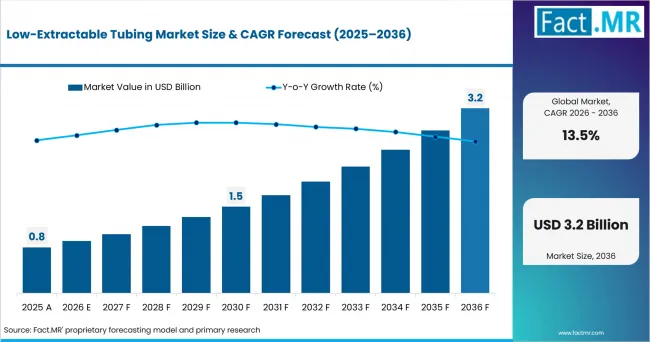
Low Extractable Tubing Market Market Value Analysis | Source: Fact.MR
What are the defining numbers behind low-extractable tubing growth?
USD 2.3 billion absolute opportunity by 2036 led by the United States and Germany.
- Demand Drivers in the Market
- Biologics production continues expanding worldwide.
- Single-use bioprocessing adoption is increasing.
- Cell therapy manufacturing requires high-purity tubing.
- Regulatory standards continue supporting low-extractable materials.
- Key Segments Analyzed
- By Material: Platinum-Cured Silicone is expected to hold 36.0% share in 2026 because it offers excellent purity and flexibility.
- By Compliance: USP Class VI is projected to account for 33.0% share in 2026 because it remains the preferred qualification standard.
- By Application: Media Transfer is expected to hold 29.0% share in 2026 because it is used throughout bioprocess operations.
- By End User: Biopharma Manufacturers are projected to account for 38.0% share in 2026 because they consume large volumes of single-use tubing.
- By Geography: The United States is projected to record 14.2% CAGR through 2036.
- Analyst Opinion at Fact.MR
- Shambhu Nath Jha, Senior Analyst at Fact.MR, states, "Low-extractable tubing has become essential for modern biopharmaceutical production. Manufacturers continue investing in tubing that supports product purity and regulatory compliance."
- Strategic Implications
- Expand production of high-purity tubing materials.
- Develop tubing compatible with automated single-use systems.
- Strengthen partnerships with CDMOs and vaccine manufacturers.
- Invest in tubing that supports advanced biologics manufacturing.
The United States is projected to record 14.2% CAGR through 2036 due to expanding biologics manufacturing. Germany is expected to grow at 13.8% CAGR because of strong pharmaceutical production. China is forecast to expand at 13.5% CAGR as biopharmaceutical capacity increases. South Korea is projected to register 13.1% CAGR through 2036 due to investment in biologics manufacturing. India is expected to grow at 12.8% CAGR through rising vaccine production and CDMO expansion.
How does the low-extractable tubing market break down by segment?
Platinum-Cured Silicone leads at 36.0%. Biopharma Manufacturers lead at 38.0%.
Which material dominates?
Platinum-Cured Silicone holds 36.0% share in 2026.
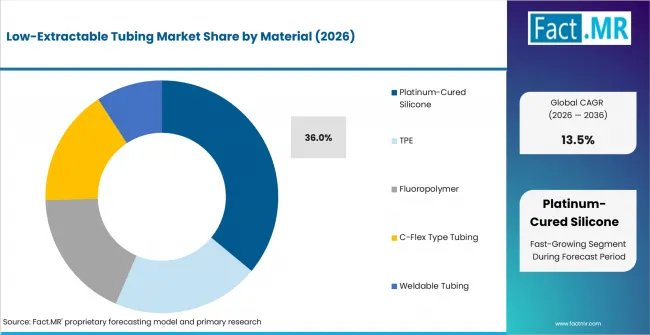
Low Extractable Tubing Market Analysis By Material | Source: Fact.MR
Platinum-cured silicone leads because it offers excellent purity and flexibility. It maintains stable performance during repeated sterilization cycles. Biopharma manufacturers prefer this material because it minimizes extractables. It also supports critical fluid transfer processes. Demand remains strong across biologics manufacturing and vaccine production. DuPont introduced Liveo™ Pharma TPE Overmolded Assemblies, a new solution designed for pharmaceutical and biopharmaceutical fluid-transfer applications. The assemblies integrate Liveo Pharma TPE tubing with molded connectors to create ready-to-use fluid paths for single-use bioprocessing systems. [1]
Which compliance standard dominates?
USP Class VI leads with 33.0% share in 2026.
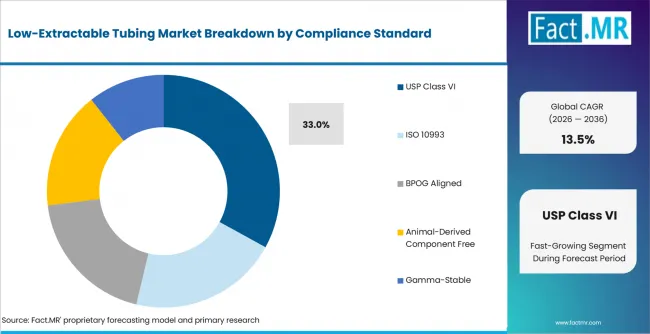
Low Extractable Tubing Market Analysis By Compliance Standard | Source: Fact.MR
USP Class VI leads because it is widely accepted for pharmaceutical manufacturing. It demonstrates material safety for critical bioprocess applications. Manufacturers continue selecting certified tubing to simplify regulatory approval.
Compliance also improves confidence during product validation. Demand remains high across commercial manufacturing facilities. AdvantaPure announced the launch of EcoFlex™, a new thermoplastic elastomer (TPE) tubing product designed for biopharmaceutical and pharmaceutical manufacturing applications. The tubing is intended for single-use systems, overmolded assemblies, and fluid-transfer operations in regulated environments. AdvantaPure stated that the product includes a comprehensive validation package for pharmaceutical and biopharmaceutical use and is designed for high-purity processing applications. [2]
Which application dominates?
Media Transfer holds 29.0% share in 2026.
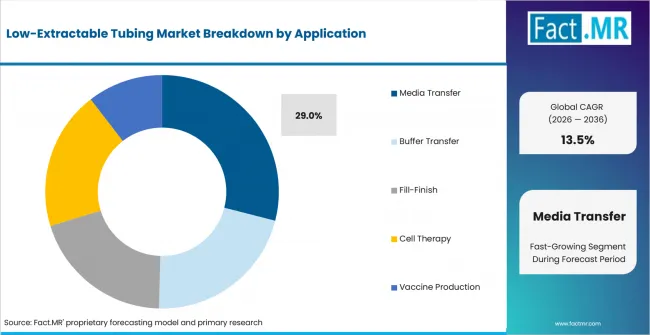
Low Extractable Tubing Market Analysis By Application | Source: Fact.MR
Media transfer leads because it is required throughout upstream bioprocessing. Reliable tubing helps maintain sterile operating conditions. Manufacturers require consistent fluid movement during production. High-purity tubing reduces contamination risk and improves process reliability. Biologics production continues supporting segment growth. Saint-Gobain Life Sciences launched Sani-Tech® STHT®-LT, a platinum-cured silicone tubing designed for cold-temperature applications. The tubing maintains flexibility and pumpability in cold-storage and frozen-process environments while meeting the purity and performance requirements of pharmaceutical fluid-transfer systems. [3]
Which end user dominates?
Biopharma Manufacturers account for 38.0% share in 2026.
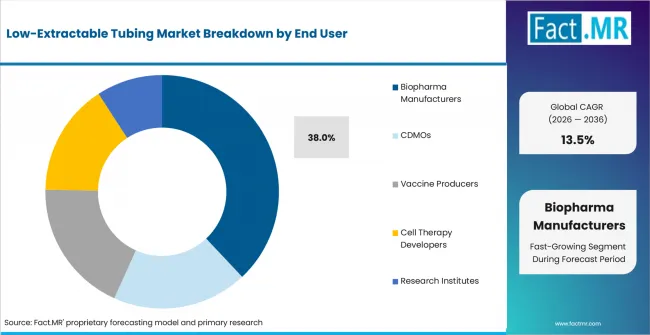
Low Extractable Tubing Market Analysis By End User | Source: Fact.MR
Biopharma manufacturers remain the largest users because they operate large single-use production systems. Tubing is required throughout manufacturing operations. Companies continue expanding biologics capacity to meet growing demand. This increases consumption of high-performance tubing products. Large commercial facilities remain the primary buyers.
What is accelerating low-extractable tubing demand and what is holding it back?
Single-use bioprocessing drives demand while premium material costs restrain adoption.
The main growth driver is expanding biologics production. Pharmaceutical companies continue increasing investment in single-use manufacturing systems. Cell therapy and vaccine production also require high-purity fluid transfer products. Regulatory standards continue supporting adoption of certified tubing materials. Demand is increasing across both commercial production and clinical manufacturing.
The main restraint is higher material cost. Premium tubing materials cost more than conventional industrial tubing. Qualification and validation also require additional time. Smaller manufacturers may delay adoption because of budget limitations. Freudenberg Medical announced the PharmaFocus® Premium ASTC UV-Shield Tubing, a new tubing solution designed specifically for photosensitive pharmaceutical fluids. The tubing features a platinum-cured silicone inner layer and an opaque outer layer to protect light-sensitive drugs and biologics during fluid transfer and processing. [4]
Where do the biggest low-extractable tubing opportunities sit?
- Biologics Manufacturing:Biologics producers continue increasing single-use production capacity across global facilities.
- Cell Therapy:Cell therapy developers require contamination-free tubing throughout manufacturing operations.
- Vaccine Production:Vaccine manufacturers continue expanding sterile fluid transfer infrastructure.
- CDMO Expansion:Contract manufacturers are investing in advanced single-use processing systems.
Which countries are scaling low-extractable tubing adoption fastest?
United States 14.2%, Germany 13.8%, China 13.5%, South Korea 13.1%, India 12.8%.
Based on regional analysis, the low-extractable tubing market is segmented into North America, Western Europe, Asia Pacific, Latin America, and Middle East and Africa.
| Country | CAGR (2026-2036) |
|---|---|
| United States | 14.2% |
| Germany | 13.8% |
| China | 13.5% |
| South Korea | 13.1% |
| India | 12.8% |
Source: Fact.MR analysis. Updated Jun 26, 2026
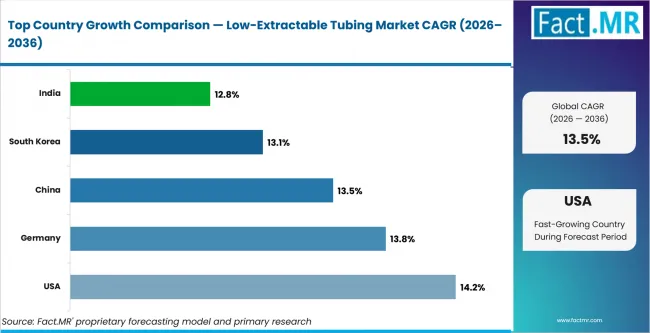
Low Extractable Tubing Market Cagr Analysis By Country | Source: Fact.MR
Why is the United States leading the low-extractable tubing market?
14.2% CAGR, supported by biologics manufacturing
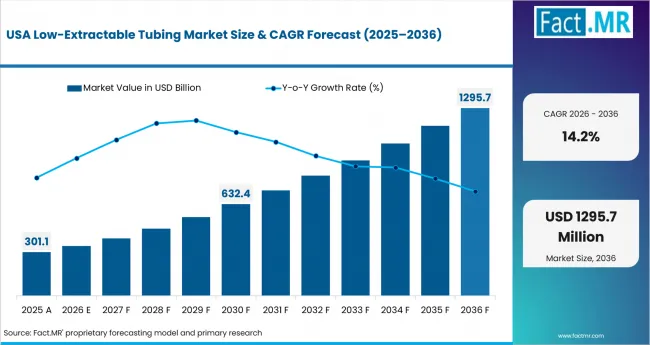
Low Extractable Tubing Market Country Value Analysis | Source: Fact.MR
The United States is projected to record 14.2% CAGR through 2036 because biologics production continues expanding. Pharmaceutical companies are investing in advanced single-use manufacturing systems. Cell therapy developers are increasing manufacturing capacity. Vaccine producers are also adopting high-purity fluid transfer systems. The country leads demand for bioprocess equipment.
What is driving growth in Germany?
13.8% CAGR, driven by pharmaceutical manufacturing
Germany is expected to post 13.8% CAGR through 2036 because pharmaceutical production continues growing. Manufacturers are upgrading facilities with validated single-use technologies. Biopharma companies require tubing that meets strict quality standards. Demand is also supported by expanding CDMO operations. The country remains a leading European manufacturing hub.
How is China expanding adoption?
13.5% CAGR, supported by biotechnology investment
China is forecast to advance at 13.5% CAGR by 2036 because investment in biotechnology continues increasing. Companies are expanding biologics manufacturing facilities across the country. Demand for sterile fluid transfer systems is rising. Production of biosimilars and vaccines is also supporting market growth. Laboratory expansion continues creating new opportunities.
Why is South Korea becoming a strong market?
13.1% CAGR, backed by biologics production
South Korea is projected to register 13.1% CAGR through 2036 because biologics manufacturing capacity continues expanding. Companies are investing in advanced bioprocess technologies. Cell therapy production is creating additional demand. Modern manufacturing facilities continue adopting single-use processing systems. The country remains a key supplier of biologic medicines.
What supports market growth in India?
12.8% CAGR, driven by vaccine manufacturing
India is expected to grow at 12.8% CAGR by 2036 because vaccine production continues expanding. Pharmaceutical exports are also increasing across regulated markets. CDMOs are investing in modern production facilities. High-purity tubing is becoming essential for validated manufacturing operations. Government support for biotechnology also contributes to market growth.
Who leads the low-extractable tubing landscape?
Saint-Gobain, DuPont, Trelleborg, Freudenberg Medical and Watson-Marlow lead through material expertise and bioprocess manufacturing capabilities.
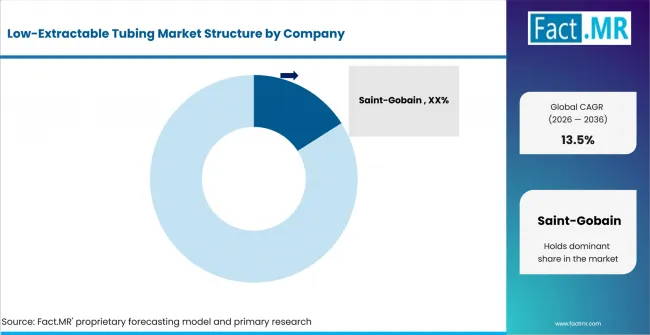
Low Extractable Tubing Market Analysis By Company | Source: Fact.MR
The market is characterized by competition focused on product purity and process reliability. Companies continue improving tubing materials for critical pharmaceutical applications.
Biopharma manufacturers remain the largest customer group. CDMOs are also increasing purchases as biologics production expands.
Regulatory compliance has become a major purchasing factor. Manufacturers prefer tubing that meets global quality standards and supports validation activities.
Saint-Gobain and Watson-Marlow maintain strong positions through broad single-use portfolios. DuPont, Trelleborg, Freudenberg Medical, AdvantaPure, Meissner and RAUMEDIC continue expanding high-purity tubing solutions.
Competition through 2036 will depend on material performance and regulatory compliance. Companies offering lower extractables and reliable supply are expected to strengthen their market position.
Which companies are the key players?
Saint-Gobain, DuPont, Trelleborg, Freudenberg Medical, Watson-Marlow
- Saint-Gobain
- DuPont
- Trelleborg
- Freudenberg Medical
- Watson-Marlow
- AdvantaPure
- Meissner
- RAUMEDIC
Bibliography
- [1] DuPont. (2026, April 21). DuPont launches Liveo™ Pharma TPE Overmolded Assemblies for pharma and biopharma applications. DuPont.
- [2] AdvantaPure. (2026, February 24). AdvantaPure launches sustainable tubing product with regional distributors Carolina Components Group at ISPE CASA. AdvantaPure.
- [3] Saint-Gobain Life Sciences. (2026, January 19). Saint-Gobain Life Sciences introduces Sani-Tech® STHT®-LT silicone tubing designed for cold-temperature applications. Saint-Gobain Life Sciences.
- [4] Freudenberg Medical. (2024, November 26). Freudenberg strengthens commitment to India with new product launches at CPhI & PMEC 2024. PR Newswire.
This Report Addresses
- Strategic intelligence on low-extractable tubing technologies.
- Segment analysis covering materials and compliance standards.
- Assessment of applications and end-user demand.
- Regional outlook covering the United States and Germany.
- Analysis of China, South Korea, and India.
- Competitive assessment of leading tubing manufacturers.
- Evaluation of single-use bioprocessing trends.
- Analysis of biologics and vaccine manufacturing demand.
- Primary interviews and supplier benchmarking.
- Assessment of opportunities across high-purity fluid transfer applications.
What does the low-extractable tubing market cover?
High-purity tubing used for pharmaceutical and bioprocess fluid transfer.
The market covers tubing products designed to minimize extractables and leachables during pharmaceutical manufacturing. Products are used across upstream and downstream bioprocess operations.
What is included in the scope?
Single-use tubing systems for critical pharmaceutical applications.
The scope includes platinum-cured silicone tubing, TPE tubing, fluoropolymer tubing, C-Flex type tubing and weldable tubing.
What is excluded from the scope?
General industrial tubing and non-pharmaceutical fluid transfer products.
The scope excludes standard PVC tubing, commodity rubber tubing, and tubing designed for non-pharmaceutical industrial processing applications.
How was the analysis built?
100+ sources, 30+ company assessments, 25+ countries and industry interviews.
- Primary Research: Interviews with bioprocess engineers and tubing manufacturers.
- Desk Research: Analysis of biologics production and regulatory standards.
- Market Sizing and Forecasting: Estimates based on bioprocess capacity and tubing consumption.
- Data Validation and Update Cycle: Forecasts validated through supplier benchmarking and industry interviews.
Segmentation
What is the report's scope and coverage?
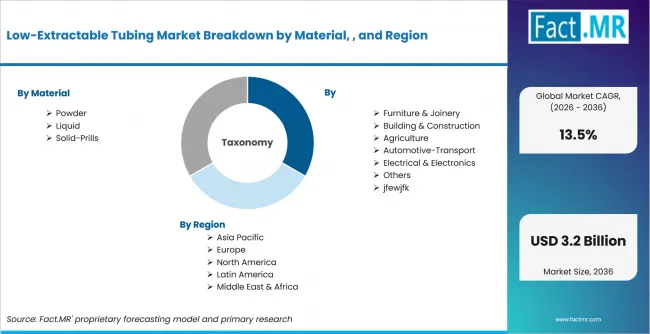
Low Extractable Tubing Market Breakdown By Material, , And Region | Source: Fact.MR
| Attribute | Details |
|---|---|
| Quantitative Units | USD Billion in 2026 to USD Billion by 2036 |
| Market Definition | High-purity tubing designed for sterile fluid transfer in biopharmaceutical manufacturing |
| Materials Covered | Platinum-Cured Silicone, TPE, Fluoropolymer, C-Flex Type Tubing, Weldable Tubing |
| Compliance Covered | USP Class VI, ISO 10993, BPOG Aligned, Animal-Derived Component Free, Gamma-Stable |
| Applications Covered | Media Transfer, Buffer Transfer, Fill-Finish, Cell Therapy, Vaccine Production |
| End Users Covered | Biopharma Manufacturers, CDMOs, Vaccine Producers, Cell Therapy Developers, Research Institutes |
| Regions Covered | North America, Western Europe, Asia Pacific, Latin America, Middle East & Africa |
| Key Countries Covered | United States, Germany, China, South Korea, India |
| Companies Covered | Saint-Gobain, DuPont, Trelleborg, Freudenberg Medical, Watson-Marlow, AdvantaPure, Meissner, RAUMEDIC |
| Forecast Period | 2026 to 2036 |
| Research Approach | Hybrid top-down and bottom-up methodology using bioprocess capacity, single-use adoption and pharmaceutical production analysis |
Source: Fact.MR analysis. Updated Jun 26, 2026
How is the market segmented?
-
By Material:
- Platinum-Cured Silicone
- TPE
- Fluoropolymer
- C-Flex Type Tubing
- Weldable Tubing
-
By Compliance:
- USP Class VI
- ISO 10993
- BPOG Aligned
- Animal-Derived Component Free
- Gamma-Stable
-
By Application:
- Media Transfer
- Buffer Transfer
- Fill-Finish
- Cell Therapy
- Vaccine Production
-
By End User:
- Biopharma Manufacturers
- CDMOs
- Vaccine Producers
- Cell Therapy Developers
- Research Institutes
-
Region:
- North America
- United States
- Canada
- Europe
- Germany
- United Kingdom
- France
- Italy
- Spain
- Asia Pacific
- China
- Japan
- South Korea
- India
- Singapore
- Latin America
- Brazil
- Mexico
- Argentina
- Middle East & Africa
- GCC Countries
- South Africa
- Israel
- North America
Frequently Asked Questions
Which material leads the market?
Which compliance standard accounts for the largest share?
What is driving demand for low-extractable tubing?
Which country is growing the fastest?
What is the primary challenge facing the market?
Which end user accounts for the largest share?
What opportunities exist for suppliers?
Why are manufacturers adopting low-extractable tubing?
Which application generates the highest demand?
Why is platinum-cured silicone widely adopted?
Who worked on this report


Preview the report firsthand - request a free sample
Free SampleGet the brochure for pricing and purchase details
Download PDF