- Base Value(2025): 1.79 Bn
- Estimated Value(2026): 1.95 Bn
- Forecast Value (2036): 3.84 Bn
- CAGR (2026 - 2036): 7.0%
Ovarian Cancer Diagnostics Market Size, Market Forecast and Outlook By FACT.MR
The ovarian cancer diagnostics market was valued at USD 1.79 billion in 2025, projected to reach USD 1.95 billion in 2026, and is forecast to expand to USD 3.84 billion by 2036 at a 7.0% CAGR. Epithelial Tumor Diagnostics leads by Tumor Type with 66.0% share in 2026, while CA 125 Test dominates the Test Type segment with 35.0% share.
The absolute dollar growth of USD 1.89 billion over the 2026 to 2036 forecast period reflects sustained structural demand expansion. FACT.MR analysts identify India and USA as priority growth markets, driven by Ayushman Bharat PM-JAY expansion covering gynaecological oncology diagnostics and national cancer screening programme rollout and CMS reimbursement for BRCA germline testing and FDA companion diagnostic approvals for PARP inhibitor therapy selection respectively.
Key national markets advance at differentiated rates. India is projected at a 8.2% CAGR, supported by Ayushman Bharat PM-JAY expansion covering gynaecological oncology diagnostics and national cancer screening programme rollout. USA is projected at a 6.6% CAGR, supported by CMS reimbursement for BRCA germline testing and FDA companion diagnostic approvals for PARP inhibitor therapy selection. Germany is projected at a 6.3% CAGR, supported by EU IVDR compliance-driven laboratory upgrades and DKG-certified cancer centre molecular testing mandates. Japan is projected at a 5.9% CAGR, supported by National Cancer Centre Japan BRCA testing reimbursement expansion and population-based ovarian cancer screening pilot programmes.
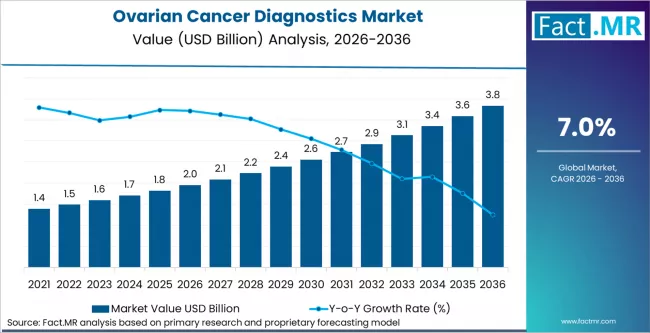
Ovarian Cancer Diagnostics Market Market Value Analysis | Source: Fact.MR
Ovarian Cancer Diagnostics Market Key Takeaways
| Metric | Details |
|---|---|
| Industry Size (2026) | USD 1.95 billion |
| Industry Value (2036) | USD 3.84 billion |
| CAGR (2026-2036) | 7.0% |
Source: Fact.MR analysis. Updated Mar 12, 2026
Ovarian Cancer Diagnostics Market Definition
The Ovarian Cancer Diagnostics encompasses all commercially distributed products, systems, and services within this category, spanning primary production through end-use application across global supply chains. The report scope covers all commercially distributed formats compliant with applicable regional product standards and regulatory frameworks.
Market Inclusions
The report covers global and regional market sizing across 3 Tumor Type segments and 7 Test Type categories from 2026 to 2036. Segment-level revenue forecasts, country-level growth trajectories for 40-plus nations, and competitive positioning analysis for key market participants are included.
Market Exclusions
Downstream finished goods and applications not directly attributable to the primary ovarian cancer diagnostics category are excluded. Adjacent and substitute markets, experimental technologies without validated revenue, and private-label volumes without publicly verifiable revenue data are omitted from the forecast model.
Research Methodology
- Primary Research: FACT.MR analysts conducted structured interviews with clinical procurement leads, product managers, reimbursement specialists, and regional distributors across 40 countries to validate adoption timelines, pricing structures, and competitive dynamics.
- Desk Research: Secondary data encompassed regulatory agency publications, international standards documentation, national statistical trade data, and company primary disclosures including annual reports and earnings call transcripts.
- Market-Sizing and Forecasting: Forecasts apply a hybrid bottom-up and top-down methodology, building segment-level revenue estimates from installed base and penetration rate inputs, then cross-validating against macroeconomic and category growth frameworks.
- Data Validation and Update Cycle: Outputs are cross-validated against quarterly financial disclosures from leading participants and benchmarked against government trade flow and reimbursement data. Forecasts are subject to annual update cycles.
Summary of Ovarian Cancer Diagnostics Market
- Market Definition
- Ovarian Cancer Diagnostics covers all commercially distributed products and services within this category, segmented by Tumor Type, Test Type, application type, and geography across the 2026 to 2036 forecast window.
- Demand Drivers in the Market
- Regulatory compliance and clinical guideline mandates are converting discretionary purchasing decisions into non-negotiable procurement requirements, compressing sales cycles and reducing price sensitivity among compliant institutional buyers.
- Rising clinical and consumer expectations for diagnostic accuracy, therapeutic efficacy, and verified safety credentials are shifting purchasing toward premium-positioned products, expanding average revenue per unit across all channels.
- Healthcare infrastructure investment and reimbursement system formalisation in India and USA are expanding the accessible buyer base while improving overall market economics for established suppliers.
- Key Segments Analyzed in the FACT.MR Report
- Tumor Type: Epithelial Tumor Diagnostics leads with 66.0% share in 2026, driven by its prevalence, clinical guidelines backing, and established reimbursement pathways.
- Test Type: CA 125 Test commands 35.0% of demand in 2026, anchored by its alignment with the most active clinical intervention and testing protocols.
- Geography: India registers the highest national CAGR at 8.2%, driven by Ayushman Bharat PM-JAY expansion covering gynaecological oncology diagnostics and national cancer screening programme rollout.
- Analyst Opinion at FACT.MR
- FACT.MR analysts observe that the ovarian cancer diagnostics market is entering a consolidation phase where regulatory certification, clinical evidence depth, and reimbursement status are replacing price as the primary supplier qualification criteria. Buyers are shortlisting vendors based on guideline compliance, payer coverage status, and outcomes data. Suppliers without these credentials face progressive exclusion from Tier 1 institutional procurement cycles.
- Strategic Implications / Executive Takeaways
- Suppliers must secure regulatory clearance and reimbursement coverage across priority markets at least 18 months before planned commercial launch to qualify for institutional procurement shortlists.
- Investment in clinical evidence generation through prospective studies and real-world data programmes will become a primary competitive differentiator as payers demand outcome-based justification for coverage decisions.
- Market development in India and USA should be prioritised, as these markets combine the highest projected growth rates with improving reimbursement infrastructure that lower risk-adjusted entry cost.
Ovarian Cancer Diagnostics Market Drivers, Restraints, and Opportunities
FACT.MR analysis identifies three structural forces shaping the ovarian cancer diagnostics market through 2036: regulatory and clinical guideline-driven adoption requirements, technology and platform transitions, and geographic demand redistribution toward high-growth emerging markets.
The primary restraint is reimbursement coverage complexity across jurisdictions. Suppliers targeting five or more national markets face distinct health technology assessment and coverage determination processes that impose time and cost burdens small participants cannot sustain without dedicated market access infrastructure.
- Regulatory and Guideline-Driven Adoption: Mandatory clinical practice guideline updates in the EU, USA, and Japan are converting previously discretionary testing and treatment decisions into standard-of-care protocols, sustaining baseline demand growth independent of economic cycle conditions.
- Geographic Market Formalisation: India and USA are advancing reimbursement and regulatory infrastructure at rates that compress the typical emerging market adoption lag, creating accessible commercial markets on compressed timelines compared with historical precedent.
- Technology Platform Transition: The transition from analogue and single-marker platforms to digital, multi-analyte, and AI-assisted systems is expanding per-unit revenue and creating replacement cycles in established markets that sustain demand beyond baseline incidence-driven growth.
What are the Different Types of Ovarian Cancer Diagnostic Imaging Techniques?
Imaging diagnostics play a vital role in ovarian cancer diagnosis and treatment as they allow professionals to explore the extent to which the tumors have spread. Some of the techniques are:
- Ultrasound for Ovarian Cancer Diagnostics
- PET Scan for Ovarian Cancer Diagnostics
- CT Scan for Ovarian Cancer Diagnostics
Demand for CT scan in ovarian cancer diagnostics is expected to increase over the next ten years due to its ability to provide insights on spread of tumor. The demand for PET scan in ovarian cancer diagnostics is expected to be moderate as it is not as commonly used.
What Does the Survey Say About Different Cancer Tests?
Due to the prevalence of different types of cancers and different nature of tumors there are a wide array of tests that can be employed to detect cancer.
Demand for CA 125 test in ovarian cancer diagnostics and HER 2 test is expected to be prominent over the forecast period in comparison to other tests. The sales of HER 2 test for ovarian cancer diagnostics are expected to see a modest growth as other tests gain popularity.
Epithelial tumors are most prominent in ovarian cancer and account for majority of instances hence demand for epithelial tumor diagnostics is substantially higher than the demand for germ cell carcinoma tumor diagnostics and stromal carcinoma tumor diagnostics demand combined.
Which Establishments are Essential for Ovarian Cancer Diagnostics?
Various healthcare establishments utilize ovarian cancer diagnostics for treatments to research. The most prominent are testing laboratories associated with hospitals and research centers.
Demand for ovarian cancer diagnostics in hospital associated labs is expected to be most prominent and predicted to increase as the instances of ovarian cancer rise. The demand for ovarian cancer diagnostics in independent diagnostic laboratories is anticipated to see a major rise as the affordability of equipment and instruments is realized. Independent diagnostic laboratories are increasing in number especially in emerging economies where the healthcare infrastructure is improving.
Demand for ovarian cancer diagnostics in cancer research institutes is expected to see a steady increase as demand for research increases. The demand for ovarian cancer diagnosis instruments is also expected to see a rise as research and developments in the industry progress.
Which Regions are Lucrative Markets for Ovarian Cancer Diagnostics?
This research details the global ovarian cancer diagnostics industry landscape in regions like North America, Latin America, Europe, APAC, and MEA.
North American region is estimated to hold a dominant stake in the global ovarian cancer diagnostics market share. The demand for BRCA test in ovarian cancer diagnostics is anticipated to rise at a positive CAGR of nearly 8% in the region. Europe is expected to account for a modest amount of market share in the global ovarian cancer diagnostics industry.
Demand for ovarian cancer diagnostics in APAC region is predicted to evolve at the fastest CAGR. The growth will majorly be driven by nations like India and China. The lack of awareness about the symptoms and treatments is a major factor that restricts the growth in APAC region.
The MEA region is expected to see relatively slower adoption of ovarian cancer diagnostics owing to the slow adoption of new diagnostic methods and limited healthcare spending potential.
Regional Analysis
As per FACT.MR, the Ovarian Cancer Diagnostics Market is analysed across North America, Latin America, Europe, East Asia, South Asia, Oceania, and Middle East & Africa. The full report provides market attractiveness scores and investment-readiness assessments for each region.
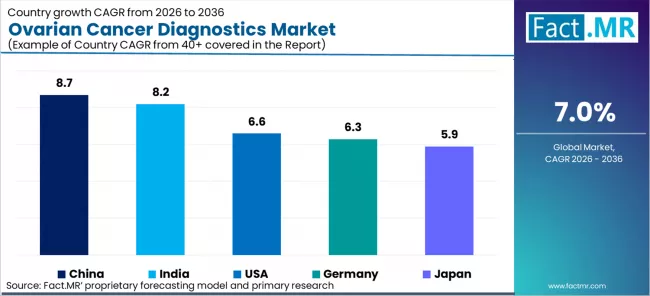
Ovarian Cancer Diagnostics Market Cagr Analysis By Country | Source: Fact.MR
| Country | CAGR (2026 to 2036) |
|---|---|
| India | 8.2% |
| USA | 6.6% |
| Germany | 6.3% |
| Japan | 5.9% |
Source: Fact.MR analysis. Updated Mar 12, 2026
Source: FACT.MR analysis, based on proprietary forecasting model and primary research
India
Demand for ovarian cancer diagnostics in India is projected to rise at a 8.2% CAGR through 2036, driven by Ayushman Bharat PM-JAY expansion covering gynaecological oncology diagnostics and national cancer screening programme rollout. Institutional procurement frameworks in India are advancing toward standardised clinical and regulatory specification requirements aligned with international guidelines, reducing qualification barriers for compliant suppliers while raising minimum standards for market participation. FACT.MR analysts note that the convergence of reimbursement formalisation and healthcare infrastructure investment in India positions this market for sustained, predictable expansion rather than the demand volatility associated with markets earlier in their development cycle.
USA
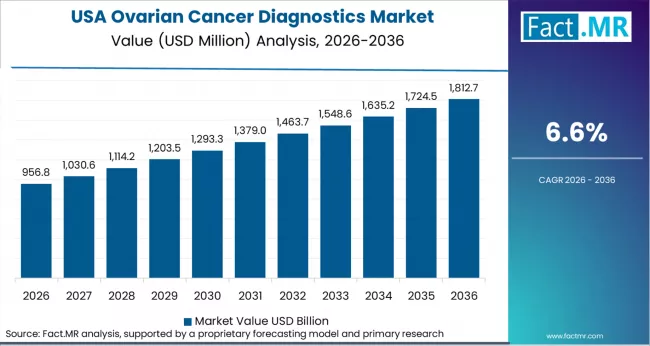
Ovarian Cancer Diagnostics Market Country Value Analysis | Source: Fact.MR
Demand for ovarian cancer diagnostics in USA is projected to rise at a 6.6% CAGR through 2036, driven by CMS reimbursement for BRCA germline testing and FDA companion diagnostic approvals for PARP inhibitor therapy selection. Institutional procurement frameworks in USA are advancing toward standardised clinical and regulatory specification requirements aligned with international guidelines, reducing qualification barriers for compliant suppliers while raising minimum standards for market participation. FACT.MR analysts note that the convergence of reimbursement formalisation and healthcare infrastructure investment in USA positions this market for sustained, predictable expansion rather than the demand volatility associated with markets earlier in their development cycle.
Germany
Demand for ovarian cancer diagnostics in Germany is projected to rise at a 6.3% CAGR through 2036, driven by EU IVDR compliance-driven laboratory upgrades and DKG-certified cancer centre molecular testing mandates. Institutional procurement frameworks in Germany are advancing toward standardised clinical and regulatory specification requirements aligned with international guidelines, reducing qualification barriers for compliant suppliers while raising minimum standards for market participation. FACT.MR analysts note that the convergence of reimbursement formalisation and healthcare infrastructure investment in Germany positions this market for sustained, predictable expansion rather than the demand volatility associated with markets earlier in their development cycle.
Japan
Demand for ovarian cancer diagnostics in Japan is projected to rise at a 5.9% CAGR through 2036, driven by National Cancer Centre Japan BRCA testing reimbursement expansion and population-based ovarian cancer screening pilot programmes. Institutional procurement frameworks in Japan are advancing toward standardised clinical and regulatory specification requirements aligned with international guidelines, reducing qualification barriers for compliant suppliers while raising minimum standards for market participation. FACT.MR analysts note that the convergence of reimbursement formalisation and healthcare infrastructure investment in Japan positions this market for sustained, predictable expansion rather than the demand volatility associated with markets earlier in their development cycle.
Category-wise Analysis
Ovarian Cancer Diagnostics Market Analysis by Tumor Type
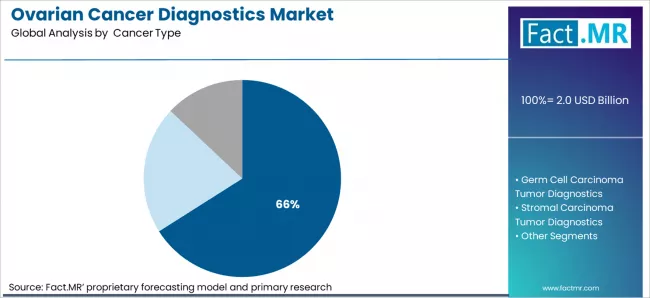
Ovarian Cancer Diagnostics Market Analysis By Cancer Type | Source: Fact.MR
Based on FACT.MR analysis, Epithelial Tumor Diagnostics account for 66.0% of ovarian cancer diagnostics market revenue in 2026. Epithelial ovarian cancers represent approximately 90% of all ovarian malignancies, generating the highest volume of diagnostic testing across all modality types. Serous high-grade carcinoma, the most common epithelial subtype, requires BRCA1/2 germline and somatic testing as a standard of care to guide PARP inhibitor therapy selection, expanding the biomarker testing panel per patient.
- PARP Inhibitor Companion Diagnostics: AstraZeneca's olaparib (Lynparza) and GSK's niraparib approval for BRCA-mutated ovarian cancer maintenance therapy created mandatory companion diagnostic testing requirements, directly linking epithelial ovarian cancer diagnosis with molecular biomarker testing volume.
- BRCA Population Testing Expansion: The National Comprehensive Cancer Network updated its 2024 ovarian cancer guidelines to recommend germline BRCA testing for all women diagnosed with epithelial ovarian cancer, regardless of family history, expanding the testable patient population beyond high-risk subgroups.
- Liquid Biopsy Monitoring: The FDA granted breakthrough device designation to ctDNA-based ovarian cancer monitoring assays in 2024, enabling non-invasive disease recurrence surveillance that generates repeat testing episodes throughout the post-treatment surveillance period.
Ovarian Cancer Diagnostics Market Analysis by Test Type
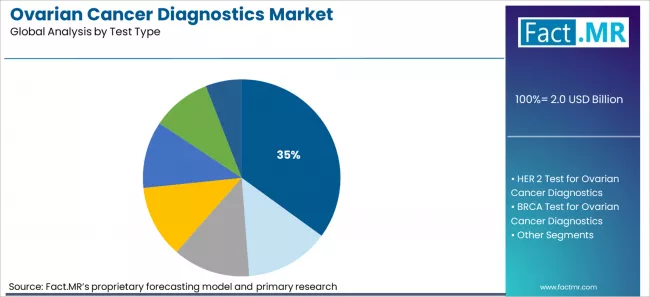
Ovarian Cancer Diagnostics Market Analysis By Test Type | Source: Fact.MR
CA 125 testing holds 35.0% of ovarian cancer test-type revenue in 2026. As the longest-established serum biomarker for ovarian cancer monitoring, CA 125 retains its dominant position for post-treatment surveillance and recurrence detection across established healthcare markets, despite its known limitations in early-stage detection specificity. Multi-marker panel integration combining CA 125 with HE4 (ROMA algorithm) is expanding the clinical utility of CA 125 in risk stratification.
- ROMA Algorithm Adoption: The FDA-cleared Risk of Ovarian Malignancy Algorithm combining CA 125 and HE4 measurements improved specificity for distinguishing benign from malignant pelvic masses, expanding the clinical indication for CA 125 testing beyond post-treatment monitoring into pre-surgical assessment.
- BRCA Test Growth Trajectory: Roche's cobas BRCA Mutation Test and Thermo Fisher's Ion Torrent-based BRCA assays are expanding institutional testing capacity for ovarian cancer BRCA analysis, reflecting the mandatory companion diagnostic designation tied to approved PARP inhibitor therapies.
- Multianalyte Liquid Biopsy: Guardant Health's 2024 annual report disclosed clinical validation data for multi-analyte ctDNA panels covering ovarian cancer recurrence biomarkers, positioning next-generation liquid biopsy as the successor to CA 125-only monitoring protocols.
Competitive Aligners for Market Players
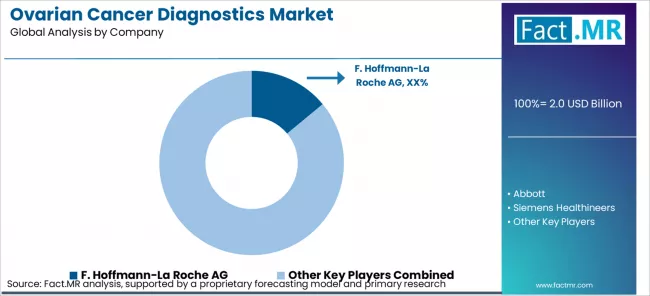
Ovarian Cancer Diagnostics Market Analysis By Company | Source: Fact.MR
The competitive landscape for the ovarian cancer diagnostics market is consolidating around suppliers with integrated product portfolios, demonstrated regulatory compliance, established reimbursement status, and clinical evidence depth across multiple geographies. Market concentration is increasing as major institutional buyers apply vendor rationalisation strategies that reduce supply chain complexity at the cost of supplier diversity.
Regulatory clearance and reimbursement coverage are transitioning from competitive differentiators to baseline qualification requirements. Suppliers without active reimbursement coverage in their target markets face exclusion from formulary and preferred vendor programmes regardless of product quality, creating significant barriers to late market entry and sustaining incumbent supplier positions.
Clinical evidence generation is becoming a continuous competitive obligation rather than a one-time regulatory requirement. Leading suppliers maintain rolling real-world evidence programmes and post-market clinical follow-up studies that generate the outcomes data payers require for coverage renewal and guideline committee endorsement.
Key Players in Ovarian Cancer Diagnostics Market
- F. Hoffmann-La Roche AG
- Abbott Laboratories
- Siemens Healthineers AG
- Thermo Fisher Scientific Inc.
- Johnson & Johnson
- GlaxoSmithKline plc
- AstraZeneca plc
- Bio-Rad Laboratories Inc.
- Quest Diagnostics Inc.
- Illumina Inc.
Bibliography
- National Comprehensive Cancer Network. (2024). NCCN clinical practice guidelines in oncology: Ovarian cancer including fallopian tube cancer and primary peritoneal cancer. NCCN.
- European Medicines Agency. (2024). Assessment reports: PARP inhibitor companion diagnostic requirements for ovarian cancer indications. EMA.
- United States Food and Drug Administration. (2024). Companion diagnostics: Approved devices and indications for ovarian cancer. U.S. FDA.
- World Health Organization / IARC. (2024). Global cancer observatory: Ovarian cancer incidence and mortality 2024. IARC.
- National Cancer Institute. (2024). Cancer statistics: Ovarian cancer incidence, survival, and mortality data. NCI SEER.
- Guardant Health Inc. (2024). Annual report 2023: Liquid biopsy clinical validation and pipeline disclosure. Guardant Health.
This Report Addresses
- Market sizing and quantitative forecast metrics for the ovarian cancer diagnostics from 2026 to 2036, including base-year valuations, segment-level revenues, and CAGR by tumor type, test type, and region.
- Segmentation analysis mapping adoption velocity and revenue concentration across Tumor Type and Test Type categories with share and growth rate breakdowns.
- Regional deployment intelligence comparing growth trajectories across North America, Europe, East Asia, and South Asia with country-level CAGR data for 4 priority markets.
- Regulatory and reimbursement compliance assessment analysing how national and regional policy frameworks are shaping product qualification requirements and procurement timelines.
- Competitive landscape evaluation covering market structure, leading supplier positioning, clinical evidence requirements, and the strategic implications of ongoing market consolidation.
- Strategic investment guidance identifying regulatory clearance timelines, reimbursement pathways, and distribution infrastructure requirements for new and expanding market participants.
- Clinical evidence and outcomes data analysis identifying the study designs and real-world data sources that support coverage decisions and guideline endorsement in priority markets.
- Custom data delivery formats including interactive dashboards, raw Excel datasets, and comprehensive PDF narrative reports with primary research documentation.
Segmentation
Scope of the Report
| Metric | Value |
|---|---|
| Quantitative Units | USD 1.95 billion to USD 3.84 billion, at a CAGR of 7.0% |
| Market Definition | Ovarian Cancer Diagnostics encompasses all commercially distributed products and services within this category across defined clinical applications and geographic markets. |
| Tumor Type Segmentation | Epithelial Tumor Diagnostics, Germ Cell Carcinoma Tumor Diagnostics, Stromal Carcinoma Tumor Diagnostics |
| Test Type Segmentation | CA 125 Test, HER2 Test, BRCA Test, CEA Test, ER & PR Test, KRAS Mutation Test, Others |
| Application Segmentation | Hospital Laboratories, Reference Laboratories, Diagnostic Imaging Centers, Research & Academic Institutes |
| Regions Covered | North America, Latin America, Europe, East Asia, South Asia, Oceania, Middle East & Africa |
| Countries Covered | India, USA, Germany, Japan, and 40 plus countries |
| Key Companies Profiled | F. Hoffmann-La Roche AG, Abbott Laboratories, Siemens Healthineers AG, Thermo Fisher Scientific Inc., Johnson & Johnson, GlaxoSmithKline plc, AstraZeneca plc, Bio-Rad Laboratories Inc., Quest Diagnostics Inc., Illumina Inc. |
| Forecast Period | 2026 to 2036 |
| Approach | Hybrid bottom-up and top-down forecasting with primary research and reimbursement data validation |
Source: Fact.MR analysis. Updated Mar 12, 2026
Ovarian Cancer Diagnostics Market Analysis by Segments
-
Tumor Type:
- Epithelial Tumor Diagnostics
- Germ Cell Carcinoma Tumor Diagnostics
- Stromal Carcinoma Tumor Diagnostics
-
Test Type:
- CA 125 Test
- HER2 Test
- BRCA Test
- CEA Test
- ER & PR Test
- KRAS Mutation Test
- Others
-
Application:
- Hospital Laboratories
- Reference Laboratories
- Diagnostic Imaging Centers
- Research & Academic Institutes
-
Region:
- North America
- Latin America
- Europe
- East Asia
- South Asia
- Oceania
- Middle East & Africa
Frequently Asked Questions
How large is the Ovarian Cancer Diagnostics in 2026?
What will the market size be by 2036?
What CAGR is forecast for 2026 to 2036?
Which Tumor Type leads in 2026?
Which Test Type is most significant?
Which country records the highest growth?
What is excluded from this report scope?
How does FACT.MR validate its forecast?
Who worked on this report


Preview the report firsthand - request a free sample
Free SampleGet the brochure for pricing and purchase details
Download PDF