- Market Value (2025): USD 2.7 Bn
- Estimated Value (2026): USD 2.8 Bn
- Forecast Value (2036): USD 4.6 Bn
- CAGR (2026-2036): 5.2%
What is the Moscato Wine Market forecast to be worth by 2036?
USD 2.8 billion in 2026 to USD 4.6 billion by 2036, at 5.2% CAGR.
- The Moscato Wine Market reached USD 2.7 billion in 2025 through still, sparkling, dessert; and lower-alcohol product sales.
- Demand is projected to increase from USD 2.8 billion in 2026 to USD 4.6 billion by 2036.
- The market is forecast to record a 5.2% CAGR from 2026 to 2036 as producers broaden casual, food-pairing, gifting; and moderation-led occasions.
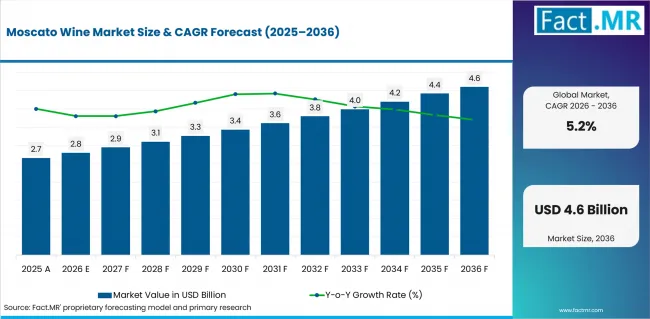
Moscato Wine Market Value Analysis | Source: Fact.MR
What are the defining numbers behind Moscato Wine Market growth?
USD 1.9 billion absolute opportunity by 2036, led by Still Moscato, Off-trade; and Glass Bottles.
- Demand Drivers in the Market
- Moscato's aromatic sweetness gives first-time and occasional wine consumers a more approachable entry point than many dry styles.
- Lower-alcohol and zero-alcohol development supports moderation-led occasions without abandoning recognizable Muscat aroma.
- Supermarkets, liquor stores, and online retailers give shoppers room to compare sweetness; origin; alcohol level; bottle size; and price before purchase.
- Pack sizes and product variants help producers serve shared meals, gifting, portion-control; and casual at-home use through one recognizable wine identity.
- Key Segments Analyzed
- By Product: Still Moscato is projected to hold 41.0% share in 2026 because it fits meal, social, and casual-drinking occasions without requiring sparkling-wine service.
- By Distribution Channel: Off-trade is expected to account for 62.0% share in 2026 as supermarkets, liquor stores, and online sellers support comparison; promotions; and at-home consumption.
- By Packaging: Glass Bottles are anticipated to capture 84.0% share in 2026 because the format preserves familiar wine cues, label detail, gifting suitability; and table service.
- By Consumer Group: Analysis covers Millennials, Young Professionals, Social Drinkers; and First-time Wine Consumers.
- By Price Range: Analysis covers Mid-range, USD 10-20, USD 20-30; and Seasonal Premium positions.
- Analyst Opinion at Fact.MR
- Shambhu Nath Jha, Principal Consultant at Fact.MR, states: “Credible revenue capture in Moscato depends on a clearly defined drinking occasion and disciplined sweetness rather than broad category expansion. Producers need to retain Muscat aroma as they reduce alcohol or add flavors. Retail programs must use pack and price architecture that avoids a low-cost-only perception; while supply planning should align appellation inventory with promotional cadence and repeat demand.”
- Strategic Implications
- Producers should validate aroma retention before scaling dealcoholized or flavored Moscato variants across retail markets.
- Brand owners should distinguish still, sparkling, dessert; and lower-alcohol propositions by occasion rather than relying on sweetness alone.
- Retail programs should coordinate 375 ml, 750 ml, and 1.5 L formats with clear price ladders across USD 10-20; USD 20-30; and seasonal premium positions.
- Importers should model alcohol duty, freight, promotional funding; and retailer margin together because landed economics can change sharply by alcohol strength and channel.
How does the Moscato Wine Market break down by segment?
Still Moscato leads at 41.0%, Off-trade at 62.0%, and Glass Bottles at 84.0% in 2026.
Why does Still Moscato lead Product?
Still Moscato holds 41.0% share in 2026.
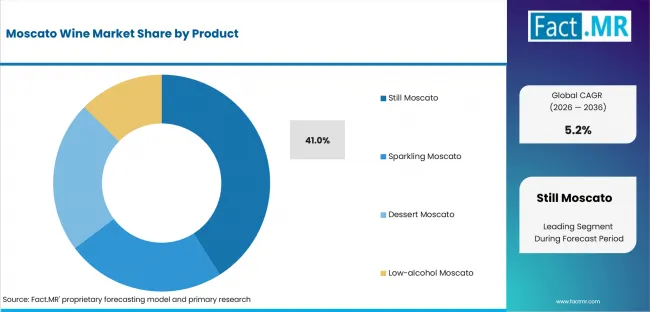
Moscato Wine Market Analysis By Product | Source: Fact.MR
Still Moscato carries the widest occasion range because it can be served chilled as a casual wine, paired with spicy or sweet foods, or positioned as a lower-alcohol choice without the service expectations attached to sparkling wine. Producers can adjust residual sugar; fruit intensity; color; and alcohol while keeping Muscat aroma recognizable. Packaging and shelf-life requirements also affect the white wine and rose wine markets.
White Moscato remains the clearest expression of the aromatic profile. Rosé Moscato broadens visual and fruit-led appeal, while Red Moscato offers a more differentiated sweet-wine proposition for brands seeking distinct shelf cues.
Why does Off-trade lead Distribution Channel?
Off-trade holds 62.0% share in 2026.
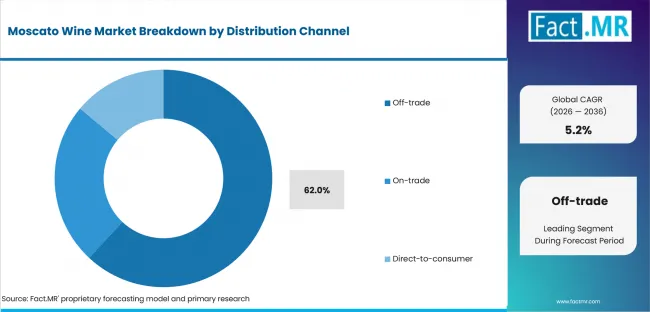
Moscato Wine Market Analysis By Distribution Channel | Source: Fact.MR
Off-trade channels let consumers compare sweetness cues, origin, alcohol level; format; and price before purchase. That comparison matters in a category spanning value brands; Italian appellation bottles; flavored editions; and zero-alcohol products.
Supermarkets and liquor stores provide the widest promotional reach and support routine at-home use. Online retail improves access to smaller Italian labels and niche variants that may not secure broad physical distribution.
Why do Glass Bottles lead Packaging?
Glass Bottles account for 84.0% share in 2026.
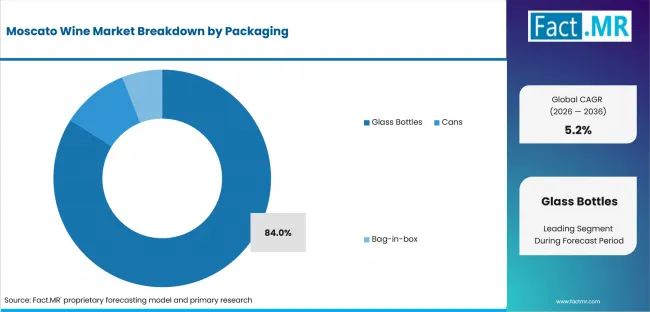
Moscato Wine Market Analysis By Packaging | Source: Fact.MR
Glass bottles remain the default because shoppers read the format as wine rather than as a flavored beverage. The package also supports origin detail, gifting, table service; and temperature control without changing the category's visual language.
The 750 ml bottle fits shared consumption. The 375 ml format supports moderation and trial, while the 1.5 L bottle extends the same familiar presentation to larger gatherings and value-led household occasions.
How do Consumer Groups shape Moscato demand?
Consumer analysis covers Millennials, Young Professionals, Social Drinkers; and First-time Wine Consumers.
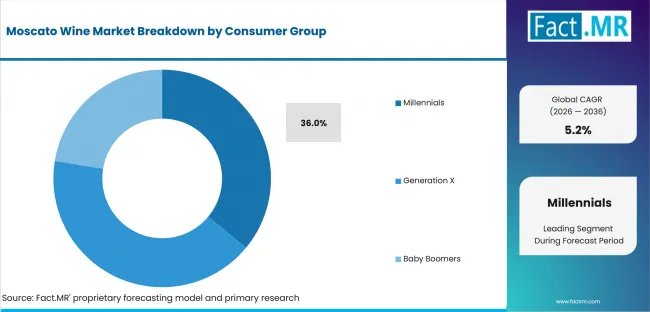
Moscato Wine Market Analysis By Consumer Group | Source: Fact.MR
Moscato can recruit legal-age consumers who prefer an aromatic, sweeter style and a less formal entry into wine. Young Professionals and Social Drinkers support casual and shared occasions, while First-time Wine Consumers respond to recognizable fruit cues and straightforward sweetness communication.
The analysis does not assign a numerical leader within Consumer Group. Commercial relevance therefore depends on matching each audience with the right product style, pack size, alcohol level; and retail message. Channel economics connect this demand with the orange wine and fortified wine markets.
How does Price Range shape purchase decisions?
Price analysis covers Mid-range, USD 10-20, USD 20-30; and Seasonal Premium positions.
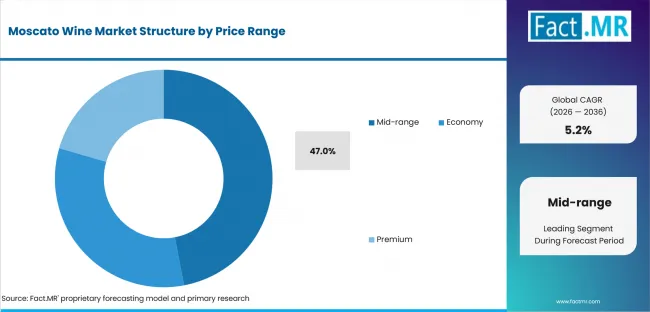
Moscato Wine Market Analysis By Price Range | Source: Fact.MR
The USD 10-20 range supports accessible trial and broad off-trade promotions. USD 20-30 products can use origin, appellation, production method; and gifting cues to justify a higher ticket; while Seasonal Premium offers depend on limited occasions and stronger presentation.
The analysis does not assign a numerical leader within Price Range. Producers still need a clear price ladder so lower-priced listings do not define the entire Moscato proposition.
What is accelerating Moscato Wine Market adoption, and what is holding it back?
Moderation and approachable flavor support growth, while mature-market wine contraction and channel economics restrain repeat purchase.
Drivers Impact Analysis
| DRIVER | QUALITATIVE RELEVANCE | GEOGRAPHIC RELEVANCE | IMPACT TIMELINE |
|---|---|---|---|
| Moderation and approachable flavor | High | USA | Current forecast period |
Source: Fact.MR analysis. Updated Aug 4, 2026
- Moderation and approachable flavor: Moscato's aromatic sweetness fits consumers seeking a less austere wine style, while lower-alcohol variants can serve occasions where total alcohol intake matters. Wine Australia reported in February 2025 that no-alcohol wine consumption grew 13% per year and low-alcohol wine grew 21% per year during the five years to 2023, while still wine declined 3% per year.
- Strength-based pricing: The United Kingdom applies alcohol duty by strength, giving lower-ABV wine a direct tax and landed-price implication. Producers that protect aroma at lower alcohol levels can use this structure as a commercial advantage rather than a compliance exercise.
Opportunity Impact Analysis
| OPPORTUNITY | QUALITATIVE RELEVANCE | GEOGRAPHIC RELEVANCE | IMPACT TIMELINE |
|---|---|---|---|
| Smaller-format products | High | Italy | Current forecast period |
Source: Fact.MR analysis. Updated Aug 4, 2026
- Smaller-format and low-alcohol innovation: The clearest opening is to make Moscato relevant to moderation, convenience, and flavor exploration without weakening wine identity. Brown Brothers launched Moscato Rosé Zero in August 2024 using lower-temperature spinning-cone processing to retain varietal character; while 375 ml bottles give retailers a practical portion-control format.
Restraints Impact Analysis
| RESTRAINT | QUALITATIVE RELEVANCE | GEOGRAPHIC RELEVANCE | IMPACT TIMELINE |
|---|---|---|---|
| Mature-market wine contraction and channel economics | High | Germany | Current forecast period |
Source: Fact.MR analysis. Updated Aug 4, 2026
- Mature-market wine contraction: The principal restraint appears between initial trial and repeat purchase. The International Organisation of Vine and Wine reported in May 2026 that global wine consumption remained under pressure from economic conditions and changing behavior in mature markets.
- Retail value pressure: FranceAgriMer recorded a 4% decline in both at-home wine volume and value in France during 2024. Producers therefore need promotional discipline and a repeatable quality proposition, not only broad shelf access. Ingredient and processing decisions remain relevant to the non alcoholic wine and organic wine markets.
Which countries are scaling Moscato Wine Market fastest?
Australia 6.2%, UK 5.9%, USA 5.6%; Germany 5.3%; Italy 5.0%; and France 4.7% through 2036.
Regional analysis covers North America, Latin America, Western Europe; Eastern Europe; East Asia; South Asia and Pacific; and the Middle East and Africa.
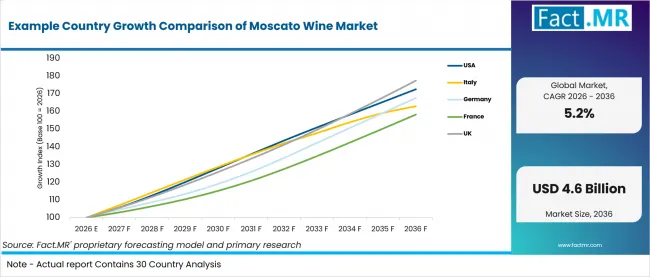
Example Country Growth Comparison Of Moscato Wine Market | Source: Fact.MR
| COUNTRY | CAGR, 2026 to 2036 |
|---|---|
| Australia | 6.2% |
| UK | 5.9% |
| USA | 5.6% |
| Germany | 5.3% |
| Italy | 5.0% |
| France | 4.7% |
Source: Fact.MR analysis. Updated Aug 4, 2026
What is shaping Australia's outlook through 2036?
6.2% CAGR through 2036, supported by a developed low-alcohol wine base and active product experimentation.
Australia records the highest listed country CAGR. Producers are using lower-alcohol and zero-alcohol development to keep aromatic wine relevant to moderation-led occasions, while established retail access gives new variants a direct route to consumers.
Wine Australia's reported growth in no-alcohol and low-alcohol wine indicates a commercial base for experimentation. Moscato can participate where producers retain varietal aroma and avoid a thin or overly processed sensory profile.
What is shaping the United Kingdom's outlook through 2036?
5.9% CAGR through 2036, supported by broad imported-wine access and strength-based duty economics.
UK buyers compare imported brands through supermarkets, specialist retailers, online sellers; and on-trade lists. Alcohol duty varies by strength; so lower-ABV Moscato can carry a different landed-price structure from stronger wine styles.
Commercial execution depends on balancing duty, freight, retailer margin; and promotional funding without reducing the category to a low-price sweet wine proposition.
What is shaping USA's outlook through 2036?
5.6% CAGR through 2036, driven by off-trade scale and informal consumption occasions.
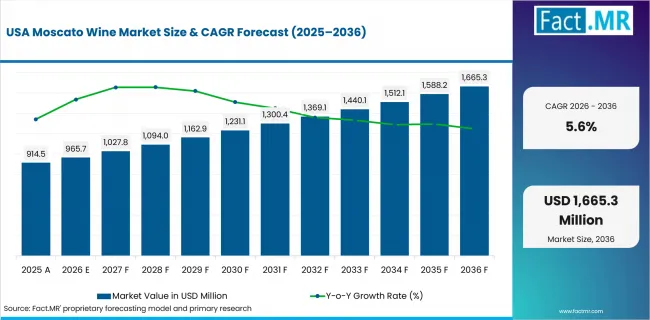
Moscato Wine Market Country Value Analysis | Source: Fact.MR
Importers, distributors, national retailers; and large brand portfolios determine shelf access across the USA. Recognizable sweetness and casual serving occasions support trial among consumers who do not begin with conventional dry wine.
Repeat purchase depends on clear style communication and stable retail availability. Still, rosé, flavored; and lower-alcohol variants need distinct positioning so shoppers understand the intended occasion before purchase. Buyer occasions also influence the canned wine and crossflow wine filters markets.
What is shaping Germany's outlook through 2036?
5.3% CAGR through 2036, shaped by familiarity with still and sparkling wine alongside value and moderation pressure.
German retailers and consumers are accustomed to both still and sparkling wine, giving Moscato several possible category positions. Purchase decisions increasingly reflect value, moderation; and demographic change rather than novelty alone.
The German Wine Institute reported in January 2026 that national wine consumption continued to decline. Moscato suppliers therefore need disciplined assortment and clear reasons for repeat purchase in a contracting mature market.
What is shaping Italy's outlook through 2036?
5.0% CAGR through 2036, anchored in appellation production, grower networks; cooperatives; and exports.
Italian producers operate through appellation rules, grower relationships, cooperative structures; domestic retail; and export channels. Supply discipline matters because promotional programs and export commitments must remain aligned with available Moscato inventory.
Origin authority supports premium and sparkling propositions, but producers still need consistent quality and channel-specific pricing to convert heritage into repeat commercial demand.
What is shaping France's outlook through 2036?
4.7% CAGR through 2036, supported by retailer access but constrained by mature household wine demand.
French household purchasing remains strongly retailer-oriented, while wine familiarity creates high expectations for origin, balance; and value. Sweetness alone is not enough to sustain repeat purchase in a market with deep category knowledge.
FranceAgriMer recorded a 4% decline in both at-home wine volume and value in 2024. Moscato therefore needs a precise occasion, sound price architecture, and visible product differentiation to grow within a pressured channel.
Who leads the Moscato Wine Market?
E. & J. Gallo Winery, Sutter Home Winery, and Barefoot Cellars anchor broad off-trade reach; while Italian producers strengthen origin and sparkling credentials. Retail execution creates a related demand signal in the wine cabinets and smart wine cellar markets.
Competition separates by retail scale, Italian origin authority, and portfolio experimentation. E. & J. Gallo Winery; Sutter Home Winery; and Barefoot Cellars compete through broad off-trade access and recognizable sweet-wine brands. Zonin1821; Tosti1820; Castello del Poggio; and Mionetto emphasize Italian sparkling and appellation cues.
Caviro Group, Marchesi Antinori, and Brown Brothers add cooperative; estate; or innovation-led routes to market. Caviro's March 2026 Tavernello 3% launch was an adjacent low-alcohol sparkling wine rather than a Moscato launch; but it shows dealcoholization capacity. Tosti1820 documented Equalitas certification and organically managed Moscato vineyards in its 2023-2024 Sustainability Report; while Brown Brothers used lower-temperature spinning-cone processing for Moscato Rosé Zero.
Competitive credibility rests on distribution access and varietal authority. Aroma retention and price-pack discipline support performance across promotional and premium channels.
Which companies are the key providers?
E. & J. Gallo Winery and Caviro Group are leading companies in the market.
- E. & J. Gallo Winery
- Caviro Group
- Zonin1821
- Marchesi Antinori
- Tosti1820
- Brown Brothers
- Castello del Poggio
- Mionetto
- Sutter Home Winery
- Barefoot Cellars
Bibliography
- International Organisation of Vine and Wine. (2026, May 12). State of the world wine sector in 2025: Tariffs, climate and consumer trends drive sector adaptation.
- Wine Australia. (2025, February 25). No and lower alcohol market update.
- HM Revenue & Customs. (2026, February 1). Alcohol Duty rates.
- German Wine Institute. (2026, January 14). Wine consumption in Germany continues to decline.
- FranceAgriMer. (2025, March 20). Partage des éclairages économiques et poursuite des réflexions stratégiques pour la filière viticole française.
This Report Addresses
- What is the Moscato Wine Market worth in 2026, and what value is forecast for 2036?
- Which demand, purchasing, and operating pressures shape the market?
- Why do Still Moscato, Off-trade, and Glass Bottles lead their respective segments?
- How do country growth rates differ across Australia, the UK, USA; Germany; Italy; and France?
- Which companies are profiled, and what determines competitive credibility?
- What market boundary, segmentation, evidence base; and methodology support the assessment?
What does the Moscato Wine Market cover?
Still, sparkling, dessert; and low-alcohol Moscato wine sold through the defined product; channel; packaging; consumer; and price universe.
The Moscato Wine Market covers finished wines sold and identified as Moscato across still, sparkling, dessert; and lower-alcohol styles. Coverage follows the Product; Distribution Channel; Packaging; Consumer Group; Price Range; and Region structure set out in this article.
Commercial value is counted at the wine-product level. The boundary is designed to separate Moscato wine revenue from upstream grape and must sales, non-Moscato wine, hospitality services; and downstream products that use Moscato only as an ingredient.
What is included in the scope?
Moscato wine sold through off-trade and other defined channels across glass-bottle formats, named consumer groups, and stated price ranges.
What is excluded from the scope?
Muscat grapes and must sold as inputs, non-Moscato wines, spirits; hospitality revenue; and unrelated downstream products are outside the scope.
The scope excludes Muscat grapes and must sold as raw inputs, non-Moscato wines, wine-based cocktails that are not sold as Moscato wine; and spirits. Hospitality meal or lodging revenue is excluded; as are downstream foods or other products that use Moscato as an ingredient rather than being sold as Moscato wine.
How was the analysis built?
Primary interviews, official wine-sector sources, national duty guidance; producer evidence; channel mapping; and market triangulation support the assessment.
- Primary Research
- Structured discussions with wine producers, importers, distributors; off-trade buyers; on-trade operators; direct-to-consumer teams; and category specialists test the market boundary; purchasing triggers; channel economics; pricing behavior; repeat-purchase conditions; and adoption frictions.
- Desk Research
- Desk research reviews official wine-sector statistics, alcohol-duty guidance, national and regional policy material; appellation information; company product pages; corporate reports; and dated company announcements. Product-positioning choices also matter in the freezer beverage and wine cooler and wine bag markets.
- Market-Sizing and Forecasting
- The sizing framework combines channel-level product availability, average selling-price ranges, pack and style mix; country consumption and trade signals; producer reach; and the market values used in this article.
- Data Validation and Update Cycle
- Findings are cross-checked across official, regional, and first-party sources; then reconciled against report years; values; shares; CAGRs; segment labels; countries; company coverage; and the defined revenue boundary.
Segmentation
What is the report’s scope and coverage?
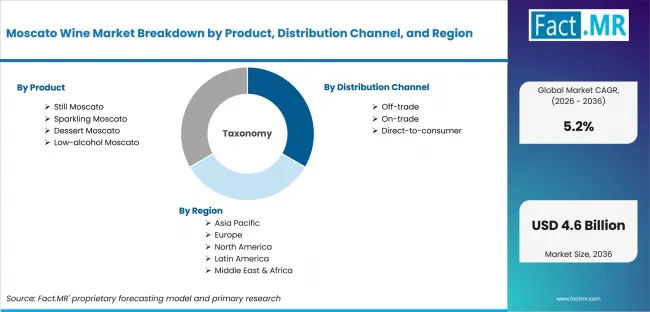
Moscato Wine Market Breakdown By Product, Distribution Channel, And Region | Source: Fact.MR
| Attribute | Details |
|---|---|
| Quantitative Units | USD 2.8 Billion in 2026 to USD 4.6 Billion by 2036 at 5.2% CAGR |
| Market Definition | Revenue from still, sparkling, dessert; and low-alcohol Moscato wine sold through the defined product; channel; packaging; consumer; and price universe |
| Product | Still Moscato; White Moscato; Rosé Moscato; Red Moscato |
| Distribution Channel | Off-trade; Supermarkets & Hypermarkets; Liquor Stores; Online Retail |
| Packaging | Glass Bottles; 750 ml Bottles; 375 ml Bottles; 1.5 L Bottles |
| Consumer Group | Millennials; Young Professionals; Social Drinkers; First-time Wine Consumers |
| Price Range | Mid-range; USD 10-20; USD 20-30; Seasonal Premium |
| Regions Covered | North America; Latin America; Western Europe; Eastern Europe; East Asia; South Asia and Pacific; Middle East and Africa |
| Countries Covered | USA; Italy; Germany; France; UK; Australia |
| Key Companies Profiled | E. & J. Gallo Winery; Caviro Group; Zonin1821; Marchesi Antinori; Tosti1820; Brown Brothers; Castello del Poggio; Mionetto; Sutter Home Winery; Barefoot Cellars |
| Forecast Period | 2026 to 2036 |
| Approach | Hybrid bottom-up and top-down approach using product availability, price and channel inputs, trade and consumption indicators; supplier evidence; and triangulation against the defined revenue boundary |
Source: Fact.MR analysis. Updated Aug 4, 2026
How is the market segmented?
-
By Product
- Still Moscato
- White Moscato
- Rosé Moscato
- Red Moscato
- Sparkling Moscato
- Moscato d'Asti
- Asti Spumante
- Semi-sparkling Moscato
- Dessert Moscato
- Late Harvest Moscato
- Fortified Moscato
- Sweet Dessert Wine
- Low-alcohol Moscato
- Light Moscato
- Fruit-infused Moscato
- Organic Moscato
- Still Moscato
-
By Distribution Channel
- Off-trade
- Supermarkets & Hypermarkets
- Liquor Stores
- Online Retail
- On-trade
- Restaurants
- Bars
- Hotels
- Direct-to-consumer
- Winery Stores
- Winery Websites
- Wine Clubs
- Off-trade
-
By Packaging
- Glass Bottles
- 750 ml Bottles
- 375 ml Bottles
- 1.5 L Bottles
- Cans
- Single-serve Cans
- Multipack Cans
- Premium Cans
- Bag-in-box
- 3 L Bag-in-box
- 5 L Bag-in-box
- Family Packs
- Glass Bottles
-
By Consumer Group
- Millennials
- Young Professionals
- Social Drinkers
- First-time Wine Consumers
- Generation X
- Premium Wine Buyers
- Casual Consumers
- Family Buyers
- Baby Boomers
- Traditional Wine Consumers
- Collectors
- Fine Wine Enthusiasts
- Millennials
-
By Price Range
- Mid-range
- USD 10–20
- USD 20–30
- Seasonal Premium
- Economy
- Below USD 10
- Value Brands
- Entry-level Wines
- Premium
- USD 30–50
- Above USD 50
- Limited Edition Wines
- Mid-range
-
By Region
- North America
- Latin America
- Western Europe
- Eastern Europe
- East Asia
- South Asia and Pacific
- Middle East & Africa
Frequently Asked Questions
Which Product leads the Moscato Wine Market?
Which Distribution Channel leads the Moscato Wine Market?
Which Packaging format leads the Moscato Wine Market?
Which Consumer Groups are covered?
Which Price Ranges are covered?
Which country records the highest CAGR in the Moscato Wine Market?
How does the UK perform in the Moscato Wine Market?
How does the USA perform in the Moscato Wine Market?
How does Italy perform in the Moscato Wine Market?
What is the primary driver in the Moscato Wine Market?
What is the main restraint in the Moscato Wine Market?
Why is Still Moscato important?
Why does Off-trade dominate demand?
Why do Glass Bottles remain dominant?
Who worked on this report


Preview the report firsthand - request a free sample
Free SampleGet the brochure for pricing and purchase details
Download PDF