- Forecast Value (2036): 7.1 Bn
- CAGR (2036): 14.7%
What is the multiplex swab cartridges market forecast to be worth by 2036?
USD 1.8 billion in 2026 to USD 7.1 billion by 2036, at 14.7% CAGR.
- The multiplex swab cartridges market crossed a valuation of USD 1.6 billion in 2025.
- Demand is expected to increase from USD 1.8 billion in 2026 to USD 7.1 billion by 2036.
- The market is forecast to record 14.7% CAGR from 2026 to 2036 as respiratory and sexual health testing shifts toward cartridge-based panels with minimal hands-on workflow.
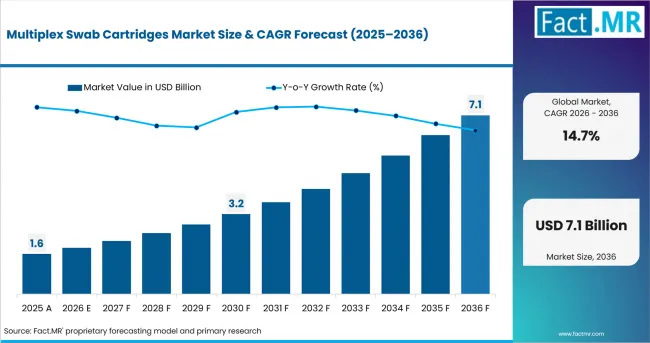
Multiplex Swab Cartridges Market Value Analysis | Source: Fact.MR
What are the defining numbers behind multiplex swab cartridges market growth?
USD 5.3 billion absolute opportunity by 2036, led by the United States and India.
- Demand Drivers in the Market
- Hospital labs need one cartridge workflow for multiple respiratory targets.
- Urgent care sites need rapid swab testing with minimal hands-on time.
- Sexual health clinics need multiplex cartridges that shorten diagnosis and treatment decisions.
- Public health programs need portable platforms for decentralized molecular testing.
- Key Segments Analyzed
- By Cartridge Format: Fully Integrated Multiplex Cartridges are expected to hold 48.0% share in 2026 as users prefer closed sample-to-answer systems.
- By Panel Type: Respiratory and Sore Throat Panels lead because seasonal symptoms need broader pathogen differentiation. The share is projected at 52.0% in 2026.
- By Swab Type: Nasopharyngeal and Anterior Nasal Swabs are likely to account for 57.0% share in 2026 because respiratory testing drives high cartridge volume.
- By Technology: Real-Time PCR Cartridges lead with 61.0% share in 2026 since installed platforms rely heavily on PCR amplification.
- By Testing Setting: Hospital and Near-Patient Testing Sites are expected to hold 44.0% share in 2026 because rapid results support same-visit decisions.
- By Geography: The United States is projected to record 16.5% CAGR through 2036 as swab cartridge menus expand.
- Analyst Opinion at Fact.MR
- Shambhu Nath Jha, Senior Analyst at Fact.MR, states, “Multiplex swab cartridges are becoming the practical format for syndromic molecular testing. We see hospitals using closed cartridges to reduce uncertainty when symptoms overlap. Providers that combine broad panels with simple specimen workflows will gain stronger access to urgent care and hospital testing budgets.”
- Strategic Implications
- Diagnostic providers should expand multiplex menus around respiratory and STI use cases.
- Hospitals should compare cartridge cost with faster clinical decisions.
- Cartridge developers should optimize swab elution and dry reagent stability early.
- Public health programs should align cartridge platforms with local disease priorities.
Multiplex swab cartridges are disposable molecular diagnostic cartridges used to detect multiple pathogens from nasal, throat, nasopharyngeal or vaginal swab specimens. The category connects with molecular diagnostics because multiplex cartridges use nucleic acid amplification to deliver broader pathogen identification. The strongest adoption case comes from care sites where one symptom set can be caused by several pathogens.
Cepheid’s Xpert Xpress CoV-2/Flu/RSV plus is a multiplex real-time PCR test used with nasopharyngeal swab or anterior nasal swab specimens. The test detects SARS-CoV-2, influenza A, influenza B, and RSV viral RNA in a self-contained cartridge workflow. [1] This supports demand for swab cartridges that simplify respiratory testing during seasonal surges.
bioMérieux announced in 2025 that its BIOFIRE SPOTFIRE Respiratory/Sore Throat Panel Mini received FDA clearance and CLIA waiver for anterior nasal swab specimens. The panel is used with the BIOFIRE® SPOTFIRE® System and expands respiratory sample-type flexibility for point-of-care settings. [2] This shows how multiplex swab cartridges are expanding sample collection options.
QIAGEN received FDA clearance in 2024 for its QIAstat-Dx Respiratory Panel Plus. The company stated that the panel delivers results in about 1 hour with less than 1 minute of hands-on time. [3] This reinforces the market shift toward closed swab cartridges with fast sample-to-answer workflow.
The United States is projected to record 16.5% CAGR through 2036 as Cepheid, BioFire and Visby Medical expand multiplex swab cartridge use. India is expected to post 15.8% CAGR through 2036 as decentralized infectious disease testing increases. Germany is likely to record 14.9% CAGR as QIAGEN strengthens syndromic cartridge testing. Switzerland is forecast to advance at 14.2% CAGR as Roche Diagnostics expands near-patient PCR. China is set to record 13.7% CAGR as hospitals adopt multiplex respiratory and STI panels.
How does the multiplex swab cartridges market break down by segment?
Fully Integrated Multiplex Cartridges lead at 48%; Respiratory and Sore Throat Panels lead at 52%.
Which cartridge format dominates?
Fully Integrated Multiplex Cartridges hold 48% share in 2026.
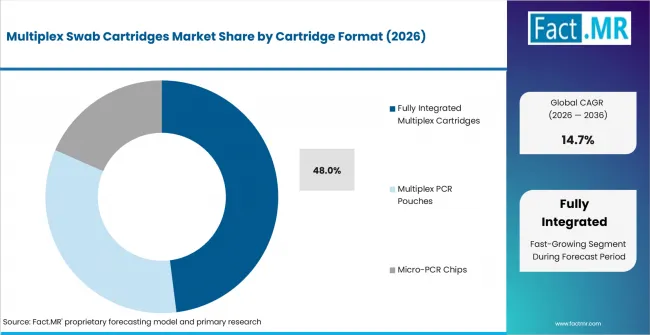
Multiplex Swab Cartridges Market Analysis By Cartridge Format | Source: Fact.MR
Fully Integrated Multiplex Cartridges are expected to hold 48% share in 2026 because they reduce manual preparation and contamination risk. These cartridges combine swab sample processing and molecular detection inside one disposable format. The segment connects with diagnostic testing because simpler workflows can support faster care decisions.
Which panel type dominates?
Respiratory and Sore Throat Panels account for 52% share in 2026.
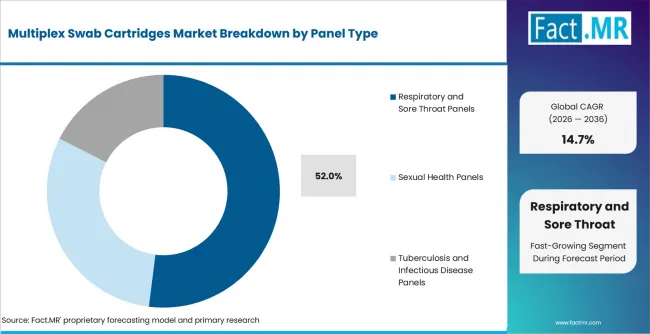
Multiplex Swab Cartridges Market Analysis By Panel Type | Source: Fact.MR
Respiratory and Sore Throat Panels lead because overlapping symptoms make single-pathogen testing less useful. The panel type is projected to capture 52% share in 2026. bioMérieux’s SPOTFIRE R/ST Panel Mini shows how respiratory and throat testing can sit on one multiplex cartridge platform. The category benefits from urgent care and pediatric testing needs during seasonal peaks.
Which swab type dominates?
Nasopharyngeal and Anterior Nasal Swabs hold 57% share in 2026.
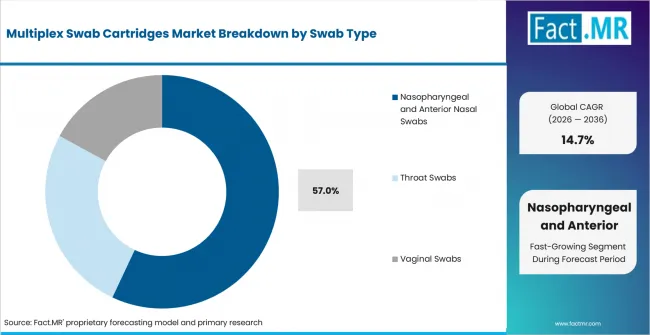
Multiplex Swab Cartridges Market Analysis By Swab Type | Source: Fact.MR
Nasopharyngeal and Anterior Nasal Swabs lead because respiratory testing creates the largest swab cartridge pull-through. The swab type is likely to account for 57% share in 2026. Anterior nasal swabs are gaining interest because collection is easier for patients and care teams. The segment connects with in-vitro diagnostics because respiratory swab testing remains a major IVD use case.
Which technology dominates?
Real-Time PCR Cartridges lead with 61% share in 2026.
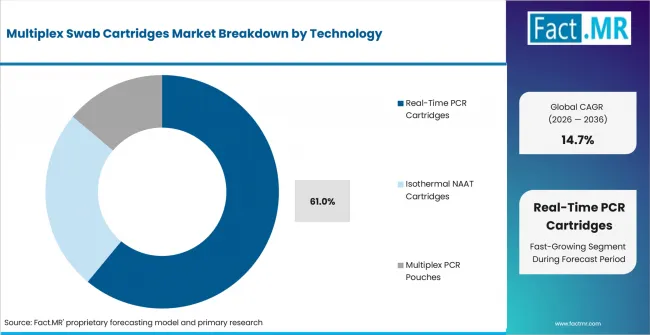
Multiplex Swab Cartridges Market Analysis By Technology | Source: Fact.MR
Multiplex Swab Cartridges Market Analysis By Technology | Source: Fact.MR
Real-Time PCR Cartridges lead because major installed platforms use PCR-based detection. The technology is expected to hold 61% share in 2026. PCR supports sensitive target detection and broad assay design. Roche’s cobas liat system uses PCR technology and supports results in 20 minutes or less for near-patient testing. [4] The segment links with PCR reagents because cartridge chemistry depends on stable amplification mixes.
Which testing setting dominates?
Hospital and Near-Patient Testing Sites hold 44% share in 2026.
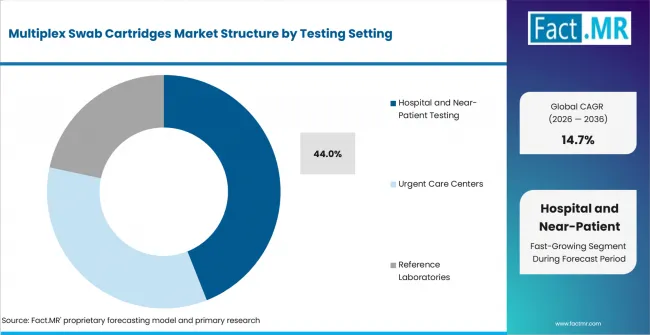
Multiplex Swab Cartridges Market Analysis By Testing Setting | Source: Fact.MR
Hospital and Near-Patient Testing Sites lead because clinicians need results during the same care episode. The testing setting is expected to hold 44% share in 2026. Emergency departments and urgent care centers use cartridge testing to reduce diagnostic delay. Visby Medical’s OTC PCR sexual health test shows how self-contained swab-based molecular testing is also moving closer to patients. [5]
What is accelerating multiplex swab cartridge demand, and what is holding it back?
Syndromic testing drives demand; cartridge cost restrains adoption.
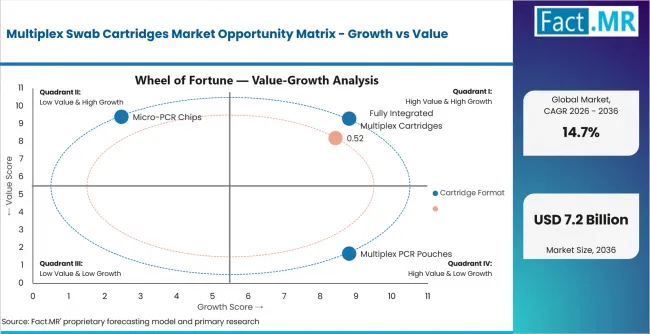
Multiplex Swab Cartridges Market Opportunity Matrix Growth Vs Value | Source: Fact.MR
Syndromic testing is the main driver. Similar symptoms can come from different pathogens, so clinicians need broader detection from one swab. Multiplex cartridges reduce repeat sampling and shorten test selection.
Decentralized infectious disease programs also support demand. Truenat workflows use chip-based real-time PCR for tuberculosis and other infectious disease testing. Molbio describes Truenat MTB Plus as a chip-based real-time PCR test for Mycobacterium tuberculosis. [6] This supports swab and specimen cartridge adoption where central lab access is limited.
The main restraint is cartridge cost. Multiplex cartridges are more expensive than single-target tests. Adoption improves when one cartridge prevents repeat testing or supports faster treatment decisions.
Where do the biggest multiplex swab cartridge opportunities sit?
Respiratory panels, STI testing and decentralized infectious disease programs.
- Respiratory Panels: Hospitals can use one swab cartridge to test for multiple seasonal pathogens.
- STI Testing: Clinics can shorten treatment decisions by using multiplex sexual health cartridges.
- Decentralized Programs: Public health teams can use cartridge systems closer to patients.
Which countries are scaling multiplex swab cartridges fastest?
United States 16.5%, India 15.8%, Germany 14.9%, Switzerland 14.2%, China 13.7%.
Based on regional analysis, the multiplex swab cartridges market covers North America and Western Europe. Asia Pacific is also included. Latin America and Middle East and Africa complete the regional scope.
.webp "Top Country Growth Comparison Multiplex Swab Cartridges Market Cagr (2026 2036)")
Top Country Growth Comparison Multiplex Swab Cartridges Market Cagr (2026 2036) | Source: Fact.MR
| Country | CAGR |
|---|---|
| United States | 16.5% |
| India | 15.8% |
| Germany | 14.9% |
| Switzerland | 14.2% |
| China | 13.7% |
Source: Fact.MR analysis. Updated Jun 26, 2026
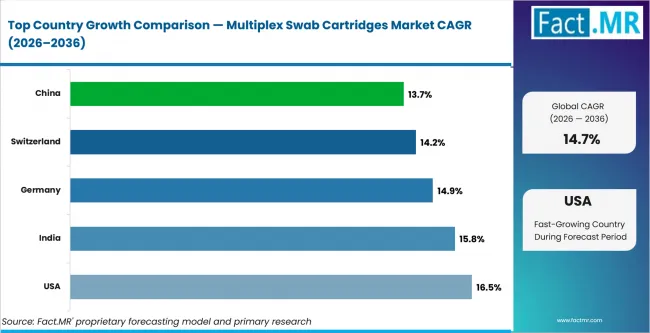
Multiplex Swab Cartridges Market Cagr Analysis By Country | Source: Fact.MR
What is powering the United States lead?
16.5% CAGR, driven by Cepheid and BioFire cartridge platform expansion.
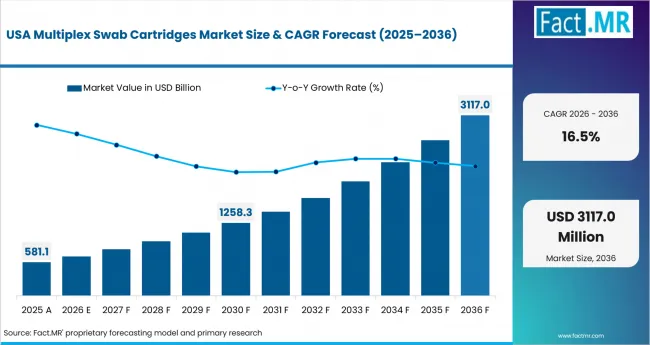
Multiplex Swab Cartridges Market Country Value Analysis | Source: Fact.MR
The United States is projected to record 16.5% CAGR through 2036 as hospitals and urgent care centers adopt multiplex swab cartridges. Cepheid supports broad respiratory testing through GeneXpert cartridges. BioFire supports multiplex respiratory and sore throat testing through SPOTFIRE. Growth will favor providers with FDA-cleared menus and strong clinical support.
How is India scaling multiplex swab cartridge demand?
15.8% CAGR, backed by Bosch Healthcare Solutions / Vivalytic and decentralized infectious disease testing.
India is expected to post 15.8% CAGR through 2036 as decentralized molecular testing expands beyond central laboratories. Molbio’s Truenat platform supports near-patient PCR workflows in public health programs. Swab and specimen cartridge systems reduce transport burden. Growth will favor platforms that balance cost and field usability.
What supports Germany’s outlook?
14.9% CAGR, driven by QIAGEN and syndromic respiratory testing.
Germany is likely to record 14.9% CAGR through 2036 as QIAstat-Dx expands multiplex respiratory testing. Hospitals need closed cartridges that reduce manual setup. German IVD expertise supports cartridge assay development. Growth will favor platforms with easy workflow and flexible panel design.
How is Switzerland scaling multiplex swab cartridge adoption?
14.2% CAGR, supported by Roche Diagnostics and cobas liat near-patient PCR.
Switzerland is forecast to advance at 14.2% CAGR through 2036 as Roche Diagnostics expands compact PCR workflows. cobas liat supports fast molecular testing in near-patient settings. Swiss diagnostic expertise strengthens assay quality systems. Growth will favor cartridges that support rapid clinical decisions.
What underpins China’s growth?
13.7% CAGR, driven by hospital molecular testing and local diagnostic manufacturing.
China is set to record 13.7% CAGR through 2036 as hospitals expand multiplex respiratory and STI testing. Local manufacturers are improving cartridge platform access. Regional labs need faster molecular workflows during seasonal outbreaks. Growth will favor cost-effective cartridges with broad disease menus.
Who leads the multiplex swab cartridges market?
Cepheid and bioMérieux/BioFire lead through large installed cartridge platforms.
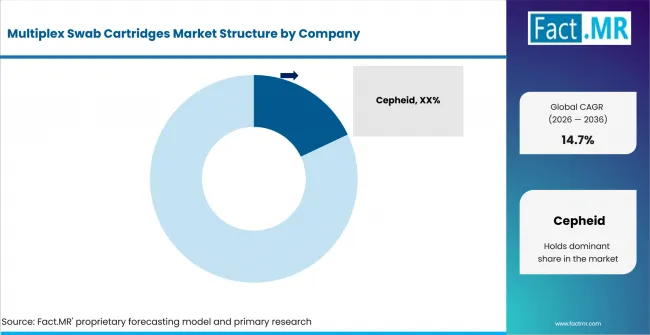
Multiplex Swab Cartridges Market Analysis By Company | Source: Fact.MR
Multiplex swab cartridges are supplied by molecular diagnostic companies with closed cartridge or pouch systems. Cepheid leads through GeneXpert cartridges for respiratory swab testing. bioMérieux/BioFire supports multiplex swab testing through FilmArray and SPOTFIRE platforms.
Roche Diagnostics competes through cobas liat near-patient PCR assays. QIAGEN supports cartridge-based syndromic testing through QIAstat-Dx. Visby Medical is active in self-contained PCR devices for sexual health testing. Bosch Healthcare Solutions / Vivalytic supports decentralized chip-based PCR through Truenat.
Competition through 2036 will depend on assay menu breadth and cartridge reliability. Providers need swab workflows that are simple for clinical teams. The sample preparation layer matters because swab elution affects cartridge performance. The molecular quality controls layer also matters because cartridge systems need reliable controls for clinical adoption.
Which companies are the key providers?
Cepheid and bioMérieux/BioFire are key providers. Roche Diagnostics and QIAGEN are also profiled. Visby Medical and Bosch Healthcare Solutions / Vivalytic& complete the company set.
- Cepheid
- bioMérieux/BioFire Diagnostics
- Roche Diagnostics
- QIAGEN
- Visby Medical
- Bosch Healthcare Solutions / Vivalytic
Bibliography
- [1] Cepheid. (2025). Xpert® Xpress CoV-2/Flu/RSV plus. Cepheid.
- [2] bioMérieux. (2025, August 18). bioMérieux receives U.S. FDA 510(k) clearance and CLIA waiver for anterior nasal swab specimens on the BIOFIRE® SPOTFIRE® R/ST Panel Mini. bioMérieux.
- [3] QIAGEN. (2024, May 13). QIAGEN receives FDA clearance for QIAstat-Dx respiratory syndromic testing panel for fast and accurate results. QIAGEN.
- [4] Roche. (2025, January 22). Roche receives FDA clearance with CLIA waiver for cobas® liat molecular tests to diagnose sexually transmitted infections at the point of care. Roche.
- [5] Visby Medical. (2025, March 28). Visby Medical receives landmark FDA De Novo authorization for first-ever OTC PCR test for sexual health. Visby Medical.
- [6] Molbio Diagnostics. (2024). Truenat® assays. Molbio Diagnostics.
This Report Addresses
- Strategic intelligence on multiplex swab cartridges across cartridge format and panel type.
- Segment analysis covering Fully Integrated Multiplex Cartridges and Respiratory/Sore Throat Panels.
- Regional outlook covering the United States, India, Germany, Switzerland and China.
- Competitive analysis of Cepheid, bioMérieux/BioFire Diagnostics, Roche Diagnostics, QIAGEN, Visby Medical and Bosch Healthcare Solutions / Vivalytic.
- Technology assessment covering PCR cartridges, swab workflows, dry reagents and microfluidic amplification.
- Use case assessment covering respiratory panels, STI testing and decentralized infectious disease programs.
- Primary interviews, provider checks and official source review support the forecast.
What does the multiplex swab cartridges market cover?
Closed diagnostic cartridges that test swab samples for multiple pathogen targets.
The multiplex swab cartridges market covers disposable cartridges and pouches used with molecular diagnostic instruments. It includes respiratory panels, sore throat panels, sexual health cartridges and decentralized infectious disease tests. The scope connects with point-of-care diagnostics because swab cartridge systems reduce steps for nurses and laboratory teams.
The market differs from standard swab testing because the cartridge integrates reagent handling, amplification, and result generation. A swab sample is loaded into a closed system. The platform then performs amplification and target detection with limited user intervention.
What is included in the scope?
Respiratory, throat and sexual health swab cartridges.
The scope includes multiplex PCR cartridges and syndromic testing pouches used with validated swab specimens. It covers clinical diagnostics platforms when swab cartridges are used for patient diagnosis. It also includes cartridge-ready assay systems for near-patient or laboratory use.
The scope includes cartridges for nasal swabs, throat swabs and vaginal swabs. It covers sample-to-answer systems and semi-integrated cartridges. It also includes cartridge consumables sold as part of installed molecular testing platforms.
What is excluded from the scope?
Single-target swab tests and open-tube molecular workflows.
The scope excludes single-analyte swab tests that do not detect multiple targets. It excludes open PCR plates and liquid reagent kits used only in central laboratories. It excludes antigen lateral flow tests because they do not use cartridge-based molecular amplification. It also excludes swab collection kits sold without a multiplex cartridge.
How was the analysis built?
100+ sources, 40+ company portfolios, 25+ countries, 20+ interviews.
- Primary Research:
- Primary research includes interviews with molecular diagnostics product managers and hospital laboratory directors. It includes input from point-of-care coordinators and cartridge manufacturing specialists.
- Desk Research:
- Desk research reviews FDA summaries, official product pages and cartridge platform documents. It covers multiplex PCR, swab sample handling and microfluidics used in closed cartridge design.
- Market-Sizing and Forecasting:
- Forecasting uses installed instrument base and cartridge pull-through. Assay menu expansion and respiratory testing seasonality support the market assessment.
- Data Validation and Update Cycle:
- Forecasts are validated through provider checks and regulatory references. FDA clearances and menu updates help confirm market direction.
Segmentation
What is the report’s scope and coverage?
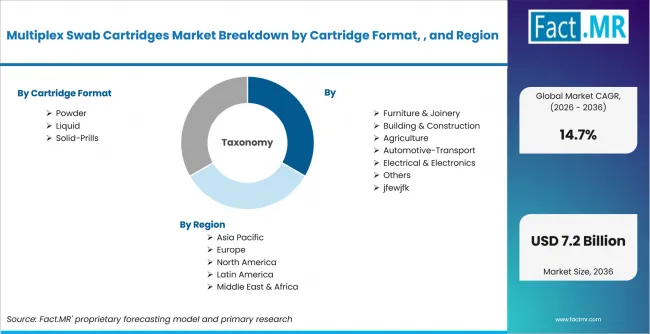
Multiplex Swab Cartridges Market Breakdown By Cartridge Format, , And Region | Source: Fact.MR
| Attribute | Details |
|---|---|
| Quantitative Units | USD Billion in 2026 to USD Billion by 2036 at CAGR |
| Market Definition | Disposable molecular diagnostic cartridges that test swab samples for multiple pathogen targets |
| Cartridge Format | Fully Integrated Multiplex Cartridges; Multiplex PCR Pouches; Micro-PCR Chips; Cartridge-Ready Reagent Chambers; Semi-Integrated Swab Cartridges |
| Panel Type | Respiratory and Sore Throat Panels; Sexual Health Panels; Tuberculosis and Infectious Disease Panels; Antimicrobial Resistance Panels; Expanded Syndromic Panels |
| Swab Type | Nasopharyngeal and Anterior Nasal Swabs; Throat Swabs; Vaginal Swabs; Rectal Swabs; Lesion and Wound Swabs |
| Technology | Real-Time PCR Cartridges; Isothermal NAAT Cartridges; Multiplex PCR Pouches; Microfluidic PCR Chips; Dry-Reagent Amplification Modules |
| Testing Setting | Hospital and Near-Patient Testing Sites; Urgent Care Centers; Reference Laboratories; Public Health Programs; Home and OTC Testing Channels |
| Regions Covered | North America; Western Europe; Asia Pacific; Latin America; Middle East and Africa |
| Countries Covered | United States; India; Germany; Switzerland; China |
| Key Companies Profiled | Cepheid; bioMérieux/BioFire Diagnostics; Roche Diagnostics; QIAGEN; Visby Medical; Bosch Healthcare Solutions / Vivalytic |
| Forecast Period | 2026 to 2036 |
| Approach | Hybrid top-down and bottom-up approach using installed instrument base, assay menu expansion, swab cartridge pull-through and provider validation |
Source: Fact.MR analysis. Updated Jun 26, 2026
How is the market segmented?
-
By Cartridge Format:
- Fully Integrated Multiplex Cartridges
- Multiplex PCR Pouches
- Micro-PCR Chips
- Cartridge-Ready Reagent Chambers
- Semi-Integrated Swab Cartridges
-
By Panel Type:
- Respiratory and Sore Throat Panels
- Sexual Health Panels
- Tuberculosis and Infectious Disease Panels
- Antimicrobial Resistance Panels
- Expanded Syndromic Panels
-
By Swab Type:
- Nasopharyngeal and Anterior Nasal Swabs
- Throat Swabs
- Vaginal Swabs
- Rectal Swabs
- Lesion and Wound Swabs
-
By Technology:
- Real-Time PCR Cartridges
- Isothermal NAAT Cartridges
- Multiplex PCR Pouches
- Microfluidic PCR Chips
- Dry-Reagent Amplification Modules
-
By Testing Setting:
- Hospital and Near-Patient Testing Sites
- Urgent Care Centers
- Reference Laboratories
- Public Health Programs
- Home and OTC Testing Channels
-
Region:
- North America
- United States
- Canada
- Europe
- Germany
- Switzerland
- United Kingdom
- France
- Netherlands
- Asia Pacific
- India
- China
- Japan
- South Korea
- Singapore
- Latin America
- Brazil
- Mexico
- Argentina
- Middle East & Africa
- UAE
- Saudi Arabia
- South Africa
- Israel
- North America
Frequently Asked Questions
Which cartridge format leads the Multiplex Swab Cartridges Market?
Which panel type leads the Multiplex Swab Cartridges Market?
Which swab type leads the Multiplex Swab Cartridges Market?
Which technology leads the Multiplex Swab Cartridges Market?
Which testing setting leads the Multiplex Swab Cartridges Market?
Which country expands fastest in the Multiplex Swab Cartridges Market?
How does India perform in the Multiplex Swab Cartridges Market?
How does Germany perform in the Multiplex Swab Cartridges Market?
How does Switzerland perform in the Multiplex Swab Cartridges Market?
How does China perform in the Multiplex Swab Cartridges Market?
What is the primary driver in the Multiplex Swab Cartridges Market?
What is the main restraint in the Multiplex Swab Cartridges Market?
Why are respiratory panels important in this market?
Why are fully integrated cartridges gaining adoption?
Who worked on this report


Preview the report firsthand - request a free sample
Free SampleGet the brochure for pricing and purchase details
Download PDF