- Market Value (2025): USD 670.0 Mn
- Estimated Value (2026): USD 762 Mn
- Forecast Value (2036): USD 2761.1 Mn
- CAGR (2026-2036): 13.7%
What is the Next-Gen Cathode Encapsulation Coatings Market forecast to be worth by 2036?
USD 762 million in 2026 to USD 2761.1 million by 2036 at a 13.7% CAGR.
- The Next-Gen Cathode cathode coatings Market reached USD 670.0 million in 2025.
- Demand is expected to increase from USD 762 million in 2026 to USD 2761.1 million by 2036.
- The market is forecast to record 13.7% CAGR from 2026 to 2036. cell makers qualify coated cathode mixes for EVs and new cell platforms.
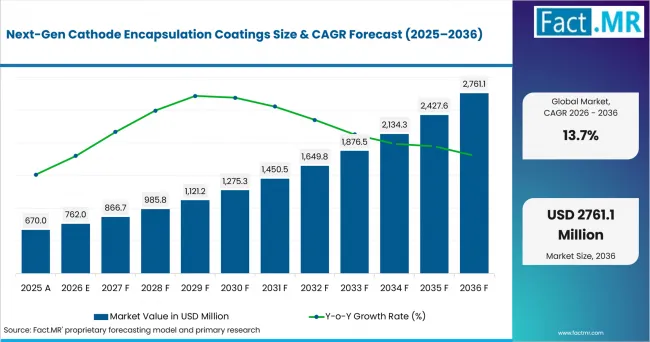
Next Gen Cathode Encapsulation Coatings Value Analysis | Source: Fact.MR
What are the defining numbers behind Next-Gen Cathode Encapsulation Coatings Market growth?
An absolute opportunity of USD 1999.1 million is expected between 2026 and 2036.
- Demand Drivers in the Market
- Cell manufacturers need stable cathode-electrolyte interfaces as battery deployment expands.
- Cathode material producers need coating systems that can be applied uniformly at particle scale while preserving lithium-ion transport and active-material capacity.
- Battery engineering teams need surface treatments compatible with nickel-rich and emerging solid-state architectures so higher energy density remains paired with controlled cathode-electrolyte behavior.
- Automotive battery programs need coating processes that can be qualified at commercial scale with consistent thickness and chemistry.
- Key Segments Analyzed
- By Coating Platform: Metal-oxide encapsulation is expected to hold 29.0% share in 2026 owing to its established role in stabilizing reactive cathode surfaces.
- By Functional Mechanism: Interfacial stabilization is projected to account for 30.0% share in 2026 as cell developers target lower parasitic reactivity at the cathode boundary.
- By Cell Format: Pouch cells are anticipated to capture 31.0% share in 2026 because thin stacked electrodes make coating consistency important for uniform cell behavior.
- By End Use: Electric vehicles are estimated to represent 26.0% share in 2026 due to high cycle-life requirements and sustained battery-manufacturing scale.
- Analyst Opinion at Fact.MR
- Shambhu Nath Jha, Principal Consultant at Fact.MR, states, “Cathode encapsulation is becoming a production qualification issue. The market is expected to favor suppliers that prove coating uniformity and stable electrochemical performance at manufacturing scale. Commercial success depends on matching coating chemistry with process control.”
- Strategic Implications
- Cathode producers should document coating thickness. Composition alongside cell test conditions. Clear process windows help cell customers compare interface results across candidate cathode systems. vendor data should connect particle-level coating control with cell-level resistance and capacity retention. That evidence is expected to reduce uncertainty during mix screening.
- Cell makers should test encapsulated cathodes under fast charging and high temperatures. The tests should match the intended duty cycle. testing should track resistance growth and capacity retention over repeated cycling. Testing should include the cell-fluid mix planned for commercialization. Chemistry-specific check is expected to make coating benefits easier to separate from broader cell-design effects.
- Coating-mix vendors should design chemistries around existing cathode synthesis and finishing steps. Easier integration reduces process changes during scale-up. Keeps test work focused on cell results. fit with plate binders. Conductive additives is expected to matter during downstream plate line work. vendors should document how the coating behaves after mixing and calendaring.
- cell developers should align coating programs with the cathode chemistry roadmap and available raw-mix base. Surface treatment choices need to remain compatible with changes in nickel content and solid-cell fluid interfaces. A coating platform that can be tuned across more than one cathode family is expected to reduce repeated work work. mix selection should stay linked to the intended voltage window.
Belgium is forecast at 14.5% CAGR through 2036. Followed by South Korea at 14.0%. The USA reaches 13.7%. Japan 13.0% and Germany 11.9% as cell investment. Testing conditions differ by country.
How does the Next-Gen Cathode Encapsulation Coatings Market break down by segment?
Pouch cells lead Cell Format at 31.0%. surface control leads Functional Mechanism at 30.0%.
Which Coating Platform leads?
Metal-oxide coating is expected to hold 29.0% share in 2026.
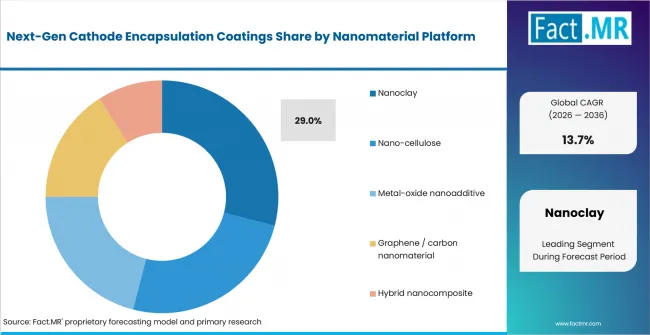
Next Gen Cathode Encapsulation Coatings Analysis By Nanomaterial Platform | Source: Fact.MR
Metal-oxide coating is expected to remain important. Reactive cathode surfaces require controlled contact with cell fluid. Uniform layer formation therefore carries direct weight in market testing. Metal-oxide systems are expected to compete on thickness control and thermal-process fit.
What leads the Functional Mechanism segment?
surface control is expected to account for 30.0% share in 2026.
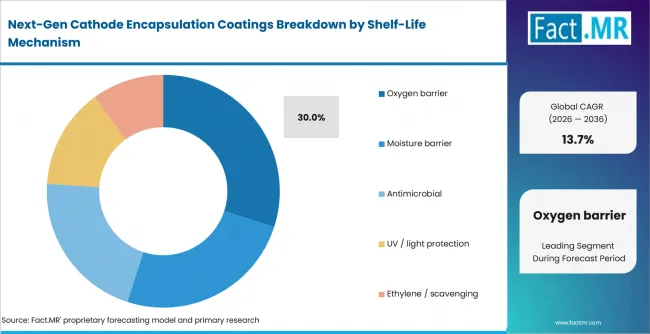
Next Gen Cathode Encapsulation Coatings Analysis By Shelf Life Mechanism | Source: Fact.MR
Interfacial stabilization addresses degradation where active material meets the electrolyte system. Encapsulation is expected to reduce unwanted surface reactions and slow impedance growth when the chemistry is well matched. Electrolyte additives can influence the same boundary through solution chemistry. Cell developers therefore need to test coating and electrolyte choices together before assigning performance gains to one component.
How does Cell Format shape demand?
Pouch cells are expected to hold 31.0% share in 2026.
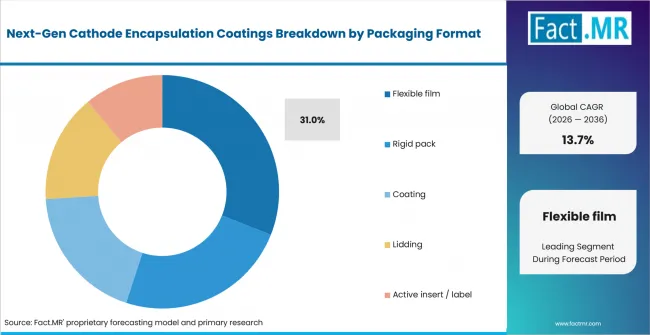
Next Gen Cathode Encapsulation Coatings Analysis By Packaging Format | Source: Fact.MR
Pouch cells use stacked electrodes inside a flexible package. Local non-uniformity can appear through swelling and impedance changes. Cathode encapsulation is expected to improve interface consistency across large coated areas. Downstream electrode binders still need to maintain adhesion after coated particles enter slurry preparation. Cell developers are therefore expected to qualify the full electrode formulation rather than the cathode powder alone.
What supports Electric Vehicles within End Use?
EVs are expected to represent 26.0% share in 2026.
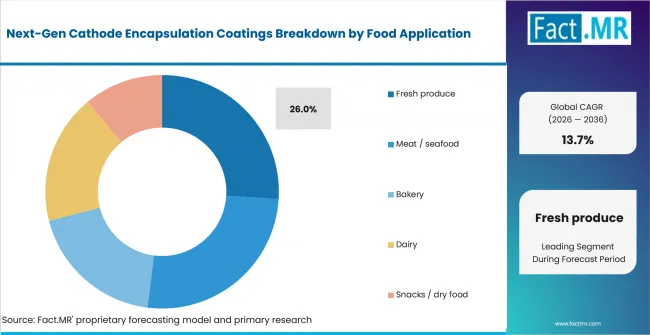
Next Gen Cathode Encapsulation Coatings Analysis By Food Application | Source: Fact.MR
EVs are expected to represent 26.0% share in 2026. Traction cells place repeated cycle-life and fast-charge demands on cathodes. Large automotive programs favor coating approaches. Retain stable interface behavior after formation and repeated charging. market selection therefore depends on measurable durability at cell level. vendors are expected to support check across the cell formats used in EV platforms.
What is accelerating Next-Gen Cathode Encapsulation Coatings Market adoption, and what is holding it back?
Higher-energy cathode testing drives adoption. coating complexity and cost pressure restrain it.
Drivers Impact Analysis
| DRIVER | (~) % IMPACT ON CAGR | GEOGRAPHIC RELEVANCE | IMPACT TIMELINE |
|---|---|---|---|
| High-voltage cathode interface control | +1.8% | Global | Short term (<= 2 years) |
| Nickel-rich cathode stabilization | +1.5% | North America, Europe, East Asia | Medium term (2-4 years) |
| Semi-solid and solid-state development | +1.2% | Japan, South Korea, Europe | Long term (>= 4 years) |
| Battery manufacturing localization | +0.9% | USA, Europe | Medium term (2-4 years) |
Source: Fact.MR analysis. Updated Sep 22, 2026
Opportunity Impact Analysis
| OPPORTUNITY | (~) % IMPACT ON CAGR | GEOGRAPHIC RELEVANCE | IMPACT TIMELINE |
|---|---|---|---|
| Composite coating architectures | +1.0% | Global | Medium term (2-4 years) |
| Dry and lower-solvent coating routes | +0.8% | North America, Europe | Long term (>= 4 years) |
| Recycled-metal cathode integration | +0.6% | Europe | Medium term (2-4 years) |
Source: Fact.MR analysis. Updated Sep 22, 2026
Restraints Impact Analysis
| RESTRAINT | (~) % IMPACT ON CAGR | GEOGRAPHIC RELEVANCE | IMPACT TIMELINE |
|---|---|---|---|
| Qualification time and process sensitivity | -0.7% | Global | Short term (<= 2 years) |
| Cathode material price pressure | -0.5% | Global | Medium term (2-4 years) |
| Critical-mineral concentration | -0.4% | North America, Europe, East Asia | Long term (>= 4 years) |
Source: Fact.MR analysis. Updated Sep 22, 2026
Which countries are scaling the Next-Gen Cathode Encapsulation Coatings Market through 2036?
- The country comparison spans 2.6 percentage points. Forms three practical growth bands across the forecast period.
- Belgium remains 0.5 percentage point above South Korea. Electrified-vehicle demand and access to the wider European cell value chain support cathode-mix testing.
- South Korea remains 0.3 percentage point above the USA through cell output depth. EV expansion and continued work of high-energy cathode mixes.
- The USA remains 0.7 percentage point above Japan. Domestic investment in cell mixes and cell output supports coating testing.
- Japan remains 1.1 percentage points above Germany through new cell policy. Solid-state cell work and domestic cathode-mix expertise.
- Germany closes the displayed range as European cell-mix investment. Recycling projects and plant scale-up strengthen the local testing base.
Similar CAGRs can still create different market conditions. Key factors include cell output, cathode investment. EV adoption, testing needs, and new cell work. Full report coverage includes North America, Latin America, Western Europe. Eastern Europe, East Asia. South Asia & Pacific, Middle East & Africa.
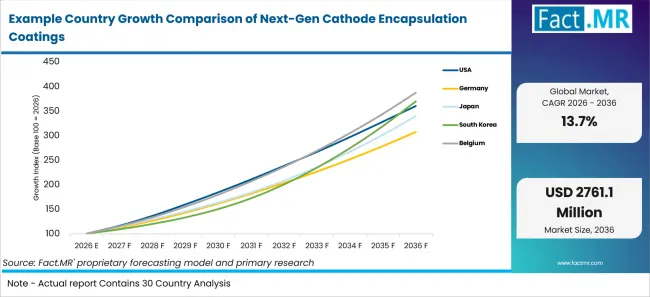
Example Country Growth Comparison Of Next Gen Cathode Encapsulation Coatings | Source: Fact.MR
| Country | CAGR (2026-2036) |
|---|---|
| Belgium | 14.5% |
| South Korea | 14.0% |
| USA | 13.7% |
| Japan | 13.0% |
| Germany | 11.9% |
Source: Fact.MR analysis. Updated Sep 22, 2026
What supports USA adoption?
13.7% CAGR, supported by domestic cell-mix investment and cell-plant growth.
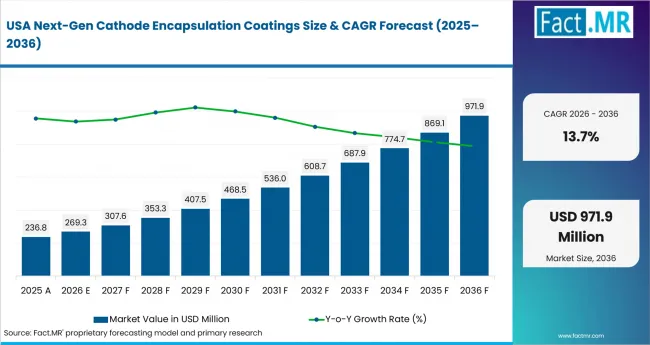
Next Gen Cathode Encapsulation Coatings Country Value Analysis | Source: Fact.MR
U.S. cell programs are expected to expand test work for cathode coatings. Domestic mix capacity grows. The U.S. Department of Energy announced in January 2025 an intent to provide up to USD 725 million for domestic cell critical mixes. Components and advanced cells. Cathode vendors can use local work cycles to align coating chemistry with cell-output needs. market progress is expected to depend on repeatable coating thickness. Stable cell results during automotive check.
What supports Germany adoption?
11.9% CAGR, led by European cell-mix investment and plant scale-up.
Germany is expected to remain an important European testing base for cathode mixes and related surface treatments. The Federal Ministry for Economic Affairs. Energy announced in December 2025 around EUR 170 million for seven transformation projects. Include cell recycling and cell-grade lithium salt output. A broader local mixes base is expected to support interaction between cathode vendors and cell programs. Coating vendors are likely to gain. Integration fits established mix finishing and quality-control steps.
What supports Japan adoption?
13.0% CAGR, backed by new cell policy and cathode-mix expertise.
Japan is expected to expand demand for interface-control mixes. Solid-state cell work moves closer to plant output. The Ministry of Economy. Trade and Industry revised its cell strategy in June 2026 with a target for 150 GWh per year of domestic output capacity from 2030 into the mid-2030s. Cathode coating is expected to benefit from programs. Require stable contact between active mix and solid cell fluid. vendor selection is likely to emphasize consistency across long work cycles.
How is South Korea developing demand?
14.0% CAGR, driven by cell output depth and expanding electric mobility.
South Korea is expected to maintain active cathode-mix work around high-energy cell platforms. The Ministry of Climate, Energy and Environment reported on January 30. 2026. South Korea had 899,101 registered EVs at year-end 2025. A larger electric-vehicle base reinforces domestic cell engineering activity and mix testing. coating vendors are expected to compete through surface stability and process fit. Cell makers refine nickel-rich cathode systems for market vehicle programs.
What supports Belgium adoption?
14.5% CAGR, shaped by vehicle electrification. Access to the wider European cell value chain.
Belgium is forecast to record the highest listed CAGR. Electrified-vehicle demand and European mixes activity widen the addressable market for cell tech. Statbel reported on January 29, 2026. 307,936 new passenger cars registered in Belgium in 2025 were hybrid or electric. Representing 72.8% of new passenger-car registrations. The country can support cathode-coating commercialization through cross-border access to European cell and mixes programs. vendors are expected to focus on testing support. Traceable process results for regional customers.
Who leads the Next-Gen Cathode Encapsulation Coatings Market?
BASF has direct participation through BASF Shanshan Battery Materials, which has developed cathode active material incorporating a composite coating layer. Its work with high-nickel NCM materials and semi-solid-state battery applications connects cathode chemistry with surface stabilization and manufacturing-scale qualification.
LG Chem and Volexion are also profiled as relevant participants in cathode materials and surface-engineering development. Their inclusion reflects the wider competitive field around coated cathode materials, interface-control technologies, and emerging approaches intended to improve cathode stability in advanced rechargeable cells.
Rather than relying on coating chemistry alone, suppliers must demonstrate that the encapsulation layer remains uniform and compatible with cathode processing. Cell developers also evaluate how coatings influence interfacial stability, lithium-ion transport, resistance growth, and performance after repeated cycling.
Which companies are the key providers?
Key companies include BASF. LG Chem. and Volexion.
- BASF
- LG Chem
- Volexion
Bibliography
- International Energy Agency. (2026, May 20). Electric vehicle batteries. In Global EV Outlook 2026.
- BASF. (2025, August 29). BASF delivers first cathode active materials for semi-solid-state batteries to WELION New Energy.
- U.S. Department of Energy. (2025, January 10). DOE issues notice of intent for funding in strengthening domestic critical materials processing and manufacturing to enhance national security.
- Bundesministerium für Wirtschaft und Energie. (2025, December 19). 170 Millionen Euro für Transformationsprojekte in den Kohleregionen im Rahmen des Bundesförderprogramms STARK (Stärkung der Transformationsdynamik und Aufbruch in den Revieren und an den Kohlekraftwerkstandorten) [€170 million for transformation projects in coal regions under the STARK federal funding programme].
- Ministry of Economy, Trade and Industry. (2026, June 2). “Battery Industry Strategy” revised as the “Battery and Power Industry Strategy”.
- Statbel. (2026, January 29). Registrations down, electrification up: the Belgian car market is changing.
This Report Answers
- The report explains where cathode encapsulation coatings fit within cathode active material production and cell qualification.
- Segment analysis identifies the leading coating platform and functional mechanism. It also covers cell format and end-use categories using the 2026 shares.
- Country analysis compares the five country CAGRs and links them to official battery, EV and manufacturing evidence.
- Competitive analysis separates verified cathode-coating activity from related polymer and conductive-material businesses.
- Application analysis considers interface stability and coating uniformity. It also reviews qualification time and cost pressure in commercial battery programs.
What does the Next-Gen Cathode Encapsulation Coatings Market cover?
The market covers materials and processes that create a protective or functional layer around cathode active material particles or at the cathode interface. These layers are used to manage surface reactions while maintaining lithium-ion transport. The boundary includes coatings applied during cathode-material finishing and composite layers developed for demanding battery chemistries.
Coverage includes metal-oxide and phosphate encapsulation approaches for lithium-ion cathode systems.Carbon-based layers create a link with graphene battery development where conductive surface engineering is required. Hybrid layers are included when the coating has a clear cathode-interface function. Solid-state cathode systems are covered when encapsulation manages contact with solid electrolyte.
What is included in the scope?
Commercial assessment covers pouch and prismatic cells along with cylindrical cells.
It spans electric vehicles and stationary storage plus other battery uses.
What is excluded from the scope?
The scope excludes separator coatings and general polymer masterbatches.
It also excludes food-packaging barriers, current-collector coatings, and anode-only materials. Electrode binders are treated as adjacent inputs because they hold the electrode together after cathode particles are coated.
How Was the Analysis Built?
The analysis draws on 120+ sources, 35+ company portfolios, 25+ countries, and more than 20 industry interviews.
- Primary Research: Primary research includes discussions with manufacturers, service providers, technology developers, distributors, end users, and subject-matter experts. These conversations examine purchasing priorities, product adoption, operational challenges, approval requirements, competitive positioning, and the factors that influence wider market acceptance.
- Desk Research: Desk research covers government statistics, regulatory publications, company filings, trade data, technical studies, industry associations, standards, public policy, and other authoritative sources. Every source used in the analysis is documented in the bibliography.
- Market Sizing and Forecasting: Market estimates combine historical performance, demand indicators, pricing and volume trends, segment shares, company participation, country-level growth, adoption patterns, investment activity, and barriers to market expansion.
- Data Validation and Update Cycle: Findings are validated by comparing primary interviews with public data, company activity, regulatory changes, trade patterns, and industry developments. Regular updates review new product launches, capacity changes, partnerships, approvals, and shifts in commercial adoption.
Segmentation
What is the report’s scope and coverage?
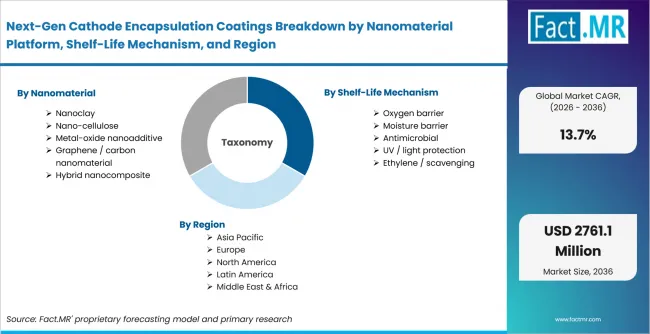
Next Gen Cathode Encapsulation Coatings Breakdown By Nanomaterial Platform, Shelf Life Mechanism, And Region | Source: Fact.MR
| Attribute | Details |
|---|---|
| Quantitative Units | USD million |
| Market Definition | Coatings or encapsulation layers applied to cathode active material particles or cathode interfaces to improve surface stability, reduce unwanted reactions and support cycle performance in rechargeable batteries. |
| Coating Platform | Metal-oxide encapsulation; Phosphate-based layer; Carbon or graphene layer; Hybrid inorganic-organic layer |
| Functional Mechanism | Interfacial stabilization; Electrolyte protection; Thermal stability; Conductivity support |
| Cell Format | Pouch; Prismatic; Cylindrical |
| End Use | Electric vehicles; Stationary storage; Consumer electronics; Industrial and specialty |
| Regions Covered | North America; Latin America; Western Europe; Eastern Europe; East Asia; South Asia & Pacific; Middle East & Africa |
| Countries Covered | USA; Germany; Japan; South Korea; Belgium |
| Key Companies Profiled | BASF; LG Chem; Volexion |
| Forecast Period | 2026 to 2036 |
| Approach | Hybrid top-down and bottom-up assessment using battery deployment, cathode-material economics, public manufacturing investment, country electrification indicators and verified supplier activity. |
Source: Fact.MR analysis. Updated Sep 22, 2026
How is the market segmented?
-
By Coating Platform:
- Metal-oxide encapsulation
- Phosphate-based layer
- Carbon or graphene layer
- Hybrid inorganic-organic layer
-
By Functional Mechanism:
- Interfacial stabilization
- Electrolyte protection
- Thermal stability
- Conductivity support
-
By Cell Format:
- Pouch
- Prismatic
- Cylindrical
-
By End Use:
- Electric vehicles
- Stationary storage
- Consumer electronics
- Industrial and specialty
-
By Region:
- North America
- Latin America
- Western Europe
- Eastern Europe
- East Asia
- South Asia & Pacific
- Middle East & Africa
Frequently Asked Questions
How big is the next-gen cathode encapsulation coatings market in 2026?
What is the CAGR of the next-gen cathode encapsulation coatings market from 2026 to 2036?
Which functional mechanism leads the market?
Which cell format leads the market?
Which companies are profiled?
Who worked on this report


Preview the report firsthand - request a free sample
Free SampleGet the brochure for pricing and purchase details
Download PDF