- Market Value (2025): USD 560.8 Mn
- Estimated Value (2026): USD 614.0 Mn
- Forecast Value (2036): USD 1518.9 Mn
- CAGR (2026-2036): 9.5%
What is the Odor-Control Polymer Matrices Market forecast to be worth by 2036?
USD 614.0 million in 2026 to USD 1518.9 million by 2036 at a 9.5% CAGR.
- The Odor-Control Polymer Matrices Market reached USD 560.8 million in 2025.
- Demand is projected to increase from USD 614.0 million in 2026 to USD 1518.9 million by 2036.
- The market is forecast to record a 9.5% CAGR from 2026 to 2036 as automotive interior suppliers, packaging converters and polymer recyclers qualify lower-odor formulations for more demanding applications.
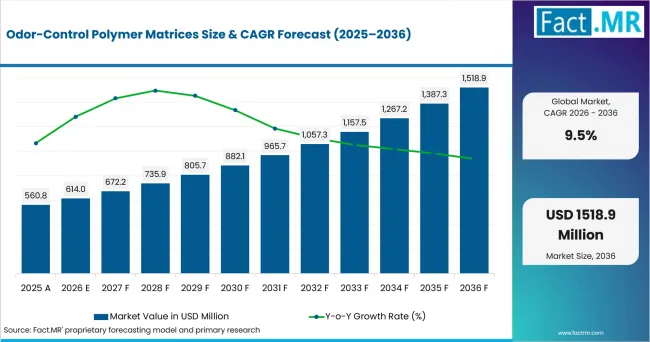
Odor Control Polymer Matrices Value Analysis | Source: Fact.MR
What are the defining numbers behind Odor-Control Polymer Matrices Market growth?
An absolute opportunity of USD 904.8 million is expected between 2026 and 2036.
- Demand Drivers in the Market
- Packaging converters need odor-control systems when post-consumer resin carries residues from prior contents or thermal history. The U.S. Census Bureau’s November 2025 full report, released on January 29, 2026, showed preliminary, not seasonally adjusted year-to-date shipments of plastics and rubber products of USD 278.387 billion through November 2025.
- Recyclers need consistent treatment when feedstock odor changes between incoming lots. The U.S. Department of Energy reported in August 2026 that the REMADE Institute awarded USD 4.8 million across 10 projects for materials recovery, remanufacturing and recycling technologies.
- Automotive material teams need lower-odor polymers because vehicle-interior materials can emit VOCs and carbonyl compounds. UNECE’s Mutual Resolution No. 3 provides a harmonized test procedure for measuring interior-air emissions from materials used in vehicle interiors. Separately, Eurostat reported in October 2025 that the EU generated 35.3 kg of plastic packaging waste per person in 2023, of which 14.8 kg was recycled.
- Key Segments Analyzed
- By Odor-Control Chemistry: Mineral adsorbent is expected to hold 26.0% share in 2026 because porous mineral systems can capture a broad range of odor-forming molecules while fitting familiar masterbatch and compounding routes.
- By Target Odor: VOC / aldehyde is projected to account for 27.0% share in 2026 as automotive interiors and consumer-facing polymer applications apply direct screening to emissions that influence sensory acceptance.
- By Polymer: PP is anticipated to capture 39.0% share in 2026 owing to its broad use in molded interiors, packaging and recycled compounds where odor can become a release criterion during material qualification.
- By Application: Automotive interiors are estimated to represent 38.0% share in 2026 because cabin materials are assessed for odor together with emissions, appearance and mechanical behavior before component approval.
- Analyst Opinion at Fact.MR
- Shambhu Nath Jha, Principal Consultant at Fact.MR, states, “Odor control becomes commercially relevant when it prevents a technically acceptable polymer from being rejected at the final application stage. Demand is expected to favor systems that work at practical dosing levels while keeping melt flow, appearance and mechanical behavior stable. Suppliers that combine broad-spectrum odor control with resin-specific application testing can shorten qualification work for compounders and converters.”
- Strategic Implications
- Masterbatch producers should document dosage windows by resin type and odor source, then connect those results with adjacent odor-scavenging masterbatches used in recycled and virgin polymers. Clear dose-response data make it easier for processors to translate laboratory results into stable line settings without overloading the formulation.
- Recycled-resin compounders should separate incoming feedstock variability from additive performance and compare results with recycled polymer odor-scavenging additives. Incoming-material controls can show whether a change in smell comes from the feedstock mix, processing history or the treatment package itself.
- Automotive material suppliers should pair sensory testing with VOC and aldehyde measurements. Adjacent automotive plastic components use many of the same PP, TPO and polyurethane systems that appear in interior trim, seating and consoles, so odor performance needs to remain compatible with the full component specification.
- Packaging converters should evaluate odor after processing and storage, especially where recycled PE or PP enters consumer-facing formats. Related odour-control technology for high-PCR HDPE illustrates why residual smell can influence the practical placement of secondary resin even when dimensional and mechanical targets are met.
France is forecast to record 12.0% CAGR through 2036 as automotive renewal and recycled-plastic quality requirements raise attention to odor control. The USA is projected to post 10.0% as polymer conversion and vehicle output support functional-additive use. Japan is anticipated to advance at 9.3% as plastic-resource circulation increases qualification work. Germany is estimated at 8.3% owing to its large recycling and plastics-processing base. Spain is forecast at 7.7% as automotive manufacturing and packaging conversion sustain material-performance requirements.
How does the Odor-Control Polymer Matrices Market break down by segment?
PP leads Polymer at 39.0% share in 2026; while Automotive interiors lead Application at 38.0% share.
Which Odor-Control Chemistry dominates?
Mineral adsorbent is expected to hold 26.0% share in 2026.
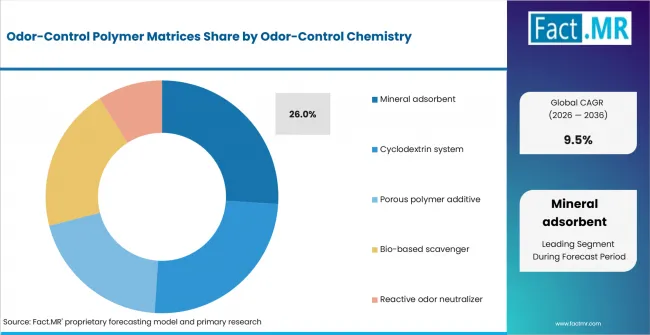
Odor Control Polymer Matrices Analysis By Odor Control Chemistry | Source: Fact.MR
Mineral adsorbents are expected to lead because their porous structures can capture several odor-forming molecules without requiring a reaction with each individual compound. Zeolite and related minerals can be delivered in masterbatch form and remain practical across common extrusion temperatures. Cyclodextrin systems serve formulations that benefit from molecular inclusion, while porous polymer additives provide an organic-matrix route. Bio-based scavengers and reactive neutralizers address narrower chemistry or documentation needs. The category overlaps with formulation additives where dispersion and compatibility determine whether the active package performs consistently after compounding.
What leads the Target Odor segment?
VOC / aldehyde is projected to account for 27.0% share in 2026.
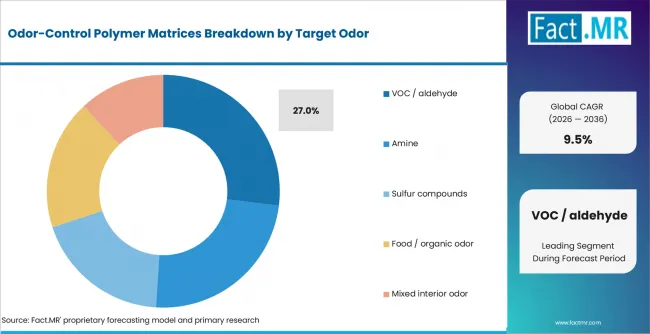
Odor Control Polymer Matrices Analysis By Target Odor | Source: Fact.MR
VOC and aldehyde control is projected to lead because these emissions are directly relevant to automotive cabins, foam systems and consumer-facing plastics. Amine control remains important in polyurethane and curing-related applications, while sulfur compounds require treatments suited to very low odor thresholds. Food and organic odors appear more often in packaging and recycled material streams. Mixed interior odor can combine several volatile sources, which increases the value of broad-spectrum adsorption before a processor moves to a narrow reactive chemistry. The segment therefore favors systems that are matched to the dominant odor profile rather than selected only by additive price.
How does Polymer shape demand?
PP is anticipated to lead with 39.0% share in 2026.
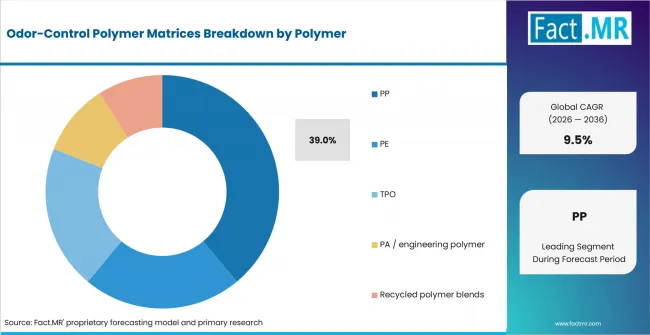
Odor Control Polymer Matrices Analysis By Polymer | Source: Fact.MR
PP is anticipated to lead because it is widely processed in automotive interiors, rigid packaging and molded consumer goods. The material is also central to polyolefin compounds where fillers, stabilizers and functional additives are introduced during compounding. PE follows across film, bottles and molded packaging. TPO demand is tied closely to interior trim and soft-touch automotive parts. PA and other engineering polymers require odor-control systems that tolerate higher processing temperatures. Recycled polymer blends create the most variable feedstock conditions, so formulation work must balance odor reduction with melt behavior and mechanical properties.
What supports Automotive interiors within Application?
Automotive interiors are estimated to represent 38.0% share in 2026.
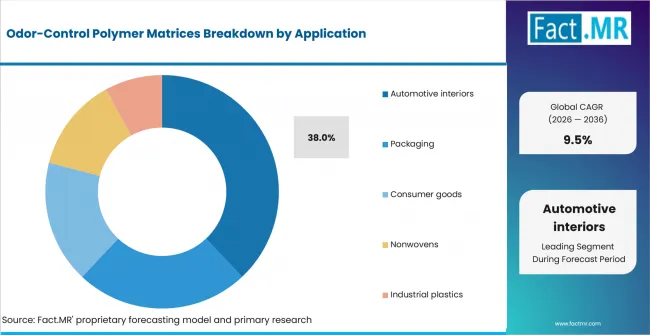
Odor Control Polymer Matrices Analysis By Application | Source: Fact.MR
Automotive interiors are estimated to lead because occupants experience odor directly inside a confined cabin and heat can amplify volatile release from polymer components. PP, TPO, polyurethane foams and engineering plastics can contribute different emission profiles. Material teams therefore evaluate sensory behavior together with VOC performance, surface quality and mechanical properties before release. Adjacent polyolefin odor neutralizers are relevant where recycled PE or PP enters interior parts and odor acceptance becomes part of the final material qualification process.
What is accelerating Odor-Control Polymer Matrices Market adoption, and what is holding it back?
Recycled-resin odor variability drives it; formulation and qualification complexity restrain it.
Drivers Impact Analysis
| DRIVER | (~) % IMPACT ON CAGR | GEOGRAPHIC RELEVANCE | IMPACT TIMELINE |
|---|---|---|---|
| Higher recycled-polymer use in visible applications | +1.5% | North America, Europe, East Asia | Short term (<= 2 years) |
| Automotive cabin odor and VOC qualification | +1.2% | Europe, Japan, USA | Medium term (2-4 years) |
| Broader masterbatch use in packaging and consumer goods | +0.9% | Global | Medium term (2-4 years) |
| Need for stable odor control across mixed feedstocks | +0.7% | Europe, North America | Long term (>= 4 years) |
Source: Fact.MR analysis. Updated Sep 21, 2026
Opportunity Impact Analysis
| OPPORTUNITY | (~) % IMPACT ON CAGR | GEOGRAPHIC RELEVANCE | IMPACT TIMELINE |
|---|---|---|---|
| Odor control for high-PCR PP and PE compounds | +1.1% | Europe, North America | Short term (<= 2 years) |
| Low-VOC automotive interior formulations | +0.8% | Germany, Japan, USA | Medium term (2-4 years) |
| Bio-based and reactive scavenger systems | +0.6% | Western Europe, Japan | Long term (>= 4 years) |
Source: Fact.MR analysis. Updated Sep 21, 2026
Restraints Impact Analysis
| RESTRAINT | (~) % IMPACT ON CAGR | GEOGRAPHIC RELEVANCE | IMPACT TIMELINE |
|---|---|---|---|
| Variable odor chemistry across recyclate lots | -0.6% | Global | Short term (<= 2 years) |
| Additive loading can affect color or mechanical properties | -0.4% | Global | Medium term (2-4 years) |
| Application-specific testing extends qualification cycles | -0.3% | Automotive markets | Medium term (2-4 years) |
Source: Fact.MR analysis. Updated Sep 21, 2026
Which countries are scaling the Odor-Control Polymer Matrices Market through 2036?
- The country comparison spans 4.3 percentage points across the five profiled markets.
- France remains 2.0 percentage points above the USA as automotive renewal and recycled-material quality requirements support material qualification.
- The USA remains 0.7 percentage point above Japan as a large plastics-conversion base supports masterbatch use across packaging and automotive applications.
- Japan remains 1.0 percentage point above Germany as plastic-resource circulation programs broaden the need for controlled recycled-material performance.
- Germany remains 0.6 percentage point above Spain through a larger packaging-recycling base and established automotive polymer processing.
- Spain closes the displayed range as automotive manufacturing and packaging conversion sustain demand for odor-sensitive polymer formulations.
Comparable CAGRs can create different entry conditions because odor-control demand depends on polymer mix, recycled-content use, automotive qualification and packaging conversion. Full report coverage includes North America, Latin America, Western Europe, Eastern Europe, East Asia, South Asia & Pacific, Middle East & Africa.
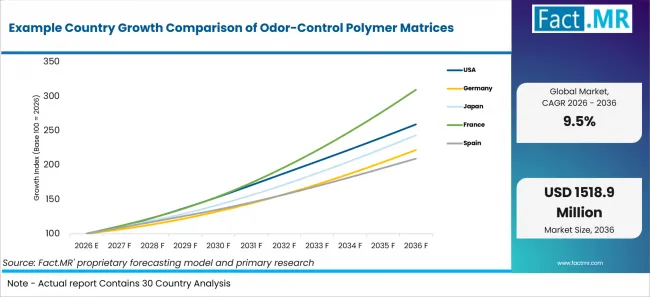
Example Country Growth Comparison Of Odor Control Polymer Matrices | Source: Fact.MR
| Country | CAGR (2026-2036) |
|---|---|
| France | 12.0% |
| United States | 10.0% |
| Japan | 9.3% |
| Germany | 8.3% |
| Spain | 7.7% |
Source: Fact.MR analysis. Updated Sep 21, 2026
What supports France adoption?
12.0% CAGR, supported by automotive renewal and recycled-plastic quality requirements.
France combines a large vehicle replacement channel with packaging applications that increasingly use recycled polymers. The Statistical Data and Studies Service reported in February 2026 that 1.665 million new passenger cars were registered in France during 2025. Each new platform creates interior-material qualification work across PP, TPO, foams and engineering polymers where odor can affect cabin acceptance. Packaging converters face a related issue when post-consumer resin carries residual food, detergent or adhesive odors. Mineral adsorbents and reactive neutralizers are therefore expected to gain attention where processors need sensory improvement while retaining color, melt flow and mechanical performance in the finished polymer part.
How is the USA scaling demand?
10.0% CAGR, driven by plastics conversion and automotive output.
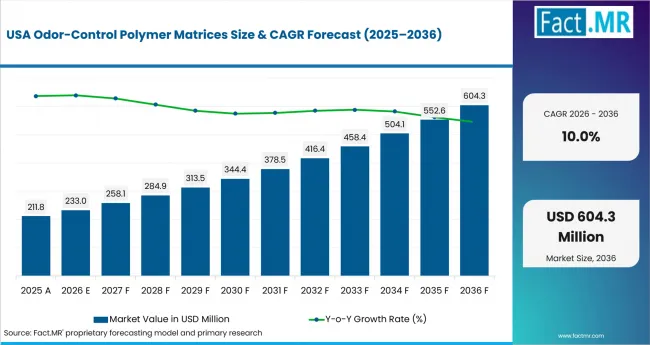
Odor Control Polymer Matrices Country Value Analysis | Source: Fact.MR
The United States has a broad base of polymer conversion across vehicle interiors, packaging and molded consumer goods. U.S. Bureau of Economic Analysis data published through FRED showed that “Motor vehicle output: Final sales of domestic product” was USD 755.023 billion in 2025, with the series updated on April 9, 2026. Automotive material teams can therefore represent a large qualification channel for low-odor PP, TPO and polyurethane systems. Recycled polymer blends add another route because feedstock odor can change with prior contents and sorting quality. Suppliers that document resin-specific dosage, VOC behavior and sensory results are expected to have an advantage when converters compare embedded odor-control systems with downstream deodorization steps.
How does Japan perform?
9.3% CAGR, led by plastic-resource circulation and transport applications.
Japan’s market is shaped by material consistency and the need to place recycled plastics into higher-value uses. The Ministry of the Environment reported in July 2025 the results of seven projects adopted under its FY2024 advanced model-formation support program for plastic resource circulation. That work supports wider evaluation of recycled-material collection and processing routes, which is relevant when residual odor limits the use of secondary polymers in visible products. PP and engineering polymers remain important for transport and consumer applications. Odor-control suppliers are expected to compete on stable performance after compounding, especially where higher processing temperatures or tight appearance requirements reduce the acceptable additive window.
What is supporting Germany’s adoption?
8.3% CAGR, supported by packaging recycling and polymer processing.
Germany has a mature recycling system that moves large volumes of secondary material back into manufacturing. The German Environment Agency and the Central Agency Packaging Register reported in January 2026 that around 5.5 million tonnes of packaging waste collected by the dual systems were recycled in 2024. Higher recovered-material use increases the importance of odor consistency because incoming streams can carry residues from prior contents, storage or repeated thermal processing. Automotive interior suppliers create another application channel for low-odor PP, TPO and foam systems. Suppliers are expected to gain more from formulation support when they can show how treatment behaves across changing recyclate lots and common German conversion processes.
What supports Spain’s growth?
7.7% CAGR, backed by automotive manufacturing and packaging conversion.
Spain combines automotive assembly with a sizable packaging and consumer-products conversion base. Eurostat reported in July 2026 that Spain recorded a 4.4% passenger-car renewal rate in 2025. Vehicle turnover sustains qualification work for interior polymer components where smell, VOC behavior and surface performance are evaluated together. Packaging converters provide a second route for odor-control matrices as recycled PE and PP move into bottles, closures and molded formats. The commercial challenge is formulation repeatability, since feedstock composition can vary between collection streams. Suppliers that support application trials and stable dosing are expected to be better aligned with converter requirements.
Who leads the Odor Control Polymer Matrices Market?
Avient, BASF, Clariant, Ampacet, Evonik and Tosaf are active across odor-control, low-odor, low-VOC and polymer-additive systems relevant to the market.
Ampacet markets OdorClear™, a range of wide-spectrum odor-absorbing masterbatches designed to reduce odors in post-consumer recycled materials. The products are suitable for a broad range of recycled polymers and can be formulated for injection molding, blow molding, film and other extrusion processes. Tosaf markets OdorSeal™ as an odor-control solution in which odor scavengers absorb and eliminate odors associated with recycled materials, including applications with demanding organoleptic requirements. These technologies are relevant where recycled polyethylene, polypropylene and other polymer streams require odor reduction before conversion into end-use products. Related recycled polyolefins provide a broader material base for odor-control additives as recycled-content use expands.
Avient contributes adjacent automotive functionality through masterbatch technology. In February 2025, the company documented the use of Smartbatch™ FX metallic-effect concentrates in PC/ABS side panels for the center console of a compact SUV. The molded-in-color approach eliminated painting, reduced VOCs and lowered cost per part by 30% or more compared with painted parts. Evonik provides low-odor and very-low-VOC polyurethane surfactants for automotive applications, including TEGOSTAB® B 8734 LO and TEGOSTAB® B 8761 LO. TEGOSTAB B 8734 LO is designed for odor-sensitive polyurethane foams and is positioned for automotive seating and interior applications, while Evonik identifies both products within its low-odor automotive polyurethane-additives portfolio. These solutions demonstrate how low-odor and low-emission characteristics can be incorporated directly into polymer and foam formulations.
BASF remains relevant through low-VOC polyurethane materials for vehicle interiors, including applications such as seating, instrument panels, door panels and acoustic foams. Clariant supplies automotive polymer additives through its AddWorks™ ATR portfolio, including light, heat and processing stabilizers for interior applications designed to meet stringent VOC requirements. AddWorks™ ATR 945 products are also documented as low-odor stabilizers for polypropylene compounds used in automotive applications. Competitive differentiation in this area is likely to depend on odor-reduction performance, polymer compatibility, dosage requirements, VOC performance and application-specific documentation. Suppliers combining odor-control capabilities with broader plastic antioxidant systems and stabilization expertise can support compounders seeking to manage odor, oxidation and processing stability in recycled and automotive polymer formulations.
Which companies are profiled in this report?
Companies profiled include Avient; BASF; Clariant; Ampacet; Evonik; and Tosaf.
- Avient
- BASF
- Clariant
- Ampacet
- Evonik
- Tosaf
Bibliography
- U.S. Census Bureau. (2026, January 29). Monthly full report on manufacturers’ shipments, inventories and orders: November 2025.
- U.S. Department of Energy. (2026, August 14). DOE’s REMADE Institute awards $4.8 million to strengthen materials recovery and recycling in American manufacturing.
- Service des données et études statistiques. (2026, February 11). Données 2025 sur les immatriculations des véhicules.
- German Environment Agency, & Central Agency Packaging Register. (2026, January 27). Facts against myths: Packaging waste recycling in Germany is working.
- Eurostat. (2025, October 22). Plastic packaging waste in the EU: 35.3 kg per person.
- Eurostat. (2026, July 17). Passenger cars in the EU.
- Avient Corporation. (2025, February 5). Enabling cleaner and safer automotive parts.
- United Nations Economic Commission for Europe. (2026, May 5). Mutual Resolution No. 3 (M.R.3) of the 1958 and the 1998 Agreements: Concerning Vehicle Interior Air Quality (VIAQ): Revision (ECE/TRANS/WP.29/1143/Rev.1).
This Report Answers
- The report explains where odor-control polymer matrices are used across chemistry, target odor, polymer and application categories.
- Segment analysis identifies the leading subsegments and the material-performance reasons processors prioritize them.
- Country analysis examines the listed markets and the manufacturing, recycling and application conditions shaping odor-control demand.
- Competitive analysis reviews current providers across odor scavengers, low-odor additives, low-VOC polymers and masterbatch delivery.
- Application analysis assesses how odor, VOC emissions, recycled-content variability and process compatibility influence material qualification.
What does the Odor-Control Polymer Matrices Market cover?
The Odor-Control Polymer Matrices Market covers polymer additives, masterbatches and compounded systems used to reduce unwanted odor or related volatile emissions within plastics and polymer-based materials. The scope includes physical adsorption, molecular inclusion and reactive neutralization where odor reduction is a purchased material function. Adjacent odor-neutralizing additives in PCR plastics provide a close benchmark for applications where post-consumer material needs sensory improvement before reuse.
Coverage spans PP, PE, TPO, engineering polymers and recycled blends across automotive interiors, packaging, consumer goods, nonwovens and industrial plastics. The analysis also considers recycled polyolefin applications where odor quality can affect placement into higher-value products.
What is included in the scope?
The scope includes mineral adsorbents, cyclodextrin systems, porous polymer additives, bio-based scavengers and reactive neutralizers when supplied for polymer odor control. It includes masterbatch and additive routes used in automotive, packaging and molded consumer applications. Related polyolefin odor neutralizers are covered when the functionality is embedded directly in PE or PP formulations.
Recycled PP, recycled PE and mixed recycled polymer streams are covered when odor treatment is required for qualification. High-PCR packaging applications are considered where odour-control technology for high-PCR HDPE is used to reduce residual smell before bottle, container or other rigid-packaging conversion.
What is excluded from the scope?
The scope excludes standalone air fresheners, fragrances and masking products outside the polymer matrix. General antimicrobial additives, stabilizers, colorants and processing aids are outside the boundary when odor reduction is outside their defined commercial function.
General VOC-control systems for buildings, coatings or air-treatment equipment are outside the scope when they are sold separately from polymer formulations. Washing and deodorization equipment are treated as recycling-process equipment unless the commercial product itself is an embedded odor-control polymer additive or matrix.
How Was the Analysis Built?
The analysis draws on 120+ sources, 35+ company portfolios, 25+ countries, and more than 20 industry interviews.
- Primary Research: Primary research includes discussions with manufacturers, service providers, technology developers, distributors, end users, and subject-matter experts. These conversations examine purchasing priorities, product adoption, operational challenges, approval requirements, competitive positioning, and the factors that influence wider market acceptance.
- Desk Research: Desk research covers government statistics, regulatory publications, company filings, trade data, technical studies, industry associations, standards, public policy, and other authoritative sources. Every source used in the analysis is documented in the bibliography.
- Market Sizing and Forecasting: Market estimates combine historical performance, demand indicators, pricing and volume trends, segment shares, company participation, country-level growth, adoption patterns, investment activity, and barriers to market expansion.
- Data Validation and Update Cycle: Findings are validated by comparing primary interviews with public data, company activity, regulatory changes, trade patterns, and industry developments. Regular updates review new product launches, capacity changes, partnerships, approvals, and shifts in commercial adoption.
Segmentation
What is the report’s scope and coverage?
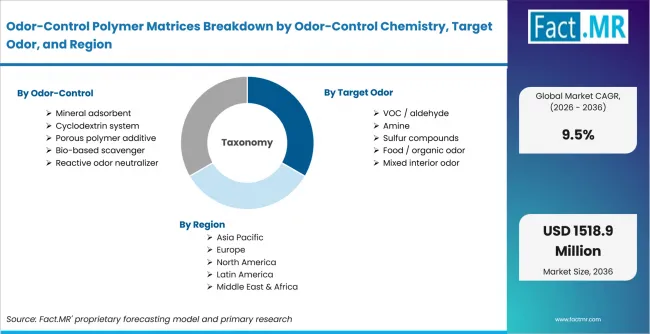
Odor Control Polymer Matrices Breakdown By Odor Control Chemistry, Target Odor, And Region | Source: Fact.MR
| Attribute | Details |
|---|---|
| Quantitative Units | USD Million |
| Market Definition | Polymer matrices, additives and masterbatch systems designed to adsorb, neutralize, bind or reduce unwanted odors and associated volatile emissions within polymer materials. |
| Odor-Control Chemistry | Mineral adsorbent; Cyclodextrin system; Porous polymer additive; Bio-based scavenger; Reactive odor neutralizer |
| Target Odor | VOC / aldehyde; Amine; Sulfur compounds; Food / organic odor; Mixed interior odor |
| Polymer | PP; PE; TPO; PA / engineering polymer; Recycled polymer blends |
| Application | Automotive interiors; Packaging; Consumer goods; Nonwovens; Industrial plastics |
| Regions Covered | North America; Latin America; Western Europe; Eastern Europe; East Asia; South Asia & Pacific; Middle East & Africa |
| Countries Covered | United States; Germany; Japan; France; Spain |
| Key Companies Profiled | Avient; BASF; Clariant; Ampacet; Evonik; Tosaf |
| Forecast Period | 2026 to 2036 |
| Approach | Hybrid top-down and bottom-up approach using polymer conversion activity, application qualification, recycled-material use, country manufacturing indicators and provider portfolio review. |
Source: Fact.MR analysis. Updated Sep 21, 2026
How is the market segmented?
-
By Odor-Control Chemistry
- Mineral adsorbent
- Cyclodextrin system
- Porous polymer additive
- Bio-based scavenger
- Reactive odor neutralizer
-
By Target Odor
- VOC / aldehyde
- Amine
- Sulfur compounds
- Food / organic odor
- Mixed interior odor
-
By Polymer
- PP
- PE
- TPO
- PA / engineering polymer
- Recycled polymer blends
-
By Application
- Automotive interiors
- Packaging
- Consumer goods
- Nonwovens
- Industrial plastics
-
By Region
- North America
- Latin America
- Western Europe
- Eastern Europe
- East Asia
- South Asia & Pacific
- Middle East & Africa
Frequently Asked Questions
How big is the odor-control polymer matrices market in 2026?
What is the CAGR of the odor-control polymer matrices market from 2026 to 2036?
Which polymer leads the market?
Which application leads the market?
Which companies are profiled in the odor-control polymer matrices market?
Who worked on this report


Preview the report firsthand - request a free sample
Free SampleGet the brochure for pricing and purchase details
Download PDF