- Base Value(2025): 77.0 Bn
- Estimated Value(2026): 83.9 Bn
- Forecast Value (2036): 198.7 Bn
- CAGR (2026 - 2036): 9.0%
Office of the CFO Software Market Overview, Growth Outlook, and Forecast by Fact.MR
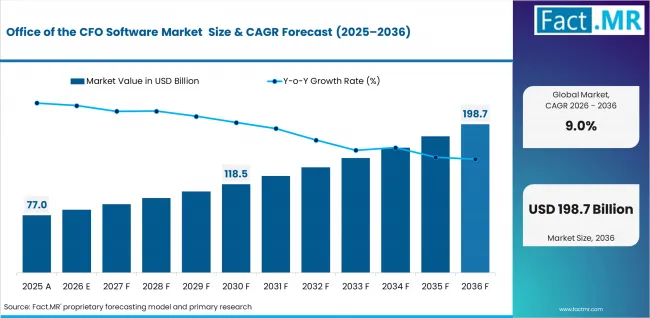
- In 2025, the Office of the CFO Software Market was valued at USD 77.0 billion.
- Based on market analysis, demand for Office of the CFO software is estimated to grow to USD 83.9 billion in 2026 and USD 198.7 billion by 2036.
- The market is projected to expand at a CAGR of 9.0% during the forecast period
Office Of The Cfo Software Market Value Analysis | Source: Fact.MR
Summary of the Office of the CFO Software Market
- Market Snapshot
- Global Office of the CFO Software Market revenue stood at USD 83.9 billion in 2026 and is forecast to reach USD 198.7 billion by 2036.
- At a 9.0% CAGR from 2026 to 2036, the market is expected to expand ~2.4x in value, creating an absolute dollar opportunity of USD 114.8 billion.
- The growth of the market is attributed to factors such as increasing enterprise spending on cloud-based finance transformation, growing demand for AI-based financial automation, and more adoption of real-time analytics and FP&A solutions.
- The growing need for integrated finance ecosystems, predictive financial planning tools, and best-of-breed finance software stacks is driving adoption in both the large enterprise and mid-market sectors.
- The rise of SaaS finance platforms and AI-native finance applications, along with digital CFO transformation programs, is driving further growth internationally.
- Demand and Growth Drivers
- Growing enterprise focus on automation of finance, operational efficiency, and enabled real-time decisions
- Increasing popularity of cloud ERP modernization and SaaS financial management systems
- Rising demand for AI-enabled forecasts, predictive analytics and autonomously driven accounting workflows
- Growing complexity in financial compliance, reporting standards and regulatory management
- Exponential growth in FP&A, AP/AR automation, and treasury management applications
- Rising adoption of digital transformation strategies in mid-market businesses and SMBs
- More AI copilots and intelligent finance assistants are being integrated across the enterprise finance functions.
- Product and Segment View
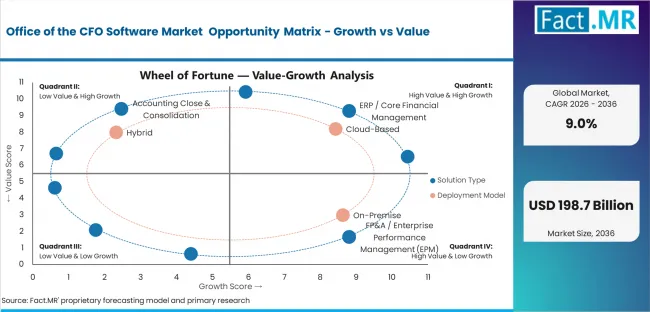
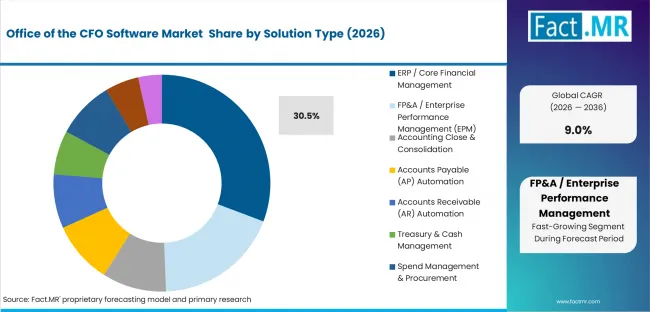
- ERP / Core Financial Management accounts for 30.5% of solution type share in 2026, emerging as the leading segment due to strong enterprise demand for integrated financial management, accounting automation, and cloud ERP modernization.
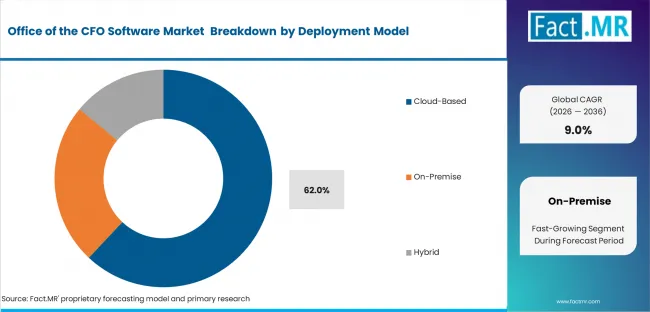
- Cloud-Based deployment holds 62.0% of deployment model share in 2026, supported by accelerating SaaS adoption, lower infrastructure costs, and increasing enterprise preference for scalable finance platforms.
- Large Enterprises represent 52.0% of organization size share in 2026, reflecting significant investments in finance transformation, compliance management, and enterprise-scale ERP modernization.
- Geography and Competitive Outlook
- The increasing adoption of cloud ERP, growing AI-based finance transformation, and augmenting enterprise digitization initiatives are among the factors driving the demand in the market in North America, East Asia, South Asia & Pacific.
- Major growth markets in the Office of the CFO Software Market include India (13.3% CAGR), Japan (11.8% CAGR), China (11.5% CAGR), Canada (9.5% CAGR), United States (7.8% CAGR), United Kingdom (7.5% CAGR), France (7.4% CAGR), and Germany (6.9% CAGR) during the forecast period.
- Market growth is aided by:
- Enterprise cloud migration is accelerating
- Growing adoption of AI finance automation
- Increasing need for predictive financial analytics
- Growth of SaaS-based FP&A and ERP solutions
- Growing need for adherence to compliance and financial governance
- Increasing need for real-time finance operations
- Prominent players in the market include SAP, Oracle, Microsoft Dynamics 365, Workday, NetSuite, Infor, Anaplan, OneStream, FloQast, HighRadius, Esker, and AvidXchange.
- Analyst Opinion
- Shambhu Nath Jha, Principal Consultant at Fact.MR, opines, “CXO leaders should understand that the next source of competitive differentiation in the CFO Office Software Market will be more and more focused on accelerating AI-enabled finance transformation, developing cloud native ERP and FP&A capabilities, utilizing predictive analytics and robotics technologies, and enhancing integrated finance ecosystems to meet escalating enterprise needs for real-time financial visibility, operational efficiency, regulatory compliance, and smart decision-making across contemporary finance organizations.
Office of the CFO Software Market — At a Glance
| Attribute | Details |
|---|---|
| Market Value 2025 | USD 77.0 Billion |
| Market Value 2026 | USD 83.9 Billion |
| Market Value 2036 | USD 198.7 Billion |
| Absolute Dollar Opportunity | USD 114.8 Billion |
| Total Growth | 136.80% |
| CAGR | 9.00% |
| Growth Multiple | 2.4x |
| Key Demand Theme | Rising enterprise demand for AI-powered finance automation and cloud-based financial transformation |
| Leading Solution Type | ERP / Core Financial Management |
| Solution Type Share | 30.50% |
| Leading Deployment Model | Cloud-Based |
| Deployment Model Share | 62.00% |
| Leading Organization Size | Large Enterprises |
| Organization Size Share | 52.00% |
| Leading Deployment Architecture | Traditional ERP-Centric |
| Deployment Architecture Share | 48.00% |
| Leading Industry Vertical | BFSI |
| Industry Vertical Share | 24.00% |
| Key Growth Regions | North America, East Asia, South Asia & Pacific |
| Key Companies | SAP, Oracle, Microsoft Dynamics 365, Workday, NetSuite, Infor, Anaplan, OneStream, FloQast, HighRadius |
| Segmentation by Solution Type | ERP / Core Financial Management, FP&A / Enterprise Performance Management (EPM), Accounting Close & Consolidation, Accounts Payable (AP) Automation, Accounts Receivable (AR) Automation, Treasury & Cash Management, Spend Management & Procurement, Revenue Management & Billing, Tax & Compliance Management, Financial Analytics, Reporting & AI |
| Segmentation by Deployment Model | Cloud-Based, On-Premises, and Hybrid |
| Segmentation by Organization Size | Large Enterprises, Mid-Market Enterprises, and Small Businesses / SMBs |
| Segmentation by Deployment Architecture | Traditional ERP-Centric, Best-of-Breed Finance Stack, AI-Native Finance Platforms |
| Segmentation by Industry Vertical | BFSI, Manufacturing, Retail & E-commerce, Healthcare, IT & SaaS, Energy & Utilities, Government & Public Sector |
| Segmentation by Region | North America, Latin America, East Asia, South Asia & Pacific, Western Europe, Eastern Europe, Middle East & Africa |
Source: Fact.MR analysis. Updated May 22, 2026
The Office of the CFO Software Market is projected to create an absolute dollar opportunity of USD 114.8 billion between 2026 and 2036.Market growth is driven by rising enterprise investments in cloud-based finance transformation, increasing demand for AI-powered financial automation, and growing adoption of real-time analytics and FP&A solutions. Expanding deployment of best-of-breed finance platforms, coupled with increasing focus on compliance, operational efficiency, and predictive financial planning, is further supporting market expansion globally. In addition, accelerating SaaS adoption and digital modernization initiatives continue to drive long-term market demand.
Key Growth Drivers, Constraints, and Opportunities
Office Of The Cfo Software Market Opportunity Matrix Growth Vs Value | Source: Fact.MR
Key Factors Driving Growth
- The intensifying focus of enterprises on transformation of finance, process efficiency and real time decision making is contributing to the high demand for Office of the CFO software worldwide.
- Increasing adoption of cloud ERP systems and AI-enabled financial automation and predictive analytics solutions across mid-market organizations and large enterprises is driving the market growth.
- High demand for solutions such as FP&A, AP/AR automation, treasury management, and intelligent finance workflows is fueling additional evolution in enterprise finance functions.
- Growth of SaaS finance ecosystems, AI-native finance platforms and integrated best-of-breed finance stacks bring new levels of scalability, accessibility and visibility into the end to end financial processes across the enterprise.
| Growth Driver | Demand Impact | Time Horizon | Key Impact Area | Fact.MR Insight |
|---|---|---|---|---|
| Rising enterprise demand for AI-powered finance automation | High | Short–Mid Term | Autonomous accounting & finance intelligence | Enterprises are increasingly investing in AI-enabled FP&A, reconciliation automation, and intelligent finance workflows to improve operational efficiency and real-time financial visibility. |
| Accelerating cloud ERP modernization initiatives | High | Short–Mid Term | Cloud-based financial management infrastructure | Organizations are rapidly migrating from legacy on-premise finance systems toward scalable SaaS-based ERP and finance transformation platforms. |
| Expanding adoption of predictive analytics and FP&A solutions | Medium-High | Mid–Long Term | Strategic planning & financial forecasting | Growing enterprise focus on scenario planning, predictive forecasting, and AI-driven business intelligence is strengthening demand for advanced FP&A platforms globally. |
| Increasing demand for treasury digitization and cash flow intelligence | Medium-High | Mid–Long Term | Treasury automation & liquidity optimization | Enterprises are deploying intelligent treasury systems to optimize working capital, liquidity visibility, and financial risk management across global operations. |
| Rising regulatory complexity and compliance automation requirements | Medium-High | Mid–Long Term | Governance, risk & compliance management | Increasing SOX, ESG, tax compliance, cybersecurity, and audit requirements are accelerating adoption of AI-driven compliance monitoring and continuous controls systems. |
Source: Fact.MR analysis. Updated May 22, 2026
Key Market Constraints
- Complexity of ERP migration process, integration issues and reliance on legacy infrastructure may slow enterprise adoption in some industries and geographies.
- Growing information security threats, concerns for privacy of financial data and compliance with regulations may pose operational and enterprise challenges.
- The high costs of implementation, the need for customization, and long deployment cycles associated with enterprise finance systems may prevent smaller organizations from adopting them.
- The lack of qualified finance transformation, AI and enterprise integration practitioners could affect large-scale modernization efforts.
Key Opportunity Areas
- Increasing enterprise demand for finance automation, autonomous accounting workflows and predictive financial analytics powered by AI will drive long-term growth opportunities.
- Greater adoption of cloud-native ERP modernization, real-time financial reporting, and continuous close solutions is creating additional expansion opportunities for the providers of finance software.
- The growth of mid-market and small and medium business (SMB) finance digitalization initiatives will fuel the demand for scalable SaaS based finance platform solution worldwide.
- Advances in generative AI, intelligent copilots, and data-led finance decision making tools, and their adoption as an integral part of CFO operations will help enable enterprise finance transformation and innovation for the next generation.
Segment-wise Analysis of the Office of the CFO Software Market
- ERP / Core Financial Management accounts for 30.5% share of the solution type segment in 2026, driven by increasing enterprise investments in cloud ERP modernization, integrated financial management systems, accounting automation, and rising demand for centralized finance operations across global organizations.
- Cloud-Based deployment represents 62.0% share of the deployment model segment in 2026, supported by accelerating SaaS adoption, lower infrastructure costs, scalable enterprise finance platforms, and growing preference for real-time financial visibility and remote accessibility.
- Large Enterprises hold 52.0% share of the organization size segment in 2026, owing to large-scale finance transformation initiatives, higher enterprise software spending, complex compliance requirements, and increasing adoption of AI-powered finance automation solutions.
The Office of the CFO Software Market is segmented by solution type, deployment model, organization size, deployment architecture, industry vertical, and region.
Which Solution Type Segment Topped the Office of the CFO Software Market?
Office Of The Cfo Software Market Analysis By Solution Type | Source: Fact.MR
The largest share in the office of the CFO software market, the ERP / Core Financial Management segment is expected to hold 30.5% by 2026. This leadership is attributed to increasing enterprises investments towards modernization of cloud ERP, growing need for integrated financial management solutions, increasing adoption of accounting automation and demand for unified finance operations, compliance management and financial reporting in real-time across global organizations.
Which Deployment Model Segment Accounts for the Highest Share in the Market?
Office Of The Cfo Software Market Analysis By Deployment Model | Source: Fact.MR
Cloud-based deployment is anticipated to account for the largest share of 62.0% in the deployment model segment by 2026. This is because of the rapid enterprise move to the cloud, rising need for scalable SaaS finance platforms, reduced infrastructure and maintenance costs, enhanced remote accessibility, and increased use of AI-based finance automation and real-time analytics products.
Which Deployment Architecture Segment Holds the Largest Share in the Market?
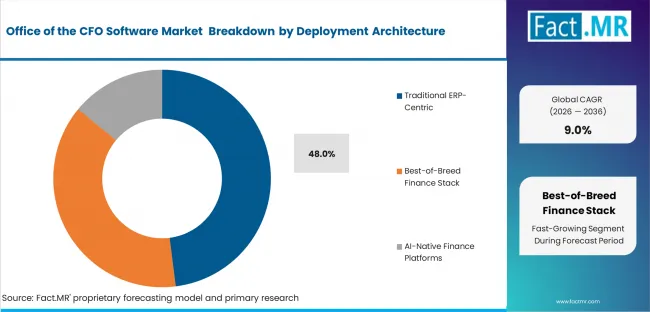
Office Of The Cfo Software Market Analysis By Deployment Architecture | Source: Fact.MR
Traditional ERP-Centric architecture is projected to dominate the deployment architecture segment, capturing 48.0% share in 2026. This leadership is supported by the extensive installed base of enterprise ERP systems, centralized finance management requirements, strong integration across business functions, and continued enterprise reliance on unified financial infrastructure for accounting, reporting, and compliance operations.
Which Industry Vertical Segment Accounts for the Highest Share in the Market?
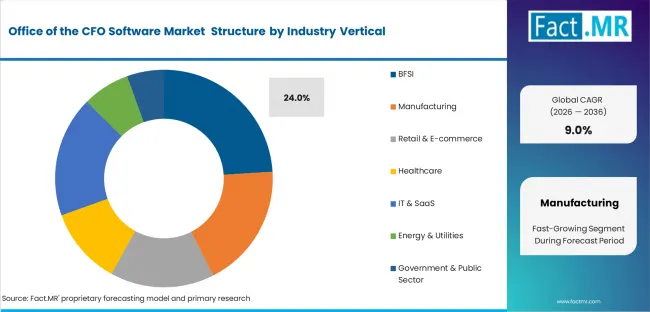
Office Of The Cfo Software Market Analysis By Industry Vertical | Source: Fact.MR
BFSI is anticipated to hold the largest share at 24.0% in the vertical industry segment in 2026. This supremacy is attributed by high regulatory compliance, growing digital finance transformation initiatives, increasing complexity of treasury and risk management and high adoption of sophisticated financial reporting, governance and AI-based finance automation solutions in banking and financial institutions.
Regional Outlook Across Key Markets
The report includes North America, Latin America, Western Europe, Eastern Europe, East Asia, South Asia & Pacific, and Middle East & Africa. It covers in depth analysis of enterprise finance transformation trends such as cloud ERP, AI-driven financial automation, demand for FP&A and treasury management solutions, growth of SaaS based finance ecosystems, enterprise digitalization initiatives, regulatory compliance considerations, and real-time financial analytics adoption across global industries. It also analyzes the regional enterprise software spending trends, modernization in finance, and growing adoption of integrated intelligent finance platforms by large enterprises, mid-market companies, and SMBs worldwide.
.webp "Top Country Growth Comparison Office Of The Cfo Software Market Cagr (2026 2036)")
Top Country Growth Comparison Office Of The Cfo Software Market Cagr (2026 2036) | Source: Fact.MR
CAGR Table
| Country | CAGR (%) |
|---|---|
| United States | 7.8% |
| Germany | 6.9% |
| United Kingdom | 7.5% |
| France | 7.4% |
| Japan | 11.8% |
| Canada | 9.5% |
| China | 11.5% |
Source: Fact.MR analysis. Updated May 22, 2026
Source: Fact.MR (FMR) analysis, based on proprietary forecasting model and primary research.
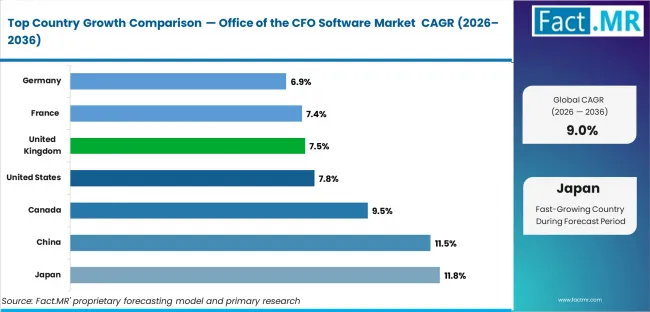
Office Of The Cfo Software Market Cagr Analysis By Country | Source: Fact.MR
North America Office of the CFO Software Market
North America is a mature with highly commercialized region in the Office of the CFO Software Market due to high enterprise software spending, high cloud ERP adoption, increasing AI-driven finance transformation initiatives, and demand for real-time financial analytics and process automation. Growth in SaaS finance ecosystems, enterprise digitalization strategies and predictive finance platforms will further drive the growth of this market in this region. Key players in the world market are SAP, Oracle, Microsoft Dynamics 365, Workday, NetSuite, Anaplan, and OneStream among others with the same trend in the regional markets.
- U.S.: Demand for Office of the CFO software in the U.S. is projected to rise at 7.8% CAGR through 2036. Growth is driven by accelerating enterprise cloud migration, rising adoption of AI-powered finance automation, increasing demand for FP&A solutions, and expansion of integrated enterprise finance ecosystems.
- Canada: Demand for Office of the CFO software in Canada is projected to grow at 9.5% CAGR through 2036, supported by increasing finance digitalization initiatives, rising adoption of cloud-native ERP platforms, and growing investments in intelligent finance automation solutions.
Europe Office of the CFO Software Market
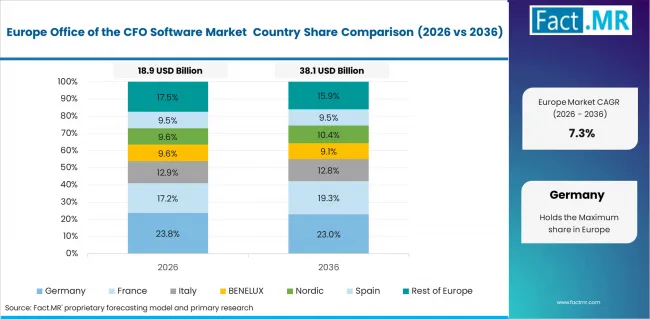
Office Of The Cfo Software Market Europe Country Market Share Analysis, 2026 & 2036 | Source: Fact.MR
Office of the CFO software in Europe involves huge capitalization, thanks to the growth of enterprise modernization in the region, increasing regulatory compliance requirements, and adoption of cloud-based financial management platform. The region is experiencing robust growth of AI-enabled finance operations, predictive financial planning, and ERP modernization strategies that consider predictive planning. Vendors like SAP, Oracle, Microsoft Dynamics 365, Workday and regional enterprise software players continue to strengthen their foothold with finance transformation and compliance led solutions.
- Germany: Demand for Office of the CFO software in Germany is projected to rise steadily through 2036, supported by increasing ERP modernization, manufacturing digitalization, and enterprise investments in automated financial reporting and compliance management systems.
- France: Demand for Office of the CFO software in France is supported by rising adoption of cloud finance platforms, expansion of AI-driven accounting automation, and growing enterprise focus on operational finance efficiency.
- United Kingdom: Demand for Office of the CFO software in the United Kingdom is projected to rise at 7.5% CAGR through 2036, driven by increasing finance transformation investments, strong SaaS adoption, and growing enterprise demand for predictive analytics and FP&A solutions.
East Asia Office of the CFO Software Market
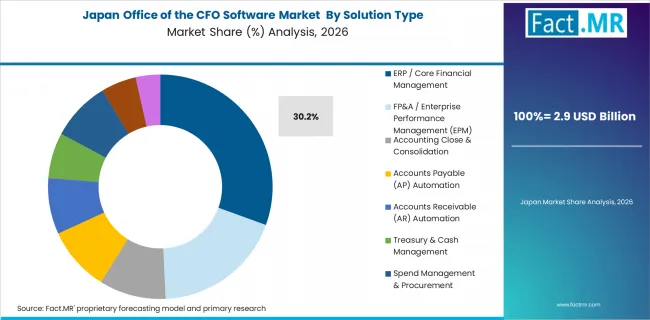
Office Of The Cfo Software Market Japan Market Share Analysis By Solution Type | Source: Fact.MR
East Asia will be a high-growth region in the office of the CFO software market owing to the fast-paced digital transformation for enterprises, growing cloud infrastructure, and rising utilization of AI-based finance automation solutions. Regional organizations are also dedicating more resources to upgrading their ERP and to predictive finance analytics, treasury digitization, and intelligent finance operations platforms.
- China: Demand for Office of the CFO software in China is projected to rise at 11.5% CAGR through 2036, driven by accelerating enterprise digitalization, increasing AI adoption, expansion of cloud ERP deployment, and rising demand for automated finance operations.
- Japan: Demand for Office of the CFO software in Japan is expected to grow at 11.8% CAGR through 2036 due to rising enterprise modernization initiatives, increasing adoption of intelligent finance systems, and growing demand for operational efficiency and regulatory compliance solutions.
South Asia & Pacific Office of the CFO Software Market
South Asia & Pacific is anticipated to be the fastest-growing region in the Office of the CFO Software Market owing to rapid enterprise cloud adoption, increasing finance digitalization, expanding SaaS ecosystems, and rising investments in AI-powered financial automation platforms. Regional enterprises are increasingly adopting cloud-native ERP systems, FP&A solutions, and intelligent finance applications to improve operational efficiency and financial visibility.
- India: Demand for Office of the CFO software in India is projected to rise at 13.3% CAGR through 2036, driven by accelerating enterprise digital transformation, rapid adoption of cloud-based ERP systems, increasing AI finance automation initiatives, and expanding demand for scalable SaaS finance platforms.
The Fact.MR report includes analysis on trends in the market, patterns in use of business software, potential models for regulation and compliance, competitive intelligence, evolution strategies for cloud ERPs, trends in finance automation powered by AI, architecture of deployment, and enablers of growth across north and Latin America, Europe, East Asia, South Asia & Pacific, as well as Middle East & Africa markets, by country.
Recent Industry Developments
- Serrala – Launch of AI-Powered Finance Platform for the Office of the CFO (May 2025)
- Serrala launched the first AI-powered finance platform designed specifically for the Office of the CFO, integrating AP automation, cash application, treasury management, and finance intelligence capabilities into a unified platform. The launch strengthens Serrala’s position in AI-driven finance automation and supports enterprise demand for real-time financial visibility, intelligent workflows, and autonomous finance operations. [1]
- Pacera – Launch of Office of the CFO Platform (June 2025)
- Pacera launched a new Office of the CFO platform focused on modernizing financial close, consolidation, planning, and reporting workflows for enterprise finance teams. The initiative strengthens Pacera’s positioning in CFO transformation software and supports increasing demand for integrated finance management and operational efficiency solutions across enterprise organizations. [2]
- OneStream – Launch of Finance Agentic Layer and Sensible AI Agents (October 2025)
- OneStream introduced its Finance Agentic Layer and announced the general availability of Sensible AI Agents designed to automate enterprise finance workflows, enhance FP&A processes, and improve financial decision-making. The launch strengthens OneStream’s competitive positioning in AI-native finance platforms and supports growing enterprise demand for intelligent finance automation and predictive analytics capabilities. [3]
- Workday – Launch of Next-Generation Illuminate Agents for HR and Finance Operations (May 2025)
- Workday unveiled the next generation of Illuminate AI Agents designed to automate finance and HR operations through AI-powered workflow orchestration, analytics, and intelligent decision support. The launch expands Workday’s AI-driven enterprise finance ecosystem and supports rising demand for autonomous finance operations, predictive planning, and cloud-native CFO transformation solutions. [4]
- SAP – Acquisition of Dremio to Strengthen Enterprise Data and AI Capabilities (May 2026)
- SAP announced the acquisition of Dremio to enhance SAP Business Data Cloud capabilities and strengthen enterprise AI, analytics, and real-time finance intelligence solutions. The acquisition supports SAP’s strategy to expand integrated finance data ecosystems, improve AI-powered decision-making, and accelerate cloud-based enterprise finance transformation initiatives globally. [5]
Leading Companies Shaping the Office of the CFO Software Market
- SAP
- Oracle
- Microsoft Dynamics 365
- Workday
- NetSuite
- Infor
- Anaplan
- OneStream
- FloQast
- HighRadius
- Esker
- Avidxchange
Sources and Research References
- [1] Serrala, “Serrala Launches the First AI-Powered Finance Platform for the Office of the CFO”, May 2025
- [2] Accel-KKR, “Pacera Launches to Power Up the Office of the CFO”, June 2025
- [3] OneStream, “OneStream Unlocks Agentic AI for the Office of the CFO with Finance Agentic Layer; Announces General Availability of Sensible AI Agents”, October 2025
- [4] Workday, “Workday Unveils Next Generation of Illuminate Agents to Transform HR and Finance Operations”, May 2025
- [5] SAP, “SAP to Acquire Dremio”, May 2026
Office of the CFO Software Market Definition
Office of the CFO Software Market is a suite of enterprise applications finance management, accounting automation, planning, compliance, treasury operations, reporting, and strategic finance transformation at an organization level. The market comprises ERP / Core Financial Management solution, FP&A and EPM suites, Accounting Close & Consolidation solution, AP / AR automation products, Treasury & Cash Management software, Spend Management application, Revenue Management system, Tax & Compliance application, Financial Analytics & Artificial Intelligence solutions via cloud, hybrid, on premise delivery models. The products cited above are heavily relied upon for financial reporting, forecasting, cash flow management, compliance monitoring, and real-time finance decisions in several sectors around the world.
Office of the CFO Software Market Inclusions
The report on Office of the CFO Software Market covers what the industry will look like in terms of size and value between 2026 and 2036. It provides comprehensive detail on the various segments by solution type, deployment model, organization size, deployment architecture, industry vertical. and analyzes the regional adoption trends, competitor landscape, enterprise digital transformation strategies, finance automation adoption, and AI-driven innovation in finance operations. The report also features emerging trends such as the cloud-native ERP modernization, AI-enabled financial analytics, autonomous accounting workflows, predictive FP&A solutions, best-of-breed finance ecosystems, real-time financial reporting, and increased usage of intelligent finance automation platforms by global enterprises.
Office of the CFO Software Market Exclusions
This study relates to enterprise financial software products for financial management, accounting automation, treasury, planning, compliance, reporting, and finance transformation, enabled by AI, at the enterprise level. However, the evaluation does not cover general enterprise IT software, customer relationship management (CRM) systems, human capital management (HCM) solutions, supply chain management solutions or standalone business intelligence tools that are not tailored specifically for CFO and finance ops. The report also does not cover finance consulting, non-CFO business process outsourcing (BPO) or multi-process BPO, analysis-only engagements, traditional banking systems, or non-finance productivity software unless they materially support workflows of the Office of the CFO, financial processes or enterprise finance decision.
Office of the CFO Software Market Research Methodology
- Primary Research
- The methods of top-down and bottom-up were used to estimate and validate the size of the global Office of the CFO Software Market. Elaborate primary research was conducted with the key industry participants including ERP vendors, FP&A platform providers, accounting automation firms, treasury software companies, finance transformation consultants, cloud infrastructure partners, enterprise finance leaders, system integrators, and industry experts. Discussions and interviews to confirm trends in the market, enterprise adoption (buy versus build), pricing models, AI and automation strategies, deployment models, competitive landscape, and long-term demand predictions by industry and geography were conducted.
- Desk Research
- The report is based on the analysis of various sources such as company financial reports, investor presentations, enterprise software industry reports, fin tech white papers, ERP modernization white papers, AI finance automation publications, SaaS market databases, regulatory compliance reports, and research study on digital transformation. Further references are taken from literature concerning financial management software, FP&A solutions, treasury technology, accounting automation, cloud ERP adoption, enterprise AI trends, and CFO transformative initiatives.
- Market-Sizing and Forecasting
- Fact.MR’s market prediction methodology involves a bottom-up approach to predict the revenues of the providers of ERP systems, FP&A platforms, accounting automation software, treasury management solutions, AP/AR automation tools, and AI-powered finance applications. This analysis was further substantiated through a top-down method by evaluating the wider enterprise software landscape, cloud finance transformation investment, and digital CFO technology adoption by key region and industry vertical.
- Data Validation and Update Cycle
- Market estimates were validated through primary‒secondary research, company financial analysis, enterprise software spending trends, cloud adoption trends, demand for finance automation, regional initiatives for digital transformation, and historical growth of enterprise finance solutions. Periodically, the forecasts are revised on account of evolving investments in enterprise technologies, increased adoption of AI and automation, regulatory changes, cybersecurity needs, cloud migration plans, and shifting priorities of CFOs with regard to financial visibility, operational efficiency, compliance management, and intelligent decision making throughout global enterprises.
Segmentation
Competitive Benchmarking and Company Positioning
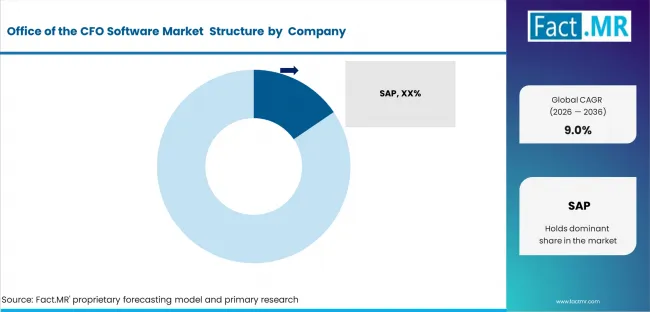
Office Of The Cfo Software Market Analysis By Company | Source: Fact.MR
Leading Companies Shaping the Office of the CFO Software Market
The players in the office of the CFO software market are Highly competing with product and service launches, SAP, Oracle, Microsoft Dynamics 365, Workday, NetSuite, Infor, Anaplan, OneStream, FloQast, HighRadius, Esker, AvidXchange. Cloud ERP, AI-enabled finance automation, FP&A innovation, integration flexibility, regulatory compliance features, and real-time analytics solutions are the functional aspects that are somewhat influencing the competitive landscape. Leading players enhance market leadership in the development of cloud-native finance platforms, intelligent automation solutions, predictive financial analytics, integrated enterprise finance ecosystems.
Vendors are increasingly creating offerings focused on AI-powered accounting automation, treasury digitization, real-time financial reporting, continuously managing the close process, predictive FP&A, and autonomous finance workflows to improve operational efficiency and strategic decision making. At the same time, startup and niche vendors compete through modular best-of-breed finance stacks, industry-specific finance solutions, scalable SaaS delivery models, and AI-native finance applications built for mid-market companies, digital-first business, and rapidly advancing global finance operations.
Scope of Analysis
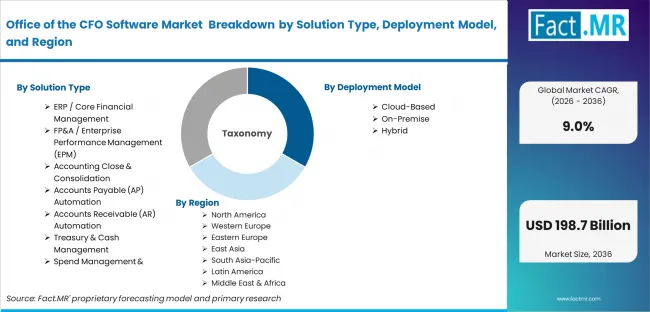
Office Of The Cfo Software Market Breakdown By Solution Type, Deployment Model, And Region | Source: Fact.MR
Parameter |
Details |
|---|---|
| Quantitative Units | USD 77.0 Billion (2025) to USD 198.7 Billion (2036), at a CAGR of 9.0% |
| Market Definition | The Office of the CFO (OCFO) Software Market comprises enterprise financial management, accounting automation, treasury management, FP&A, compliance, reporting, and AI-driven finance transformation solutions designed to improve operational efficiency, financial visibility, governance, and strategic decision-making across organizations. These solutions include ERP / Core Financial Management systems, FP&A and EPM platforms, AP/AR automation software, treasury & cash management applications, tax & compliance systems, and financial analytics & AI platforms deployed through cloud-based, hybrid, and on-premise architectures. |
| Regions Covered | North America, Latin America, Western Europe, Eastern Europe, East Asia, South Asia & Pacific, Middle East & Africa |
| Countries Covered | United States, Canada, Germany, United Kingdom, France, China, Japan, India, South Korea, Brazil, Australia, UAE, Saudi Arabia, South Africa, and 20+ countries |
| Key Companies | SAP, Oracle, Microsoft Dynamics 365, Workday, NetSuite, Infor, Anaplan, OneStream, FloQast, HighRadius, Esker, AvidXchange |
| Forecast Period | 2026 to 2036 |
| Approach | Hybrid demand-side and top-down methodology based on enterprise software spending trends, cloud ERP modernization, AI-powered finance automation adoption, FP&A expansion, treasury digitization, SaaS finance platform penetration, compliance technology investments, and enterprise digital transformation initiatives. Market estimates were validated through primary interviews with ERP vendors, finance automation providers, enterprise CFOs, treasury specialists, system integrators, cloud platform partners, and finance transformation consultants across key global markets. |
Source: Fact.MR analysis. Updated May 22, 2026
Analysis by Solution Type, Deployment Model, Organization Size, Deployment Architecture, Industry Vertical, and Region
-
Office of the CFO Software Market by Solution Type:
- ERP / Core Financial Management
- FP&A / Enterprise Performance Management (EPM)
- Accounting Close & Consolidation
- Accounts Payable (AP) Automation
- Accounts Receivable (AR) Automation
- Treasury & Cash Management
- Spend Management & Procurement
- Revenue Management & Billing
- Tax & Compliance Management
- Financial Analytics, Reporting & AI
-
Office of the CFO Software Market by Deployment Model:
- Cloud-Based
- On-Premises
- Hybrid
-
Office of the CFO Software Market by Organization Size:
- Large Enterprises
- Mid-Market Enterprises
- Small Businesses / SMBs
-
Office of the CFO Software Market by Deployment Architecture:
- Traditional ERP-Centric
- Best-of-Breed Finance Stack
- AI-Native Finance Platforms
-
Office of the CFO Software Market by Industry Vertical:
- BFSI
- Manufacturing
- Retail & E-commerce
- Healthcare
- IT & SaaS
- Energy & Utilities
- Government & Public Sector
-
Office of the CFO Software Market by Region:
- North America
- USA
- Canada
- Mexico
- Latin America
- Brazil
- Chile
- Rest of LATAM
- East Asia
- China
- Japan
- South Korea
- Taiwan
- South Asia & Pacific
- India
- Singapore
- Australia
- ASEAN
- Western Europe
- Germany
- France
- U.K.
- Italy
- Spain
- BENELUX
- Nordic
- Rest of Western Europe
- Eastern Europe
- Poland
- Hungary
- Czech Republic
- Balkan & Baltics
- Rest of Eastern Europe
- Middle East and Africa
- Kingdom of Saudi Arabia
- United Arab Emirates
- South Africa
- Rest of Middle East and Africa
- North America
Frequently Asked Questions
How large is the demand for Office of the CFO Software in the global market in 2025?
What will be the market size of the Office of the CFO Software Market by 2036?
What is the expected demand growth for the Office of the CFO Software Market between 2026 and 2036?
How significant is the growth outlook for India in this market?
Which company is identified as a leading player in the Office of the CFO Software Market?
Who worked on this report


Preview the report firsthand - request a free sample
Free SampleGet the brochure for pricing and purchase details
Download PDF