- Market Value (2025): USD 1.0 Bn
- Estimated Value (2026): USD 1.1 Bn
- Forecast Value (2036): USD 2.0 Bn
- CAGR (2026-2036): 6.0%
What is the Paper-Based Food Liners Market forecast to be worth by 2036?
USD 1.1 billion in 2026 and USD 2.0 billion by 2036, representing 6.0% CAGR.
- The paper-based food liners market crossed a valuation of USD 1.0 billion in 2025 through recurring foodservice and processing consumption.
- Paper-based food liners demand is expected to move from USD 1.1 billion in 2026 to USD 2.0 billion by 2036.
- The market is forecast to record a 6.0% CAGR from 2026 to 2036 as restaurant chains and converters qualify paper alternatives.
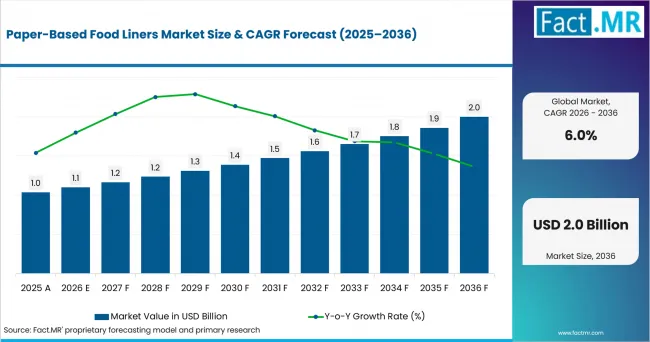
Paper Based Food Liners Market Value Analysis | Source: Fact.MR
What are the defining numbers behind Paper-Based Food Liners Market growth?
USD 0.9 billion absolute opportunity by 2036, led by Box - Carton Liners and Greaseproof Paper alongside Foodservice demand.
- Demand Drivers in the Market
- Quick-service restaurant operators need consistent liner placement owing to high transaction volume across standardized carton and basket formats.
- Bakery and deli teams need dependable food release due to direct contact with oily pastries and prepared products.
- Paper converters need fluorine-free grease performance supported by documentation that remains valid across customer qualification programs.
- Foodservice distributors require reliable stock availability influenced by frequent replenishment and varied pack-count requirements across independent accounts.
- Key Segments Analyzed
- By Product Type: Box - Carton Liners are expected to hold 36.0% share in 2026, supported by familiar takeaway container footprints.
- By Material: Greaseproof Paper is projected to account for 38.0% share in 2026, owing to oil resistance and converting flexibility.
- By Barrier - Treatment: Grease-Resistant formats are anticipated to capture 46.0% share in 2026, due to visible strike-through risk.
- By Application: Quick-Service Restaurants are estimated to represent 38.0% share in 2026, attributable to repeat liner use per transaction.
- By End Use: Foodservice is forecast to garner 58.0% share in 2026, driven by recurring preparation and serving workflows.
- By Sales Channel: Direct - OEM is expected to record 44.0% share in 2026, reinforced by custom dimensions and qualification support.
- Analyst Opinion at Fact.MR
- Shambhu Nath Jha, Principal Consultant at FactMR states “As foodservice operators strengthen qualification standards, verified liner performance and coating disclosure continue to guide purchasing decisions.”
- Strategic Implications
- Restaurant chains should test liner performance with actual hot and oily foods before approving multi-location specifications.
- Converters should document coating composition and migration status before presenting fluorine-free claims to food-contact customers.
- Distributors should hold regional stock in pack sizes that match outlet turnover and storage constraints.
- Packaging engineers should compare liner cost with container protection and service cleanliness across the complete operating cycle.
Mondi expanded FunctionalBarrier Paper Ultimate in Poland during August 2025, signaling stronger demand for qualified barrier paper solutions as foodservice operators and packaging converters increase adoption of paper-based food-contact materials.s
India is projected to record 8.4% CAGR through foodservice expansion. China is estimated to post 7.6% CAGR on converting capacity. The United Kingdom is anticipated to advance at 6.5% CAGR as producer-responsibility definitions sharpen. Brazil is forecast to register 6.4% CAGR with support from cellulosic food-contact rules. Germany is expected to grow at 5.6% CAGR under detailed material review.
How does the Paper-Based Food Liners Market break down by segment?
Box - Carton Liners are projected to account for 36.0% share, Greaseproof Paper is estimated to garner 38.0% share.
Which Product Type dominates?
Box - Carton Liners are projected to account for 36.0% share in 2026
Box - carton liners are forecast to represent 36.0% as they fit common takeaway cartons within the wider fresh food packaging landscape. Demand remains concentrated in high-volume foodservice operations while tray, basket, and cup liners serve more application-specific requirements.
What leads the Material segment?
Greaseproof Paper is estimated to garner 38.0% share in 2026
Greaseproof paper is anticipated to capture 38.0% in 2026 because dense fibers support thin foldable liners. Parchment remains prominent in baking while kraft and coated papers address specialized strength and branding requirements.
How does Barrier - Treatment shape demand?
Grease-resistant formats are anticipated to capture 46.0% share in 2026
Grease-resistant formats are expected to hold 46.0% since oil staining disrupts service and reinforces demand for barrier paper systems. Moisture-resistant and dual-barrier options address applications involving chilled foods, sauces and higher moisture exposure.
What supports Quick-Service Restaurants within Application?
Quick-Service Restaurants are estimated to represent 38.0% share in 2026
Quick-service restaurants are projected to record 38.0% in 2026 as each transaction uses a fresh liner within on-the-go food packaging formats. High transaction volumes and standardized packaging formats sustain recurring liner consumption across restaurant networks.
Why does Foodservice hold the End Use position?
Foodservice is forecast to garner 58.0% share in 2026
Foodservice packaging is estimated to account for 58.0% share in 2026, driven by repeated preparation and serving cycles. Food processing and retail applications generate additional demand although purchasing patterns are generally less frequent.
What drives Direct - OEM purchasing?
Direct - OEM is expected to record 44.0% share in 2026
Direct - OEM is forecast to capture 44.0% in 2026 since custom liners need coordinated dimensions and documented barriers across paper packaging materials programs. Distributor networks primarily serve standard product demand while online channels support smaller-volume purchases and product trials.
What is accelerating Paper-Based Food Liners Market adoption, and what is holding it back?
Recurring prepared-food consumption drives it, fluorine-free performance qualification restrains it.
Drivers Impact Analysis
| DRIVER | (~) % IMPACT ON CAGR | GEOGRAPHIC RELEVANCE | IMPACT TIMELINE |
|---|---|---|---|
| Recurring prepared-food transactions and liner replenishment | +0.8% | North America and Asia Pacific | Medium term (2-4 years) |
| Transition away from PFAS grease-proofing chemistry | +0.7% | United States and Europe | Short term (<= 2 years) |
| Quick-service format standardization and custom print programs | +0.5% | Global chain accounts | Medium term (2-4 years) |
| Paper substitution across takeaway and bakery formats | +0.4% | Europe and Asia Pacific | Medium term (2-4 years) |
| Local food-contact documentation and converter expansion | +0.3% | India, China and Brazil | Long term (>= 4 years) |
Source: Fact.MR analysis. Updated Aug 1, 2026
- Recurring prepared-food transactions: Each serving cycle consumes a fresh liner, which creates steady replenishment demand within chain foodservice formats.
- PFAS chemistry transition: Food-contact rules favor documented fluorine-free coatings that pass grease, heat, and handling tests.
- Quick-service standardization: Repeated container sizes create predictable liner orders after color and dimension approval.
- Paper substitution: Qualified paper liners replace selected plastic sheets when food release and grease control remain intact.
- Local documentation capacity: Current technical files shorten regional testing cycles for foodservice accounts requiring prompt specification support.
Opportunity Impact Analysis
| OPPORTUNITY | (~) % IMPACT ON CAGR | GEOGRAPHIC RELEVANCE | IMPACT TIMELINE |
|---|---|---|---|
| Fluorine-free grease barriers for hot and oily foods | +0.5% | United States and Europe | Short term (<= 2 years) |
| Low-coating recyclable papers for box and tray liners | +0.4% | Europe and North America | Medium term (2-4 years) |
| Custom printed liners for restaurant and bakery chains | +0.4% | India, China and United Kingdom | Medium term (2-4 years) |
| Regional conversion and distributor inventory programs | +0.3% | Brazil and India | Long term (>= 4 years) |
Source: Fact.MR analysis. Updated Aug 1, 2026
- Fluorine-free grease barriers: Clear composition records strengthen opportunities where dwell-time tests confirm foodservice performance.
- Low-coating papers: Thin barriers gain interest when recycling evidence matches local collection and fiber-recovery routes.
- Custom printed liners: Successful menu trials can convert visible restaurant branding into recurring orders across approved outlets.
Restraints Impact Analysis
| RESTRAINT | (~) % IMPACT ON CAGR | GEOGRAPHIC RELEVANCE | IMPACT TIMELINE |
|---|---|---|---|
| Performance loss during fluorine-free qualification | -0.5% | Global foodservice accounts | Short term (<= 2 years) |
| Coating, basis-weight and printing cost pressure | -0.4% | Global | Medium term (2-4 years) |
| Food-contact migration and composition documentation | -0.3% | Europe, India and Brazil | Medium term (2-4 years) |
| Recycling claim differences across local waste systems | -0.2% | Global multi-country programs | Long term (>= 4 years) |
Source: Fact.MR analysis. Updated Aug 1, 2026
- Fluorine-free qualification risk: Failed grease or heat trials delay multi-outlet conversion until complete service-cycle performance is proven.
- Cost pressure: Higher basis weight and coating can reduce line speed across high-volume disposable liner formats.
- Documentation burden: Multi-country food-contact programs require current composition and migration files for each intended food type.
Which countries are scaling Paper-Based Food Liners Market fastest?
India 8.4%, China 7.6%, United Kingdom 6.5%, Brazil 6.4%, Germany 5.6%.
The report covers North America, Latin America, European, Asian, Middle Eastern, and African markets through defined regional assessments.
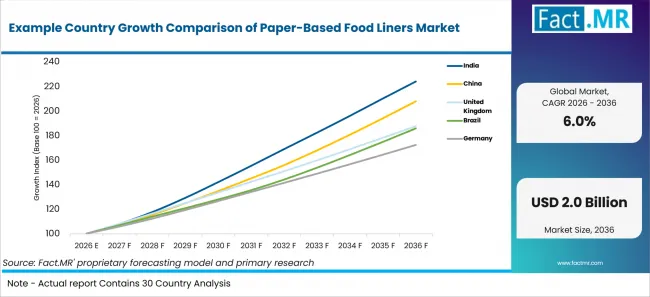
Example Country Growth Comparison Of Paper Based Food Liners Market | Source: Fact.MR
| COUNTRY | CAGR |
|---|---|
| United Kingdom | 6.5% |
| Brazil | 6.4% |
| Germany | 5.6% |
Source: Fact.MR analysis. Updated Aug 1, 2026
What is powering India's growth?
8.4% CAGR during the forecast period, driven by foodservice expansion and packaging rule review.
India is projected to record 8.4% CAGR between 2026 and 2036. Rapid expansion of organized foodservice and takeaway consumption is increasing demand for standardized paper liner formats across major cities. Regulatory review of food-contact packaging materials is also encouraging suppliers to expand compliant paper-based product portfolios.
How is China scaling liner demand?
7.6% CAGR, supported by catering growth and converting scale.
China is expected to post 7.6% CAGR through the forecast period. Large-scale paper converting operations enable efficient production of liner formats for restaurant and catering applications. Rising out-of-home dining activity continues to generate recurring demand across high-volume foodservice channels.
What supports the United Kingdom outlook?
6.5% CAGR, supported by paper classification and producer-responsibility requirements.
The United Kingdom is anticipated to advance at 6.5% CAGR by 2036. Foodservice operators are placing greater emphasis on material classification and end-of-life considerations before adopting new packaging formats. Continued scrutiny of recyclable food packaging is supporting demand for qualified paper-based liner solutions.
What underpins Brazil's expansion?
6.4% CAGR, supported by local conversion and cellulosic food-contact rules.
Brazil is forecast to grow at 6.4% CAGR during the forecast period. Expanding domestic converting capacity is improving access to paper-based liner products across regional markets. Updated focus on cellulosic food-contact materials is further encouraging adoption among packaging users and foodservice businesses.
How is Germany developing qualified demand?
5.6% CAGR, backed by detailed paper food-contact recommendations.
Germany is expected to register 5.6% CAGR through 2036. Buyers prioritize documented food-contact compliance and detailed material assessment before approving paper substitutions. This qualification-driven purchasing approach continues to support demand for advanced barrier-paper and food liner products.
Who leads the Paper-Based Food Liners Market?
Novolex and Georgia-Pacific lead converted liner coverage, while Mondi and Stora Enso strengthen barrier-paper capability.
Key players such as Novolex has strengthened its position in converted foodservice liners following the Pactiv Evergreen acquisition, while Georgia-Pacific and Detmold Group continue to expand their presence through established food-paper portfolios and restaurant relationships. Huhtamaki combines packaging engineering expertise with strong foodservice engagement. Mondi, Stora Enso, and Nordic Paper support market growth through specialized barrier and grease-resistant paper grades designed for food-contact applications.
Which companies are the key providers?
Novolex and Georgia-Pacific lead profiles, while Detmold, Huhtamaki, Mondi, Stora Enso, and Nordic Paper complete coverage.
- Novolex
- Georgia-Pacific
- Detmold Group
- Huhtamaki
- Mondi Group
- Stora Enso
- Nordic Paper
Bibliography
- Agência Nacional de Vigilância Sanitária. (2025, June 4). Processos deliberados na 8ª Reunião Ordinária Pública de 4 de junho de 2025. Anvisa.
- Environment Agency. (2025, July 7). Extended producer responsibility for packaging: Fibre-based composite and paper and board obligations: RPS 351. GOV.UK.
- Food Safety and Standards Authority of India. (2025, October 13). Draft Food Safety and Standards (Packaging) Amendment Regulations, 2025 regarding provisions related to Poly- and perfluoroalkyl substances (PFAs) and Bisphenol A (BPA) for food contact materials. FSSAI.
- German Federal Institute for Risk Assessment. (2026, April 10). Public Consultation on the Draft Revision of BfR Recommendations on paper and board for food contact. BfR.
- Huhtamaki. (2025, February 28). Huhtamaki launches recyclable single coated paper cups for yogurt and dairy. Huhtamaki.
- Mondi Group. (2025, August 14). Mondi ramps up FunctionalBarrier Paper Ultimate to meet growing demand for sustainable high-barrier paper-based packaging. Mondi Group.
- National Bureau of Statistics of China. (2026, January 20). Total Retail Sales of Consumer Goods in December 2025. National Bureau of Statistics of China.
- Pactiv Evergreen Inc. (2025, April 1). Current Report on Form 8-K. U.S. Securities and Exchange Commission.
This Report Addresses
- Product type and material choices guide food liner qualification across foodservice and processing programs.
- The report assesses box - carton liners and greaseproof paper among other key segments.
- India, China, the United Kingdom, Brazil, and Germany anchor the country comparison.
- Company assessment compares converted-liner access with paper and foodservice capabilities.
- Product coverage assesses carton, tray, basket, bag, and cup liners for direct food contact.
- Material analysis compares greaseproof paper, parchment, kraft paper, and coated paper by performance requirement.
What does the Paper-Based Food Liners Market cover?
Box - Carton, Tray & Bowl, Basket - Bag, and Cup Liners used for direct food-contact protection.
The market covers disposable paper sheets and converted formats placed inside containers during preparation or service. Coverage includes carton, tray, basket, bag, and cup formats.
The market covers separately sold liners with direct food-contact functions. Finished containers remain excluded from market value.
What is included in the scope?
Paper-based food liner formats used inside prepared-food, foodservice, processing and retail handling environments.
Scope covers food-contact liners for cartons, trays, baskets, bags, and cups across specified channels.
What is excluded from the scope?
Finished outer containers and non-paper liner systems are outside the defined market boundary.
Plastic films, foil, reusable mats, standalone outer wraps, and excluded food containers remain outside the boundary.
How Was the Analysis Built?
The analysis draws on 120+ sources, 35+ company portfolios, 25+ countries, and more than 20 industry interviews.
- Primary Research: Primary research includes discussions with manufacturers, service providers, technology developers, distributors, end users, procurement teams, and subject-matter experts. These conversations examine purchasing priorities, product adoption, operational challenges, approval requirements, competitive positioning, and the factors that influence wider market acceptance.
- Desk Research: Desk research covers government statistics, regulatory publications, company filings, trade data, technical studies, industry associations, standards, public policy, and other authoritative sources. Every source used in the analysis is documented in the bibliography.
- Market Sizing and Forecasting: Market estimates combine historical performance, demand indicators, pricing and volume trends, segment shares, company participation, country-level growth, adoption patterns, investment activity, and barriers to market expansion.
- Data Validation and Update Cycle: Findings are validated by comparing primary interviews with public data, company activity, regulatory changes, trade patterns, and industry developments. Regular updates review new product launches, capacity changes, partnerships, approvals, procurement trends, and shifts in commercial adoption.
Segmentation
What is the report’s scope and coverage?
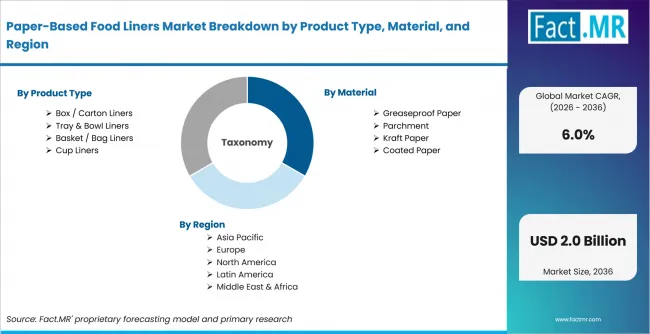
Paper Based Food Liners Market Breakdown By Product Type, Material, And Region | Source: Fact.MR
| Attribute | Details |
|---|---|
| Quantitative Units | USD Billion |
| Market Definition | Disposable paper sheets and converted liner formats intended for direct food contact inside cartons, trays, baskets, bags and cups |
| Product Type | Box - Carton Liners, Tray & Bowl Liners, Basket - Bag Liners, Cup Liners |
| Material | Greaseproof Paper, Parchment, Kraft Paper, Coated Paper |
| Barrier - Treatment | Grease-Resistant, Moisture-Resistant, Dual Barrier, Untreated |
| Application | Quick-Service Restaurants, Bakery & Confectionery, Retail Grocery, Others |
| End Use | Foodservice, Food Processing, Retail, Others |
| Sales Channel | Direct - OEM, Foodservice Distributors, Online, Others |
| Regions and Countries Covered | North America, Latin America, Western Europe, Eastern Europe, East Asia, South Asia and Pacific, Middle East and Africa, thirty or more countries |
| Key Companies Profiled | Novolex, Georgia-Pacific, Detmold Group, Huhtamaki, Mondi Group, Stora Enso, Nordic Paper |
| Forecast Period | 2026 to 2036 |
| Approach | Hybrid top-down and bottom-up approach using liner volumes, paper and coating mix, foodservice activity, replacement cycles, channel structure and supplier validation |
Source: Fact.MR analysis. Updated Aug 1, 2026
How is the market segmented?
-
By Product Type:
- Box - Carton Liners
- Tray & Bowl Liners
- Basket - Bag Liners
- Cup Liners
-
By Material:
- Greaseproof Paper
- Parchment
- Kraft Paper
- Coated Paper
-
By Barrier - Treatment:
- Grease-Resistant
- Moisture-Resistant
- Dual Barrier
- Untreated
-
By Application:
- Quick-Service Restaurants
- Bakery & Confectionery
- Retail Grocery
- Others
-
By End Use:
- Foodservice
- Food Processing
- Retail
- Others
-
By Sales Channel:
- Direct - OEM
- Foodservice Distributors
- Online
- Others
-
By Region:
- North America
- United States
- Canada
- Latin America
- Brazil
- Mexico
- Argentina
- Chile
- Western Europe
- Germany
- France
- United Kingdom
- Italy
- Spain
- Benelux
- Nordics
- Eastern Europe
- Poland
- Czech Republic
- Romania
- Hungary
- East Asia
- China
- Japan
- South Korea
- South Asia and Pacific
- India
- ASEAN
- Australia and New Zealand
- Middle East and Africa
- GCC Countries
- South Africa
- Türkiye
- Israel
- North America
Frequently Asked Questions
What share do Box - Carton Liners capture?
How is Greaseproof Paper positioned by Material?
Which Barrier - Treatment category carries the primary share?
What supports Quick-Service Restaurants within Application?
How much End Use share does Foodservice record?
Which Sales Channel has the significant position?
How quickly is India expected to expand?
What is the primary demand driver?
Who worked on this report


Preview the report firsthand - request a free sample
Free SampleGet the brochure for pricing and purchase details
Download PDF