- Base Value(2025): 1.3 Bn
- Estimated Value(2025): 1.3 Bn
- Forecast Value (2035): 2.4 Bn
- CAGR (2025 - 2035): 6.3%
Phase-transfer Catalyst Market Forecast and Outlook 2025 to 2035
The global phase-transfer catalyst market is set to grow from USD 1.3 billion in 2025 to USD 2.4 billion by 2035, adding USD 1.1 billion in new revenue and advancing at a CAGR of 6.3%. Growth is driven by escalating demand for pharmaceutical synthesis optimization, expanding agrochemical manufacturing infrastructure across developed and emerging markets, and accelerating green chemistry adoption requirements among chemical organizations seeking environmentally friendly reaction pathways.
Phase-transfer catalysts are increasingly recognized as essential tools for organic synthesis practitioners, offering precise phase boundary reaction capabilities, solvent reduction assurance, and comprehensive process efficiency characteristics compared to traditional homogeneous catalyst approaches. Ammonium salts dominate the market, favored in pharmaceutical and chemical environments for their established catalytic properties, providing versatile reaction facilitation mechanisms, structural modification capabilities, and commercial acceptance across diverse organic synthesis applications and chemical demographics.
Quick Stats for Phase-transfer Catalyst Market
- Phase-transfer Catalyst Market Value (2025): USD 1.3 billion
- Phase-transfer Catalyst Market Forecast Value (2035): USD 2.4 billion
- Phase-transfer Catalyst Market Forecast CAGR: 6.3%
- Leading Type in Phase-transfer Catalyst Market: Ammonium Salts (48.5%)
- Key Growth Regions in Phase-transfer Catalyst Market: Asia Pacific, North America, and Europe
- Top Players in Phase-transfer Catalyst Market: Tokyo Chemical Industry Co. Ltd., SACHEM Inc., Nippon Chemical Industrial Co. Ltd., Tatva Chintan Pharma Chem Limited, Pat Impex
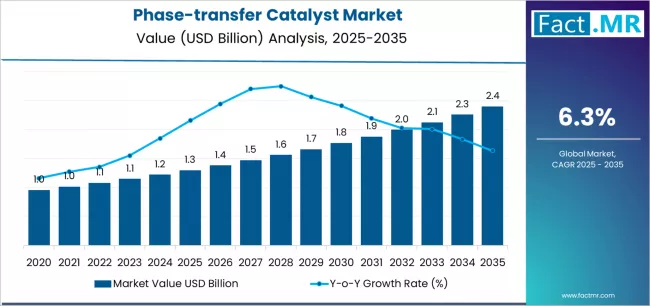
Phase Transfer Catalyst Market Market Value Analysis | Source: Fact.MR
Ammonium salt products remain fundamental in synthesis protocols where heterogeneous reaction acceleration and interfacial mass transfer enhancement match operational requirements and reaction efficiency standards. Pharmaceuticals are advancing among end-use categories as specialized active pharmaceutical ingredient manufacturing networks expand and complex synthesis infrastructure increases accessibility in production-convenient locations with comprehensive chemical structures.
Geographic concentration demonstrates dynamic growth patterns with India and China leading expansion, supported by rising pharmaceutical manufacturing capacity, green chemistry consciousness expansion among chemical populations, and catalyst technology establishment programs in production centers.
The USA, Germany, Japan, Brazil, and UK demonstrate robust development through established pharmaceutical ecosystems, regulatory framework maturity for chemical processes, and standardized acceptance of phase-transfer catalysis procedures. Competitive advantage is consolidating around catalytic efficiency profiles, selectivity documentation, process integration compatibility, and comprehensive synthesis portfolios rather than standalone catalyst formulations alone.
The first half of the decade will witness the market climbing from USD 1.3 billion to approximately USD 1.8 billion, adding USD 0.5 billion in value, which constitutes 45% of the total forecast growth period. This phase will be characterized by the continued dominance of ammonium salt methodologies in pharmaceutical synthesis settings, combined with accelerating adoption of asymmetric synthesis technologies in chiral drug manufacturing applications where reaction selectivity validation and enantiomeric purity create favorable product outcomes.
The latter half will witness sustained expansion from USD 1.8 billion to USD 2.4 billion, representing an addition of USD 0.6 billion or 55% of the decade's growth, defined by broadening acceptance of sustainable chemistry protocols and integration of recyclable catalyst platforms across mainstream pharmaceutical manufacturing facilities.
Where revenue comes from - Now Vs Next (industry-level view)
| Period | Primary Revenue Buckets | Share | Notes |
|---|---|---|---|
| Today | Ammonium Salts | 48.5% | Type dominance |
| Pharmaceuticals | 37.4% | Primary end-use sector | |
| Quaternary Ammonium | 34-40% | Common catalyst class | |
| API Manufacturing | 32-38% | Core pharmaceutical segment | |
| Alkylation Reactions | 28-34% | Key application | |
| Future (3-5 yrs) | Chiral Phase-transfer Catalysts | 30-36% | Asymmetric synthesis growth |
| Agrochemical Intermediates | 32-38% | Agriculture expansion | |
| Green Chemistry Applications | 28-34% | Sustainability focus | |
| Recyclable Catalysts | 24-30% | Circular economy | |
| Fine Chemicals | 26-32% | Specialty production | |
| Bio-based Catalysts | 20-26% | Renewable materials | |
| Task-specific Catalysts | 22-28% | Application optimization |
Source: Fact.MR analysis. Updated Dec 2, 2025
Phase-transfer Catalyst Market Key Takeaways
At-a-Glance Metrics
| Metric | Value |
|---|---|
| Market Value (2025) → | USD 1.3 billion |
| Market Forecast (2035) ↑ | USD 2.4 billion |
| Growth Rate ★ | 6.3% CAGR |
| Leading Type → | Ammonium Salts |
| Primary End-use → | Pharmaceuticals |
Source: Fact.MR analysis. Updated Dec 2, 2025
The market demonstrates exceptional fundamentals with Ammonium Salts capturing a commanding 48.5% share through superior catalytic versatility characteristics, established synthesis advantages, and proven efficiency profiles across phase-transfer catalysis applications.
Pharmaceuticals drive primary end-use demand at 37.4% share, supported by established active pharmaceutical ingredient infrastructure and complex synthesis requirements that maintain reaction compliance across diverse chemical segments.
Geographic concentration remains anchored in Asia Pacific with emerging market leadership through pharmaceutical manufacturing expansion and chemical synthesis infrastructure development, while developed markets show accelerated adoption rates driven by green chemistry demographics and sustainable process preferences.
Imperatives for Stakeholders in Phase-transfer Catalyst Market
Design for selectivity and sustainability, not just reaction acceleration
- Offer complete synthesis solutions: advanced catalyst formulations + process optimization support + reaction condition guidance + analytical validation systems + sustainability tracking platforms.
- Preconfigured reaction packages: pharmaceutical synthesis specifications, agrochemical manufacturing configurations, fine chemical production programs, and combination catalysis protocols for diverse chemical requirements.
Performance readiness for synthesis applications
- Comprehensive selectivity documentation, reaction validation systems, and efficiency infrastructure (recyclability assessment, solvent compatibility, thermal stability protocols).
Affordability-by-design approach
- Cost-optimized catalyst portfolios, flexible pricing models, chemical manufacturer loyalty programs, and transparent total synthesis cost documentation.
Chemist training-focused market penetration
- Established reaction optimization workshops + comprehensive certification programs (catalyst selection, mechanism understanding, troubleshooting management); direct chemist engagement for relationship development and synthesis confidence building.
Segmental Analysis
The market segments by type into ammonium salts, potassium salts, and others, representing the evolution from basic phase-transfer facilitation toward sophisticated reaction selectivity with diverse ionic capabilities, comprehensive catalytic efficiency, and integrated synthesis characteristics.
The end-use segmentation divides the market into pharmaceuticals (37.4%) with active pharmaceutical ingredient synthesis and complex molecule manufacturing applications, agriculture (23.7%), chemical, and others, reflecting distinct production objectives for therapeutic compound development and drug substance creation versus crop protection chemical manufacturing and specialty material synthesis implementation.
The segmentation structure reveals phase-transfer catalyst evolution from basic interfacial reaction technology toward comprehensive synthesis optimization platforms with enhanced selectivity characteristics and multi-dimensional green chemistry capabilities, while type diversity spans from conventional quaternary ammonium compounds to specialized crown ethers requiring advanced synthetic chemistry techniques.
Which Phase-transfer Catalyst Type is in High Demand?
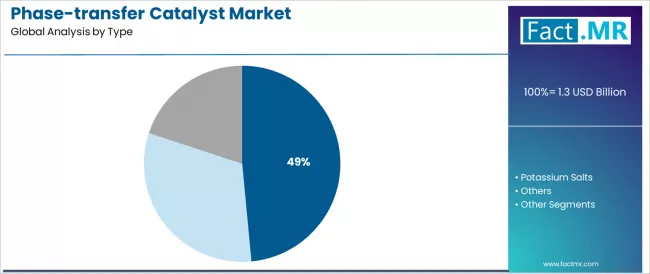
Phase Transfer Catalyst Market Analysis By Type | Source: Fact.MR
Ammonium salts command the leading position in the phase-transfer catalyst market with a 48.5% market share through superior catalytic versatility characteristics, including established reaction compatibility, extensive application documentation, and standardized synthesis pathways that enable organic chemists to achieve predictable reaction outcomes across varied pharmaceutical categories and diverse chemical demographics.
The segment benefits from mechanistic advantages through quaternary ammonium cation formation, proven lipophilicity balance without excessive hydrophobic character, and established structural modification documentation without requiring extensive catalyst redesign. Advanced formulation technology enables alkyl chain optimization, counterion variation, and functional group customization, where phase-transfer efficiency and reaction selectivity represent critical synthesis requirements.
Tetrabutylammonium salts hold significant share within the ammonium salt segment, appealing to chemists seeking balanced lipophilicity capabilities for nucleophilic substitution reactions. Ammonium salt phase-transfer catalysts differentiate through proven synthetic accessibility profiles, organic chemist familiarity advantages, and integration with established reaction protocols that enhance synthesis confidence while maintaining compliant reaction outcomes for diverse phase-transfer catalysis applications.
Key market characteristics:
- Advanced catalytic properties with efficient ion-pair formation and phase boundary transport for accelerated reactions
- Superior application documentation, enabling reaction standardization and optimization readiness for synthesis applications
- Comprehensive chemist acceptance, including synthetic methodology integration and reaction guideline inclusion for global market applications
Why do Potassium Salts Represent a Specialized Catalysis Segment?
Potassium salts maintain specialized market position with a 29.6% share through inorganic base characteristics and specific reaction capabilities. These products appeal to process chemists and manufacturers seeking comprehensive deprotonation with strong base functionality, offering nucleophile generation patterns and specific reaction facilitation approaches through potassium cation systems. Market adoption is driven by elimination reaction applications, emphasizing complete base strength and selectivity optimization through alkali metal mechanisms.
Which is the Leading End-use Segment in the Phase-transfer Catalyst Market?
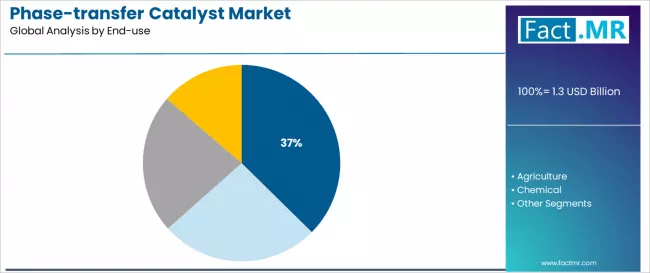
Phase Transfer Catalyst Market Analysis By End Use | Source: Fact.MR
Pharmaceuticals demonstrate end-use leadership in the phase-transfer catalyst market with a 37.4% share due to widespread active pharmaceutical ingredient synthesis requirements and established focus on complex molecule construction, chiral compound manufacturing, and multi-step reaction sequences that maximize product purity while maintaining consistent synthetic efficiency characteristics.
Pharmacists prioritize phase-transfer catalysis for nucleophilic substitution facilitation, alkylation reaction enhancement, and integration with green chemistry principles that enables coordinated synthesis experiences across multiple reaction steps. The segment benefits from substantial drug development momentum and process chemistry documentation that emphasizes catalyst-based approaches for efficient API production across diverse therapeutic demographics.
Oncology drug intermediates capture significant share within the pharmaceutical segment, demonstrating chemist preference for complex synthesis solutions. Generic drug manufacturing expansion incorporates phase-transfer catalysis as essential synthetic protocols for cost-effective production, while biologics conjugation increases catalyst demand that meets coupling requirements and ensures bioconjugate synthesis capabilities.
What drives Phase-transfer Catalysts adoption in Agriculture?
Agriculture captures substantial end-use share at 23.7% through comprehensive requirements in pesticide intermediate synthesis, herbicide production applications, and crop protection chemical manufacturing.
These applications demand sophisticated catalytic protocols capable of achieving regulatory purity standards while providing consistent reaction reliability and minimal waste generation, appealing to agrochemical manufacturers seeking evidence-based synthesis advantages beyond traditional multi-step approaches.
What are the Drivers, Restraints, and Key Trends of the Phase-transfer Catalyst Market?
| Category | Factor | Impact | Why It Matters |
|---|---|---|---|
| Driver | Rising pharmaceutical production & generic drug manufacturing (API synthesis, process efficiency) | ★★★★★ | Drug manufacturing enables catalyst demand for synthesis optimization; increasing generic production drives technology adoption across pharmaceutical markets and diverse geographic segments. |
| Driver | Growth in green chemistry adoption and sustainability initiatives (solvent reduction, waste minimization) | ★★★★★ | Drives demand for environmentally friendly synthesis systems and efficient reaction protocols; manufacturers providing sustainable processes gain competitive advantage in regulatory-focused pharmaceutical segments. |
| Driver | Agrochemical expansion & crop protection chemical demand (pesticide synthesis, herbicide production) | ★★★★☆ | Chemists demand validated catalysis methods and documented efficiency systems; agricultural visibility expanding addressable segments beyond traditional pharmaceutical synthesis and conventional chemical clientele. |
| Restraint | High catalyst costs & specialized expertise requirements (material expenses, technical knowledge) | ★★★★☆ | Cost-conscious manufacturers face budget limitations and expertise constraints, restricting catalyst adoption and affecting technology penetration in resource-limited organizations and developing market facilities. |
| Restraint | Catalyst recovery challenges & reaction complexity (separation difficulty, optimization needs) | ★★★☆☆ | Facilities face operational concerns and process limitations; increases implementation barriers and affects adoption penetration in simple synthesis applications and cost-sensitive manufacturing operations. |
| Trend | Asymmetric phase-transfer catalysis development (chiral catalysts, enantioselective synthesis) | ★★★★★ | Growing pharmaceutical emphasis on single enantiomer drugs and stereochemical control beyond traditional racemic synthesis; chiral catalysts become core differentiation strategy for advanced pharmaceutical positioning. |
| Trend | Recyclable and immobilized catalyst innovation (supported catalysts, catalyst recovery) | ★★★★☆ | Synthesis evolving beyond disposable catalyst use toward circular economy protocols; recyclability positioning drives enhanced sustainability and cost reduction in sophisticated manufacturing environments. |
Source: Fact.MR analysis. Updated Dec 2, 2025
Analysis of the Phase-transfer Catalyst Market by Key Countries
The phase-transfer catalyst market demonstrates robust regional growth dynamics with emerging leaders including India (7.3% CAGR) and China (7.1% CAGR) driving expansion through pharmaceutical manufacturing programs and chemical synthesis infrastructure development. Strong performers encompass the USA (6.8% CAGR), Germany (6.5% CAGR), and Japan (5.9% CAGR), benefiting from established pharmaceutical infrastructure and specialty chemical demographics. Mature markets feature Brazil (5.6% CAGR) and UK (5.1% CAGR), where chemical manufacturing normalization and pharmaceutical synthesis support consistent growth patterns.
Regional synthesis reveals Asian markets leading adoption through comprehensive pharmaceutical capacity positioning and chemical manufacturing investment expansion, while Western countries demonstrate measured growth potential supported by green chemistry preferences and sustainable synthesis influence. North American markets show solid development driven by pharmaceutical innovation culture integration and advanced catalyst infrastructure.
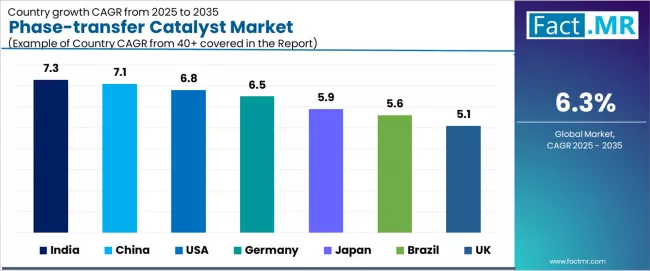
Phase Transfer Catalyst Market Cagr Analysis By Country | Source: Fact.MR
| Region/Country | 2025 to 2035 Growth | How to win | What to watch out |
|---|---|---|---|
| India | 7.3% | Focus on cost-effective catalyst portfolios | Quality consistency; technical support needs |
| China | 7.1% | Lead with manufacturing-scale solutions | Price competition; local catalyst development |
| USA | 6.8% | Provide green chemistry technologies | Regulatory complexity; sustainability requirements |
| Germany | 6.5% | Maintain quality-focused positioning | Conservative adoption; documentation standards |
| Japan | 5.9% | Offer precision synthesis solutions | Market maturity; cost pressures |
| Brazil | 5.6% | Deliver agrochemical applications | Economic volatility; investment constraints |
| UK | 5.1% | Push R&D-driven innovations | Market fragmentation; academic-industrial gaps |
Source: Fact.MR analysis. Updated Dec 2, 2025
India Drives PLI-stimulated Manufacturing Growth
India establishes fastest market growth through progressive production-linked incentive scheme implementation and comprehensive pharmaceutical manufacturing expansion, positioning phase-transfer catalyst technologies as essential synthesis solutions in active pharmaceutical ingredient facilities and emerging contract research organizations. The country's 7.3% growth rate reflects rising domestic pharmaceutical capacity levels supporting chemical investment and growing export-oriented manufacturing that encourage the deployment of efficient catalyst products in diverse API synthesis settings.
Growth concentrates in major pharmaceutical zones, including Hyderabad pharmaceutical cluster, Gujarat chemical corridor, and Baddi pharmaceutical hub, where manufacturers showcase increasing capacity for cGMP standard adoption that appeal to international pharmaceutical companies demanding validated synthesis optimization and cost-effective production outcomes.
Indian process chemists are developing standardized phase-transfer catalysis protocols that combine international catalyst technologies with domestic manufacturing expertise, including generic API synthesis programs and contract manufacturing expansion. Distribution channels through specialty chemical distributors and pharmaceutical intermediate suppliers expand market access, while chemistry education initiatives support adoption across diverse facility types and therapeutic area specializations.
China Emerges as Industrial Chemical Expansion Leader
In regions spanning Yangtze River Delta and Pearl River Delta chemical parks, pharmaceutical companies and fine chemical manufacturers are adopting advanced phase-transfer catalyst technologies as essential synthesis tools for production operations, driven by increasing Made-in-China 2025 investments and elevation of chemical manufacturing expectations that emphasize the importance of validated reaction efficiency.
The market holds a 7.1% growth rate, supported by pharmaceutical capacity expansion and agrochemical production investment that promote catalyst adoption for process optimization applications. Chinese chemists are favoring established catalyst platforms that provide comprehensive catalytic performance and cost-effectiveness evidence, particularly appealing in industrial clusters where reaction reliability and economic efficiency represent critical operational factors.
Market expansion benefits from substantial pharmaceutical facility investment and chemical engineering advancement that enable widespread adoption of evidence-based synthesis methodologies for diverse organic chemistry applications. Industry adoption follows patterns established in pharmaceutical manufacturing excellence programs, where process system advantages and green chemistry documentation drive manufacturer confidence and international competitiveness achievement.
USA Shows Green Chemistry Push Leadership
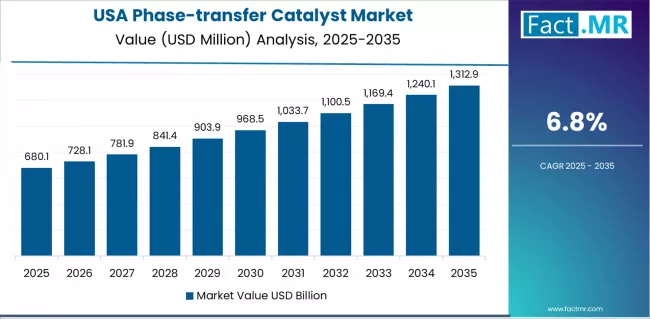
Phase Transfer Catalyst Market Country Value Analysis | Source: Fact.MR
USA establishes green chemistry leadership through comprehensive EPA sustainable synthesis initiatives and established pharmaceutical innovation ecosystem, integrating phase-transfer catalyst technologies across branded drug development, generic API manufacturing, and contract research organizations.
The country's 6.8% growth rate reflects established FDA quality maturity and sophisticated process chemist expertise levels that support widespread deployment of validated catalyst products in pharmaceutical and agrochemical applications. Growth concentrates in established pharmaceutical regions, including New Jersey, North Carolina, and California, where manufacturers showcase advanced green chemistry adoption that appeals to sustainability-focused organizations seeking predictable environmental outcomes and comprehensive process efficiency.
American pharmaceutical chemists leverage established supplier relationships and comprehensive synthetic methodology frameworks, including process chemistry optimization programs and sustainable manufacturing initiatives that create catalyst confidence and synthesis standardization. The market benefits from substantial pharmaceutical innovation development and specialty chemical advancement that encourage premium catalyst purchases while supporting continuous research investments and catalysis validation funding.
Germany Shows Specialty Chemical Sector Integration
Germany's advanced chemical market demonstrates sophisticated phase-transfer catalyst integration with documented sustainability emphasis in synthesis optimization and process chemistry precision through specialized pharmaceutical manufacturers and established fine chemical networks. The country leverages rigorous quality standard principles and evidence-based green chemistry approaches to maintain a 6.5% growth rate.
Premium chemical centers, including Bavaria, North Rhine-Westphalia, and Hesse, showcase environmental excellence priorities where catalyst technologies integrate with established German chemical cultures and comprehensive sustainability practices to optimize synthesis efficiency and ensure appropriate environmental performance.
German process chemists prioritize environmental compliance requirements and comprehensive reaction documentation in catalyst implementation, creating demand for sustainability-validated products with extensive performance characteristics, including recyclability data, comparative efficiency studies, and comprehensive technical literature. The market benefits from established specialty chemical sectors and pharmaceutical intermediate maturity that provide differentiation opportunities and compliance with strict German chemical regulations.
Japan Shows Precision-driven Pharmaceutical Applications
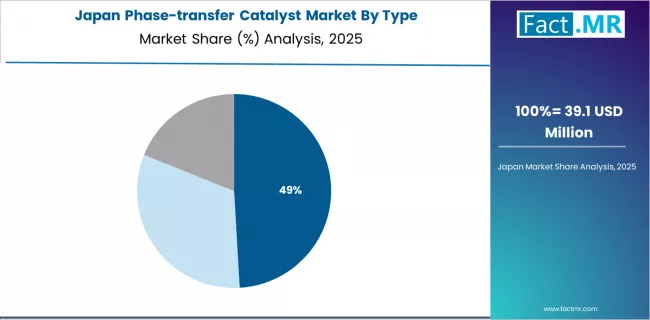
Phase Transfer Catalyst Market Japan Market Share Analysis By Type | Source: Fact.MR
Japan's mature pharmaceutical market demonstrates established phase-transfer catalyst integration with documented precision emphasis in synthesis methodology and reaction selectivity execution through specialized pharmaceutical manufacturers and established fine chemical networks. The country maintains a 5.9% growth rate, leveraging pharmaceutical technology heritage and quality-focused synthesis cultures in production environments.
Major pharmaceutical regions, including Tokyo, Osaka, and Shizuoka areas, showcase synthesis precision where catalyst technologies integrate with established Japanese pharmaceutical environments and comprehensive quality control practices to optimize product purity and maintain competitive advantages under demanding regulatory requirements.
Japanese pharmaceutical chemists prioritize reaction optimization advancement and comprehensive quality assurance in catalyst implementation, creating demand for high-purity products with extensive selectivity characteristics, including enantiomeric excess capabilities, byproduct minimization, and technical consultation services. The market benefits from established pharmaceutical research sectors and advanced synthesis technology awareness that provide premium differentiation opportunities and maintain alignment with Japanese pharmaceutical quality standards.
Brazil Shows Agrochemical Focus
Brazil's developing agricultural market demonstrates progressive phase-transfer catalyst adoption with increasing agrochemical focus in crop protection synthesis and agricultural intermediate manufacturing through expanding pesticide facilities and established herbicide production operations.
The country maintains a 5.6% growth rate, leveraging agricultural sector importance and agrochemical manufacturing expansion in production environments. Key agricultural regions, including Sao Paulo, Parana, and Mato Grosso, showcase crop-focused priorities where catalyst technologies integrate with developing agrochemical cultures and expanding synthesis capabilities to optimize pesticide production and maintain agricultural productivity under evolving farming requirements.
Brazilian agrochemical chemists prioritize cost-effective synthesis strategies and comprehensive agricultural application in catalyst program development, creating demand for economical products with performance characteristics, including herbicide intermediate synthesis, insecticide production capabilities, and technical implementation guidance. The market benefits from emerging agrochemical sectors and growing agricultural efficiency awareness that provide market development opportunities and support expansion of crop protection manufacturing services.
UK Shows R&D-led Innovation
UK's research-intensive market demonstrates established phase-transfer catalyst integration with documented innovation emphasis in catalyst development and advanced synthesis optimization through comprehensive pharmaceutical research organizations and specialized academic-industrial partnerships. The country maintains a 5.1% growth rate, leveraging pharmaceutical research excellence and chemistry innovation cultures in academic and industrial environments.
Principal research centers, including Cambridge, Oxford, and London regions, showcase R&D priorities where catalyst technologies integrate with established UK research environments and comprehensive innovation practices to optimize synthetic methodology and maintain scientific leadership under competitive research requirements.
UK pharmaceutical chemists prioritize catalyst optimization advancement and comprehensive mechanistic understanding in catalyst implementation, creating demand for innovative products with extensive customization characteristics, including bespoke catalyst design, collaborative development services, and technical research support. The market benefits from established pharmaceutical research sectors and academic-industrial collaboration maturity that provide innovation differentiation opportunities and maintain alignment with UK research excellence frameworks.
Europe Market Split by Country
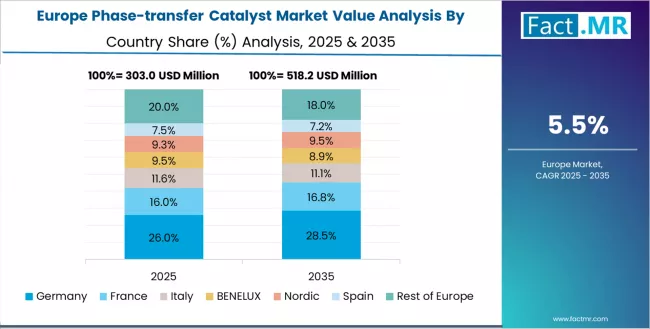
Phase Transfer Catalyst Market Europe Country Market Share Analysis, 2025 & 2035 | Source: Fact.MR
The phase-transfer catalyst market in Europe is projected to grow from USD 0.4 billion in 2025 to USD 0.6 billion by 2035, registering a CAGR of 5.8% over the forecast period. Germany is expected to maintain its leadership position with a 26.8% market share in 2025, supported by its advanced chemical infrastructure and established pharmaceutical synthesis networks.
France follows with USD 0.1 billion, representing 18.9% of the European market in 2025, driven by comprehensive specialty chemical integration and pharmaceutical manufacturing concentration. UK holds USD 0.1 billion with 17.3% market share through established research excellence and pharmaceutical innovation density. Italy commands USD 0.1 billion representing 14.2% share, while Spain accounts for USD 0.0 billion or 11.6% in 2025.
The rest of Europe region maintains USD 0.0 billion, representing 11.2% of the European market, attributed to increasing phase-transfer catalyst adoption in Nordic countries and emerging Eastern European pharmaceutical sectors implementing synthesis optimization programs.
Competitive Landscape of the Phase-transfer Catalyst Market
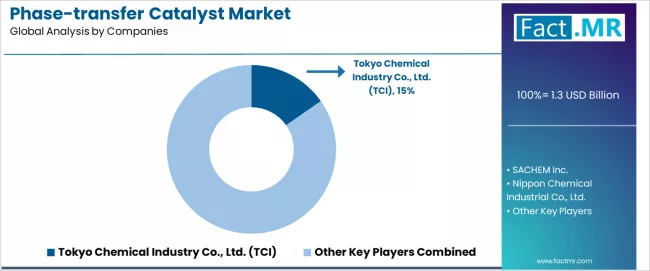
Phase Transfer Catalyst Market Analysis By Company | Source: Fact.MR
The phase-transfer catalyst market exhibits a moderately fragmented competitive structure with approximately 40-60 active players operating across global specialty chemical networks and regional synthesis reagent distribution portfolios. Tokyo Chemical Industry Co., Ltd. maintains market leadership at a 15.3% share, reflecting strong product portfolio positioning across diverse catalyst categories with sophisticated global pharmaceutical strategies.
This competitive landscape demonstrates the maturation of phase-transfer catalyst technology, where established players leverage brand recognition advantages, extensive application evidence documentation, and process chemist relationship programs to maintain dominant positions, while emerging chiral catalyst developers and regional specialty chemical manufacturers create niche opportunities through innovative formulation offerings and competitive pricing strategies.
Market leadership is maintained through several critical competitive advantages extending beyond manufacturing capabilities and product portfolios. Global distribution networks enable leading players to navigate diverse regulatory requirements and access varied pharmaceutical segments including branded drug manufacturers, generic API producers, and contract research organizations.
Technical support infrastructure and synthesis application program availability represent crucial differentiators in catalyst categories, where decades of organic chemistry expertise, reaction optimization protocols, and selectivity enhancement frameworks create purchasing preference among quality-focused chemists.
Manufacturing efficiency in specialty chemical production facilities, supply chain quality management, and purity control separate major suppliers from smaller competitors, while comprehensive performance documentation addressing catalytic efficiency data, selectivity studies, and synthesis case references strengthen market position and customer confidence.
The market demonstrates emerging differentiation opportunities in asymmetric phase-transfer catalyst categories and recyclable catalyst technologies, where traditional achiral catalyst approaches face competition from innovation-focused entrants offering enantioselective advantages. However, significant competitive advantages persist in established quaternary ammonium categories through comprehensive pharmaceutical acceptance portfolios and process chemistry relationship depth.
Premium positioning strategies with chiral catalyst integration and sustainability enhancement capabilities command margin premiums through superior selectivity and environmental performance. Specialized catalyst portfolios combining multiple structural variations with application-specific optimizations create comprehensive positioning that justifies higher price points beyond commodity reagent competition. Integrated solution offerings emphasizing complementary reaction optimization compatibility, unified technical support, and synthetic methodology programs generate brand loyalty and catalyst preferences beyond transactional purchases.
| Stakeholder | What they actually control | Typical strengths | Typical blind spots |
|---|---|---|---|
| Global specialty chemical corporations | Comprehensive catalyst portfolios; global distribution; application documentation | Brand recognition; quality evidence; chemist relationships; regulatory expertise | Innovation speed; pricing flexibility; niche applications; emerging market customization |
| Specialized catalyst companies | Innovation expertise; synthesis technology; structure optimization | Product differentiation; technical sophistication; chemistry support; customer loyalty | Market penetration; distribution infrastructure; price competitiveness; geographic coverage |
| Regional chemical manufacturers | Local production; cost optimization; regional distribution; pharmaceutical proximity | Affordability positioning; delivery speed; local support; cultural understanding | Purity validation; brand recognition; international expansion; advanced structures |
| Academic spin-offs | Novel catalyst designs; mechanistic insights; chiral catalysts; research partnerships | Innovation leadership; selectivity profiles; scientific credibility; IP strength | Commercial scaling; manufacturing capacity; distribution reach; market awareness |
| Pharmaceutical ingredient suppliers | Customer relationships; pharmaceutical integration; regulatory knowledge; quality systems | Pharmaceutical understanding; GMP compliance; audit readiness; supply reliability | Catalyst innovation; chemistry expertise; technical differentiation; research investment |
Source: Fact.MR analysis. Updated Dec 2, 2025
Key Players in the Phase-transfer Catalyst Market
- Tokyo Chemical Industry Co., Ltd. (TCI)
- SACHEM Inc.
- Nippon Chemical Industrial Co., Ltd.
- Tatva Chintan Pharma Chem Limited
- Pat Impex
- Central Drug House
- Volant-Chem Corp.
- Pacific Organics Pvt Ltd
- Otto Chemie Pvt. Ltd.
- NAGASE & CO., LTD.
Segmentation
Scope of the Report
| Items | Values |
|---|---|
| Quantitative Units (2025) | USD 1.3 billion |
| Type | Ammonium Salts, Potassium Salts, Others |
| End-use | Pharmaceuticals, Agriculture, Chemical, Others |
| Regions Covered | North America, Europe, Asia Pacific, Latin America, Middle East & Africa |
| Countries Covered | India, China, USA, Germany, Japan, Brazil, UK |
| Key Companies Profiled | Tokyo Chemical Industry Co., Ltd. (TCI), SACHEM Inc., Nippon Chemical Industrial Co., Ltd., Tatva Chintan Pharma Chem Limited, Pat Impex, Central Drug House, Volant-Chem Corp., Pacific Organics Pvt Ltd, Otto Chemie Pvt. Ltd., NAGASE & CO., LTD. |
| Additional Attributes | Dollar sales by type and end-use categories, regional adoption trends across Asia Pacific, North America, and Europe, competitive landscape with established specialty chemical corporations and specialized catalyst companies, chemist preferences for catalyst methodologies and synthesis protocols, integration with pharmaceutical manufacturing facilities and agrochemical production organizations, innovations in chiral catalyst technologies and recyclable platforms, and development of sophisticated synthesis systems with enhanced selectivity profiles and comprehensive green chemistry documentation frameworks. |
Source: Fact.MR analysis. Updated Dec 2, 2025
Phase-transfer Catalyst Market by Segments
-
Type :
- Ammonium Salts
- Potassium Salts
- Others
-
End-use :
- Pharmaceuticals
- Agriculture
- Chemical
- Others
-
Region :
- North America
- USA
- Canada
- Mexico
- Europe
- Germany
- France
- UK
- Italy
- Spain
- Rest of Europe
- Asia Pacific
- India
- China
- Japan
- South Korea
- ASEAN
- Australia & New Zealand
- Rest of Asia Pacific
- Latin America
- Brazil
- Rest of Latin America
- Middle East & Africa
- GCC Countries
- Saudi Arabia
- South Africa
- Rest of Middle East & Africa
- North America
Frequently Asked Questions
How big is the phase-transfer catalyst market in 2025?
What will be the size of phase-transfer catalyst market in 2035?
How much will be the phase-transfer catalyst market growth between 2025 and 2035?
What are the key product types in the phase-transfer catalyst market?
Which end-use segment to contribute significant share in the phase-transfer catalyst market in 2025?
Who worked on this report


Preview the report firsthand - request a free sample
Free SampleGet the brochure for pricing and purchase details
Download PDF