- Estimated Value(2026): 2.9 Bn
- Forecast Value (2036): 4.3 Bn
- CAGR (2026 - 2036): 4.2%
Polishing Chemicals Market Forecast and Outlook 2026 to 2036
In 2025, the polishing chemicals market surpassed a valuation of USD 2.8 billion. Based on Fact.MR analysis, demand for polishing chemicals is estimated to grow to USD 2.9 billion in 2026 and USD 4.3 billion by 2036. Fact.MR projects a CAGR of 4.2% during the forecast period.
The market is expected to generate an absolute dollar opportunity of USD 1.4 billion between 2026 and 2036. This sustained growth reflects the polishing chemicals segment's embedded position across commercial and institutional facility maintenance, where contract renewal cycles in janitorial services and facilities management create a predictable consumption floor.
Stefan Hartung, Chairman of the Board of Management of Robert Bosch GmbH notes, "The economic reality is reflected in our results, 2025 was a difficult and sometimes painful year for Bosch. In an unfavorable environment, we are continuing to work systematically on our growth strategy, which also requires us to strengthen our competitiveness. We are now setting our course for the future. Our long-term strategy will help us overcome economic realities and seize opportunities."
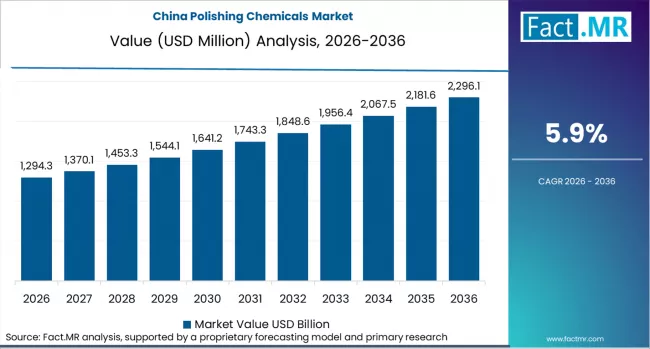
Country growth reflects commercial construction activity and regulatory compliance timelines. China leads at 5.9% CAGR, driven by rapid commercial real estate expansion and hospitality sector investment. Brazil follows at 5.3% under growing retail and healthcare facility development. The United States grows at 4.2% supported by steady institutional replacement procurement. Germany records 3.9% as EU chemical safety regulations prompt reformulation investment. South Korea posts 3.5% amid maturing commercial facility density with ongoing premium product adoption.
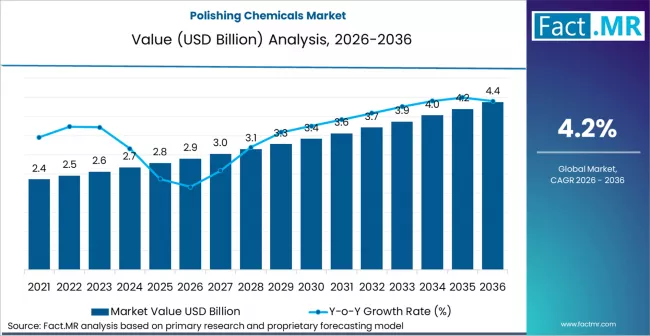
Polishing Chemicals Market Market Value Analysis | Source: Fact.MR
| Metric | Value |
|---|---|
| Estimated Value in 2026 | USD 2.9 billion |
| Forecast Value in 2036 | USD 4.3 billion |
| Forecast CAGR (2026 to 2036) | 4.2% |
Market Definition
The polishing chemicals market includes chemical formulations used to clean, protect, seal, and restore hard floor surfaces in commercial, institutional, and residential settings. Products include floor finishes, spray polishes, strippers, sealers, restorers, and burnishing aids applied to concrete, terrazzo, VCT, stone, tile, hardwood, and laminate. Applications span janitorial programs, healthcare and education facilities, and hospitality and retail environments.
Market Inclusions
The report provides global and regional revenue forecasts from 2026 to 2036 segmented by finish type, system component, floor substrate, end use sector, and geography. It evaluates commercial, institutional, and residential channels, low VOC and green-certified adoption, and jan san distribution networks. Country coverage includes China, Brazil, the United States, Germany, and South Korea.
Market Exclusions
The scope excludes automotive and metal polishes, household surface cleaners, personal care polish products, and industrial abrasives not formulated for floors. Mechanical polishing machines and pads without chemicals are excluded. Low concentration residential sprays outside institutional grade standards are not included.
Research Methodology
- Primary Research: Interviews were conducted with facilities managers, jan san distributors, contract cleaning firms, and commercial real estate procurement teams across North America, Europe, and Asia Pacific.
- Desk Research: Sources included EPA Safer Choice databases, LEED certification criteria, EU REACH filings, janitorial association data, and commercial construction pipeline reports.
- Market Sizing and Forecasting: A hybrid model combined facility counts by sector with consumption rates per square foot and average pricing by finish type and component tier. Assumptions were validated through distributor sales disclosures.
- Data Validation and Update Cycle: Results were cross checked against green certification registrations, building permit data, and distributor sales records. Forecasts are reviewed annually.
Summary
- Market Definition
- Polishing chemicals are formulated floor care compounds used to clean, protect, seal, and restore hard floor substrates across commercial, institutional, and residential environments, including finishes, strippers, sealers, restorers, and burnishing aids.
- Demand Drivers
- Growing adoption of EPA Safer Choice certified and LEED compatible waterborne formulations is expanding institutional procurement.
- Rising commercial construction in Asia Pacific and Latin America is generating first installation demand for maintenance chemical programs.
- Increased outsourcing to contract cleaning services is driving bulk purchasing through distributors.
- Key Segments Analyzed
- By Finish Type High Gloss Finishes hold about 40% share due to durability and visual appeal in high traffic facilities.
- By End Use Sector Commercial Facilities account for roughly 43% share driven by recurring maintenance schedules.
- By Geography North America leads in revenue while Asia Pacific records the fastest growth.
- Analyst Opinion at FACT.MR
- Shambhu Nath Jha, Principal Consultant at Fact.MR, opines, "CXOs will find this report essential for understanding how the polishing chemicals market is dividing between legacy solvent based products under regulatory pressure and premium green certified waterborne systems delivering higher margins and recurring institutional revenue through 2036."
- Strategic Implications
- Manufacturers should expand EPA Safer Choice and LEED compatible product lines to capture institutional sustainability mandates.
- Distributors should target healthcare and education sectors in China and Brazil where structured procurement is expanding.
- Suppliers should bundle finish, stripper, and restorer systems with service contracts to secure recurring program revenue.
- Methodology
- Market sizing combined facility counts with chemical consumption per square foot and pricing tiers validated through distributor data.
- Green certification trends were benchmarked against EPA registrations and confirmed product launches.
- Regional forecasts incorporated construction permits, institutional investment data, and contract cleaning industry growth.
Segmental Analysis
Polishing Chemicals Market Analysis by Finish Type
Polishing Chemicals Market Analysis By Finish Type | Source: Fact.MR
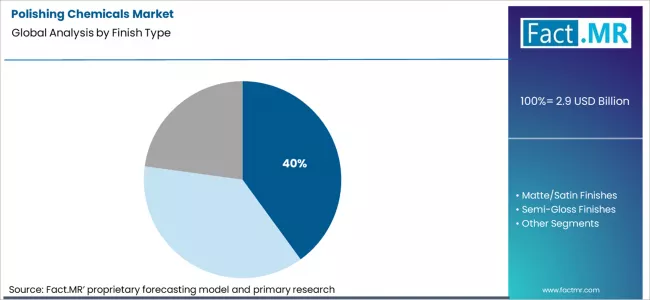
Based on FACT.MR's polishing chemicals market report, high-gloss finish products are estimated to hold 40% share in 2026. High-gloss systems remain the preferred institutional specification because they deliver durability under heavy foot traffic while maintaining visual standards required in retail, hospitality, and healthcare settings. Their reflective surface also helps facility managers visually assess wear, reinforcing their default use in commercial janitorial contracts.
- Ecolab Floor Care Portfolio Expansion: In 2025, Ecolab enhanced its Revitalize and Floor Force lines with improved polymer crosslink technology for longer-lasting gloss in high-burnish environments. These products align with EPA Safer Choice criteria and target healthcare and food service facilities requiring hygiene and appearance compliance. [5]
- Low-VOC High-Gloss Formulation Technology: BASF’s Acronal and Joncryl polymer platforms support waterborne high-gloss formulations. In 2024, BASF introduced optimized emulsion grades designed for improved gloss retention and faster drying, addressing contractor productivity needs in commercial settings. [6]
- Matte Finish Growth in European Design Markets: European design trends are encouraging matte and satin floor specifications in premium retail and hospitality interiors. Germany and the Netherlands have recorded growing architect-led adoption of low-sheen finishes aligned with minimalist design preferences.
Polishing Chemicals Market Analysis by End Use Sector
Polishing Chemicals Market Analysis By End Use Sector | Source: Fact.MR
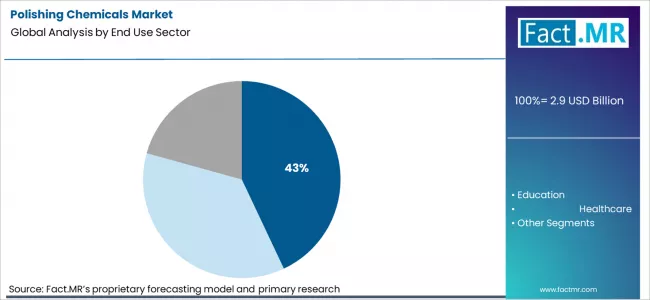
Fact.MR estimates commercial facilities will hold 43% share in 2026. This segment combines the largest managed floor area with structured janitorial contracts that specify product systems and maintenance frequency. Such contractual frameworks create predictable, recurring chemical demand independent of short-term purchasing shifts.
- Diversey Commercial Facility Programs: Diversey expanded its floor care systems in 2025 with lower-odour, faster-curing formulations under its IntelliCare and Stride ranges. These products support maintenance in occupied commercial buildings requiring minimal disruption. [1]
- Healthcare Floor Care Procurement Growth: Healthcare remains a major segment due to infection-control protocols. In 2024, the U.S. Centers for Disease Control and Prevention reinforced environmental cleaning guidelines, supporting structured procurement of compliant floor maintenance chemistries in hospitals and care facilities. [7]
- Retail Sector Flooring Investment: Retail expansion in Asia Pacific continues to drive first-installation chemical programs. Regional retail floor space grew around 5% annually in 2024 and 2025, with new store openings specifying integrated polishing and maintenance systems across concrete, VCT, and stone substrates.
Drivers, Restraints, and Opportunities
Demand is contract-based rather than discretionary, as hospitals, schools, offices, and retail facilities require recurring chemical replenishment to maintain safety, hygiene, and surface durability. The market is shifting from solvent-based finishes to waterborne, low-VOC, and green-certified alternatives aligned with EPA Safer Choice, EU REACH, and LEED standards. Although these compliant products cost 15 to 25% more, they deliver comparable performance while lifting average selling prices and improving overall revenue mix.
- Green Certification Procurement Mandates: EPA Safer Choice and EU Ecolabel certifications are increasingly embedded in institutional tenders. By 2024, more than 2,700 products carried EPA Safer Choice status, and major universities and healthcare systems updated contracts to require compliant chemistries, narrowing demand for legacy solvent formulations. [2]
- Commercial Construction Pipeline Demand: Asia Pacific commercial development is driving first-installation demand for floor care systems. China’s commercial construction investment exceeded CNY 3.2 trillion in 2024 under the 14th Five-Year Plan, generating specification-led procurement for polishing and maintenance programs across new retail and hospitality assets. [3]
- Healthcare Sector Expansion: Healthcare infrastructure growth is expanding floor care chemical demand in regulated environments. India’s Ayushman Bharat Health Infrastructure Mission allocated USD 4.7 billion through 2026 for hospital upgrades and new builds, increasing procurement of antimicrobial and protective floor care chemistries in clinical facilities. [4]
Regional Analysis
The polishing chemicals market is analysed across North America, Latin America, Europe, East Asia, South Asia, Oceania and Middle East & Africa across 40+ countries. The full report also offers market attractiveness analysis based on regional trends.
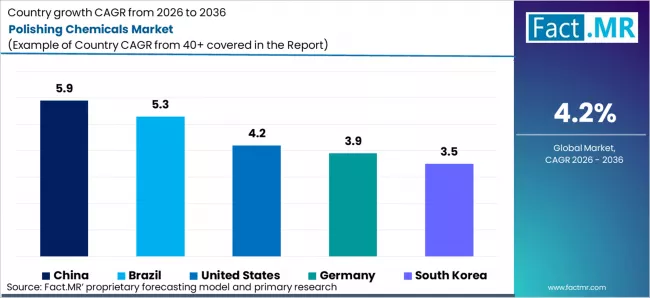
Polishing Chemicals Market Cagr Analysis By Country | Source: Fact.MR
| Country | CAGR (2026-2036) |
|---|---|
| China | 5.9% |
| Brazil | 5.3% |
| United States | 4.2% |
| Germany | 3.9% |
| South Korea | 3.5% |
Source: Fact.MR (FACT.MR) analysis, based on proprietary forecasting model and primary research
Asia Pacific Polishing Chemicals Market Analysis
Polishing Chemicals Market Country Value Analysis | Source: Fact.MR
Asia Pacific is the fastest growing region for polishing chemicals, supported by expanding commercial construction, rising institutional facility standards, and growing outsourcing of maintenance services. The region balances premium international formulations in regulated institutional segments with cost competitive domestic suppliers serving volume driven commercial maintenance demand.
- China: Demand for polishing chemicals in China is projected to rise at 5.9% CAGR through 2036. Commercial real estate, hospitality, and retail expansion under the 14th Five Year Plan are enlarging managed floor area. Healthcare facility investment and premium retail projects are increasing adoption of full floor care systems. Domestic players focus on spray and restorer categories, while international brands lead in high specification institutional finishes.
- South Korea: Demand in South Korea is projected to rise at 3.5% CAGR through 2036. A mature commercial base supports steady replacement demand, while healthcare and education segments are upgrading to certified products. The Ministry of Environment’s expanded K Eco certification requirements are strengthening demand for low VOC compliant floor care formulations.
FACT.MR's Asia Pacific analysis covers China, Japan, South Korea, Australia and New Zealand, India, ASEAN, and Rest of Asia Pacific. Readers can review construction pipelines, certification adoption rates, and institutional procurement structures by country.
Europe Polishing Chemicals Market Analysis
Europe’s market is shaped by EU REACH restrictions, Ecolabel certification, and sustainability led procurement policies. Institutional buyers treat chemical compliance as a baseline requirement, making reformulation and certified product portfolios central to competitive positioning.
- Germany: Demand in Germany is projected to rise at 3.9% CAGR through 2036. A dense commercial and industrial facility base ensures stable consumption. EU REACH and Ecolabel timelines are accelerating replacement of solvent based finishes with waterborne alternatives. Updated federal procurement standards effective 2025 now require certified floor care chemistries for public contracts.
FACT.MR's European analysis covers Germany, France, the United Kingdom, Norway, Spain, the Netherlands, Nordics, and Rest of Europe. The report details compliance timelines, municipal budgets, and certified product adoption volumes.
North America Polishing Chemicals Market Analysis
North America is the largest market by revenue, supported by an extensive installed base of commercial, healthcare, and education facilities. Demand is primarily replacement driven, anchored in contract renewals across jan san distribution and institutional maintenance programs.
- United States: Demand in the United States is projected to rise at 4.2% CAGR through 2036. Growth reflects EPA Safer Choice adoption, renovation cycles in commercial properties, and healthcare compliance requirements. Leading suppliers such as Ecolab, Zep, and SC Johnson Professional maintain strong institutional relationships, while 2024 federal procurement updates reinforced green certified mandates for government facilities.
FACT.MR's North American analysis covers the United States, Canada, and Mexico. Readers can access certification data, distribution channel structures, procurement benchmarks, and renovation trends.
Latin America Polishing Chemicals Market Analysis
Latin America is expanding alongside healthcare infrastructure and retail construction, with Brazil leading regional growth. The market combines international premium systems in regulated segments with domestic alternatives serving price sensitive commercial maintenance demand.
- Brazil: Demand in Brazil is projected to rise at 5.3% CAGR through 2036. Healthcare expansion under Ministry of Health programmes, retail floor area growth in major cities, and hospitality investment are enlarging floor maintenance requirements. ANVISA compliance standards for hospital cleaning chemicals are encouraging procurement of certified floor care formulations in new clinical facilities.
FACT.MR's Latin America analysis covers Brazil, Chile, Ecuador, and Rest of Latin America. Readers can review healthcare procurement trends, construction pipelines, and retail floor care adoption by country.
Competitive Aligners for Market Players
Polishing Chemicals Market Analysis By Company | Source: Fact.MR
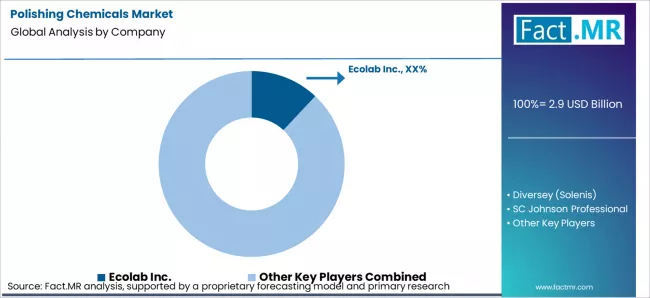
The global polishing chemicals market is moderately fragmented, with multinational cleaning and specialty chemical companies leading institutional and commercial segments, while regional suppliers compete on price in residential and volume driven categories. Ecolab, Diversey, and SC Johnson Professional together account for more than 35% of the institutional segment in North America and Western Europe. Their strength lies in integrated floor care systems, strong jan san distribution networks, and green certified portfolios that align closely with healthcare, education, and government procurement standards.
Structural advantage in this market comes from formulation control and service integration. Companies that own proprietary waterborne polymer platforms and maintain direct institutional sales teams build long term customer relationships. Ecolab’s managed floor care programs increase switching costs through documented maintenance systems and performance guarantees. Diversey benefits from Solenis’ formulation capabilities and global reach, while upstream suppliers such as BASF and Dow influence product standards through base polymer chemistry supply.
Institutional buyers typically operate approved vendor lists and multi-year contracts, limiting supplier churn. In contrast, residential demand remains brand driven, where familiarity with names like Bona AB and 3M supports repeat purchasing, creating distinct competitive dynamics across segments.
Recent Development
- In 2025, Solenis-owned Diversey launched its TASKI Jontec Care floor care system, replacing fluorinated leveling agents with next-generation chemistries to enhance sustainability and performance in commercial floor maintenance programs.
- In 2025, Diversey introduced Oxivir Three 64 Concentrate, a next-gen cleaning chemical aimed at broad institutional cleaning and maintenance demand, reflecting innovation in commercial care chemistries
Key Players
- Ecolab Inc.
- Diversey (Solenis)
- SC Johnson Professional
- 3M Company
- Zep Inc.
- BASF SE
- Dow Inc.
- Sika AG
- RPM International Inc.
- Bona AB
Bibliography
- [1] Diversey (Solenis). (2025). Diversey Floor Care Portfolio: Sustainability Commitments and EPA Safer Choice Product Registrations. Diversey Corporate Communications.
- [2] U.S. Environmental Protection Agency. (2024). Safer Choice Program: Certified Product List and Institutional Procurement Guidance. EPA Safer Choice Programme.
- [3] National Bureau of Statistics of China. (2024). 14th Five-Year Plan Commercial Real Estate Construction Investment Report. National Bureau of Statistics, People's Republic of China.
- [4] Ministry of Health and Family Welfare, Government of India. (2024). Ayushman Bharat Health Infrastructure Mission: Hospital Construction Progress and Infrastructure Investment Report.
- [5] Ecolab Inc. (2025). Floor Care Product Portfolio: Revitalize and Floor Force System Specifications and EPA Safer Choice Registration Documentation. Ecolab Corporate Product Information.
- [6] BASF SE. (2024). Acronal and Joncryl Waterborne Polymer Emulsions for Floor Care Applications: Technical Data Sheets and Application Guidelines. BASF Performance Chemicals.
- [7] U.S. Centers for Disease Control and Prevention. (2024). Guidelines for Environmental Infection Control in Health-Care Facilities: Floor Maintenance and Chemical Disinfection Protocols. CDC Healthcare Infection Control Practices Advisory Committee.
This Report Addresses
- Market intelligence to enable structured strategic decision making across mature and emerging surface treatment economies
- Market size estimation and 10 year revenue forecasts from 2026 to 2036, supported by validated capacity and trade benchmarks
- Growth opportunity mapping across high-gloss, matte, and sustainable finishes with emphasis on labor-saving systems
- Segment and regional revenue forecasts covering commercial, healthcare, education, and industrial applications
- Competition strategy assessment including M&A integration models, cost survivability positioning, and compliance capability benchmarking
- Product reformulation and environmental compliance tracking including low-VOC and bio-based grade adoption
- Regulatory impact analysis covering worker safety fines, indoor air quality mandates, and green building certifications
- Market report delivery in PDF, Excel, PPT, and interactive dashboard formats for executive and operational use
Segmentation
Scope of Report
| Items | Values |
|---|---|
| Quantitative Units | USD 2.9 billion (2026) to USD 4.3 billion (2036), at a CAGR of 4.2% |
| Market Definition | Polishing chemicals are formulated floor care compounds used to clean, protect, restore, and maintain the surface finish of hard floor substrates across commercial, institutional, and residential environments, including floor finishes, strippers, sealers, restorers, and burnishing aids applied to concrete, terrazzo, VCT, stone, tile, wood, and laminate substrates. |
| Finish Type Segmentation | High-Gloss Finishes, Matte/Satin Finishes, Semi-Gloss Finishes, Sealers/Primers |
| System Component Segmentation | Finish/Polish Coatings, Maintenance Sprays, Strippers, Restorers, Burnishing Aids |
| Floor Substrate Segmentation | Concrete/Terrazzo, VCT/Resilient Floors, Stone/Tile, Wood, Laminate |
| End Use Sector Segmentation | Commercial Facilities, Education, Healthcare, Retail, Hospitality, Industrial, Residential |
| Application Coverage | Commercial facility floor maintenance, institutional jan-san procurement programs, healthcare infection control floor care, hospitality and retail floor finish programs, education sector maintenance contracts, residential premium floor care |
| Regions Covered | Asia Pacific, Europe, North America, Latin America, Middle East and Africa |
| Countries Covered | China, Japan, South Korea, Australia and New Zealand, India, ASEAN, Rest of Asia Pacific, Norway, Germany, United Kingdom, France, Spain, Netherlands, Nordics, Rest of Europe, United States, Canada, Mexico, Brazil, Chile, Ecuador, Rest of Latin America, Kingdom of Saudi Arabia, United Arab Emirates, South Africa, Turkey, Rest of Middle East and Africa |
| Key Companies Profiled | Ecolab Inc., Diversey (Solenis), SC Johnson Professional, 3M Company, Zep Inc., BASF SE, Dow Inc., Sika AG, RPM International Inc., Bona AB |
| Forecast Period | 2026 to 2036 |
| Approach | A hybrid top down and bottom up model was used. Top down inputs assessed total managed commercial and institutional floor area by sector and region. Bottom up inputs included average pricing by finish type, chemical consumption per square foot, maintenance frequency, and new construction growth validated through distributor and facilities management interviews. |
Polishing Chemicals Market by Segment
-
By Finish Type :
- High-Gloss Finishes
- Matte/Satin Finishes
- Semi-Gloss Finishes
- Sealers/Primers
-
By System Component :
- Finish/Polish Coatings
- Maintenance Sprays
- Strippers
- Restorers
- Burnishing Aids
-
By Floor Substrate :
- Concrete/Terrazzo
- VCT/Resilient Floors
- Stone/Tile
- Wood
- Laminate
-
By End Use Sector :
- Commercial Facilities
- Education
- Healthcare
- Retail
- Hospitality
- Industrial
- Residential
-
By Region :
- North America
- United States
- Canada
- Mexico
- Europe
- Germany
- United Kingdom
- France
- Norway
- Spain
- Netherlands
- Nordics
- Rest of Europe
- Asia Pacific
- China
- Japan
- South Korea
- India
- Australia and New Zealand
- ASEAN
- Rest of Asia Pacific
- Latin America
- Brazil
- Chile
- Ecuador
- Rest of Latin America
- Middle East and Africa
- Kingdom of Saudi Arabia
- United Arab Emirates
- South Africa
- Turkey
- Rest of Middle East and Africa
- North America
Frequently Asked Questions
How large is the polishing chemicals market in 2025?
What will the market size be in 2026?
What is the projected market size by 2036?
What is the expected CAGR for the forecast period 2026 to 2036?
Which finish type segment is poised to lead the polishing chemicals market?
Which end use sector holds the largest share?
Which country shows the fastest growth rate?
How fast is the polishing chemicals market expected to expand in Brazil?
What is the forecast CAGR for Germany's polishing chemicals market?
How is the polishing chemicals market in the United States expected to grow?
Who worked on this report


Preview the report firsthand - request a free sample
Free SampleGet the brochure for pricing and purchase details
Download PDF