- Market Value (2025): USD 2.0 Bn
- Estimated Value (2026): USD 2.4 Bn
- Forecast Value (2036): USD 11.7 Bn
- CAGR (2026-2036): 17.2%
What is the Portable Collaborative Robot Systems Market forecast to be worth by 2036?
USD 2.4 billion in 2026 and USD 11.7 billion by 2036 at a 17.2% CAGR.
- The portable collaborative robot systems market was valued at USD 2.0 billion in 2025 and associates demand with factory testing of flexible workcells for tending and inspection.
- Demand to increase from USD 2.4 billion in 2026 to USD 11.7 billion by 2036.
- The market is forecast to record 17.2% CAGR from 2026 to 2036 and associates growth with high-mix production and faster redeployment cycles.
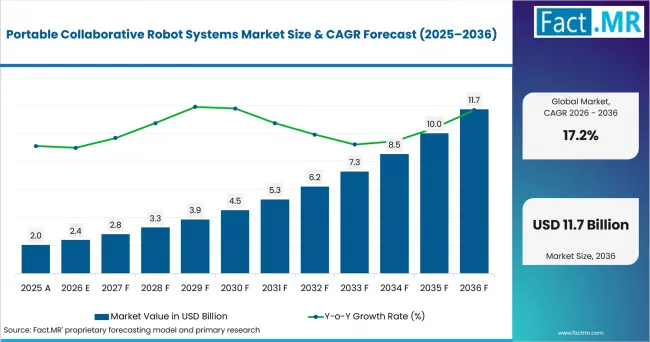
Portable Collaborative Robot Systems Market Value Analysis | Source: Fact.MR
What are the defining numbers behind Portable Collaborative Robot Systems Market growth?
USD 9.3 billion absolute opportunity by 2036.
- Demand Drivers in the Market
- Manufacturing engineers need portable cobots that reduce fixture dependence when parts move between short runs.
- BLS reported 2.5 million private-industry nonfatal workplace injuries and illnesses in 2024.
- Automation teams are expected to value small-footprint systems that fit beside CNC machines and test benches in applications where task-level risk assessment permits collaborative operation without fixed perimeter guarding.
- A3 reported 1,052 collaborative robots valued at USD 39.2 million in North American orders during Q1 2025.
- Key Segments Analyzed
- By Payload: Up to 5 kg to hold 38.0% share in 2026 and associates the lead with lightweight arms suited to inspection and handling tasks.
- By Application: Machine tending to account for 27.0% share in 2026 and associates the lead with the ability to redeploy one portable cell across several machines.
- By Mobility: Cart/base-mounted systems to capture 46.0% share in 2026 and associates the lead with faster redeployment than fixed cells.
- By End-Use Industry: Automotive to represent 26.0% share in 2026 and associates the lead with tending, part loading and inspection use cases.
- Analyst Opinion at Fact.MR
- Shambhu Nath Jha, Principal Consultant at Fact.MR states, “Portable cobots draw attention because one arm can serve several tasks. Production acceptance is expected to depend on safe redeployment and repeatable setup. Suppliers should combine risk-assessment support with simple programming evidence.”
- Strategic Implications
- Factory engineering teams should test real parts before comparing quoted payload and cycle-time claims.
- System integrators should document safety zones and fixture changes so plant teams can repeat setups after redeployment.
- Procurement teams should compare full workcell cost. Tooling, carts, vision packages and operator training need separate review.
- Investors should separate portable cobot exposure from broader industrial robotics systems that depend on fixed cells.
South Korea to record 19.6% CAGR through 2036. The United States is expected to post 18.2%, while Italy is forecast to advance at 17.8%. Germany is anticipated to reach 17.4%. France is estimated to record 17.3%, and Japan is projected to reach 17.2%.
How does the Portable Collaborative Robot Systems Market break down by segment?
Up to 5 kg to lead Payload at 38.0%; Cart/base-mounted systems are estimated to lead Mobility at 46.0%.
Which payload category dominates?
Up to 5 kg is projected to account for 38.0% share in 2026.
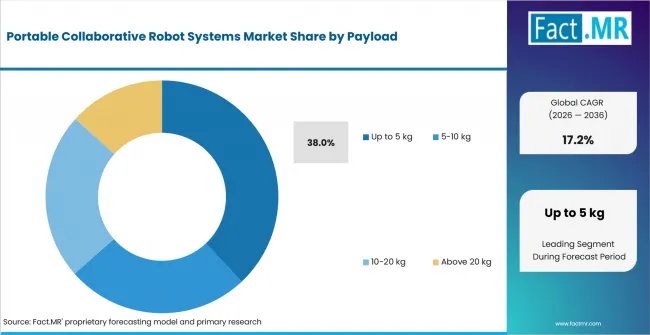
Portable Collaborative Robot Systems Market Analysis By Payload | Source: Fact.MR
Up to 5 kg systems lead because portable cobots are well suited to light-part and small-tool handling across high-mix production. FANUC America introduced the CRX-3iA in April 2026, an ultra-lightweight collaborative robot designed for fast redeployment across small, high-mix tasks, supporting greater flexibility in collaborative automation.
What leads the Application segment?
Machine tending is expected to hold 27.0% share in 2026.
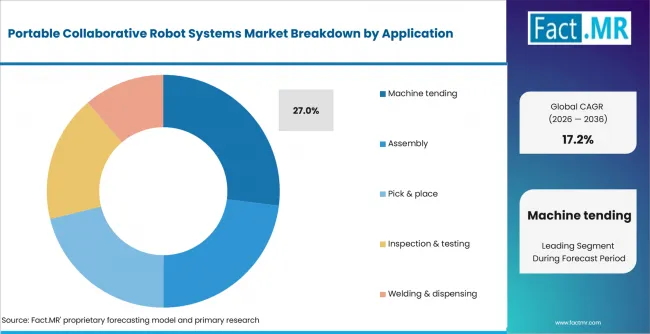
Portable Collaborative Robot Systems Market Analysis By Application | Source: Fact.MR
Machine tending leads because portable cobot cells can load and unload machines during unattended periods while reducing repetitive manual work. BLS reported 946,290 DART cases in private industry over the 2023–2024 period caused by overexertion, repetitive motion, and bodily conditions, highlighting a potential area for ergonomic automation.
How does Mobility shape demand?
Cart/base-mounted systems are anticipated to lead with 46.0% share in 2026.
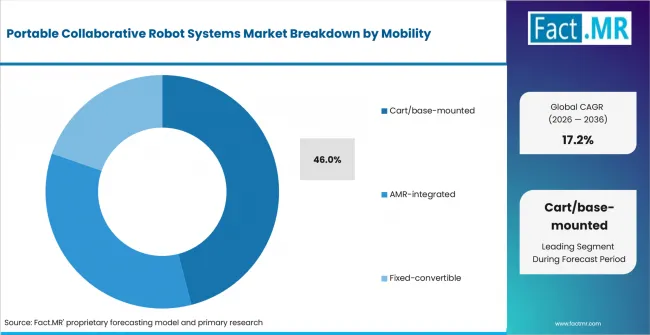
Portable Collaborative Robot Systems Market Analysis By Mobility | Source: Fact.MR
Cart/base-mounted systems lead because manufacturers can redeploy one cobot across similar workstations without permanently fixing automation to a single cell. This flexibility supports high-mix operations, changing production schedules and shared equipment use, while portable configurations align closely with broader adoption of mobile industrial robot platforms.
What supports Automotive within End-Use Industry?
Automotive is estimated to represent 26.0% share in 2026.
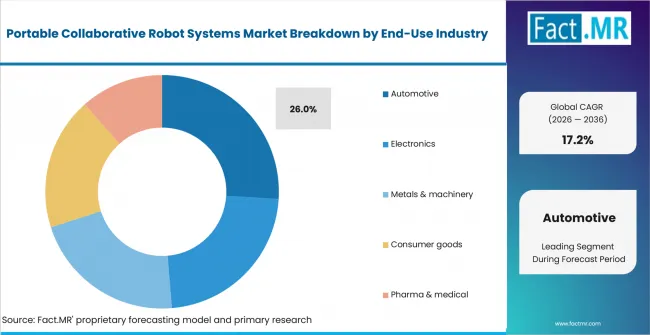
Portable Collaborative Robot Systems Market Analysis By End Use Industry | Source: Fact.MR
Automotive leads because cobots support machine tending, inspection and component-handling tasks across flexible production environments. Their redeployability helps manufacturers adapt automation to changing models and workstation requirements. IFR reported that Japan’s automotive industry installed about 13,000 robots in 2024, highlighting continued automation activity across vehicle manufacturing.
What is accelerating Portable Collaborative Robot Systems Market adoption, and what is holding it back?
Flexible workcell deployment drives it; safety validation and utilization risk restrain it.
Drivers Impact Analysis
| Driver | (~) % Impact on CAGR | Geographic Relevance | Impact Timeline |
|---|---|---|---|
| High-mix machine tending | +4.2% | United States, Germany, Italy | Short term (<= 2 years) |
| Operator-proximity automation | +3.5% | United States, France, Japan | Short term (<= 2 years) |
| Cart-based redeployment | +2.8% | Global manufacturing clusters | Medium term (2-4 years) |
| Light-payload inspection | +2.1% | Electronics and automotive sites | Medium term (2-4 years) |
| Simple programming tools | +1.4% | SME manufacturing bases | Long term (>= 4 years) |
Source: Fact.MR analysis. Updated Aug 18, 2026
- Operator-proximity automation: Manufacturers are anticipated to use cobots where workers still need access to parts and fixtures.
- Cart-based redeployment: Portable bases are projected to reduce trial cost when buyers move one cobot between tending, testing and packaging jobs.
- Light-payload inspection: Small payload arms are estimated to gain from camera inspection and sample movement. Compatibility with robot control systems is expected to affect supplier selection.
- Simple programming tools: Plant teams are forecast to favor systems that operators can adjust without long offline-programming cycles.
Opportunity Impact Analysis
| Opportunity | (~) % Impact on CAGR | Geographic Relevance | Impact Timeline |
|---|---|---|---|
| Plug-and-play tooling kits | +1.6% | United States and Europe | Short term (<= 2 years) |
| AMR-linked workcells | +1.3% | Japan, South Korea, Germany | Medium term (2-4 years) |
| Vision-guided inspection | +1.0% | Electronics clusters | Medium term (2-4 years) |
| SME rental and leasing | +0.8% | Italy, France, United States | Long term (>= 4 years) |
Source: Fact.MR analysis. Updated Aug 18, 2026
- Plug-and-play tooling kits: Grippers, screwdrivers and dispensers are expected to shorten trial time. That favors suppliers tied to robotic end-of-arm tooling.
- AMR-linked workcells: Mobile manipulation is anticipated to expand when plants standardize paths and docking points.
- Vision-guided inspection: Lightweight robot arms are expected to benefit when quality checks need flexible positioning.
- SME rental and leasing: Smaller manufacturers are estimated to test portable cobots when rental routes reduce capital friction.
Restraints Impact Analysis
| Restraint | (~) % Impact on CAGR | Geographic Relevance | Impact Timeline |
|---|---|---|---|
| Safety documentation load | -1.6% | United States, Germany, France | Short term (<= 2 years) |
| Low utilization risk | -1.2% | Small and mid-sized factories | Short term (<= 2 years) |
| Tooling mismatch | -0.9% | High-mix factories | Medium term (2-4 years) |
| Mobile traffic control | -0.7% | AMR-integrated sites | Long term (>= 4 years) |
Source: Fact.MR analysis. Updated Aug 18, 2026
- Low utilization risk: A3 reported 3,085 collaborative robots valued at USD 114 million in first-half 2025 North American orders.
- Tooling mismatch: Movable arms still fail when grippers or dispensers are not matched to the part family. This supports demand for autonomous grippers.
- Mobile traffic control: AMR-integrated systems require stable routes, charging points and handoff zones.
Which countries are scaling Portable Collaborative Robot Systems Market fastest?
- The country comparison spans 2.40 percentage points and forms three practical growth bands across the forecast period.
- South Korea remains 1.42 percentage points above the United States through electronics automation, high robot density and flexible workcell adoption.
- The United States remains 0.33 percentage point above Italy through installation recovery, machine tending and labor-safety considerations.
- Italy remains 0.38 percentage point above Germany through machinery, metalworking and high-mix production needs.
- Germany remains 0.12 percentage point above France through robot density, precision manufacturing and cart-mounted cobot deployment.
- France remains 0.15 percentage point above Japan through manufacturing recovery and flexible production requirements.
- Japan closes the displayed range through automotive and electronics automation depth, compact design and established robotics expertise.
Comparable CAGRs can create different entry conditions due to robot density, factory layout, safety-validation requirements and local integration depth. Full report coverage includes North America, Latin America, Europe, East Asia, South Asia and Pacific, Middle East and Africa.
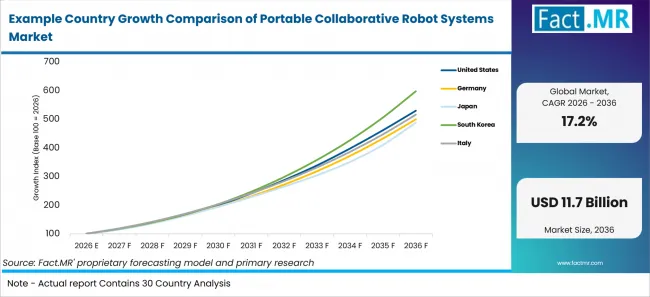
Example Country Growth Comparison Of Portable Collaborative Robot Systems Market | Source: Fact.MR
| Country | CAGR (2026-2036) |
|---|---|
| South Korea | 19.6% |
| United States | 18.2% |
| Italy | 17.8% |
| Germany | 17.4% |
| France | 17.3% |
| Japan | 17.2% |
Source: Fact.MR analysis. Updated Aug 18, 2026
What supports South Korea adoption?
19.6% CAGR, supported by electronics automation and high robot density.
South Korea’s growth is reinforced by its established automation base and electronics manufacturing depth. IFR reported that South Korea had 1,220 operational industrial robots per 10,000 manufacturing employees in 2024, while South Korea’s mining and manufacturing establishments with 10 or more employees recorded shipments of KRW 2,090.2 trillion. Lightweight cobots suit changing production needs, although weaker manufacturing output, high buyer expectations and AMR routing requirements can slow deployment.
How is the United States scaling demand?
18.2% CAGR, backed by robot-installation growth and flexible machine-tending demand.
The United States benefits from expanding industrial automation and labor-safety priorities. IFR reported that industrial robot installations in the United States increased 11.0% year over year to 38,000 units in 2025, while BLS reported 2.5 million private-industry nonfatal workplace injuries and illnesses in 2024. Cart-mounted cobots support high-mix tasks, although safety validation, tooling approval and limited in-house programming expertise can extend implementation.
What supports Italy adoption?
17.8% CAGR, driven by machinery, metalworking and high-mix production.
Italy’s outlook is shaped by machinery, metalworking and flexible manufacturing environments. Istat reported that metallurgy and metal-product manufacturing represented 16.4% of Italy’s industrial production index weighting structure under the 2023 calculation base, while the seasonally adjusted industrial production index increased 0.5% month over month in April 2026. Cart-mounted cobots support mixed production, though uncertain utilization and process-specific validation can delay smaller factory investments.
How is Germany developing demand?
17.4% CAGR, supported by robot density and precision-manufacturing activity.
Germany’s market benefits from a mature automation base and strong machinery production. IFR reported that Germany had 449 operational industrial robots per 10,000 manufacturing employees in 2024, while Destatis reported that, after revision, German new orders in manufacturing increased 6.4% month over month in December 2025. Portable cobots suit shared machine-loading tasks, although weaker machinery output, safety documentation and higher engineering costs can lengthen payback periods.
What is driving France growth from 2026 to 2036?
17.3% CAGR, backed by manufacturing recovery and flexible production needs.
France’s growth reflects demand for automation that preserves product-change flexibility. INSEE reported that French manufacturing output was 1.8% higher year over year in the fourth quarter of 2025, while output in the manufacture of transport equipment increased 12.4%. Mobile and cart-mounted cobots fit existing workstations, although weaker monthly output, operator training requirements and non-standardized plant routes can restrain deployment.
How does Japan perform?
17.2% CAGR, led by automotive and electronics automation depth.
Japan’s outlook is supported by an established robotics industry and strong emphasis on reliability and compact design. Its automotive sector installed about 13,000 robots in 2024, while machinery orders increased 3.4% month over month in April 2026. Lightweight cobots suit inspection and handling tasks, although mature fixed automation and careful risk assessment can slow wider adoption.
Who leads the Portable Collaborative Robot Systems Market?
Universal Robots and FANUC both offer collaborative robots with flexibility or redeployment-oriented features. Doosan Robotics, ABB, Techman Robot and KUKA complete the report’s broader collaborative automation provider set.
Universal Robots supports flexible collaborative automation through the lightweight, small-footprint UR15. FANUC explicitly positions the 11 kg CRX-3iA for fast redeployment and portable automation. Doosan Robotics, ABB, Techman Robot and KUKA complete the report’s broader provider set.
Which companies are the key providers?
Key companies include Universal Robots, Techman Robot and FANUC. Doosan Robotics, ABB and KUKA complete the provider set.
- Universal Robots
- Techman Robot
- FANUC
- Doosan Robotics
- ABB
- KUKA
How is the market segmented?
-
By Payload:
- Up to 5 kg
- 5-10 kg
- 10-20 kg
- Above 20 kg
-
By Application:
- Machine tending
- Assembly
- Pick & place
- Inspection & testing
- Welding & dispensing
-
By Mobility:
- Cart/base-mounted
- AMR-integrated
- Fixed-convertible
-
By End-Use Industry:
- Automotive
- Electronics
- Metals & machinery
- Consumer goods
- Pharma & medical
-
By Region:
- North America
- Latin America
- Europe
- East Asia
- South Asia and Oceania
- Middle East and Africa
Bibliography
- Association for Advancing Automation. (2025, May 22). North American robot orders hold steady in Q1 2025 as A3 launches first-ever collaborative robot tracking.
- Association for Advancing Automation. (2025, August 12). New A3 report signals steady automation investment in first half of 2025.
- U.S. Bureau of Labor Statistics. (2026, January 22). Employer-reported workplace injuries and illnesses, 2023–2024.
- Federal Statistical Office (Destatis). (2026, March 9). New orders in manufacturing in January 2026: -11.1% on the previous month.
- Federal Statistical Office (Destatis). (2026, February 6). Production in December 2025: -1.9% on the previous month.
- FANUC America Corporation. (2026, April 20). FANUC America debuts ultra lightweight CRX-3iA collaborative robot and new capabilities across the CRX lineup.
- Institut national de la statistique et des études économiques. (2026, February 5). In December 2025, manufacturing output fell back sharply (-0.8%).
- Institut national de la statistique et des études économiques. (2026, July 3). In May 2026, manufacturing output fell back by 1.0%.
- International Federation of Robotics. (2025, July 15). Japan’s car industry has highest robot installations in five years.
- Istat. (2025, April 10). Industrial production index – Updating of the calculation basis.
- Istat. (2026, February 11). Industrial production – December 2025.
- Istat. (2026, June 10). Industrial production – April 2026.
- Ministry of Data and Statistics. (2025, December 17). Preliminary results of the 2024 Mining and Manufacturing Survey.
- Ministry of Data and Statistics. (2026, January 30). Monthly industrial statistics, December 2025.
- Universal Robots. (2025, May 12). Universal Robots introduces its fastest ever cobot to enable unprecedented performance in collaborative automation.
- Ministry of Economy, Trade and Industry. (2026, June 12). Revised report for April 2026: Indices of industrial production.
This Report Answers
- The report provides strategic intelligence on the Portable Collaborative Robot Systems Market across Payload and Application choices that shape flexible cobot programs.
- Segment analysis covers Up to 5 kg and Cart/base-mounted systems as the share leaders within the 2026 market.
- Country outlook evaluates the United States and Germany alongside Japan and South Korea. Italy and France complete the growth comparison.
- Competitive analysis profiles Universal Robots and FANUC alongside Doosan Robotics and ABB. Techman Robot and KUKA complete the provider set.
- Mobility assessment covers Cart/base-mounted and AMR-integrated systems. Fixed-convertible systems complete the mobility view alongside portable autonomous robot systems.
What does the Portable Collaborative Robot Systems Market cover?
Portable collaborative robot systems are designed for factory tasks in which a movable robot operates in operator-adjacent or collaborative applications and must be assessed for safe deployment near workers and equipment.
The market covers cobot arms and controllers. Safety packages and mobile mounts are included when used in portable collaborative deployment. Coverage extends to industrial robot platforms when the equipment is configured for operator-adjacent use. It includes factory robot cells only when portability and redeployment are part of the value proposition.
What is included in the scope?
The scope includes Payload, Application, Mobility and End-Use Industry alongside Region.
All listed payload classes are included where collaborative operation remains feasible. Adjacent automated material handling equipment is included only when it directly enables portable collaborative workcells.
What is excluded from the scope?
Conventional caged robots and unrelated factory automation equipment remain outside the scope of this market.
The scope excludes fixed industrial robots that cannot operate collaboratively or be redeployed between tasks. Standalone AMRs without a manipulator are excluded. General conveyors and machine tools remain outside the scope unless sold as part of a portable collaborative workcell.
How Was the Analysis Built?
The analysis draws on 120+ sources, 35+ company portfolios, 25+ countries, and more than 20 industry interviews.
- Primary Research: Primary research includes discussions with manufacturers, service providers, technology developers, distributors, end users, procurement teams, and subject-matter experts. These conversations examine purchasing priorities, product adoption, operational challenges, approval requirements, competitive positioning, and the factors that influence wider market acceptance.
- Desk Research: Desk research covers government statistics, regulatory publications, company filings, trade data, technical studies, industry associations, standards, public policy, and other authoritative sources. Every source used in the analysis is documented in the bibliography.
- Market Sizing and Forecasting: Market estimates combine historical performance, demand indicators, pricing and volume trends, segment shares, company participation, country-level growth, adoption patterns, investment activity, and barriers to market expansion.
- Data Validation and Update Cycle: Findings are validated by comparing primary interviews with public data, company activity, regulatory changes, trade patterns, and industry developments. Regular updates review new product launches, capacity changes, partnerships, approvals, procurement trends, and shifts in commercial adoption.
Segmentation
What is the report’s scope and coverage?
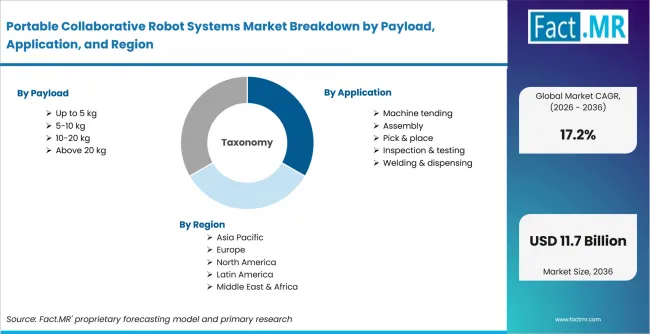
Portable Collaborative Robot Systems Market Breakdown By Payload, Application, And Region | Source: Fact.MR
| Attribute | Details |
|---|---|
| Quantitative Units | USD billion in 2026 to USD billion by 2036 at CAGR |
| Market Definition | Portable collaborative robot systems used for flexible factory automation where safe redeployment, payload fit, end tooling and setup repeatability determine production acceptance |
| Payload | Up to 5 kg; 5-10 kg; 10-20 kg; Above 20 kg |
| Application | Machine tending; Assembly; Pick & place; Inspection & testing; Welding & dispensing |
| Mobility | Cart/base-mounted; AMR-integrated; Fixed-convertible |
| End-Use Industry | Automotive; Electronics; Metals & machinery; Consumer goods; Pharma & medical |
| Regions Covered | North America; Latin America; Europe; East Asia; South Asia and Pacific; Middle East and Africa |
| Countries Covered | United States; Germany; Japan; South Korea; Italy; France |
| Key Companies Profiled | Universal Robots; Techman Robot; FANUC; Doosan Robotics; ABB; KUKA |
| Forecast Period | 2026 to 2036 |
| Approach | Hybrid top-down and bottom-up approach using robot installation activity; cobot order tracking; workplace safety indicators; manufacturing output; payload mix; application demand; mobility format; country adoption patterns and company portfolio review |
Source: Fact.MR analysis. Updated Aug 18, 2026
Frequently Asked Questions
How big is the portable collaborative robot systems market in 2026?
What is the CAGR of the portable collaborative robot systems market from 2026 to 2036?
Which payload category leads the portable collaborative robot systems market?
Which application leads the portable collaborative robot systems market?
Who are the leading companies in the portable collaborative robot systems market?
Who worked on this report


Preview the report firsthand - request a free sample
Free SampleGet the brochure for pricing and purchase details
Download PDF