- Market Value (2025): USD 6.4 Bn
- Estimated Value (2026): USD 6.9 Bn
- Forecast Value (2036): USD 14.0 Bn
- CAGR (2026-2036): 7.4%
What is the Prefabricated E-House Systems Market forecast to be worth by 2036?
USD 6.9 billion in 2026 to USD 14.0 billion by 2036 at a 7.4% CAGR.
- The Prefabricated E-House Systems Market reached USD 6.4 billion in 2025.
- Demand is projected to increase from USD 6.9 billion in 2026 to USD 14.0 billion by 2036.
- The market is forecast to record 7.4% CAGR from 2026 to 2036 supported by utilities, LNG operators and data centers shortening electrical-room installation cycles.
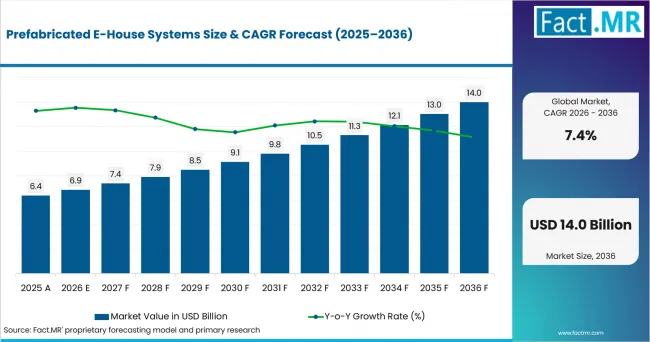
Prefabricated E House Systems Value Analysis | Source: Fact.MR
What are the defining numbers behind Prefabricated E-House Systems Market growth?
An absolute opportunity of USD 7.1 billion is expected between 2026 and 2036.
- Demand Drivers in the Market
- Utility project teams need factory-tested control rooms since grid connection schedules are tightening around renewable and load-growth projects.
- Renewable developers specify packaged switchgear rooms where new capacity requires fast electrical connection. IRENA reported on April 1, 2026, that 692 GW of renewable power capacity was added globally in 2025.
- Data center developers seek prefabricated electrical modules where large computing facilities need faster energization and repeatable power blocks.
- Remote mining and LNG sites use skid-mounted e-houses where haulage distance and limited field labor make conventional electrical rooms slower.
- Key Segments Analyzed
- By E-House Type: LV/MV distribution e-house is expected to hold 34.0% share in 2026 since it fits plant-level distribution and substation-room needs.
- By Voltage: 1-15 kV is projected to account for 34.0% share in 2026 owing to its use in medium-voltage feeder packages.
- By Industry: Oil & gas / LNG is anticipated to capture 25.0% share in 2026 due to remote site power needs and modular build practices.
- By Construction: Steel skid-mounted is estimated to represent 48.0% share in 2026 with structural skids simplifying lifting and foundation planning.
- Analyst Opinion at Fact.MR
- Fact.MR Principal Consultant Shambhu Nath Jha states, "E-house selection has moved beyond a shelter choice. Owners are testing how quickly a vendor can engineer the switchgear, cabling and controls as one ready-to-place electrical room. Demand is expected to favor suppliers that combine voltage engineering, transport design and factory acceptance testing while keeping field complexity low."
- Strategic Implications
- Equipment makers should package factory-test records for switchgear and relays in one handover file. HVAC and fire-system checks should stay in the same file.
- EPC contractors should freeze module dimensions early so transport and cable plans stay aligned with the civil schedule.
- Utility owners should align e-house design with protection studies and grid-code needs before substation civil work begins.
- Data center developers should compare electrical rooms against land use and capacity-block repeatability before final project design.
Saudi Arabia is expected to record 9.0% CAGR through 2036 supported by renewable interconnections and remote industrial power. Australia is projected to post 8.6% CAGR owing to mining and grid-transition work. The USA is anticipated to advance at 8.3% CAGR due to data center power additions. The UK is estimated to hold 6.7% CAGR with clean power connections moving forward. Germany is forecast to reach 6.3% CAGR supported by transmission expansion and faster substation delivery.
How does the Prefabricated E-House Systems Market break down by segment?
LV/MV distribution e-house is projected to lead E-House Type at 34.0%; steel skid-mounted is expected to lead Construction at 48.0%.
Which E-House Type dominates?
LV/MV distribution e-house is expected to hold 34.0% share in 2026.
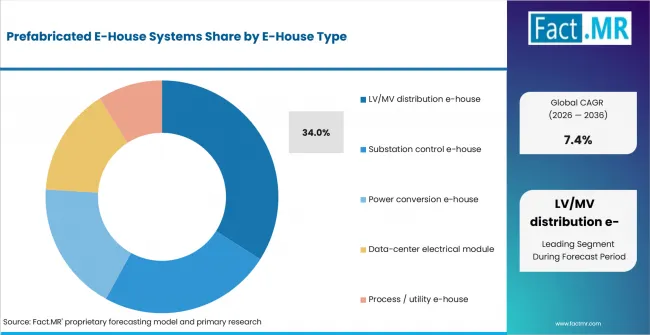
Prefabricated E House Systems Analysis By E House Type | Source: Fact.MR
LV/MV distribution e-houses lead since most industrial and utility sites need a protected room for medium-voltage and low-voltage switchgear. The format suits new substations and process plants where electrical equipment must arrive wired and tested before site work becomes constrained.
On March 26, 2026, ABB announced additional VoltaGrid orders covering 35 synchronous condensers with flywheel technology and associated prefabricated eHouse units for data-center power projects. ABB stated that the systems support the voltage stability and resilient operation required by high-density data-center loads.
What leads the Voltage segment?
1-15 kV is projected to account for 34.0% share in 2026.
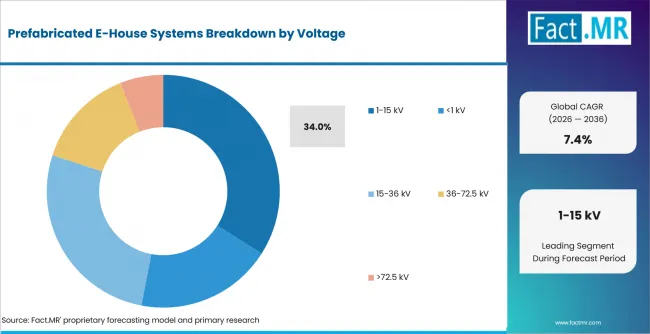
Prefabricated E House Systems Analysis By Voltage | Source: Fact.MR
The 1-15 kV range leads the voltage segment owing to common medium-voltage feeder and distribution needs in packaged substations. It fits switchgear and motor-control packages installed near process loads or generation interfaces.
Siemens Energy published a May 2026 white paper on E-Houses for power generation, describing modular, prefabricated electrical buildings that reduce on-site complexity and accelerate project deployment. Related Siemens Energy solutions integrate medium- and high-voltage switchgear, control and auxiliary systems in preassembled and factory-tested modules, supporting projects that require faster electrical-system installation and grid connection.
How does Industry shape demand?
Oil & gas / LNG is anticipated to capture 25.0% share in 2026.
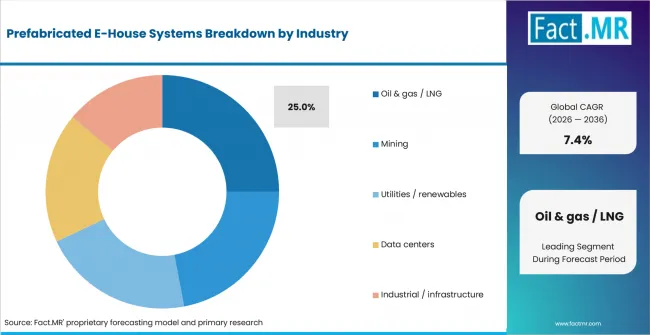
Prefabricated E House Systems Analysis By Industry | Source: Fact.MR
Oil & gas / LNG leads industry use due to remote locations and high-power process equipment. Prefabricated electrical rooms let operators move distribution equipment and control panels into a tested enclosure before the module reaches the field.
In April 2026, ACWA Power said the Rabigh 2 IPP Expansion agreement included the development, financing and expansion of a 380 kV substation to support grid integration and network stability. Large power-generation and grid-infrastructure projects of this type represent potential applications for prefabricated electrical rooms that integrate switchgear, control and other electrical equipment.
What supports steel skid-mounted construction?
Steel skid-mounted is estimated to represent 48.0% share in 2026.
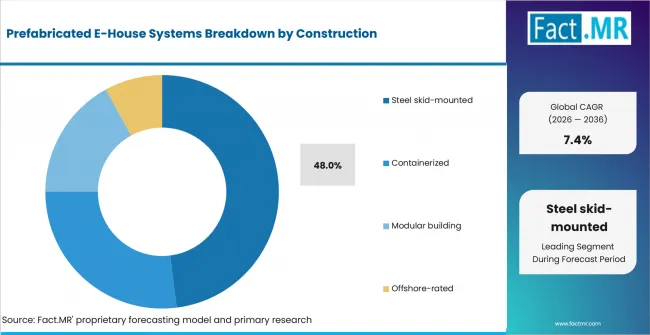
Prefabricated E House Systems Analysis By Construction | Source: Fact.MR
Steel skid-mounted construction leads since it gives heavy electrical rooms a rigid transport base. Engineering teams can plan lifting points and foundation loads before delivery. Early clearance review reduces late field changes.
In June 2025, Eaton and Siemens Energy announced a data-center collaboration combining integrated onsite power generation with modular construction. Eaton said it would provide electrical equipment and related engineering and software, with skidded and modular designs intended to accelerate data-center construction and commissioning.
What is accelerating Prefabricated E-House Systems Market adoption, and what limits wider use?
Demand is expected to rise through grid expansion and data center power needs. Transport planning, custom engineering and long-lead electrical equipment shape wider use.
Drivers Impact Analysis
| DRIVER | (~) % IMPACT ON CAGR | GEOGRAPHIC RELEVANCE | IMPACT TIMELINE |
|---|---|---|---|
| Grid expansion and renewable interconnection work | +1.4% | Global, Europe, Australia, Middle East | Medium term (2-4 years) |
| Data center power and fast commissioning needs | +1.2% | USA, UK, Germany | Short term (<= 2 years) |
| Remote oil, gas, LNG and mining site construction | +1.0% | Middle East, Australia, North America | Medium term (2-4 years) |
| Factory-tested LV/MV electrical integration | +0.8% | Global | Long term (>= 4 years) |
Source: Fact.MR analysis. Updated Sep 10, 2026
Opportunity Impact Analysis
| OPPORTUNITY | (~) % IMPACT ON CAGR | GEOGRAPHIC RELEVANCE | IMPACT TIMELINE |
|---|---|---|---|
| Skid-mounted power modules for data centers | +0.9% | USA, UK, Germany | Short term (<= 2 years) |
| Renewable substations and grid-connection packages | +0.8% | Europe, Australia, Middle East | Medium term (2-4 years) |
| Offshore-rated and harsh-environment e-houses | +0.6% | Middle East, Australia, North Sea | Long term (>= 4 years) |
Source: Fact.MR analysis. Updated Sep 10, 2026
Restraints Impact Analysis
| RESTRAINT | (~) % IMPACT ON CAGR | GEOGRAPHIC RELEVANCE | IMPACT TIMELINE |
|---|---|---|---|
| Heavy transport and lifting constraints | -0.5% | Global, Australia, Middle East | Short term (<= 2 years) |
| Custom voltage and protection engineering | -0.4% | Global | Medium term (2-4 years) |
| Switchgear and transformer availability risk | -0.3% | North America, Europe | Medium term (2-4 years) |
Source: Fact.MR analysis. Updated Sep 10, 2026
Which countries are scaling the Prefabricated E-House Systems Market through 2036?
- The country comparison spans 2.7 percentage points and forms three practical growth bands across the forecast period.
- Saudi Arabia stays ahead of Australia with renewable interconnections and remote industrial power projects raising modular substation needs.
- Australia remains above the USA owing to mining and renewable-grid work that creates remote installation needs.
- The USA stays above the UK due to data center power additions and LNG infrastructure requirements.
- The UK tracks above Germany with connection reform giving clean power and demand projects clearer grid-entry pathways.
- Germany closes the displayed range through transmission approvals, renewable-grid integration and industrial electrification.
Comparable CAGRs create different entry conditions due to voltage standards and module logistics. Full report coverage includes North America, Latin America, Western Europe, Eastern Europe, East Asia, South Asia & Pacific, Middle East & Africa.
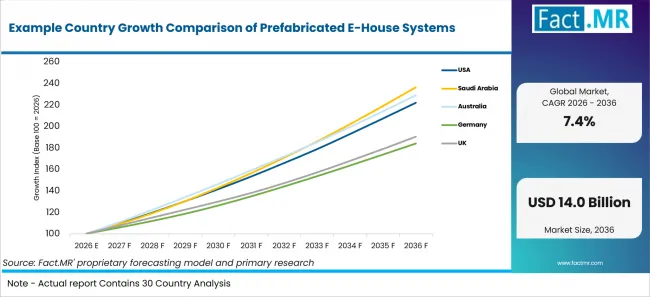
Example Country Growth Comparison Of Prefabricated E House Systems | Source: Fact.MR
| Country | CAGR (2026-2036) |
|---|---|
| Saudi Arabia | 9.0% |
| Australia | 8.6% |
| United States | 8.3% |
| United Kingdom | 6.7% |
| Germany | 6.3% |
Source: Fact.MR analysis. Updated Sep 10, 2026
What supports Saudi Arabia adoption?
9.0% CAGR, supported by renewable interconnections and remote industrial power.
Saudi Arabia needs modular electrical rooms for renewable plants and remote industrial sites where field assembly is costly. The National Platform reported in July 2025 that power-purchase agreements covered seven solar and wind projects with a total capacity of 15,000 MW. That project scale supports packaged substations and skid-mounted power rooms near generation and grid-interface points.
How is Australia scaling demand?
8.6% CAGR, driven by mining and LNG projects alongside renewable-grid work.
Australia uses prefabricated e-houses where mining and transmission work must be delivered across long transport routes. In 2026, the Australian energy department reported that on-grid electricity generation reached 263.0 TWh in 2025. Remote load growth and renewable integration support containerized or skid-mounted electrical rooms for project teams.
What supports USA adoption?
8.3% CAGR, backed by data center power needs and LNG infrastructure.
The USA is shaped by data center campuses and LNG export plants that need repeatable LV/MV rooms. In May 2026, the U.S. Energy Information Administration estimated that data center servers accounted for 7% of commercial-sector electricity consumption in 2025. That load profile supports prefabricated electrical modules that can be tested before arrival.
What supports the United Kingdom's growth?
6.7% CAGR, supported by clean power connections and data center electrical modules.
The United Kingdom is moving from an overloaded grid queue toward a filtered connection pipeline. That helps developers plan electrical-room delivery. In December 2025, NESO confirmed a new pipeline containing 283 GW of generation and storage capacity. Offshore wind and data center projects are expected to use packaged substations where site access is tight.
What is supporting Germany's adoption?
6.3% CAGR, led by transmission expansion and renewable power integration.
Germany needs modular grid equipment with transmission approvals moving through the energy transition pipeline. Bundesnetzagentur reported in January 2026 that it approved roughly 2,000 km of power lines in 2025. Industrial plants and renewable projects are expected to use e-houses to place switchgear and controls close to load or generation nodes.
Who leads the Prefabricated E-House Systems Market?
ABB participates through prefabricated eHouse and skid-mounted solutions for data-center power distribution and other primary electrical applications. Its integrated modular solutions can incorporate medium- and low-voltage switchgear, transformers, critical power equipment and associated control systems.
Siemens provides prefabricated E-House substations for industrial and distribution applications, together with skids, equipment enclosures and frames designed for data-center power infrastructure.
Schneider Electric offers E-House solutions integrating medium-voltage switchgear, transformers, HVAC, UPS and control systems, alongside prefabricated modular data-center infrastructure. Eaton supplies prefabricated Integrated Power Assemblies and Modular Power Assemblies for power distribution and critical data-center loads. Powell Industries provides factory-integrated Power Control Rooms and E-Houses for power-distribution applications across industrial, energy and data-center markets.
Hitachi Energy supplies containerized and prefabricated substations together with its Grid-eXpand modular grid-connection solutions. Across these offerings, suppliers provide factory-assembled and tested designs, while configuration options include enclosed eHouses, skid-mounted systems and containerized modules with application-specific environmental-control and electrical-protection equipment.
Which companies are the key providers?
Key companies include ABB; Siemens; Schneider Electric; Eaton; Powell Industries; and Hitachi Energy.
- ABB
- Siemens
- Schneider Electric
- Eaton
- Powell Industries
- Hitachi Energy
Bibliography
- ABB. (2025, November 10). ABB and VoltaGrid partner to deliver stable data center power to support AI growth.
- ABB. (2026, March 26). ABB and VoltaGrid extend collaboration on data center power infrastructure.
- Acwa. (2026, April 19). Acwa signs power purchase agreement for the expansion of Rabigh 2 power plant project.
- Australian Energy Market Operator. (2026, June 25). 2026 Integrated System Plan (ISP).
- Bundesnetzagentur. (2026, January 2). Energy transition clears crucial hurdle: Significant progress in electricity grid expansion in 2025.
- Department of Climate Change, Energy, the Environment and Water. (2026). Australian Energy Statistics, Table O electricity generation by fuel type 2024–25 and 2025.
- Eaton. (2025, June 3). Eaton and Siemens Energy join forces to provide power and technology to accelerate the delivery of new data center capacity.
- Hitachi, Ltd. (2025, September 4). Hitachi announces historic $1 billion USD manufacturing investment to power America’s energy future through production of critical grid infrastructure.
- International Energy Agency. (2025, April 10). Energy and AI.
- International Renewable Energy Agency. (2026, April 1). Near-700 GW surge in 2025 proves renewable energy resilience.
- National Energy System Operator. (2025, December 8). Unveiling the new project pipeline to deliver Clean Power by 2030.
- National Platform (National Portal). (2025, July 14). Principal Buyer signed power purchase agreements for seven new renewable energy projects with a total capacity of 15,000 MW.
- Powell Industries, Inc. (2025, November 19). Annual report for fiscal year ended September 30, 2025 [Form 10-K].
- Schneider Electric. (2025, June 11). Schneider Electric accelerates the development and deployment of AI factories at scale with NVIDIA.
- Statistisches Bundesamt (Destatis). (2026, March 6). Stromerzeugung aus Photovoltaik und Erdgas erreicht im Jahr 2025 neue Höchstwerte [Electricity generation from photovoltaics and natural gas reaches new highs in 2025].
- U.S. Energy Information Administration. (2026, May 19). Data center server energy use grows across the commercial building stock.
- Vieira, P. (2026, May 26). White paper: E-Houses for power generation. Siemens Energy.
This Report Answers
- The report explains e-house use across type and voltage. It covers industry, construction and region in the same segmentation framework.
- Segment analysis explains the leading subsegments and the selection reasoning behind them.
- Country analysis examines grid and industrial mechanisms supporting module demand.
- Competitive analysis reviews suppliers across switchgear integration and modular power packages.
- Application analysis assesses voltage scope and site access. It covers environmental control and factory testing in the same application review.
What does the Prefabricated E-House Systems Market cover?
The Prefabricated E-House Systems Market covers factory-built electrical rooms used to house switchgear systems, protection devices and control panels. It includes transportable structures that reduce field wiring and keep critical equipment inside a protected environment.
The assessment links to adjacent electrical houses where modular power distribution, substation control and industrial project delivery overlap. Demand is assessed across voltage, industry use and construction format.
Related efficient power switchgear demand is included only when it is packaged inside a transportable room or skid-mounted electrical module.
What is included in the scope?
The scope includes walk-in and non-walk-in e-houses and steel-skid electrical rooms. Containerized power modules and modular substations are covered when used in electric power distribution automation systems. Factory-integrated HVAC and fire detection are included. Lighting and auxiliary systems are included when bundled inside the module.
Included systems can support low-voltage distribution, medium-voltage feeders and substation control. Projects that use electric power transmission distribution equipment are covered when the e-house forms part of the packaged electrical delivery.
The scope covers data center electrical modules where power rooms are tied to critical power and cooling. Packaged interfaces with pad-mounted switchgear are included when they form part of the e-house delivery.
What is excluded from the scope?
The scope excludes standalone transformers, loose switchgear and shell-only civil buildings. General DC power distribution systems are outside the core boundary unless packaged inside an e-house.
The scope excludes software-only grid optimization and rack-level dense power distribution inside server halls. Standalone HV/EHV GIS yards are excluded when they are delivered outside prefabricated enclosures.
How Was the Analysis Built?
The analysis draws on 120+ sources, 35+ company portfolios, 25+ countries, and more than 20 industry interviews.
- Primary Research: Primary research includes discussions with manufacturers, service providers, technology developers, distributors, end users, and subject-matter experts. These conversations examine purchasing priorities, product adoption, operational challenges, approval requirements, competitive positioning, and the factors that influence wider market acceptance.
- Desk Research: Desk research covers government statistics, regulatory publications, company filings, trade data, technical studies, industry associations, standards, public policy, and other authoritative sources. Every source used in the analysis is documented in the bibliography.
- Market Sizing and Forecasting: Market estimates combine historical performance, demand indicators, pricing and volume trends, segment shares, company participation, country-level growth, adoption patterns, investment activity, and barriers to market expansion.
- Data Validation and Update Cycle: Findings are validated by comparing primary interviews with public data, company activity, regulatory changes, trade patterns, and industry developments. Regular updates review new product launches, capacity changes, partnerships, approvals, and shifts in commercial adoption.
Segmentation
What is the report's scope and coverage?
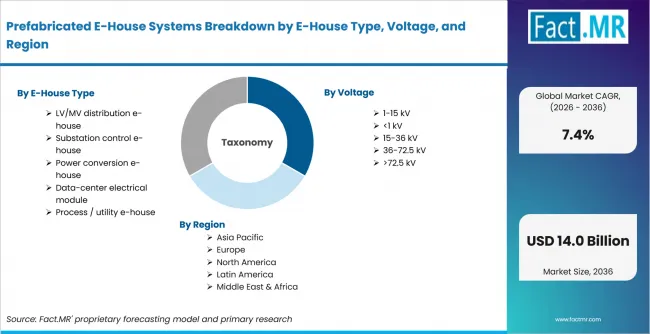
Prefabricated E House Systems Breakdown By E House Type, Voltage, And Region | Source: Fact.MR
| Attribute | Details |
|---|---|
| Quantitative Units | USD billion |
| Market Definition | Factory-built electrical rooms or transportable modules used to house power distribution, protection, control, monitoring, HVAC, fire and auxiliary systems for industrial, utility, energy and data center projects. |
| E-House Type | LV/MV distribution e-house; Substation control e-house; Power conversion e-house; Data-center electrical module; Process / utility e-house |
| Voltage | <1 kV; 1-15 kV; 15-36 kV; 36-72.5 kV; >72.5 kV |
| Industry | Oil & gas / LNG; Mining; Utilities / renewables; Data centers; Industrial / infrastructure |
| Construction | Steel skid-mounted; Containerized; Modular building; Offshore-rated |
| Regions Covered | North America; Latin America; Western Europe; Eastern Europe; East Asia; South Asia & Pacific; Middle East & Africa |
| Countries Covered | United States; Saudi Arabia; Australia; Germany; United Kingdom |
| Key Companies Profiled | ABB; Siemens; Schneider Electric; Eaton; Powell Industries; Hitachi Energy |
| Forecast Period | 2026 to 2036 |
| Approach | Hybrid top-down and bottom-up approach using project pipelines, voltage mix, module configuration, end-use demand, country growth and provider portfolio review. |
Source: Fact.MR analysis. Updated Sep 10, 2026
How is the market segmented?
-
By E-House Type
- LV/MV distribution e-house
- Substation control e-house
- Power conversion e-house
- Data-center electrical module
- Process / utility e-house
-
By Voltage
- <1 kV
- 1-15 kV
- 15-36 kV
- 36-72.5 kV
- >72.5 kV
-
By Industry
- Oil & gas / LNG
- Mining
- Utilities / renewables
- Data centers
- Industrial / infrastructure
-
By Construction
- Steel skid-mounted
- Containerized
- Modular building
- Offshore-rated
-
By Region
- North America
- Latin America
- Western Europe
- Eastern Europe
- East Asia
- South Asia & Pacific
- Middle East & Africa
Frequently Asked Questions
How big is the prefabricated e-house systems market in 2026?
What is the CAGR of the prefabricated e-house systems market from 2026 to 2036?
Which voltage range leads the prefabricated e-house systems market?
Which construction format leads the prefabricated e-house systems market?
Who are the leading companies in the prefabricated e-house systems market?
Who worked on this report


Preview the report firsthand - request a free sample
Free SampleGet the brochure for pricing and purchase details
Download PDF