- Market Value (2025): USD 1.0 Bn
- Estimated Value (2026): USD 1.1 Bn
- Forecast Value (2036): USD 3.8 Bn
- CAGR (2026-2036): 13.2%
What is the Shop-Floor Geometry Scanners Market forecast to be worth by 2036?
USD 1.1 billion in 2026 to USD 3.8 billion by 2036 at a 13.2% CAGR.
- As per Fact.MR analysis, the shop-floor geometry scanners market reached USD 1.0 billion in 2025.
- Demand is projected to increase from USD 1.1 billion in 2026 to USD 3.8 billion by 2036.
- The market is forecast to record 13.2% CAGR from 2026 to 2036.
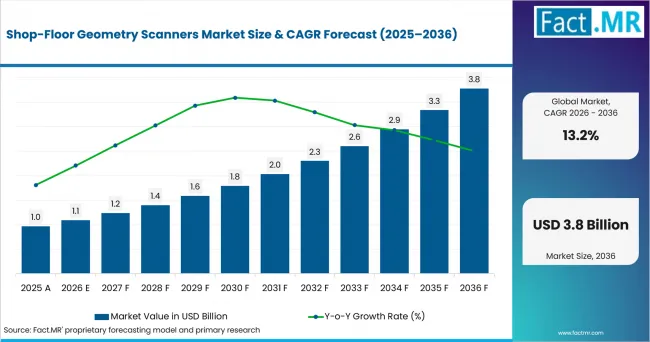
Shop Floor Geometry Scanners Market Value Analysis | Source: Fact.MR
What are the defining numbers behind Shop-Floor Geometry Scanners Market growth?
USD 2.6 billion absolute opportunity is expected between 2026 and 2036.
- Demand Drivers in the Market
- Quality engineers need scanners near production lines to check the size and shape of complex parts. In September 2026, NIST awarded more than USD 30 million to 12 MEP centers to support advanced manufacturing technology [1].
- Manufacturing engineers need faster scanning and CAD work to check parts and correct tools. Digital files help design and production staff work with the same part measurements.
- Automation teams need scanners that work with robot cells for regular part checks. Fixed scanners reduce handling and follow the same checking process across production shifts.
- Plant managers need measurement results linked to production records. This helps workers track changes in parts and adjust tools when measurements change.
- Key Segments Analyzed
- By Scanner: Structured light is expected to hold a 29.0% share in 2026 because it quickly scans the full surface of a part.
- By Part Size: Parts below 100 mm are projected to account 36.0% share in 2026 because small parts are common in precision machining and assembly.
- By Inspection: Dimensional QA is anticipated to capture 32.0% share in 2026 because scan data helps workers compare finished parts with CAD designs and required measurements.
- By Integration: Standalone scanners are estimated to represent 28.0% share in 2026 because they can be added to existing work areas with fewer changes.
- Analyst Opinion at Fact.MR
- Shambhu Nath Jha, Principal Consultant at Fact.MR, states, “Demand is expected to grow as software makes scanning and reporting easier. Suppliers need accurate scanners that are easy to use and connect with CAD, inspection, and factory systems.”
- Strategic Implications
- Scanner suppliers should make setup and calibration easier for workers. In June 2025, Hexagon introduced its Autonomous Metrology Suite to make measurement setup and quality checks easier.
- Software providers should make CAD comparison and inspection reports easy to use. Saved steps help workers follow the same checking process across shifts.
- Robot-mounted scanners should check parts from the same position each time. This helps give consistent results during production.
- Manufacturers should choose scanners based on part size and required accuracy before adding automation. This helps reduce scanning time and focus on important measurements.
The USA leads at 14.3% CAGR as factories use more advanced technology. Germany follows at 14.0% due to strong precision manufacturing. France reaches 13.7% as factories upgrade equipment. The UK records 13.4% due to automotive and manufacturing growth, while Japan reaches 12.1% as factory automation increases part inspection.
How does the Shop-Floor Geometry Scanners Market break down by segment?
Structured light leads Scanner at 29.0% share; <100 mm leads Part Size at 36.0% share.
Which Scanner type leads?
Structured light is expected to hold 29.0% share in 2026.
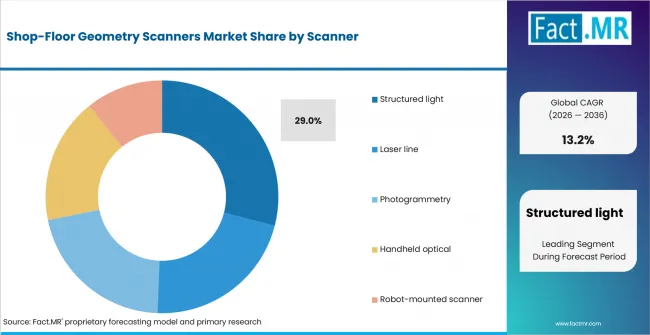
Shop Floor Geometry Scanners Market Analysis By Scanner | Source: Fact.MR
Structured light is expected to lead because it quickly scans detailed shapes and curved parts. Laser line scanners are useful when speed, distance, or shiny surfaces matter. Photogrammetry is used for large objects where reference points help measure the full shape.
What leads the Part Size segment?
<100 mm is projected to account for 36.0% share in 2026.
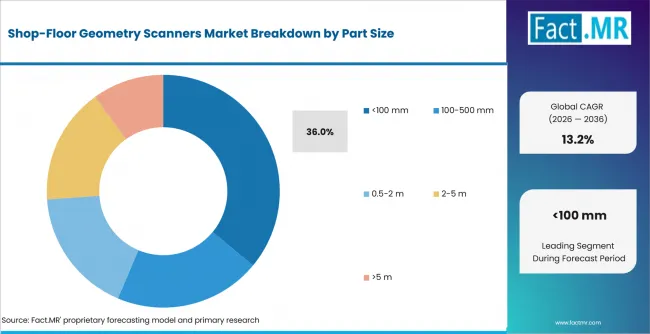
Shop Floor Geometry Scanners Market Analysis By Part Size | Source: Fact.MR
Parts below 100 mm are expected to lead in precision work. Small parts often have many details that take time to check one by one. The 100–500 mm range is used for housings, brackets, castings, and machined parts. Parts from 0.5–2 m need scanners that can move easily and cover a larger area. Full-surface scanning helps check small holes, edges, and curved surfaces faster. A simple setup works well for repeated checks on small parts.
How does Inspection shape demand?
Dimensional QA is anticipated to capture 32.0% share in 2026.
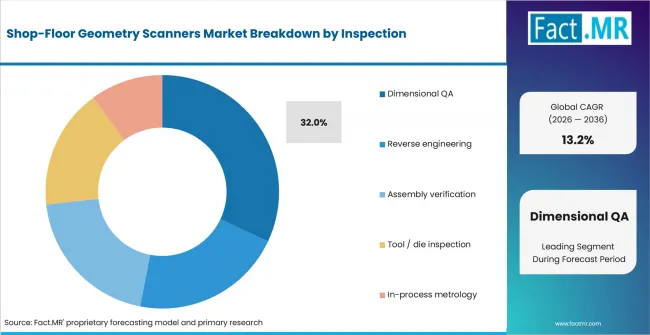
Shop Floor Geometry Scanners Market Analysis By Inspection | Source: Fact.MR
Dimensional QA is expected to lead because scanners measure the full shape of a part and compare it with the design. Reverse engineering uses scan data to create CAD when drawings are missing or tools have changed. Assembly checks make sure parts fit and line up correctly before more work is done. A color map shows where the part shape is different from the CAD design.
What supports Standalone integration?
Standalone is estimated to represent 28.0% share in 2026.
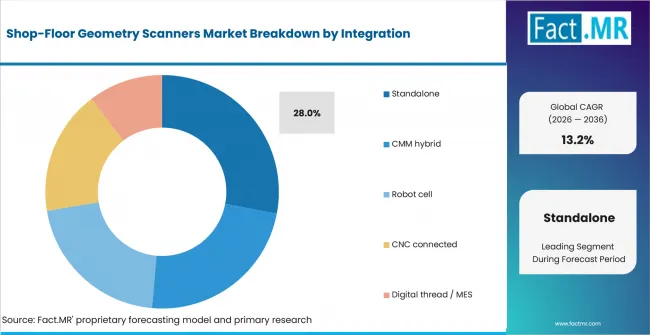
Shop Floor Geometry Scanners Market Analysis By Integration | Source: Fact.MR
Standalone systems are expected to lead because manufacturers can add scanners without changing the production line. CMM hybrid systems combine optical scanning with standard measurement methods when both are needed. Robot cells check the same parts in the same way each time, while CNC-connected systems give quick measurement results after machining.
What is accelerating Shop-Floor Geometry Scanners Market adoption, and what is holding it back?
Faster part checks increase demand, while system setup and worker skills can slow use.
Drivers Impact Analysis
| DRIVER | (~) % IMPACT ON CAGR | GEOGRAPHIC RELEVANCE | IMPACT TIMELINE |
|---|---|---|---|
| Inspection moved closer to production | +1.8% | Global | Short term (<= 2 years) |
| Scan-to-CAD and reverse-engineering workflows | +1.4% | North America, Europe, East Asia | Short term (<= 2 years) |
| Robot and cell automation | +1.2% | Europe, East Asia, North America | Medium term (2-4 years) |
| Tighter tolerance and traceability needs | +0.9% | Global | Medium term (2-4 years) |
| Digital-thread connection of quality data | +0.7% | North America, Europe | Long term (>= 4 years) |
Source: Fact.MR analysis. Updated Oct 6, 2026
Opportunity Impact Analysis
| OPPORTUNITY | (~) % IMPACT ON CAGR | GEOGRAPHIC RELEVANCE | IMPACT TIMELINE |
|---|---|---|---|
| Simpler scanner workflows for SMEs | +1.1% | Global | Short term (<= 2 years) |
| Automated sheet-metal and casting inspection | +0.9% | Europe, North America, East Asia | Medium term (2-4 years) |
| Large-part portable measurement | +0.7% | Aerospace and heavy manufacturing hubs | Medium term (2-4 years) |
| Closed-loop machining feedback | +0.6% | Germany, Japan, USA | Long term (>= 4 years) |
Source: Fact.MR analysis. Updated Oct 6, 2026
Restraints Impact Analysis
| RESTRAINT | (~) % IMPACT ON CAGR | GEOGRAPHIC RELEVANCE | IMPACT TIMELINE |
|---|---|---|---|
| Accuracy and calibration requirements | -0.8% | Global | Short term (<= 2 years) |
| Reflective and difficult surface conditions | -0.6% | Global | Short term (<= 2 years) |
| Integration effort in mixed factory systems | -0.5% | North America, Europe, East Asia | Medium term (2-4 years) |
| Shortage of metrology and automation skills | -0.4% | Europe, North America, Japan | Long term (>= 4 years) |
Source: Fact.MR analysis. Updated Oct 6, 2026
Which countries are scaling the Shop-Floor Geometry Scanners Market through 2036?
- The country comparison spans 2.2 percentage points across the five markets in the forecast period.
- The USA remains 0.3 percentage point above Germany as manufacturing investment supports wider use of production measurement.
- Germany remains 0.3 percentage point above France through factory modernization and precision manufacturing activity.
- France remains 0.3 percentage point above the UK as industrial expansion supports production quality investment.
- The UK remains 1.3 percentage points above Japan through automotive investment and digital manufacturing programs.
- Japan closes the displayed range as machinery investment and factory automation support dimensional inspection demand.
Comparable CAGRs can lead to different adoption paths because factory mix, automation depth and measurement practice vary by country. Full report coverage includes North America, Latin America, Western Europe, Eastern Europe, East Asia, South Asia & Pacific, Middle East & Africa.
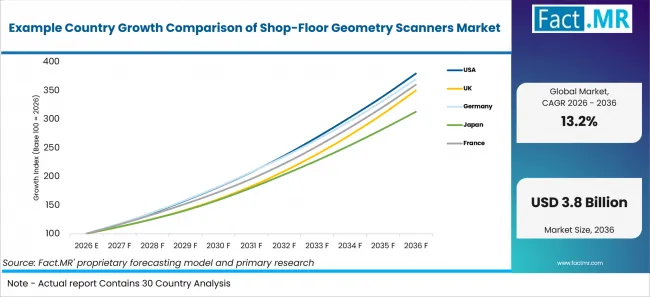
Example Country Growth Comparison Of Shop Floor Geometry Scanners Market | Source: Fact.MR
| Country | CAGR (2026-2036) |
|---|---|
| USA | 14.3% |
| Germany | 14.0% |
| France | 13.7% |
| UK | 13.4% |
| Japan | 12.1% |
Source: Fact.MR analysis. Updated Oct 6, 2026
What supports USA adoption?
14.3% CAGR, supported by manufacturing investment and wider use of advanced factory technology.
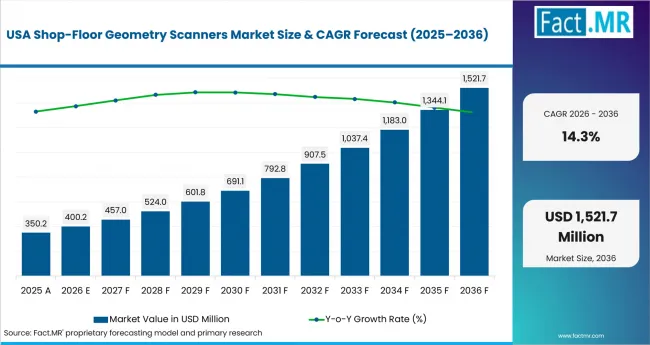
Shop Floor Geometry Scanners Market Country Value Analysis | Source: Fact.MR
U.S. factories are expected to use more measurement tools near production lines as new factory investment increases the need for fast part checks. In June 2026, the U.S. Bureau of Economic Analysis reported USD 121.8 billion in new foreign direct investment in manufacturing during 2025 [2]. Portable and automated scanners can help workers check parts faster near machining and assembly areas.
What supports Germany adoption?
14.0% CAGR, supported by industrial investment and precision manufacturing activity.
Germany’s strong engineering industry supports geometry scanning in machinery, automotive, and precision manufacturing. In March 2026, the Federal Government reported that federal investment reached about EUR 87 billion in 2025, around 17% higher than in 2024 [3]. Factories are expected to use shop-floor scanners more as they bring digital part checks closer to production equipment.
How is France scaling demand?
13.7% CAGR, supported by factory expansion and industrial modernization.
French manufacturers are expected to use more portable and standalone scanners as factory growth increases the need for easy part checks. In March 2026, the Direction générale des Entreprises reported a positive balance of 19 major factory openings and expansions after accounting for closures and production cuts [4]. Geometry scanners can help check formed, machined, and assembled parts at active factories.
What supports the United Kingdom outlook?
13.4% CAGR, supported by automotive investment and advanced manufacturing programs.
UK demand is expected to grow as automotive and precision engineering companies need faster checks of parts and tools. In July 2025, the Department for Business and Trade announced the GBP 2.5 billion DRIVE35 program for automotive manufacturing and development [5]. Portable scanners can help factories compare parts with CAD designs across different components and production areas.
How does Japan perform?
12.1% CAGR, supported by machinery investment and factory automation.
Japan’s precision manufacturing industry supports regular scanning of small and medium parts near automated production lines. In February 2026, the Cabinet Office reported that machinery orders rose 11.8% from the previous quarter during October to December 2025 [6]. Robot-mounted and CNC-connected scanners can support factories that use automation and need accurate part checks.
Who leads the Shop-Floor Geometry Scanners Market?
Hexagon and ZEISS Industrial Quality Solutions offer 3D measurement systems for factory inspection. Their products include handheld scanners, optical scanners, measurement tools, inspection software, and automated systems.
FARO Creaform offer portable 3D measurement systems for factory inspection. KEYENCE offers 3D scanners and measurement systems. Nikon Metrology offers non-contact measurement systems, including Laser Radar and automated tools.
Suppliers differ in accuracy, ease of use, software connection, portability, and support for automated inspection.
Which companies are the key providers?
Hexagon and ZEISS Industrial Quality Solutions are key providers. FARO Creaform are also profiled. KEYENCE and Nikon Metrology complete the company set.
- Hexagon
- ZEISS Industrial Quality Solutions
- FARO Creaform
- KEYENCE
- Nikon Metrology
Bibliography
- [1] National Institute of Standards and Technology. (2026, September 15). NIST awards more than $30 million for MEP centers in 11 states and Puerto Rico.
- [2] U.S. Bureau of Economic Analysis. (2026, June 10). New Foreign Direct Investment in the United States, 2025.
- [3] Federal Government of Germany. (2026, March 25). Extra investment in Germany’s future.
- [4] Direction générale des Entreprises. (2026, March 29). Baromètre industriel de l'État : en 2025, les extensions d'usines portent la réindustrialisation avec un solde positif malgré un contexte international dégradé.
- [5] Department for Business and Trade. (2025, July 13). Backing British Industry: Government launches £2.5bn DRIVE35 programme to power UK auto investment and jobs.
- [6] Economic and Social Research Institute, Cabinet Office, Government of Japan. (2026, February 19). Machinery Orders in December, 2025 and Forecast for Jan.-Mar. 2026.
- [7] KEYENCE America. (2025, July 3). Understanding the Role of 3D Scanning in Industrial Metrology.
- [8] Nikon Metrology, LLC. (2026, April 30). Nikon Begins Commercial Deployment of its Next-Generation APDIS MV5X Laser Radar System Powered by Aeva.
- [9] ZEISS Industrial Quality Solutions. (2025, May 27). ZEISS introduces ScanPort, a new dimension in semi-automated 3D metrology.
This Report Addresses
- Scanner and part-size selection for dimensional measurement near production.
- Segment analysis of structured light, <100 mm parts, dimensional QA, and standalone integration.
- Regional outlook for the USA, Germany, France, the UK, and Japan.
- Competitive coverage of Hexagon, ZEISS, FARO Creaform, KEYENCE, and Nikon Metrology.
- Technology coverage of structured light, laser line, photogrammetry, handheld, and robot-mounted scanners.
- Inspection coverage of dimensional QA, reverse engineering, assembly verification, tool inspection, and in-process metrology.
- Integration coverage of standalone, CMM hybrid, robot cell, CNC, and digital-thread workflows.
- Forecast validation using official data, first-party company sources, and provider portfolio checks.
What does the Shop-Floor Geometry Scanners Market cover?
Structured light, laser line, photogrammetry, handheld optical, and robot-mounted scanners used for industrial geometry measurement.
The scope covers 3D scanner systems used for dimensional inspection and reverse engineering. It also overlaps with industrial metrology solutions where full-surface geometry supports production quality decisions.
Shop-floor use includes integrated 3D scanners and software for 3D scanner programming when scan routines must be repeated across part families. These workflows connect physical geometry with CAD comparison and inspection records.
What is included in the scope?
Shop-floor geometry scanning systems used for dimensional inspection and production-linked measurement.
Coverage includes structured light, laser line, photogrammetry and handheld optical systems. Related factory workflows include 3D machine vision systems and inspection robot systems where measurement supports automated quality work.
What is excluded from the scope?
General vision inspection and non-geometry sensing are outside the core scope.
Adjacent automation categories include autonomous inspection robots and articulated robot systems. They enter this scope when dimensional geometry capture forms part of the inspection task.
How Was the Analysis Built?
The analysis draws on 120+ sources, 35+ company portfolios, 25+ countries, and more than 20 industry interviews.
- Primary Research: Primary research includes discussions with manufacturers, service providers, technology developers, distributors, end users, and subject-matter experts. These conversations examine purchasing priorities, product adoption, operational challenges, approval requirements, competitive positioning, and the factors that influence wider market acceptance.
- Desk Research: Desk research covers government statistics, regulatory publications, company filings, trade data, technical studies, industry associations, standards, public policy, and other authoritative sources. Every source used in the analysis is documented in the bibliography.
- Market Sizing and Forecasting: Market estimates combine historical performance, demand indicators, pricing and volume trends, segment shares, company participation, country-level growth, adoption patterns, investment activity, and barriers to market expansion.
- Data Validation and Update Cycle: Findings are validated by comparing primary interviews with public data, company activity, regulatory changes, trade patterns, and industry developments. Regular updates review new product launches, capacity changes, partnerships, approvals, and shifts in commercial adoption.
Segmentation
What is the report’s scope and coverage?
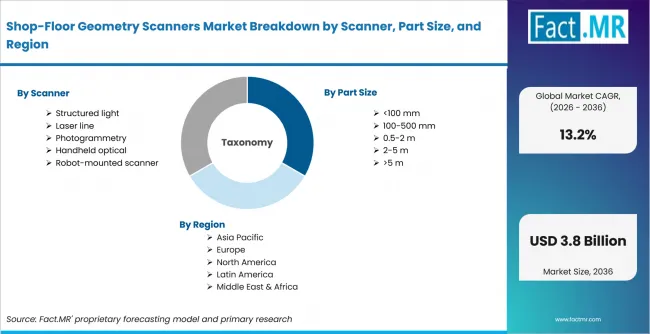
Shop Floor Geometry Scanners Market Breakdown By Scanner, Part Size, And Region | Source: Fact.MR
| Attribute | Details |
|---|---|
| Quantitative Units | USD billion |
| Market Definition | Shop-floor geometry scanners for dimensional inspection, reverse engineering, verification, and production feedback. |
| Scanner | Structured light; Laser line; Photogrammetry; Handheld optical; Robot-mounted scanner |
| Part Size | <100 mm; 100-500 mm; 0.5-2 m; 2-5 m; >5 m |
| Inspection | Dimensional QA; Reverse engineering; Assembly verification; Tool / die inspection; In-process metrology |
| Integration | Standalone; CMM hybrid; Robot cell; CNC connected; Digital thread / MES |
| Regions Covered | North America; Latin America; Western Europe; Eastern Europe; East Asia; South Asia & Pacific; Middle East & Africa |
| Countries Covered | USA; UK; Germany; Japan; France |
| Key Companies Profiled | Hexagon; ZEISS Industrial Quality Solutions; FARO Creaform; KEYENCE; Nikon Metrology |
| Forecast Period | 2026 to 2036 |
| Approach | Hybrid approach using scanner portfolios, manufacturing activity, inspection workflows, country adoption, and provider validation. |
Source: Fact.MR analysis. Updated Oct 6, 2026
How is the market segmented?
-
By Scanner:
- Structured light
- Laser line
- Photogrammetry
- Handheld optical
- Robot-mounted scanner
-
By Part Size:
- <100 mm
- 100-500 mm
- 0.5-2 m
- 2-5 m
- >5 m
-
By Inspection:
- Dimensional QA
- Reverse engineering
- Assembly verification
- Tool / die inspection
- In-process metrology
-
By Integration:
- Standalone
- CMM hybrid
- Robot cell
- CNC connected
- Digital thread / MES
-
By Region:
- North America
- Latin America
- Western Europe
- Eastern Europe
- East Asia
- South Asia & Pacific
- Middle East & Africa
Frequently Asked Questions
How big is the Shop-Floor Geometry Scanners Market in 2026?
What is the CAGR of the Shop-Floor Geometry Scanners Market from 2026 to 2036?
Which scanner type leads the Shop-Floor Geometry Scanners Market?
Which inspection type leads the Shop-Floor Geometry Scanners Market?
Who are the leading companies in the Shop-Floor Geometry Scanners Market?
Who worked on this report


Preview the report firsthand - request a free sample
Free SampleGet the brochure for pricing and purchase details
Download PDF