- Market Value (2025): USD 965.1 Mn
- Estimated Value (2026): USD 1080.0 Mn
- Forecast Value (2036): USD 3324.5 Mn
- CAGR (2026-2036): 11.9%
What is the 3D Scanner Programmers Market forecast to be worth by 2036?
USD 1080.0 million in 2026 to USD 3324.5 million by 2036 at an 11.9% CAGR.
- The 3D Scanner Programmers Market reached USD 965.1 million in 2025.
- Demand is projected to increase from USD 1080.0 million in 2026 to USD 3324.5 million by 2036.
- The market is forecast to record 11.9% CAGR from 2026 to 2036 as metrology teams and automation integrators shift repeat inspection work into programmable scanner workflows.
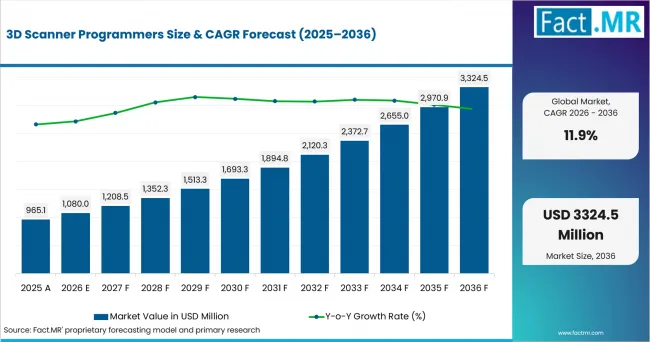
3d Scanner Programmers Value Analysis | Source: Fact.MR
What are the defining numbers behind 3D Scanner Programmers Market growth?
An absolute opportunity of USD 2244.5 million is expected between 2026 and 2036.
- Demand Drivers in the Market
- Quality engineers need programmed scan routines because manual setup becomes hard to repeat across mixed parts and changing production batches.
- Robot-cell integrators need collision-free scan paths as inspection moves closer to automated production cells. The International Federation of Robotics reported in September 2025 that factories installed 542,000 industrial robots in 2024.
- Design teams need reverse-engineering workflows that convert point clouds into editable CAD geometry during product changes and replacement-part work.
- Plant managers need shop-floor stations that keep scan templates, inspection reports and operator prompts inside one controlled workflow.
- Service bureaus need programming tools that support several scanner brands because customers often submit data from structured-light, laser and CMM-based systems.
- Key Segments Analyzed
- By Software Function: Scan acquisition / control is expected to hold 29.0% share in 2026 because scanner setup, exposure control and capture sequencing come before inspection analysis.
- By Scanner Type: Structured light is projected to account for 30.0% share in 2026 as controlled factory and lab settings favor detailed surface capture.
- By Deployment: Desktop workstation is anticipated to capture 46.0% share in 2026 since larger scan files and CAD conversion tasks still need stable local computing.
- By Application: Industrial inspection is estimated to represent 35.0% share in 2026 owing to repeatable quality checks across automotive, aerospace and machinery parts.
- Analyst Opinion at Fact.MR
- Shambhu Nath Jha, Principal Consultant at Fact.MR, states, "The value in this market comes from repeatability. A scanner program is no longer a one-time setup file; it is becoming a controlled quality process that decides how parts are captured, checked and reported. Vendors are expected to gain ground when their tools reduce scripting effort and still keep metrology teams in control of tolerances."
- Strategic Implications
- Software vendors should reduce scripting steps for scan templates, robot paths and report generation so quality teams spend less time rebuilding repeat jobs.
- Scanner manufacturers should keep open links with inspection software and CAD tools because mixed hardware fleets are common in factories and service bureaus.
- System integrators should package training with deployment templates so shop-floor teams can run programmed scans after installation.
- Metrology managers should track programming time per part family because setup hours influence whether inspection automation pays back quickly.
The UK is projected to record 13.8% CAGR through 2036 as software-rich inspection workflows expand. The USA follows at 12.7% CAGR supported by software talent and automated inspection demand. Japan is anticipated to post 12.4% CAGR owing to precision manufacturing and robotic metrology. Germany is estimated to reach 12.1% CAGR as industrial automation supports programmable inspection. France is forecast to advance at 10.7% CAGR through aerospace, transport and industrial equipment demand.
How does the 3D Scanner Programmers Market break down by segment?
Desktop workstation leads Deployment at 46.0% share in 2026, while Industrial inspection leads Application at 35.0% share.
Which Software Function dominates?
Scan acquisition / control is expected to hold 29.0% share in 2026.
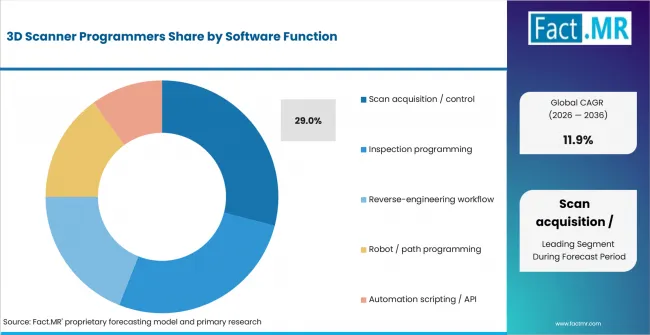
3d Scanner Programmers Analysis By Software Function | Source: Fact.MR
Scan acquisition / control leads because every downstream inspection routine depends on repeatable capture conditions. Programmers define exposure, sensor angle, scan order and part coverage before metrology teams compare surfaces or generate reports. Inspection programming follows closely where users need automated pass-fail checks. Reverse-engineering workflow is shaped by scan-to-CAD conversion needs, especially for legacy parts.
What leads the Scanner Type segment?
Structured light is projected to account for 30.0% share in 2026.
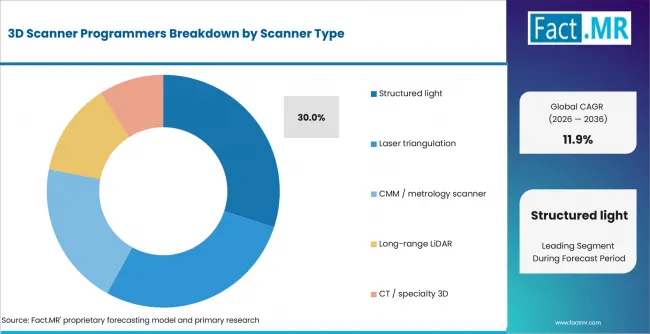
3d Scanner Programmers Analysis By Scanner Type | Source: Fact.MR
Structured light leads scanner type because it captures detailed surface geometry in controlled settings where lighting and part position can be managed. Programmers can standardize scan positions and template settings for repeat jobs. Laser triangulation supports moving-part inspection and profiles along production lines. CMM / metrology scanner workflows serve plants that combine tactile measurement with optical data. Long-range LiDAR and CT / specialty 3D remain relevant for large components and internal features. Scanner programming follows the hardware mix present in quality labs and production cells.
How does Deployment shape demand?
Desktop workstation is anticipated to capture 46.0% share in 2026.
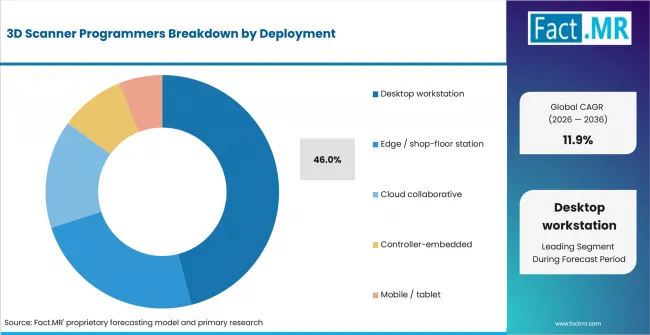
3d Scanner Programmers Analysis By Deployment | Source: Fact.MR
Desktop workstation deployment leads because large point-cloud files, mesh cleanup and CAD comparison work still rely on stable local compute. Many plants use workstation seats near metrology rooms so engineers can review deviations before releasing reports. Edge / shop-floor stations are expanding where operators run repeat templates next to production lines. Cloud collaborative workflows support review, storage and multi-site sharing. Controller-embedded and mobile / tablet deployment serve lighter inspection tasks where simple guided capture carries more value than full reverse-engineering depth.
What supports Industrial inspection within Application?
Industrial inspection is estimated to represent 35.0% share in 2026.
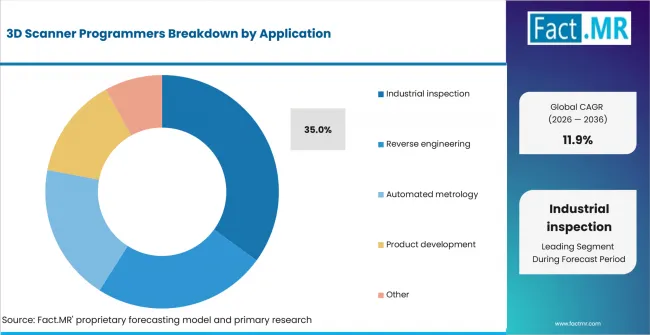
3d Scanner Programmers Analysis By Application | Source: Fact.MR
Industrial inspection leads application demand because scan programs give quality teams the same measurement path for every part family. The workflow is useful for dimensional checks, surface comparison and deviation reporting. Automated metrology supports repeat tasks inside production cells. Reverse engineering helps teams recover geometry when CAD files are missing or outdated. Product development uses scanner programming during prototype changes and tooling reviews. This application mix keeps programmers close to manufacturing quality budgets, where repeatability and traceable reporting carry commercial weight.
What is accelerating 3D Scanner Programmers Market adoption, and what is holding it back?
Automated inspection drives it; workflow integration restrains it.
Drivers Impact Analysis
| DRIVER | (~) % IMPACT ON CAGR | GEOGRAPHIC RELEVANCE | IMPACT TIMELINE |
|---|---|---|---|
| Automated inspection cells | +1.8% | North America, Europe, East Asia | Short term (<= 2 years) |
| Repeatable scan acquisition | +1.4% | Global | Medium term (2-4 years) |
| Reverse-engineering workflows | +1.1% | North America, Europe | Medium term (2-4 years) |
| Shop-floor metrology stations | +0.9% | Europe, East Asia | Long term (>= 4 years) |
Source: Fact.MR analysis. Updated Sep 9, 2026
- Automated inspection cells: Robotic and semi-automated measurement cells require scanner paths that avoid collisions and repeat the same part coverage. Programming tools reduce manual setup time across recurring jobs.
- Repeatable scan acquisition: Stable scan routines help plants reduce variation between operators and shifts. Demand is projected to rise where quality teams handle many part families on shared scanners.
- Reverse-engineering workflows: Reverse-engineering users need cleaner point-cloud processing and guided CAD conversion. This driver is anticipated to support service bureaus and manufacturers that redesign supplier parts.
- Shop-floor metrology stations: Inspection is moving closer to production lines where operators need guided steps and simple pass-fail outputs. Demand is forecast to strengthen where plants want quicker feedback.
Opportunity Impact Analysis
| OPPORTUNITY | (~) % IMPACT ON CAGR | GEOGRAPHIC RELEVANCE | IMPACT TIMELINE |
|---|---|---|---|
| No-code scanner workflow builders | +1.2% | North America, Western Europe | Short term (<= 2 years) |
| Open scanner-to-CAD conversion | +1.0% | Global | Medium term (2-4 years) |
| Robot path programming for metrology | +0.8% | East Asia, Europe | Medium term (2-4 years) |
| Cloud review and template sharing | +0.6% | North America, Europe, Japan | Long term (>= 4 years) |
Source: Fact.MR analysis. Updated Sep 9, 2026
- No-code scanner workflow builders: Automated workflow tools can expand scanner adoption beyond specialist robot programmers. CAD-driven inspection planning helps quality teams create repeatable scanning routines with less manual programming, reducing setup effort and making automated metrology more accessible across production environments.
- Open scanner-to-CAD conversion: Open conversion workflows create opportunities for software that can process data from multiple scanner brands and formats. This flexibility is valuable for manufacturers operating mixed scanner fleets and seeking consistent downstream inspection, modeling, and CAD-comparison processes.
- Robot path programming for metrology: Robot path tools help integrators combine scanner reach with repeatable part coverage. Simulation, collision checking, and offline path validation can reduce deployment risk while improving inspection consistency before programs are transferred to live production cells.
- Cloud review and template sharing: Cloud-based review supports multi-site engineering teams that need common inspection templates, reporting formats, and approval processes. Shared workflows can help global manufacturers standardize quality practices while allowing inspection results to be reviewed across plants.
Restraints Impact Analysis
| RESTRAINT | (~) % IMPACT ON CAGR | GEOGRAPHIC RELEVANCE | IMPACT TIMELINE |
|---|---|---|---|
| Integration with legacy metrology systems | -0.8% | Global | Short term (<= 2 years) |
| Need for metrology-skilled programmers | -0.6% | North America, Europe | Medium term (2-4 years) |
| Large scan-file handling limits | -0.5% | Global | Medium term (2-4 years) |
| Validation effort for regulated parts | -0.4% | Aerospace, medical, automotive hubs | Long term (>= 4 years) |
Source: Fact.MR analysis. Updated Sep 9, 2026
- Integration with legacy metrology systems: Many plants already use CMM routines, inspection databases and fixed reporting formats. Adoption is constrained where integration work takes more time than the inspection gain.
- Need for metrology-skilled programmers: Scanner programming requires knowledge of tolerances, fixtures and measurement uncertainty. Growth is expected to favor platforms that guide users through part setup and reporting rules.
- Large scan-file handling limits: High-resolution scanners create heavy point clouds that can slow processing on weaker workstations. Vendors are projected to improve file handling and template reuse to reduce waiting time.
- Validation effort for regulated parts: Aerospace, automotive and medical-device teams need proof that new programs repeat the required measurement path. Demand is anticipated to move toward tools that store templates, audit trails and repeatable report settings
Which countries are scaling the 3D Scanner Programmers Market through 2036?
- The country comparison spans 3.1 percentage points and forms three practical growth bands across the forecast period.
- The UK remains 1.1 percentage points above the USA as software R&D depth supports programmable measurement workflows.
- The USA remains 0.3 percentage point above Japan through software talent and automated inspection deployment.
- Japan remains 0.3 percentage point above Germany because precision manufacturing supports high-tolerance metrology workflows.
- Germany remains 1.4 percentage points above France through industrial automation and established factory quality systems.
- France closes the displayed range through aerospace, transport and industrial equipment inspection demand.
Comparable CAGRs can create different entry conditions due to software talent, factory automation, metrology depth and manufacturing investment cycles. Full coverage includes North America, Latin America, Western Europe, Eastern Europe, East Asia, South Asia & Pacific, and Middle East & Africa.
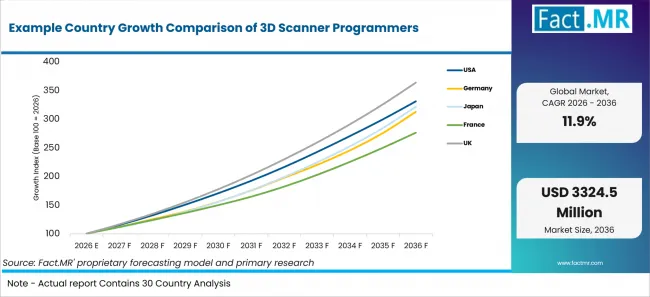
Example Country Growth Comparison Of 3d Scanner Programmers | Source: Fact.MR
| Country | CAGR |
|---|---|
| UK | 13.8% |
| USA | 12.7% |
| Japan | 12.4% |
| Germany | 12.1% |
| France | 10.7% |
Source: Fact.MR analysis. Updated Sep 9, 2026
What supports UK adoption?
13.8% CAGR, supported by software-rich inspection workflows.
The UK is projected to record 13.8% CAGR as metrology teams shift more scanner setup into repeatable software workflows. The Office for National Statistics reported on 28 November 2025 that the software development product group accounted for GBP 10.3 billion, or 18.5%, of UK business R&D performed in 2024. This provides a broad software-capability indicator relevant to software-intensive industrial metrology workflows.
How is the USA scaling demand?
12.7% CAGR, driven by software talent and automated inspection demand.
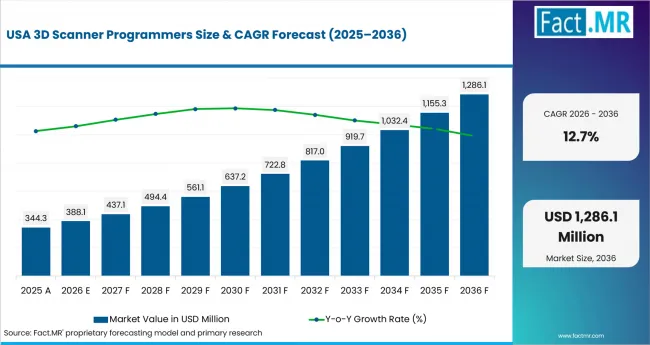
3d Scanner Programmers Country Value Analysis | Source: Fact.MR
The USA is estimated to advance at 12.7% CAGR as production sites combine 3D scanners with programmable inspection routines. The Bureau of Labor Statistics reported on 15 May 2026 that employment in the software and web developers, programmers, and testers occupational group totaled 2,150,380 in May 2025. This provides a broad indicator of U.S. software-programming capacity relevant to software-intensive measurement workflows.
How does Japan perform?
12.4% CAGR, led by precision manufacturing and robotic metrology.
Japan is anticipated to post 12.4% CAGR as manufacturers use 3D scanning for high-tolerance parts and design validation. The Statistics Bureau of Japan reported on 28 January 2026 that total R&D expenditure in fiscal 2024 reached JPY 23.79 trillion. This provides national R&D context for technology-intensive manufacturing and measurement workflows.
What supports Germany’s adoption?
12.1% CAGR, backed by industrial automation and metrology depth.
Germany is forecast to reach 12.1% CAGR as machinery, automotive and industrial equipment plants standardize programmable inspection. Destatis' 2024 Business Register, dated 1 December 2025, records 209,815 legal units in manufacturing. This establishes the breadth of Germany's manufacturing base for industrial metrology adoption.
What underpins France’s growth?
10.7% CAGR, driven by manufacturing R&D and automated quality control.
France is projected to record 10.7% CAGR as aerospace, transport and industrial equipment manufacturers use scanning for inspection and reverse engineering. INSEE reported on 21 July 2026 that manufacturing production in value reached EUR 981 billion in 2025, based on provisional data. This provides manufacturing-scale context for industrial metrology adoption.
Who leads the 3D Scanner Programmers Market?
Hexagon, ZEISS, FARO CREAFORM (AMETEK) offer metrology software or scanner-linked workflows relevant to 3D scanning, inspection and automation tasks.
Hexagon is active through PRESTO Quality Stations and metrology software compatibility with PC-DMIS, Inspire and SpatialAnalyzer. ZEISS supports the market through ZEISS INSPECT and ZEISS ScanPort, linking optical 3D scanning with guided measurement and inspection workflows.
Nikon Metrology contributes automated Laser Radar inspection systems that interface with Metrolog, PolyWorks and SpatialAnalyzer. SHINING 3D combines metrology scanners with SHINING3D Inspect software for integrated 3D inspection workflows. ZEISS released its 2026 quality software update in November 2025, adding ZEISS INSPECT Optical 3D improvements including surface-based decalibration checks and enhanced T-SCAN hawk 2 capabilities. Across these suppliers, product portfolios emphasize inspection templates and guided workflows, scanner and software compatibility, reporting capabilities, and measurement solutions suitable for both metrology laboratories and shop-floor environments.
Which companies are the key providers?
Key companies include Hexagon, ZEISS, FARO, Creaform (AMETEK), Nikon Metrology, and SHINING 3D.
- Hexagon
- ZEISS
- FARO CREAFORM (AMETEK)
- Nikon Metrology
- SHINING 3D
Bibliography
- U.S. Bureau of Labor Statistics. (2026, May 15). Table 1. National employment and wage data from the Occupational Employment and Wage Statistics survey by occupation, May 2025 [Data table].
- Creaform. (2025, February 20). Creaform releases Creaform.OS and the Creaform Metrology Suite for the ultimate user experience (UX).
- FARO Technologies, Inc. (2025, January 23). FARO Technologies pushes 3D metrology forward with new FARO Leap ST.
- Federal Statistical Office (Destatis). (2025, December 1). Business register: Legal units, employees and turnover 2024 [Data table].
- Hexagon. (2025, May 8). Hexagon brings automated quality inspection to smaller manufacturing operations and large-scale applications with new PRESTO Quality Stations.
- Institut national de la statistique et des études économiques. (2026, July 21). Indicateurs macroéconomiques de l’industrie manufacturière.
- International Federation of Robotics. (2025, September 25). World Robotics 2025 report – Industrial robots – released by IFR.
- Nikon Corporation. (2026, April 20). Nikon’s APDIS MV5X Laser Radar sets a new standard for compact, high-speed precision measurement.
- Office for National Statistics. (2025, November 28). Business enterprise research and development, UK: 2024.
- SHINING 3D. (2026, May 20). SHINING3D Inspect 2026 enhances 3D inspection with more streamlined and modular workflows.
- Statistics Bureau of Japan. (2026, January 28). News Bulletin January 28, 2026 (No. 375).
- ZEISS Industrial Quality Solutions. (2025, May 27). ZEISS introduces ScanPort, a new dimension in semi-automated 3D metrology.
- ZEISS Industrial Quality Solutions. (2025, November 20). New benchmarks in quality inspection and data analysis.
This Report Answers
- The report explains where scanner programming software is used across software function, scanner type, deployment and application demand.
- Segment analysis identifies the lead subsegments and the operational reasons measurement teams prioritize them.
- Country analysis examines the UK, USA, Japan, Germany and France through software, R&D and manufacturing indicators.
- Competitive analysis reviews current providers across metrology software, scan-to-CAD workflows, handheld scanning and automated inspection.
- Application analysis assesses how repeatability, file handling and reporting control influence scanner programming decisions.
What does the 3D Scanner Programmers Market cover?
The 3D Scanner Programmers Market covers software and workflow tools that control how 3D scanners capture parts, process point clouds and create inspection outputs. It includes scan setup templates, inspection routines, robot path programming, reverse-engineering workflows and automation scripting used around industrial 3D measurement systems.
The assessment covers standalone software, bundled scanner workflow tools and programming modules inside wider metrology platforms. Hardware-only scanners and broad manufacturing software remain outside the boundary unless scanner programming is a core function.
What is included in the scope?
The scope includes software used to program scan acquisition, automate inspection steps, convert scan data into CAD-ready geometry and guide repeat measurement routines. It covers structured light, laser triangulation, CMM-linked scanning, long-range LiDAR and CT / specialty 3D workflows across workstation, shop-floor and cloud formats.
The adjacent 3D scanner systems view separates hardware demand from programming and workflow software. Coverage of integrated 3D scanners supports the boundary around scanner-software bundles.
What is excluded from the scope?
The scope excludes standalone scanner hardware, general-purpose CAD platforms, broad PLM systems and manual measurement services sold without scanner programming software. It also excludes 3D printing slicers, photogrammetry-only apps and generic image-analysis tools where 3D scan acquisition control or inspection workflow control is absent.
How Was the Analysis Built?
The analysis draws on 120+ sources, 35+ company portfolios, 25+ countries, and more than 20 industry interviews.
- Primary Research: Primary research includes discussions with manufacturers, service providers, technology developers, distributors, end users, and subject-matter experts. These conversations examine purchasing priorities, product adoption, operational challenges, approval requirements, competitive positioning, and the factors that influence wider market acceptance.
- Desk Research: Desk research covers government statistics, regulatory publications, company filings, trade data, technical studies, industry associations, standards, public policy, and other authoritative sources. Every source used in the analysis is documented in the bibliography.
- Market Sizing and Forecasting: Market estimates combine historical performance, demand indicators, pricing and volume trends, segment shares, company participation, country-level growth, adoption patterns, investment activity, and barriers to market expansion.
- Data Validation and Update Cycle: Findings are validated by comparing primary interviews with public data, company activity, regulatory changes, trade patterns, and industry developments. Regular updates review new product launches, capacity changes, partnerships, approvals, and shifts in commercial adoption.
Segmentation
What is the report’s scope and coverage?
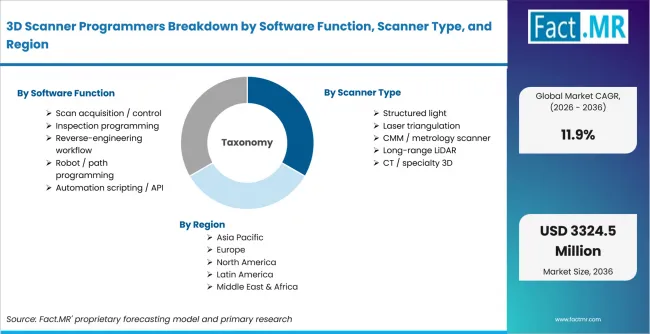
3d Scanner Programmers Breakdown By Software Function, Scanner Type, And Region | Source: Fact.MR
| Attribute | Details |
|---|---|
| Quantitative Units | USD million |
| Market Definition | Software tools and programming workflows used to control 3D scanner acquisition, automate inspection routines, guide reverse-engineering tasks and connect scan data with reporting or CAD systems. |
| Software Function | Scan acquisition / control; Inspection programming; Reverse-engineering workflow; Robot / path programming; Automation scripting / API |
| Scanner Type | Structured light; Laser triangulation; CMM / metrology scanner; Long-range LiDAR; CT / specialty 3D |
| Deployment | Desktop workstation; Edge / shop-floor station; Cloud collaborative; Controller-embedded; Mobile / tablet |
| Application | Industrial inspection; Reverse engineering; Automated metrology; Product development; Other |
| Regions Covered | North America; Latin America; Western Europe; Eastern Europe; East Asia; South Asia & Pacific; Middle East & Africa |
| Countries Covered | USA; Germany; Japan; France; UK |
| Key Companies Profiled | Hexagon; ZEISS; FARO CREAFORM (AMETEK); Nikon Metrology; SHINING 3D |
| Forecast Period | 2026 to 2036 |
| Approach | Hybrid top-down and bottom-up approach using scanner software revenue, metrology workflow intensity, deployment mix, application demand, country adoption and provider portfolio review. |
Source: Fact.MR analysis. Updated Sep 9, 2026
How is the market segmented?
-
By Software Function
- Scan acquisition / control
- Inspection programming
- Reverse-engineering workflow
- Robot / path programming
- Automation scripting / API
-
By Scanner Type
- Structured light
- Laser triangulation
- CMM / metrology scanner
- Long-range LiDAR
- CT / specialty 3D
-
By Deployment
- Desktop workstation
- Edge / shop-floor station
- Cloud collaborative
- Controller-embedded
- Mobile / tablet
-
By Application
- Industrial inspection
- Reverse engineering
- Automated metrology
- Product development
- Other
-
By Region
- North America
- Latin America
- Western Europe
- Eastern Europe
- East Asia
- South Asia & Pacific
- Middle East & Africa
Frequently Asked Questions
How big is the 3D scanner programmers market in 2026?
What is the CAGR of the 3D scanner programmers market from 2026 to 2036?
Which software function leads the 3D scanner programmers market?
Which deployment leads the 3D scanner programmers market?
Which companies are profiled in the 3D scanner programmers market?
Who worked on this report


Preview the report firsthand - request a free sample
Free SampleGet the brochure for pricing and purchase details
Download PDF