- Base Value(2026): 3.1 Bn
- Estimated Value(2026): 3.1 Bn
- Forecast Value (2036): 5.4 Bn
- CAGR (2026 - 2036): 5.7%
Smart Indoor Gardening System Market Forecast and Outlook 2026 to 2036
In 2025, the smart indoor gardening system market surpassed a valuation of USD 3.0 billion. Based on Fact.MR analysis, demand for smart indoor gardening systems is estimated to grow to USD 3.1 billion in 2026 and USD 5.4 billion by 2036. Fact.MR projects a CAGR of 5.7% during the forecast period.
Between 2026 and 2036, the market is projected to create an absolute dollar opportunity of USD 2.3 billion. This growth reflects sustained consumer interest in home-grown produce, urban apartment living constraints, and increased integration of IoT-enabled household appliances. However, high upfront system costs and limited crop variety flexibility moderate acceleration in price-sensitive markets.
Mattias Lepp, Founder & CEO of Click & Grow said, "When Click & Grow’s founder created the first Smartpot, the coolest thing was to see how children, parents and busy entrepreneurs would lean over their Click & Grow every five minutes to check for sprouts... It causes you to weigh decisions, seek solutions, and learn about things and about yourself."
Country growth reflects urbanization intensity, consumer disposable income, smart home adoption rates, and sustainability policy momentum. China leads at 8.0% CAGR supported by smart appliance penetration and urban apartment density. India follows at 7.6% driven by rising middle-class home improvement spending. Germany posts 7.0% due to sustainability-led consumer behavior and energy-efficient appliance incentives. Brazil registers 6.5% as urban vertical gardening gains traction. The United States grows at 5.8% anchored by premium kitchen appliance integration. The United Kingdom expands at 5.1% driven by eco-conscious consumer segments but moderated by energy cost sensitivity.
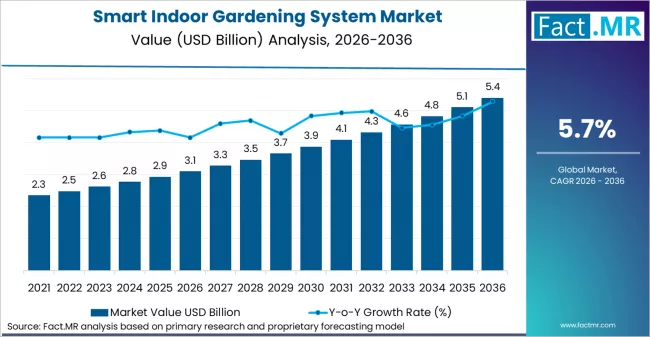
Smart Indoor Gardening System Market Market Value Analysis | Source: Fact.MR
| Metric | Value |
|---|---|
| Estimated Value in 2026 | USD 3.1 billion |
| Forecast Value in 2036 | USD 5.4 billion |
| Forecast CAGR (2026 to 2036) | 5.7% |
Source: Fact.MR analysis. Updated Mar 5, 2026
Market Definition
Smart indoor gardening systems are compact, technology-enabled cultivation units designed for residential or commercial indoor environments. These systems integrate automated lighting (LED grow lights), self-watering mechanisms, nutrient dosing controls, and, in advanced models, smart sensors connected to mobile applications. Their primary function is to enable controlled-environment agriculture within homes, offices, and urban apartments. End-use applications include herb cultivation, leafy greens, microgreens, and decorative plants for consumers seeking convenience, sustainability, and food transparency.
Market Inclusions
Includes global and regional revenue forecasts (2026-2036) by type and deployment model. Covers residential and small commercial indoor gardening systems incorporating automated irrigation, LED lighting, and IoT connectivity. Encompasses pricing trends, smart home integration rates, and sustainability adoption patterns across major regions.
Market Exclusions
Excludes large-scale commercial vertical farming infrastructure, greenhouse industrial systems, and hydroponic farm installations exceeding household scale. Also excludes traditional manual indoor planters and non-electronic gardening kits without integrated automation or connectivity features.
Research Methodology
- Primary Research: Interviews were conducted with smart appliance manufacturers, urban agriculture startups, home improvement retailers, and IoT integration specialists across North America, Europe, and Asia Pacific.
- Desk Research: Sources included company annual reports, smart home market publications, government sustainability incentive records, appliance association statistics, and investor presentations from 2024 and 2025.
- Market Sizing and Forecasting: A hybrid model combined top-down smart appliance adoption rates with bottom-up average selling price data by system type and deployment level. Urbanization trends and consumer spending benchmarks informed growth assumptions.
- Data Validation and Update Cycle: Forecast outputs were validated against manufacturer revenue disclosures, retail sales benchmarks, and regional smart home adoption statistics, with annual updates reflecting technology cost reductions and policy incentives.
Summary
- Market Definition
- Smart indoor gardening systems are automated, sensor-enabled home cultivation units that integrate lighting, watering, and nutrient management for controlled indoor plant growth.
- Demand Drivers
- Rising urban apartment living is increasing demand for compact, self-contained food cultivation solutions.
- Growing sustainability awareness encourages consumers to reduce food miles and improve transparency.
- Smart home ecosystem expansion supports integration of connected gardening devices.
- Key Segments Analyzed
- By Type: Small Garden leads with 47% share due to affordability and countertop compatibility.
- By Deployment: Self-Watering holds 40% share reflecting ease-of-use demand among first-time buyers.
- By Geography: Asia Pacific leads growth, with China (8.0%) and India (7.6%) contributing the highest expansion rates.
- Analyst Opinion at FACT.MR
- Shambhu Nath Jha, Principal Consultant at Fact.MR, opines, “The market’s next wave will not be defined by hardware alone, but by ecosystem integration-data-driven plant monitoring and subscription-based seed and nutrient services will define margin expansion.”
- Strategic Implications
- Manufacturers should invest in app-enabled monitoring and subscription refill ecosystems.
- Retailers should position smart gardening systems within broader smart kitchen appliance portfolios.
- Companies should localize crop varieties to regional dietary preferences to drive repeat engagement.
- Methodology
- Revenue modelling combined ASP benchmarking with household penetration rates.
- Smart appliance adoption data from 2024-2025 informed growth projections.
- Regional forecasts validated through retailer channel performance benchmarks.
Segmental Analysis
Smart Indoor Gardening System Market Analysis by Type
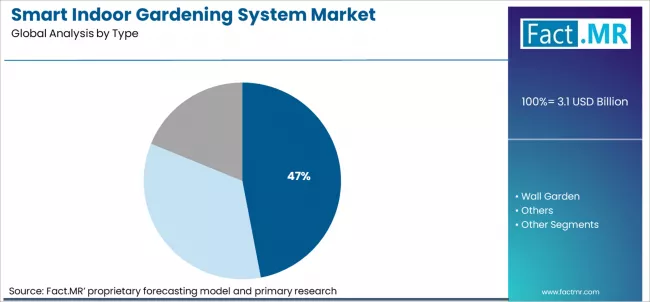
Smart Indoor Gardening System Market Analysis By Type | Source: Fact.MR
Based on FACT.MR's smart indoor gardening system market report, consumption of Small Garden systems is estimated to hold 47% share in 2026. Small garden systems dominate due to affordability, countertop footprint compatibility, and ease of installation for apartment residents.
- LG Electronics Smart Garden Launch: In 2025, LG Electronics expanded its indoor gardening appliance portfolio targeting premium kitchen integration, reinforcing demand for compact modular systems. [2]
- CLICK & GROW Retail Expansion: In 2024, CLICK & GROW LLC expanded retail partnerships across European home improvement chains, strengthening distribution for small countertop units. [3]
- E-Commerce Growth Trend: Online home appliance sales growth in 2024 across Amazon and specialty smart home retailers increased direct-to-consumer penetration for compact indoor garden kits. [4]
Smart Indoor Gardening System Market Analysis by Deployment
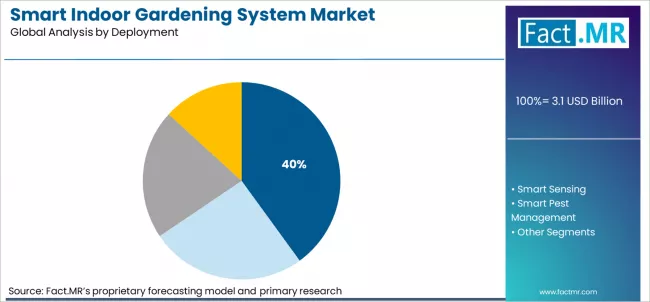
Smart Indoor Gardening System Market Analysis By Deployment | Source: Fact.MR
Based on FACT.MR's smart indoor gardening system market report, Self-Watering systems are estimated to hold 40% share in 2026. Self-watering technology simplifies maintenance and reduces user effort, making it the most accessible entry-level deployment category.
- Rise Gardens Product Upgrade: In 2025, Rise Gardens introduced upgraded nutrient automation features within its modular self-watering systems. [5]
- AeroGarden Technology Expansion: In 2024, AeroGarden launched Wi-Fi-enabled models allowing automated light and water scheduling via smartphone integration. [6]
- Urban Logistics Trend: Growing same-day delivery infrastructure in metropolitan regions accelerated impulse purchases of compact self-watering systems via e-commerce platforms. [7]
Drivers, Restraints, and Opportunities
FACT.MR analysts observe that the smart indoor gardening market has transitioned from niche hobbyist adoption to mainstream smart home accessory positioning. At USD 3.0 billion in 2025, the market reflects convergence between home improvement, sustainability, and IoT-enabled consumer electronics.
The core tension lies between premium connected systems and lower-cost non-connected alternatives. While connected units command higher prices, slower replacement cycles and electricity cost concerns in Europe moderate repeat purchases.
- Hyper-Urbanization & Localized Food Security: With over half of the global population residing in urban areas, limited access to outdoor gardening space is accelerating demand for compact indoor cultivation systems. These systems function as localized food supply units, reducing dependence on external supply chains and mitigating exposure to food inflation and climate-driven crop volatility.
- Proactive Wellness & Biophilic Integration: Post-2024 consumer behavior reflects growing emphasis on environmental wellness and biophilic design within homes. Indoor gardening systems are increasingly positioned as air-quality enhancers and mental well-being tools, aligning with healthy home certification frameworks and broader wellness-oriented home improvement spending.
- Technological Maturity & Autonomous Cultivation: Advancements in AI-enabled plant monitoring, computer vision diagnostics, and energy-efficient LED lighting have significantly reduced the effort-to-yield ratio. By 2026, smart sensing and automated nutrient management features lower the knowledge barrier for first-time users, expanding addressable demand beyond hobbyists to mainstream urban professionals.
Regional Analysis
The smart indoor gardening market is analysed across Asia Pacific, Europe, North America, Latin America, and Middle East and Africa, spanning over 40+ countries.
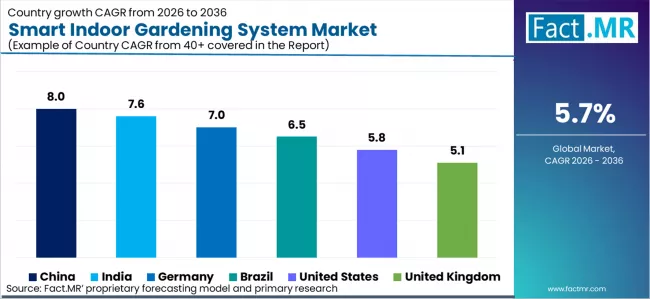
Smart Indoor Gardening System Market Cagr Analysis By Country | Source: Fact.MR
| Country | CAGR (2026-2036) |
|---|---|
| China | 8.0% |
| India | 7.6% |
| Germany | 7.0% |
| Brazil | 6.5% |
| United States | 5.8% |
| United Kingdom | 5.1% |
Source: Fact.MR analysis. Updated Mar 5, 2026
Asia Pacific Smart Indoor Gardening System Market Analysis
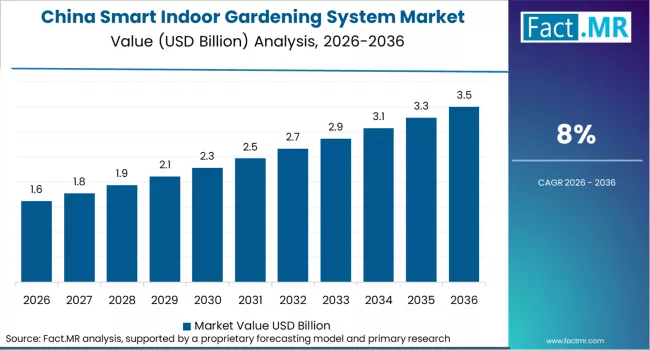
Smart Indoor Gardening System Market Country Value Analysis | Source: Fact.MR
Asia Pacific remains the volume expansion and innovation hub for the smart indoor gardening system market, supported by hyper-urban living patterns, state-backed agri-tech initiatives, and rapid IoT-enabled appliance adoption. The region combines compact living constraints with digitally connected consumer ecosystems, enabling scalable deployment of modular countertop and wall-mounted cultivation systems across residential and institutional environments.
- China: China’s smart indoor gardening system market is projected to expand at 8.0% CAGR through 2036. Alignment with the 14th Five-Year Plan’s emphasis on urban agriculture and vertical farming technology is strengthening institutional and commercial interest in compact cultivation systems. Rapid adoption among Gen Z urban consumers, particularly for desktop-level modular units, reflects strong “green lifestyle” positioning. Domestic manufacturing integration allows low-cost production of IoT-enabled sensors and Bluetooth/Wi-Fi connectivity modules, supporting competitive pricing. Strategic opportunities include scaling “Nature Education” pods for schools and public institutions and leveraging vertically integrated supply chains for AI-enabled product upgrades.
- India: India is forecast to grow at 7.6% CAGR through 2036. Severe metro air pollution in cities such as Delhi and Mumbai is increasing demand for indoor flora with perceived air-purification benefits. Rapid e-commerce logistics expansion is improving distribution of smart seed kits into Tier-2 cities. Strategic arenas include Botanics-as-a-Service (BaaS) subscription models delivering fresh herbs to premium residential complexes and integrated wall-garden installations for farm-to-fork restaurant concepts in hospitality hubs.
FACT.MR's Asia Pacific analysis of the smart indoor gardening system market covers China, India, Japan, South Korea, ASEAN, Australia and New Zealand, and Rest of Asia Pacific. Readers can find country-level CAGR projections, IoT appliance penetration benchmarks, urban density indicators, and sustainability-driven adoption trends.
Europe Smart Indoor Gardening System Market Analysis
Europe represents a sustainability-led innovation arena for smart indoor gardening systems, characterized by ESG-driven corporate adoption, energy efficiency prioritization, and circular economy alignment. The region integrates environmental certification frameworks with consumer-level demand for biodegradable and plastic-free cultivation solutions.
- Germany: Germany is projected to register 7.0% CAGR through 2036. ESG corporate mandates are encouraging office integration of indoor gardens to support WELL and LEED certification targets. Energy-efficient LED systems and recycled material use are prioritized by German consumer’s sensitive to energy costs and sustainability benchmarks. Industrial biotechnology research into peat-free substrates and seaweed-based nutrient solutions further strengthens innovation potential.
- United Kingdom: The UK market is expected to grow at 5.1% CAGR through 2036. Post-Brexit food inflation is accelerating adoption of home-grown salad greens and herbs as a cost-of-living adaptation strategy. Strong zero-waste consumer trends support demand for plastic-free “kitchen garden” solutions. Strategic opportunities include fully home-compostable seed pods that avoid industrial waste streams and space-efficient wall-mounted or hanging smart systems tailored to London’s micro-apartment living.
FACT.MR's European analysis of the smart indoor gardening system market covers Germany, France, the United Kingdom, Italy, Spain, the Nordics, and Rest of Europe. Readers can find ESG certification adoption benchmarks, energy efficiency metrics, biodegradable material innovation trends, and country-level CAGR projections.
North America Smart Indoor Gardening System Market Analysis
North America functions as a premium innovation and ecosystem integration market, supported by federal agricultural resilience initiatives, smart home maturity, and institutional wellness integration across corporate and healthcare facilities.
- United States: The U.S. smart indoor gardening system market is projected to expand at 5.8% CAGR through 2036. USDA resilience grants supporting hydroponic nutrient efficiency research (USD 14M+) are strengthening domestic innovation in controlled-environment cultivation. Integration with Matter, Alexa, and Google Home ecosystems enhances compatibility within established smart home frameworks. Institutional adoption across corporate campuses and hospitals where indoor gardens are positioned as wellness tools creates a differentiated B2B demand channel.
FACT.MR's North American analysis of the smart indoor gardening system market covers the United States and Canada. Readers can find federal funding impact assessments, smart ecosystem integration benchmarks, and institutional wellness adoption metrics.
Latin America Smart Indoor Gardening System Market Analysis
Latin America represents an emerging urbanization-driven growth corridor for smart indoor gardening systems, with Brazil leading regional expansion due to compact living transitions and agri-tech expertise.
- Brazil: Brazil’s market is projected to grow at 6.5% CAGR through 2036. With over 85% of the population residing in urban areas, demand for vertical compact living solutions is expanding. Brazil’s bio-energy and agri-tech ecosystem supports development of locally sourced planter materials and organic hydroponic nutrient formulations. Strategic opportunities include leveraging “Bio-to-X” innovation pipelines to create low-cost nutrient systems and forming retail partnerships with major home-improvement chains such as Leroy Merlin for floor-model installations that increase consumer visibility and adoption.
FACT.MR's Latin American analysis of the smart indoor gardening system market covers Brazil, Chile, Mexico, and Rest of Latin America. Readers can find urban density adoption metrics, bio-based input innovation trends, and retail partnership benchmarks across key regional markets.
Competitive Aligners for Market Players
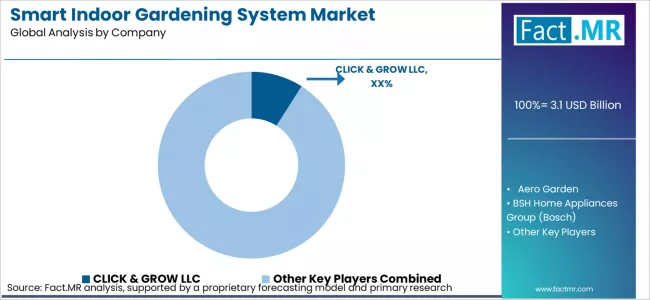
Smart Indoor Gardening System Market Analysis By Company | Source: Fact.MR
The global smart indoor gardening system market is moderately fragmented, with technology-led startups competing alongside established home appliance manufacturers. Companies such as CLICK & GROW LLC, AeroGarden, Gardyn, and Rise Gardens dominate the direct-to-consumer ecosystem model, while LG Electronics and BSH Home Appliances Group leverage broader smart kitchen integration and global distribution strength.
The primary competitive variable is not hardware alone, but ecosystem stickiness systems that combine intuitive mobile applications, automated nutrient dosing, and subscription-based seed pod replenishment achieve higher customer lifetime value. Structural advantages favor players with vertically integrated supply chains for LED modules, IoT sensors, and nutrient cartridge production, enabling cost control and faster product iteration. AI-enabled diagnostics and energy-efficient lighting also serve as differentiation levers in markets sensitive to electricity costs, particularly in Europe.
Buyer behavior is shifting toward design-conscious, space-efficient units that blend into modern interiors, elevating aesthetics as a secondary but influential purchasing factor. As institutional wellness and ESG-driven corporate adoption expands, B2B partnerships in hospitality, education, and office environments present incremental growth channels beyond traditional residential demand.
Recent Development
- At CES 2025, Plantaform introduced its innovative Smart Indoor Garden unit to the U.S. market featuring advanced fogponics technology that grows plants with ultra-fine mist delivery of water and nutrients, enhancing growth speed and water efficiency while providing fully automated cultivation control via a custom mobile app.
- In 2025, LG Electronics unveiled a new smart indoor gardening appliance at CES 2025 with a sleek floor-standing lamp design, expanded growing space and height-adjustable LED lighting, enabling users to cultivate a wider variety of plants indoors while managing conditions via the LG ThinQ™ app.
Key Players
- CLICK & GROW LLC
- BSH Home Appliances Group (Bosch)
- AeroFarms
- Rise Gardens
- Gardyn
- Plantui
- Aero Garden
- The Scotts Company LLC
- LG Electronics
- Plenty Unlimited Inc.
Bibliography
- [1] Click & Grow LLC. 2024. Corporate Overview and Founder Commentary on Smartpot Innovation. Company Media Statement and Corporate Website Archive, 2024.
- [2] LG Electronics. 2025. LG Unveils Advanced Indoor Gardening Appliance at CES 2025. LG Electronics Press Release, Las Vegas, NV.
- [3] CLICK & GROW LLC. 2024. Retail Expansion Announcement Across European Home Improvement Chains. Company Press Release, 2024.
- [4] Amazon Inc. 2024. Annual Report 2024: E-commerce and Smart Home Category Performance Overview. Seattle, WA.
- [5] Rise Gardens. 2025. Product Upgrade Release: Enhanced Nutrient Automation and Modular Self-Watering Systems. Company Product Announcement, 2025.
- [6] AeroGarden (Scotts Miracle-Gro). 2024. Launch of Wi-Fi Enabled Smart Garden Models with App Integration. Corporate Product Release, 2024.
- [7] U.S. Department of Agriculture (USDA). 2024. Resilient Food Systems Infrastructure and Controlled Environment Agriculture Grant Awards Summary. Washington, DC.
This Report Addresses
- Strategic intelligence on hyper-urban adoption in China, air-quality-driven demand in India, ESG-certified office integration in Germany, institutional wellness deployment in the United States, compact living solutions in the United Kingdom, and bio-material innovation alignment in Brazil.
- Market size and forecast: valued at USD 3.1 billion in 2026, projected to reach USD 5.4 billion by 2036 at a 4.8% CAGR, segmented by type, deployment model, and region.
- Growth opportunity mapping across compact countertop systems, AI-enabled smart sensing upgrades, subscription-based seed and nutrient ecosystems, hospitality and education-based installations, and smart kitchen appliance integration.
- Country CAGR outlook: China (8.0%), India (7.6%), Germany (7.0%), Brazil (6.5%), United States (5.8%), and United Kingdom (5.1%) with detailed segment splits by system type and deployment intensity.
- Competitive analysis of CLICK & GROW LLC, LG Electronics, Gardyn, Rise Gardens, AeroGarden, BSH Home Appliances Group, and Plenty Unlimited Inc., covering IoT integration capability, LED efficiency, supply chain localization, subscription ecosystem models, and design-led differentiation.
- Product and technology tracking including AI-enabled plant diagnostics, energy-efficient full-spectrum LED modules, refillable nutrient cartridges, biodegradable seed pods, modular wall-garden configurations, and app-integrated monitoring systems.
- Regulatory and policy impact analysis covering China’s 14th Five-Year Plan urban agriculture alignment, USDA resilience grants in the United States, EU circular economy compliance frameworks, UK zero-waste retail commitments, and urban sustainability mandates across Asia Pacific.
- Report delivered in Excel datasets, PowerPoint summary, and detailed PDF supported by smart appliance penetration data, urbanization statistics, corporate disclosures, sustainability policy records, and primary interviews with manufacturers, distributors, and IoT solution providers.
Segmentation
Scope of Report
| Items | Values |
|---|---|
| Quantitative Units | USD 3.1 billion (2026) to USD 5.4 billion (2036), at a CAGR of 4.8% |
| Market Definition | Smart indoor gardening systems are automated, technology-enabled home cultivation units integrating LED grow lighting, self-watering mechanisms, nutrient dosing systems, and IoT-enabled smart sensing features to support controlled-environment plant growth in residential and small commercial indoor spaces. |
| Type | Small Garden, Wall Garden, Others |
| Deployment | Self-Watering, Smart Sensing, Smart Pest Management, Others |
| Application Coverage | Urban home herb cultivation, microgreens and leafy vegetable production, biophilic office installations, educational cultivation pods, hospitality wall gardens, smart kitchen integration, and sustainability-driven indoor farming for compact living environments. |
| Regions Covered | Asia Pacific, Europe, North America, Latin America, Middle East and Africa |
| Countries Covered | China, India, Germany, Brazil, United States, United Kingdom, Rest of Asia Pacific, Rest of Europe, Rest of North America, Rest of Latin America, Rest of Middle East and Africa |
| Key Companies Profiled | CLICK & GROW LLC, BSH Home Appliances Group (Bosch), AeroFarms, Rise Gardens, Gardyn, Plantui, Aero Garden, The Scotts Company LLC, LG Electronics, Plenty Unlimited Inc. |
| Forecast Period | 2026 to 2036 |
| Approach | A hybrid top-down and bottom-up model was applied. Top-down inputs included urbanization rates, smart home penetration levels, sustainability policy incentives, and consumer appliance expenditure trends. Bottom-up inputs covered average selling prices by system type and deployment model, subscription refill rates, replacement cycle assumptions, retailer order data, and company revenue disclosures from 2024-2026. |
| Approach | A hybrid top-down and bottom-up model was applied. Top-down inputs included global tourism statistics, gig fleet budgets, government electrification budgets. Bottom-up inputs covered average prices by type, mode, replacement assumptions, order data from releases. |
Source: Fact.MR analysis. Updated Mar 5, 2026
Smart Indoor Gardening System Market by Segments
-
Type:
- Small Garden
- Wall Garden
- Others
-
Deployment:
- Self-Watering
- Smart Sensing
- Smart Pest Management
- Others
-
Region:
- North America
- USA
- Canada
- Mexico
- Latin America
- Brazil
- Chile
- Rest of Latin America
- Western Europe
- Germany
- UK
- Italy
- Spain
- France
- Nordic
- BENELUX
- Rest of Western Europe
- Eastern Europe
- Russia
- Poland
- Hungary
- Balkan & Baltic
- Rest of Eastern Europe
- East Asia
- China
- Japan
- South Korea
- South Asia and Pacific
- India
- ASEAN
- Australia & New Zealand
- Rest of South Asia and Pacific
- Middle East & Africa
- Kingdom of Saudi Arabia
- Other GCC Countries
- Turkiye
- South Africa
- Other African Union
- Rest of Middle East & Africa
- North America
Frequently Asked Questions
How large is the smart indoor gardening system market in 2025?
What will the market size be in 2026?
What is the projected market size by 2036?
What is the expected CAGR?
Which type leads the market?
Which deployment segment dominates?
Which country shows fastest growth?
What role does IoT play in this market?
Is the market driven more by residential or commercial demand?
How do subscription models impact revenue growth?
What is the primary restraint in this market?
Who worked on this report


Preview the report firsthand - request a free sample
Free SampleGet the brochure for pricing and purchase details
Download PDF