- Market Value (2025): USD 455.4 Mn
- Estimated Value (2026): USD 510.0 Mn
- Forecast Value (2036): USD 1584.0 Mn
- CAGR (2026-2036): 12.0%
What is the Soluble Rice Flours Market forecast to be worth by 2036?
USD 510.0 million in 2026 to USD 1,584.0 million by 2036 at a 12.0% CAGR.
- The Soluble Rice Flours Market reached USD 455.4 million in 2025.
- Demand is projected to increase from USD 510.0 million in 2026 to USD 1,584.0 million by 2036.
- The market is forecast to record 12.0% CAGR from 2026 to 2036 as food brands use rice-based powders in beverages, bakery mixes and nutrition products.
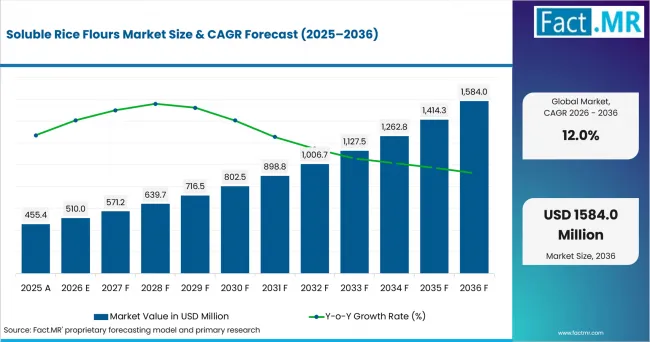
Soluble Rice Flours Market Value Analysis | Source: Fact.MR
What are the defining numbers behind Soluble Rice Flours Market growth?
An absolute opportunity of USD 1,074.0 million is expected between 2026 and 2036.
- Demand Drivers in the Market
- Beverage developers need powder bases that disperse quickly in instant drink mixes and keep flavor systems mild. Soluble rice flour is expected to help replace harsher carriers where clean labeling shapes formulation choice.
- Food manufacturers need rice-based ingredients as global rice use remains high. FAO reported on July 3, 2026 that world rice utilization is forecast to reach 558.2 million tonnes in 2026/27.
- U.S. packaged-food producers operate across dry mixes, nutrition powders and prepared foods. Soluble rice flour is expected to gain channel reach where brands need mild carriers with a clear rice identity.
- Bakery and sauce teams need neutral texture builders that fit gluten-free and wheat-reduced recipes. Rice-based soluble grades are anticipated to gain use where flavor release and opacity must remain controlled.
- Ingredient buyers need traceable rice supply as sourcing teams ask for stronger raw-material records. Documented rice origin is expected to shorten approval discussions for food brands using rice-based inputs.
- Key Segments Analyzed
- By Product: Rice-based is expected to hold 41.0% share in 2026 because it gives formulators the clearest link between product identity and the soluble rice flour proposition.
- By Function: Solubility is projected to account for 38.0% share in 2026 as dry-mix makers value instant hydration in beverages, sauces and nutrition powders.
- By Application: Beverages are anticipated to capture 34.0% share in 2026 since powder drink systems need mild carriers that disperse evenly without masking flavors.
- By Form: Powder is estimated to represent 46.0% share in 2026 owing to simple storage, dosing and blending across industrial food lines.
- Analyst Opinion at Fact.MR
- Shambhu Nath Jha, Principal Consultant at Fact.MR, states, “Soluble rice flour is gaining attention because it answers a practical formulation problem rather than a trend label. Food brands are expected to use it where rice identity, dispersion and mild taste must work together in one ingredient. Suppliers that combine clean documentation with application support are better placed with beverage, bakery and nutrition customers.”
- Strategic Implications
- Ingredient suppliers should document hydration behavior by application so beverage and soup brands can compare rice-based grades against maltodextrin and starch systems.
- Food brands should test soluble rice flour early in sugar-reduction and gluten-free reformulation projects because carrier choice can affect flavor release and mouthfeel.
- Distributors should separate rice-based, wheat-based and corn-based grades clearly so procurement teams can match allergen, texture and label requirements without long screening cycles.
USA leads at 13.2% CAGR through food spending scale and rice ingredient substitution. Germany follows at 12.6% as food processing depth supports industrial formulation. Japan reaches 11.8% through starch-use planning and rice-based food programs. France posts 11.3% through bakery and agri-food manufacturing depth. Brazil records 10.8% as domestic grain supply gives processors a regional sourcing base.
How does the Soluble Rice Flours Market break down by segment?
Rice-based leads Product at 41.0% share in 2026; Powder leads Form at 46.0% share.
Which Product dominates?
Rice-based is expected to hold 41.0% share in 2026.
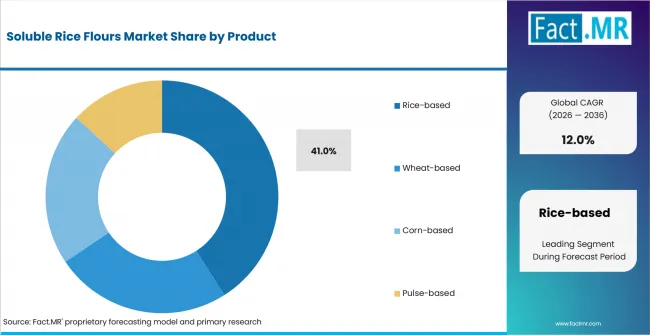
Soluble Rice Flours Market Analysis By Product | Source: Fact.MR
Rice-based products lead because the ingredient identity is clear for brands that want a clean rice label. The format gives beverage, bakery and nutrition teams a direct link between formulation performance and the wider rice flour market, where specific grain properties affect texture and consumer positioning.
Soluble rice flour competes with rice starch systems when brands need opacity, smoothness or short texture. Rice-based grades are expected to hold their position when product developers need flour labeling and quick dispersion together.
What leads the Function segment?
Solubility is projected to account for 38.0% share in 2026.
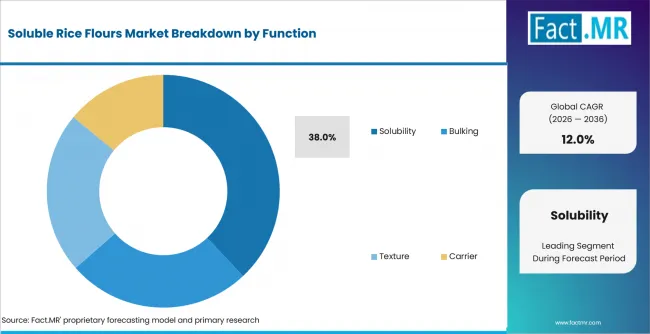
Soluble Rice Flours Market Analysis By Function | Source: Fact.MR
Solubility leads because instant powders must hydrate without clumping during mixing. Beverage manufacturers value that behavior in sachets, protein blends and nutrition mixes where the ingredient must disappear into the base system quickly.
Soups and sauces that use dry premixes rely on the same hydration behavior. Food makers can design convenience products that behave closer to modified starch market systems while carrying a simpler rice flour identity.
How does Application shape demand?
Beverages are anticipated to capture 34.0% share in 2026.
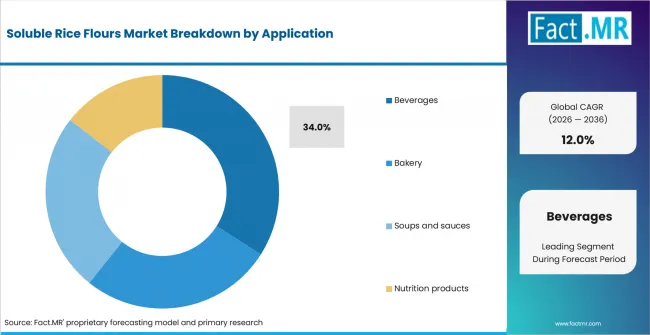
Soluble Rice Flours Market Analysis By Application | Source: Fact.MR
Beverages lead because instant drink systems place high pressure on carrier taste and wetting speed. A mild rice base helps flavors remain clear and reduces the risk that the carrier becomes visible in the finished drink.
Gluten-free bread and baking mixes create adjacent application pull when the same food company uses rice ingredients across bakery and drink platforms. That overlap helps ingredient buyers compare formulation performance across several product lines.
What supports Powder within Form?
Powder is estimated to represent 46.0% share in 2026.
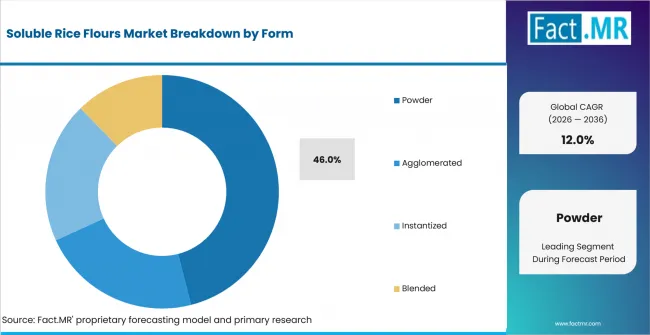
Soluble Rice Flours Market Analysis By Form | Source: Fact.MR
Powder leads because it fits existing dry-blending, packing and storage systems. Food factories can dose powder with familiar equipment, which reduces the process change needed for beverage premixes and bakery formulations.
Powdered grades align with pre-cooked flour market and instant starches market use cases where ease of handling and fast preparation determine the commercial value of the ingredient.
What is accelerating Soluble Rice Flours Market adoption, and what is holding it back?
Demand is expected to rise through beverage dispersion, clean-label reformulation and rice ingredient traceability.
Drivers Impact Analysis
| DRIVER | (~) % IMPACT ON CAGR | GEOGRAPHIC RELEVANCE | IMPACT TIMELINE |
|---|---|---|---|
| Instant beverage and nutrition premixes | +1.2% | Global | Short term (<= 2 years) |
| Clean-label rice-based carrier replacement | +1.0% | North America, Europe | Medium term (2-4 years) |
| Gluten-free bakery and sauce formulation | +0.8% | North America, Western Europe, Japan | Medium term (2-4 years) |
| Traceable rice sourcing programs | +0.6% | Europe, East Asia | Long term (>= 4 years) |
- Instant beverage and nutrition premixes: Powder drink producers need ingredients that hydrate quickly and carry flavor systems. Soluble rice flour is expected to gain use where clean labels and mild taste shape repeat formulation.
- Clean-label rice-based carrier replacement: Brands can use rice flour language where maltodextrin or modified starch language weakens product positioning. This links the category with broader functional flour market substitution needs.
- Gluten-free bakery and sauce formulation: Bakery and sauce teams need texture, opacity and stable dispersion. Soluble rice flour is expected to support these applications where wheat reduction shapes product design.
- Traceable rice sourcing programs: Rice ingredient buyers increasingly ask how raw material is grown and processed. Supplier documentation is expected to help soluble grades move through technical approval faster.
Opportunity Impact Analysis
| OPPORTUNITY | (~) % IMPACT ON CAGR | GEOGRAPHIC RELEVANCE | IMPACT TIMELINE |
|---|---|---|---|
| Rice-based beverage carriers | +0.9% | Global | Short term (<= 2 years) |
| Organic and allergen-aware bakery mixes | +0.7% | North America, Western Europe | Medium term (2-4 years) |
| Localized rice milling and pre-gelatinized grades | +0.5% | East Asia, Latin America | Long term (>= 4 years) |
- Rice-based beverage carriers: Drink brands can expand soluble rice flour use in instant coffees, plant-based powders and nutrition sachets where fast wetting improves consumer preparation.
- Organic and allergen-aware bakery mixes: The opportunity is concentrated in products that need rice-based inputs instead of wheat carriers. Adjacent dry-mix categories show how rice source claims can shape positioning.
- Localized rice milling and pre-gelatinized grades: Regional processors can serve food brands that want shorter supply chains and quick-preparation behavior without switching to higher-priced specialty starch systems.
Restraints Impact Analysis
| RESTRAINT | (~) % IMPACT ON CAGR | GEOGRAPHIC RELEVANCE | IMPACT TIMELINE |
|---|---|---|---|
| Rice supply and price exposure | -0.5% | USA, Brazil, East Asia | Short term (<= 2 years) |
| Competition from starch and maltodextrin carriers | -0.4% | Global | Medium term (2-4 years) |
| Allergen and gluten-control documentation burden | -0.3% | North America, Europe, Japan | Medium term (2-4 years) |
- Rice supply and price exposure: USDA ERS reported in August 2026 that U.S. all-rice supply for 2026/27 was 262.0 million cwt and still down 14% from the prior year.
- Competition from starch and maltodextrin carriers: Food manufacturers already understand native starch market and corn-based carrier systems. Soluble rice flour must prove texture, taste and label value during trials.
- Allergen and gluten-control documentation burden: Premium buyers require segregation records and test results. The approval cycle can lengthen when one production line handles rice, wheat or pulse flour alternatives.
Which countries are scaling the Soluble Rice Flours Market through 2036?
- The country comparison spans 2.4 percentage points and forms two practical growth bands across the forecast period.
- The USA remains 0.6 percentage point above Germany through packaged food spending and broader rice ingredient use.
- Germany remains 0.8 percentage point above Japan as industrial food processing supports dry ingredient demand.
- Japan remains 0.5 percentage point above France through rice-based food programs and starch planning.
- France remains 0.5 percentage point above Brazil as bakery and prepared-food channels support formulation trials.
- Brazil closes the displayed range with local grain scale and domestic rice supply for regional ingredient conversion.
Comparable CAGRs can create different entry conditions due to rice supply, food processing depth, label rules and behavior. Full report coverage includes North America, Latin America, Western Europe, Eastern Europe, East Asia, South Asia & Pacific, Middle East & Africa.
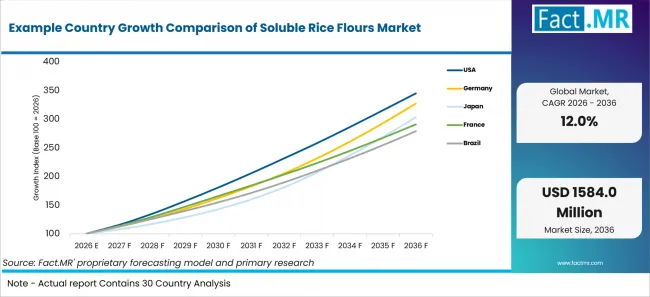
Example Country Growth Comparison Of Soluble Rice Flours Market | Source: Fact.MR
| Country | CAGR (2026-2036) |
|---|---|
| USA | 13.2% |
| Germany | 12.6% |
| Japan | 11.8% |
| France | 11.3% |
| Brazil | 10.8% |
What supports USA adoption?
13.2% CAGR, supported by packaged food scale and rice ingredient substitution.
U.S. food brands have a large addressable base for dry mixes, nutrition powders and prepared foods. USDA ERS reported in June 2026 that food spending by consumers, businesses and government entities reached USD 2.51 trillion in 2025. The USA to lead the displayed country group and interprets the scale of U.S. food spending as supportive context for rice-based carrier trials in beverage and bakery applications.
How is Germany scaling demand?
12.6% CAGR, backed by food processing depth and industrial ingredient use.
Germany’s food processors evaluate ingredients for performance, documentation and price consistency before approving new dry systems. USDA FAS reported in March 2026 that Germany produced an estimated USD 270.1 billion in processed food and beverages in 2024. Industrial base as supportive of soluble rice flour trials in sauces, bakery mixes and convenience foods where rice-based labeling improves product fit.
What supports Japan’s growth?
11.8% CAGR, led by starch planning and rice-based food development.
Japan’s formulation base is shaped by rice identity and careful starch-use planning. MAFF reported in February 2026 that demand for the Reiwa 7 starch year was forecast at 2,399 thousand tonnes, up 0.6% from the prior year. Soluble rice flour to gain where brands need mild flavor, non-wheat positioning and quick hydration in processed foods.
How is France developing demand?
11.3% CAGR, driven by bakery formulation and prepared-food manufacturing.
France combines bakery know-how with a large prepared-food manufacturing base. INSEE reported in February 2026 that the food products and beverages turnover index reached 123.62 in December 2025. Soluble rice flour will gain use where brands need rice-based texture, clean opacity and mild taste in bakery, soup and sauce formats.
How does Brazil perform?
10.8% CAGR, supported by grain supply and domestic rice processing.
Brazil offers regional sourcing scale for dry ingredient processors. Conab reported in August 2026 that 2025/26 grain production was estimated at 360.8 million tonnes, while rice production was estimated at 11.1 million tonnes. Brazil will grow from a smaller formulation base as beverage and nutrition brands test rice-based carriers against corn and starch alternatives.
Who leads the Soluble Rice Flours Market?
Ingredion Incorporated is an active provider of specialty food ingredients, including rice-based solutions used in clean-label formulation, texture management and processing applications. Its broader ingredient portfolio supports food manufacturers seeking functional alternatives for sauces, soups, bakery products, beverages and prepared foods.
Cargill, Incorporated participates through its broad starch, texturizer and food-ingredient capabilities, giving customers access to formulation support across multiple end-use applications. Ebro Foods, S.A. / Ebro Ingredients strengthens the competitive landscape through rice-processing expertise and ingredient solutions serving food manufacturers.
Siddiq Agricoze (Pvt.) Ltd. contributes rice-processing and ingredient capabilities, while GH2 Group expands supplier participation in specialty rice-based ingredients. Competition therefore centers on flour solubility, clean-label positioning, batch consistency and application performance, together with supplier ability to support formulation trials and commercial-scale food production.
Which companies are the key providers?
Key companies include Ingredion Incorporated, Cargill, Incorporated, Ebro Foods, S.A. / Ebro Ingredients, Siddiq Agricoze (Pvt.) Ltd., and GH2 Group.
- Ingredion Incorporated
- Cargill, Incorporated
- Ebro Foods, S.A. / Ebro Ingredients
- Siddiq Agricoze (Pvt.) Ltd.
- GH2 Group
Bibliography
- Companhia Nacional de Abastecimento. (2026, August 13). Estimativa aponta para uma produção de 360,8 milhões de toneladas na safra 2025/26.
- Food and Agriculture Organization of the United Nations. (2026, July 3). FAO Cereal Supply and Demand Brief.
- Institut national de la statistique et des études économiques. (2026, February 26). In December 2025, manufacturing turnover bounced back (+1.7%).
- Zeballos, E., & Sinclair, W. (2026, June 11). Total U.S. food spending reached $2.51 trillion in 2025. U.S. Department of Agriculture, Economic Research Service.
- U.S. Department of Agriculture, Economic Research Service. (2026, August 14). Rice - Market Outlook.
- Loeser, J. (2026, March 30). Food processing ingredients annual: Germany (GAIN Report No. GM2026-0007). U.S. Department of Agriculture, Foreign Agricultural Service.
This Report Answers
- The report explains where soluble rice flour is used across product, function, application and form. Regional and country-level adoption patterns are covered in the same assessment.
- Segment analysis identifies why rice-based products, solubility, beverages and powder forms receive priority from food formulators.
- Country analysis examines the listed markets and the food processing or rice supply mechanisms supporting soluble rice flour use.
- Competitive analysis reviews current providers across rice ingredients, starch systems, formulation support and distribution reach.
- Application analysis assesses how dispersion, texture and label language affect purchase decisions in beverages, bakery and nutrition products.
What does the Soluble Rice Flours Market cover?
The Soluble Rice Flours Market covers rice-based flours designed to disperse more easily than conventional flour in food and beverage systems. It includes grades used for solubility, carrier, bulking and texture functions where manufacturers need rice identity and dependable process behavior.
The assessment covers Product, Function, Application and Form across food and beverage uses. It places the category near rice starch and functional flour demand while keeping the scope focused on soluble flour grades.
What is included in the scope?
The scope includes soluble rice flour sold to beverage, bakery, soup, sauce and nutrition product manufacturers. It includes powder, agglomerated, instantized and blended formats when the ingredient is positioned around hydration or dispersion performance.
It includes rice-based grades that compete with native starch, modified starch and instant starch systems in specific food applications. Related food ingredient categories support adjacent demand mapping without expanding the soluble rice flour boundary.
What is excluded from the scope?
The scope excludes conventional rice flour sold only as a household baking staple with no soluble or instant performance positioning. Raw rice, rice bran, rice protein isolates and finished gluten-free bakery products fall outside the assessment.
General flour blends are excluded when soluble rice flour is a minor filler with no defined function. Pulse flour alternatives are assessed only as substitutes when they compete for allergen-aware or protein-forward formulation briefs.
How Was the Analysis Built?
The analysis draws on 120+ sources, 35+ company portfolios, 25+ countries, and more than 20 industry interviews.
- Primary Research: Primary research includes discussions with ingredient producers, distributors, food manufacturers, product developers, and subject-matter experts. These conversations examine formulation priorities, product testing, approval requirements, sourcing needs and the factors that influence wider market acceptance.
- Desk Research: Desk research covers government statistics, agricultural publications, company pages, product documentation, trade data, regulatory material, technical studies and other authoritative sources. Every source used in the analysis is documented in the bibliography.
- Market Sizing and Forecasting: Market estimates combine historical performance, food ingredient demand, application mix, rice supply, segment shares, company participation, country-level growth, adoption patterns and barriers to market expansion.
- Data Validation and Update Cycle: Findings are validated by comparing primary interviews with public data, company activity, agricultural supply signals, formulation trends. Updates review product launches, sourcing programs, approvals and changes in commercial adoption.
What is the report’s scope and coverage?
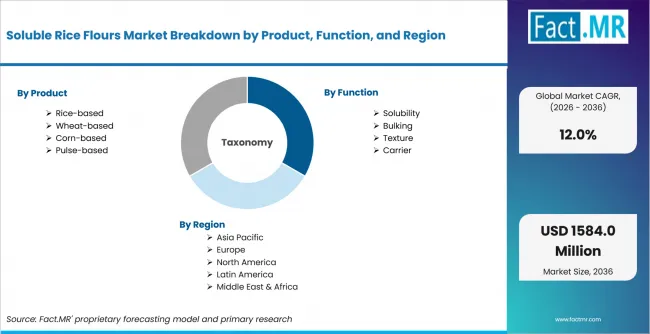
Soluble Rice Flours Market Breakdown By Product, Function, And Region | Source: Fact.MR
| Attribute | Details |
|---|---|
| Quantitative Units | USD million |
| Market Definition | Soluble rice flours used as rice-based dry ingredients for dispersion, carrier, bulking and texture functions in food and beverage formulations. |
| Product | Rice-based; Wheat-based; Corn-based; Pulse-based |
| Function | Solubility; Bulking; Texture; Carrier |
| Application | Beverages; Bakery; Soups and sauces; Nutrition products |
| Form | Powder; Agglomerated; Instantized; Blended |
| Regions Covered | North America; Latin America; Western Europe; Eastern Europe; East Asia; South Asia & Pacific; Middle East & Africa |
| Countries Covered | USA; Germany; Japan; France; Brazil |
| Key Companies Profiled | Ingredion Incorporated, Cargill, Incorporated, Ebro Foods, S.A. / Ebro Ingredients, Siddiq Agricoze (Pvt.) Ltd., and GH2 Group. |
| Forecast Period | 2026 to 2036 |
| Approach | Hybrid top-down and bottom-up approach using food ingredient demand, rice flour use, application mix, country adoption and provider portfolio review. |
How is the market segmented?
-
By Product
- Rice-based
- Wheat-based
- Corn-based
- Pulse-based
-
By Function
- Solubility
- Bulking
- Texture
- Carrier
-
By Application
- Beverages
- Bakery
- Soups and sauces
- Nutrition products
-
By Form
- Powder
- Agglomerated
- Instantized
- Blended
-
By Region
- North America
- Latin America
- Western Europe
- Eastern Europe
- East Asia
- South Asia & Pacific
- Middle East & Africa