Spent Grain Isolate Market Size, Share, Growth and Forecast (2026 - 2036)
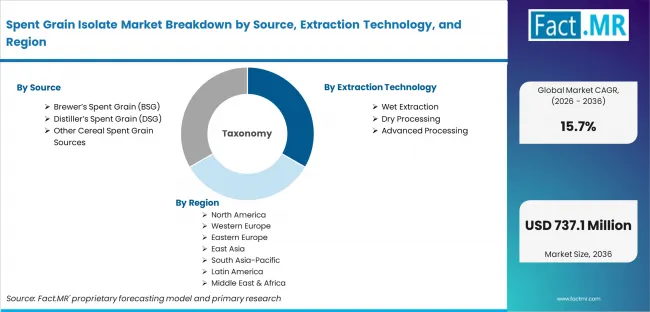
The Spent Grain Isolate Market is segmented by Source, Extraction Technology, Protein Purity Level, Functional Property, Application, End User and Region. Forecast for 2026 to 2036.
Fact.MR is of the opinion that the Spent Grain Isolate Market is transitioning from a brewery by-product valorization model toward a high-value sustainable protein ingredient ecosystem, where commercialization success will be determined by scalable extraction technologies, high-purity protein development, and adoption across food, nutraceutical, and functional ingredient applications.
Spent Grain Isolate Market Overview, Growth Outlook, and Forecast by Fact.MR
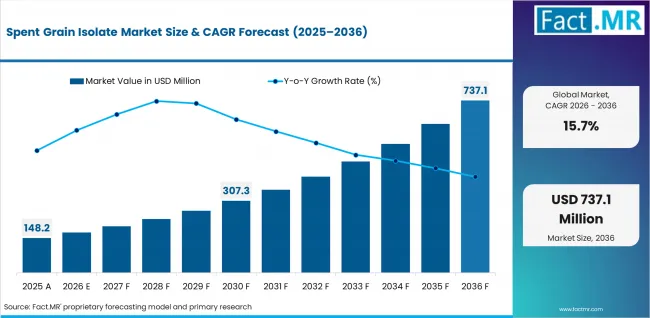
- Global Spent Grain Isolate Market revenue stood at USD 148.2 Mn in 2025 and is forecast to reach USD 737.1 Mn by 2036. At a 15.7% CAGR from 2026 to 2036.
- This market is set to expand to ~ 4.3x in value, adding USD 566 Mn in absolute opportunity
Summary of the Spent Grain Isolate Market
- Market Snapshot
- Global spent grain isolate market revenue stood at USD 148.2 Mn in 2025 and is forecast to reach USD 737.1 Mn by 2036.
- At a 15.7% CAGR from 2026 to 2036, this market is set to expand ~4.3x in value, adding USD 566 Mn in absolute opportunity.
- Growth is being driven by increasing adoption of upcycled protein ingredients across food, nutraceutical, feed, and industrial applications.
- Rising emphasis on sustainable protein sourcing, circular food systems, and valorization of brewery by-products is accelerating demand for spent grain isolates. Advances in extraction technologies, protein purification methods, and functional ingredient development are further supporting market expansion globally.
- Demand and Growth Drivers
- Increasing consumer demand for sustainable and alternative protein ingredients is driving growth in spent grain isolate applications.
- Growing focus on food waste reduction and circular economy practices is supporting commercialization of brewery and cereal by-product proteins.
- Expansion of functional food, nutraceutical, and plant-based formulation markets is accelerating adoption of spent grain isolates.
- Rising investments in advanced protein extraction and purification technologies are improving product quality and scalability.
- Need for solutions that provide:
- Sustainable and upcycled protein sources
- Enhanced nutritional and functional ingredient performance
- Improved emulsification, texture, and solubility functionality
- Reduced environmental footprint in ingredient sourcing
- Product and Segment View
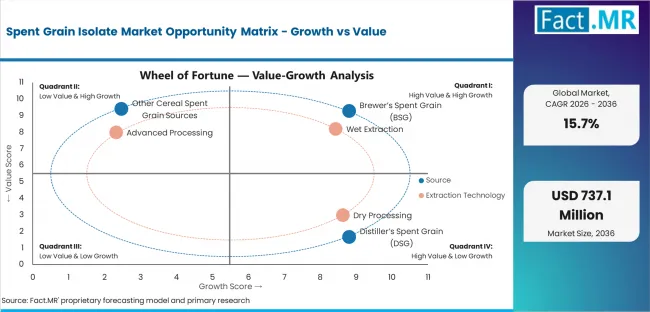
- Brewer’s spent grain (BSG) holds 68% of source share in 2025, emerging as the leading segment due to abundant raw material availability and established brewery supply chains.
- Distiller’s spent grain (DSG) accounts for 22% share, while other cereal spent grain sources represent 10%.
- Wet extraction technology holds 46% share by extraction technology, positioning it as the dominant segment driven by higher protein recovery efficiency and industrial scalability.
- Dry processing accounts for 31% share, while advanced processing methods contribute 23%.
- High purity isolates (above 80% protein) hold 48% share by protein purity level, supported by increasing demand for premium nutritional and formulation performance.
- Geography and Competitive Outlook
- Growth is supported across North America, Europe, and Asia Pacific driven by increasing demand for sustainable proteins and circular ingredient innovation.
- Key growth markets and CAGR include: U.S. 14.8%, Germany 15.1%, U.K. 15.4%, Japan 15.9%, China 16.6%, India 17.8%, and South Korea 18.4%.
- Market expansion is closely tied to:
- Rising deployment of upcycled and sustainable protein ingredients
- Expansion of functional foods, nutraceuticals, and alternative protein products
- Increasing investment in brewery by-product valorization and advanced ingredient technologies
- Key companies active in this market include EverGrain Ingredients, Kerry Group plc, Arla Foods Ingredients, ADM, and Cargill Incorporated.
- Analyst Opinion
- Shambhu Nath Jha, Principal Consultant at Fact.MR, says, “The Spent Grain Isolate Market is no longer defined solely by low-value by-product utilization and limited feed applications. Growth is increasingly driven by upcycled protein innovation, advanced extraction technologies, sustainable ingredient sourcing priorities, and the transition toward circular food production systems that enhance protein purity, functional performance, clean-label positioning, and scalability across food & beverage, nutraceutical, animal nutrition, personal care, and industrial ingredient applications.
Spent Grain Isolate Market— At a Glance
| Attribute | Details |
|---|---|
| Market Value 2025 | USD 148.2 Mn |
| Market Value 2036 | USD 737.1 Mn |
| Absolute Dollar Opportunity 2025–2036 | USD 566 Mn |
| Total Growth 2025–2036 | 397.4% |
| CAGR 2026–2036 | 15.7% |
| Growth Multiple | ~4.3x |
| Key Demand Theme | Increasing adoption of sustainable and upcycled protein ingredients |
| Leading Segment by Source (2026) | Brewer’s Spent Grain (BSG) |
| Segment Share (2026) | 68% |
| Leading Segment by Extraction Technology (2026) | Wet Extraction |
| Segment Share (2026) | 46% |
| Leading Segment by Protein Purity Level (2026) | High Purity Isolate (Above 80% Protein) |
| Segment Share (2026) | 48% |
| Leading Segment by Functional Property (2026) | Solubility Enhancement / Texture Functionality |
| Segment Share (2026) | 37% |
| Leading Segment by Application (2026) | Food & Beverage |
| Segment Share (2026) | 44% |
| Leading Segment by End User (2026) | Food Manufacturers |
| Segment Share (2026) | 42% |
| Key Growth Regions | North America, Europe, Asia Pacific |
| Country CAGRs | U.S. 14.8%, Germany 15.1%, U.K. 15.4%, Japan 15.9%, China 16.6%, India 17.8%, South Korea 18.4% |
| Top Companies | EverGrain Ingredients, Kerry Group, Arla Foods Ingredients, ADM, Cargill |
| Segmentation by Source | Brewer’s Spent Grain (BSG), Distiller’s Spent Grain (DSG), Other Cereal Spent Grain Sources |
| Segmentation by Extraction Technology | Wet Extraction, Dry Processing, Advanced Processing |
| Segmentation by Protein Purity Level | Low Purity Isolate (Below 60% Protein), Medium Purity Isolate (60–80% Protein), High Purity Isolate (Above 80% Protein) |
| Segmentation by Functional Property | Solubility Enhancement, Emulsification Functionality, Texture Functionality |
| Segmentation by Application | Food & Beverage, Nutraceuticals, Animal Nutrition, Personal Care & Cosmetics, Industrial Applications |
| Segmentation by End User | Food Manufacturers, Nutraceutical Manufacturers, Feed Manufacturers, Cosmetic Manufacturers |
| Segmentation by Region | North America, Latin America, Europe, Asia Pacific, Middle East & Africa |
This represents a circular protein ingredient transformation rather than a conventional plant protein market expansion, driven by increasing brewer’s and distiller’s spent grain valorization initiatives, rising demand for sustainable and upcycled food ingredients, accelerating consumer preference for alternative and clean-label proteins, and rapid advancements in protein extraction and purification technologies.Growth momentum is expected to remain strong due to expanding adoption across food & beverage, nutraceutical, and animal nutrition applications, increasing investments in sustainable ingredient innovation, and growing commercialization of high-purity protein isolates, although factors such as processing cost intensity, raw material variability, scalability limitations, and evolving regulatory compliance requirements may moderate market penetration across certain end-use sectors and regional markets.
Key Growth Drivers, Constraints, and Opportunities
Key Factors Driving Growth
- Increasing demand for spent grain isolates products is predicted to increase globally owing to the rising trend towards sustainable protein ingredients, upcycling of food systems, plant-based nutrition, and circular economy in food manufacturing.
- There is an increasing demand for protein isolates with high purity levels, advanced extraction techniques, and clean label ingredient systems that have better nutritional and functional performance capabilities.
- Increasing usage of spent grain isolate in different applications including food & beverage, nutraceuticals, animal nutrition, personal care, and industrial ingredients will drive the market.
| Growth Driver | Demand Impact | Time Horizon | Key Impact Area | Fact.MR Insight |
|---|---|---|---|---|
| Rising demand for sustainable and upcycled protein ingredients | High | Short-Mid Term | Circular food ingredients | Sustainability priorities are accelerating adoption of spent grain protein solutions |
| Increasing consumer preference for plant-based and clean-label nutrition | High | Short-Mid Term | Alternative protein demand | Consumers are shifting toward functional, sustainable protein ingredients |
| Expansion of food, nutraceutical, and functional ingredient applications | High | Mid-Long Term | End-use market expansion | Manufacturers are integrating spent grain isolates into diverse product portfolios |
| Advancements in protein extraction and purification technologies | Medium-High | Mid-Long Term | Product performance and scalability | Improved extraction efficiency is enhancing commercial viability and protein quality |
| Growing investment in upcycled food innovation and alternative protein platforms | Medium | Short-Mid Term | Commercialization and scale-up | Strategic investments and partnerships are accelerating industrial adoption |
Key Market Constraints
- Increasing costs associated with the installation of advanced extraction techniques, purification, and specialty processing facilities could hinder growth in the market.
- Adoption might be hampered by factors including variable feedstock, protein functionality optimization challenges, scalability issues, and difficulties in integrating into the supply chain.
- Food ingredient labeling, regulatory approval and awareness in emerging regions regarding upcycled protein ingredients can pose a challenge to market growth.
Key Opportunity Areas
- Increasing demand from different application areas such as food & beverage, nutraceuticals, animal nutrition, personal care, and industrial will provide manufacturers of spent grain isolates a good opportunity.
- Adoption of spent grain isolates in plant-based foods, functional beverages, sports nutrition, and premium pet food will create new market opportunities.
Investment in advanced extraction technologies, innovations within circular bioeconomy, scalability in protein recovery, and sustainability in ingredient production will provide long term market value.
Segment-wise Analysis of the Spent Grain Isolate Market
- By 2026, Food & Beverage accounts for a 44% market share of the application segment due to rising demand for sustainable protein ingredients, increasing incorporation of upcycled proteins into plant-based foods and functional beverages, growing clean-label formulation trends, and expanding commercialization of spent grain isolates across bakery, dairy alternative, and nutrition product categories.
- High Purity Isolate (Above 80% Protein) represents a 48% market share of the protein purity level segment by 2026, driven by increasing demand for high-functionality protein ingredients, superior nutritional density, broader applicability across food and nutraceutical formulations, and growing investments in advanced extraction and purification technologies globally.
The segmentation of the Spent Grain Isolate Market includes source, extraction technology, protein purity level, functional property, application, end user, and region.
Which Source Dominates the Spent Grain Isolate Market?
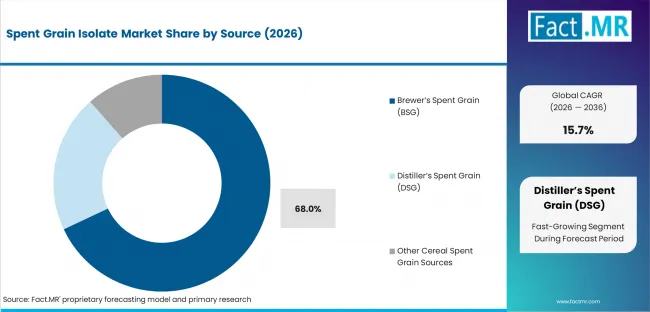
Brewers' Spent Grain (BSG) holds a 68% share in the brewer's protein isolates market, attributed to the wide availability of BSG from brewing processes across the globe, higher protein yield from BSG, well-established supply chains, and increasing usage of BSG in sustainable ingredients manufacture. Market growth will be supported by increasing valorization efforts for brewery waste, increasing demand for recycled proteins, and adoption in food and nutraceutical products.
Which Extraction Technology Dominates the Spent Grain Isolate Market?
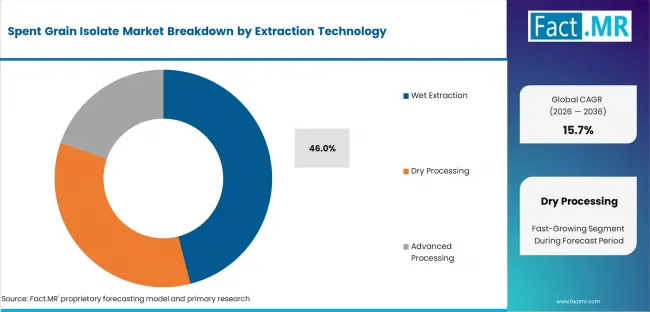
Wet Extraction segment shares a market size of 46%, owing to the excellent protein recovery, higher purity attainable through the process, and wide adoption in the process industry equipment used for ingredient processing. The segment is expected to grow at a steady rate owing to the increasing demand for functional proteins, rising industrial capacity for protein isolation and separation, and increased efficiency through technology.
Which Protein Purity Level Dominates the Spent Grain Isolate Market?
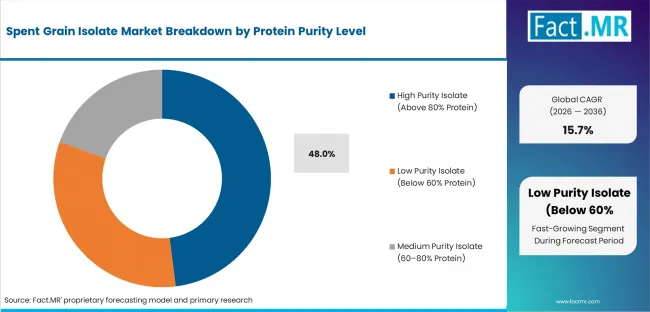
High Purity Isolate (Above 80% Protein) holds 48% of the market share, attributable to high demand for high-end protein nutrition ingredients, enhanced performance of the isolated proteins in food products, and their suitability in nutraceutical and performance nutrition products. Expansion is supported by rising demand for high-purity proteins and their application in premium protein foods, technological advances in the purification of proteins, and growing investments in ingredient manufacturing plants.
Which Functional Property Dominates the Spent Grain Isolate Market?
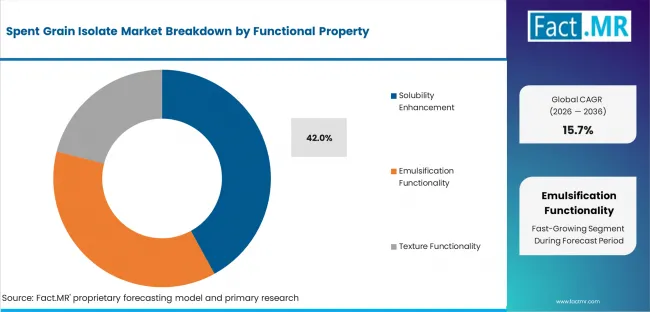
The Solubility Enhancement and Texture Functionality segments share a market size of 37%. Their dominant position in the market is because they play a vital role in formulation performance. Market growth will continue to be robust, due to an increasing use of brewers' spent grain in plant-based foods and beverages, functional beverages, and texture-sensitive food formulations.
Which Application Dominates the Spent Grain Isolate Market?
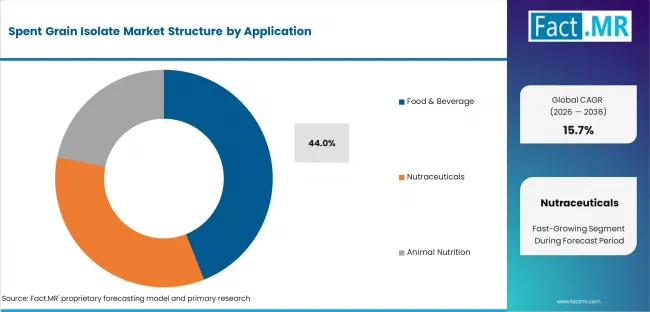
Food & Beverage Applications hold a leading share of 44%, attributed to an increasing trend of including sustainable proteins in baked foods, dairy alternatives, beverages, and plant-based products. Growth will continue to be strong, as a result of rising adoption of alternative proteins, preference for clean-label products, and growing incorporation of sustainable ingredients in food formulation.
Regional Outlook Across Key Markets
The market analysis covers key global regions, including South Asia and Pacific, Middle East & Africa, North America, Latin America, Western Europe, and Eastern Europe. It is segmented geographically, with specific market dynamics for each region. The full report provides a detailed market attractiveness analysis.
.webp)
CAGR Table
| Country | CAGR (%) |
|---|---|
| U.S. | 14.8% |
| Germany | 15.1% |
| U.K. | 15.4% |
| Japan | 15.9% |
| China | 16.6% |
| India | 17.8% |
| South Korea | 18.4% |
Source: Fact.MR (FMR) analysis, based on proprietary forecasting model and primary research.
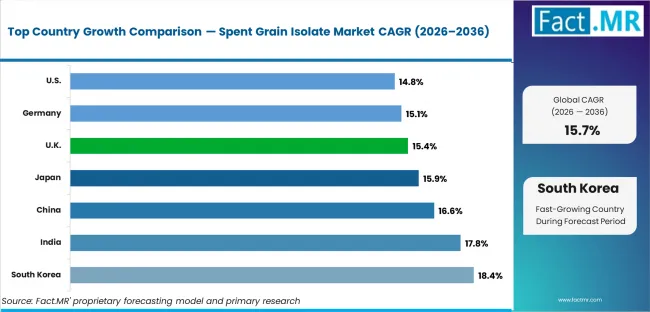
North America: The Upcycled Ingredient Commercialization Hub
North America represents the commercialization hub of the Spent Grain Isolate Market, supported by advanced brewing infrastructure, strong investment in upcycled food ingredients, and rising demand for sustainable plant-based proteins. The region benefits from active participation by companies such as EverGrain Ingredients, AB InBev, and Cargill, which are strengthening brewer’s spent grain valorization capabilities and ingredient innovation. Growing consumer preference for clean-label proteins, circular food systems, and functional nutrition products continues to accelerate adoption across food, beverage, and nutrition applications.
- U.S.: Demand for spent grain isolate in the U.S. is projected to rise at 14.8% CAGR through 2036. Growth in the U.S. is being driven by strong commercialization of upcycled protein technologies, sustainability targets in food manufacturing, and increasing industry collaboration around circular ingredient systems.
Western Europe: The Circular Food Innovation and Regulatory Leadership Center
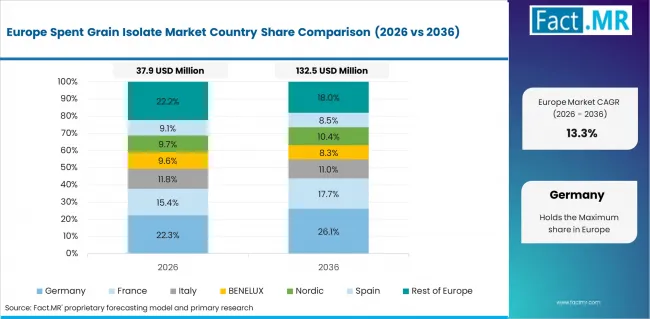
Western Europe serves as the circular food innovation center of the Spent Grain Isolate Market, driven by stringent sustainability goals, mature brewing industries, and strong regulatory emphasis on food waste reduction. Major companies including EverGrain Ingredients, Boortmalt, and Kerry Group are advancing sustainable ingredient development and alternative protein applications across the region. Growing emphasis on resource efficiency, clean-label formulations, and industrial symbiosis supports increasing integration of spent grain isolates into food manufacturing value chains.
- Germany: Demand for spent grain isolate in Germany is projected to rise at 15.1% CAGR through 2036. Germany’s growth is supported by its large brewing base, circular bioeconomy initiatives, and increasing investment in sustainable food processing.
East Asia: The High-Growth Functional Ingredient Manufacturing Base
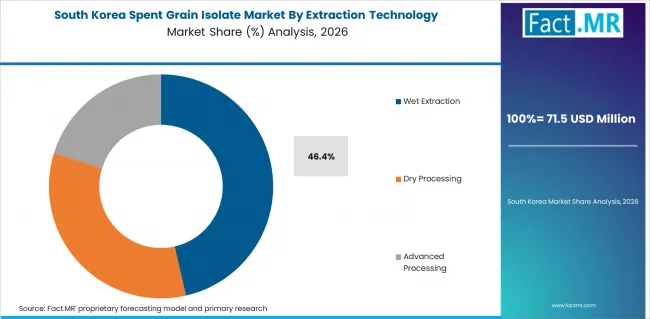
East Asia functions as the high-growth manufacturing and functional ingredient base of the Spent Grain Isolate Market, supported by strong brewing industries, advanced food processing capabilities, and rising demand for health-oriented protein ingredients. Companies such as Kirin Holdings, Asahi Group, and CJ CheilJedang are strengthening innovation in sustainable food systems and ingredient diversification. Regional demand is reinforced by growing focus on circular economy practices and functional nutrition products.
- China: Demand for spent grain isolate in China is projected to rise at 16.6% CAGR through 2036. China’s market expansion is supported by industrial food processing growth, protein diversification strategies, and circular manufacturing policies.
- South Korea: Demand for spent grain isolate in South Korea is projected to rise at 18.4% CAGR through 2036. South Korea demonstrates the fastest growth profile due to strong food innovation ecosystems, functional nutrition demand, and sustainability-focused manufacturing strategies.
South Asia & Pacific: The Emerging Sustainable Protein Growth Corridor
South Asia & Pacific represents the emerging growth corridor of the Spent Grain Isolate Market, supported by rising nutrition awareness, growing brewing output, and increasing investment in sustainable food ingredients. Companies including Tata Consumer Products, AB InBev India, and regional ingredient innovators are exploring opportunities in alternative proteins and circular food manufacturing. Expanding demand for functional foods and affordable sustainable ingredients continues to support market penetration.
- India: Demand for spent grain isolate in India is projected to rise at 17.8% CAGR through 2036. Growth in India is fueled by expanding food processing investments, rising plant-protein demand, and increasing policy emphasis on food sustainability.
Fact.MR’s analysis of the Spent Grain Isolate Market provides a region-wise and country-level assessment covering North America, Western Europe, East Asia, and South Asia & Pacific, including the U.S., Germany, U.K., Japan, China, India, and South Korea. Readers can access detailed insights on growth outlook, regulatory influences, sustainability initiatives, brewing ecosystem developments, and commercialization trends shaping regional market expansion.
Competitive Benchmarking and Company Positioning
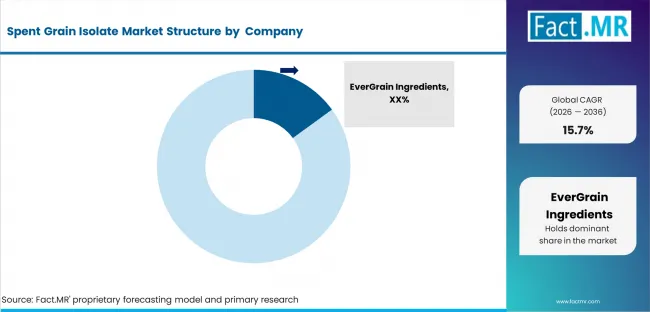
Leading Companies Shaping the Spent Grain Isolate Market
There exists moderate fragmentation within the Spent Grain Isolate market, featuring competition among specialists in upcycled ingredients, food ingredients producers operating internationally, and producers of processing technologies. The key advantage for EverGrain Ingredients, Duynie, and Upgrain AG lies in their feedstock availability and expertise in producing circular ingredients, whereas companies like Cargill, Kerry Group, Tetra Pak, and Alfa Laval enjoy advantages in terms of their scale of operations, processing abilities, and distribution networks. Food and nutraceutical producers that act as buyers diversify sources of supplies, minimizing suppliers’ influence over prices.
Key Players of the Spent Grain Isolate Market
- EverGrain Ingredients
- Duynie
- Upgrain AG
- Brewer’s Foods
- NETZRO, SBC.
- Tetra Pak
- Alfa Laval
- Cargill, Incorporated
- Terra Bioindustries
- Upcycled Foods Inc.
- Kerry Group plc
Recent Industry Developments
- EverGrain expands commercialization of upcycled barley protein ingredients (2025): EverGrain, backed by AB InBev, continued scaling its spent-grain-derived ingredient platform for food and beverage applications, highlighting broader adoption of EverPro® barley protein isolate and EverVita® fiber/protein solutions for sustainable nutrition formulations and clean-label product development. The expansion reinforces the company’s competitive position in brewer’s spent grain valorization and protein innovation. [1]
- Cargill showcases advanced ingredient solutions supporting sustainable food innovation at AAHAR 2025 (March 2025): Cargill introduced new ingredient systems and application-focused food solutions at AAHAR 2025, strengthening its positioning in functional, sustainable, and next-generation food ingredients. The initiative aligns with rising industry demand for circular, plant-based, and value-added protein ingredients relevant to the spent grain isolate ecosystem. [Cargill News Release] [2]
- Post Consumer Brands strengthens ingredient sustainability and food system initiatives (May 2025): Post Consumer Brands expanded its “Ingredients for Good” program across North America, reinforcing corporate emphasis on ingredient sustainability, food system resilience, and responsible sourcing themes increasingly associated with upcycled and alternative ingredient markets, including spent-grain-based nutrition solutions. [Post Consumer Brands News Release] [3]
- Kalsec strengthens beverage ingredient portfolio through advanced hop solutions distribution expansion (July 2025-active market expansion): Kalsec continued expanding market access for its advanced hop ingredients portfolio, including hop acids, aroma extracts, hop oils, and flavoring systems used in brewing and beverage formulation. The initiative supports innovation in beer, non-alcoholic beverages, and brewery-linked ingredient applications, reinforcing Kalsec’s role in natural hop-derived technologies relevant to spent grain and brewing ingredient ecosystems. [Food Industry Executive] [4]
- Lehmann Ingredients advances commercialization of upcycled barley malt rice protein from brewer’s spent grain (July 2025): Lehmann Ingredients highlighted the growing market deployment of barley malt rice protein derived from brewers’ spent grain, emphasizing circular-economy processing, improved functionality, and sustainable protein sourcing for food and beverage manufacturers seeking alternative plant proteins. [Lehmann Ingredients] [5]
Sources and Research References
- [1] Alfa Laval, Here for the Beer: Upcycling Sustainable Protein from Brewer’s Spent Grain, 2025.
- [2] Cargill, Cargill Showcases Food Innovation at AAHAR 2025, March 2025.
- [3] Post Consumer Brands, 2025 Ingredients for Good Initiative, May 2025.
- [4] Food Industry Executive, Univar Solutions Adds Kalsec® Inc. Advanced Hop Ingredients to its Portfolio Through New Distribution Agreement, July 2025-active reference used.
- [5] Lehmann Ingredients, Upcycling Brewers Spent Grain into Innovative, Nutritional and Functional Barley Malt Rice Protein, July 2025.
Spent Grain Isolate Market Definition
The spent grain isolate industry comprises activities in manufacturing and selling protein content ingredients isolated from spent grains that are derived as waste from beer breweries and distilleries. The concentrates have various functional properties like solubility, improved texture, and emulsification and are used for the formulation of ingredients with increased protein content. Industrial uses involve application of the isolates as sustainable protein contents for ingredient formulations.
Spent Grain Isolate Market Inclusions
This report presents the size analysis of global and regional markets, along with the projections made from 2026 to 2036 in terms of revenue for spent grain isolates market. It segments the market by source, extraction technology, protein purity, functional property, application, and end user. Additionally, an assessment of pricing trend, innovations in technologies, changes in supply chains, sustainability initiatives, competitive landscape, and regional adoption rates of protein ingredient markets will be provided.
Spent Grain Isolate Market Exclusions
The scope of this report excludes unprocessed spent grain used directly in the production of livestock feed, fertilizer, or as energy for biomass fuel and which do not involve any isolation of proteins. The scope does not cover the consumption of products where spent grain isolates are used for formulation of final products intended for the consumer market such as protein bars, beverages, dietary supplements, and cosmetics among others.
Spent Grain Isolate MarketResearch Methodology
- Primary Research
- Primary research involved conversations with players at various stages of the processing of brewer’s yeast by-products, producers of proteins as ingredients, food formulators, nutraceutical players, feed companies, companies providing extraction technologies, and corporate executives working with alternative proteins.
- Desk Research
- Desk research was based on company annual reports, presentations for investors, sustainability reports, industry-related journals, trade association communications, food ingredient databases, government statistics on trade in proteins, patent applications, and scientific papers on protein extraction, upcycling, and functional foods.
- Market-Sizing and Forecasting
- Fact.MR employs a mixed approach to market sizing that involves evaluating the global protein ingredient markets via a top-down approach, while assessing the production capacity for extracting spent grains, technology usage, and demand for applications through a bottom-up process. The forecasting process factors in price changes, improvements in extraction techniques, regulatory environment, and regional protein consumption levels.
- Data Validation and Update Cycle
- Triangulation involving primary interviews, supply-side capacity assessment, demand-side consumption modeling, and comparison with past market performance is utilized in order to verify market projections. Projections made are periodically verified and adjusted to reflect developments in technologies, new product introductions, changes in regulations, and sustainability trends.
Scope of Analysis

| Parameter | Details |
|---|---|
| Quantitative Units | USD 148.2 million in 2025 to USD 737.1 million in 2036, at a CAGR of 15.7% |
| Market Definition | The Spent Grain Isolate Market comprises protein ingredients derived from brewer’s, distiller’s, and cereal spent grains through extraction technologies, used across food, nutraceutical, animal nutrition, cosmetic, and industrial applications. |
| Regions Covered | North America, Latin America, Europe, East Asia, South Asia and Pacific, MiddleEastand Africa |
| Countries Covered | USA, Canada, UK, Germany, China, India, 30 plus countries |
| Key Companies | EverGrain Ingredients, Duynie, Upgrain AG, Brewer’s Foods, NETZRO, SBC., Tetra Pak, Alfa Laval, Cargill, Incorporated, Terra Bioindustries, Upcycled Foods Inc., Kerry Group plc |
| Forecast Period | 2026 to 2036 |
| Approach | Hybrid demand-side and top-downmethodologybuilt on country-level application demand, product benchmarking, pricing analysis, shipment validation, and primary interviews across manufacturers, distributors, retailers, and end users |
Analysis by Source, by Extraction Technology, by Protein Purity Level, by Functional Property, by Application, by End User and by Region
-
Spent Grain Isolate Market by Source
- Brewer’s Spent Grain (BSG)
- Barley-Based BSG
- Wheat-Based BSG
- Mixed Grain BSG
- Distiller’s Spent Grain (DSG)
- Corn-Based DSG
- Rye-Based DSG
- Sorghum-Based DSG
- Other Cereal Spent Grain Sources
- Oat Spent Grain
- Rice Spent Grain
- Millet Spent Grain
- Brewer’s Spent Grain (BSG)
-
Spent Grain Isolate Market by Extraction Technology
-
- Wet Extraction
- Alkaline Extraction
- Enzymatic Extraction
- Solvent-Assisted Extraction
- Dry Processing
- Air Classification
- Mechanical Separation
- Dry Fractionation
- Advanced Processing
- Membrane Filtration
- Ultrafiltration
- Fermentation-Assisted Isolation
- Wet Extraction
-
Spent Grain Isolate Market by Protein Purity Level
- Low Purity Isolate (Below 60% Protein)
- Medium Purity Isolate (60–80% Protein)
- High Purity Isolate (Above 80% Protein)
-
Spent Grain Isolate Market by End User
- Solubility Enhancement
- High Water Solubility
- Neutral pH Solubility
- Emulsification Functionality
- Oil Binding Capacity
- Emulsion Stability
- Texture Functionality
- Gelation
- Foaming Capacity
- Water Holding Capacity
- Solubility Enhancement
-
Spent Grain Isolate Market by Application
- Food & Beverage
- Bakery Products
- Dairy Alternatives
- Meat Alternatives
- Ready-to-Drink Beverages
- Sports & Performance Nutrition
- Nutraceuticals
- Dietary Supplements
- Protein Powders
- Clinical Nutrition
- Animal Nutrition
- Livestock Feed
- Aquafeed
- Pet Food
- Personal Care & Cosmetics
- Skin Care
- Hair Care
- Functional Cosmetic Formulations
- Industrial Applications
- Biopolymer Ingredients
- Fermentation Media
- Food & Beverage
-
Spent Grain Isolate Market by End User
- Food Manufacturers
- Plant-Based Food Producers
- Bakery Manufacturers
- Beverage Companies
- Nutraceutical Manufacturers
- Supplement Brands
- Sports Nutrition Producers
- Feed Manufacturers
- Animal Feed Companies
- Aquaculture Feed Producers
- Cosmetic Manufacturers
- Personal Care Brands
- Specialty Ingredient Blenders
- Food Manufacturers
-
Spent Grain Isolate Market by Region
- North America
- USA
- Canada
- Mexico
- Latin America
- Brazil
- Chile
- Rest of LATAM
- East Asia
- China
- Japan
- South Korea
- Western Europe
- Germany
- Italy
- France
- U.K.
- Spain
- BENELUX
- Nordic
- Rest of W. Europe
- Eastern Europe
- Russia
- Hungary
- Poland
- Balkan & Baltics
- Rest of E. Europe
- South Asia & Pacific
- India
- ASEAN
- ANZ
- Rest of SAP
- Middle East and Africa
- Kingdom of Saudi Arabia
- United Arab Emirates
- South Africa
- Rest of Middle East and Africa
- North America
- Frequently Asked Questions -
How large is the demand for Spent Grain Isolate in the global market in 2026?
Demand for Spent Grain Isolate in the global market is estimated to be valued at USD 171.5 million in 2026.
What will be the market size of Spent Grain Isolate in the global market by 2036?
The market size for Spent Grain Isolate is projected to reach USD 737.1 million by 2036.
What is the expected demand growth for Spent Grain Isolate in the global market between 2026 and 2036?
Demand for Spent Grain Isolate in the global market is expected to grow at a CAGR of 15.7% between 2026 and 2036, driven by rising demand for sustainable protein ingredients and upcycled food solutions.
Which source segment is expected to dominate the market?
Brewer’s Spent Grain (BSG) is expected to dominate the market, accounting for 68% of the market share in 2026, supported by abundant raw material availability and increasing valorization of brewing by-products.
Which region is expected to show the highest growth rate for Spent Grain Isolate?
South Korea is projected to show the highest regional CAGR at 18.4%, supported by growing demand for functional foods, sustainable ingredients, and alternative protein products.
How significant is the growth outlook for India in this market?
India is expected to grow at a CAGR of 17.8%, reflecting rising adoption of plant-based nutrition, food innovation, and circular economy ingredients.
What is the growth outlook for China in this report?
China is anticipated to grow at a CAGR of 16.6%, supported by increasing demand for protein fortification, clean-label foods, and sustainable food manufacturing practices.
What is the growth outlook for Japan in this market?
Japan is expected to grow at a CAGR of 15.9%, driven by interest in functional nutrition, premium food ingredients, and sustainable product development.
What is the growth outlook for the United Kingdom in the Spent Grain Isolate market?
The United Kingdom is expected to grow at a CAGR of 15.4%, influenced by growing consumer demand for upcycled ingredients, alternative proteins, and environmentally conscious food products.
Which company is identified as a leading player in the Spent Grain Isolate market?
EverGrain Ingredients is recognized as a leading player in this market, producing sustainable protein and fiber ingredients derived from brewer’s spent grain.
Table of Content
- Spent Grain Isolate Market – Executive Summary
- Market Overview
- Market Definition & Introduction
- Market Taxonomy & Research Scope
- Global Spent Grain Isolate Market Demand Analysis 2021-2025 and Forecast, 2026–2036
- Historical Market Volume (MT) Analysis, 2021-2025
- Current and Future Market Volume (MT) Projections, 2026–2036
- Y-o-Y Growth Trend Analysis
- Global Spent Grain Isolate Market - Pricing Analysis
- Product Category and Country-Level Pricing Analysis
- Region Average Pricing Analysis Benchmark
- Price Trends and Forecasts
- Historical price trends
- Future price forecasts
- Factors Influencing Pricing
- Competitive Pricing Strategies
- Cost Structure Analysis: Elementary Deep Dive
- Protein Isolate Average Selling Price (USD/kg)
- Market Background and Foundational Data Points
- Global Brewer’s Spent Grain Production Volume
- Distiller’s Spent Grain Availability
- Protein Extraction Yield Rate
- Alternative Protein Ingredient Demand
- Upcycled Food Ingredient Market Growth
- Plant-Based Food Consumption Trends
- Brewing Industry Production Output
- Processing Technology Advancement
- Commercial Production Capacity Expansion
- End-Use Industry Penetration Rate
- Regulatory & Sustainability Compliance Trends
- Trade Scenario, 2025
- Imports and Export Analysis
- By Region
- By Country
- Imports and Export Analysis
- Start-up Ecosystem Analysis, 2021-2025
- Spent Grain Isolate Market Opportunity Assessment
- Total Available Market (US$ Mn)
- Serviceable Addressable Market (US$ Mn)
- Serviceable Obtainable Market (US$ Mn)
- Porter’s Five Forces and PESTEL Analysis
- Investment Feasibility Analysis
- Macro-Economic Factors & Forecast Factors - Relevance & Impact
- Industry Value and Supply Chain Analysis
- List of Key Channel Partners
- Profit Margin & Operating Margin at Each Node of Supply Chain.
- Notes on Value Added at Each Node in the Value Chain
- Factors Influencing Value Chain
- Market Dynamics
- Drivers
- Restraints
- Opportunity
- Trend Analysis
- Key Regulations & Certifications
- Spent Grain Isolate Market Analysis 2021-2025 and Forecast 2026–2036, By Source
- Introduction / Key Findings
- Historical Market Size (US$ Mn) & Volume (MT) Trend Analysis By Source, 2021-2025
- Current and Future Market Size (US$ Mn) & Volume (MT) Analysis and Forecast By Source, 2026-2036
- Brewer’s Spent Grain (BSG)
- Barley-Based BSG
- Wheat-Based BSG
- Mixed Grain BSG
- Distiller’s Spent Grain (DSG)
- Corn-Based DSG
- Rye-Based DSG
- Sorghum-Based DSG
- Other Cereal Spent Grain Sources
- Oat Spent Grain
- Rice Spent Grain
- Millet Spent Grain
- Brewer’s Spent Grain (BSG)
- Market Attractiveness Analysis By Source
- Spent Grain Isolate Market Analysis 2021-2025 and Forecast 2026–2036, By Extraction Technology
- Introduction / Key Findings
- Historical Market Size (US$ Mn) & Volume (MT) Trend Analysis By Extraction Technology, 2021-2025
- Current and Future Market Size (US$ Mn) & Volume (MT) Analysis and Forecast By Extraction Technology, 2026-2036
- Wet Extraction
- Alkaline Extraction
- Enzymatic Extraction
- Solvent-Assisted Extraction
- Dry Processing
- Air Classification
- Mechanical Separation
- Dry Fractionation
- Advanced Processing
- Membrane Filtration
- Ultrafiltration
- Fermentation-Assisted Isolation
- Wet Extraction
- Market Attractiveness Analysis By Extraction Technology
- Spent Grain Isolate Market Analysis 2021-2025 and Forecast 2026–2036, By Protein Purity Level
- Introduction / Key Findings
- Historical Market Size (US$ Mn) & Volume (MT) Trend Analysis By Protein Purity Level, 2021-2025
- Current and Future Market Size (US$ Mn) & Volume (MT) Analysis and Forecast By Protein Purity Level, 2026-2036
- Low Purity Isolate (Below 60% Protein)
- Medium Purity Isolate (60–80% Protein)
- High Purity Isolate (Above 80% Protein)
- Market Attractiveness Analysis By Protein Purity Level
- Spent Grain Isolate Market Analysis 2021-2025 and Forecast 2026–2036, By Functional Property
- Introduction / Key Findings
- Historical Market Size (US$ Mn) & Volume (MT) Trend Analysis By Functional Property, 2021-2025
- Current and Future Market Size (US$ Mn) & Volume (MT) Analysis and Forecast By Functional Property, 2026-2036
- Solubility Enhancement
- High Water Solubility
- Neutral pH Solubility
- Emulsification Functionality
- Oil Binding Capacity
- Emulsion Stability
- Texture Functionality
- Gelation
- Foaming Capacity
- Water Holding Capacity
- Solubility Enhancement
- Market Attractiveness Analysis By Functional Property
- Spent Grain Isolate Market Analysis 2021-2025 and Forecast 2026–2036, By Application
- Introduction / Key Findings
- Historical Market Size (US$ Mn) & Volume (MT) Trend Analysis By Application, 2021-2025
- Current and Future Market Size (US$ Mn) & Volume (MT) Analysis and Forecast By Application, 2026-2036
- Food & Beverage
- Bakery Products
- Dairy Alternatives
- Meat Alternatives
- Ready-to-Drink Beverages
- Sports & Performance Nutrition
- Nutraceuticals
- Dietary Supplements
- Protein Powders
- Clinical Nutrition
- Animal Nutrition
- Livestock Feed
- Aquafeed
- Pet Food
- Personal Care & Cosmetics
- Skin Care
- Hair Care
- Functional Cosmetic Formulations
- Industrial Applications
- Biopolymer Ingredients
- Fermentation Media
- Food & Beverage
- Market Attractiveness Analysis By Application
- Spent Grain Isolate Market Analysis 2021-2025 and Forecast 2026–2036, By End User
- Introduction / Key Findings
- Historical Market Size (US$ Mn) & Volume (MT) Trend Analysis by End User, 2021-2025
- Current and Future Market Size (US$ Mn) & Volume (MT) Analysis and Forecast by End User, 2026-2036
- Food Manufacturers
- Plant-Based Food Producers
- Bakery Manufacturers
- Beverage Companies
- Nutraceutical Manufacturers
- Supplement Brands
- Sports Nutrition Producers
- Feed Manufacturers
- Animal Feed Companies
- Aquaculture Feed Producers
- Cosmetic Manufacturers
- Personal Care Brands
- Specialty Ingredient Blenders
- Food Manufacturers
- Market Attractiveness Analysis by End User
- Global Spent Grain Isolate Market Analysis and Forecast, by Region
- Introduction / Key Findings
- Historical Market Size (US$ Mn) & Volume (MT) Trend Analysis by Region, 2021-2025
- Current and Future Market Size (US$ Mn) & Volume (MT) Analysis and Forecast by Region, 2026-2036
- North America
- Latin America
- Western Europe
- Eastern Europe
- East Asia
- South Asia & Pacific
- Middle East & Africa
- Market Attractiveness Analysis by Region
- North America Spent Grain Isolate Market Analysis and Forecast
- Introduction / Key Findings
- Pricing Analysis
- Historical Market Size (US$ Mn) & Volume (MT) Trend Analysis by Market Taxonomy, 2021-2025
- Current and Future Market Size (US$ Mn) and Volume (MT) Analysis & Forecast by Market Taxonomy, 2026-2036
- By Country
- United States
- Canada
- Mexico
- By Taxonomy
- Market Attractiveness Analysis By Country & Taxonomy
- Market Trends
- Key Market Participants – Intensity Mapping
- Drivers and Restraints - Impact Analysis
- Latin America Spent Grain Isolate Market Analysis and Forecast
- Introduction / Key Findings
- Pricing Analysis
- Historical Market Size (US$ Mn) & Volume (MT) Trend Analysis by Market Taxonomy, 2021-2025
- Current and Future Market Size (US$ Mn) and Volume (MT) Analysis & Forecast by Market Taxonomy, 2026-2036
- By Country
- Brazil
- Chile
- Rest of LATAM
- By Taxonomy
- Market Attractiveness Analysis By Country & Taxonomy
- Market Trends
- Key Market Participants – Intensity Mapping
- Drivers and Restraints - Impact Analysis
- Western Europe Spent Grain Isolate Market Analysis and Forecast
- Introduction / Key Findings
- Pricing Analysis
- Historical Market Size (US$ Mn) & Volume (MT) Trend Analysis by Market Taxonomy, 2021-2025
- Current and Future Market Size (US$ Mn) and Volume (MT) Analysis & Forecast by Market Taxonomy, 2026-2036
- By Country
- Germany
- Italy
- France
- United Kingdom
- Spain
- BENELUX
- Nordics
- Rest of Western Europe
- By Taxonomy
- Market Attractiveness Analysis By Country & Taxonomy
- Market Trends
- Key Market Participants – Intensity Mapping
- Drivers and Restraints - Impact Analysis
- Eastern Europe Spent Grain Isolate Market Analysis and Forecast
- Introduction / Key Findings
- Pricing Analysis
- Historical Market Size (US$ Mn) & Volume (MT) Trend Analysis by Market Taxonomy, 2021-2025
- Current and Future Market Size (US$ Mn) and Volume (MT) Analysis & Forecast by Market Taxonomy, 2026-2036
- By Country
- Russia
- Hungary
- Poland
- Balkan & Baltics
- Rest of Eastern Europe
- By Taxonomy
- Market Attractiveness Analysis By Country & Taxonomy
- Market Trends
- Key Market Participants – Intensity Mapping
- Drivers and Restraints - Impact Analysis
- East Asia Spent Grain Isolate Market Analysis and Forecast
- Introduction / Key Findings
- Pricing Analysis
- Historical Market Size (US$ Mn) & Volume (MT) Trend Analysis by Market Taxonomy, 2021-2025
- Current and Future Market Size (US$ Mn) and Volume (MT) Analysis & Forecast by Market Taxonomy, 2026-2036
- By Country
- China
- Japan
- South Korea
- By Taxonomy
- Market Attractiveness Analysis By Country & Taxonomy
- Market Trends
- Key Market Participants – Intensity Mapping
- Drivers and Restraints - Impact Analysis
- South Asia & Pacific Spent Grain Isolate Market Analysis and Forecast
- Introduction / Key Findings
- Pricing Analysis
- Historical Market Size (US$ Mn) & Volume (MT) Trend Analysis by Market Taxonomy, 2021-2025
- Current and Future Market Size (US$ Mn) and Volume (MT) Analysis & Forecast by Market Taxonomy, 2026-2036
- By Country
- India
- ASEAN
- Australia & New Zealand
- Rest of South Asia & Pacific
- By Taxonomy
- Market Attractiveness Analysis By Country & Taxonomy
- Market Trends
- Key Market Participants – Intensity Mapping
- Drivers and Restraints - Impact Analysis
- Middle East & Africa Spent Grain Isolate Market Analysis and Forecast
- Introduction / Key Findings
- Pricing Analysis
- Historical Market Size (US$ Mn) & Volume (MT) Trend Analysis by Market Taxonomy, 2021-2025
- Current and Future Market Size (US$ Mn) and Volume (MT) Analysis & Forecast by Market Taxonomy, 2026-2036
- By Country
- Kingdom of Saudi Arabia
- Other GCC Countries
- Turkiye
- South Africa
- Other African Union
- By Taxonomy
- Market Attractiveness Analysis By Country & Taxonomy
- Market Trends
- Key Market Participants – Intensity Mapping
- Drivers and Restraints - Impact Analysis
- Country-level Spent Grain Isolate Market Analysis and Forecast
- Introduction
- Market Value Proportion Analysis, By Key Countries
- Global Vs. Country Growth Comparison
- United States Spent Grain Isolate Market Analysis
- Market Size (US$ Mn) & Volume (MT) Analysis by Market Taxonomy, 2021–2036
- By Source
- By Extraction Technology
- By Protein Purity Level
- By Functional Property
- By Application
- By End User
- United States Spent Grain Isolate Market Analysis
-
-
- Canada Spent Grain Isolate Market Analysis
- Mexico Spent Grain Isolate Market Analysis
- Brazil Spent Grain Isolate Market Analysis
- Chile Spent Grain Isolate Market Analysis
- Germany Spent Grain Isolate Market Analysis
- France Spent Grain Isolate Market Analysis
- Italy Spent Grain Isolate Market Analysis
- Spain Spent Grain Isolate Market Analysis
- United Kingdom Spent Grain Isolate Market Analysis
- BENELUX Spent Grain Isolate Market Analysis
- Nordics Spent Grain Isolate Market Analysis
- Poland Spent Grain Isolate Market Analysis
- Russia Spent Grain Isolate Market Analysis
- Hungary Spent Grain Isolate Market Analysis
- Balkan & Baltics Spent Grain Isolate Market Analysis
- China Spent Grain Isolate Market Analysis
- Japan Spent Grain Isolate Market Analysis
- South Korea Spent Grain Isolate Market Analysis
- India Spent Grain Isolate Market Analysis
- ASEAN Spent Grain Isolate Market Analysis
- ANZ Spent Grain Isolate Market Analysis
- KSA Spent Grain Isolate Market Analysis
- Other GCC Countries Spent Grain Isolate Market Analysis
- South Africa Spent Grain Isolate Market Analysis
- Turkiye Spent Grain Isolate Market Analysis
-
- Spent Grain Isolate Market Structure Analysis
- Market Analysis by Tier of Companies
- Market Concentration
- Market Share Analysis of Top Players
- Market Space for New Brands and Dollar Opportunity
- Market Presence Analysis
- Regional Footprint of Players
- Product Footprint by Players
- Mobile Optical Pluggable Competition Analysis
- Competition Dashboard
- Pricing Analysis by Competition
- Competition Benchmarking
- Competition Deep Dive
- EverGrain Ingredients
- Overview
- Product Portfolio
- Sales Footprint
- Key Developments
- SWOT Analysis
- Strategy Overview
- Key Financials
- Duynie
- Upgrain AG
- Brewer’s Foods
- NETZRO, SBC.
- Tetra Pak
- Alfa Laval
- Cargill, Incorporated
- Terra Bioindustries
- Upcycled Foods Inc.
- Kerry Group plc
- Other Prominent Players
- EverGrain Ingredients
- Primary insights
- Assumptions & Acronyms Used
- Research Methodology & Data Sources
List Of Table
- Table 1: Global Market Value (USD Mn) Forecast by Region, 2021 to 2036
- Table 2: Global Market Volume (MT) Forecast by Region, 2021 to 2036
- Table 3: Global Market Value (USD Mn) Forecast by Source, 2021 to 2036
- Table 4: Global Market Volume (MT) Forecast by Source, 2021 to 2036
- Table 5: Global Market Value (USD Mn) Forecast by Extraction Technology, 2021 to 2036
- Table 6: Global Market Volume (MT) Forecast by Extraction Technology, 2021 to 2036
- Table 7: Global Market Value (USD Mn) Forecast by Protein Purity Level, 2021 to 2036
- Table 8: Global Market Volume (MT) Forecast by Protein Purity Level, 2021 to 2036
- Table 9: Global Market Value (USD Mn) Forecast by Functional Property, 2021 to 2036
- Table 10: Global Market Volume (MT) Forecast by Functional Property, 2021 to 2036
- Table 11: Global Market Value (USD Mn) Forecast by Application, 2021 to 2036
- Table 12: Global Market Volume (MT) Forecast by Application, 2021 to 2036
- Table 13: Global Market Value (USD Mn) Forecast by End User, 2021 to 2036
- Table 14: Global Market Volume (MT) Forecast by End User, 2021 to 2036
- Table 15: North America Market Value (USD Mn) Forecast by Country, 2021 to 2036
- Table 16: North America Market Volume (MT) Forecast by Country, 2021 to 2036
- Table 17: North America Market Value (USD Mn) Forecast by Source, 2021 to 2036
- Table 18: North America Market Volume (MT) Forecast by Source, 2021 to 2036
- Table 19: North America Market Value (USD Mn) Forecast by Extraction Technology, 2021 to 2036
- Table 20: North America Market Volume (MT) Forecast by Extraction Technology, 2021 to 2036
- Table 21: North America Market Value (USD Mn) Forecast by Protein Purity Level, 2021 to 2036
- Table 22: North America Market Volume (MT) Forecast by Protein Purity Level, 2021 to 2036
- Table 23: North America Market Value (USD Mn) Forecast by Functional Property, 2021 to 2036
- Table 24: North America Market Volume (MT) Forecast by Functional Property, 2021 to 2036
- Table 25: North America Market Value (USD Mn) Forecast by Application, 2021 to 2036
- Table 26: North America Market Volume (MT) Forecast by Application, 2021 to 2036
- Table 27: North America Market Value (USD Mn) Forecast by End User, 2021 to 2036
- Table 28: North America Market Volume (MT) Forecast by End User, 2021 to 2036
- Table 29: Latin America Market Value (USD Mn) Forecast by Country, 2021 to 2036
- Table 30: Latin America Market Volume (MT) Forecast by Country, 2021 to 2036
- Table 31: Latin America Market Value (USD Mn) Forecast by Source, 2021 to 2036
- Table 32: Latin America Market Volume (MT) Forecast by Source, 2021 to 2036
- Table 33: Latin America Market Value (USD Mn) Forecast by Extraction Technology, 2021 to 2036
- Table 34: Latin America Market Volume (MT) Forecast by Extraction Technology, 2021 to 2036
- Table 35: Latin America Market Value (USD Mn) Forecast by Protein Purity Level, 2021 to 2036
- Table 36: Latin America Market Volume (MT) Forecast by Protein Purity Level, 2021 to 2036
- Table 37: Latin America Market Value (USD Mn) Forecast by Functional Property, 2021 to 2036
- Table 38: Latin America Market Volume (MT) Forecast by Functional Property, 2021 to 2036
- Table 39: Latin America Market Value (USD Mn) Forecast by Application, 2021 to 2036
- Table 40: Latin America Market Volume (MT) Forecast by Application, 2021 to 2036
- Table 41: Latin America Market Value (USD Mn) Forecast by End User, 2021 to 2036
- Table 42: Latin America Market Volume (MT) Forecast by End User, 2021 to 2036
- Table 43: Western Europe Market Value (USD Mn) Forecast by Country, 2021 to 2036
- Table 44: Western Europe Market Volume (MT) Forecast by Country, 2021 to 2036
- Table 45: Western Europe Market Value (USD Mn) Forecast by Source, 2021 to 2036
- Table 46: Western Europe Market Volume (MT) Forecast by Source, 2021 to 2036
- Table 47: Western Europe Market Value (USD Mn) Forecast by Extraction Technology, 2021 to 2036
- Table 48: Western Europe Market Volume (MT) Forecast by Extraction Technology, 2021 to 2036
- Table 49: Western Europe Market Value (USD Mn) Forecast by Protein Purity Level, 2021 to 2036
- Table 50: Western Europe Market Volume (MT) Forecast by Protein Purity Level, 2021 to 2036
- Table 51: Western Europe Market Value (USD Mn) Forecast by Functional Property, 2021 to 2036
- Table 52: Western Europe Market Volume (MT) Forecast by Functional Property, 2021 to 2036
- Table 53: Western Europe Market Value (USD Mn) Forecast by Application, 2021 to 2036
- Table 54: Western Europe Market Volume (MT) Forecast by Application, 2021 to 2036
- Table 55: Western Europe Market Value (USD Mn) Forecast by End User, 2021 to 2036
- Table 56: Western Europe Market Volume (MT) Forecast by End User, 2021 to 2036
- Table 57: Eastern Europe Market Value (USD Mn) Forecast by Country, 2021 to 2036
- Table 58: Eastern Europe Market Volume (MT) Forecast by Country, 2021 to 2036
- Table 59: Eastern Europe Market Value (USD Mn) Forecast by Source, 2021 to 2036
- Table 60: Eastern Europe Market Volume (MT) Forecast by Source, 2021 to 2036
- Table 61: Eastern Europe Market Value (USD Mn) Forecast by Extraction Technology, 2021 to 2036
- Table 62: Eastern Europe Market Volume (MT) Forecast by Extraction Technology, 2021 to 2036
- Table 63: Eastern Europe Market Value (USD Mn) Forecast by Protein Purity Level, 2021 to 2036
- Table 64: Eastern Europe Market Volume (MT) Forecast by Protein Purity Level, 2021 to 2036
- Table 65: Eastern Europe Market Value (USD Mn) Forecast by Functional Property, 2021 to 2036
- Table 66: Eastern Europe Market Volume (MT) Forecast by Functional Property, 2021 to 2036
- Table 67: Eastern Europe Market Value (USD Mn) Forecast by Application, 2021 to 2036
- Table 68: Eastern Europe Market Volume (MT) Forecast by Application, 2021 to 2036
- Table 69: Eastern Europe Market Value (USD Mn) Forecast by End User, 2021 to 2036
- Table 70: Eastern Europe Market Volume (MT) Forecast by End User, 2021 to 2036
- Table 71: East Asia Market Value (USD Mn) Forecast by Country, 2021 to 2036
- Table 72: East Asia Market Volume (MT) Forecast by Country, 2021 to 2036
- Table 73: East Asia Market Value (USD Mn) Forecast by Source, 2021 to 2036
- Table 74: East Asia Market Volume (MT) Forecast by Source, 2021 to 2036
- Table 75: East Asia Market Value (USD Mn) Forecast by Extraction Technology, 2021 to 2036
- Table 76: East Asia Market Volume (MT) Forecast by Extraction Technology, 2021 to 2036
- Table 77: East Asia Market Value (USD Mn) Forecast by Protein Purity Level, 2021 to 2036
- Table 78: East Asia Market Volume (MT) Forecast by Protein Purity Level, 2021 to 2036
- Table 79: East Asia Market Value (USD Mn) Forecast by Functional Property, 2021 to 2036
- Table 80: East Asia Market Volume (MT) Forecast by Functional Property, 2021 to 2036
- Table 81: East Asia Market Value (USD Mn) Forecast by Application, 2021 to 2036
- Table 82: East Asia Market Volume (MT) Forecast by Application, 2021 to 2036
- Table 83: East Asia Market Value (USD Mn) Forecast by End User, 2021 to 2036
- Table 84: East Asia Market Volume (MT) Forecast by End User, 2021 to 2036
- Table 85: South Asia and Pacific Market Value (USD Mn) Forecast by Country, 2021 to 2036
- Table 86: South Asia and Pacific Market Volume (MT) Forecast by Country, 2021 to 2036
- Table 87: South Asia and Pacific Market Value (USD Mn) Forecast by Source, 2021 to 2036
- Table 88: South Asia and Pacific Market Volume (MT) Forecast by Source, 2021 to 2036
- Table 89: South Asia and Pacific Market Value (USD Mn) Forecast by Extraction Technology, 2021 to 2036
- Table 90: South Asia and Pacific Market Volume (MT) Forecast by Extraction Technology, 2021 to 2036
- Table 91: South Asia and Pacific Market Value (USD Mn) Forecast by Protein Purity Level, 2021 to 2036
- Table 92: South Asia and Pacific Market Volume (MT) Forecast by Protein Purity Level, 2021 to 2036
- Table 93: South Asia and Pacific Market Value (USD Mn) Forecast by Functional Property, 2021 to 2036
- Table 94: South Asia and Pacific Market Volume (MT) Forecast by Functional Property, 2021 to 2036
- Table 95: South Asia and Pacific Market Value (USD Mn) Forecast by Application, 2021 to 2036
- Table 96: South Asia and Pacific Market Volume (MT) Forecast by Application, 2021 to 2036
- Table 97: South Asia and Pacific Market Value (USD Mn) Forecast by End User, 2021 to 2036
- Table 98: South Asia and Pacific Market Volume (MT) Forecast by End User, 2021 to 2036
- Table 99: Middle East & Africa Market Value (USD Mn) Forecast by Country, 2021 to 2036
- Table 100: Middle East & Africa Market Volume (MT) Forecast by Country, 2021 to 2036
- Table 101: Middle East & Africa Market Value (USD Mn) Forecast by Source, 2021 to 2036
- Table 102: Middle East & Africa Market Volume (MT) Forecast by Source, 2021 to 2036
- Table 103: Middle East & Africa Market Value (USD Mn) Forecast by Extraction Technology, 2021 to 2036
- Table 104: Middle East & Africa Market Volume (MT) Forecast by Extraction Technology, 2021 to 2036
- Table 105: Middle East & Africa Market Value (USD Mn) Forecast by Protein Purity Level, 2021 to 2036
- Table 106: Middle East & Africa Market Volume (MT) Forecast by Protein Purity Level, 2021 to 2036
- Table 107: Middle East & Africa Market Value (USD Mn) Forecast by Functional Property, 2021 to 2036
- Table 108: Middle East & Africa Market Volume (MT) Forecast by Functional Property, 2021 to 2036
- Table 109: Middle East & Africa Market Value (USD Mn) Forecast by Application, 2021 to 2036
- Table 110: Middle East & Africa Market Volume (MT) Forecast by Application, 2021 to 2036
- Table 111: Middle East & Africa Market Value (USD Mn) Forecast by End User, 2021 to 2036
- Table 112: Middle East & Africa Market Volume (MT) Forecast by End User, 2021 to 2036
List Of Figures
- Figure 1: Global Market Volume (MT) Forecast 2021–2036
- Figure 2: Global Market Pricing Analysis
- Figure 3: Global Market Value (USD Mn) Forecast 2021–2036
- Figure 4: Global Market Value Share and BPS Analysis by Source, 2026 and 2036
- Figure 5: Global Market Y-o-Y Growth Comparison by Source, 2026 to 2036
- Figure 6: Global Market Attractiveness Analysis by Source
- Figure 7: Global Market Value Share and BPS Analysis by Extraction Technology, 2026 and 2036
- Figure 8: Global Market Y-o-Y Growth Comparison by Extraction Technology, 2026 to 2036
- Figure 9: Global Market Attractiveness Analysis by Extraction Technology
- Figure 10: Global Market Value Share and BPS Analysis by Protein Purity Level, 2026 and 2036
- Figure 11: Global Market Y-o-Y Growth Comparison by Protein Purity Level, 2026 to 2036
- Figure 12: Global Market Attractiveness Analysis by Protein Purity Level
- Figure 13: Global Market Value Share and BPS Analysis by Functional Property, 2026 and 2036
- Figure 14: Global Market Y-o-Y Growth Comparison by Functional Property, 2026 to 2036
- Figure 15: Global Market Attractiveness Analysis by Functional Property
- Figure 16: Global Market Value Share and BPS Analysis by Application, 2026 and 2036
- Figure 17: Global Market Y-o-Y Growth Comparison by Application, 2026 to 2036
- Figure 18: Global Market Attractiveness Analysis by Application
- Figure 19: Global Market Value Share and BPS Analysis by End User, 2026 and 2036
- Figure 20: Global Market Y-o-Y Growth Comparison by End User, 2026 to 2036
- Figure 21: Global Market Attractiveness Analysis by End User
- Figure 22: Global Market Value (USD Mn) Share and BPS Analysis by Region, 2026 and 2036
- Figure 23: Global Market Y-o-Y Growth Comparison by Region, 2026 to 2036
- Figure 24: Global Market Attractiveness Analysis by Region
- Figure 25: North America Market Incremental $ Opportunity, 2026 to 2036
- Figure 26: Latin America Market Incremental $ Opportunity, 2026 to 2036
- Figure 27: Western Europe Market Incremental $ Opportunity, 2026 to 2036
- Figure 28: Eastern Europe Market Incremental $ Opportunity, 2026 to 2036
- Figure 29: East Asia Market Incremental $ Opportunity, 2026 to 2036
- Figure 30: South Asia and Pacific Market Incremental $ Opportunity, 2026 to 2036
- Figure 31: Middle East & Africa Market Incremental $ Opportunity, 2026 to 2036
- Figure 32: North America Market Value Share and BPS Analysis by Country, 2026 and 2036
- Figure 33: North America Market Value Share and BPS Analysis by Source, 2026 and 2036
- Figure 34: North America Market Y-o-Y Growth Comparison by Source, 2026 to 2036
- Figure 35: North America Market Attractiveness Analysis by Source
- Figure 36: North America Market Value Share and BPS Analysis by Extraction Technology, 2026 and 2036
- Figure 37: North America Market Y-o-Y Growth Comparison by Extraction Technology, 2026 to 2036
- Figure 38: North America Market Attractiveness Analysis by Extraction Technology
- Figure 39: North America Market Value Share and BPS Analysis by Protein Purity Level, 2026 and 2036
- Figure 40: North America Market Y-o-Y Growth Comparison by Protein Purity Level, 2026 to 2036
- Figure 41: North America Market Attractiveness Analysis by Protein Purity Level
- Figure 42: North America Market Value Share and BPS Analysis by Functional Property, 2026 and 2036
- Figure 43: North America Market Y-o-Y Growth Comparison by Functional Property, 2026 to 2036
- Figure 44: North America Market Attractiveness Analysis by Functional Property
- Figure 45: North America Market Value Share and BPS Analysis by Application, 2026 and 2036
- Figure 46: North America Market Y-o-Y Growth Comparison by Application, 2026 to 2036
- Figure 47: North America Market Attractiveness Analysis by Application
- Figure 48: North America Market Value Share and BPS Analysis by End User, 2026 and 2036
- Figure 49: North America Market Y-o-Y Growth Comparison by End User, 2026 to 2036
- Figure 50: North America Market Attractiveness Analysis by End User
- Figure 51: Latin America Market Value Share and BPS Analysis by Country, 2026 and 2036
- Figure 52: Latin America Market Value Share and BPS Analysis by Source, 2026 and 2036
- Figure 53: Latin America Market Y-o-Y Growth Comparison by Source, 2026 to 2036
- Figure 54: Latin America Market Attractiveness Analysis by Source
- Figure 55: Latin America Market Value Share and BPS Analysis by Extraction Technology, 2026 and 2036
- Figure 56: Latin America Market Y-o-Y Growth Comparison by Extraction Technology, 2026 to 2036
- Figure 57: Latin America Market Attractiveness Analysis by Extraction Technology
- Figure 58: Latin America Market Value Share and BPS Analysis by Protein Purity Level, 2026 and 2036
- Figure 59: Latin America Market Y-o-Y Growth Comparison by Protein Purity Level, 2026 to 2036
- Figure 60: Latin America Market Attractiveness Analysis by Protein Purity Level
- Figure 61: Latin America Market Value Share and BPS Analysis by Functional Property, 2026 and 2036
- Figure 62: Latin America Market Y-o-Y Growth Comparison by Functional Property, 2026 to 2036
- Figure 63: Latin America Market Attractiveness Analysis by Functional Property
- Figure 64: Latin America Market Value Share and BPS Analysis by Application, 2026 and 2036
- Figure 65: Latin America Market Y-o-Y Growth Comparison by Application, 2026 to 2036
- Figure 66: Latin America Market Attractiveness Analysis by Application
- Figure 67: Latin America Market Value Share and BPS Analysis by End User, 2026 and 2036
- Figure 68: Latin America Market Y-o-Y Growth Comparison by End User, 2026 to 2036
- Figure 69: Latin America Market Attractiveness Analysis by End User
- Figure 70: Western Europe Market Value Share and BPS Analysis by Country, 2026 and 2036
- Figure 71: Western Europe Market Value Share and BPS Analysis by Source, 2026 and 2036
- Figure 72: Western Europe Market Y-o-Y Growth Comparison by Source, 2026 to 2036
- Figure 73: Western Europe Market Attractiveness Analysis by Source
- Figure 74: Western Europe Market Value Share and BPS Analysis by Extraction Technology, 2026 and 2036
- Figure 75: Western Europe Market Y-o-Y Growth Comparison by Extraction Technology, 2026 to 2036
- Figure 76: Western Europe Market Attractiveness Analysis by Extraction Technology
- Figure 77: Western Europe Market Value Share and BPS Analysis by Protein Purity Level, 2026 and 2036
- Figure 78: Western Europe Market Y-o-Y Growth Comparison by Protein Purity Level, 2026 to 2036
- Figure 79: Western Europe Market Attractiveness Analysis by Protein Purity Level
- Figure 80: Western Europe Market Value Share and BPS Analysis by Functional Property, 2026 and 2036
- Figure 81: Western Europe Market Y-o-Y Growth Comparison by Functional Property, 2026 to 2036
- Figure 82: Western Europe Market Attractiveness Analysis by Functional Property
- Figure 83: Western Europe Market Value Share and BPS Analysis by Application, 2026 and 2036
- Figure 84: Western Europe Market Y-o-Y Growth Comparison by Application, 2026 to 2036
- Figure 85: Western Europe Market Attractiveness Analysis by Application
- Figure 86: Western Europe Market Value Share and BPS Analysis by End User, 2026 and 2036
- Figure 87: Western Europe Market Y-o-Y Growth Comparison by End User, 2026 to 2036
- Figure 88: Western Europe Market Attractiveness Analysis by End User
- Figure 89: Eastern Europe Market Value Share and BPS Analysis by Country, 2026 and 2036
- Figure 90: Eastern Europe Market Value Share and BPS Analysis by Source, 2026 and 2036
- Figure 91: Eastern Europe Market Y-o-Y Growth Comparison by Source, 2026 to 2036
- Figure 92: Eastern Europe Market Attractiveness Analysis by Source
- Figure 93: Eastern Europe Market Value Share and BPS Analysis by Extraction Technology, 2026 and 2036
- Figure 94: Eastern Europe Market Y-o-Y Growth Comparison by Extraction Technology, 2026 to 2036
- Figure 95: Eastern Europe Market Attractiveness Analysis by Extraction Technology
- Figure 96: Eastern Europe Market Value Share and BPS Analysis by Protein Purity Level, 2026 and 2036
- Figure 97: Eastern Europe Market Y-o-Y Growth Comparison by Protein Purity Level, 2026 to 2036
- Figure 98: Eastern Europe Market Attractiveness Analysis by Protein Purity Level
- Figure 99: Eastern Europe Market Value Share and BPS Analysis by Functional Property, 2026 and 2036
- Figure 100: Eastern Europe Market Y-o-Y Growth Comparison by Functional Property, 2026 to 2036
- Figure 101: Eastern Europe Market Attractiveness Analysis by Functional Property
- Figure 102: Eastern Europe Market Value Share and BPS Analysis by Application, 2026 and 2036
- Figure 103: Eastern Europe Market Y-o-Y Growth Comparison by Application, 2026 to 2036
- Figure 104: Eastern Europe Market Attractiveness Analysis by Application
- Figure 105: Eastern Europe Market Value Share and BPS Analysis by End User, 2026 and 2036
- Figure 106: Eastern Europe Market Y-o-Y Growth Comparison by End User, 2026 to 2036
- Figure 107: Eastern Europe Market Attractiveness Analysis by End User
- Figure 108: East Asia Market Value Share and BPS Analysis by Country, 2026 and 2036
- Figure 109: East Asia Market Value Share and BPS Analysis by Source, 2026 and 2036
- Figure 110: East Asia Market Y-o-Y Growth Comparison by Source, 2026 to 2036
- Figure 111: East Asia Market Attractiveness Analysis by Source
- Figure 112: East Asia Market Value Share and BPS Analysis by Extraction Technology, 2026 and 2036
- Figure 113: East Asia Market Y-o-Y Growth Comparison by Extraction Technology, 2026 to 2036
- Figure 114: East Asia Market Attractiveness Analysis by Extraction Technology
- Figure 115: East Asia Market Value Share and BPS Analysis by Protein Purity Level, 2026 and 2036
- Figure 116: East Asia Market Y-o-Y Growth Comparison by Protein Purity Level, 2026 to 2036
- Figure 117: East Asia Market Attractiveness Analysis by Protein Purity Level
- Figure 118: East Asia Market Value Share and BPS Analysis by Functional Property, 2026 and 2036
- Figure 119: East Asia Market Y-o-Y Growth Comparison by Functional Property, 2026 to 2036
- Figure 120: East Asia Market Attractiveness Analysis by Functional Property
- Figure 121: East Asia Market Value Share and BPS Analysis by Application, 2026 and 2036
- Figure 122: East Asia Market Y-o-Y Growth Comparison by Application, 2026 to 2036
- Figure 123: East Asia Market Attractiveness Analysis by Application
- Figure 124: East Asia Market Value Share and BPS Analysis by End User, 2026 and 2036
- Figure 125: East Asia Market Y-o-Y Growth Comparison by End User, 2026 to 2036
- Figure 126: East Asia Market Attractiveness Analysis by End User
- Figure 127: South Asia and Pacific Market Value Share and BPS Analysis by Country, 2026 and 2036
- Figure 128: South Asia and Pacific Market Value Share and BPS Analysis by Source, 2026 and 2036
- Figure 129: South Asia and Pacific Market Y-o-Y Growth Comparison by Source, 2026 to 2036
- Figure 130: South Asia and Pacific Market Attractiveness Analysis by Source
- Figure 131: South Asia and Pacific Market Value Share and BPS Analysis by Extraction Technology, 2026 and 2036
- Figure 132: South Asia and Pacific Market Y-o-Y Growth Comparison by Extraction Technology, 2026 to 2036
- Figure 133: South Asia and Pacific Market Attractiveness Analysis by Extraction Technology
- Figure 134: South Asia and Pacific Market Value Share and BPS Analysis by Protein Purity Level, 2026 and 2036
- Figure 135: South Asia and Pacific Market Y-o-Y Growth Comparison by Protein Purity Level, 2026 to 2036
- Figure 136: South Asia and Pacific Market Attractiveness Analysis by Protein Purity Level
- Figure 137: South Asia and Pacific Market Value Share and BPS Analysis by Functional Property, 2026 and 2036
- Figure 138: South Asia and Pacific Market Y-o-Y Growth Comparison by Functional Property, 2026 to 2036
- Figure 139: South Asia and Pacific Market Attractiveness Analysis by Functional Property
- Figure 140: South Asia and Pacific Market Value Share and BPS Analysis by Application, 2026 and 2036
- Figure 141: South Asia and Pacific Market Y-o-Y Growth Comparison by Application, 2026 to 2036
- Figure 142: South Asia and Pacific Market Attractiveness Analysis by Application
- Figure 143: South Asia and Pacific Market Value Share and BPS Analysis by End User, 2026 and 2036
- Figure 144: South Asia and Pacific Market Y-o-Y Growth Comparison by End User, 2026 to 2036
- Figure 145: South Asia and Pacific Market Attractiveness Analysis by End User
- Figure 146: Middle East & Africa Market Value Share and BPS Analysis by Country, 2026 and 2036
- Figure 147: Middle East & Africa Market Value Share and BPS Analysis by Source, 2026 and 2036
- Figure 148: Middle East & Africa Market Y-o-Y Growth Comparison by Source, 2026 to 2036
- Figure 149: Middle East & Africa Market Attractiveness Analysis by Source
- Figure 150: Middle East & Africa Market Value Share and BPS Analysis by Extraction Technology, 2026 and 2036
- Figure 151: Middle East & Africa Market Y-o-Y Growth Comparison by Extraction Technology, 2026 to 2036
- Figure 152: Middle East & Africa Market Attractiveness Analysis by Extraction Technology
- Figure 153: Middle East & Africa Market Value Share and BPS Analysis by Protein Purity Level, 2026 and 2036
- Figure 154: Middle East & Africa Market Y-o-Y Growth Comparison by Protein Purity Level, 2026 to 2036
- Figure 155: Middle East & Africa Market Attractiveness Analysis by Protein Purity Level
- Figure 156: Middle East & Africa Market Value Share and BPS Analysis by Functional Property, 2026 and 2036
- Figure 157: Middle East & Africa Market Y-o-Y Growth Comparison by Functional Property, 2026 to 2036
- Figure 158: Middle East & Africa Market Attractiveness Analysis by Functional Property
- Figure 159: Middle East & Africa Market Value Share and BPS Analysis by Application, 2026 and 2036
- Figure 160: Middle East & Africa Market Y-o-Y Growth Comparison by Application, 2026 to 2036
- Figure 161: Middle East & Africa Market Attractiveness Analysis by Application
- Figure 162: Middle East & Africa Market Value Share and BPS Analysis by End User, 2026 and 2036
- Figure 163: Middle East & Africa Market Y-o-Y Growth Comparison by End User, 2026 to 2036
- Figure 164: Middle East & Africa Market Attractiveness Analysis by End User
- Figure 165: Global Market – Tier Structure Analysis
- Figure 166: Global Market – Company Share Analysis