- Base Value(2025): 1.9 Bn
- Estimated Value(2026): 2.1 Bn
- Forecast Value (2036): 5.6 Bn
- CAGR (2026 - 2036): 10.1%
Spent Grain Soluble Fiber Ingredients Market Forecast and Outlook By Fact.MR
In 2025, the spent grain soluble fiber ingredients market was valued at USD 1.9 billion. Based on Fact.MR analysis, demand for spent grain soluble fiber ingredients is estimated to grow to USD 2.1 billion in 2026 and USD 5.6 billion by 2036. FACT.MR projects a CAGR of 10.1% during the forecast period.
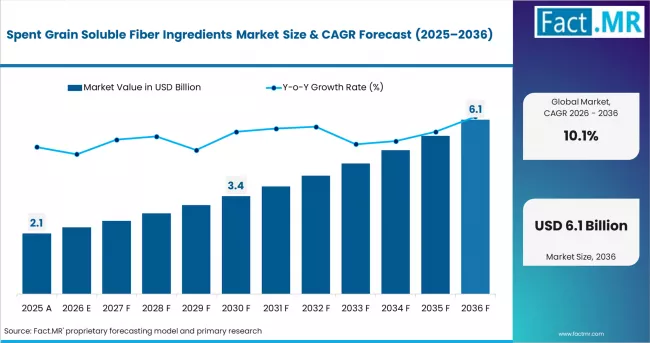
Spent Grain Soluble Fiber Ingredients Market Market Value Analysis | Source: Fact.MR
| Metric | Value |
|---|---|
| Estimated Value in 2026 | USD 2.1 billion |
| Forecast Value in 2036 | USD 5.6 billion |
| Forecast CAGR (2026 to 2036) | 10.1% |
Source: Fact.MR analysis. Updated Apr 21, 2026
Summary of Spent Grain Soluble Fiber Ingredients Market
- Market Definition
- Covers soluble fiber ingredients from wheat and barley spent grain in dry powder, liquid extract, and granular formats for food, nutraceutical, animal feed, and personal care applications globally.
- Demand Drivers
- India's urban demand for high-fiber fortified snacks is expanding soluble fiber ingredient procurement through organised food retail and supplement channels.
- UK circular bioeconomy funding programmes are accelerating brewery residue valorisation investment and upcycled food ingredient commercialisation.
- EFSA dietary fiber health claim compliance is driving demand for documented beta-glucan content and standardised soluble fiber extraction in European food and supplement procurement.
- Key Segments Analyzed
- By Grain Source: Wheat spent grain leads 73% in 2026. Largest brewing and grain processing by-product volume with well-documented soluble fiber content benchmarks.
- By Application: Animal feed leads 54% in 2026. Highest volume outlet for spent grain, with growing share shifting toward food and nutraceutical channels.
- By Product Form: Dry/powder form leads 70% in 2026. Preferred for shelf-stable food and supplement formulation and efficient long-distance distribution.
- By Extraction Method: Enzymatic hydrolysis leads 43% in 2026. Produces the highest purity soluble fiber with documented beta-glucan content for premium food procurement.
- By Geography: India leads at 11.4% CAGR. Driven by urban functional food demand and better-for-you snack premiumisation.
- Analyst Opinion at FACT.MR
- Shambhu Nath Jha, Principal Consultant at Fact.MR, opines, ' CXOs will find that enzymatically extracted, beta-glucan-standardised soluble fiber is outperforming basic wet grain by-products. Food and nutraceutical buyers prefer validated and high-purity ingredients. EFSA-compliant health claim documentation is becoming essential.’
- Strategic Implications
- Invest in enzymatic hydrolysis extraction capacity and beta-glucan standardisation documentation to qualify for food-grade and nutraceutical soluble fiber ingredient supply agreements in India and the United Kingdom.
- Pursue Upcycled Food Association certification and EFSA dietary fiber health claim alignment to access premium food brand procurement in North America and Europe.
- Build brewery feedstock supply agreements with large wheat and barley beer producers in Germany and China to secure consistent spent grain volume for commercial-scale soluble fiber extraction.
- Methodology
- Market sizing based on soluble fiber ingredient producer revenues and brewery by-product processing volumes, validated with 2024-2025 procurement benchmarks.
- Supported by EFSA health claim data, UK WRAP circular economy records, Upcycled Food Association certification data, and country-level brewery production statistics.
- Forecasts incorporate fiber ingredient demand trends, extraction method adoption rates, and expert interviews with food ingredient procurement specialists.
Between 2026 and 2036, the market is expected to create USD 3.5 billion in new opportunity. Growth is driven by circular bioeconomy policies and fiber-enriched food reformulation. Brewery residue valorisation is increasing. Expansion is constrained by variability in spent grain composition. Cold-chain logistics from breweries remain complex. Enzymatic extraction capacity is still limited at scale.
Procurement is shifting toward high-purity soluble fiber ingredients. Animal feed-grade wet grain is losing share. Demand is rising for dry powder and extracted formats. Food and nutraceutical buyers prefer documented functionality. Upcycled Food Association certification is gaining importance. EFSA health claim compliance is required. Premium products command 40–60% price premiums. Non-validated suppliers are being excluded.
India leads with 11.4% CAGR through 2036. Growth is driven by demand for fortified snacks and dietary shifts. China follows at 10.8%, supported by large beer production and valorisation investment. The United Kingdom records 9.6%, driven by circular economy funding and startup activity. The United States records 9.2%, supported by upcycled food adoption and fiber demand. Germany records 8.9%, supported by strong processing capability. Mature markets face constraints from long qualification cycles and feedstock variability.
Segmental Analysis
Spent Grain Soluble Fiber Ingredients Market Analysis by Grain Source
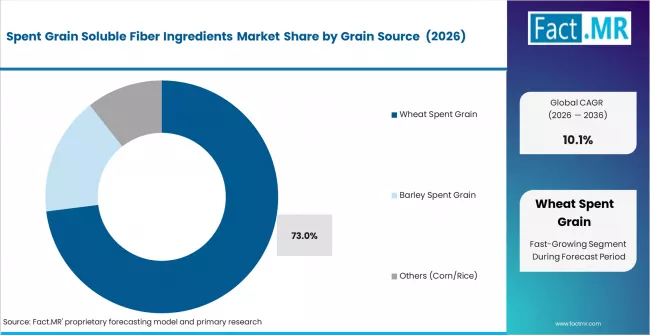
Spent Grain Soluble Fiber Ingredients Market Analysis By Grain Source | Source: Fact.MR
Based on Fact.MR, wheat spent grain holds 73% share in 2026. It dominates due to its position as the largest brewing and grain processing by-product volume globally, combined with well-documented soluble arabinoxylan and beta-glucan fiber fractions that enable standardised food-grade ingredient production. No other spent grain source offers comparable feedstock volume consistency for commercial-scale soluble fiber extraction.
- EverGrain Wheat Fiber Scale-up: EverGrain, a joint venture between AB InBev and Anheuser-Busch, expanded its wheat spent grain soluble fiber production capacity in 2024, processing barley and wheat brewing residues into protein and fiber ingredients targeting U.S. and European food and beverage manufacturer procurement. [4]
- Kerry Group Barley Fiber Development: Kerry Group launched an expanded barley spent grain beta-glucan fiber ingredient range in early 2025, with documented EFSA-compliant health claim substantiation data targeting European bakery, cereal, and sports nutrition manufacturers seeking clinically validated soluble fiber inclusion. [1]
- Wheat Spent Grain Volume Trend: The Brewers Association reported that U.S. craft breweries generated over 850,000 tons of spent grain in 2024, with wheat-dominant recipes representing the fastest-growing share of brewery residue, directly expanding feedstock availability for soluble fiber ingredient extraction. [5]
Spent Grain Soluble Fiber Ingredients Market Analysis by Application
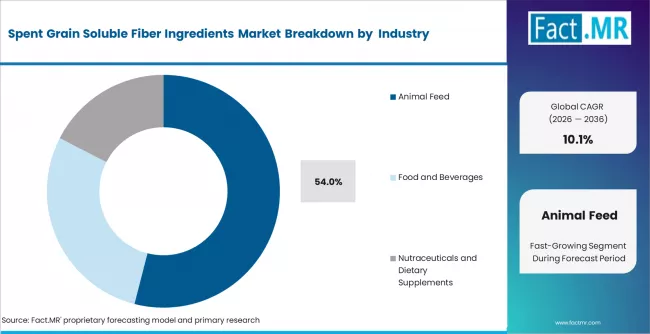
Spent Grain Soluble Fiber Ingredients Market Analysis By Application | Source: Fact.MR
Based on Fact.MR, animal feed holds 54% share in 2026. It represents the highest-volume outlet for spent grain soluble fiber due to direct brewery-to-farm supply chains and established wet grain procurement infrastructure. Growing share is shifting toward food and nutraceutical channels as extraction technology enables food-grade standardisation.
- Cargill Animal Feed Programme: Cargill expanded its brewery by-product animal feed ingredient supply programme in 2024, increasing spent grain soluble fiber inclusion in ruminant and swine feed formulations targeting large-scale livestock producers in the U.S. and European markets. [6]
- ReGrained Food Application Development: ReGrained launched expanded food-grade spent grain soluble fiber ingredient products in 2025, targeting U.S. snack, bakery, and functional food manufacturers seeking Upcycled Food Association certified, high-fiber ingredient inclusion for better-for-you product reformulation. [7]
- Nutraceutical Channel Adoption Trend: The Global Prebiotic Association reported 28% growth in brewery-derived prebiotic fiber ingredient adoption in dietary supplement formulations in 2024, driven by consumer demand for beta-glucan immune health and digestive wellness claims in capsule and powder supplement formats. [8]
Drivers, Restraints, and Opportunities
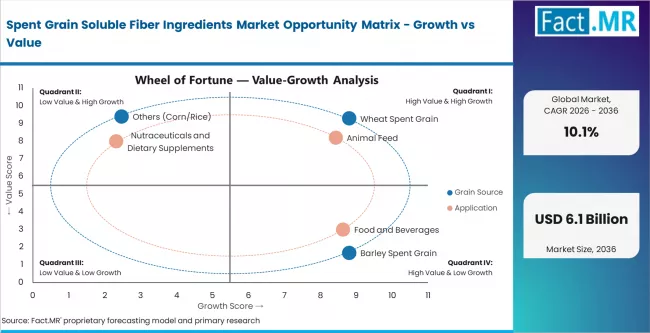
Spent Grain Soluble Fiber Ingredients Market Opportunity Matrix Growth Vs Value | Source: Fact.MR
Specification upgrades are reshaping the market. Wet brewers grain is losing value. High-purity enzymatic extracts are gaining share. Documented ingredients command 40–60% premiums. Suppliers without validation are losing food-grade access.
- EFSA Fiber Health Claim Compliance: EFSA Regulation (EC) No 1924/2006 requires validated fiber content. Extraction methods and clinical data are mandatory. This drives demand for standardised fiber ingredients. Kerry Group expanded certified fiber products in 2024.
- UK Circular Bioeconomy Funding: UK Research and Innovation expanded funding in 2024. This supports brewery residue upcycling projects. ReGrained and EverGrain scaled production in 2024–2025. Infrastructure development is accelerating. [2]
- China Brewery Residue Valorisation: China expanded circular economy guidelines in 2024. This supports investment in residue processing. Archer Daniels Midland increased regional activity. Functional food demand is rising. [3]
Regional Analysis
The spent grain soluble fiber ingredients market is assessed across Asia Pacific, North America, Europe, Latin America, and Middle East and Africa, covering 40+ countries with distinct demand profiles shaped by brewery production scale, circular economy policy investment, dietary fiber regulation frameworks, and upcycled ingredient retail infrastructure. The full report provides market attractiveness analysis by region and country.
.webp "Top Country Growth Comparison Spent Grain Soluble Fiber Ingredients Market Cagr (2026 2036)")
Top Country Growth Comparison Spent Grain Soluble Fiber Ingredients Market Cagr (2026 2036) | Source: Fact.MR
| Country | CAGR (2026 to 2036) |
|---|---|
| India | 11.4% |
| China | 10.8% |
| United Kingdom | 9.6% |
| United States | 9.2% |
| Germany | 8.9% |
Source: Fact.MR analysis. Updated Apr 21, 2026
Source: Fact.MR (FACT.MR) analysis, based on proprietary forecasting model and primary research
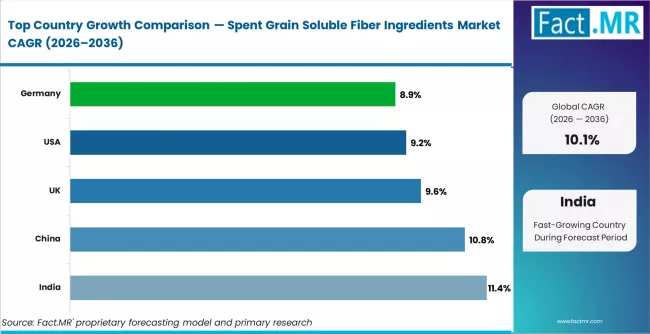
Spent Grain Soluble Fiber Ingredients Market Cagr Analysis By Country | Source: Fact.MR
Asia Pacific Spent Grain Soluble Fiber Ingredients Market Analysis
Asia Pacific shows the fastest expansion, supported by India’s fortified food demand and China’s large brewery residue base. The region reflects a divide between health-driven ingredient adoption and industrial-scale valorisation. EverGrain and Cargill serve both premium and bulk demand segments.
- India: India records an 11.4% CAGR through 2036. Urban dietary shifts are increasing demand for high-fiber and fortified foods. FSSAI updates in 2024 require clear soluble fiber labelling, shaping procurement standards. Food and nutraceutical brands prefer standardised and documented ingredients. ReGrained and EverGrain expanded supply programmes for Indian manufacturers.
- China: China advances at 10.8% CAGR through 2036. The country’s large beer production base ensures consistent spent grain availability. Industrial processors are investing in large-scale extraction facilities. Procurement is driven by OEM supply chains rather than retail branding. Archer Daniels Midland expanded regional partnerships in 2024. Circular economy policies are accelerating adoption across food and feed sectors.
FACT.MR covers China, India, Japan, South Korea, ASEAN, and ANZ. It includes regulatory benchmarks, production data, and forecasts.
North America Spent Grain Soluble Fiber Ingredients Market Analysis
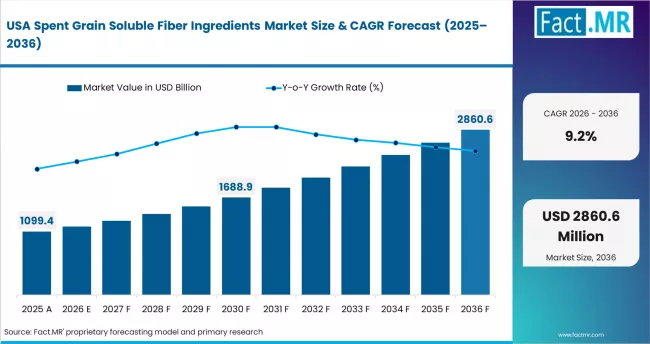
Spent Grain Soluble Fiber Ingredients Market Country Value Analysis | Source: Fact.MR
North America reflects strong demand for certified, upcycled, and high-functionality ingredients. Market growth is supported by consumer awareness and retail-driven reformulation. EverGrain, ReGrained, and Ingredion maintain strong supply positions.
- United States: The United States posts a 9.2% CAGR through 2036. Demand is driven by high-fiber diets and clean-label product positioning. Upcycled Food Association certification is influencing procurement decisions. Retail brands are incorporating upcycled fiber into snacks and beverages. USDA research in 2024 supports ingredient validation and commercial adoption.
FACT.MR covers the United States, Canada, and Mexico. It includes certification trends, retail benchmarks, and forecasts.
Europe Spent Grain Soluble Fiber Ingredients Market Analysis
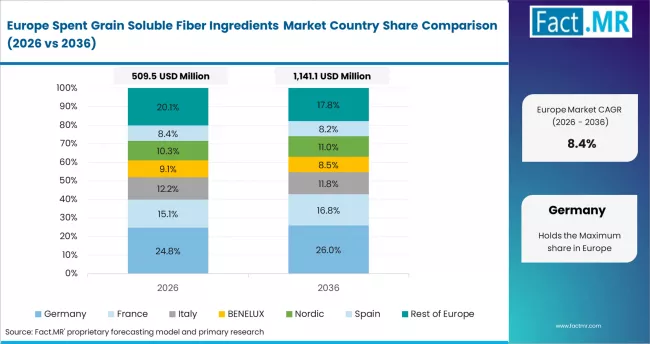
Spent Grain Soluble Fiber Ingredients Market Europe Country Market Share Analysis, 2026 & 2036 | Source: Fact.MR
Europe acts as a regulatory and circular bioeconomy hub for spent grain fiber ingredients. EFSA compliance and government funding programmes define procurement standards. Kerry Group, Ingredion, and EverGrain support certified ingredient supply.
- United Kingdom: The United Kingdom shows a 9.6% CAGR through 2036. Public funding programmes are accelerating upcycled ingredient innovation. Startup ecosystems are expanding through brewery partnerships. WRAP guidelines introduced in 2024 standardise certification pathways. Food brands are actively adopting high-fiber upcycled ingredients.
- Germany: Germany records an 8.9% CAGR through 2036. The country has strong industrial processing infrastructure for brewery by-products. Procurement is specification-driven under EFSA and DIN standards. Ingredient purity and extraction validation are critical. Kerry Group and Ingredion expanded supply to bakery and cereal manufacturers.
FACT.MR covers Germany, France, the UK, Italy, Spain, and Rest of Europe. It includes regulatory compliance data, processing benchmarks, and forecasts.
Competitive Aligners for Market Players
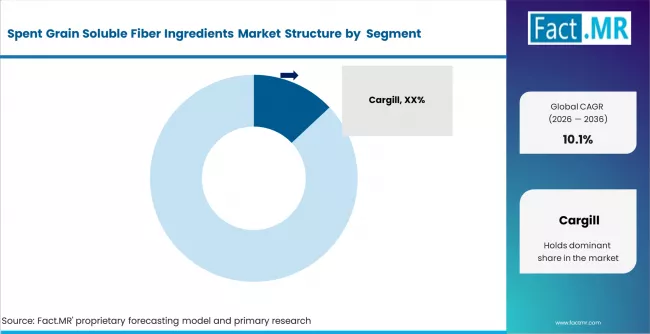
Spent Grain Soluble Fiber Ingredients Market Analysis By Company | Source: Fact.MR
The spent grain soluble fiber ingredients market is shaped by technical capability rather than simple price competition. The key differentiators are extraction quality, certification depth, and access to consistent brewery feedstock. Suppliers operate in a system where documentation matters more than cost. Buyers increasingly require proof of beta-glucan content, validated processing methods, and recognised certifications such as those from the Upcycled Food Association and EFSA. This has created a layered structure, where only a limited group of qualified producers can access high-value food and nutraceutical contracts.
Companies like EverGrain and ReGrained benefit from early entry and strong integration with brewery networks. Their direct access to raw material ensures stable supply and cost control. More importantly, they have developed expertise in enzymatic extraction and clean-label processing, which allows them to meet strict food-grade requirements. Their established relationships with food brands in North America and Europe further strengthen their position.
Larger ingredient players such as Kerry Group and Ingredion compete through scale and portfolio strength. They leverage existing customer relationships and offer certified fiber ingredients alongside broader functional ingredient solutions. This makes it easier for buyers to integrate spent grain fiber into existing procurement systems. Procurement patterns are clearly shifting toward fewer, more reliable suppliers. Food and nutraceutical companies prefer partners that can guarantee consistency, certification, and performance. Once an ingredient is approved and used in a formulation, switching becomes costly and time-consuming. This creates long-term relationships and supports premium pricing for validated, high-quality ingredients.
Key Players
- Cargill
- Archer Daniels Midland
- Ingredion
- Kerry Group
- ReGrained
- EverGrain
Bibliography
- [1] Kerry Group plc. (2024). Annual Report 2024: Dietary Fiber Ingredient Portfolio Expansion Including EFSA-Compliant Beta-Glucan Spent Grain Soluble Fiber Range for European Bakery, Cereal, and Sports Nutrition Manufacturer Procurement. Kerry.com/investor-relations
- [2] UK Research and Innovation / Innovate UK. (2024). Circular Economy Accelerator Programme 2024: Brewery Residue Valorisation Project Awards Including Upcycled Soluble Fiber Ingredient Production Scale-Up Funding for UK Food Brand and Nutraceutical Procurement Targets. ukri.org/opportunity
- [3] Archer Daniels Midland Company. (2025). Asia Pacific Ingredient Supply Programme Update: Spent Grain Soluble Fiber and Circular Economy Ingredient Expansion Targeting Chinese Functional Food and Animal Feed Manufacturers Under MIIT Circular Economy Guidelines. January 2025. adm.com/news
- [4] EverGrain Ingredients. (2024). Capacity Expansion Announcement: Enzymatic Hydrolysis Spent Grain Soluble Fiber and Protein Ingredient Production Scale-Up at AB InBev Partnership Facility Targeting U.S. and European Food and Beverage Manufacturer Procurement. 2024. evergrain.com/news
- [5] Brewers Association. (2024). Craft Brewing Industry Statistics 2024: U.S. Craft Brewery Spent Grain Production Volume Data Including Wheat and Barley Spent Grain Tonnage by Brewing Category and Regional Distribution. brewersassociation.org/statistics-and-data
- [6] Cargill Inc. (2024). Brewery By-Product Animal Feed Programme Expansion: Spent Grain Soluble Fiber Inclusion in Ruminant and Swine Feed Formulations for U.S. and European Livestock Producers Under Sustainable Ingredient Sourcing Programmes. 2024. cargill.com/news
- [7] ReGrained Inc. (2025). Product Launch: Expanded Food-Grade Spent Grain Soluble Fiber Ingredient Range with Upcycled Food Association Certification Targeting U.S. Snack, Bakery, and Functional Beverage Manufacturer Reformulation. January 2025. regrainedfoods.com/news
- [8] Global Prebiotic Association. (2024). Prebiotic Fiber Market Report 2024: Brewery-Derived Beta-Glucan Prebiotic Fiber Adoption Growth in Dietary Supplement Capsule and Powder Formats Including Immune Health and Digestive Wellness Claim Procurement Data. globalprebiotic.org
This Report Addresses
- Strategic intelligence on demand across brewery-derived soluble fiber food reformulation, nutraceutical prebiotic supply, animal feed high-fiber inclusion, and upcycled ingredient commercial procurement globally.
- Market forecast from USD 2.1 billion in 2026 to USD 5.6 billion by 2036 at a CAGR of 10.1%.
- Growth opportunities across India FSSAI fiber labelling expansion, China brewery residue valorisation investment, UK UKRI bioeconomy funding, U.S. Upcycled Food Association adoption, and Germany industrial bakery ingredient processing.
- Segment analysis by grain source, application, product form, and extraction method covering wheat and barley spent grain across food, nutraceutical, animal feed, and personal care end uses.
- Regional outlook covering Asia Pacific health-food-driven growth, North America upcycled ingredient certification leadership, and Europe EFSA-regulation-driven soluble fiber procurement.
- Competitive analysis of Cargill, ADM, Ingredion, Kerry Group, ReGrained, and EverGrain covering extraction capability, certification breadth, and brewery feedstock supply positioning.
- Regulatory analysis covering EFSA dietary fiber health claim standards, Upcycled Food Association certification framework, UK WRAP brewery by-product food ingredient guidelines, India FSSAI fiber labelling updates, and China MIIT circular economy food processing guidelines.
- Report delivered in PDF, Excel, and presentation formats. Supported by producer revenue data, brewery processing records, certification documentation, and expert interviews.
Spent Grain Soluble Fiber Ingredients Market Definition
The market includes soluble dietary fiber ingredients extracted from the spent grain by-product of beer, whisky, and grain processing. Key sources include wheat and barley spent grain. Products include dry powder, liquid extract, and granular formats derived through enzymatic, mechanical, or chemical extraction.
Spent Grain Soluble Fiber Ingredients Market Inclusions
Covers global forecasts from 2026 to 2036 by grain source, application, product form, and extraction method. Includes wheat, barley, and other spent grain fiber ingredients. Covers food and beverage, nutraceutical, animal feed, cosmetic, and biofuel end uses across government-supported and commercial procurement channels.
Spent Grain Soluble Fiber Ingredients Market Exclusions
Excludes whole wet brewers grain not processed for soluble fiber extraction. Omits finished food products incorporating spent grain fiber as a recipe ingredient. Excludes insoluble dietary fiber fractions and non-food-grade brewery by-products. Focus remains on standardised soluble fiber ingredient supply to food, nutraceutical, and feed manufacturers.
Spent Grain Soluble Fiber Ingredients Market Research Methodology
- Primary Research: Interviews with brewery ingredient procurement managers, soluble fiber producers, food and nutraceutical formulators, and circular bioeconomy specialists across key markets.
- Desk Research: Uses data from EverGrain, ReGrained, and Kerry Group reports, EFSA dietary fiber health claim records, UK WRAP circular economy programme data, and 2024-2025 spent grain ingredient trade statistics.
- Market-Sizing and Forecasting: Hybrid model using spent grain ingredient producer revenues and application-level volume estimates by extraction method, product form, and end-use segment.
- Data Validation and Update Cycle: Validated using producer revenue data, brewery by-product processing volumes, and food ingredient procurement benchmarks. Cross-checked with expert interviews. Updated annually.
Segmentation
Scope of Report
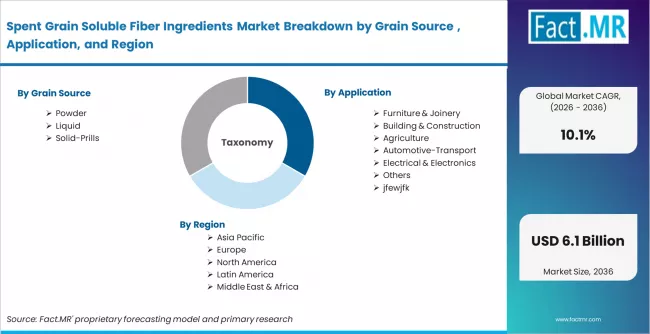
Spent Grain Soluble Fiber Ingredients Market Breakdown By Grain Source , Application, And Region | Source: Fact.MR
| Attribute | Details |
|---|---|
| Quantitative Units | USD 2.1 billion (2026) to USD 5.6 billion (2036), at a CAGR of 10.1% |
| Market Definition | Soluble dietary fiber ingredients extracted from wheat, barley, and other brewery spent grains in dry powder, liquid extract, and granular formats, supplied with extraction method documentation and beta-glucan content standardisation for food, nutraceutical, animal feed, and personal care applications globally. |
| Grain Source Segmentation | Wheat Spent Grain, Barley Spent Grain, Others (Corn/Rice) |
| Application Segmentation | Animal Feed, Food and Beverages, Nutraceuticals and Dietary Supplements, Cosmetics and Personal Care, Bio-fuels/Others |
| Product Form Segmentation | Dry/Powder Form, Liquid/Extract Form, Granular/Pellet Form |
| Extraction Method Segmentation | Enzymatic Hydrolysis, Mechanical/Physical Separation, Chemical Extraction |
| Application Coverage | High-fiber food reformulation using brewery-derived soluble beta-glucan, dietary supplement prebiotic fiber supply, animal feed soluble fiber inclusion, cosmetics and personal care natural fiber ingredient applications, and biofuel co-processing of spent grain residues. |
| Regions Covered | North America, Europe, Asia Pacific, Latin America, Middle East and Africa |
| Countries Covered | USA, Canada, Mexico, Germany, UK, France, Italy, Spain, Nordic, BENELUX, China, Japan, South Korea, India, ASEAN, Australia and New Zealand, Brazil, Argentina, Chile, Saudi Arabia, GCC, Turkey, South Africa, Rest of MEA |
| Key Companies Profiled | Cargill, Archer Daniels Midland, Ingredion, Kerry Group, ReGrained, EverGrain |
| Forecast Period | 2026 to 2036 |
| Approach | Hybrid top-down and bottom-up model using spent grain ingredient producer revenues, brewery residue processing volumes by grain source, average selling prices by product form and extraction method, food ingredient procurement benchmarks, and primary interviews with brewery ingredient specialists and food formulation procurement managers. |
Source: Fact.MR analysis. Updated Apr 21, 2026
Spent Grain Soluble Fiber Ingredients Market by Segments
-
By Grain Source:
- Wheat Spent Grain
- Barley Spent Grain
- Others (Corn/Rice)
-
By Application:
- Animal Feed
- Food and Beverages
- Nutraceuticals and Dietary Supplements
- Cosmetics and Personal Care
- Bio-fuels/Others
-
By Product Form:
- Dry/Powder Form
- Liquid/Extract Form
- Granular/Pellet Form
-
By Extraction Method:
- Enzymatic Hydrolysis
- Mechanical/Physical Separation
- Chemical Extraction
-
By Region:
-
North America
- United States
- Canada
- Mexico
-
Latin America
- Brazil
- Mexico
- Argentina
- Chile
- Rest of Latin America
-
Western Europe
- Germany
- United Kingdom
- France
- Italy
- Spain
- Nordic Countries
- BENELUX
- Rest of Western Europe
-
Eastern Europe
- Russia
- Poland
- Hungary
- Balkan and Baltic
- Rest of Eastern Europe
-
East Asia
- China
- Japan
- South Korea
-
South Asia and Pacific
- India
- ASEAN
- Australia and New Zealand
- Rest of South Asia and Pacific
-
Middle East and Africa
- Kingdom of Saudi Arabia
- Other GCC Countries
- Turkey
- South Africa
- Rest of Middle East and Africa
-
Frequently Asked Questions
How large is the spent grain soluble fiber ingredients market in 2025?
What will the market size be by 2036?
What is the expected CAGR for the market from 2026 to 2036?
Which grain source segment is poised to lead the market?
Which application segment is expected to dominate?
Which country shows the fastest growth?
What is driving demand for spent grain soluble fiber ingredients?
What are the major restraints?
Which extraction method leads the market?
What applications dominate usage?
What is the main challenge in this market?
Who worked on this report


Preview the report firsthand - request a free sample
Free SampleGet the brochure for pricing and purchase details
Download PDF