- Base Value(2025): 1.5 Bn
- Estimated Value(2026): 1.6 Bn
- Forecast Value (2036): 2.4 Bn
- CAGR (2026 - 2036): 4.9%
Threonine Acids Market Forecast and Outlook By Fact.MR
In 2025, the global threonine acids market was valued at USD 1.5 billion. Based on Fact.MR analysis, demand for threonine acids is estimated to grow to USD 1.6 billion in 2026 and USD 2.4 billion by 2036. FACT.MR projects a CAGR of 4.9% during the forecast period.
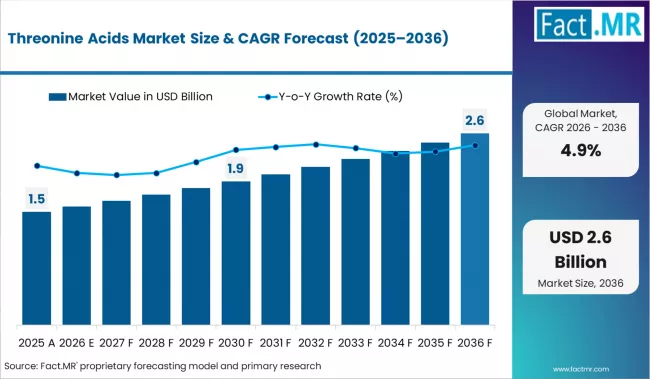
Threonine Acids Market Market Value Analysis | Source: Fact.MR
Summary of the Surplus and Imperfect Produce Retail Market
- Market Definition
- The market covers L-Threonine, D-Threonine, and related preparations from animal- and plant-based sources used in feed, pharmaceuticals, and food applications globally.
- Demand Drivers
- India’s pharmaceutical expansion and nutraceutical retail growth are increasing demand for certified pharmaceutical-grade and food supplement L-Threonine.
- China’s poultry and swine production supports high-volume feed demand, while investments in pharmaceutical-grade capacity are creating premium segments.
- EU feed regulations are driving demand for certified L-Threonine with approved safety documentation, favoring compliant producers.
- Key Segments Analyzed
- By Product Type: L-Threonine leads with 80% share in 2026 due to large-scale production, broad application use, and regulatory acceptance.
- By End Use: Animal Feed leads with 60% share in 2026, driven by its role in improving feed efficiency in swine and poultry.
- By Geography: India leads growth at 6.1% CAGR through 2036, supported by rising pharmaceutical and supplement demand.
- Analyst Opinion at FACT.MR
- Shambhu Nath Jha, Senior Consultant at Fact.MR, states that non-Chinese producers must develop GMP-certified and plant-based L-Threonine to compete in premium markets, or remain limited to low-margin feed segments.
- Strategic Implications
- Non-Chinese producers should invest in GMP-certified pharmaceutical-grade production to access premium clinical and nutraceutical markets.
- Development of plant-based L-Threonine can target clean-label demand in North America and Europe.
- Companies should focus on India with FSSAI-compliant products, leveraging regulatory and domestic market advantages.
- Methodology
- Market sizing is based on production volumes, pricing by grade, and validated with industry data from 2024-2025.
- Regulatory data (EU, FDA, Japan) and livestock statistics supported demand analysis.
- Forecasts incorporate livestock trends, pharmaceutical demand, plant-based adoption, and expert insights.
| Metric | Value |
|---|---|
| Estimated Value in 2026 | USD 1.6 billion |
| Forecast Value in 2036 | USD 2.4 billion |
| Forecast CAGR (2026 to 2036) | 4.9% |
Source: Fact.MR analysis. Updated Mar 27, 2026
Between 2026 and 2036, the market is expected to generate an absolute dollar opportunity of approximately USD 0.8 billion, indicating steady and incremental expansion. Growth will be primarily supported by sustained demand for poultry and swine feed in Asia Pacific and Latin America. In parallel, increasing procurement of pharmaceutical- and food-grade threonine in regulated markets will contribute to value growth, particularly within premium segments. However, market expansion will remain moderated by structural challenges. Persistent overcapacity in Chinese fermentation production continues to exert downward pressure on commodity pricing. Additionally, volatility in key feedstocks such as corn and molasses is impacting cost structures and margin stability across regions. The market outlook reflects stable growth, with stronger momentum in higher-value applications alongside continued pressure in bulk supply segments.
Country growth reflects pharmaceutical amino acid regulatory standards, livestock production expansion, and indigenous fermentation capacity investment. India leads at 6.1% CAGR through expanding pharmaceutical-grade threonine demand and organised food supplement retail growth. China follows at 5.8% through continued large-scale poultry feed procurement expansion and pharmaceutical-grade fermentation investment. Japan records 5.5% through FOSHU-labelled functional food ingredient demand and pharmaceutical threonine procurement for parenteral nutrition applications. Germany records 5.0% through EU feed additive regulation-compliant certified threonine supply and pharmaceutical amino acid product development. The USA records 4.8%, generating steady replacement demand through established animal feed and nutraceutical manufacturer procurement channels, constrained by Chinese commodity pricing pressure and high domestic production cost structures.
Segmental Analysis
Threonine Acids Market Analysis by Product Type
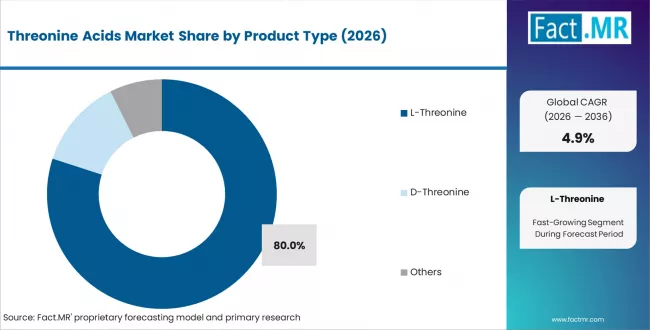
Threonine Acids Market Analysis By Product Type | Source: Fact.MR
Based on FACT.MR analysis, L-Threonine is projected to hold 80% share in 2026 as the dominant product. This is supported by large-scale fermentation production, wide regulatory acceptance, and strong integration across feed, pharmaceutical, and food applications globally.
- Ajinomoto L-Threonine Expansion: In 2024, Ajinomoto expanded fermentation capacity in Iowa and Thailand to strengthen supply for animal feed markets while continuing investment in pharmaceutical-grade product lines. [4]
- Evonik Pharmaceutical Grade Launch: In October 2024, Evonik expanded its GMP-certified amino acid portfolio, including L-Threonine, targeting clinical nutrition and pharmaceutical manufacturers in Europe and North America. [5]
- D-Threonine Niche Adoption Trend: A 2024 review by the American Chemical Society highlighted growing use of D-Threonine in peptide synthesis and antibiotic research, reflecting niche but expanding pharmaceutical demand. [6]
Threonine Acids Market Analysis by End Use
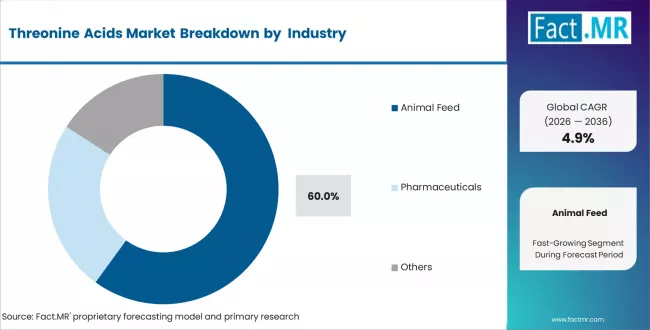
Threonine Acids Market Analysis By End Use | Source: Fact.MR
According to FACT.MR, Animal Feed is expected to account for 60% share in 2026. Growth is driven by L-Threonine’s role in improving feed efficiency, reducing crude protein usage, and supporting environmental compliance in livestock production.
- Evonik Animal Nutrition Investment: In September 2024, Evonik continued development of its EssentaminOH programme, integrating L-Threonine for precision nutrition in swine and poultry under environmental regulations. [7]
- Kyowa Pharma Technology Development: In January 2025, Kyowa Hakko Bio expanded its pharmaceutical-grade L-Threonine portfolio for clinical nutrition and parenteral applications in Japan and the U.S. [8]
- Food Supplement Adoption Trend: The Council for Responsible Nutrition reported a 12% increase in amino acid supplement usage among U.S. adults in 2024, supporting growth in higher-value food supplement applications. [9]
Drivers, Restraints, and Opportunities
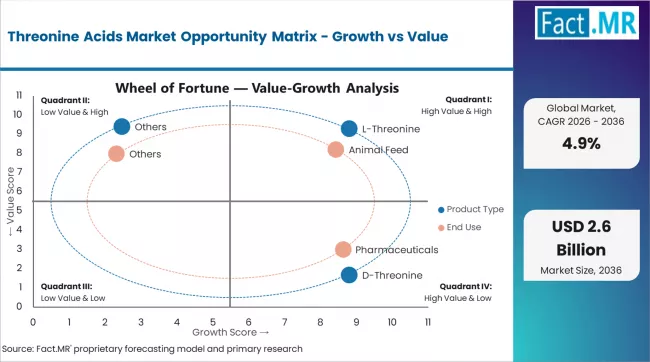
Threonine Acids Market Opportunity Matrix Growth Vs Value | Source: Fact.MR
FACT.MR analysts observe that the threonine acids market is shifting from a commodity livestock nutrition input to a bifurcated specialty amino acid category. Standard animal feed grade L-Threonine continues to face margin pressure due to Chinese fermentation overcapacity. At the same time, pharmaceutical- and food supplement-grade threonine with certified purity is gaining traction in regulated applications, supporting overall market value growth.
The market is moving toward certified-grade specialization. Commodity feed-grade threonine is increasingly price-competitive, while GMP-certified and FOSHU-grade L-Threonine commands 50 to 100% premiums. This premium segment growth offsets declining average prices in bulk animal feed applications.
- EU Feed Additive Regulation: EU Regulation (EC) No 1831/2003 requires EFSA evaluation and approval for amino acid feed additives. The 2024 re-evaluation of L-Threonine maintained strict compliance requirements, creating entry barriers that favor EU-approved suppliers over unregistered imports. [2]
- India Pharmaceutical Grade Demand: India’s Ministry of AYUSH and FSSAI updated amino acid standards in 2024, strengthening purity and documentation requirements. This is driving demand for certified pharmaceutical-grade threonine alongside growth in nutraceutical retail and manufacturing. [3]
- Japan FOSHU Amino Acid Programme: Japan’s Consumer Affairs Agency continues to permit L-Threonine in FOSHU-labelled functional foods. This supports demand for certified amino acid supply in premium food and beverage applications led by domestic manufacturers. [1]
Regional Analysis
The threonine acids market is assessed across North America, Asia Pacific, Europe, Latin America, and Middle East and Africa, covering 40+ countries with demand profiles shaped by livestock production scale, pharmaceutical amino acid regulatory standards, food supplement market maturity, and indigenous fermentation capacity investment. The full report provides market attractiveness analysis by region and country.
.webp "Top Country Growth Comparison Threonine Acids Market Cagr (2026 2036)")
Top Country Growth Comparison Threonine Acids Market Cagr (2026 2036) | Source: Fact.MR
| Country | CAGR (2026 to 2036) |
|---|---|
| India | 6.1% |
| China | 5.8% |
| Japan | 5.5% |
| Germany | 5.0% |
| United States | 4.8% |
Source: Fact.MR analysis. Updated Mar 27, 2026
Source: Fact.MR (FACT.MR) analysis, based on proprietary forecasting model and primary research
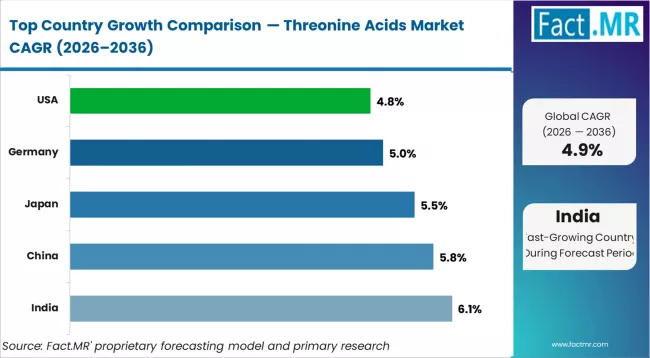
Threonine Acids Market Cagr Analysis By Country | Source: Fact.MR
Asia Pacific Threonine Acids Market Analysis
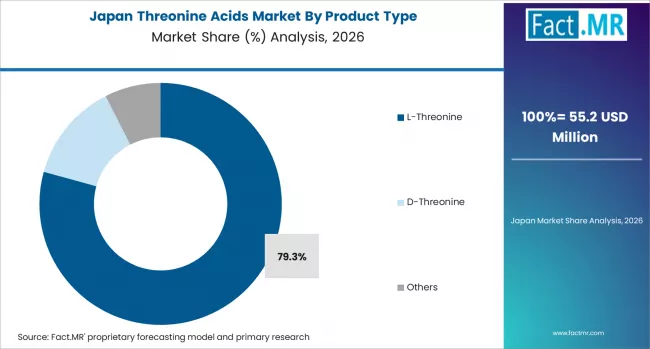
Threonine Acids Market Japan Market Share Analysis By Product Type | Source: Fact.MR
Asia Pacific is the production hub and largest volume market for threonine acids. China dominates global supply of animal feed grade L-Threonine through large-scale fermentation. India and Japan are key premium demand centers driven by pharmaceuticals and functional foods. Ajinomoto, Kyowa Hakko Bio, and Shanghai Kyowa Amino Acid lead regional pharmaceutical-grade supply.
- India: Pharmaceutical demand and organised nutraceutical retail are driving growth in India, projected at 6.1% CAGR through 2036. FSSAI updated amino acid standards in 2024, strengthening purity and documentation requirements for L-Threonine. This is expanding procurement of certified products. Summit Ingredients expanded its distribution programme in August 2024 targeting pharmaceutical and AYUSH-compliant supplement manufacturers. India’s demand is largely premium-driven, unlike China’s feed-volume-led market.
- China: Large-scale feed demand and fermentation upgrades support growth in China, projected at 5.8% CAGR through 2036. Updated 2024 feed amino acid standards align with Codex requirements, supporting export readiness. Shanghai Kyowa Amino Acid continues investment in pharmaceutical-grade capacity targeting domestic and global markets. China’s growth combines feed volume expansion and premium upgrade.
- Japan: Functional food demand and clinical nutrition applications support growth in Japan, projected at 5.5% CAGR through 2036. L-Threonine remains approved under the FOSHU programme, enabling health-focused food products. Kyowa Hakko Bio expanded pharmaceutical-grade offerings in 2025 for hospital and clinical use. Japan’s demand is driven by regulated, high-value applications.
FACT.MR’s Asia Pacific analysis covers India, China, Japan, South Korea, ASEAN, and Australia & New Zealand. It includes regulatory data, feed statistics, and forecasts by product type and end use.
Europe Threonine Acids Market Analysis
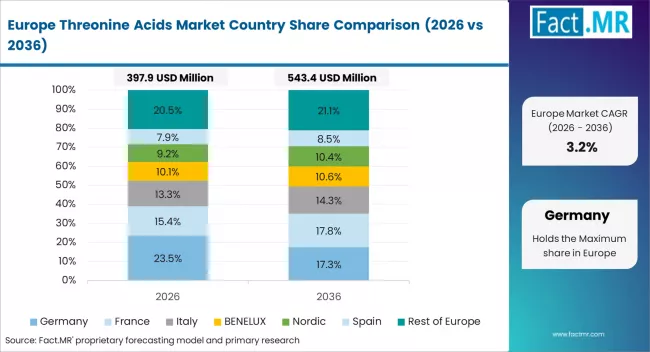
Threonine Acids Market Europe Country Market Share Analysis, 2026 & 2036 | Source: Fact.MR
Europe represents the global benchmark for regulatory compliance. EU feed additive regulation and pharmaceutical GMP standards strongly influence procurement. Evonik leads certified supply, while AMINO GmbH serves specialty pharmaceutical demand.
- Germany: Regulatory compliance and GMP investment are driving demand in Germany, projected at 5.0% CAGR through 2036. The 2024 EU re-evaluation of L-Threonine maintained strict documentation requirements under Regulation (EC) No 1831/2003. This compels sourcing from approved suppliers. Evonik expanded its EssentaminOH programme to support feed efficiency and environmental compliance. Germany’s model is compliance-driven, unlike the U.S. GRAS-based system.
FACT.MR’s Europe analysis includes Germany, France, the UK, Italy, Spain, and Rest of Western Europe. It covers regulatory benchmarks, feed adoption trends, and country-level forecasts.
North America Threonine Acids Market Analysis
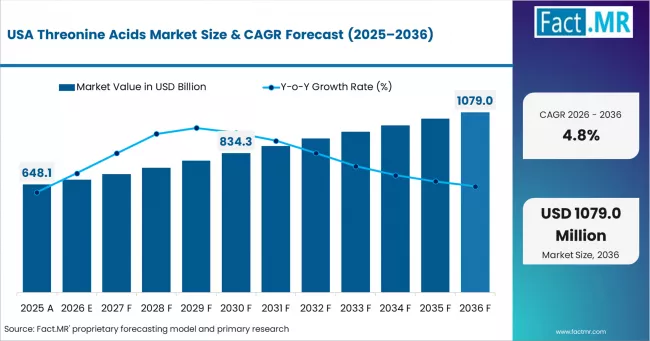
Threonine Acids Market Country Value Analysis | Source: Fact.MR
North America is a mature, premium-value market driven by pharmaceutical demand and established livestock feed procurement. Ajinomoto and Evonik serve high-value segments, while distributors support feed and supplement channels.
- United States: Nutraceutical growth and GMP-compliant pharmaceutical demand support the U.S. market, projected at 4.8% CAGR through 2036. FDA reinforced 21 CFR Part 111 requirements in 2024, increasing demand for certified L-Threonine. Ajinomoto continues supplying pharmaceutical- and food-grade products under long-term contracts. The U.S. market emphasizes quality certification over low-cost imports.
FACT.MR’s North America analysis includes the United States, Canada, and Mexico. It covers FDA compliance, procurement benchmarks, feed trends, and forecasts by product type and source.
Competitive Aligners for Market Players
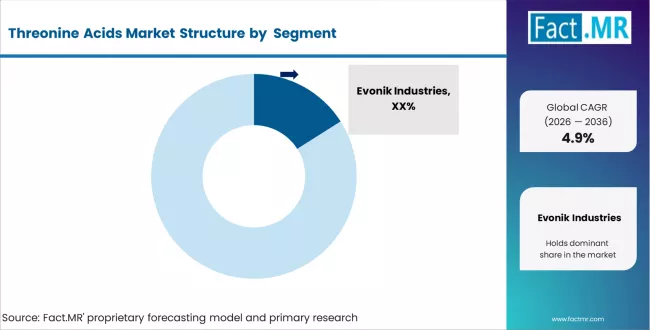
Threonine Acids Market Analysis By Company | Source: Fact.MR
The threonine acids market shows moderate concentration at the premium end, particularly in pharmaceutical and food-grade segments. Companies such as Ajinomoto, Evonik Industries, and Kyowa Hakko Bio hold strong positions due to their GMP-certified production and long-standing relationships with pharmaceutical clients. In contrast, the commodity animal feed segment is largely dominated by Chinese producers like Tianjin Tianyao Pharmaceuticals and Yangzhou Gami Biochem, who supply high volumes at competitive prices.
Competition differs across tiers. In premium segments, success depends on consistent purity, strong regulatory approvals, and detailed GMP documentation. In the commodity segment, pricing and production scale remain the key differentiators. Ajinomoto benefits from its global production network and established presence in Japan’s FOSHU ecosystem. Its long-term supply agreements with clinical nutrition companies create high switching costs for buyers. Evonik Industries leverages its integrated portfolio, offering threonine alongside other amino acids and feed solutions, especially within Europe. Kyowa Hakko Bio maintains a strong position through its pharmaceutical expertise and focus on high-purity products for clinical and hospital use.
Buyer behavior also varies by segment. Pharmaceutical customers tend to maintain long-term supplier relationships due to high re-qualification costs and strict compliance requirements. This creates stability for certified producers. On the other hand, animal feed manufacturers usually work with multiple suppliers. This allows them to manage price fluctuations and negotiate better terms.
Thus, the market reflects a balance between stable premium relationships and highly competitive commodity supply dynamics.
Key Players of Threonine Acids Market
- Evonik Industries
- Ajinomoto Co., Inc.
- AMINO GmbH
- Mitsubishi Tanabe Pharma Corporation
- Kyowa Hakko Bio Co., Ltd.
- Tianjin Tianyao Pharmaceuticals Co., Ltd.
- Yangzhou Gami Biochem Co., Ltd.
- Summit Ingredients
- SIGMA TAU Pharmaceuticals
- Shanghai Kyowa Amino Acid Co., Ltd.
Bibliography
- [1] Consumer Affairs Agency, Japan. (2024). Food for Specified Health Uses Approved Ingredient List Maintenance: L-Threonine Continued FOSHU Approval Status for Immune Support and Metabolic Health Functional Food Product Applications. 2024.
- [2] European Commission. (2024). EU Regulation (EC) No 1831/2003 Feed Additive Re-evaluation Programme: L-Threonine Feed Additive Authorisation Continued Confirmation with Updated Safety Documentation Requirements for EU Animal Feed Market Supply. 2024.
- [3] Food Safety and Standards Authority of India. (2024). Amino Acid Ingredient Standards Update for Food Supplement Products: L-Threonine Purity and Identity Documentation Requirements for Nutraceutical Retail Channel Compliance Under Food Safety and Standards Health Supplements Regulations. 2024.
- [4] Ajinomoto Co., Inc. (2024). Production Programme Update: L-Threonine Fermentation Expansion at Iowa and Thailand Facilities for North American and Asian Animal Feed Amino Acid and Pharmaceutical-Grade Customer Supply with Clinical Nutrition Product Line Investment. 2024.
- [5] Evonik Industries AG. (2024). Pharmaceutical-Grade Amino Acid Portfolio Expansion: GMP-Certified L-Threonine with Documented Purity for European and North American Clinical Nutrition and Parenteral Amino Acid Solution Manufacturer Supply Under EU Pharmaceutical Ingredient Standards. October 2024.
- [6] American Chemical Society. (2024). D-Threonine Research Applications Review: Expanding Pharmaceutical Research Demand for Non-Natural Threonine Enantiomer in Peptide Synthesis and Antibiotic Development Applications. 2024.
- [7] Evonik Industries AG. (2024). EssentaminOH Precision Amino Acid Programme Expansion: L-Threonine Integration with European Swine and Poultry Producer Nitrogen Excretion Reduction Programmes Under EU Nitrates Directive Environmental Compliance Requirements. September 2024.
- [8] Kyowa Hakko Bio Co., Ltd. (2025). Pharmaceutical-Grade L-Threonine Product Range Expansion: Hospital Parenteral Nutrition and Clinical Nutrition Product Manufacturer Supply in Japan and United States Markets Through Certified Amino Acid Quality Documentation Programme. January 2025.
- [9] Council for Responsible Nutrition. (2024). 2024 Consumer Survey on Dietary Supplements: Amino Acid Supplement Usage Growth of 12% Among U.S. Adults Including L-Threonine in Multi-Amino Acid Formulations for Immune Support and Metabolic Health Applications. October 2024.
This Report Addresses
- Insights on threonine demand across India (pharma), China (feed & upgrades), Japan (FOSHU), Germany (EU compliance), and U.S. (nutraceuticals).
- Market forecast from USD 1.6 billion in 2026 to USD 2.4 billion by 2036 at a CAGR of 4.9%.
- Growth opportunities in India (FSSAI pharma), China (fermentation upgrades), Japan (FOSHU supply), Germany (EU-certified feed), and U.S. (cGMP supplements).
- Segment analysis by product type, end use, and source.
- Regional outlook covering Asia Pacific dominance, North America maturity, and Europe’s regulatory-driven demand.
- Competitive landscape of key players with focus on GMP certification and supply positioning.
- Technology trends including GMP fermentation, plant-based threonine, and precision nutrition.
- Report available in PDF, Excel, and presentation formats, supported by primary research and regulatory data.
Threonine Acids Market Definition
The threonine acids market includes L-Threonine, D-Threonine, and related amino acid preparations produced via fermentation or chemical synthesis. These are used as supplements in animal feed, pharmaceutical-grade nutrition, food supplements, and functional foods.
Threonine Acids Market Inclusions
Includes global and regional forecasts from 2026 to 2036 by product type, end use, and source. Covers L-Threonine and D-Threonine across animal feed, pharmaceutical, and food applications from animal- and plant-based fermentation sources across major regions.
Threonine Acids Market Exclusions
Excludes finished pharmaceutical drugs containing threonine and compounded intravenous amino acid solutions sold at end-user prices. Also omits synthetic peptide compounds and downstream feed products where threonine is not sold as a stand-alone supplement.
Threonine Acids Market Research Methodology
- Primary Research: Interviews with feed procurement managers, pharmaceutical buyers, supplement formulators, fermentation engineers, and livestock nutrition experts across key regions.
- Desk Research: Analysis of EU feed regulations, FDA GRAS filings, Japan FOSHU approvals, USDA feed data, and threonine producer reports from 2024-2025.
- Market-Sizing and Forecasting: Hybrid approach using production volumes, average selling prices by grade and region, feed inclusion benchmarks, and pharmaceutical market data.
- Data Validation and Update Cycle: Validated through producer revenues, industry statistics, regulatory databases, and expert inputs with periodic updates.
Segmentation
Scope of Report
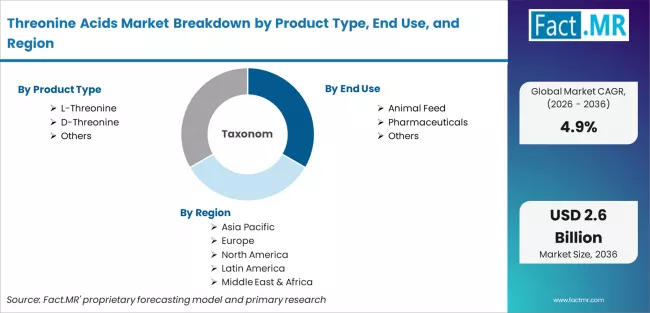
Threonine Acids Market Breakdown By Product Type, End Use, And Region | Source: Fact.MR
| Quantitative Units | USD 1.6 billion (2026) to USD 2.4 billion (2036), at a CAGR of 4.9% |
|---|---|
| Market Definition | Market covers L-Threonine, D-Threonine, and related threonine amino acid preparations from animal-based and plant-based fermentation sources supplied as essential amino acid supplements for animal feed, pharmaceutical preparations, food dietary supplements, and functional food formulations globally. |
| Product Type Segmentation | D-Threonine, L-Threonine, Others |
| End Use Segmentation | Food Dietary Supplements, Animal Feed, Pharmaceuticals, Others |
| Source Segmentation | Animal Based, Plant-Based |
| Application Coverage | Poultry and swine feed L-Threonine supplementation, pharmaceutical parenteral nutrition amino acid supply, FOSHU-labelled functional food ingredient procurement, nutraceutical dietary supplement formulation, aquaculture amino acid precision nutrition, and clinical nutrition product development. |
| Regions Covered | North America, Europe, Asia Pacific, Latin America, Middle East and Africa |
| Countries Covered | USA, Canada, Mexico, Germany, UK, France, Italy, Spain, Nordic, BENELUX, Eastern Europe, China, Japan, South Korea, India, ASEAN, Australia and New Zealand, Brazil, Argentina, Chile, Saudi Arabia, GCC, Turkey, South Africa, Rest of MEA |
| Key Companies Profiled | Evonik Industries, Ajinomoto Co. Inc., AMINO GmbH, Mitsubishi Tanabe Pharma Corporation, Kyowa Hakko Bio Co. Ltd., Tianjin Tianyao Pharmaceuticals Co. Ltd., Yangzhou Gami Biochem Co. Ltd., Summit Ingredients, SIGMA TAU Pharmaceuticals, Shanghai Kyowa Amino Acid Co. Ltd. |
| Forecast Period | 2026 to 2036 |
| Approach | Hybrid top-down and bottom-up model using threonine production volumes by product type and end use, average selling prices by grade and geography, animal feed amino acid inclusion benchmarks, pharmaceutical amino acid procurement data, and primary interviews with feed nutrition consultants and pharmaceutical amino acid procurement managers. |
Source: Fact.MR analysis. Updated Mar 27, 2026
Threonine Acids Market by Segments
-
By Product Type :
- D-Threonine
- L-Threonine
- Others
-
By End Use :
- Food Dietary Supplements
- Animal Feed
- Pharmaceuticals
- Others
-
By Source :
- Animal Based
- Plant-Based
-
By Region :
- North America
- United States
- Canada
- Mexico
- Latin America
- Brazil
- Mexico
- Argentina
- Chile
- Rest of Latin America
- Western Europe
- Germany
- United Kingdom
- France
- Italy
- Spain
- Nordic Countries
- BENELUX
- Rest of Western Europe
- Eastern Europe
- Russia
- Poland
- Hungary
- Balkan and Baltic
- Rest of Eastern Europe
- East Asia
- China
- Japan
- South Korea
- South Asia and Pacific
- India
- ASEAN
- Australia and New Zealand
- Rest of South Asia and Pacific
- Middle East and Africa
- Kingdom of Saudi Arabia
- Other GCC Countries
- Turkey
- South Africa
- Rest of Middle East and Africa
- North America
Frequently Asked Questions
How large is the threonine acids market in 2025?
What will the market size be in 2026?
What is the projected market size by 2036?
What is the expected CAGR of the threonine acids market?
What is the absolute dollar opportunity in this market?
Which product type segment leads the market?
Which end-use segment holds the largest share?
Which region grows fastest?
Which country shows the fastest growth?
What is driving growth in the threonine acids market?
Why is L-Threonine the dominant segment?
Which region leads the threonine acids market?
Why is pharmaceutical-grade threonine gaining importance?
What challenges does the market face?
How is regulation impacting the market?
What is the role of threonine in animal feed?
Who worked on this report


Preview the report firsthand - request a free sample
Free SampleGet the brochure for pricing and purchase details
Download PDF