- Base Value(2025): 707.8 Mn
- Forecast Value (2035): 2939.2 Mn
- CAGR (2035): 15.4%
Ticket Validators Market Outlook 2025 to 2035
The global ticket validators market is expected to reach USD 2,939.2 Million by 2035, up from USD 707.8 Million in 2025. During the forecast period 2025 to 2035, the industry is projected to expand at a CAGR of 15.3%.
The ticket validators market is growing as more people are adopting contactless and automated fare collection systems in all types of transport, events, and smart cities. The main factors are increasing urbanization, increasing volumes of people on movement and the need to travel smoothly without cash.
Mobile ticketing and IoT integration and AI-controlled validation systems make it more efficient and convenient. Moreover, the state programs of intelligent transportation, the introduction of digital payments, and the necessity of reliable and quality control of fares contribute to the development of the market.
Quick Stats for Ticket Validators Market
- Industry Value (2025): USD 707.8 Million
- Projected Value (2035): USD 2,939.2 Million
- Forecast CAGR (2025 to 2035): 15.3%
- Leading Segment (2025): Hardware (52.7% Market Share)
- Fastest Growing Country (2025-2035): India (18.5% CAGR)
- Top Key Players: Cubic Transportation Systems, Thales Group, Scheidt & Bachmann, BookMyShow, Siemens, Kapsch TrafficCom, Genfare, Parkeon, Luminator Technology Group and StubHub
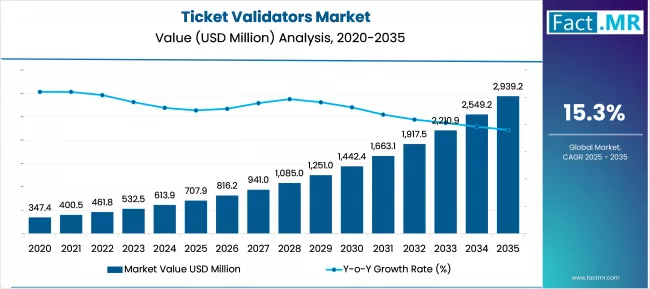
Ticket Validators Market Market Value Analysis | Source: Fact.MR
What are the drivers of the Ticket Validators Market?
The ticket validators market is experiencing an active development due to the fact that the transportation authorities and organizers of events are turning to automated, contactless fare collection to improve their efficiency and convenience to the passengers. Increasing urbanization, growth in the use of public transportation and the need to use cashless and smooth means of transport is leading to the uptake.
By combining with mobile ticketing applications, smart cards, and IoT-enabled devices, real-time validation and data analytics can be offered to enhance operational management. The development of AIs and machine learning streamlines the identification of fraud and passenger traffic.
Government efforts to promote intelligent transportation, uptake of digital payments, and partnerships between technology vendors and transit agencies are rapidly increasing the implementation of ticket validator systems around the world.
What are the regional trends of the Ticket Validators Market?
Infrastructure maturity, development of the public transit, and regulatory support determine the regional adoption of the ticket validators market. The developed transit networks and extensive contactless fare use in buses and metros are advanced in North America.
Europe lays stress on intelligent and sustainable transport including environmental friendly validators and incorporation in the mobility of the urban projects.
Asia-Pacific, China, India, and Southeast Asia have the advantage of the rapid urbanization, adoption of digital payments, and the growth of metro networks to the point of deploying ticket validators everywhere.
Latin America is concerned about modernization of the transport systems and enhanced convenience to the commuters with automated fare collections. Middle East and Africa embrace the adoption of smart cities and retail transport solution, which leads to the growth of the market.
What are the challenges and restraining factors of the Ticket Validators Market?
The ticket validators market is experiencing the challenges of high cost of installation and maintenance, especially to the small and mid-sized transit operators. The complexity of technologies, such as the integration with mobile ticketing, IoT, and old transit systems, prevents quick deployment. The operational barriers are the regulatory variations and compliance standards among the regions, whereas the uneven infrastructure, internet connectivity and the use of digital payments influence the performance.
Digital fare collection has data security and privacy issues that are also dangerous. Also, lack of digital literacy in some areas may hamper rapid adoption, and inconsistency in standards of smart transit systems impedes interoperability, so the global commercialization and scalability of ticket validator solutions may be difficult.
Country-Wise Insights
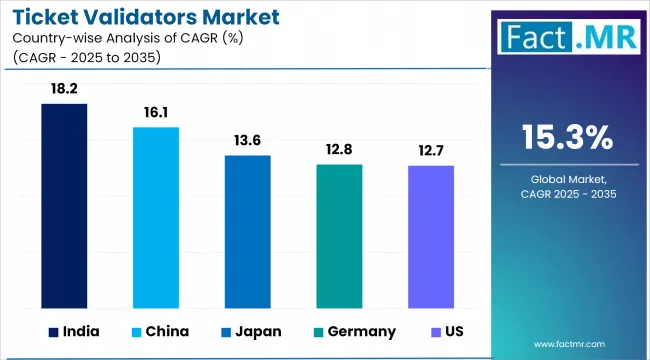
Ticket Validators Market Cagr Analysis By Country | Source: Fact.MR
Germany leads in smart transit with advanced ticket validators
The German Ticket Validators Market is growing at an accelerated rate as a result of the adoption of contactless and automated fare collection systems in urban and intercity transport systems. Cities like Berlin, Munich, and Hamburg are on the top of the list of adoption because of tech-savvy passengers and government projects of smart mobility.
Commuter convenience is improved by investment in digital ticketing infrastructure and mobile application and smart card interoperability. Deployment is further increased by the growing need to have efficient public transportation and sustainability policies. Greater urbanization, modernization of the Metro and buses, and the cooperation between the technology suppliers and transit companies make Germany a key point of the ticket validators solutions.
China rapidly adopts contactless ticketing across urban transport networks
The Chinese Ticket Validators Market is developing at a high rate because such cities as Beijing, Shanghai and Guangzhou are developing metro and bus systems that have smart features in terms of ticketing. The fast pace of urbanization, an increasing population density, and an increase in commuter demand are compelling transit authorities to implement a contactless fare collection solution.
Mobile apps, QR, and digital payment system integration can make commuting more convenient. Smart city programs and modernization projects in the field of the transport sector supported by the government contribute to a broad implementation. Also in use, partnerships with technology suppliers and increasing consumer demands of seamless, cashless travel are driving adoption, and China is one of the most rapidly expanding markets of ticket validator technologies.
India’s public transport modernizes with digital ticket validation solutions
The ticket validators market in India is growing briskly as metro and bus networks in the cities of Delhi, Mumbai, and Bangalore turn to automated fare collection systems. The growing urban population, the growing use of digital payments, and the governmental efforts are directed at smart urban mobility.
Mobile ticketing, smart cards, and IoT-enabled validation integration can improve the efficiency of operations and convenience to passengers. The demands of a smooth, non-contactless transportation, in combination with the ever-growing extensions of the metro network, as well as the modernization of the infrastructure of the public transport system in India, predisposes the country to a rapid rise of the market of ticket validators, with both local and foreign technological companies investing therein.
Category-Wise Analysis
Hardware segment powers ticket validation with reliable devices globally
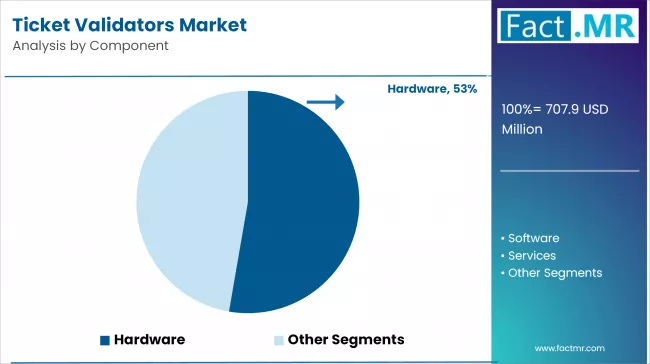
Ticket Validators Market Analysis By Component | Source: Fact.MR
Hardware is the foundation of the Ticket Validators Market, with the handheld scanners, kiosks, fixed validators and integrated fare collection terminals. Such devices play an important role in precision in processing fares, minimizing human error, and operational efficiency in the entire public transportation.
The adoption of hardware is stimulated by modernization of metro, bus, and rail networks, and the government programs to adopt smart cities. It can be easily integrated with software and IoT-enabled systems to ensure real-time monitoring, anticipatory maintenance, and upgrades in an easy way. Hardware is a major area of growth in the market as the demand to have secure, durable, and scalable devices increase.
Contactless smart cards enable fast, secure fare payments
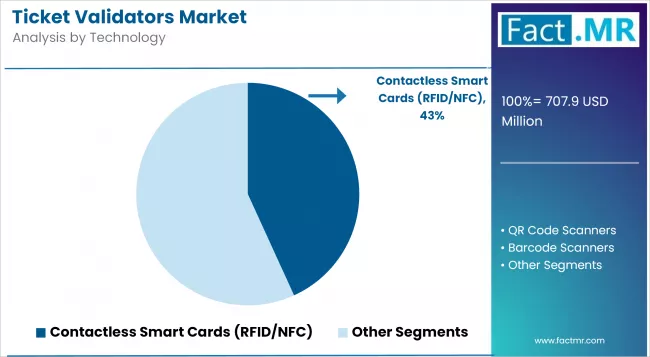
Ticket Validators Market Analysis By Technology | Source: Fact.MR
Contactless smart cards, RFID and NFC-based smart card solutions are also an emerging portion of the ticketing validation market, and commuters are presented with convenient methods of paying fares in a safe and quick manner. These cards decrease cash-based transactions, decrease the number of queues and improve the passenger experience in metros, buses and trams. Connection to mobile apps and digital wallets enables a seamless recharge and cross-maturity between various transit networks.
Smart cards are being encouraged by governments and transport authorities to enhance cashless travel, enhance efficiency and gather ridership information to facilitate planning. Their importance is demonstrated by high adoption in the urban centers and tech-enabled cities.
Public transportation drives adoption of automated ticket validation systems
The majority of ticket validators are sold to the end-user market of the public transportation segment because the metro, buses, and railways need automated fare collection to serve large quantities of passengers. Adoption in this sector is driven by urbanization, increasing commuter demand and the requirements to achieve operational efficiency.
Ticket validators enhance faster delivery, less fare evasion and the incorporation of mobile applications and smart cards. The government efforts of modernizing the city mobility and establishing cashless, contactless systems further speed up the deployment. This segment is one of the key sources of income because the authorities in the field of public transport are investing in the development of sophisticated validation systems to deliver safe, convenient, and efficient transportation.
Competitive Analysis
The Key players in the Ticket Validators Market are Cubic Transportation Systems, Thales Group, Scheidt & Bachmann, BookMyShow, Siemens, Kapsch TrafficCom, Genfare, Parkeon, Luminator Technology Group and StubHub.
The Ticket Validators Market is getting more and more competitive with hardware manufacturers, software developers and transit solution providers innovating to take their share of the market. Major stakeholders are spending on new contactless technology, IoT-compliant verification systems, AI-driven fraud detection, and mobile-integrated services to increase efficiency and consumer comfort. It is not uncommon to have strategic alliances and cooperation with government agencies in transport and technology companies to expand implementation in urban metros, buses, and railways.
Leaders in the market concentrate on providing an end-to-end solution, such as hardware, software, and maintenance services, whereas regional players concentrate on the local transit network solutions tailored based on their requirements. The competitive landscape is beginning to show sustainable, energy-efficient, and point of payment integration as a major difference maker.
Recent Development
- In March 2025, Scheidt and Bachmann added to its smart bus ticketing family by attaching the QR code and barcode scanning features. This will enable the passengers to access digital tickets via smartphones enhancing convenience and sustainability, besides placing the company at the center of digital fare collection technology.
- In Jan 2025, Cubic Transportation Systems upgraded the contactless ticket validators with the new RFID and NFC technologies. These validators allow secure and quicker fare collection in urban metros and buses and allow mobile wallets and contactless cards. This new technology enhances Cubic as a prominent supplier of intelligent ticketing systems in the world market.
Fact.MR has provided detailed information about the price points of key manufacturers of Ticket Validators Market positioned across regions, sales growth, production capacity, and speculative technological expansion, in the recently published report.
Methodology and Industry Tracking Approach
The Global Ticket Validators Market report by Fact.MR (2025) interviewed 10,500 stakeholders in 30 countries (at least 300 in each major region). Close to 60 percent of the respondents were transit operators, public transport authorities, and other event organizers whereas 40 percent were technology providers, system integrators, and policymakers.
The data were collected between June 2024 and May 2025, including adoption trends, investment in ticketing technology, regulatory effects, market potential and challenges. More than 250 secondary sources such as patents, industry reports, regulatory documents and scholarly literature were examined. Enhanced techniques were used to come up with reliable and accurate market forecasts, including regression analysis, scenario-based forecasts and market models.
With Fact.MR monitoring consumer behavior, product efficacy, industry trends, and market opportunities since 2018, this report is becoming an authoritative source of information that stakeholders can rely on.
Segmentation
Segmentation of Ticket Validators Market
-
By Component :
- Hardware
- Software
- Services
-
By Technology :
- Contactless Smart Cards (RFID/NFC)
- QR Code Scanners
- Barcode Scanners
- Magnetic Stripe Readers
-
By Application :
- Public Transportation
- Private Transportation
- Tourism & Leisure
- Educational Institutions
- Parking & Toll Systems
- Airports & Transit Hubs
- Healthcare & Corporate Campuses
-
By End-User :
- Bus Operators
- Rail & Metro Operators
- Airports & Airlines (Shuttle / Ground Transport)
- Corporate Fleets
- Educational Institutions
- Event Venues & Entertainment
- Tourism & Theme Parks
- Parking & Toll Management
- Government & Public Services
-
By Region :
- North America
- Latin America
- Western Europe
- Eastern Europe
- East Asia
- South Asia & Pacific
- Middle East & Africa
Frequently Asked Questions
What was the Global Ticket Validators Market Size Reported by Fact.MR for 2025?
Who are the Major Players Operating in the Ticket Validators Market?
What is the Estimated Valuation of the Ticket Validators Market in 2035?
What Value CAGR did the Ticket Validators Market Exhibit Over the Last Five Years?
Who worked on this report


Preview the report firsthand - request a free sample
Free SampleGet the brochure for pricing and purchase details
Download PDF