- Market Value (2025): USD 1.4 Bn
- Estimated Value (2026): USD 1.5 Bn
- Forecast Value (2036): USD 2.8 Bn
- CAGR (2026-2036): 6.3%
What is the Urine Testing Cups Market forecast to be worth by 2036?
USD 1.5 billion in 2026 to USD 2.8 billion by 2036, at a 6.3% CAGR.
Workplace and clinical demand should be read with Fact.MR's Point of Care Drug of Abuse Testing Market, since urine cups often serve the same rapid screening need.
- The urine testing cups market reached USD 1.4 billion in 2025 as diagnostic laboratories and medical distributors spent against a clear use case: integrated urine specimen collection and rapid multi-panel screening for drugs, medications and compliance monitoring.
- Demand is projected to increase from USD 1.5 billion in 2026 to USD 2.8 billion by 2036, at a 6.3% CAGR.
- The market is forecast to record 6.3% CAGR from 2026 to 2036 as companies prove integrated urine specimen collection and compliance monitoring.
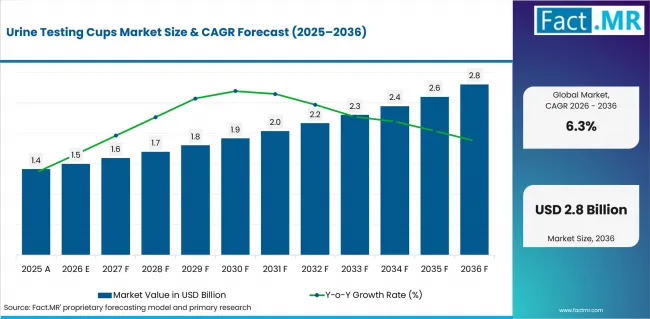
Urine Testing Cups Market Value Analysis | Source: Fact.MR
What are the defining numbers behind Urine Testing Cups Market growth?
USD 1.3 billion absolute opportunity is expected by 2036.
Testing volume connects with Fact.MR's Drug Screening Market, where policy, chain of custody and turnaround decide product selection.
- Demand Drivers in the Market
- Multi-panel urine testing cups lead as buyers prefer one collection device that can screen several drug classes in a single workflow.
- Drug abuse screening leads because workplace, clinical, treatment and justice settings need quick presumptive results before confirmatory testing decisions.
- Hospitals and diagnostic laboratories lead as they combine test volume, chain-of-custody discipline and access to confirmation pathways.
- Direct sales lead as institutions buy by panel configuration, volume, documentation, CLIA or regulatory status and distribution reliability.
- Key Segments Analyzed
- By Product Type: Multi-Panel Urine Testing Cups is projected to hold 40.4% share in 2026. Multi-panel urine testing cups lead as they reduce handling steps and allow several drug classes to be screened from the same specimen.
- By End User: Hospitals & Diagnostic Laboratories is projected to hold 31.6% share in 2026. Hospitals and diagnostic laboratories lead as they can combine rapid screening with confirmatory testing and documented procedures.
- By Distribution Channel: Direct Sales is projected to hold 34.8% share in 2026. Direct sales lead as institutional buyers specify panel counts, cutoffs, validation status and shipment reliability.
- By Test Panel: 10-Panel Tests is projected to hold 40.2% share in 2026. 10-panel tests lead as they balance broad drug coverage with manageable cost and readable results.
- Analyst Opinion at Fact.MR
- Shambhu Nath Jha, Sr. Consultant at Fact.MR, opines, "Urine testing cups grow when they make screening easier without weakening evidence. The best products help collectors control the specimen, read the panel correctly and know when confirmation is needed."
- Strategic Implications
- Companies should position cups by panel configuration, cutoff clarity, specimen validity features and confirmation workflow support.
- Healthcare buyers should align panel selection with local drug trends and clinical use case rather than buying only by panel count.
- Distributors should maintain documentation packs for FDA status, CLIA status, instructions, shelf life and lot traceability.
USA continues to be a leading market and is projected to grow at a CAGR of 8.16%; other key markets include USA, UK, Canada, Germany.
How does the Urine Testing Cups Market break down by segment?
Multi-Panel Urine Testing Cups leads Product Type at 40.4%.
Near-patient testing links to Fact.MR's Point of Care Diagnostics Market, because cup formats compete on speed and ease of use at the collection site.
Why does Multi-Panel Urine Testing Cups lead Product Type?
Multi-Panel Urine Testing Cups is projected to account for 40.4% share in 2026.
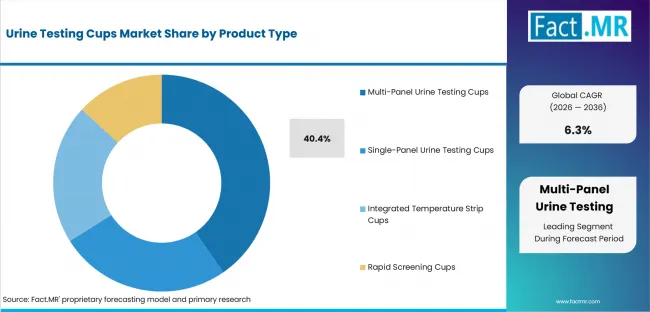
Urine Testing Cups Market Analysis By Product Type | Source: Fact.MR
Multi-panel urine testing cups lead as they reduce handling steps and allow several drug classes to be screened from the same specimen.
Why does Drug Abuse Screening lead Application?
Drug Abuse Screening is projected to account for 32.4% share in 2026.

Urine Testing Cups Market Analysis By Application | Source: Fact.MR
Drug abuse screening leads because urine testing cups are most often used where collectors need a quick presumptive result before confirmation, workplace action or clinical follow-up.
Why does Hospitals & Diagnostic Laboratories lead End User?
Hospitals & Diagnostic Laboratories is projected to account for 31.6% share in 2026.
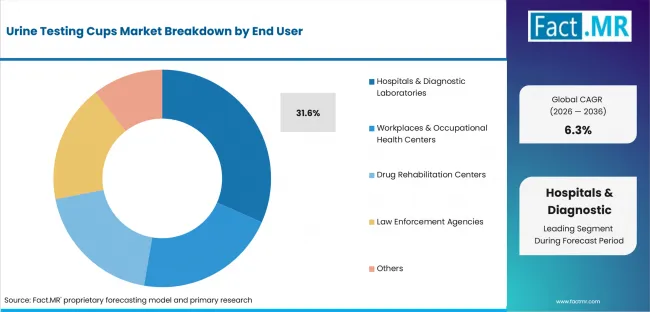
Urine Testing Cups Market Analysis By End User | Source: Fact.MR
Hospitals and diagnostic laboratories lead as they can combine rapid screening with confirmatory testing and documented procedures.
Why does Direct Sales lead Distribution Channel?
Direct Sales is projected to account for 34.8% share in 2026.
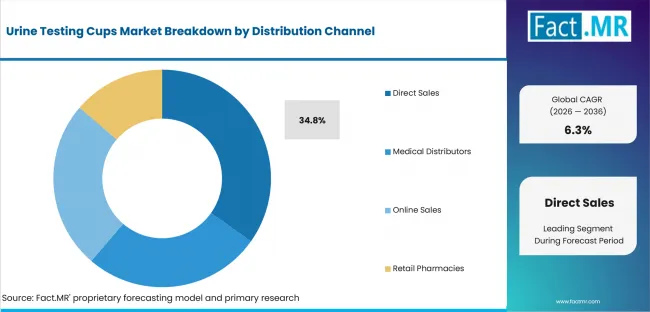
Urine Testing Cups Market Analysis By Distribution Channel | Source: Fact.MR
Direct sales lead as institutional buyers specify panel counts, cutoffs, validation status and shipment reliability.
Why does 10-Panel Tests lead Test Panel?
10-Panel Tests is projected to account for 40.2% share in 2026.
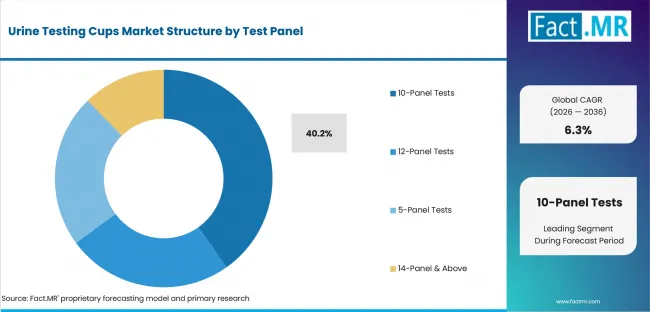
Urine Testing Cups Market Analysis By Test Panel | Source: Fact.MR
10-panel tests lead as they balance broad drug coverage with manageable cost and readable results.
What is accelerating Urine Testing Cups Market adoption, and what is holding it back?
Urine testing cup demand rises when workplaces, clinics and treatment programs need specimen collection and multi-drug screening in the same controlled device. Adoption slows when buyers need confirmatory testing before a presumptive result can support a final decision.
Low-cost format design should be compared with Fact.MR's Paper Diagnostics Market, where simple substrates support decentralized testing.
Drivers Impact Analysis
| DRIVER | QUALITATIVE RELEVANCE | GEOGRAPHIC RELEVANCE | IMPACT TIMELINE |
|---|---|---|---|
| Multi-panel screening in one device | High | South Korea | Short term (<=2 years) |
| Workplace and clinical drug screening | High | USA | Short term (<=2 years) |
| Hospital and lab confirmation pathways | Moderate | UK | Medium term (2-4 years) |
| Direct institutional procurement | Selective | Canada | Medium term (2-4 years) |
Source: Fact.MR analysis. Updated Jul 30, 2026
- Multi-panel screening in one device: Multi-panel urine testing cups lead as buyers prefer one collection device that can screen several drug classes in a single workflow.
- Workplace and clinical drug screening: Drug abuse screening leads because workplace, clinical, treatment and justice settings need quick presumptive results before confirmatory testing decisions.
- Hospital and lab confirmation pathways: Hospitals and diagnostic laboratories lead as they combine test volume, chain-of-custody discipline and access to confirmation pathways.
- Direct institutional procurement: Direct sales lead as institutions buy by panel configuration, volume, documentation, CLIA or regulatory status and distribution reliability.
Opportunity Impact Analysis
| OPPORTUNITY | QUALITATIVE RELEVANCE | GEOGRAPHIC RELEVANCE | IMPACT TIMELINE |
|---|---|---|---|
| Synthetic-drug panel expansion | High | USA | Medium term (2-4 years) |
| Tamper and temperature validity features | Moderate | South Korea | Medium term (2-4 years) |
| Treatment-program monitoring demand | Selective | UK | Medium term (2-4 years) |
Source: Fact.MR analysis. Updated Jul 30, 2026
- Synthetic-drug panel expansion: Fentanyl and synthetic-drug panel expansion can create upgrade demand where legacy panels miss changing drug patterns.
- Tamper and temperature validity features: Tamper-evident packaging, temperature strips and chain-of-custody documentation can support institutional purchasing.
- Treatment-program monitoring demand: Treatment programs can increase repeat demand where point-of-care screening supports clinical monitoring.
Restraints Impact Analysis
| RESTRAINT | QUALITATIVE RELEVANCE | GEOGRAPHIC RELEVANCE | IMPACT TIMELINE |
|---|---|---|---|
| Need for confirmatory testing | High | USA | Short term (<=2 years) |
| Panel mismatch with local drug trends | Moderate | South Korea | Medium term (2-4 years) |
| Collection and reading-window errors | Selective | Canada | Medium term (2-4 years) |
Source: Fact.MR analysis. Updated Jul 30, 2026
- Need for confirmatory testing: Presumptive results require confirmation in many settings, which limits the cup's role as a final decision tool.
- Panel mismatch with local drug trends: Panel mismatch can reduce value when local drug patterns change faster than procurement specifications.
- Collection and reading-window errors: Improper collection, storage or reading windows can create disputed results and buyer distrust.
Which countries are scaling Urine Testing Cups Market fastest?
Country rates show where buying conditions and supplier proof are already stronger.
Specimen handling connects with Fact.MR's Body Fluid Collection and Diagnostics Market, since cup reliability depends on secure collection and clear result reading.
- South Korea: The market is expected to grow at a CAGR of 4.45% from 2026 to 2036. South Korea's growth is supported by hospital procurement discipline and demand for reliable point-of-care diagnostic workflows.
- USA: The market is expected to grow at a CAGR of 8.16% from 2026 to 2036. USA demand is shaped by workplace screening, substance-use treatment, clinical monitoring and FDA-regulated drugs-of-abuse tests.
- UK: The market is expected to grow at a CAGR of 6.32% from 2026 to 2036. UK adoption is tied to clinical services, workplace testing and procurement standards that require clear documentation and confirmation pathways.
- Canada: The market is expected to grow at a CAGR of 5.64% from 2026 to 2036. Canada's market follows workplace safety, treatment programs and laboratory-backed screening demand.
- Germany: The market is expected to grow at a CAGR of 6.94% from 2026 to 2036. Germany's adoption is guided by diagnostic quality expectations, documentation and cautious use of rapid tests in institutional settings.
- Australia: The market is expected to grow at a CAGR of 5.08% from 2026 to 2036. Australia benefits from workplace safety programs and clinical testing, with panel selection shaped by local drug-use patterns.
- Japan: The market is expected to grow at a CAGR of 7.54% from 2026 to 2036. Japan's outlook is steadier because institutional use is selective and buyers emphasize quality, documentation and distributor reliability.
The full report provides country-level CAGR analysis across North America, Latin America, Europe, East Asia, South Asia and Oceania, and the Middle East and Africa.
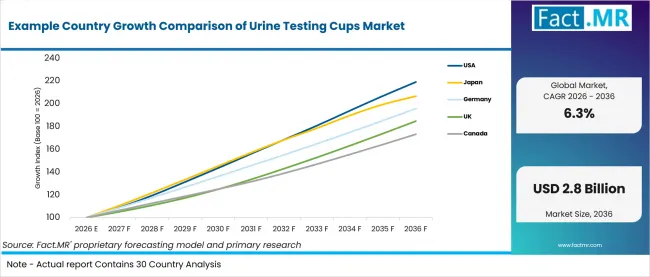
Example Country Growth Comparison Of Urine Testing Cups Market | Source: Fact.MR
| Country | CAGR (2026-2036) |
|---|---|
| South Korea | 4.45% |
| USA | 8.16% |
| UK | 6.32% |
| Canada | 5.64% |
| Germany | 6.94% |
| Australia | 5.08% |
| Japan | 7.54% |
Source: Fact.MR analysis. Updated Jul 30, 2026
What is shaping South Korea's outlook through 2036?
4.45% CAGR from 2026 to 2036.
South Korea's growth is supported by hospital procurement discipline and demand for reliable point-of-care diagnostic workflows.
What is shaping USA's outlook through 2036?
8.16% CAGR from 2026 to 2036.
USA demand is shaped by workplace screening, substance-use treatment, clinical monitoring and FDA-regulated drugs-of-abuse tests.
What is shaping UK's outlook through 2036?
6.32% CAGR from 2026 to 2036.
UK adoption is tied to clinical services, workplace testing and procurement standards that require clear documentation and confirmation pathways.
What is shaping Canada's outlook through 2036?
5.64% CAGR from 2026 to 2036.
Canada's market follows workplace safety, treatment programs and laboratory-backed screening demand.
What is shaping Germany's outlook through 2036?
6.94% CAGR from 2026 to 2036.
Germany's adoption is guided by diagnostic quality expectations, documentation and cautious use of rapid tests in institutional settings.
Who leads the Urine Testing Cups Market?
Abbott Laboratories; Thermo Fisher Scientific; QuidelOrtho Corporation; Siemens Healthineers are among the visible providers in the urine testing cups market.
Abbott Laboratories and Thermo Fisher Scientific are among the most visible providers. Competition is shaped by product proof, channel access and buyer trust.
Between 2026 and 2036, market rivalry is likely to center on clearer positioning around Multi-Panel Urine Testing Cups, stronger documentation and better support at the point of purchase.
Which companies are the key providers?
Key companies include Abbott Laboratories; Thermo Fisher Scientific; QuidelOrtho Corporation; Siemens Healthineers; ACON Laboratories; Premier Biotech; Confirm Biosciences; MEDTOX Diagnostics.
- Abbott Laboratories
- Thermo Fisher Scientific
- QuidelOrtho Corporation
- Siemens Healthineers
- ACON Laboratories
- Premier Biotech
- Confirm Biosciences
- MEDTOX Diagnostics
Bibliography
- U.S. FDA, Drugs of Abuse Tests.
- CDC, Clinical Drug Test Dashboard.
- CDC, Clinical Drug Test Dashboard Key Findings.
- SAMHSA, Data.
- SAMHSA, National Helpline.
- Fact.MR, Point of Care Drug of Abuse Testing Market.
This Report Answers
- The report provides strategic intelligence on the Urine Testing Cups Market across segment choices that shape the 2026 market structure.
- Segment analysis covers Multi-Panel Urine Testing Cups and Drug Abuse Screening as the share leaders within the 2026 market.
- Country outlook evaluates the listed markets by CAGR and explains the adoption conditions in each country.
- Competitive analysis profiles the named providers and evaluates competition around product proof, channel access and buyer trust.
- Related Fact.MR coverage helps readers compare urine testing cups with adjacent point-of-care diagnostics and drug-of-abuse testing workflows.
What does the Urine Testing Cups Market cover?
The Urine Testing Cups Market covers single-panel and multi-panel urine testing cups, integrated collection cups, specimen-validity cups and rapid drugs-of-abuse screening cups used in hospitals, laboratories, workplaces, treatment centers and justice settings.
The Urine Testing Cups Market covers single-panel and multi-panel urine testing cups, integrated collection cups, specimen-validity cups and rapid drugs-of-abuse screening cups used in hospitals, laboratories, workplaces, treatment centers and justice settings.
Adjacent spending is included only when it is part of the same purchase decision or operating use case.
What is included in the scope?
The scope includes Product Type, Application, End User, Distribution Channel, Test Panel and regional demand.
Coverage includes adjacent segment options only when they are purchased for the same defined market use.
What is excluded from the scope?
blood, saliva and hair testing products, laboratory analyzers sold separately, confirmatory mass-spectrometry services and urine collection cups without diagnostic test panels.
The scope excludes blood, saliva and hair testing products, laboratory analyzers sold separately, confirmatory mass-spectrometry services and urine collection cups without diagnostic test panels.
How Was the Analysis Built?
The analysis combines primary research with desk research focused on the urine testing cups market, its segment structure and country-level demand.
- Primary Research: Interviews and validation discussions test buyer priorities, adoption barriers, pricing logic and operating requirements.
- Desk Research: The assessment reviews company disclosures, public datasets, regulatory material, technical literature and industry records relevant to the market.
- Market Sizing and Forecasting: Estimates combine top-down and bottom-up checks across demand signals, segment shares, country activity, company participation and adoption constraints.
- Data Validation and Update Cycle: Findings are validated against public evidence, company activity and country-level adoption patterns before final use.
Segmentation
What is the report's scope and coverage?
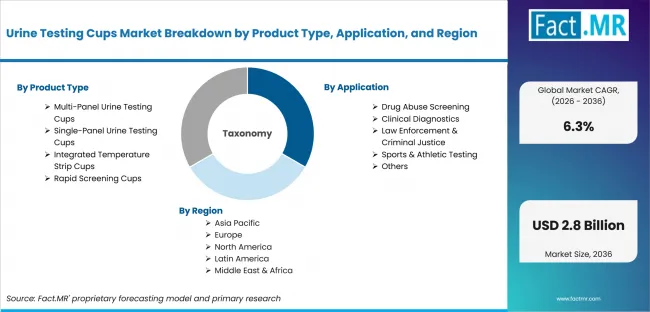
Urine Testing Cups Market Breakdown By Product Type, Application, And Region | Source: Fact.MR
| Attribute | Details |
|---|---|
| Quantitative Units | USD 1.5 billion in 2026 to USD 2.8 billion by 2036, at a 6.3% CAGR. |
| Market Definition | Urine Testing Cups Market covers single-panel and multi-panel urine testing cups, integrated collection cups, specimen-validity cups and rapid drugs-of-abuse screening cups used in hospitals, laboratories, workplaces, treatment centers and justice settings. |
| Product Type | Multi-Panel Urine Testing Cups; 10-Panel Test Cups; 12-Panel Test Cups; Single-Panel Urine Testing Cups; Drug-Specific Test Cups; Pregnancy Test Cups; Integrated Temperature Strip Cups; Adulteration Detection Cups; Temperature Indicator Cups; Rapid Screening Cups; CLIA-Waived Cups; Point-of-Care Test Cups |
| Application | Drug Abuse Screening; Workplace Drug Testing; Pre-Employment Screening; Clinical Diagnostics; Hospital Testing; Primary Care Testing; Law Enforcement & Criminal Justice; Probation Testing; Forensic Drug Screening; Sports & Athletic Testing; Anti-Doping Programs; Fitness Organizations; Others; Home Testing; School Screening |
| End User | Hospitals & Diagnostic Laboratories; Hospitals; Diagnostic Laboratories; Workplaces & Occupational Health Centers; Corporate Screening Programs; Industrial Health Centers; Drug Rehabilitation Centers; Addiction Treatment Centers; Behavioral Health Clinics; Law Enforcement Agencies; Police Departments; Correctional Facilities; Others; Home Users; Educational Institutions |
| Distribution Channel | Direct Sales; Hospital Procurement; Institutional Contracts; Medical Distributors; National Distributors; Regional Distributors; Online Sales; E-commerce Platforms; Manufacturer Websites; Retail Pharmacies; Chain Pharmacies; Independent Pharmacies |
| Test Panel | 10-Panel Tests; Amphetamines; Opiates; 12-Panel Tests; Benzodiazepines; Methadone; 5-Panel Tests; Cannabinoids; Cocaine; 14-Panel & Above; Fentanyl; Synthetic Opioids |
| Regions Covered | North America; Latin America; Europe; East Asia; South Asia and Oceania; Middle East and Africa |
| Countries Covered | South Korea; USA; UK; Canada; Germany; Australia; Japan |
| Key Companies Profiled | Abbott Laboratories; Thermo Fisher Scientific; QuidelOrtho Corporation; Siemens Healthineers; ACON Laboratories; Premier Biotech; Confirm Biosciences; MEDTOX Diagnostics |
| Forecast Period | 2026 to 2036 |
| Approach | Hybrid top-down and bottom-up assessment using demand indicators, segment mix, country growth, company participation and public evidence relevant to the category. |
Source: Fact.MR analysis. Updated Jul 30, 2026
How is the market segmented?
-
By Product Type:
- Multi-Panel Urine Testing Cups
- 10-Panel Test Cups
- 12-Panel Test Cups
- Single-Panel Urine Testing Cups
- Drug-Specific Test Cups
- Pregnancy Test Cups
- Integrated Temperature Strip Cups
- Adulteration Detection Cups
- Temperature Indicator Cups
- Rapid Screening Cups
- CLIA-Waived Cups
- Point-of-Care Test Cups
-
By Application:
- Drug Abuse Screening
- Workplace Drug Testing
- Pre-Employment Screening
- Clinical Diagnostics
- Hospital Testing
- Primary Care Testing
- Law Enforcement & Criminal Justice
- Probation Testing
- Forensic Drug Screening
- Sports & Athletic Testing
- Anti-Doping Programs
- Fitness Organizations
- Others
- Home Testing
- School Screening
-
By End User:
- Hospitals & Diagnostic Laboratories
- Hospitals
- Diagnostic Laboratories
- Workplaces & Occupational Health Centers
- Corporate Screening Programs
- Industrial Health Centers
- Drug Rehabilitation Centers
- Addiction Treatment Centers
- Behavioral Health Clinics
- Law Enforcement Agencies
- Police Departments
- Correctional Facilities
- Others
- Home Users
- Educational Institutions
-
By Distribution Channel:
- Direct Sales
- Hospital Procurement
- Institutional Contracts
- Medical Distributors
- National Distributors
- Regional Distributors
- Online Sales
- E-commerce Platforms
- Manufacturer Websites
- Retail Pharmacies
- Chain Pharmacies
- Independent Pharmacies
-
By Test Panel:
- 10-Panel Tests
- Amphetamines
- Opiates
- 12-Panel Tests
- Benzodiazepines
- Methadone
- 5-Panel Tests
- Cannabinoids
- Cocaine
- 14-Panel & Above
- Fentanyl
- Synthetic Opioids
-
By Region:
- North America
- Latin America
- Europe
- East Asia
- South Asia and Oceania
- Middle East and Africa
Frequently Asked Questions
Which Product Type leads the market?
Which Application leads the market?
Which End User leads the market?
Which Distribution Channel leads the market?
Which Test Panel leads the market?
Which country records the highest listed CAGR?
What is the primary driver in this market?
What is the main restraint?
Who worked on this report


Preview the report firsthand - request a free sample
Free SampleGet the brochure for pricing and purchase details
Download PDF