Vital Signs Simulator Market (2026 - 2036)

Vital Signs Simulator Market is segmented by Product Type (Patient Simulators, Task Trainers, and Surgical Simulators), End User (Hospitals, Academic Institutes, and Ambulatory Centers), and Region. Forecast for 2026 to 2036.

Core Findings

    Vital Signs Simulator Market Forecast and Outlook 2026 to 2036

    In 2025, the vital signs simulator market surpassed a valuation of USD 0.7 billion. Based on Fact.MR analysis, demand for vital signs simulators is estimated to grow to USD 0.8 billion in 2026 and USD 1.3 billion by 2036. Fact.MR projects a CAGR of 5.0% during the forecast period.

    Between 2026 and 2036, the vital signs simulator market is projected to create an absolute dollar opportunity of USD 0.5 billion. This structurally sustained expansion reflects the market's embedded position as a mandatory capital investment for healthcare education institutions subject to clinical accreditation requirements.

    Neil Weber, President, Laerdal North America, stated regarding the SimMan Critical Care launch in April 2024: 'We know that critical and respiratory care are complex areas of practice, and that simulation training, especially when conducted realistically in the actual clinical environment, can provide crucial hands-on learning opportunities to help clinicians master these skills and build preparedness using their own equipment.' [1]

    Country growth is shaped by healthcare workforce policies, accreditation standards, and hospital simulation investment. China leads at 7.2% CAGR, supported by the 14th Five-Year Plan and government backing for AI-based medical simulation. India follows at 6.9%, driven by National Medical Commission reforms requiring simulation training across medical colleges. The United States grows at 4.8%, supported by ACGME requirements, Joint Commission standards, and over 1,000 accredited simulation centres. Germany records 4.2% growth due to medical education reforms and university hospital investment. The United Kingdom expands at 3.9%, backed by NHS simulation funding but moderated by capital budget constraints.
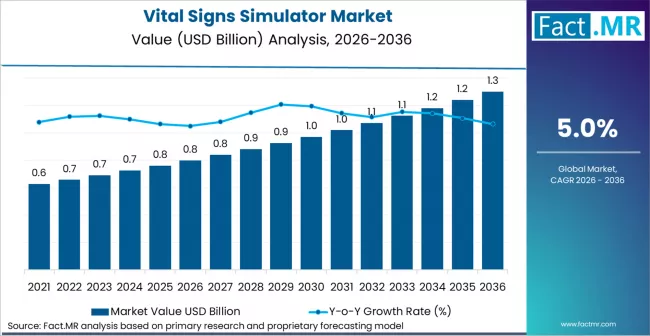
    Vital Signs Simulator Market Market Value Analysis

    Metric Value
    Estimated Value in 2026 USD 0.8 billion
    Forecast Value in 2036 USD 1.3 billion
    Forecast CAGR (2026 to 2036) 5.0%

    Market Definition

    The vital signs simulator market includes manikins, task trainers, and virtual systems that replicate heart rate, blood pressure, respiration, oxygen saturation, and temperature for clinical training. These tools support competency assessment in hospitals, medical schools, and training centres.

    Market Inclusions

    Covers global and regional forecasts (2026-2036) by product type, end user, and geography. Includes patient simulators, task trainers, surgical simulators, hardware, software, VR systems, and debriefing platforms across key countries.

    Market Exclusions

    Excludes standalone software without hardware integration, dental or ophthalmic simulators without vital signs, basic VR tools without physiology modelling, and CPR manikins lacking measurable feedback.

    Research Methodology

    • Primary Research: Interviews with simulation centre directors, academic coordinators, hospital buyers, and distributors.
    • Desk Research: Reviewed accreditation standards, health authority reports, company disclosures, and verified product launches.
    • Market Sizing and Forecasting: Combined simulation centre counts with pricing and replacement cycles.
    • Data Validation and Update Cycle: Validated using manufacturer revenues, accreditation rules, and procurement records. Updated annually.

    Summary

    • Market Definition
      • Vital signs simulators are manikins, task trainers, and virtual systems that replicate measurable physiological parameters for clinical training and accreditation-based competency assessment in a safe, controlled environment.
    • Demand Drivers
      • Accreditation standards in the U.S. create mandatory simulator procurement.
      • Healthcare workforce shortages drive simulation centre expansion in China, India, and the U.S.
      • Surgical Science’s 2025 subscription-based integration with da Vinci systems expands embedded simulator use. [2]
    • Key Segments Analyzed
      • By Product Type: Patient simulators hold 48% share, driven by hospital and university demand for high-fidelity manikins used in emergency and critical care training.
      • By End User: Hospitals account for 42% share, supported by accreditation standards and patient safety-driven simulation investment.
      • By Geography: North America leads in revenue due to mature accreditation systems, while Asia Pacific shows the fastest growth from medical and nursing school expansion.
    • Analyst Opinion at FACT.MR
      • Shambhu Nath Jha notes that the market is shifting from one-time hardware sales to recurring software subscriptions. Vendors bundling AI analytics, outcome tracking, and VR platforms with hardware will secure stronger long-term revenue and resist price commoditization.
    • Strategic Implications / Executive Takeaways
      • Manufacturers should prioritise AI debriefing and measurable competency analytics to win multi-year contracts.
      • Distributors should focus on China and India academic procurement driven by curriculum reforms.
      • Technology suppliers should offer modular upgrades with AI and VR to drive recurring licence revenue and retention.
    • Methodology
      • Sizing based on simulation centre volumes, pricing, and replacement cycles, validated with distributor and manufacturer data.
      • Shares benchmarked against accreditation standards and investment records.
      • Forecasts built using enrolment growth, workforce targets, and national health investment trends.

    Segmental Analysis

    Vital Signs Simulator Market Analysis by Product Type
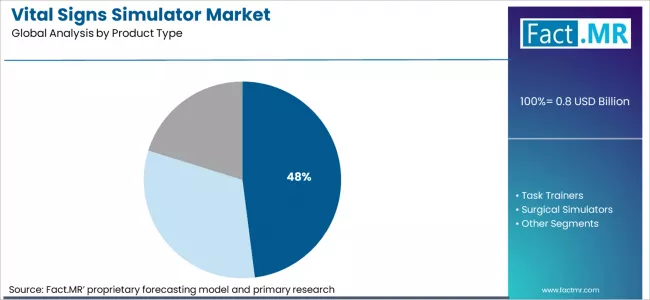
    Vital Signs Simulator Market Analysis By Product Type

    Patient Simulators are projected to hold 48% share in 2026. They dominate because they replicate full physiological response. They model heart rhythm, blood pressure, respiration, oxygen saturation, and consciousness together. Task trainers cannot replicate this complexity. Accreditation bodies increasingly require scenario-based competency validation.

    • Laerdal Medical SimMan Critical Care and Mama Anne Launches: Laerdal launched SimMan Critical Care and Mama Anne in 2024. SimMan integrates tetherless respiratory simulation via ASL 5000. Neil Weber noted it enables in situ ICU training with real equipment. Both products shipped in 2024. [1]
    • Laerdal Medical Acquisition of SIMCharacters: Laerdal acquired SIMCharacters in February 2025. The Austrian firm develops neonatal simulators including Paul, Emily, and Emma. This expands Laerdal’s neonatal ICU training portfolio. [5]
    • AI-Powered VR Integration in Patient Simulator Platforms: In April 2025, Wolters Kluwer and Laerdal added conversational AI to vrClinicals for Nursing. Students can interact verbally with virtual patients. This signals deeper AI-manikin ecosystem integration.

    Vital Signs Simulator Market Analysis by End User
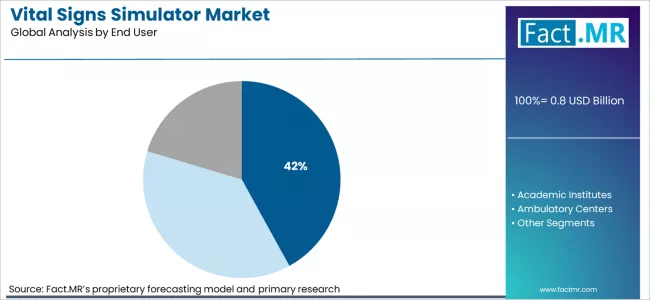
    Vital Signs Simulator Market Analysis By End User

    Hospitals are projected to hold 42% share in 2026. They operate the largest simulation centres. Residency and fellowship training are accreditation-linked. Joint Commission standards tie competency to simulation documentation. Hospitals also embed simulation into robotic surgery platforms.

    • Surgical Science and Intuitive Surgical da Vinci 5 Subscription Integration: Simulation software was embedded into da Vinci 5 under subscription pricing. FDA clearance came in March 2024 and CE approval in July 2025. This creates recurring hospital simulation spend. [2]
    • Wolters Kluwer and Laerdal vrClinicals Conversational AI Enhancement: Conversational AI was added to vrClinicals in April 2025. Nursing students can practise assessment anytime. This supplements physical simulator use. [6]
    • Hospital Simulation Centre Accreditation Expansion Trend: Accredited simulation centres in North America surpassed 1,000 in 2024. Hospitals led expansion. Accreditation-linked competency mandates continue to drive structured procurement. [7]

    Drivers, Restraints, and Opportunities

    Fact.MR values the vital signs simulator market at USD 0.7 billion in 2025. Demand is structurally anchored in accreditation. Simulation is no longer optional in healthcare education. It is required under ACGME, CCNE, Joint Commission, and National Medical Commission mandates. Institutions must document simulation hours to retain programme approval and funding. Hospitals also invest to reduce adverse events, where prevention costs are far lower than litigation or safety failures.

    • Accreditation-Linked Simulation as Non-Discretionary Procurement Floor: ACGME strengthened simulation documentation rules in 2024. CCNE requires simulation-integrated curricula across 900+ U.S. nursing programmes. Institutions risk accreditation loss without compliant simulator use. This creates a protected procurement base. [3]
    • Asia Pacific National Healthcare Workforce Expansion Policy: China’s 14th Five-Year Plan prioritises simulation investment. AI-enabled medical education use cases were formally recognised in 2024. India mandates competency-based simulation across 706 medical colleges. This creates national-scale demand. [4]
    • Surgical Robotics Platform Integration Creating Captive Simulation Installed Base: Surgical Science integrated simulation into da Vinci 5 systems under subscription pricing from 2025-2028. FDA clearance came in March 2024 and EU CE mark in July 2025. With 9,500+ da Vinci systems globally, this embeds recurring simulation spend inside hospitals.

    Regional Analysis

    The vital signs simulator market is analysed across North America, Latin America, Europe, East Asia, South Asia, Oceania and Middle East & Africa across 40+ countries. The full report also offers market attractiveness analysis based on regional trends.
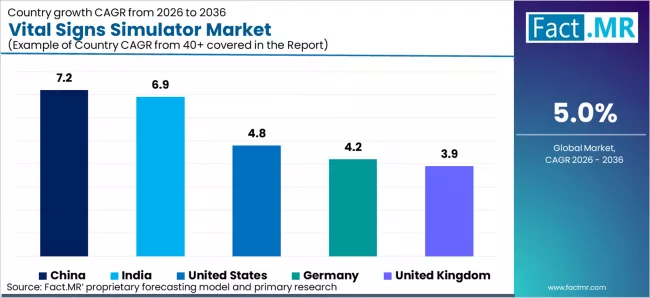
    Vital Signs Simulator Market Cagr Analysis By Country

    Country CAGR (2026-2036)
    China 7.2%
    India 6.9%
    United States 4.8%
    Germany 4.2%
    United Kingdom 3.9%

    Source: Fact.MR (FACT.MR) analysis, based on proprietary forecasting model and primary research

    Asia Pacific Vital Signs Simulator Market Analysis

    Asia Pacific is the fastest-growing region for vital signs simulators. Growth is driven by rapid medical and nursing school expansion in China and India. Governments are mandating competency-based training with structured simulation hours. Hospitals are also investing in simulation centres across tier-one and tier-two cities. Premium global brands such as Laerdal, Gaumard, and Kyoto Kagaku serve top university hospitals. Domestic manufacturers compete in price-sensitive community and nursing segments.

    • China: Demand is projected to rise at 7.2% CAGR through 2036. The 14th Five-Year Plan prioritises simulation in healthcare education. In November 2024, the NMPA formally recognised AI-enabled medical simulation across 84 use cases. This policy backing supports budget allocation for advanced patient simulators.
    • India: Demand is projected to rise at 6.9% CAGR through 2036. The National Medical Commission mandates simulation exposure across 706 medical colleges. Accreditation audits enforce compliance. NABH strengthened hospital simulation requirements in 2024. Nursing school expansion is accelerating demand for cost-effective simulators.

    FACT.MR’s Asia Pacific analysis covers China, Japan, South Korea, India, Australia and New Zealand, ASEAN, and Rest of Asia Pacific. It includes enrolment data, mandate timelines, hospital investment trends, and product adoption rates.

    Europe Vital Signs Simulator Market Analysis

    Europe is a regulatory benchmark and major revenue contributor. Germany and the UK provide structured institutional procurement. Laerdal and Limbs and Things maintain strong regional relationships across medical schools and hospital simulation centres.

    • Germany: Demand is projected to rise at 4.2% CAGR through 2036. The revised Licensing Regulations strengthens competency-based simulation training. Updated 2024 recommendations specify minimum simulator standards. Germany’s 36 university medical centres form a concentrated high-value procurement base.
    • United Kingdom: Demand is projected to rise at 3.9% CAGR through 2036. NHS workforce strategy maintains simulation funding. Updated 2024 standards require documented vital sign training. All UK medical schools must comply with accreditation guidance. Laerdal and Limbs and Things support NHS and academic procurement.

    FACT.MR’s European analysis covers Germany, France, the United Kingdom, Norway, Spain, the Netherlands, Nordics, and Rest of Europe. It details accreditation timelines and hospital investment benchmarks.

    North America Vital Signs Simulator Market Analysis

    North America leads in revenue and simulation centre density. Accreditation-linked procurement is mature. Laerdal, Gaumard, and Simulab maintain strong hospital and academic networks. Accredited simulation centres surpassed 1,000 in 2024.

    • United States: Demand is projected to rise at 4.8% CAGR through 2036. ACGME reinforced simulation documentation requirements in 2024. Hospitals must maintain compliant simulator infrastructure. In April 2024, Laerdal launched SimMan Critical Care with ASL 5000 respiratory integration.

    FACT.MR’s North America analysis covers the United States, Canada, and Mexico. It includes accreditation data, hospital procurement trends, and product adoption benchmarks.

    Competitive Aligners for Market Players
    Vital Signs Simulator Market Analysis By Company

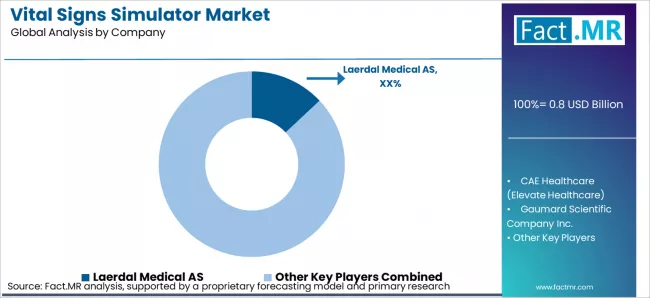
    The global vital signs simulator market is moderately concentrated in the high-fidelity segment. Laerdal Medical and Gaumard Scientific lead hospital and university procurement. Their advantage comes from long-standing clinical research partnerships, accreditation alignment, and global distribution networks. Elevate Healthcare (formerly CAE Healthcare) remains strong in anaesthesia and obstetric simulation. Surgical Science dominates surgical simulation through its integration with Intuitive Surgical’s da Vinci platform.

    At the task trainer level, competition is more fragmented. Companies such as Simulaids, 3B Scientific, Limbs and Things, Kyoto Kagaku, and Simulab compete on price and procedural training breadth. In the premium segment, clinical validation is the key differentiator. Manufacturers that can demonstrate measurable patient outcome improvements gain stronger positioning with accreditation-driven buyers.

    Structural advantages favour vertically integrated ecosystems. Laerdal combines hardware, software, VR platforms, debriefing tools, and CPR competency programmes into one education stack. Its 2025 acquisition of SIMCharacters strengthened neonatal capabilities. Surgical Science benefits from subscription-based integration with da Vinci systems, creating a growing captive software base.

    Hospitals prioritise service reliability and accreditation compliance over price. Universities show higher price sensitivity, creating a two-tier market between premium and mid-fidelity providers.

    Recent Development

    • In February 2025, Laerdal Medical announced the acquisition of SIMCharacters GmbH, a Vienna-based MedUni Vienna spin-off and developer of high-fidelity neonatal simulators including the preterm baby simulator Paul, in use at over 150 neonatal units worldwide, and new full-term newborn simulators Emily and Emma.
    • In January 2025, Surgical Science Sweden AB formalised a four-year subscription pricing agreement with Intuitive Surgical, mandating integration of Surgical Science simulation software into all da Vinci 5 robotic surgical systems from January 2025 through 2028.

    Key Players

    • Laerdal Medical AS
    • CAE Healthcare (Elevate Healthcare)
    • Gaumard Scientific Company Inc.
    • Simulaids Inc.
    • Kyoto Kagaku Co., Ltd.
    • Mentice AB
    • Simulab Corporation
    • 3B Scientific GmbH
    • Limbs & Things Ltd.
    • Surgical Science Sweden AB

    Scope of Report

    Items Values
    Quantitative Units USD 0.8 billion (2026) to USD 1.3 billion (2036), at a CAGR of 5.0%
    Market Definition Vital signs simulators are manikins, task trainers, and virtual simulation systems that reproduce measurable human physiological parameters for clinical education and accreditation-linked competency assessment, serving hospitals, academic institutes, and ambulatory training centres across emergency medicine, critical care, nursing, surgical, and obstetric training applications.
    Product Type Segmentation Patient Simulators, Task Trainers, Surgical Simulators
    End User Segmentation Hospitals, Academic Institutes, Ambulatory Centers
    Regions Covered Asia Pacific, Europe, North America, Latin America, Middle East and Africa
    Countries Covered China, Japan, South Korea, India, Australia and New Zealand, ASEAN, Rest of Asia Pacific, Germany, United Kingdom, France, Norway, Spain, Netherlands, Nordics, Rest of Europe, United States, Canada, Mexico, Brazil, Chile, Ecuador, Rest of Latin America, Kingdom of Saudi Arabia, United Arab Emirates, South Africa, Turkey, Rest of Middle East and Africa
    Key Companies Profiled Laerdal Medical AS, CAE Healthcare (Elevate Healthcare), Gaumard Scientific Company Inc., Simulaids Inc., Kyoto Kagaku Co. Ltd., Mentice AB, Simulab Corporation, 3B Scientific GmbH, Limbs & Things Ltd., Surgical Science Sweden AB
    Forecast Period 2026 to 2036
    Approach A hybrid top-down and bottom-up model was used. Top-down inputs included simulation centre counts by region and end user, enrolment data, and accreditation-mandated training hours. Bottom-up inputs covered unit pricing by simulator type, five-year replacement cycles, software subscription benchmarks, and new centre setup rates from primary interviews

    Vital Signs Simulator Market by Segment

    • By Product Type

      • Patient Simulators
      • Task Trainers
      • Surgical Simulators
    • By End User

      • Hospitals
      • Academic Institutes
      • Ambulatory Centers
    • By Region

      • North America
        • United States
        • Canada
        • Mexico
      • Europe
        • Germany
        • United Kingdom
        • France
        • Norway
        • Spain
        • Netherlands
        • Nordics
        • Rest of Europe
      • Asia Pacific
        • China
        • Japan
        • South Korea
        • India
        • Australia and New Zealand
        • ASEAN
        • Rest of Asia Pacific
      • Latin America
        • Brazil
        • Chile
        • Ecuador
        • Rest of Latin America
      • Middle East and Africa
        • Kingdom of Saudi Arabia
        • United Arab Emirates
        • South Africa
        • Turkey
        • Rest of Middle East and Africa

    Bibliography

    • [1] Respiratory Therapy Magazine / Laerdal Medical. (2024, April 30). Laerdal Medical and IngMar Medical Partner on SimMan Critical Care Simulation Manikin. Respiratory Therapy Magazine.
    • [2] Surgical Science Sweden AB. (2025, January 15). Surgical Science is transitioning to a fully subscription-based revenue model with Intuitive and all da Vinci 5 systems will be equipped with Surgical Science simulation software. Surgical Science Press Release.
    • [3] Accreditation Council for Graduate Medical Education. (2024). ACGME Common Program Requirements (Residency): Section VI.B Simulation-Based Learning Documentation. ACGME.
    • [4] National Medical Products Administration, China. (2024, November). Reference Guide for AI Application Scenarios in the Healthcare Industry: Medical Education and Simulation Use Cases. NMPA / Chinese Government Official Publications.
    • [5] Laerdal Medical / HealthySimulation.com. (2025, February 13). Laerdal Medical Announces Acquisition of SIMCharacters. Laerdal Medical Press Room / Healthy Simulation.
    • [6] Wolters Kluwer Health / Business Wire. (2025, April 3). Wolters Kluwer and Laerdal Medical Enhance VR Simulation for Nursing Education With Conversational AI. Business Wire.
    • [7] Society for Simulation in Healthcare. (2024). SSH Accreditation Programme: 2024 Annual Statistics on Accredited Simulation Centres in North America. SSH.
    • [8] German Society for Medical Education (GMA). (2024). Recommendations for Simulation-Based Clinical Training in Undergraduate Medicine: Vital Sign Assessment Standards Update.

    This Report Addresses

    • Strategic insights on simulator product development, hospital and academic procurement strategy, AI software positioning, and response to mid-fidelity pricing pressure.
    • Market size and forecast: USD 0.8 billion in 2026, reaching USD 1.3 billion by 2036 at 5.0% CAGR, segmented by product, end user, and region.
    • Growth mapping across AI-enabled ICU simulators, China and India academic expansion, and robotic surgery-linked subscription revenue.
    • Country CAGR analysis: China (7.2%), India (6.9%), U.S. (4.8%), Germany (4.2%), UK (3.9%), with product and end-user splits.
    • Competitive positioning of Laerdal, Gaumard, Surgical Science, Elevate Healthcare, and Kyoto Kagaku across validation strength, software depth, and procurement dynamics.
    • Technology tracking: AI physiology engines, VR integration, conversational AI, tetherless systems, neonatal expansion, and subscription transitions.
    • Regulatory impact review covering ACGME, CCNE, Joint Commission, NMC India, NHS England, and EU simulation policy frameworks.
    • Delivery in Excel datasets, PowerPoint summary, and detailed PDF with verified regulatory and manufacturer source

    Table of Content

    1. Executive Summary
      • Global Market Outlook
      • Demand to side Trends
      • Supply to side Trends
      • Technology Roadmap Analysis
      • Analysis and Recommendations
    2. Market Overview
      • Market Coverage / Taxonomy
      • Market Definition / Scope / Limitations
    3. Research Methodology
      • Chapter Orientation
      • Analytical Lens and Working Hypotheses
        • Market Structure, Signals, and Trend Drivers
        • Benchmarking and Cross-market Comparability
        • Market Sizing, Forecasting, and Opportunity Mapping
      • Research Design and Evidence Framework
        • Desk Research Programme (Secondary Evidence)
          • Company Annual and Sustainability Reports
          • Peer-reviewed Journals and Academic Literature
          • Corporate Websites, Product Literature, and Technical Notes
          • Earnings Decks and Investor Briefings
          • Statutory Filings and Regulatory Disclosures
          • Technical White Papers and Standards Notes
          • Trade Journals, Industry Magazines, and Analyst Briefs
          • Conference Proceedings, Webinars, and Seminar Materials
          • Government Statistics Portals and Public Data Releases
          • Press Releases and Reputable Media Coverage
          • Specialist Newsletters and Curated Briefings
          • Sector Databases and Reference Repositories
          • FMR Internal Proprietary Databases and Historical Market Datasets
          • Subscription Datasets and Paid Sources
          • Social Channels, Communities, and Digital Listening Inputs
          • Additional Desk Sources
        • Expert Input and Fieldwork (Primary Evidence)
          • Primary Modes
            • Qualitative Interviews and Expert Elicitation
            • Quantitative Surveys and Structured Data Capture
            • Blended Approach
          • Why Primary Evidence is Used
          • Field Techniques
            • Interviews
            • Surveys
            • Focus Groups
            • Observational and In-context Research
            • Social and Community Interactions
          • Stakeholder Universe Engaged
            • C-suite Leaders
            • Board Members
            • Presidents and Vice Presidents
            • R&D and Innovation Heads
            • Technical Specialists
            • Domain Subject-matter Experts
            • Scientists
            • Physicians and Other Healthcare Professionals
          • Governance, Ethics, and Data Stewardship
            • Research Ethics
            • Data Integrity and Handling
        • Tooling, Models, and Reference Databases
      • Data Engineering and Model Build
        • Data Acquisition and Ingestion
        • Cleaning, Normalisation, and Verification
        • Synthesis, Triangulation, and Analysis
      • Quality Assurance and Audit Trail
    4. Market Background
      • Market Dynamics
        • Drivers
        • Restraints
        • Opportunity
        • Trends
      • Scenario Forecast
        • Demand in Optimistic Scenario
        • Demand in Likely Scenario
        • Demand in Conservative Scenario
      • Opportunity Map Analysis
      • Product Life Cycle Analysis
      • Supply Chain Analysis
      • Investment Feasibility Matrix
      • Value Chain Analysis
      • PESTLE and Porter’s Analysis
      • Regulatory Landscape
      • Regional Parent Market Outlook
      • Production and Consumption Statistics
      • Import and Export Statistics
    5. Global Market Analysis 2021 to 2025 and Forecast, 2026 to 2036
      • Historical Market Size Value (USD Million) Analysis, 2021 to 2025
      • Current and Future Market Size Value (USD Million) Projections, 2026 to 2036
        • Y to o to Y Growth Trend Analysis
        • Absolute $ Opportunity Analysis
    6. Global Market Pricing Analysis 2021 to 2025 and Forecast 2026 to 2036
    7. Global Market Analysis 2021 to 2025 and Forecast 2026 to 2036, By Product Type
      • Introduction / Key Findings
      • Historical Market Size Value (USD Million) Analysis By Product Type , 2021 to 2025
      • Current and Future Market Size Value (USD Million) Analysis and Forecast By Product Type , 2026 to 2036
        • Patient Simulators
        • Task Trainers
        • Surgical Simulators
      • Y to o to Y Growth Trend Analysis By Product Type , 2021 to 2025
      • Absolute $ Opportunity Analysis By Product Type , 2026 to 2036
    8. Global Market Analysis 2021 to 2025 and Forecast 2026 to 2036, By End User
      • Introduction / Key Findings
      • Historical Market Size Value (USD Million) Analysis By End User, 2021 to 2025
      • Current and Future Market Size Value (USD Million) Analysis and Forecast By End User, 2026 to 2036
        • Hospitals
        • Academic Institutes
        • Ambulatory Centers
      • Y to o to Y Growth Trend Analysis By End User, 2021 to 2025
      • Absolute $ Opportunity Analysis By End User, 2026 to 2036
    9. Global Market Analysis 2021 to 2025 and Forecast 2026 to 2036, By Region
      • Introduction
      • Historical Market Size Value (USD Million) Analysis By Region, 2021 to 2025
      • Current Market Size Value (USD Million) Analysis and Forecast By Region, 2026 to 2036
        • North America
        • Latin America
        • Western Europe
        • Eastern Europe
        • East Asia
        • South Asia and Pacific
        • Middle East & Africa
      • Market Attractiveness Analysis By Region
    10. North America Market Analysis 2021 to 2025 and Forecast 2026 to 2036, By Country
      • Historical Market Size Value (USD Million) Trend Analysis By Market Taxonomy, 2021 to 2025
      • Market Size Value (USD Million) Forecast By Market Taxonomy, 2026 to 2036
        • By Country
          • USA
          • Canada
          • Mexico
        • By Product Type
        • By End User
      • Market Attractiveness Analysis
        • By Country
        • By Product Type
        • By End User
      • Key Takeaways
    11. Latin America Market Analysis 2021 to 2025 and Forecast 2026 to 2036, By Country
      • Historical Market Size Value (USD Million) Trend Analysis By Market Taxonomy, 2021 to 2025
      • Market Size Value (USD Million) Forecast By Market Taxonomy, 2026 to 2036
        • By Country
          • Brazil
          • Chile
          • Rest of Latin America
        • By Product Type
        • By End User
      • Market Attractiveness Analysis
        • By Country
        • By Product Type
        • By End User
      • Key Takeaways
    12. Western Europe Market Analysis 2021 to 2025 and Forecast 2026 to 2036, By Country
      • Historical Market Size Value (USD Million) Trend Analysis By Market Taxonomy, 2021 to 2025
      • Market Size Value (USD Million) Forecast By Market Taxonomy, 2026 to 2036
        • By Country
          • Germany
          • UK
          • Italy
          • Spain
          • France
          • Nordic
          • BENELUX
          • Rest of Western Europe
        • By Product Type
        • By End User
      • Market Attractiveness Analysis
        • By Country
        • By Product Type
        • By End User
      • Key Takeaways
    13. Eastern Europe Market Analysis 2021 to 2025 and Forecast 2026 to 2036, By Country
      • Historical Market Size Value (USD Million) Trend Analysis By Market Taxonomy, 2021 to 2025
      • Market Size Value (USD Million) Forecast By Market Taxonomy, 2026 to 2036
        • By Country
          • Russia
          • Poland
          • Hungary
          • Balkan & Baltic
          • Rest of Eastern Europe
        • By Product Type
        • By End User
      • Market Attractiveness Analysis
        • By Country
        • By Product Type
        • By End User
      • Key Takeaways
    14. East Asia Market Analysis 2021 to 2025 and Forecast 2026 to 2036, By Country
      • Historical Market Size Value (USD Million) Trend Analysis By Market Taxonomy, 2021 to 2025
      • Market Size Value (USD Million) Forecast By Market Taxonomy, 2026 to 2036
        • By Country
          • China
          • Japan
          • South Korea
        • By Product Type
        • By End User
      • Market Attractiveness Analysis
        • By Country
        • By Product Type
        • By End User
      • Key Takeaways
    15. South Asia and Pacific Market Analysis 2021 to 2025 and Forecast 2026 to 2036, By Country
      • Historical Market Size Value (USD Million) Trend Analysis By Market Taxonomy, 2021 to 2025
      • Market Size Value (USD Million) Forecast By Market Taxonomy, 2026 to 2036
        • By Country
          • India
          • ASEAN
          • Australia & New Zealand
          • Rest of South Asia and Pacific
        • By Product Type
        • By End User
      • Market Attractiveness Analysis
        • By Country
        • By Product Type
        • By End User
      • Key Takeaways
    16. Middle East & Africa Market Analysis 2021 to 2025 and Forecast 2026 to 2036, By Country
      • Historical Market Size Value (USD Million) Trend Analysis By Market Taxonomy, 2021 to 2025
      • Market Size Value (USD Million) Forecast By Market Taxonomy, 2026 to 2036
        • By Country
          • Kingdom of Saudi Arabia
          • Other GCC Countries
          • Turkiye
          • South Africa
          • Other African Union
          • Rest of Middle East & Africa
        • By Product Type
        • By End User
      • Market Attractiveness Analysis
        • By Country
        • By Product Type
        • By End User
      • Key Takeaways
    17. Key Countries Market Analysis
      • USA
        • Pricing Analysis
        • Market Share Analysis, 2025
          • By Product Type
          • By End User
      • Canada
        • Pricing Analysis
        • Market Share Analysis, 2025
          • By Product Type
          • By End User
      • Mexico
        • Pricing Analysis
        • Market Share Analysis, 2025
          • By Product Type
          • By End User
      • Brazil
        • Pricing Analysis
        • Market Share Analysis, 2025
          • By Product Type
          • By End User
      • Chile
        • Pricing Analysis
        • Market Share Analysis, 2025
          • By Product Type
          • By End User
      • Germany
        • Pricing Analysis
        • Market Share Analysis, 2025
          • By Product Type
          • By End User
      • UK
        • Pricing Analysis
        • Market Share Analysis, 2025
          • By Product Type
          • By End User
      • Italy
        • Pricing Analysis
        • Market Share Analysis, 2025
          • By Product Type
          • By End User
      • Spain
        • Pricing Analysis
        • Market Share Analysis, 2025
          • By Product Type
          • By End User
      • France
        • Pricing Analysis
        • Market Share Analysis, 2025
          • By Product Type
          • By End User
      • India
        • Pricing Analysis
        • Market Share Analysis, 2025
          • By Product Type
          • By End User
      • ASEAN
        • Pricing Analysis
        • Market Share Analysis, 2025
          • By Product Type
          • By End User
      • Australia & New Zealand
        • Pricing Analysis
        • Market Share Analysis, 2025
          • By Product Type
          • By End User
      • China
        • Pricing Analysis
        • Market Share Analysis, 2025
          • By Product Type
          • By End User
      • Japan
        • Pricing Analysis
        • Market Share Analysis, 2025
          • By Product Type
          • By End User
      • South Korea
        • Pricing Analysis
        • Market Share Analysis, 2025
          • By Product Type
          • By End User
      • Russia
        • Pricing Analysis
        • Market Share Analysis, 2025
          • By Product Type
          • By End User
      • Poland
        • Pricing Analysis
        • Market Share Analysis, 2025
          • By Product Type
          • By End User
      • Hungary
        • Pricing Analysis
        • Market Share Analysis, 2025
          • By Product Type
          • By End User
      • Kingdom of Saudi Arabia
        • Pricing Analysis
        • Market Share Analysis, 2025
          • By Product Type
          • By End User
      • Turkiye
        • Pricing Analysis
        • Market Share Analysis, 2025
          • By Product Type
          • By End User
      • South Africa
        • Pricing Analysis
        • Market Share Analysis, 2025
          • By Product Type
          • By End User
    18. Market Structure Analysis
      • Competition Dashboard
      • Competition Benchmarking
      • Market Share Analysis of Top Players
        • By Regional
        • By Product Type
        • By End User
    19. Competition Analysis
      • Competition Deep Dive
        • Laerdal Medical AS
          • Overview
          • Product Portfolio
          • Profitability by Market Segments (Product/Age /Sales Channel/Region)
          • Sales Footprint
          • Strategy Overview
            • Marketing Strategy
            • Product Strategy
            • Channel Strategy
        • CAE Healthcare (Elevate Healthcare)
        • Gaumard Scientific Company Inc.
        • Simulaids Inc.
        • Kyoto Kagaku Co., Ltd.
        • Mentice AB
        • Simulab Corporation
    20. Assumptions & Acronyms Used

    List Of Table

    • Table 1: Global Market Value (USD Million) Forecast by Region, 2021 to 2036
    • Table 2: Global Market Value (USD Million) Forecast by Product Type , 2021 to 2036
    • Table 3: Global Market Value (USD Million) Forecast by End User, 2021 to 2036
    • Table 4: North America Market Value (USD Million) Forecast by Country, 2021 to 2036
    • Table 5: North America Market Value (USD Million) Forecast by Product Type , 2021 to 2036
    • Table 6: North America Market Value (USD Million) Forecast by End User, 2021 to 2036
    • Table 7: Latin America Market Value (USD Million) Forecast by Country, 2021 to 2036
    • Table 8: Latin America Market Value (USD Million) Forecast by Product Type , 2021 to 2036
    • Table 9: Latin America Market Value (USD Million) Forecast by End User, 2021 to 2036
    • Table 10: Western Europe Market Value (USD Million) Forecast by Country, 2021 to 2036
    • Table 11: Western Europe Market Value (USD Million) Forecast by Product Type , 2021 to 2036
    • Table 12: Western Europe Market Value (USD Million) Forecast by End User, 2021 to 2036
    • Table 13: Eastern Europe Market Value (USD Million) Forecast by Country, 2021 to 2036
    • Table 14: Eastern Europe Market Value (USD Million) Forecast by Product Type , 2021 to 2036
    • Table 15: Eastern Europe Market Value (USD Million) Forecast by End User, 2021 to 2036
    • Table 16: East Asia Market Value (USD Million) Forecast by Country, 2021 to 2036
    • Table 17: East Asia Market Value (USD Million) Forecast by Product Type , 2021 to 2036
    • Table 18: East Asia Market Value (USD Million) Forecast by End User, 2021 to 2036
    • Table 19: South Asia and Pacific Market Value (USD Million) Forecast by Country, 2021 to 2036
    • Table 20: South Asia and Pacific Market Value (USD Million) Forecast by Product Type , 2021 to 2036
    • Table 21: South Asia and Pacific Market Value (USD Million) Forecast by End User, 2021 to 2036
    • Table 22: Middle East & Africa Market Value (USD Million) Forecast by Country, 2021 to 2036
    • Table 23: Middle East & Africa Market Value (USD Million) Forecast by Product Type , 2021 to 2036
    • Table 24: Middle East & Africa Market Value (USD Million) Forecast by End User, 2021 to 2036

    List Of Figures

    • Figure 1: Global Market Pricing Analysis
    • Figure 2: Global Market Value (USD Million) Forecast 2021-2036
    • Figure 3: Global Market Value Share and BPS Analysis by Product Type , 2026 and 2036
    • Figure 4: Global Market Y to o to Y Growth Comparison by Product Type , 2026-2036
    • Figure 5: Global Market Attractiveness Analysis by Product Type
    • Figure 6: Global Market Value Share and BPS Analysis by End User, 2026 and 2036
    • Figure 7: Global Market Y to o to Y Growth Comparison by End User, 2026-2036
    • Figure 8: Global Market Attractiveness Analysis by End User
    • Figure 9: Global Market Value (USD Million) Share and BPS Analysis by Region, 2026 and 2036
    • Figure 10: Global Market Y to o to Y Growth Comparison by Region, 2026-2036
    • Figure 11: Global Market Attractiveness Analysis by Region
    • Figure 12: North America Market Incremental Dollar Opportunity, 2026-2036
    • Figure 13: Latin America Market Incremental Dollar Opportunity, 2026-2036
    • Figure 14: Western Europe Market Incremental Dollar Opportunity, 2026-2036
    • Figure 15: Eastern Europe Market Incremental Dollar Opportunity, 2026-2036
    • Figure 16: East Asia Market Incremental Dollar Opportunity, 2026-2036
    • Figure 17: South Asia and Pacific Market Incremental Dollar Opportunity, 2026-2036
    • Figure 18: Middle East & Africa Market Incremental Dollar Opportunity, 2026-2036
    • Figure 19: North America Market Value Share and BPS Analysis by Country, 2026 and 2036
    • Figure 20: North America Market Value Share and BPS Analysis by Product Type , 2026 and 2036
    • Figure 21: North America Market Y to o to Y Growth Comparison by Product Type , 2026-2036
    • Figure 22: North America Market Attractiveness Analysis by Product Type
    • Figure 23: North America Market Value Share and BPS Analysis by End User, 2026 and 2036
    • Figure 24: North America Market Y to o to Y Growth Comparison by End User, 2026-2036
    • Figure 25: North America Market Attractiveness Analysis by End User
    • Figure 26: Latin America Market Value Share and BPS Analysis by Country, 2026 and 2036
    • Figure 27: Latin America Market Value Share and BPS Analysis by Product Type , 2026 and 2036
    • Figure 28: Latin America Market Y to o to Y Growth Comparison by Product Type , 2026-2036
    • Figure 29: Latin America Market Attractiveness Analysis by Product Type
    • Figure 30: Latin America Market Value Share and BPS Analysis by End User, 2026 and 2036
    • Figure 31: Latin America Market Y to o to Y Growth Comparison by End User, 2026-2036
    • Figure 32: Latin America Market Attractiveness Analysis by End User
    • Figure 33: Western Europe Market Value Share and BPS Analysis by Country, 2026 and 2036
    • Figure 34: Western Europe Market Value Share and BPS Analysis by Product Type , 2026 and 2036
    • Figure 35: Western Europe Market Y to o to Y Growth Comparison by Product Type , 2026-2036
    • Figure 36: Western Europe Market Attractiveness Analysis by Product Type
    • Figure 37: Western Europe Market Value Share and BPS Analysis by End User, 2026 and 2036
    • Figure 38: Western Europe Market Y to o to Y Growth Comparison by End User, 2026-2036
    • Figure 39: Western Europe Market Attractiveness Analysis by End User
    • Figure 40: Eastern Europe Market Value Share and BPS Analysis by Country, 2026 and 2036
    • Figure 41: Eastern Europe Market Value Share and BPS Analysis by Product Type , 2026 and 2036
    • Figure 42: Eastern Europe Market Y to o to Y Growth Comparison by Product Type , 2026-2036
    • Figure 43: Eastern Europe Market Attractiveness Analysis by Product Type
    • Figure 44: Eastern Europe Market Value Share and BPS Analysis by End User, 2026 and 2036
    • Figure 45: Eastern Europe Market Y to o to Y Growth Comparison by End User, 2026-2036
    • Figure 46: Eastern Europe Market Attractiveness Analysis by End User
    • Figure 47: East Asia Market Value Share and BPS Analysis by Country, 2026 and 2036
    • Figure 48: East Asia Market Value Share and BPS Analysis by Product Type , 2026 and 2036
    • Figure 49: East Asia Market Y to o to Y Growth Comparison by Product Type , 2026-2036
    • Figure 50: East Asia Market Attractiveness Analysis by Product Type
    • Figure 51: East Asia Market Value Share and BPS Analysis by End User, 2026 and 2036
    • Figure 52: East Asia Market Y to o to Y Growth Comparison by End User, 2026-2036
    • Figure 53: East Asia Market Attractiveness Analysis by End User
    • Figure 54: South Asia and Pacific Market Value Share and BPS Analysis by Country, 2026 and 2036
    • Figure 55: South Asia and Pacific Market Value Share and BPS Analysis by Product Type , 2026 and 2036
    • Figure 56: South Asia and Pacific Market Y to o to Y Growth Comparison by Product Type , 2026-2036
    • Figure 57: South Asia and Pacific Market Attractiveness Analysis by Product Type
    • Figure 58: South Asia and Pacific Market Value Share and BPS Analysis by End User, 2026 and 2036
    • Figure 59: South Asia and Pacific Market Y to o to Y Growth Comparison by End User, 2026-2036
    • Figure 60: South Asia and Pacific Market Attractiveness Analysis by End User
    • Figure 61: Middle East & Africa Market Value Share and BPS Analysis by Country, 2026 and 2036
    • Figure 62: Middle East & Africa Market Value Share and BPS Analysis by Product Type , 2026 and 2036
    • Figure 63: Middle East & Africa Market Y to o to Y Growth Comparison by Product Type , 2026-2036
    • Figure 64: Middle East & Africa Market Attractiveness Analysis by Product Type
    • Figure 65: Middle East & Africa Market Value Share and BPS Analysis by End User, 2026 and 2036
    • Figure 66: Middle East & Africa Market Y to o to Y Growth Comparison by End User, 2026-2036
    • Figure 67: Middle East & Africa Market Attractiveness Analysis by End User
    • Figure 68: Global Market - Tier Structure Analysis
    • Figure 69: Global Market - Company Share Analysis

    - FAQs -

    How large is the vital signs simulator market in 2025?

    The global vital signs simulator market surpassed a valuation of USD 0.7 billion in 2025.

    What will the market size be in 2026?

    The vital signs simulator market is estimated to grow to USD 0.8 billion in 2026.

    What is the projected market size by 2036?

    The market is projected to reach USD 1.3 billion by 2036, representing an absolute dollar gain of USD 0.5 billion over the forecast period.

    What is the expected CAGR for the forecast period 2026 to 2036?

    Fact.MR projects a CAGR of 5.0% from 2026 to 2036 for the global vital signs simulator market.

    Which product type is poised to lead the vital signs simulator market?

    Patient Simulators are forecast to lead with an estimated 48% share.

    Which end-user segment holds the largest share in the vital signs simulator market?

    Hospitals account for an estimated 42% share.

    Which country shows the fastest growth rate?

    China projects the fastest country-level CAGR at 7.2% through 2036.

    How fast is the vital signs simulator market expected to expand in India?

    India is projected to register a CAGR of 6.9% through 2036.

    What is the forecast CAGR for the United States vital signs simulator market?

    The United States is anticipated to grow at a CAGR of 4.8% through 2036.

    What growth rate is expected for Germany's vital signs simulator market?

    Germany is forecast to expand at a CAGR of 4.2% through 2036.

    How is the vital signs simulator market in the United Kingdom expected to grow?

    The United Kingdom is projected to grow at a CAGR of 3.9% through 2036.

    Vital Signs Simulator Market