- Market Value (2025): USD 151.9 Mn
- Estimated Value (2026): USD 172.1 Mn
- Forecast Value (2036): USD 600.0 Mn
- CAGR (2026-2036): 13.3%
What is the Vitamin D Toxicity Market forecast to be worth by 2036?
USD 172.1 million in 2026 to USD 600.0 million by 2036, at a 13.3% CAGR.
Treatment setting context can be read with Fact.MR's Physiological Saline Market, since severe toxicity cases may require fluid management under medical supervision.
- The vitamin d toxicity market reached USD 151.9 million in 2025 as hospitals and clinical lab stakeholders spent against a clear use case: diagnosis and treatment of vitamin D overdose-related hypercalcemia, dehydration and renal or cardiac complications.
- Demand is projected to increase from USD 172.1 million in 2026 to USD 600.0 million by 2036, at a 13.3% CAGR.
- The market is forecast to record 13.3% CAGR from 2026 to 2036 as companies prove diagnosis and renal or cardiac complications.
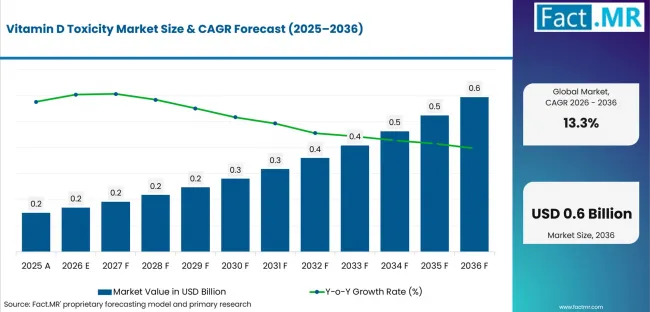
Vitamin D Toxicity Market 3 | Source: Fact.MR
What are the defining numbers behind Vitamin D Toxicity Market growth?
USD 600.0 million market value is expected by 2036.
Exposure risk links to Fact.MR's Dietary Supplement Market, where high-dose supplement use can raise monitoring needs.
- Demand Drivers in the Market
- Intravenous fluid therapy leads because initial treatment focuses on stopping vitamin D and correcting dehydration and hypercalcemia under clinical supervision.
- Hospital management leads because symptomatic toxicity can involve kidney, cardiac, neurologic and electrolyte risks that require monitoring.
- Hospitals lead as they manage severe hypercalcemia, lab testing, IV treatment and specialist referral in one setting.
- Hospital pharmacies lead as IV fluids, corticosteroids, bisphosphonates and supportive medications are dispensed under inpatient protocols.
- Key Segments Analyzed
- By Treatment Type: Intravenous Fluid Therapy is projected to hold 38.5% share in 2026. Intravenous fluid therapy leads because volume correction and calcium lowering are central to early management of clinically significant toxicity.
- By End User: Hospitals is projected to hold 30.8% share in 2026. Hospitals lead as emergency and inpatient teams handle the complications of hypercalcemia and dehydration.
- By Distribution Channel: Hospital Pharmacies is projected to hold 32.8% share in 2026. Hospital pharmacies lead as the relevant therapies are tied to inpatient protocols and monitored administration.
- By Route of Administration: Intravenous is projected to hold 37.5% share in 2026. Intravenous leads because severe cases require fluids and medications that act quickly under clinical supervision.
- Analyst Opinion at Fact.MR
- Shambhu Nath Jha, Sr. Consultant at Fact.MR, opines, "Vitamin D toxicity demand is small but clinically serious. The commercial opportunity sits in diagnosis, monitored treatment and hospital pharmacy protocols, not in general vitamin D consumption."
- Strategic Implications
- Hospitals should connect supplement history, calcium testing, 25(OH)D testing and renal monitoring in the intake pathway.
- Pharmacy teams should maintain protocols for IV fluids and calcium-lowering therapy where severe hypercalcemia is present.
- Market participants should avoid framing toxicity as a broad wellness market; it is a complication-management segment.
USA continues to be a leading market and is projected to grow at a CAGR of 17.33%; other key markets include USA, UK, Australia, Germany.
How does the Vitamin D Toxicity Market break down by segment?
Intravenous Fluid Therapy leads Treatment Type at 38.5%.
Prevention behavior should be compared with Fact.MR's Bone and Joint Health Supplement Market, because vitamin D is often taken for musculoskeletal benefit.
Why does Intravenous Fluid Therapy lead Treatment Type?
Intravenous Fluid Therapy is projected to account for 38.5% share in 2026.
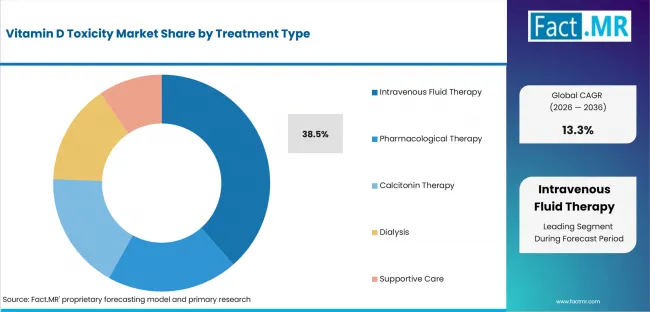
Vitamin D Toxicity Market Analysis By Treatment Type | Source: Fact.MR
Intravenous fluid therapy leads because volume correction and calcium lowering are central to early management of clinically significant toxicity.
Why does Hospital Management lead Application?
Hospital Management is projected to account for 29.8% share in 2026.
Hospital management leads because severe vitamin D toxicity can require monitored hydration, calcium control, renal assessment and cardiac-risk review before discharge.
Why does Hospitals lead End User?
Hospitals is projected to account for 30.8% share in 2026.
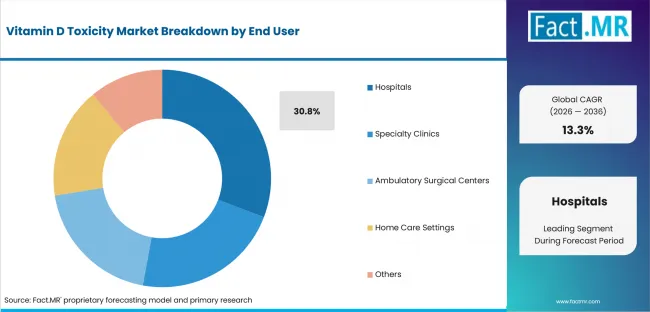
Vitamin D Toxicity Market Analysis By End User | Source: Fact.MR
Hospitals lead as emergency and inpatient teams handle the complications of hypercalcemia and dehydration.
Why does Hospital Pharmacies lead Distribution Channel?
Hospital Pharmacies is projected to account for 32.8% share in 2026.
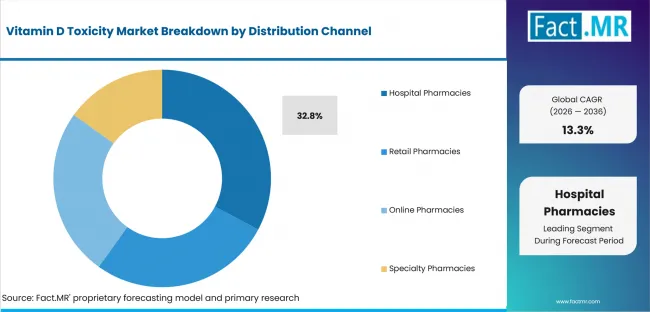
Vitamin D Toxicity Market Analysis By Distribution Channel | Source: Fact.MR
Hospital pharmacies lead as the relevant therapies are tied to inpatient protocols and monitored administration.
Why does Intravenous lead Route of Administration?
Intravenous is projected to account for 37.5% share in 2026.
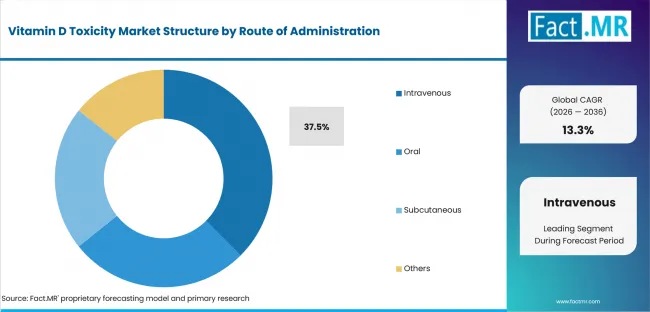
Vitamin D Toxicity Market Analysis By Route Of Administration | Source: Fact.MR
Intravenous leads because severe cases require fluids and medications that act quickly under clinical supervision.
What is accelerating Vitamin D Toxicity Market adoption, and what is holding it back?
Vitamin D toxicity demand rises when high-dose supplement use creates a need for testing, emergency management and monitored treatment of hypercalcemia. Adoption remains selective because many mild cases are handled through dose withdrawal and follow-up rather than specialized intervention.
Regional consumption signals connect with Fact.MR's Sales of Vitamins and Derivatives in USA, where supplement purchasing can affect toxicity risk awareness.
Drivers Impact Analysis
| DRIVER | QUALITATIVE RELEVANCE | GEOGRAPHIC RELEVANCE | IMPACT TIMELINE |
|---|---|---|---|
| IV fluids for hypercalcemia management | High | South Korea | Short term (<=2 years) |
| Hospital monitoring of severe cases | High | USA | Short term (<=2 years) |
| Hospital pharmacy protocol demand | Moderate | UK | Medium term (2-4 years) |
| Lab monitoring for high-dose supplement users | Selective | Australia | Medium term (2-4 years) |
Source: Fact.MR analysis. Updated Jul 30, 2026
- IV fluids for hypercalcemia management: Intravenous fluid therapy leads because initial treatment focuses on stopping vitamin D and correcting dehydration and hypercalcemia under clinical supervision.
- Hospital monitoring of severe cases: Hospital management leads because symptomatic toxicity can involve kidney, cardiac, neurologic and electrolyte risks that require monitoring.
- Hospital pharmacy protocol demand: Hospitals lead as they manage severe hypercalcemia, lab testing, IV treatment and specialist referral in one setting.
- Lab monitoring for high-dose supplement users: Hospital pharmacies lead as IV fluids, corticosteroids, bisphosphonates and supportive medications are dispensed under inpatient protocols.
Opportunity Impact Analysis
| OPPORTUNITY | QUALITATIVE RELEVANCE | GEOGRAPHIC RELEVANCE | IMPACT TIMELINE |
|---|---|---|---|
| Supplement safety and referral education | High | USA | Medium term (2-4 years) |
| Hospital hypercalcemia protocols | Moderate | South Korea | Medium term (2-4 years) |
| High-risk monitoring packages | Selective | UK | Medium term (2-4 years) |
Source: Fact.MR analysis. Updated Jul 30, 2026
- Supplement safety and referral education: Clear supplement safety education can increase testing and referral when patients use high-dose vitamin D without monitoring.
- Hospital hypercalcemia protocols: Hospital protocols for supplement-related hypercalcemia can improve treatment consistency and pharmacy demand visibility.
- High-risk monitoring packages: Lab monitoring packages for high-risk patients can create earlier detection before severe toxicity develops.
Restraints Impact Analysis
| RESTRAINT | QUALITATIVE RELEVANCE | GEOGRAPHIC RELEVANCE | IMPACT TIMELINE |
|---|---|---|---|
| Rare clinical incidence | High | USA | Short term (<=2 years) |
| Supportive-care management limits drug intensity | Moderate | South Korea | Medium term (2-4 years) |
| Coding and attribution complexity | Selective | Australia | Medium term (2-4 years) |
Source: Fact.MR analysis. Updated Jul 30, 2026
- Rare clinical incidence: Vitamin D toxicity is uncommon, so the addressable treatment pool remains much smaller than vitamin D deficiency or supplementation markets.
- Supportive-care management limits drug intensity: Many cases are managed by stopping supplements and supportive care, limiting use of higher-cost interventions.
- Coding and attribution complexity: Coding and attribution can be difficult when toxicity overlaps with renal disease, calcium disorders or medication interactions.
Which countries are scaling Vitamin D Toxicity Market fastest?
Country rates show where buying conditions and supplier proof are already stronger.
Quality checks link to Fact.MR's Sports Nutrition and Dietary Supplements Testing and Certification Market, since labeling accuracy matters when buyers combine supplements.
- South Korea: The market is expected to grow at a CAGR of 9.34% from 2026 to 2036. South Korea's outlook is supported by hospital access, diagnostic testing and consumer supplement use, but cases remain clinically selective.
- USA: The market is expected to grow at a CAGR of 17.33% from 2026 to 2036. USA demand is shaped by supplement use, lab testing access and emergency management of severe hypercalcemia.
- UK: The market is expected to grow at a CAGR of 13.28% from 2026 to 2036. UK growth is tied to NHS clinical pathways, supplement guidance and hospital management of symptomatic cases.
- Australia: The market is expected to grow at a CAGR of 10.64% from 2026 to 2036. Australia's market is linked to high supplement awareness and hospital care pathways for electrolyte disorders.
- Germany: The market is expected to grow at a CAGR of 14.59% from 2026 to 2036. Germany's adoption depends on physician-led supplementation, lab monitoring and inpatient management of severe cases.
- Canada: The market is expected to grow at a CAGR of 11.96% from 2026 to 2036. Canada's outlook follows supplement use, winter vitamin D testing patterns and hospital protocols for hypercalcemia.
- Japan: The market is expected to grow at a CAGR of 15.93% from 2026 to 2036. Japan's growth is modest and tied to aging patients, renal monitoring and cautious supplement use.
The full report provides country-level CAGR analysis across North America, Latin America, Europe, East Asia, South Asia and Oceania, and the Middle East and Africa.
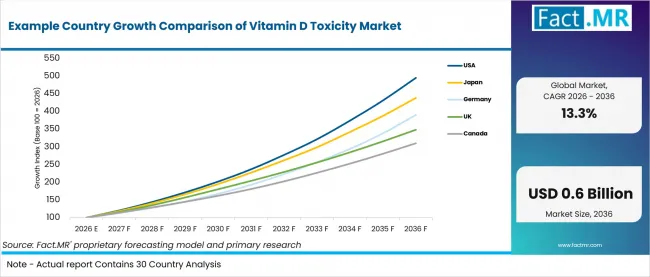
Vitamin D Toxicity Market | Source: Fact.MR
| Country | CAGR (2026-2036) |
|---|---|
| South Korea | 9.34% |
| USA | 17.33% |
| UK | 13.28% |
| Australia | 10.64% |
| Germany | 14.59% |
| Canada | 11.96% |
| Japan | 15.93% |
Source: Fact.MR analysis. Updated Jul 30, 2026
What is shaping South Korea's outlook through 2036?
9.34% CAGR from 2026 to 2036.
South Korea's outlook is supported by hospital access, diagnostic testing and consumer supplement use, but cases remain clinically selective.
What is shaping USA's outlook through 2036?
17.33% CAGR from 2026 to 2036.
USA demand is shaped by supplement use, lab testing access and emergency management of severe hypercalcemia.
What is shaping UK's outlook through 2036?
13.28% CAGR from 2026 to 2036.
UK growth is tied to NHS clinical pathways, supplement guidance and hospital management of symptomatic cases.
What is shaping Australia's outlook through 2036?
10.64% CAGR from 2026 to 2036.
Australia's market is linked to high supplement awareness and hospital care pathways for electrolyte disorders.
What is shaping Germany's outlook through 2036?
14.59% CAGR from 2026 to 2036.
Germany's adoption depends on physician-led supplementation, lab monitoring and inpatient management of severe cases.
Who leads the Vitamin D Toxicity Market?
Pfizer Inc.; Fresenius Kabi; Baxter International; Sanofi are among the visible providers in the vitamin d toxicity market.
Pfizer Inc. and Fresenius Kabi are among the most visible providers. Competition is shaped by product proof, channel access and buyer trust.
Between 2026 and 2036, market rivalry is likely to center on clearer positioning around Intravenous Fluid Therapy, stronger documentation and better support at the point of purchase.
Which companies are the key providers?
Key companies include Pfizer Inc.; Fresenius Kabi; Baxter International; Sanofi; Hikma Pharmaceuticals; Mylan (Viatris); Teva Pharmaceutical Industries; Sun Pharmaceutical Industries.
- Pfizer Inc.
- Fresenius Kabi
- Baxter International
- Sanofi
- Hikma Pharmaceuticals
- Mylan (Viatris)
- Teva Pharmaceutical Industries
- Sun Pharmaceutical Industries
Bibliography
- NIH Office of Dietary Supplements, Vitamin D Health Professional Fact Sheet.
- NCBI Bookshelf, Vitamin D Toxicity.
- NCBI Bookshelf, Hypercalcemia.
- Mayo Clinic, Vitamin D Toxicity.
- Cleveland Clinic, Vitamin D Toxicity.
- Fact.MR, Physiological Saline Market.
This Report Answers
- The report provides strategic intelligence on the Vitamin D Toxicity Market across segment choices that shape the 2026 market structure.
- Segment analysis covers Intravenous Fluid Therapy and Hospital Management as the share leaders within the 2026 market.
- Country outlook evaluates the listed markets by CAGR and explains the adoption conditions in each country.
- Competitive analysis profiles the named providers and evaluates competition around product proof, channel access and buyer trust.
- Related Fact.MR coverage helps readers compare toxicity management with physiological saline, dietary supplements and supplement-testing workflows.
What does the Vitamin D Toxicity Market cover?
The Vitamin D Toxicity Market covers diagnosis, monitoring and treatment products and services used for vitamin D toxicity, including IV fluids, calcium-lowering therapies, hospital management, lab testing and pharmacy distribution.
The Vitamin D Toxicity Market covers diagnosis, monitoring and treatment products and services used for vitamin D toxicity, including IV fluids, calcium-lowering therapies, hospital management, lab testing and pharmacy distribution.
Adjacent spending is included only when it is part of the same purchase decision or operating use case.
What is included in the scope?
The scope includes Treatment Type, Application, End User, Distribution Channel, Route of Administration and regional demand.
Coverage includes adjacent segment options only when they are purchased for the same defined market use.
What is excluded from the scope?
ordinary vitamin D supplements, deficiency treatment, general bone-health products and wellness testing not linked to suspected toxicity or hypercalcemia management.
The scope excludes ordinary vitamin D supplements, deficiency treatment, general bone-health products and wellness testing not linked to suspected toxicity or hypercalcemia management.
How Was the Analysis Built?
The analysis combines primary research with desk research focused on the vitamin d toxicity market, its segment structure and country-level demand.
- Primary Research: Interviews and validation discussions test buyer priorities, adoption barriers, pricing logic and operating requirements.
- Desk Research: The assessment reviews company disclosures, public datasets, regulatory material, technical literature and industry records relevant to the market.
- Market Sizing and Forecasting: Estimates combine top-down and bottom-up checks across demand signals, segment shares, country activity, company participation and adoption constraints.
- Data Validation and Update Cycle: Findings are validated against public evidence, company activity and country-level adoption patterns before final use.
Segmentation
What is the report's scope and coverage?
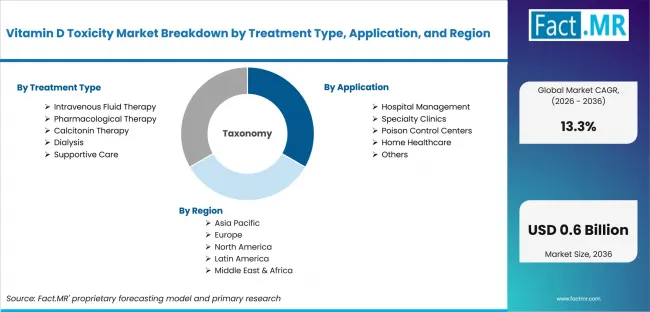
Vitamin D Toxicity Market 1 | Source: Fact.MR
| Attribute | Details |
|---|---|
| Quantitative Units | USD 172.1 million in 2026 to USD 600.0 million by 2036, at a 13.3% CAGR. |
| Market Definition | Vitamin D Toxicity Market covers diagnosis, monitoring and treatment products and services used for vitamin D toxicity, including IV fluids, calcium-lowering therapies, hospital management, lab testing and pharmacy distribution. |
| Treatment Type | Intravenous Fluid Therapy; Normal Saline Infusion; Electrolyte Replacement; Pharmacological Therapy; Corticosteroids; Bisphosphonates; Calcitonin Therapy; Salmon Calcitonin; Synthetic Calcitonin; Dialysis; Hemodialysis; Peritoneal Dialysis; Supportive Care; Dietary Calcium Restriction; Monitoring & Observation |
| Application | Hospital Management; Inpatient Treatment; Emergency Care; Specialty Clinics; Endocrinology Clinics; Nephrology Clinics; Poison Control Centers; Toxicology Management; Overdose Assessment; Home Healthcare; Follow-up Monitoring; Nursing Care; Others; Research Institutions; Ambulatory Care |
| End User | Hospitals; Public Hospitals; Private Hospitals; Specialty Clinics; Endocrinology Clinics; Toxicology Clinics; Ambulatory Surgical Centers; Day Care Centers; Observation Units; Home Care Settings; Home Nursing; Remote Monitoring; Others; Academic Institutes; Research Centers |
| Distribution Channel | Hospital Pharmacies; Inpatient Pharmacies; Emergency Pharmacies; Retail Pharmacies; Chain Pharmacies; Independent Pharmacies; Online Pharmacies; E-commerce Pharmacies; Direct-to-Patient Supply; Specialty Pharmacies; Endocrine Care Pharmacies; Hospital Network Pharmacies |
| Route of Administration | Intravenous; IV Fluids; IV Medications; Oral; Oral Corticosteroids; Oral Hydration Therapy; Subcutaneous; Calcitonin Injection; Biologic Therapy; Others; Dialysis-Based Therapy; Combination Administration |
| Regions Covered | North America; Latin America; Europe; East Asia; South Asia and Oceania; Middle East and Africa |
| Countries Covered | South Korea; USA; UK; Australia; Germany; Canada; Japan |
| Key Companies Profiled | Pfizer Inc.; Fresenius Kabi; Baxter International; Sanofi; Hikma Pharmaceuticals; Mylan (Viatris); Teva Pharmaceutical Industries; Sun Pharmaceutical Industries |
| Forecast Period | 2026 to 2036 |
| Approach | Hybrid top-down and bottom-up assessment using demand indicators, segment mix, country growth, company participation and public evidence relevant to the category. |
Source: Fact.MR analysis. Updated Jul 30, 2026
How is the market segmented?
-
By Treatment Type:
- Intravenous Fluid Therapy
- Normal Saline Infusion
- Electrolyte Replacement
- Pharmacological Therapy
- Corticosteroids
- Bisphosphonates
- Calcitonin Therapy
- Salmon Calcitonin
- Synthetic Calcitonin
- Dialysis
- Hemodialysis
- Peritoneal Dialysis
- Supportive Care
- Dietary Calcium Restriction
- Monitoring & Observation
-
By Application:
- Hospital Management
- Inpatient Treatment
- Emergency Care
- Specialty Clinics
- Endocrinology Clinics
- Nephrology Clinics
- Poison Control Centers
- Toxicology Management
- Overdose Assessment
- Home Healthcare
- Follow-up Monitoring
- Nursing Care
- Others
- Research Institutions
- Ambulatory Care
-
By End User:
- Hospitals
- Public Hospitals
- Private Hospitals
- Specialty Clinics
- Endocrinology Clinics
- Toxicology Clinics
- Ambulatory Surgical Centers
- Day Care Centers
- Observation Units
- Home Care Settings
- Home Nursing
- Remote Monitoring
- Others
- Academic Institutes
- Research Centers
-
By Distribution Channel:
- Hospital Pharmacies
- Inpatient Pharmacies
- Emergency Pharmacies
- Retail Pharmacies
- Chain Pharmacies
- Independent Pharmacies
- Online Pharmacies
- E-commerce Pharmacies
- Direct-to-Patient Supply
- Specialty Pharmacies
- Endocrine Care Pharmacies
- Hospital Network Pharmacies
-
By Route of Administration:
- Intravenous
- IV Fluids
- IV Medications
- Oral
- Oral Corticosteroids
- Oral Hydration Therapy
- Subcutaneous
- Calcitonin Injection
- Biologic Therapy
- Others
- Dialysis-Based Therapy
- Combination Administration
-
By Region:
- North America
- Latin America
- Europe
- East Asia
- South Asia and Oceania
- Middle East and Africa
Frequently Asked Questions
Which Treatment Type leads the market?
Which Application leads the market?
Which End User leads the market?
Which Distribution Channel leads the market?
Which Route of Administration leads the market?
Which country records the highest listed CAGR?
What is the primary driver in this market?
What is the main restraint?
Who worked on this report


Preview the report firsthand - request a free sample
Free SampleGet the brochure for pricing and purchase details
Download PDF