- Market Value (2025): USD 1.1 Bn
- Estimated Value (2026): USD 1.2 Bn
- Forecast Value (2036): 2.7 Bn
- CAGR (2026-2036): 10.0%
What is the Water-Based Cartonboard Coatings Market forecast to be worth by 2036?
USD 1.2 billion in 2026 to USD 2.7 billion by 2036, recording 8.5% CAGR.
- The market reached USD 1.1 billion in 2025 as qualification expanded across commercial cartonboard packaging.
- Water-based cartonboard coatings market is expected to increase from USD 1.2 billion in 2026 to USD 2.7 billion by 2036.
- The market is forecast to record an 8.5% CAGR through 2036 as mills replace fluorinated and plastic-heavy barriers.
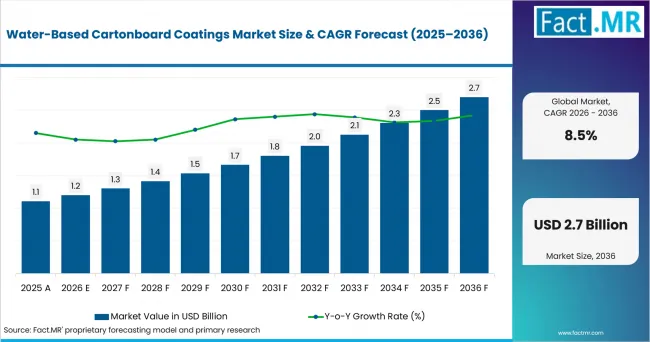
Water Based Cartonboard Coatings Market Value Analysis | Source: Fact.MR
What are the defining numbers behind Water-Based Cartonboard Coatings Market growth?
USD 1.5 billion absolute opportunity by 2036, led by Acrylic Dispersion and Moisture - Water alongside Food Packaging applications.
- Demand Drivers in the Market
- Paperboard mills need dispersions that dry efficiently while maintaining uniform coat weight at production speed.
- Food packaging converters need grease and moisture barriers that survive repeated folding and sealing.
- Packaging teams need food-contact and recycling evidence before replacing wax or extrusion-coated structures.
- Formulators need modular chemistries that combine barrier functions without exceeding converter or recovery limits.
- Key Segments Analyzed
- By polymer: Acrylic dispersion is expected to account for 36.0% share in 2026, supported by adjustable film formation.
- By barrier property: Moisture and water is projected to garner 36.0% share in 2026, owing to liquid holdout.
- By application method: Blade and rod coating is anticipated to record 40.0% share in 2026, attributable to accurate metering.
- By end use: Food packaging is estimated to hold 48.0% share in 2026, driven by recurring qualification.
- By substrate: Folding boxboard is forecast to capture 42.0% share in 2026, reinforced by stiffness and printability.
- Analyst Opinion at Fact.MR
- Shambhu Nath Jha, Principal Consultant at Fact.MR: “Commercial approval depends on performance under the converter’s dryer and crease geometry. Adoption is expected to favor platforms that reduce food-contact and recycling risk. Providers should combine formulation control with regional application support.”
- Strategic Implications
- Formulators should validate barrier performance on the exact printed and creased board selected for commercial use.
- Paperboard mills need to compare coat weight and drying load while scaling formulations across production speeds.
- Converters must document sealing and fold performance before replacing established extrusion coatings within approved packages.
- Packaging teams should align food-contact evidence with the intended collection and fiber-recovery route.
Heat-seal performance and moisture holdout remain critical qualification parameters for water-based cartonboard coatings. Defined coat weights and drying conditions are used during qualification to verify consistent packaging performance across converting and filling operations.
India is projected to record 10.9% CAGR through 2036 as paper packaging materials replace plastic-heavy structures. China is estimated to post 9.9% CAGR during the forecast period, supported by lines serving on-the-go food packaging. The United Kingdom is anticipated to advance at 9.0% CAGR by 2036 owing to package-composition reviews. Germany is forecast to grow at 8.2% CAGR between 2026 and 2036 as recyclability documentation shapes qualification. Brazil is expected to expand at 8.1% CAGR over the assessment period, reinforced by moisture protection needs.
How does the Water-Based Cartonboard Coatings Market break down by segment?
Acrylic Dispersion is projected to account for 36.0% share, Moisture - Water is estimated to garner 36.0% share.
Which Polymer category dominates?
Acrylic Dispersion is projected to account for 36.0% share in 2026
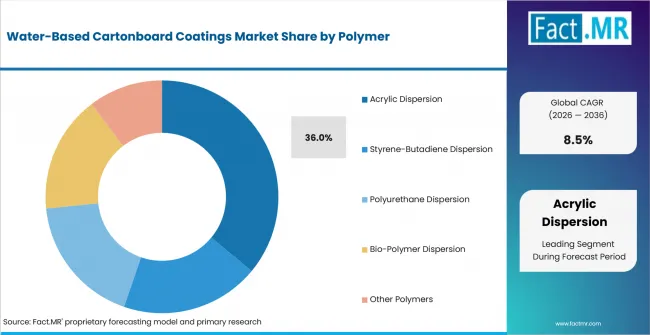
Water Based Cartonboard Coatings Market Analysis By Polymer | Source: Fact.MR
By polymer, acrylic dispersion is estimated to hold 36.0% share in 2026 owing to adaptable adhesion and film formation. Compatible coating additives let formulators adjust water resistance without rebuilding the entire waterborne platform.
What leads the Barrier Property segment?
Moisture - Water is estimated to garner 36.0% share in 2026
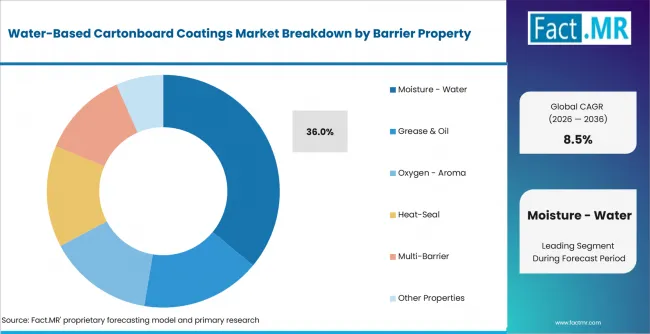
Water Based Cartonboard Coatings Market Analysis By Barrier Property | Source: Fact.MR
In 2026, moisture and water barriers are expected to lead the category with 36.0% share because absorption weakens board stiffness. Waterproof paper coatings protect dimensional stability during chilled storage and damp handling. Their broad use gives the segment a wider qualification base than specialized oxygen barriers.
How does Application Method shape demand?
Blade - Rod Coating is anticipated to record 40.0% share in 2026
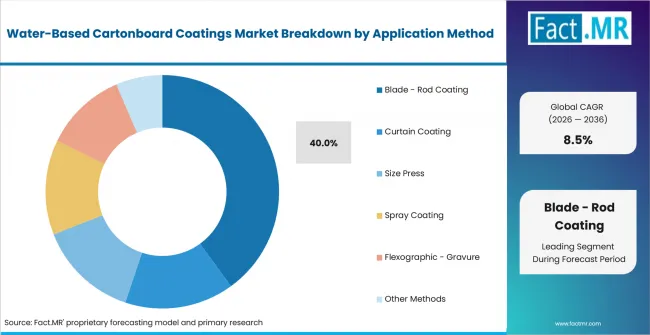
Water Based Cartonboard Coatings Market Analysis By Application Method | Source: Fact.MR
Based on application method, blade and rod coating is projected to account for 40.0% share in 2026 due to stable metering. Paper barrier coatings applied by these methods maintain a controlled wet film across wide webs. Reliable profiles reduce pinholes and polymer waste during commercial scale-up.
What supports Food Packaging within End Use?
Food Packaging is forecast to capture 48.0% share in 2026
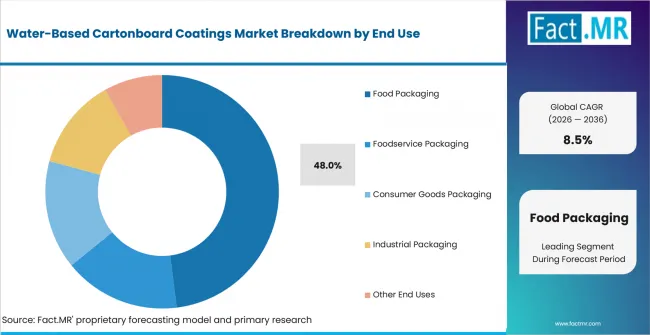
Water Based Cartonboard Coatings Market Analysis By End Use | Source: Fact.MR
Food packaging is projected to hold 48.0% share in 2026 owing to recurring volumes and strict protection requirements. Fresh food packaging formats require grease resistance and moisture holdout after printing and folding.
Which Substrate category carries the primary share?
Folding Boxboard is expected to represent 42.0% share in 2026
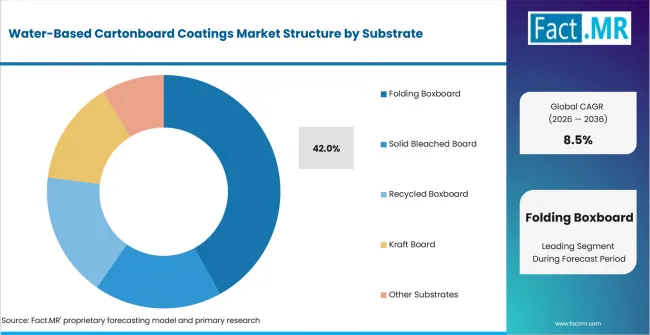
Water Based Cartonboard Coatings Market Analysis By Substrate | Source: Fact.MR
By substrate, folding boxboard is forecast to represent 42.0% share in 2026 driven by folding strength and printable surfaces. Folding carton packaging uses its coated face for graphics while the fiber structure provides stiffness at low material weight.
What is accelerating Water-Based Cartonboard Coatings Market adoption, and what is holding it back?
Packaging redesign is expected to drive adoption, multi-stage qualification and line-scale risk are anticipated to restrain commercial conversion speed.
Drivers Impact Analysis
| DRIVER | (~) % IMPACT ON CAGR | GEOGRAPHIC RELEVANCE | IMPACT TIMELINE |
|---|---|---|---|
| Packaging rules moving recyclability into material selection | +0.8% | Western Europe and North America | Medium term (2-4 years) |
| Food-contact PFAS withdrawal creating replacement work | +0.7% | North America and Europe | Short term (<= 2 years) |
| Fiber-recovery protocols requiring package-level evidence | +0.6% | Europe and North America | Medium term (2-4 years) |
| Waterborne conversion on active paperboard lines | +0.4% | East Asia and South Asia | Medium term (2-4 years) |
| Lower coat weight improving package economics | +0.3% | Global | Long term (>= 4 years) |
Source: Fact.MR analysis. Updated Jul 31, 2026
- Packaging redesign: Carton converters now compare barrier performance with the finished package recovery route before approving material changes.
- Food-contact transition: Grease-barrier reformulation requires functional testing and renewed compliance documentation. .
- Fiber-recovery evidence: A coating claim remains incomplete without testing against the intended paper-mill process. The 2025 4evergreen protocol separates recycling routes by mill process. Providers therefore need package tests that match the expected recovery system.
- Installed-line conversion: Commercial adoption depends on proving stable coat weight and drying at the converter’s normal speed.
- Coat-weight economics: Engineering teams favor thin functional layers that remain uniform at production speed.
Opportunity Impact Analysis
| OPPORTUNITY | (~) % IMPACT ON CAGR | GEOGRAPHIC RELEVANCE | IMPACT TIMELINE |
|---|---|---|---|
| Multi-functional coatings combining water and grease barriers | +0.5% | Europe and North America | Medium term (2-4 years) |
| Low-plastic heat-seal structures for food packaging | +0.4% | Europe and Asia | Short term (<= 2 years) |
| Application laboratories supporting local board grades | +0.4% | India and China | Medium term (2-4 years) |
| Bio-based dispersion platforms for selected recovery routes | +0.3% | Asia Pacific and Europe | Long term (>= 4 years) |
Source: Fact.MR analysis. Updated Jul 31, 2026
- Multi-functional layers: Combined water and grease protection reduces qualification steps when printed and sealed packages pass recovery tests.
- Heat-seal structures: Waterborne layers support lower-plastic cups and cartons when seal strength remains stable across filling temperatures.
- Local application support: Regional laboratories shorten trials across varied Indian and Chinese lines, while local inventory limits qualification disruption.
- Bio-based platforms: Renewable dispersions require commercial barrier performance, feedstock continuity, and consistent batch quality before approval.
Restraints Impact Analysis
| Multi-stage qualification across coating and converting | -0.5% | Global | Medium term (2-4 years) |
|---|---|---|---|
| Drying load reducing line speed on sensitive grades | -0.4% | Asia and Europe | Short term (<= 2 years) |
| Food-contact documentation varying by application | -0.3% | North America and Asia | Medium term (2-4 years) |
| Different collection and recycling routes by country | -0.2% | Global | Long term (>= 4 years) |
Source: Fact.MR analysis. Updated Jul 31, 2026
- Qualification burden: Flat-sheet results do not predict folding or sealing performance, so separate line trials delay conversion.
- Drying constraints: Limited dryer capacity reduces line speed or coat weight, causing mills to reject disruptive formulations.
- Documentation differences: Food-contact approval varies by geography, so incomplete composition and migration records prolong trials.
Which countries are scaling Water-Based Cartonboard Coatings Market fastest?
India 10.9%, China 9.9%, United Kingdom 9.0%, Germany 8.2%, Brazil 8.1%.
Water-Based Cartonboard Coatings Market covers five regions: North America, Europe, Asia Pacific, Latin America, Middle East & Africa.
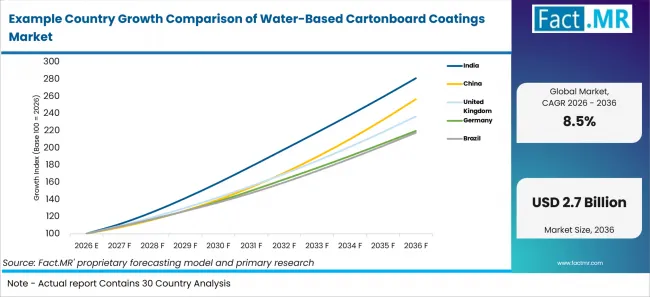
Example Country Growth Comparison Of Water Based Cartonboard Coatings Market | Source: Fact.MR
| COUNTRY | CAGR |
|---|---|
| India | 10.9% |
| China | 9.9% |
| United Kingdom | 9.0% |
| Germany | 8.2% |
| Brazil | 8.1% |
Source: Fact.MR analysis. Updated Jul 31, 2026
How is India scaling cartonboard coating demand?
10.9% CAGR, supported by packaging conversion and food-contact inspection.
Indian converters manage strict cost targets while direct-contact cartons face formal food-safety scrutiny. FSSAI’s April 2025 inspection guidance classifies food-grade packaging as critical to food safety. The industry in India is projected to expand at a 10.9% CAGR through 2036, underpinned by stricter compliance requirements.
What underpins China’s expansion?
9.9% CAGR, driven by high-output converting and local production controls.
Chinese mills require stable runnability across high-speed assets and varied domestic board grades. The market is estimated to rise at a 9.9% CAGR through 2036, propelled by
local formulation support that shortens trial cycles. Dryer capacity and coat-weight control remain key barriers to consistent approval across converter lines.
What supports the United Kingdom outlook?
9.0% CAGR, owing to material classification and package-composition reviews.
United Kingdom packaging teams compare coating mass with mineral-oil barriers during recyclability reviews. The national methodology places fiber composites containing no more than 5% plastic within the paper assessment route. The market is anticipated to post a 9.0% CAGR through 2036, aided by evolving package-composition reviews.
How does Germany’s documentation regime shape growth?
8.2% CAGR, shaped by recycling design and conformity documentation.
German converters evaluate coated cartons through recovery tests and production-line performance. The 2025 ZSVR standard assesses the complete packaging structure instead of the coating alone. The market is forecast to grow at an 8.2% CAGR through 2036, reinforced by package-level qualification of waterborne heat-seal coatings alongside inks and adhesives.
Which local condition influences Brazil’s growth?
8.1% CAGR, reinforced by barrier-line control and warm distribution conditions.
Brazilian converters need moisture protection that remains stable across warm distribution routes and varied board quality. The demand is expected to expand at an 8.1% CAGR through 2036, supported by broader use across food and consumer packaging applications. Long service distances and uneven recovery infrastructure continue to favor simple coating platforms backed by regional technical partners.
Who leads the Water-Based Cartonboard Coatings Market?
BASF and Solenis provide broad coating chemistry coverage, while Michelman and Archroma strengthen specialized barrier formulation capabilities.
The competitive field combines chemical groups with integrated board producers, so concentration differs by capability instead of one ranking. New entrants need food-contact records and recycling evidence before commercial trials. Partnerships supporting paperboard cold-chain cartons help specialists connect formulation knowledge with line-scale access.
BASF and Solenis focus on broad aqueous chemistry platforms and technical service across board grades. Michelman and Archroma concentrate on sealing and liquid barriers, while Kemira develops bio-based routes. Stora Enso combines coated-board production with package development. Competitive advantage depends on qualification speed and regional support.
Which companies are the key providers?
Some of the key players profiled include BASF, Solenis, Michelman, Archroma, Kemira, Stora Enso.
- BASF
- Solenis
- Michelman
- Archroma
- Kemira
- Stora Enso.
Bibliography
- European Commission. (2025, February 11). Packaging waste. European Commission.
- Food Safety and Standards Authority of India. (2025, April 3). Reclassification of point related to “Food grade Packaging material” as “critical to food safety” under inspection checklist. FSSAI.
- 4evergreen. (2025, January 31). 4evergreen published updated Recyclability Evaluation Protocol. 4evergreen Alliance.
- Michelman. (2026, April 30). Michelman introduces Nuvita® Life 4002 & Nuvita® Life 4605: Bio-based barrier coatings for paper packaging applications. Michelman.
- United Kingdom Department for Environment, Food & Rural Affairs. (2025, September 4). Recyclability assessment methodology: Assessing materials. GOV.UK.
- U.S. Food and Drug Administration. (2025, January 3). FDA determines authorization for 35 food contact notifications related to PFAS are no longer effective. FDA.
- Zentrale Stelle Verpackungsregister. (2025, August 28). Minimum standard for determining the recyclability of packaging: Edition 2025. ZSVR.
This Report Addresses
- The report examines polymer and barrier choices that determine coating performance and qualification.
- Segment analysis covers acrylic dispersion, moisture barriers, application methods, end uses, and substrates.
- Regional analysis compares India, China, the United Kingdom, Germany, and Brazil.
- Competitive analysis profiles BASF, Solenis, Michelman, Archroma, Kemira, and Stora Enso.
- Polymer assessment covers acrylic, styrene-butadiene, polyurethane, and bio-polymer cartonboard systems.
- Application assessment covers food, foodservice, consumer-goods, and industrial cartons requiring functional barriers.
- Forecast coverage connects regulation, company activity, and regional adoption across the value chain.
What does the Water-Based Cartonboard Coatings Market cover?
Acrylic, styrene-butadiene, polyurethane, and bio-polymer dispersions used to provide functional barriers across commercial cartonboard packaging applications.
The market covers waterborne coatings providing moisture, grease, oxygen, aroma, heat-seal, or combined barriers on cartonboard.
The boundary excludes finished cartons because revenue comes from coating formulations and application support. Plastic films remain outside unless waterborne layers provide the principal barrier.
What is included in the scope?
Water-based cartonboard coating systems used across food, foodservice, consumer-goods, and industrial packaging applications requiring defined functional barriers.
The scope covers major waterborne polymers applied to folding boxboard and other cartonboard substrates. It includes moisture, grease, oxygen, aroma, heat-seal, and combined barriers across mill or converter routes. Food, foodservice, consumer-goods, and industrial packaging remain included.
What is excluded from the scope?
Plastic film laminates and printing coatings without a functional barrier role are outside the market boundary.
The scope excludes plastic layers and standalone films without a waterborne functional coating. Decorative inks and varnishes remain outside unless they provide a defined barrier. Finished cartons represent end uses instead of coating revenue.
How Was the Analysis Built?
The analysis draws on 120+ sources, 35+ company portfolios, 25+ countries, and more than 20 industry interviews.
- Primary Research: Primary research includes discussions with manufacturers, service providers, technology developers, distributors, end users, procurement teams, and subject-matter experts. These conversations examine purchasing priorities, product adoption, operational challenges, approval requirements, competitive positioning, and the factors that influence wider market acceptance.
- Desk Research: Desk research covers government statistics, regulatory publications, company filings, trade data, technical studies, industry associations, standards, public policy, and other authoritative sources. Every source used in the analysis is documented in the bibliography.
- Market Sizing and Forecasting: Market estimates combine historical performance, demand indicators, pricing and volume trends, segment shares, company participation, country-level growth, adoption patterns, investment activity, and barriers to market expansion.
- Data Validation and Update Cycle: Findings are validated by comparing primary interviews with public data, company activity, regulatory changes, trade patterns, and industry developments. Regular updates review new product launches, capacity changes, partnerships, approvals, procurement trends, and shifts in commercial adoption.
Segmentation
What is the report’s scope and coverage?
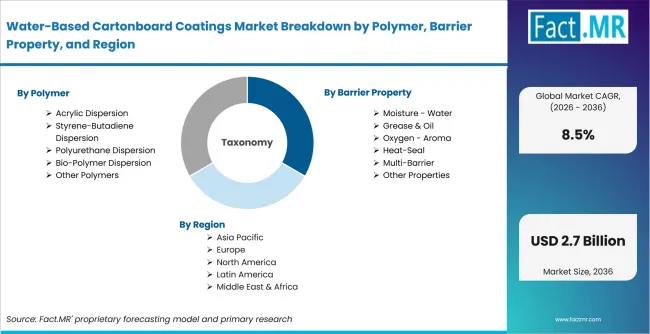
Water Based Cartonboard Coatings Market Breakdown By Polymer, Barrier Property, And Region | Source: Fact.MR
| Coverage field | Report scope |
|---|---|
| Quantitative Units | USD Billion |
| Market Definition | Waterborne functional coatings applied to cartonboard to provide moisture, grease, oxygen, aroma, or heat-seal performance across commercial packaging applications |
| Polymer | Acrylic Dispersion, Styrene-Butadiene Dispersion, Polyurethane Dispersion, Bio-Polymer Dispersion, Other Polymers |
| Barrier Property | Moisture - Water, Grease & Oil, Oxygen - Aroma, Heat-Seal, Multi-Barrier, Other Properties |
| Application Method | Blade - Rod Coating, Curtain Coating, Size Press, Spray Coating, Flexographic - Gravure, Other Methods |
| End Use | Food Packaging, Foodservice Packaging, Consumer Goods Packaging, Industrial Packaging, Other End Uses |
| Substrate | Folding Boxboard, Solid Bleached Board, Recycled Boxboard, Kraft Board, Other Substrates |
| Regions Covered | North America, Europe, Asia Pacific, Latin America, Middle East & Africa |
| Countries Covered | India, China, United Kingdom, Germany, Brazil, United States, Canada, France, Italy, Spain, Japan, South Korea, Australia, Mexico, Saudi Arabia, South Africa |
| Key Companies Profiled | BASF, Solenis, Michelman, Archroma, Kemira, Stora Enso |
| Forecast Period | 2026 to 2036 |
| Approach | Hybrid top-down and bottom-up approach using cartonboard output, coating consumption, coat-weight assumptions, barrier-function mix, converter qualification, replacement cycles, regional demand indicators |
Source: Fact.MR analysis. Updated Jul 31, 2026
How is the market segmented?
-
By Polymer
- Acrylic Dispersion
- Styrene-Butadiene Dispersion
- Polyurethane Dispersion
- Bio-Polymer Dispersion
- Other Polymers
-
By Barrier Property
- Moisture - Water
- Grease & Oil
- Oxygen - Aroma
- Heat-Seal
- Multi-Barrier
- Other Properties
-
By Application Method
- Blade - Rod Coating
- Curtain Coating
- Size Press
- Spray Coating
- Flexographic - Gravure
- Other Methods
-
By End Use
- Food Packaging
- Foodservice Packaging
- Consumer Goods Packaging
- Industrial Packaging
- Other End Uses
-
By Substrate
- Folding Boxboard
- Solid Bleached Board
- Recycled Boxboard
- Kraft Board
- Other Substrates
-
By Region
- North America
- United States
- Canada
- Europe
- Germany
- United Kingdom
- France
- Italy
- Spain
- Poland
- Asia Pacific
- India
- China
- Japan
- South Korea
- Australia & New Zealand
- ASEAN
- Latin America
- Brazil
- Mexico
- Chile
- Middle East & Africa
- Saudi Arabia
- Other GCC Countries
- Türkiye
- South Africa
- Other African Union
- North America
Who worked on this report


Preview the report firsthand - request a free sample
Free SampleGet the brochure for pricing and purchase details
Download PDF