- Market Value (2025): USD 417.8 Bn
- Estimated Value (2026): USD 445.0 Bn
- Forecast Value (2036): USD 1150 Bn
- CAGR (2026-2036): 10.0%
What is the Waterborne Wood Emulsions Market forecast to be worth by 2036?
USD 2.1 Billion in 2026 to USD 3.9 Billion by 2036, at 6.3% CAGR.
- The Waterborne Wood Emulsions Market crossed a valuation of USD 2.0 Billion in 2025.
- Demand is projected to increase from USD 2.1 Billion in 2026 to USD 3.9 Billion by 2036.
- The market is forecast to record a 6.3% CAGR from 2026 to 2036 as furniture coaters and flooring finishers replace solvent-heavy binders with waterborne systems.
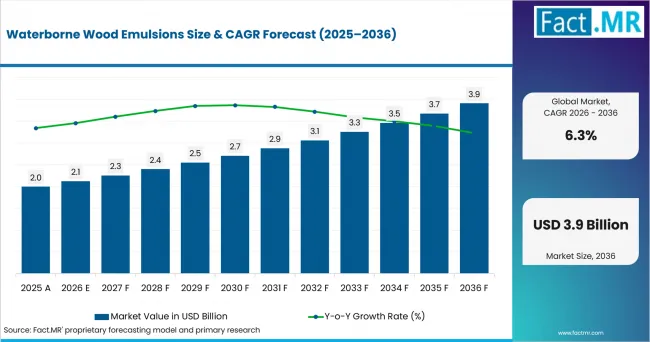
Waterborne Wood Emulsions Value Analysis | Source: Fact.MR
What are the defining numbers behind Waterborne Wood Emulsions Market growth?
USD 1.8 Billion absolute opportunity by 2036, led by Clear coat, Pure acrylic and furniture coatings.
- Demand Drivers in the Market
- Furniture coating formulators need acrylic emulsions that keep wood grain visible and improve water resistance on interior panels.
- Flooring finish producers need fast-dry binders with scratch resistance because coated boards move quickly through finishing lines.
- Joinery manufacturers need low-odor clear coats shaped by VOC rules and indoor-air expectations.
- DIY and decorative brands need emulsions that balance stain penetration, matte effects and water clean-up.
- Key Segments Analyzed
- By Polymer: Pure acrylic is expected to hold 31.0% share in 2026 because formulators use it where clarity, weatherability and water resistance carry buying weight.
- By Wood Application: Furniture coatings are projected to account for 28.0% share in 2026 due to recurring demand from interior tables, chairs, cabinets and panel finishes.
- By Finish: Clear coat is anticipated to capture 34.0% share in 2026 owing to its role in protecting visible wood grain while preserving color.
- By Performance: Block / scratch resistance is estimated to represent 26.0% share in 2026 as factory-coated components need stackability and handling strength.
- Analyst Opinion at Fact.MR
- Shambhu Nath Jha, Principal Consultant at Fact.MR, states, "Waterborne wood emulsions are drawing attention because low VOC now has to protect appearance. Demand is expected to move toward binders that deliver early hardness and clear film quality. Suppliers should combine application support, resin consistency and regulatory documentation."
- Strategic Implications
- Binder producers should document early block resistance on common wood species so coaters shorten handling checks.
- Furniture OEMs should test clear-coat clarity after heat and detergent exposure.
- Distributors should segment products by application because flooring and joinery need different drying profiles.
The USA is expected to post 7.5% CAGR through 2036, supported by furniture refinishing. Italy is projected to advance at 7.1% CAGR through design-led furniture demand. Germany is anticipated to record 6.8% CAGR owing to joinery production. Poland is estimated to reach 5.9% CAGR due to housing completions. The UK is forecast to post 4.8% CAGR as repair work shapes coating choices.
How does the Waterborne Wood Emulsions Market break down by segment?
Clear coat leads at 34.0%; Pure acrylic follows at 31.0%.
Which Polymer dominates?
Pure acrylic holds 31.0% share in 2026.
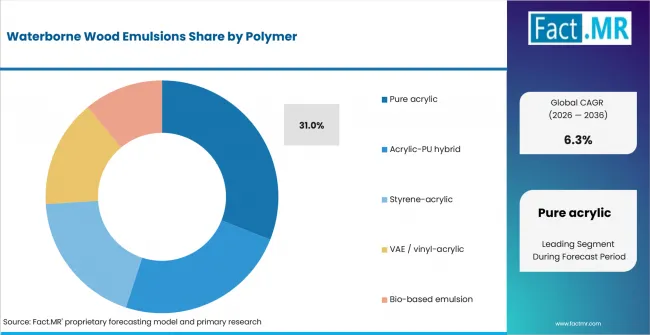
Waterborne Wood Emulsions Analysis By Polymer | Source: Fact.MR
Pure acrylic is expected to hold 31.0% share in 2026 because it balances clarity and water resistance. Acrylic-PU hybrid systems serve flooring and door coatings that need toughness. Dow lists PRIMAL IW-530 for interior wood coatings requiring early hardness and block resistance.
What leads the Wood Application segment?
Furniture coatings account for 28.0% share in 2026.
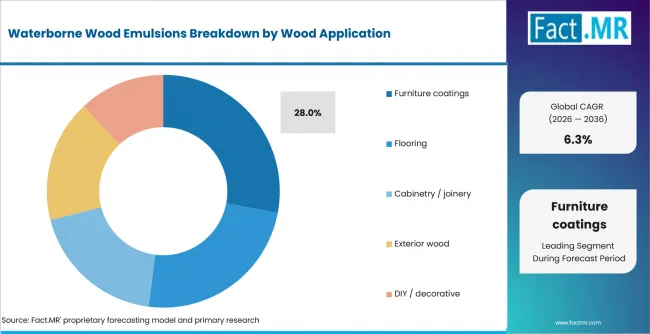
Waterborne Wood Emulsions Analysis By Wood Application | Source: Fact.MR
Furniture coatings are projected to account for 28.0% share in 2026 due to repeated clear-coat use on tables and cabinets. Flooring coatings require abrasion resistance. The U.S. Census Bureau initially reported in July 2026 that privately owned housing completions in June were at a seasonally adjusted annual rate of 1,392,000 units.
How does Finish shape demand?
Clear coat leads with 34.0% share in 2026.
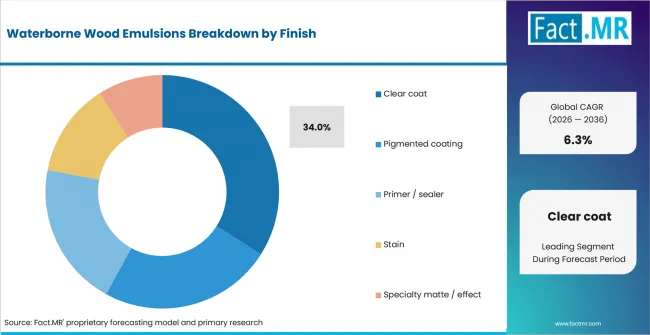
Waterborne Wood Emulsions Analysis By Finish | Source: Fact.MR
Clear coat is anticipated to capture 34.0% share in 2026 owing to visible-grain protection. Pigmented coatings serve furniture lines that need color consistency. Arkema describes SYNAQUA 9511 as a waterborne acrylic polyol emulsion for industrial wood finishes needing chemical resistance.
What supports Block / scratch resistance within Performance?
Block / scratch resistance represents 26.0% share in 2026.
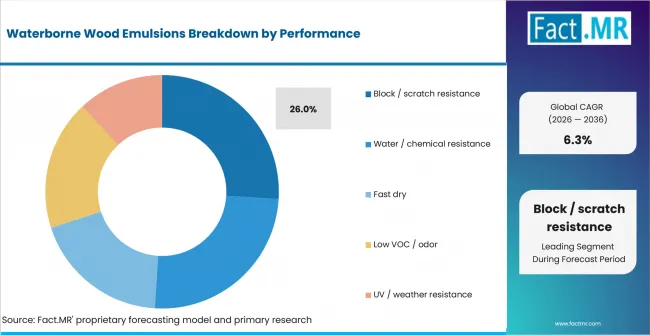
Waterborne Wood Emulsions Analysis By Performance | Source: Fact.MR
Block / scratch resistance is estimated to represent 26.0% share in 2026 as coated parts are stacked soon after finishing. Water / chemical resistance supports kitchen and flooring uses. Dow positions PRIMAL™ CL-103 as a water-based alternative for industrial wood coatings that can substantially reduce solvent content compared with nitrocellulose coatings.
What is accelerating Waterborne Wood Emulsions Market adoption, and what is holding it back?
VOC reformulation drives it; substrate variability restrains it.
Drivers Impact Analysis
| Driver | (~) % Impact on CAGR | Geographic Relevance | Impact Timeline |
|---|---|---|---|
| VOC and indoor-air reformulation | +1.6% | North America, Europe | Short term (<= 2 years) |
| Furniture clear-coat conversion | +1.3% | USA, Italy, Germany | Medium term (2-4 years) |
| Factory handling and stacking needs | +1.1% | Global | Short term (<= 2 years) |
| Construction and repair demand | +0.8% | USA, UK, Poland | Medium term (2-4 years) |
| Bio-based binder development | +0.5% | Europe | Long term (>= 4 years) |
Source: Fact.MR analysis. Updated Sep 10, 2026
Opportunity Impact Analysis
| Opportunity | (~) % Impact on CAGR | Geographic Relevance | Impact Timeline |
|---|---|---|---|
| Low-VOC clear coats for furniture | +1.2% | USA, Europe | Short term (<= 2 years) |
| Joinery primers and sealers | +0.9% | Germany, UK, Italy | Medium term (2-4 years) |
| Flooring systems with faster handling | +0.7% | Europe, North America | Medium term (2-4 years) |
| Bio-based emulsions for decorative wood | +0.4% | Europe | Long term (>= 4 years) |
Source: Fact.MR analysis. Updated Sep 10, 2026
Restraints Impact Analysis
| Restraint | (~) % Impact on CAGR | Geographic Relevance | Impact Timeline |
|---|---|---|---|
| Substrate and species variability | -0.6% | Global | Short term (<= 2 years) |
| Drying equipment and line changes | -0.5% | North America, Europe | Medium term (2-4 years) |
| Raw material and wood-price pressure | -0.4% | Germany, Poland, Italy | Short term (<= 2 years) |
| Performance gap versus solvent lacquers | -0.3% | Global | Long term (>= 4 years) |
Source: Fact.MR analysis. Updated Sep 10, 2026
Which countries are scaling Waterborne Wood Emulsions Market fastest?
USA 7.5%; Italy 7.1%; Germany 6.8%; Poland 5.9%; UK 4.8%.
- The country comparison spans 2.7 percentage points and forms three practical growth bands across the forecast period.
- The USA remains 0.4 percentage point above Italy as VOC-sensitive furniture and interior finishing applications move toward waterborne binders.
- Italy remains 0.3 percentage point above Germany through design-led furniture demand and joinery coating-line upgrades.
- Germany remains 0.9 percentage point above Poland as joinery standards and industrial coating documentation shape formulation choices.
- Poland remains 1.1 percentage points above the UK through housing completions and wood-products manufacturing.
- The UK closes the displayed range as repair work and decorative paint compliance support steady waterborne binder use.
Comparable CAGRs create different entry conditions due to VOC rules, furniture production depth and coating-line qualification. Full report coverage includes North America, Latin America, Western Europe, Eastern Europe, East Asia, South Asia & Pacific, and Middle East & Africa.
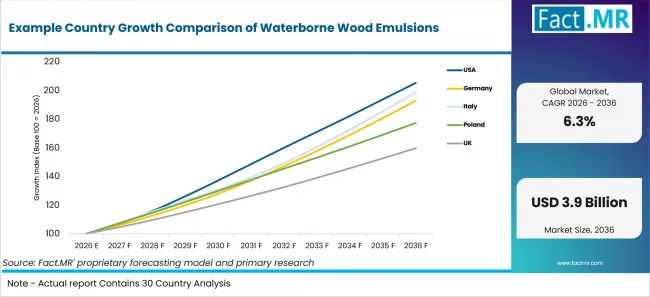
Example Country Growth Comparison Of Waterborne Wood Emulsions | Source: Fact.MR
| Country | CAGR |
|---|---|
| USA | 7.5% |
| Italy | 7.1% |
| Germany | 6.8% |
| Poland | 5.9% |
| UK | 4.8% |
Source: Fact.MR analysis. Updated Sep 10, 2026
What is powering USA adoption?
7.5% CAGR through 2036, supported by interior furniture conversion and VOC-sensitive coating choices.
Dow PRIMAL IW-530 gives factory-applied interior wood coaters early hardness, block resistance and water resistance. The USA is expected to record 7.5% CAGR through 2036. The U.S. Census Bureau reported that private residential construction spending was at a seasonally adjusted annual rate of USD 870.6 billion in June 2026.
How is Italy scaling waterborne wood emulsions demand?
7.1% CAGR through 2036, driven by furniture design demand and coating-line modernization.
BASF Acronal 6335 suits primers and topcoats for transparent systems. Italy is projected to advance at 7.1% CAGR through 2036. Istat reported construction production rose 2.0% in the three months to May 2026.
What supports Germany's outlook?
6.8% CAGR through 2036, backed by joinery demand and performance-led coating standards.
Germany is anticipated to record 6.8% CAGR through 2036. Destatis reported that the construction of 21,600 dwellings was approved in Germany in June 2026.
What underpins Poland's growth?
5.9% CAGR through 2036, shaped by housing completions and wood-products manufacturing.
Synthomer's wood coatings portfolio supports interior and exterior finishes with low-VOC properties. Poland is estimated to post 5.9% CAGR through 2036. Statistics Poland reported 94.9 thousand dwellings completed in January-June 2026.
How does the UK perform?
4.8% CAGR through 2036, supported by repair work and coating compliance needs.
Arkema and Synthomer offer binder technologies used in industrial wood finishes, varnishes and stains. The UK is forecast to post 4.8% CAGR through 2036. ONS reported that construction output grew 1.5% in the three months to May 2026 compared with the three months to February 2026.
Who leads the Waterborne Wood Emulsions Market?
Dow and BASF have direct waterborne wood-emulsion product coverage, while Arkema and Synthomer offer related performance-binder options.
Dow participates through PRIMAL acrylic and styrene-acrylic emulsions designed for wood coatings, including clear sealers, topcoats and lightly pigmented formulations. BASF offers Acronal 6335 as a universal binder for joinery coatings across primer, midcoat and topcoat layers. Arkema supplies SYNAQUA waterborne acrylic polyol technology for industrial coating applications, including industrial wood finishes.
Synthomer supports wood-coating formulations through PLEXTOL acrylic binders, with its portfolio addressing low-VOC formulations and performance requirements such as water and block resistance. Celanese supplies vinyl-acrylic and 100% acrylic emulsions specifically for waterborne wood stains and clear wood coatings and also maintains a broader VAE dispersion portfolio. Competitive differentiation is likely to depend on application-specific technical support and coating performance, including block resistance, water resistance, hardness and finish quality.
Which companies are the key providers?
Companies profiled include Dow, BASF, Arkema, Synthomer, and Celanese.
- Dow
- BASF
- Arkema
- Synthomer
- Celanese
Bibliography
- BASF. (2025, April 28). Acronal® 6335 – the universal dispersion for the joinery industry.
- European Commission. (2025, December 22). Commission Decision (EU) 2025/2607 of 17 December 2025 establishing the EU Ecolabel criteria for decorative paints, varnishes, and related products, performance coatings and related products, and water-based aerosol spray paints and repealing Decision 2014/312/EU. EUR-Lex.
- Federal Statistical Office (Destatis). (2026a, August 18). Baugenehmigungen für Wohnungen im Juni 2026: +13,8 % zum Vorjahresmonat.
- Federal Statistical Office (Destatis). (2026b, July 20). Producer prices in June 2026: +1.8% on June 2025.
- Istat. (2026, July 17). Production in the construction sector – May 2026.
- Office for National Statistics. (2026, July 16). Construction output in Great Britain: May 2026.
- Statistics Poland. (2026, July 20). Residential construction in the period of January–June 2026.
- U.S. Census Bureau. (2026a, August 3). Monthly construction spending, June 2026.
- U.S. Census Bureau. (2026b, July 17). Monthly new residential construction, June 2026.
- U.S. Environmental Protection Agency. (2026, March 4). Architectural coatings: National volatile organic compounds emission standards.
This Report Answers
- The report explains waterborne wood emulsion use across polymer and wood application.
- Segment analysis identifies the leading subsegments and the coating reasons formulators prioritize them.
- Country analysis examines the USA, Italy, Germany, Poland and the UK.
- Competitive analysis reviews Dow, BASF, Arkema, Synthomer, and Celanese.
- Polymer assessment covers pure acrylic, acrylic-PU hybrid, styrene-acrylic, VAE / vinyl-acrylic and bio-based emulsion systems.
- Application assessment covers furniture coatings, flooring, cabinetry / joinery and exterior wood.
- The forecast is supported by primary interviews, company portfolio checks and official source review.
What does the Waterborne Wood Emulsions Market cover?
Acrylic, acrylic-PU, styrene-acrylic and VAE / vinyl-acrylic binders used for wood coatings.
The Waterborne Wood Emulsions Market covers water-dispersed binder systems used to formulate coatings for furniture, floors, cabinetry and exterior wood. It includes emulsions that support clear coats, primers, stains and specialty matte effects.
The assessment focuses on the emulsion binder that gives film formation, adhesion and resistance properties. Finished paints and varnishes are included only where the waterborne emulsion component is assessed.
What is included in the scope?
Waterborne wood emulsion systems used in furniture, flooring, joinery and decorative wood finishing.
The scope includes pure acrylic, acrylic-PU hybrid, styrene-acrylic, VAE / vinyl-acrylic and bio-based emulsion binders used in interior and exterior wood coatings. It covers furniture coatings, flooring, cabinetry / joinery, exterior wood and DIY / decorative applications. Adjacent context is reviewed through waterborne acrylic resin, emulsion polymers and coating binders where those categories explain binder chemistry and formulation choices for wood substrates.
What is excluded from the scope?
Finished solventborne coatings and non-wood coating binders are outside the scope.
Outside scope are solventborne lacquer resins, powder coatings, neat monomers, additives sold without binder function and finished coatings where emulsion binder value is assessed only within the finished product. Broader wood coatings are referenced only to define the downstream coating boundary while the analysis stays at emulsion-binder level.
How Was the Analysis Built?
120+ sources, 35+ company portfolios, 25+ countries, and more than 20 interviews.
- Primary Research: Primary research includes discussions with coating formulators, resin suppliers and finishing-line specialists. These conversations examine qualification, drying behavior and resistance requirements.
- Desk Research: Desk research covers government statistics, construction data, regulatory publications, product pages and official coating standards.
- Market Sizing and Forecasting: Market estimates combine application demand, binder chemistry, finish type, performance needs, country indicators, pricing signals and adoption barriers.
- Data Validation and Update Cycle: Findings are validated by comparing interviews with public data, company product activity and regulatory changes.
Segmentation
What is the report’s scope and coverage?
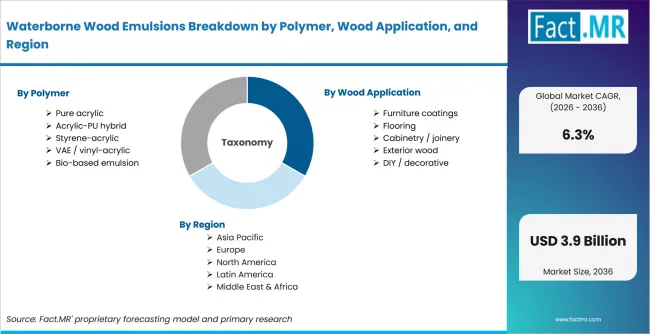
Waterborne Wood Emulsions Breakdown By Polymer, Wood Application, And Region | Source: Fact.MR
| Attribute | Details |
|---|---|
| Quantitative Units | USD Billion |
| Market Definition | Aqueous polymer emulsions used as binder systems in wood coatings, including acrylic, acrylic-PU, styrene-acrylic, VAE / vinyl-acrylic and bio-based formats. |
| Polymer | Pure acrylic; Acrylic-PU hybrid; Styrene-acrylic; VAE / vinyl-acrylic; Bio-based emulsion |
| Wood Application | Furniture coatings; Flooring; Cabinetry / joinery; Exterior wood; DIY / decorative |
| Finish | Clear coat; Pigmented coating; Primer / sealer; Stain; Specialty matte / effect |
| Performance | Block / scratch resistance; Water / chemical resistance; Fast dry; Low VOC / odor; UV / weather resistance |
| Regions Covered | North America; Latin America; Western Europe; Eastern Europe; East Asia; South Asia & Pacific; Middle East & Africa |
| Countries Covered | USA; Italy; Germany; Poland; UK |
| Key Companies Profiled | Dow; BASF; Arkema; Synthomer; Celanese |
| Forecast Period | 2026 to 2036 |
| Approach | Hybrid top-down and bottom-up approach using wood coating applications, binder chemistry, finishing requirements, country indicators and provider portfolio review. |
Source: Fact.MR analysis. Updated Sep 10, 2026
How is the market segmented?
-
By Polymer
- Pure acrylic
- Acrylic-PU hybrid
- Styrene-acrylic
- VAE / vinyl-acrylic
- Bio-based emulsion
-
By Wood Application
- Furniture coatings
- Flooring
- Cabinetry / joinery
- Exterior wood
- DIY / decorative
-
By Finish
- Clear coat
- Pigmented coating
- Primer / sealer
- Stain
- Specialty matte / effect
-
By Performance
- Block / scratch resistance
- Water / chemical resistance
- Fast dry
- Low VOC / odor
- UV / weather resistance
-
By Region
- North America
- Latin America
- Western Europe
- Eastern Europe
- East Asia
- South Asia & Pacific
- Middle East & Africa
Frequently Asked Questions
How big is the Waterborne Wood Emulsions Market in 2026?
What is the CAGR of the Waterborne Wood Emulsions Market from 2026 to 2036?
Which polymer leads the Waterborne Wood Emulsions Market?
Which finish leads the Waterborne Wood Emulsions Market?
Who are the leading companies in the Waterborne Wood Emulsions Market?
Who worked on this report


Preview the report firsthand - request a free sample
Free SampleGet the brochure for pricing and purchase details
Download PDF