- Market Value (2025): USD 838.4 Mn
- Estimated Value (2026): USD 903.0 Mn
- Forecast Value (2036): USD 1896.0 Mn
- CAGR (2026-2036): 7.7%
What is the Additive-Free Butter Powders Market forecast to be worth by 2036?
USD 903.0 million in 2026 to USD 1,896.0 million by 2036, at a 7.7% CAGR.
- The Additive-Free Butter Powders Market was valued at USD 838.4 million in 2025.
- Demand is projected to increase from USD 903.0 million in 2026 to USD 1,896.0 million by 2036.
- The market is forecast to grow at a 7.7% CAGR from 2026 to 2036. Bakery, savory, and prepared-food makers use shelf-stable butter powders in dry mixes and routine production.
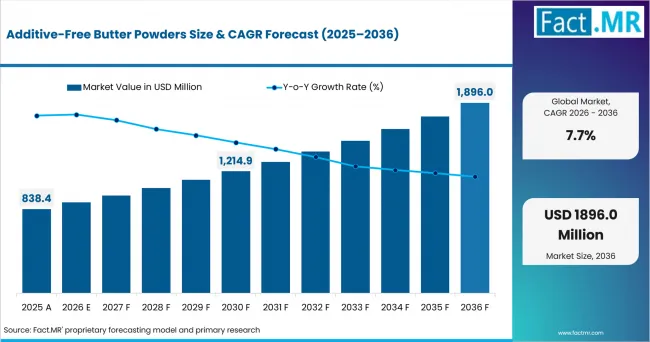
Additive Free Butter Powders Value Analysis | Source: Fact.MR
What are the defining numbers behind Additive-Free Butter Powders Market growth?
The market offers a USD 993.0 million absolute opportunity by 2036.
- Demand Drivers in the Market
- Bakery teams need dry butter ingredients that give a clear butter taste and mix well into dough and premixes. In July 2026, the UK Office for National Statistics reported that food manufacturing was the largest manufacturing division. It made up 22.9% of total UK manufacturers’ product sales in 2025.
- Snack and seasoning makers value powders because they spread dairy-fat flavor through dry blends and coatings. Dry storage and measured dosing can also support steady output across seasoning lines.
- Prepared-food makers use butter powders to add dairy richness to sauces and soups. Stable solids and measured dosing make these powders useful in dry mixes and standard recipes.
- Clean-label teams review the full ingredient list. Additive-free butter powders can compete through familiar butter taste and a short ingredient list that fits the chosen label.
- Key Segments Analyzed
- By Butter Powder Type: Sweet cream butter powder is expected to hold a 34.0% share in 2026. Its familiar dairy taste fits bakery and prepared foods.
- By Label Positioning: Additive-free products are projected to hold a 31.0% share in 2026. Demand is supported by short ingredient lists and direct dairy positioning.
- By Application: Bakery is expected to capture a 36.0% share in 2026. Butter flavor is widely used in cakes, cookies, and dry mixes.
- By Fat Content: Below 40% fat is estimated to hold a 29.0% share in 2026. These lower-fat powders support dry-blend handling and flexible recipes.
- Analyst Opinion at Fact.MR
- Shambhu Nath Jha, Principal Consultant at Fact.MR, states, “The main test for additive-free butter powder is simple: can a short ingredient list still give the butter taste and process behavior that food makers need? Demand is likely to favor powders with steady batch results and simple records. Suppliers should pair dairy-fat know-how with practical support for bakery, savory, and prepared-food uses.”
- Strategic Implications
- Butter-powder producers should clearly separate additive-free grades from products that use carriers or flow agents. This helps product teams compare ingredient lists.
- Bakery teams should test heat response and final taste at real use levels before moving from pilot work to full production. In July 2026, INSEE reported that French food, beverage, and tobacco manufacturing generated EUR 207 billion in production value in 2025. This shows the large scale of the sector in France.
- Snack and seasoning makers should test powder flow and coating spread under normal plant humidity. Handling can affect line consistency even when flavor stays acceptable.
- Prepared-food makers should match the powder type and fat level to the final sauce or soup. This can support a cleaner label and steady process results.
China is forecast to grow at a 9.2% CAGR through 2036 as dairy supply and food production expand. Japan is projected to grow at 8.1% as industrial butter demand stays firm. The USA is forecast to grow at 7.7%, supported by its large food-processing base. France is also estimated at 7.7% as dairy processing supports ingredient supply. Germany is forecast to grow at 7.5%, backed by its butter-production base.
How does the Additive-Free Butter Powders Market break down by segment?
Sweet cream butter powder leads Butter Powder Type at 34.0%; Bakery leads Application at 36.0%.
Which Butter Powder Type leads?
Sweet cream butter powder is expected to hold 34.0% share in 2026.
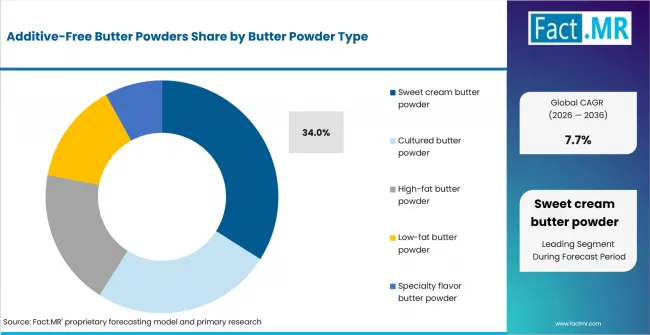
Additive Free Butter Powders Analysis By Butter Powder Type | Source: Fact.MR
Sweet cream butter powder is expected to lead because its familiar butter taste works well in baked goods and dry savory foods. Cultured butter powder suits products that need a tangier dairy note. High-fat and low-fat grades give developers options for flavor strength and recipe fat levels.
The best type depends on the final food and the process used. Bakery mixes need stable flavor after heating. Soup and snack seasonings need even spread in a dry mix.
How does Label Positioning shape demand?
Additive-free is projected to account for 31.0% share in 2026.
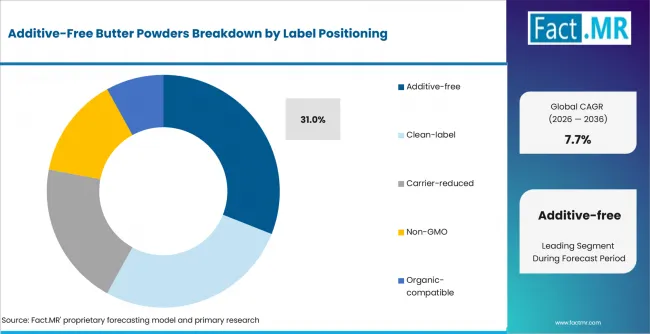
Additive Free Butter Powders Analysis By Label Positioning | Source: Fact.MR
Additive-free products are projected to lead because the ingredient list is a key part of product choice. Clean-label grades suit makers that allow a wider set of familiar ingredients. Carrier-reduced grades suit products that still need some process support.
Product checks start with the ingredient list, then move to taste and process tests. A shorter list must still give even mixing and stable butter taste after heating.
What supports Bakery within Application?
Bakery is anticipated to capture 36.0% share in 2026.
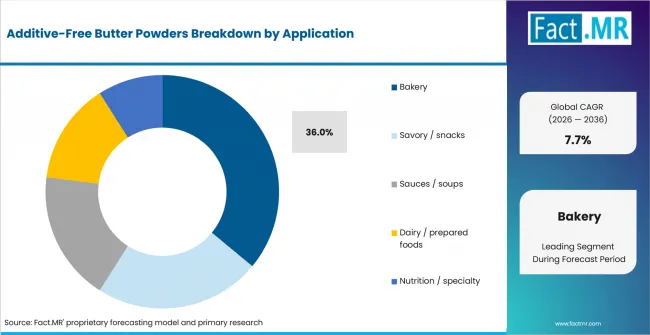
Additive Free Butter Powders Analysis By Application | Source: Fact.MR
Bakery is expected to lead because butter taste is common in cookies, cakes, and pastries. Powder formats work well in dry premixes and central ingredient handling. Savory foods use butter notes in seasonings. Sauces and prepared foods use them for dairy richness.
The USDA Economic Research Service reported in June 2026 that U.S. food spending reached USD 2.51 trillion in 2025. This large food market supports demand for baking ingredients and other dry dairy products that need steady dosing.
How does Fat Content influence selection?
Below 40% fat is estimated to represent 29.0% share in 2026.
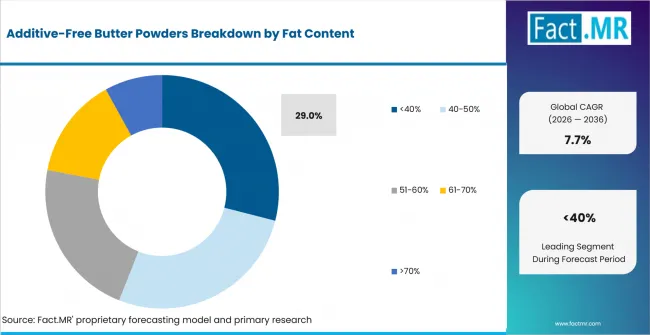
Additive Free Butter Powders Analysis By Fat Content | Source: Fact.MR
Below-40% fat powders are estimated to lead because they leave more room for other dry ingredients. The 40-50% and 51-60% bands suit recipes that need more dairy fat. Higher-fat grades focus on richer flavor.
Fat level affects storage and mixing. Higher-fat powders need tighter control of caking and temperature. Lower-fat grades can fit more easily into premix lines.
What is accelerating Additive-Free Butter Powders Market adoption, and what is holding it back?
Simple labels and easy dry handling support adoption. Product quality and changes in dairy costs can slow demand.
Drivers Impact Analysis
| Driver | (~) % Impact on CAGR | Geographic Relevance | Impact Timeline |
|---|---|---|---|
| Additive-free formulation programs | +1.5% | North America, Europe, East Asia | Short term (<= 2 years) |
| Shelf-stable dry ingredient handling | +1.2% | Global | Medium term (2-4 years) |
| Bakery and savory application breadth | +1.0% | Global | Medium term (2-4 years) |
| Specification-led dairy sourcing | +0.7% | Europe, North America | Long term (>= 4 years) |
| Powder use in multi-site food production | +0.5% | North America, East Asia | Long term (>= 4 years) |
Source: Fact.MR analysis. Updated Sep 22, 2026
Opportunity Impact Analysis
| Opportunity | (~) % Impact on CAGR | Geographic Relevance | Impact Timeline |
|---|---|---|---|
| Short-declaration bakery powders | +1.1% | North America, Europe | Short term (<= 2 years) |
| Cultured and browned butter profiles | +0.8% | Europe, East Asia | Medium term (2-4 years) |
| Low-carrier dry seasoning systems | +0.6% | North America, East Asia | Medium term (2-4 years) |
| Application-specific fat bands | +0.4% | Global | Long term (>= 4 years) |
Source: Fact.MR analysis. Updated Sep 22, 2026
Restraints Impact Analysis
| Restraint | (~) % Impact on CAGR | Geographic Relevance | Impact Timeline |
|---|---|---|---|
| Carrier-free flow and caking control | -0.8% | Global | Short term (<= 2 years) |
| Butterfat price variability | -0.7% | Global | Medium term (2-4 years) |
| Sensory loss after heat processing | -0.5% | Bakery-intensive markets | Medium term (2-4 years) |
| Claim and specification complexity | -0.4% | North America, Europe | Long term (>= 4 years) |
Source: Fact.MR analysis. Updated Sep 22, 2026
Which countries are scaling the Additive-Free Butter Powders Market through 2036?
- The country CAGR range is 1.7 percentage points for 2026 to 2036.
- China is 1.1 percentage points above Japan. Growth in dairy supply supports wider use of dry dairy ingredients.
- Japan is 0.4 percentage point above the USA. Firm industrial butter demand and managed imports support ingredient supply.
- The USA and France both have a 7.7% CAGR. Their food and dairy sectors, however, have different structures.
- France is 0.2 percentage point above Germany. Its dairy and food-processing base supports additive-free product use.
Similar CAGRs can still reflect different market conditions. Dairy supply, food-production scale, and product approval practices vary by country. The report covers North America, Latin America, Western Europe, Eastern Europe, East Asia, South Asia & Pacific, and Middle East & Africa.
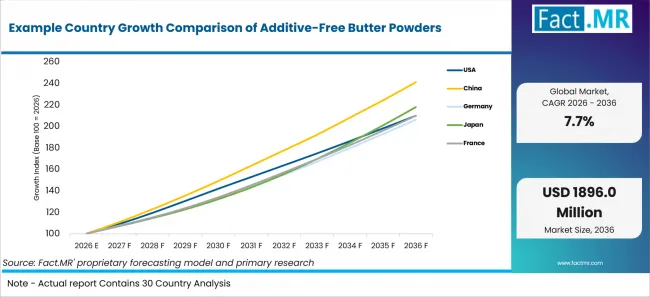
Example Country Growth Comparison Of Additive Free Butter Powders | Source: Fact.MR
| Country | CAGR (2026-2036) |
|---|---|
| China | 9.2% |
| Japan | 8.1% |
| USA | 7.7% |
| France | 7.7% |
| Germany | 7.5% |
Source: Fact.MR analysis. Updated Sep 22, 2026
How is China scaling additive-free butter powder demand?
China is projected to record a 9.2% CAGR through 2036, supported by expanding dairy supply and food-production activity.
Chinese food makers are expected to use more dry dairy ingredients as milk supply grows. The National Bureau of Statistics reported in January 2026 that China produced 40.91 million tonnes of milk in 2025. This supply can support bakery and prepared foods that use dairy powders.
What supports the Japan outlook?
Japan is expected to advance at an 8.1% CAGR by 2036 as industrial butter demand and managed imports support ingredient availability.
Japan's food makers are expected to keep using butter-based ingredients in bakery and prepared foods. In January 2025, the Ministry of Agriculture, Forestry and Fisheries set the fiscal-2025 butter import quota at 8,000 to about 10,000 tonnes. These imports can support ingredient supply for food production.
What underpins USA growth?
The USA is projected to post a 7.7% CAGR from 2026 to 2036, supported by a large food market and established butter production.
U.S. food makers benefit from a large dairy base and strong bakery and prepared-food channels. The USDA National Agricultural Statistics Service reported in December 2025 that U.S. butter production reached about 186 million pounds in October 2025. This output can support supply for butter-powder products.
How is France developing demand?
France is anticipated to record a 7.7% CAGR through 2036 as dairy processing and food-manufacturing activity support butter-powder use.
France's dairy-processing base supports supply for bakery and prepared-food applications. Agreste reported in September 2026 that French butter production reached 232,705 tonnes through July 2026. This output provides a substantial dairy-fat base for food manufacturers using butter-derived ingredients.
What supports Germany's position?
Germany is expected to register a 7.5% CAGR by 2036, led by high butter output within its established dairy-processing sector.
Germany's dairy sector can support steady supply of butter-based ingredients. The Federal Information Centre for Agriculture reported in April 2026 that Germany produced about 518,100 tonnes of butter, milk-fat products, and dairy spread-fat products in 2025. This output can support food makers that use dairy-fat ingredients.
Who leads the Additive-Free Butter Powders Market?
Kanegrade and Bluegrass Ingredients both list butter-powder products. This makes them direct suppliers in this market. Other companies may take part through wider dairy-ingredient ranges.
Kanegrade lists butter powders with several fat levels in its dairy-powder range. Bluegrass Ingredients offers butter powders for baked goods, snacks, sauces, and other foods.
Butter Buds offers concentrated butter-flavor ingredients made with real butterfat. Its range includes powders and pastes for bakery, desserts, snacks, sauces, seasonings, ready meals, and other foods. Key supplier factors include ingredient mix, butter taste, product form, end use, and technical support.
Which companies are the key providers?
Key companies include EPI Ingredients (Laïta); All American Foods, Inc.; Kanegrade; Bluegrass Ingredients; and Butter Buds.
- EPI Ingredients (Laïta)
- All American Foods, Inc.
- Kanegrade
- Bluegrass Ingredients
- Butter Buds
Bibliography
- Office for National Statistics. (2026, July 24). UK manufacturers’ sales by product: 2025.
- Insee. (2026, July 21). Indicateurs macroéconomiques de l’industrie manufacturière : Données annuelles de 2010 à 2025.
- Zeballos, E., & Sinclair, W. (2026, June 11). Total U.S. food spending reached $2.51 trillion in 2025. U.S. Department of Agriculture, Economic Research Service.
- National Bureau of Statistics of China. (2026, January 19). National economy pushed forward with innovation-led and high-quality development and expected targets achieved successfully in 2025.
- U.S. Department of Agriculture, National Agricultural Statistics Service. (2025, December 15). Dairy products.
- Agreste. (2026, September 15). Lait : Juillet 2026 - la collecte de lait quasi stable (Conjoncture – Infos Rapides No. 2026-115).
- Bundesinformationszentrum Landwirtschaft. (2026, April 17). Wie viel Milch braucht man für ein Päckchen Butter?
This Report Addresses
- The report covers Butter Powder Type and Label Positioning. It reviews how product composition and label needs affect product approval.
- The segment analysis covers sweet cream butter powder and bakery as the leading segments. It also reviews the other type, application, and fat-content groups.
- The country analysis covers China, Japan, the USA, France, and Germany. It uses the stated 2026–2036 CAGR values and first-hand evidence.
- The competitive analysis profiles EPI Ingredients (Laïta), All American Foods, Inc., Kanegrade, Bluegrass Ingredients, and Butter Buds. It reviews product fit, market activity, and formulation support.
What does the Additive-Free Butter Powders Market cover?
The market covers sweet cream, cultured, high-fat, low-fat, and specialty flavor butter powders. These products are positioned around short ingredient lists.
The market covers dry butter powders positioned as additive-free products. It sits next to the wider butter and margarine category. Product teams may also use clean-label support when they reformulate foods. Coverage includes sweet cream, cultured, high-fat, low-fat, and specialty flavor butter powders across the stated fat bands.
What is included in the scope?
The scope includes additive-free butter powder used in bakery, savory foods, sauces, soups, dairy foods, prepared foods, and specialty products.
The scope links additive-free butter powders with other dry dairy products such as buttermilk powder. Cream powder is another related dry dairy category. Baking and dry-mix uses also link this market with functional bakery ingredients.
The scope also includes food-formulation links to emulsifiers and other food additives. Broader food-ingredient pages give added category context. Food-processing ingredients show downstream use, while market sizing stays within the stated butter-powder scope.
What is excluded from the scope?
The market covers additive-free butter powders used as dry food ingredients.
The scope stays focused on powdered butter ingredients. It excludes retail table butter, liquid butterfat, liquid anhydrous milk fat, and stand-alone non-dairy butter flavors. These are treated as related categories.
Clean-label, non-GMO, organic-compatible, and carrier-reduced products are related label positions. Each has its own ingredient and label rules. Each grade is reviewed based on its real composition and market position.
How Was the Analysis Built?
The analysis draws on 120+ sources, 35+ company portfolios, 25+ countries, and more than 20 industry interviews.
- Primary Research: Primary research includes discussions with manufacturers, service providers, technology developers, distributors, end users, and subject-matter experts. These conversations examine purchasing priorities, product adoption, operational challenges, approval requirements, competitive positioning, and the factors that influence wider market acceptance.
- Desk Research: Desk research covers government statistics, regulatory publications, company filings, trade data, technical studies, industry associations, standards, public policy, and other authoritative sources. Every source used in the analysis is documented in the bibliography.
- Market Sizing and Forecasting: Market estimates combine historical performance, demand indicators, pricing and volume trends, segment shares, company participation, country-level growth, adoption patterns, investment activity, and barriers to market expansion.
- Data Validation and Update Cycle: Findings are validated by comparing primary interviews with public data, company activity, regulatory changes, trade patterns, and industry developments. Regular updates review new product launches, capacity changes, partnerships, approvals, and shifts in commercial adoption.
Segmentation
What is the report's scope and coverage?
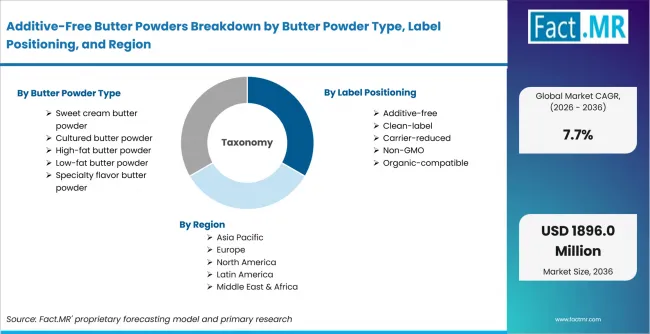
Additive Free Butter Powders Breakdown By Butter Powder Type, Label Positioning, And Region | Source: Fact.MR
| Attribute | Details |
|---|---|
| Quantitative Units | USD million |
| Market Definition | Additive-free butter powders used as dry dairy ingredients across food formulation applications. |
| Butter Powder Type | Sweet cream butter powder; Cultured butter powder; High-fat butter powder; Low-fat butter powder; Specialty flavor butter powder |
| Label Positioning | Additive-free; Clean-label; Carrier-reduced; Non-GMO; Organic-compatible |
| Application | Bakery; Savory / snacks; Sauces / soups; Dairy / prepared foods; Nutrition / specialty |
| Fat Content | <40%; 40-50%; 51-60%; 61-70%; >70% |
| Regions Covered | North America; Latin America; Western Europe; Eastern Europe; East Asia; South Asia & Pacific; Middle East & Africa |
| Countries Profiled | USA; China; Germany; Japan; France |
| Key Companies Profiled | EPI Ingredients (Laïta); All American Foods, Inc.; Kanegrade; Bluegrass Ingredients; Butter Buds |
| Forecast Period | 2026 to 2036 |
| Approach | Demand-side and supplier-side review using fixed market inputs, official dairy and food-manufacturing evidence, company portfolio checks and application analysis. |
Source: Fact.MR analysis. Updated Sep 22, 2026
How is the market segmented?
-
By Butter Powder Type
- Sweet cream butter powder
- Cultured butter powder
- High-fat butter powder
- Low-fat butter powder
- Specialty flavor butter powder
-
By Label Positioning
- Additive-free
- Clean-label
- Carrier-reduced
- Non-GMO
- Organic-compatible
-
By Application
- Bakery
- Savory / snacks
- Sauces / soups
- Dairy / prepared foods
- Nutrition / specialty
-
By Fat Content
- <40%
- 40-50%
- 51-60%
- 61-70%
- >70%
-
By Region
- North America
- Latin America
- Western Europe
- Eastern Europe
- East Asia
- South Asia & Pacific
- Middle East & Africa
Frequently Asked Questions
How big is the Additive-Free Butter Powders Market in 2026?
What is the CAGR of the Additive-Free Butter Powders Market from 2026 to 2036?
Which Butter Powder Type leads the Additive-Free Butter Powders Market?
Which Application leads the Additive-Free Butter Powders Market?
Which companies are profiled in the Additive-Free Butter Powders Market?
Who worked on this report


Preview the report firsthand - request a free sample
Free SampleGet the brochure for pricing and purchase details
Download PDF