- Forecast Value (2036): 4940.8 Mn
- CAGR (2036): 22.1%
Defense Data Labeling Market Overview, Growth Outlook, and Forecast by Fact.MR
- In 2025, the global Defense Data Labeling market was valued at approximately USD 549.5 million.
- Based on Fact.MR analysis, demand for Defense Data Labeling is estimated to grow to around USD 670.9 million in 2026 and USD 4,940.8 million by 2036.
- The market is projected to expand at a CAGR of 22.1% during the forecast period.
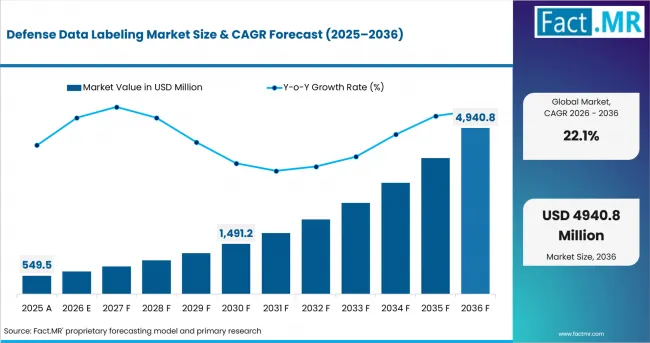
Defense Data Labeling Market Value Analysis | Source: Fact.MR
Summary of the Defense Data Labeling Market
- Market Snapshot
- In 2025, the global Defense Data Labeling market was valued at approximately USD 549.5 million.
- The market is estimated to reach around USD 670.9 million in 2026 and is projected to attain nearly USD 4,940.8 million by 2036.
- The Defense Data Labeling market is expected to expand at a CAGR of 22.1% during the forecast period.
- The market is anticipated to create an absolute dollar opportunity of approximately USD 4,269.9 million between 2026 and 2036.
- In terms of data type, Geospatial & Satellite Data Labeling holds the largest share in 2026, supported by increasing deployment of AI-enabled geospatial intelligence platforms, satellite imagery analytics, and military surveillance programs.
- Based on annotation type, Bounding Box Annotation accounts for the leading share in 2026, driven by its extensive use in object detection, target identification, vehicle recognition, and computer vision model training across defense applications.
- Intelligence, Surveillance & Reconnaissance (ISR) is expected to remain the dominant application segment through 2036, reflecting growing investments in AI-powered intelligence gathering, persistent monitoring, and real-time threat assessment capabilities.
- North America is expected to remain the leading regional market, supported by rising investments in artificial intelligence, defense modernization initiatives, geospatial intelligence programs, and large-scale military data annotation projects undertaken by government agencies and defense organizations.
- Demand and Growth Drivers
- Growing penetration of artificial intelligence, machine learning, and computer vision technologies in defense applications is increasing the demand for defense data labeling services due to the need for enhanced accuracy and reliability of AI-based solutions.
- High levels of investment into intelligence, surveillance, and reconnaissance (ISR) are increasing the demand for highly accurate labeled datasets used in developing object detection models, target recognition models, anomaly detection algorithms, and geospatial intelligence tools.
- Growing focus on the development of autonomous military systems, multi-domain operations, and decision-making with the help of AI technologies is encouraging the increased use of data annotation solutions in defense applications.
- Product and Segment View
- In 2026, the Geospatial & Satellite Data Labeling segment will hold the largest share of the market. This is explained by the growing application of satellite imagery, geospatial intelligence solutions, and intelligent surveillance systems in defense and national security missions.
- The Bounding Box Annotation segment is forecasted to hold the leading share in 2026. It is driven by the application of this solution in such areas as object detection, vehicle recognition, target tracking, and computer vision model development for military purposes.
- In 2026, the Intelligence, Surveillance & Reconnaissance (ISR) segment will represent the largest application category. The growing need for timely intelligence gathering, real-time monitoring of situations, and threats detection contributes to this trend.
- Defence Ministries & Government Agencies will represent the leading end-user segment in 2026. It is explained by the increasing investments in AI modernization, defense intelligence, and massive data preparation initiatives for the purposes of national security.
- Among others, Autonomous Military Systems will represent the fastest-growing application segments during the forecast period.
- Geography and Competitive Outlook
- North America is positioned as the largest market globally within the Defense Data Labeling market owing to significant defense expenditure, massive scale of artificial intelligence initiatives, and intelligence, surveillance, and reconnaissance developments. Increasing utilization of geospatial intelligence systems powered by AI, unmanned military vehicles, and computer vision technologies is likely to further fuel market growth in the region. The U.S. will exhibit robust growth at a 21.0% CAGR from 2026 to 2036.
- The Defense Data Labeling market in Europe is set to record the second-largest share in terms of revenue generation in the global market driven by increasing defense digitalization initiatives, investment in AI-enabled intelligence systems, and military modernization plans. Growing attention towards improving situational awareness, cybersecurity, and decision making via artificial intelligence is expected to boost the growth rate in this regard. Germany, France, and Italy will show strong growth rates of 21.9%, 23.3%, and 23.4%, respectively.
- Increased investment in defense, increased usage of artificial intelligence in military operations, and emphasis on development of indigenous defense technologies are expected to make East Asia and South Asia & Pacific the fastest growing regions in the market under review. Growth will be driven by the rising need for intelligent intelligence processing, satellite image analytics, autonomous military vehicles, and situational awareness solutions in the battlefield. South Korea will show the highest CAGR of 24.5%, followed by India at 23.1%, China at 18.3%, and Japan at 21.6%.
- Analyst Opinion
- Shambhu Nath Jha, Principal Consultant at Fact.MR, says, “Growth in the global Defense Data Labeling market will be attributed to the rising penetration of artificial intelligence, machine learning, and computer vision technologies into the domain of defense and intelligence operations. With defense organizations making active investments in high-quality labeled datasets, the accuracy and effectiveness of artificial intelligence and machine learning algorithms used for intelligence gathering, target identification, surveillance, autonomous military operations, and military decision-making will improve. Increasing investments in geospatial intelligence, AI-based command & control systems, and autonomous defense platforms are contributing to growing demand for secure and reliable data annotation services."
Defense Data Labeling Market - At a Glance
| Metric | Value |
|---|---|
| Market Value 2025 | USD 549.5 Million |
| Market Value 2026 | USD 670.9 Million |
| Market Value 2036 | USD 4,940.8 Million |
| Absolute Dollar Opportunity | USD 4,269.9 Million |
| CAGR (2026–2036) | 22.10% |
| Growth Multiple | 7.4X |
| Key Demand Theme | Growing adoption of artificial intelligence across defense operations, increasing investments in intelligence, surveillance & reconnaissance (ISR), rising deployment of computer vision systems, autonomous military platforms, geospatial intelligence analytics, and AI-enabled battlefield decision-making. |
| Leading Data Type | Geospatial & Satellite Data Labeling |
| Leading Annotation Type | Bounding Box Annotation |
| Leading Application | Intelligence, Surveillance & Reconnaissance (ISR) |
| Leading Platform | Airborne Defense Systems |
| Leading End User | Defense Ministries & Government Agencies |
| End User Share | ~41.0% |
| Fastest Growing Application | Autonomous Military Systems |
| Application CAGR Outlook | Highest growth through 2036 |
| Key Growth Regions | North America, Western Europe, East Asia, South Asia & Pacific |
| Fastest Growing Countries | South Korea (24.5%), France (23.3%), China (18.3%), India (23.1%) |
| Key Companies | Scale AI, Labelbox, Appen, Sama, Cogito Tech, CloudFactory, Snorkel AI, SuperAnnotate |
| Data Type Segmentation | Image Data Labeling, Video Data Labeling, Audio & Speech Data Labeling, Text & Document Annotation, Sensor Data Labeling, Geospatial & Satellite Data Labeling, Multi-Modal Data Labeling |
| Annotation Type Segmentation | Bounding Box Annotation, Semantic Segmentation, Polygon Annotation, Keypoint & Landmark Annotation, Object Tracking, Entity Recognition & Text Annotation, Classification & Categorization |
| Application Segmentation | Intelligence, Surveillance & Reconnaissance (ISR), Autonomous Military Systems, Target Detection & Recognition, Battlefield Situational Awareness, Cyber Defense & Threat Intelligence, Electronic Warfare Systems, Command & Control (C2) Systems, Military Training & Simulation |
| Platform Segmentation | Land-Based Defense Systems, Naval Defense Systems, Airborne Defense Systems, Space-Based Defense Systems, Joint & Multi-Domain Operations |
| End User Segmentation | Defense Ministries & Government Agencies, Armed Forces, Defense Contractors & OEMs, Intelligence Agencies, Homeland Security Organizations |
| Deployment Model Segmentation | On-Premise Secure Facilities, Cloud-Based Deployment, Hybrid Deployment |
| Regions | North America, Western Europe, Eastern Europe, East Asia, South Asia & Pacific, Latin America, Middle East & Africa |
Source: Fact.MR analysis. Updated Jun 17, 2026
The increasing integration of artificial intelligence, machine learning, and computer vision technologies across defense operations is expected to support market expansion over the next decade. Defense agencies are increasingly investing in high-quality labeled datasets to enhance the accuracy of intelligence, surveillance, reconnaissance, target recognition, and autonomous mission systems. As military modernization initiatives continue to prioritize AI-enabled decision-making, geospatial intelligence processing, and multi-domain operational capabilities, demand for defense-focused data labeling solutions is anticipated to witness substantial growth through 2036.
Key Growth Drivers, Constraints, and Opportunities
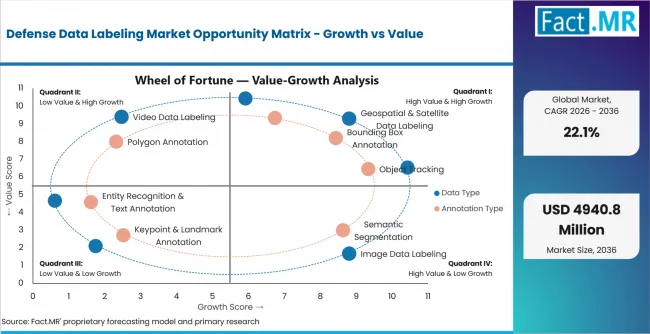
Defense Data Labeling Market Opportunity Matrix Growth Vs Value | Source: Fact.MR
Key Factors Driving Growth
- The increasing utilization of artificial intelligence, machine learning, and computer vision technologies by defense organizations is propelling demand for defense data labeling solutions. Defense agencies are making significant investments towards building their capability around developing AI-enabled systems for which large amounts of accurately labeled data will be required.
- Rising defense investments in intelligence, surveillance, and reconnaissance (ISR) modernization programs are propelling the demand for well-annotated datasets. Defense agencies are making use of satellite imagery, drone footage, radar sensors, and other kinds of sensor feeds to provide situational awareness to their troops.
- The increasing deployment of autonomous military systems and AI-enabled battlefield applications will play a crucial role in promoting market growth. The development of autonomous platforms, threat detection systems, command & control applications, and computer vision models will require accurately annotated datasets.
| Growth Driver | Demand Impact | Time Horizon | Key Impact Area | Fact.MR Insight |
|---|---|---|---|---|
| Growing adoption of artificial intelligence, machine learning, and computer vision technologies across defense operations | High | Short–Mid Term | Defense AI modernization | Defense organizations are increasingly deploying AI-enabled systems for intelligence analysis, target recognition, surveillance, and battlefield decision-making, creating strong demand for high-quality labeled datasets. |
| Increasing investments in intelligence, surveillance, and reconnaissance (ISR) programs | High | Short–Mid Term | Intelligence superiority | Military agencies require accurately annotated imagery, video, sensor, and geospatial data to improve intelligence collection, threat identification, and operational awareness across complex mission environments. |
| Expansion of autonomous military systems and AI-enabled mission platforms | High | Mid Term | Autonomous operations | The growing deployment of autonomous vehicles, unmanned systems, and AI-assisted defense applications is increasing the need for large-scale data annotation to train and validate machine learning models. |
| Rising adoption of geospatial intelligence (GEOINT) and satellite imagery analytics | High | Mid–Long Term | Situational awareness | Defense agencies are expanding the use of satellite imagery and geospatial intelligence platforms to support object detection, anomaly identification, mission planning, and strategic intelligence operations. |
| Growing defense spending on AI infrastructure, data ecosystems, and military modernization initiatives | Medium–High | Mid–Long Term | Defense technology investment | Increasing investments in defense AI programs, secure data environments, and next-generation military technologies are supporting long-term demand for specialized defense data labeling services and platforms. |
Source: Fact.MR analysis. Updated Jun 17, 2026
Key Market Constraints
- The requirement to develop high-quality defense data labeling programs may involve considerable expenses towards building the infrastructure, recruiting experts, quality assurance processes, etc. The nature of the data being annotated will add additional constraints for participating companies.
- Annotating complex defense datasets, such as satellite imagery, multi-modal intelligence information, sensor feeds, and radar data, is quite challenging. In addition, it becomes more difficult for defense organizations to scale up their data annotation activities due to quality-related challenges.
- Security constraints, data access issues, government procurement regulations, etc., may complicate defense data labeling projects. These factors may slow down project implementation or limit the participation of some market players in such projects.
Key Opportunity Areas
- The increasing adoption of intelligence, surveillance, and reconnaissance (ISR) systems powered by AI and ML is generating many opportunities for defense data labeling providers. Defense agencies are demanding accurately annotated data in order to improve object detection, threat identification, target recognition, etc.
- The growing defense spending on AI, autonomous military systems, and geospatial intelligence programs in North America, Western Europe, and the Asia Pacific is providing many opportunities to defense data labeling providers. Countries like South Korea, China, India, France, Italy, etc., are likely to be lucrative markets in 2036.
- Advances in AI-assisted annotation, computer vision, geospatial analytics, multi-modal data processing, etc., will generate opportunities for defense data labeling providers. Automating the process of annotation through integrating humans with machines is expected to bring down costs and increase productivity.
Segment-wise Analysis of the Defense Data Labeling Market
- Geospatial & Satellite Data Labeling is forecasted to account for about 31.8% market share in terms of data type. The demand for geospatial data labeling will be supported by the increasing deployment of satellite imagery, geospatial intelligence platforms, and AI-powered surveillance systems.
- Bounding Box Annotation will capture about 29.4% share in terms of annotation type. Bounding box annotation is highly effective in computer vision applications that rely on object detection, vehicle recognition, target tracking, military asset recognition, etc.
- The Intelligence, Surveillance & Reconnaissance (ISR) application area is likely to hold nearly 34.6% share. The increasing utilization of advanced intelligence, surveillance, and reconnaissance (ISR) systems in defense applications is generating opportunities for defense data labeling providers.
- Airborne Defense Systems will represent about 36.2% share in terms of platform. The growing use of airborne defense systems, such as surveillance aircraft, unmanned aerial systems, airborne ISR platforms, aerial intelligence, etc., requires large amounts of geospatial imagery.
- Defense Ministries & Government Agencies are expected to account for approximately 41.0% market share in terms of end-user. The demand for defense data labeling solutions will be driven by rising defense investments and development of defense capabilities within governments.
- On-Premise Secure Facilities is likely to gain about 47.5% market share in terms of deployment model. The demand for deploying data annotation programs within secured facilities will be generated due to security considerations and classified data handling rules.
The global Defense Data Labeling market is segmented by Data type, Annotation Type, Platform, Deployment Model, Application, End User and region.
Which Data Type Segment is Largest?
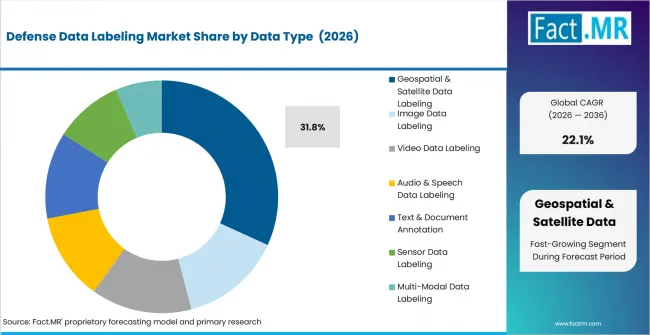
Defense Data Labeling Market Analysis By Data Type | Source: Fact.MR
Geospatial & Satellite Data Labeling segment currently enjoys a leading position in the market by capturing nearly 31.8% market share in 2026. During the forecast period, the segment will sustain its position owing to rising use of satellite imagery, geospatial intelligence platforms, and AI-based surveillance systems in defense operations. Investment in object detection, activity analysis, anomaly detection, and intelligence analysis will further propel segment growth.
Which Annotation Type Segment is Largest?
Bounding Box Annotation dominates the market by contributing approximately 29.4% of market share in 2026. During the forecast period, the segment will remain dominant owing to widespread application in computer vision techniques such as object detection, vehicle recognition, target tracking, and identification of military equipment. Increasing adoption of computer vision in intelligence and surveillance applications will fuel the popularity of this method of annotation.
Which Application Segment is Largest?
Intelligence, Surveillance & Reconnaissance (ISR) segment accounts for about 34.6% market share in 2026. Rising need for real-time intelligence gathering, surveillance, threat assessment, target detection, and situational awareness on the battlefield will drive the demand for AI-based ISR solutions backed up by high-quality labeled data.
Which Platform Segment is Largest?
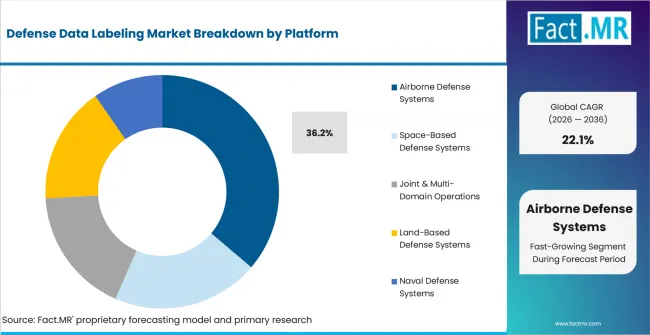
Defense Data Labeling Market Analysis By Platform | Source: Fact.MR
Airborne Defense Systems segment leads the market with a market share of about 36.2%. In the future, the segment will sustain its leadership position owing to increasing deployment of surveillance aircraft, unmanned aerial systems, airborne ISR platforms, and aerial intelligence systems. High volumes of imagery and other sensor data generated by airborne platforms require annotation and analysis, thus driving demand.
Which End User Segment is Largest?
Defense Ministries & Government Agencies constitute about 41.0% market share in 2026. Defense AI programs, intelligence modernization, national security projects, and military technology advancement will spur the procurement of defense data labeling services in the coming years. Governments' efforts in developing new solutions will drive market demand going forward.
Which Deployment Model Segment is Largest?
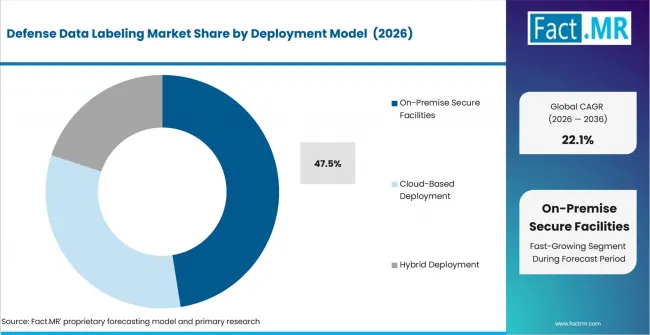
Defense Data Labeling Market Analysis By Deployment Model | Source: Fact.MR
On-Premise Secure Facilities dominate the market and constitute about 47.5% of market share. Stringent security requirements, dealing with classified data, and growing data sovereignty issues will force defense organizations to continue carrying out their operations in highly secure facilities.
Which Application Segment is Expected to be the Fastest Growing?
Autonomous Military Systems segment is anticipated to grow at the highest CAGR during the forecast period. Investments in autonomous vehicles, unmanned systems, mission planning powered by AI, and development of next generation defense technologies will increase the need for massive amounts of high-quality labeled data. Growing deployment of autonomous systems across various domains of warfare will fuel demand.
Regional Outlook Across Key Markets
The regional market analysis encompasses key markets worldwide, namely North America, Western Europe, Eastern Europe, East Asia, South Asia & Pacific, Latin America, and Middle East & Africa. Geographical segmentation along with market dynamics of each region is provided. The comprehensive study offers insights into regional attractiveness, competitive landscape, country-level outlook, and regional growth potential in the Defense Data Labeling industry.
.webp "Top Country Growth Comparison Defense Data Labeling Market Cagr (2026 2036)")
Top Country Growth Comparison Defense Data Labeling Market Cagr (2026 2036) | Source: Fact.MR
CAGR Table
| Country | CAGR (%) |
|---|---|
| United States | 21.0% |
| Germany | 21.9% |
| Japan | 21.6% |
| Italy | 23.4% |
| France | 23.3% |
| India | 23.1% |
| China | 18.3% |
| South Korea | 24.5% |
Source: Fact.MR analysis. Updated Jun 17, 2026
Source: Fact.MR analysis, based on proprietary forecasting model and primary research.
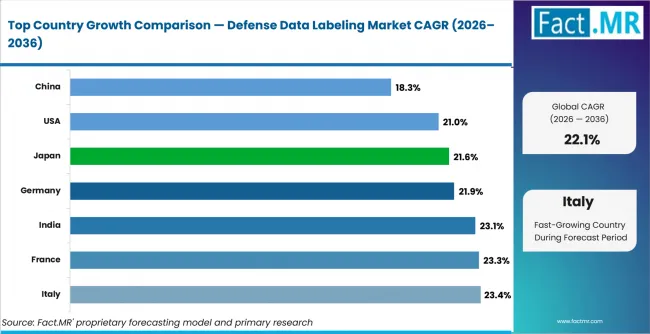
Defense Data Labeling Market Cagr Analysis By Country | Source: Fact.MR
North America - Pioneers in Defense AI Data Infrastructure Advancements
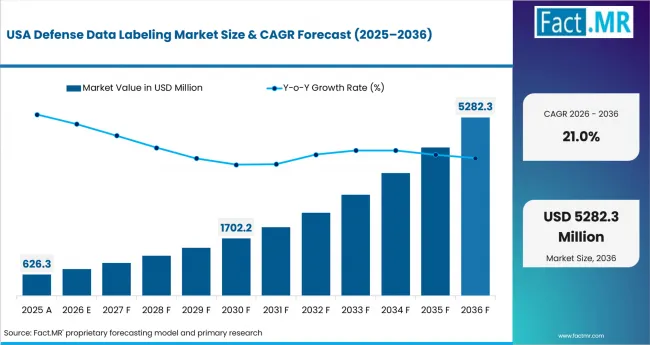
Defense Data Labeling Market Country Value Analysis | Source: Fact.MR
The Defense Data Labeling solutions market is rapidly growing in North America in light of growing military investments into AI applications, machine learning techniques, geospatial intelligence solutions, and autonomous military systems. Favorable factors contributing to regional growth include heavy military spending, advanced digital infrastructure, and investments into modernization aimed at leveraging artificial intelligence.
- United States - Strong Growth Expected in the US Military Sector, The need for Defense Data Labeling solutions in the United States is expected to show CAGR growth of 21.0% in light of investments into military artificial intelligence projects, military intelligence modernization initiatives, investments into autonomous military systems, and geospatial intelligence applications.
Western Europe – Rapidly Growing Market for Artificial Intelligence in Defense Operations
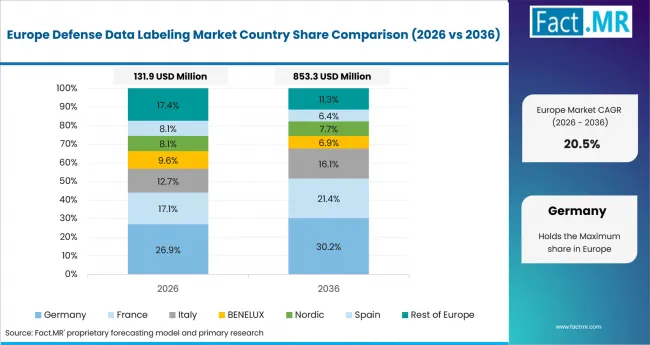
Defense Data Labeling Market Europe Country Market Share Analysis, 2026 & 2036 | Source: Fact.MR
Military modernization projects based on investments into computer vision technology, autonomous systems, cyber defense applications, and next-generation intelligence platforms are expected to fuel growing demand for Defense Data Labeling services in the Western European region.
- Germany – CAGR Growth Expected of 21.9%. Defense Data Labeling solution demand in Germany will experience robust growth driven by rising defense technology investments, military modernization programs, and increased use of artificial intelligence-powered intelligence platforms.
- France – Expected CAGR Growth Rate of 23.3%. Growing investments into defense artificial intelligence programs, surveillance modernization efforts, and military data analytics technology will boost demand for Defense Data Labeling solutions in France, resulting in CAGR growth of 23.3%.
- Italy – CAGR Growth Rate to Reach 23.4%. Demand for Defense Data Labeling services will be rising in Italy owing to defense modernization programs and the introduction of advanced military AI and intelligence, surveillance, and reconnaissance capability.
East Asia – Rapidly Advancing Market for Defense AI Solutions
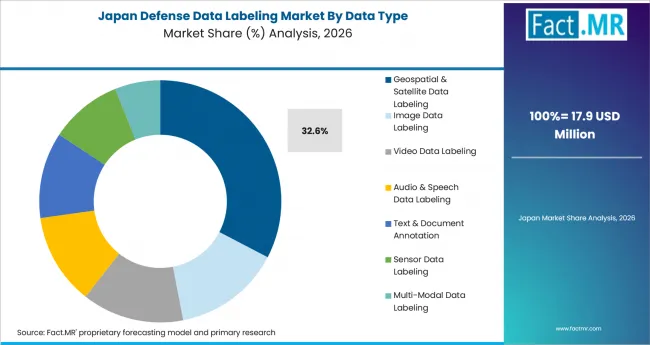
Defense Data Labeling Market Japan Market Share Analysis By Data Type | Source: Fact.MR
Advanced military technology development, rising military expenditure, and growing adoption of artificial intelligence across defense operations are expected to contribute to market growth across the East Asian market.
- China – Growing CAGR of 18.3%. The Chinese market is forecasted to exhibit CAGR growth rate of 18.3% thanks to massive military artificial intelligence investments, autonomous military platform procurement, computer vision technologies, and intelligence modernization.
- Japan – CAGR Growth of 21.6%. Growing demand for Defense Data Labeling solutions in Japan will be underpinned by military digitalization initiatives, intelligence modernization, and rising use of AI-powered surveillance applications.
- South Korea – Fastest-Growing Major Market with CAGR of 24.5%. Investments in indigenous military technology, AI adoption in the defense sector, autonomous military system introduction, and artificial intelligence technology will lead to growing demand for Defense Data Labeling solutions with projected CAGR of 24.5%.
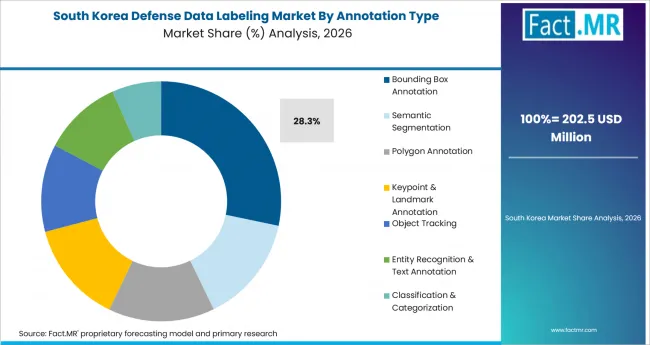
Defense Data Labeling Market South Korea Market Share Analysis By Annotation Type | Source: Fact.MR
South Asia & Pacific – Growing Adoption of Artificial Intelligence
Governments in South Asia & Pacific are increasingly implementing artificial intelligence and machine learning technologies, which creates growing demand for intelligence, autonomy, and geospatial intelligence technology. This is likely to provide a range of opportunities for Defense Data Labeling solutions.
Latin America – Rapidly Expanding Military Sector
Latin American defense sector is expected to see steady growth due to rising adoption of AI technologies as a means of improving surveillance, border security, intelligence gathering, and threat detection applications in the military sector.
Middle East & Africa – Growing Demand for Defense AI Solutions
The Defense Data Labeling market in the Middle East & Africa is likely to remain promising due to increased defense budgets, heightened security concerns, and rising investments into AI-based military solutions. Advanced surveillance technologies, intelligence platforms, autonomous systems, and geospatial analytics are key segments that will drive market growth.
According to Fact.MR's research findings, a number of factors will be responsible for shaping the future development of the global Defense Data Labeling market in North America, Western Europe, Eastern Europe, East Asia, South Asia & Pacific, Latin America, and Middle East & Africa regions.
Competitive Benchmarking and Company Positioning
The Defense Data Labeling market is marked by the availability of niche players such as defense artificial intelligence solution providers, geospatial intelligence firms, militaries, autonomous military system developers, and data annotation companies skilled in computer vision, machine learning, geospatial intelligence, autonomous vehicles, and secure computing environment solutions. The market continues to exhibit moderate fragmentation, with dominant players including Scale AI, Labelbox, Appen, Sama, Cogito Tech, CloudFactory, Snorkel AI, SuperAnnotate having captured a significant market share in global defense artificial intelligence data preparation and analytics.
Growth opportunities in the upcoming period would be driven by growing defense spending on artificial intelligence, increased deployment of autonomous defense systems, growing geospatial intelligence and surveillance activities, and increasing demand for quality training data sets used in computer vision, target detection, intelligence analysis, battlefield awareness, cybersecurity, and artificial intelligence-based command & control. With the continuing acceleration of digital transformation initiatives within the defense industry, demand for secure and accurate data labeling services is expected to rise significantly from 2026 to 2036.
Key Players of the Defense Data Labeling Market
- Scale AI
- Labelbox
- Appen
- Sama
- Cogito Tech
- CloudFactory
- Snorkel AI
- SuperAnnotate
Recent Industry Developments
- Enabled Intelligence - NGA Sequoia Data Labeling Contract (November 2025)
- In November 2025, Enabled Intelligence secured the National Geospatial-Intelligence Agency’s Sequoia AI/ML Data Labeling-as-a-Service contract. The single-award IDIQ contract carries a ceiling value of up to USD 708.0 million over seven years and supports GEOINT AI/ML capabilities across the DoD and Intelligence Community.
- Scale AI - CDAO Enterprise AI Agreement (September 2025)
- In September 2025, Scale AI signed a five-year enterprise agreement with the DoD Chief Digital and Artificial Intelligence Office. The agreement has a ceiling value of USD 100.0 million and supports AI-ready data, model development, and secure deployment across defense mission environments.
- Anduril and Palantir - National Security AI Data Partnership (December 2024)
- In December 2024, Anduril and Palantir announced a partnership to accelerate AI capabilities for national security. The partnership supports the flow of defense data from tactical systems into cloud-based AI workflows for structuring, labeling, and model preparation.
- CDAO and DIU - AI Rapid Capabilities Cell Launch (December 2024)
- In December 2024, the DoD Chief Digital and Artificial Intelligence Office and Defense Innovation Unit launched the AI Rapid Capabilities Cell. The effort was initially resourced with about USD 100.0 million across FY 2024 and FY 2025 for AI pilots, foundational infrastructure, and tools.
Sources and Research References
- Enabled Intelligence. (2025, November 24). Enabled Intelligence awarded NGA’s $708 million SEQUOIA contract for AI/ML Data Labeling-as-a-Service.
- National Geospatial-Intelligence Agency. (2024, September 30). NGA announces $708M data labeling RFP.
- Scale AI. (2025, September 17). From prototype to production: Unlocking mission-ready AI.
- Anduril Industries. (2024, December 6). Anduril and Palantir to accelerate AI capabilities for national security.
- U.S. Department of Defense. (2024, December 11). CDAO and DIU launch new effort focused on accelerating DoD adoption of AI capabilities.
Defense Data Labeling Market Definition
The Defense Data Labeling market represents the annotation, classification, tagging, and structuring of defense datasets that are used to train, validate, and optimize artificial intelligence and machine learning models. These include various types of datasets related to imagery, video, audio, text, sensor, radar, and geospatial intelligence information employed in different applications within the defense sector.
Defense Data Labeling Market Inclusions
The Defense Data Labeling market involves the provision of annotation services, including image data labeling, video data labeling, audio and speech annotation, text and document annotation, sensor data labeling, geospatial and satellite data labeling, and multi-modal data annotation services. It encompasses annotation services for bounding box annotation, semantic segmentation, polygon annotation, keypoint and landmark annotation, object tracking, entity recognition, and other activities that contribute to the development of artificial intelligence systems in different defense use cases.
Defense Data Labeling Market Exclusions
The Defense Data Labeling market excludes artificial intelligence software platforms purchased separately from annotation services, model development and deployment services, cybersecurity software, defense cloud infrastructure, satellite manufacturing, military hardware procurement, commercial data labeling projects that are not directly linked to defense applications, and broader IT consulting services, if data annotation is not the main component of the solution provided. The market does not cover general-use commercial datasets used to train AI algorithms outside of defense and intelligence sectors.
- Primary Research
- This current analysis report focuses exclusively on the global Defense Data Labeling market. Specifically, it provides insights into market dynamics, AI solutions adoption trends, defense intelligence modernization programs, annotation techniques, data labeling deployment models, defense data labeling applications, defense AI procurement trends, and the demand for data labeling services among defense ministries, armed forces, intelligence agencies, homeland security organizations, and defense contractors.
- Desk Research
- Secondary research plays a vital role in the development of this study and is being done via a thorough investigation of publicly available documents from defense ministries, intelligence agencies, defense modernization programs, defense government contracts database, industry associations, technology vendors, and other credible resources. Documents analyzed include annual reports, investor presentations, services portfolio, defense budgets, procurement announcements, technical white papers, artificial intelligence strategy, and defense technology reports published by the leading players in the industry.
- Market-Sizing and Forecasting
- A combination of top-down and bottom-up techniques was used for estimation of the global size of the Defense Data Labeling market. Bottom-up method entailed assessment of revenue derived from defense-focused data labeling services including geospatial data labeling, satellite data labeling, image and video data labeling, sensor data labeling, text data labeling, and other services provided by leading defense data labeling vendors, AI solution providers, and defense technology contractors. The top-down method entailed taking into account defense artificial intelligence spending trends, military modernization trends, intelligence and surveillance investments, procurement spendings, and rates of adoption of defense data labeling in various regions.
- Data Validation and Update Cycle
- Validation of market data for defense data labeling was carried out via rigorous cross-checking of all estimates against different primary and secondary sources. For validation of market size estimation, financial statements, defense procurement database, defense budget allocations, investor presentations, government procurement contract announcements, services portfolio, databases maintained by defense industry associations, and interviews with experts were used. Periodic updates will be incorporated in the study considering factors like change in adoption rate of defense AI technologies, defense technology spending, procurement policies, and intelligence modernization programs affecting market dynamics.
Segmentation
Scope of Analysis
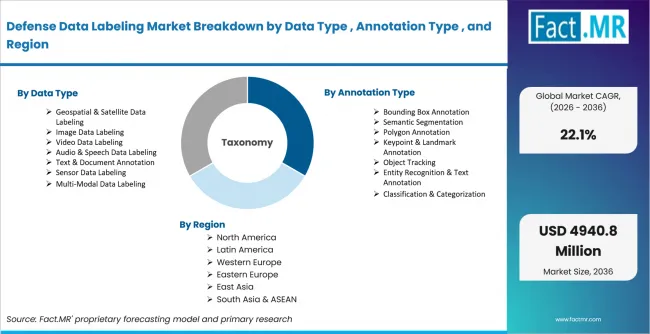
Defense Data Labeling Market Breakdown By Data Type , Annotation Type , And Region | Source: Fact.MR
| Parameter | Details |
|---|---|
| Quantitative Units | USD 549.5 Million in 2025 to USD 4,940.8 Million in 2036, at a CAGR of 22.1% |
| Market Definition | The Defense Data Labeling market comprises annotation, classification, tagging, and structuring services used to prepare defense-related datasets for training, validation, and optimization of artificial intelligence and machine learning models. These datasets include imagery, video, audio, text, sensor, radar, and geospatial intelligence data utilized across military, intelligence, surveillance, reconnaissance, autonomous systems, cyber defense, and command-and-control applications. |
| Regions Covered | North America, Western Europe, Eastern Europe, East Asia, South Asia & Pacific, Latin America, Middle East & Africa |
| Countries Covered | United States, Canada, Mexico, Germany, France, Italy, United Kingdom, China, Japan, South Korea, India, Brazil, Chile, and 30+ countries |
| Key Companies | Enabled Intelligence, Scale AI, Palantir Technologies, Anduril Industries, Maxar Intelligence, BlackSky Technology, Planet Labs, Leidos, C3 AI, Shield AI |
| Forecast Period | 2026 to 2036 |
Source: Fact.MR analysis. Updated Jun 17, 2026
Analysis by Data Type, Annotation Type, Application, End User, Platform, Deployment Model, and Region
-
Defense Data Labeling Market by Data Type
- Image Data Labeling
- Video Data Labeling
- Audio & Speech Data Labeling
- Text & Document Annotation
- Sensor Data Labeling
- Geospatial & Satellite Data Labeling
- Multi-Modal Data Labeling
-
Defense Data Labeling Market by Annotation Type
- Bounding Box Annotation
- Semantic Segmentation
- Polygon Annotation
- Keypoint & Landmark Annotation
- Object Tracking
- Entity Recognition & Text Annotation
- Classification & Categorization
-
Defense Data Labeling Market by Platform
- Land-Based Defense Systems
- Naval Defense Systems
- Airborne Defense Systems
- Space-Based Defense Systems
- Joint & Multi-Domain Operations
-
Defense Data Labeling Market by Deployment Model
- On-Premise Secure Facilities
- Cloud-Based Deployment
- Hybrid Deployment
-
Defense Data Labeling Market by Application
- Intelligence, Surveillance & Reconnaissance (ISR)
- Autonomous Military Systems
- Target Detection & Recognition
- Battlefield Situational Awareness
- Cyber Defense & Threat Intelligence
- Electronic Warfare Systems
- Command & Control (C2) Systems
- Military Training & Simulation
-
Defense Data Labeling Market by End Users
- Defense Ministries & Government Agencies
- Armed Forces
- Defense Contractors & OEMs
- Intelligence Agencies
- Homeland Security Organizations
-
Defense Data Labeling Market by Region
- North America
- USA
- Canada
- Mexico
- Latin America
- Brazil
- Chile
- Rest of LATAM
- East Asia
- China
- Japan
- South Korea
- Western Europe
- Germany
- Italy
- France
- U.K.
- Spain
- BENELUX
- Nordic
- Rest of W. Europe
- Eastern Europe
- Russia
- Hungary
- Poland
- Balkan & Baltics
- Rest of E. Europe
- Middle East and Africa
- Kingdom of Saudi Arabia
- United Arab Emirates
- South Africa
- Rest of Middle East and Africa
- North America
Frequently Asked Questions
Which data type segment will lead the Defense Data Labeling market?
What is the forecasted growth rate for the United States?
What are top players in the Defense Data Labeling Market?
Who worked on this report


Preview the report firsthand - request a free sample
Free SampleGet the brochure for pricing and purchase details
Download PDF