Aesthetic Exosomes Market Size, Share, Growth and Forecast (2026 - 2036)
The Aesthetic Exosomes Market is segmented by Product Type, by Source Type, by Application, by End User, by Sales Channel, and Region. Forecast for 2026 to 2036.
Aesthetic Exosomes Market Size, Market Forecast and Outlook by Fact.MR
- The aesthetic exosomes market was valued at USD 0.3 billion in 2025. Demand is expected to increase from USD 0.4 billion in 2026 to USD 1.8 billion by 2036.
- The market is forecast to record 16.2% CAGR from 2026 to 2036 as professional clinics add exosome-based topical products to post-procedure protocols.
- Aesthetic exosomes demand is becoming more protocol-led. Dermatology clinics use topical exosome products after laser and microneedling procedures.
- Allure reported on October 1, 2025 that in-office exosome treatments involve topical products applied after microneedling and laser resurfacing, while also noting that no FDA-approved exosome treatments are currently on the market [1].
- Medical spas need products that support skin-quality claims without crossing into unapproved therapeutic positioning.
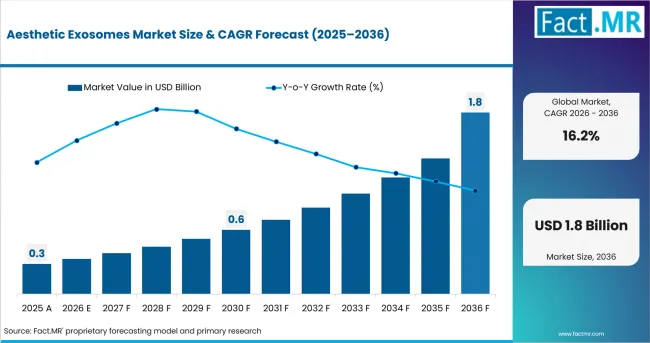
Summary of Aesthetic Exosomes Market
- Demand Drivers in the Market
- Dermatology clinics need topical products that support post-procedure skin comfort and patient satisfaction after laser or microneedling sessions.
- Medical spas use exosome-positioned products to build premium treatment packages and improve perceived skin-quality outcomes after procedures.
- Consumers are showing stronger interest in regenerative-looking skin care as aesthetic procedures gain wider social acceptance across major markets.
- Key Segments Analyzed
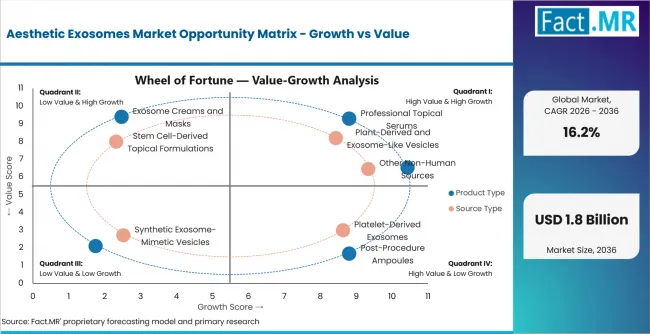
- By Product Type: Professional topical serums hold 40.0% share in 2026 because clinics need easy post-procedure application formats.
- By Source Type: Plant-derived and exosome-like vesicles account for 34.0% share in 2026 due to cosmetic compliance appeal.
- By Application: Skin rejuvenation captures 46.0% share in 2026 because clinics use exosome products for texture and radiance support.
- By End User: Dermatology clinics hold 39.0% share in 2026 since physician-led settings control post-procedure product protocols.
- By Sales Channel: Professional clinic sales account for 52.0% share in 2026 as provider dispensing builds patient trust.
- By Geography: South Korea records 19.8% CAGR through 2036 as K-beauty clinics expand exosome-based skin protocols.
- Analyst Opinion at Fact.MR
- Shambhu Nath Jha, Principal Consultant at Fact.MR, notes, “Aesthetic exosomes are moving into clinic protocols through topical use and post-procedure positioning. Suppliers must be careful with claims because regulatory scrutiny is high. Companies with clean documentation, stable formulations and provider training can support premium aesthetic clinic programs.”
- Strategic Implications
- Suppliers need clear claim language that avoids unapproved treatment positioning and supports responsible professional product use.
- Clinics should verify source documentation before adding exosome products to laser or microneedling protocols.
- Distributors need training programs that explain topical use, contraindication screening and realistic patient expectations.
| Metric | Details |
|---|---|
| Industry Size 2026 | USD 0.4 billion |
| Industry Value 2036 | USD 1.8 billion |
| CAGR 2026 to 2036 | 16.2% |
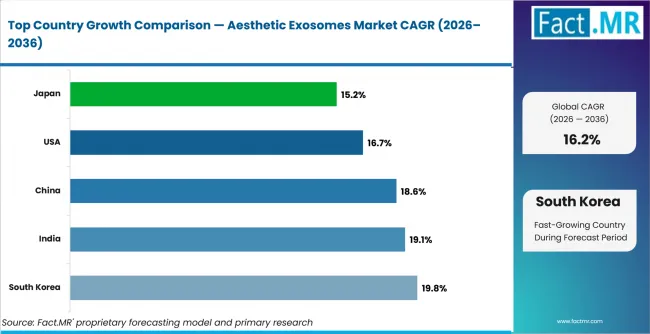
South Korea is likely to record 19.8% CAGR through 2036 as K-beauty clinics expand regenerative-looking skin treatments. India is projected to post 19.1% CAGR as urban clinics and premium medspas add post-procedure skin care products. China is forecast to advance at 18.6% CAGR by 2036 because private aesthetic clinics are adding advanced topical protocols. The United States is expected to register 16.7% CAGR as physician-dispensed exosome skin care gains provider interest. Japan is set to record 15.2% CAGR as premium dermatology clinics focus on aging-linked skin-quality support.
Segmental Analysis
Aesthetic Exosomes Market Analysis by Product Type
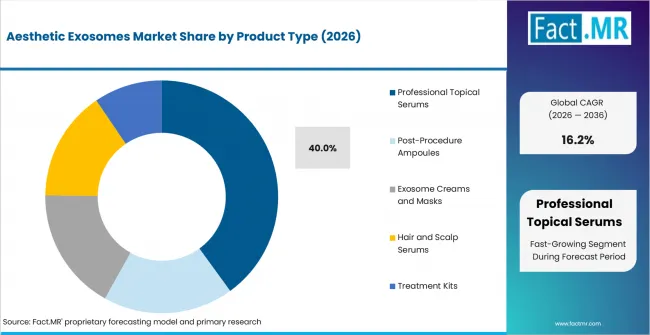
Professional topical serums lead because clinics need simple formats for immediate post-procedure use. Post-procedure ampoules are gaining interest in laser and microneedling protocols. Professional topical serums hold 40.0% share in 2026 because they support easy dispensing and follow-up product sales.
- Topical Serums: Professional topical serums support post-procedure skin-quality protocols and physician-dispensed premium skin care programs.
- Post-Procedure Ampoules: Post-procedure ampoules fit microneedling and laser sessions that need controlled topical application steps.
- Hair Serums: Hair and scalp serums support premium aesthetic programs focused on fuller-looking hair appearance.
Aesthetic Exosomes Market Analysis by Source Type
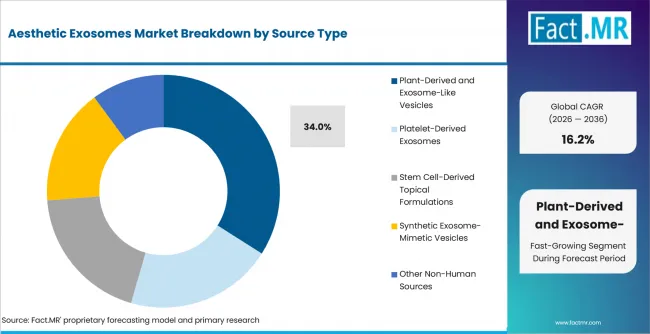
Plant-derived and exosome-like vesicles lead because cosmetic compliance and consumer safety perception are central to adoption. Platelet-derived products are gaining through provider-dispensed brands. Plant-derived and exosome-like vesicles account for 34.0% share in 2026 because non-human positioning helps reduce regulatory concern in cosmetics.
- Plant-Derived Vesicles: Plant-derived and exosome-like vesicles support cosmetic positioning with stronger non-human source acceptance.
- Platelet-Derived Exosomes: Platelet-derived exosome products serve premium physician-dispensed skin care and post-procedure recovery protocols.
- Synthetic Mimetic Vesicles: Synthetic exosome-mimetic vesicles appeal to brands seeking consistency, scalability and controlled ingredient sourcing.
Aesthetic Exosomes Market Analysis by Application
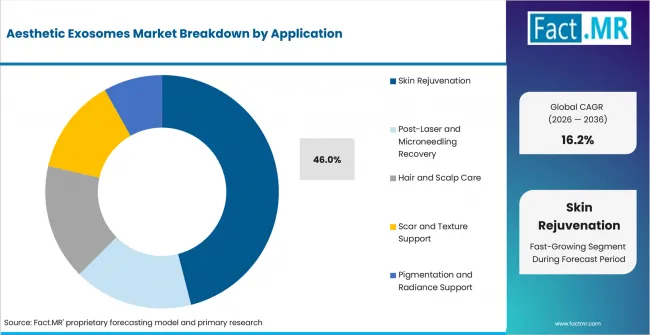
Skin rejuvenation leads because clinics use exosome-positioned products for radiance, texture and appearance support. Post-laser and microneedling recovery is also expanding. Skin rejuvenation captures 46.0% share in 2026 as patients seek smoother-looking and healthier-looking skin after professional treatments.
- Skin Rejuvenation: Skin rejuvenation applications support texture, radiance and aging-linked appearance improvement across professional clinic protocols.
- Post-Procedure Recovery: Post-procedure recovery products support patient comfort after laser, microneedling and resurfacing treatments.
- Hair and Scalp Care: Hair and scalp care applications support fuller-looking hair programs in premium aesthetic clinics.
Aesthetic Exosomes Market Analysis by End User
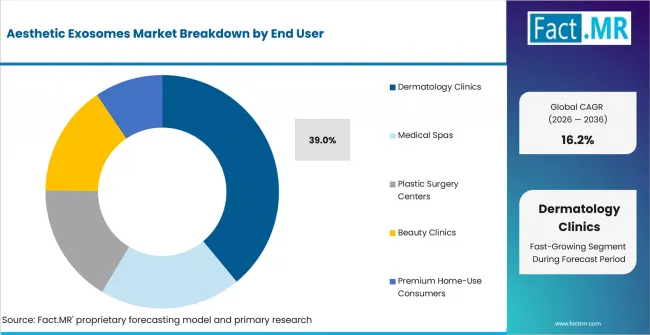
Dermatology clinics lead because physician-led settings manage procedure-linked protocols and product recommendations. Medical spas are expanding through premium skin care packages. Dermatology clinics hold 39.0% share in 2026 because providers can explain use conditions and set realistic patient expectations.
- Dermatology Clinics: Dermatology clinics guide exosome product use through physician oversight and post-procedure care protocols.
- Medical Spas: Medical spas use exosome-positioned products to create premium facial and microneedling packages.
- Plastic Surgery Centers: Plastic surgery centers use topical exosome products for appearance-focused post-procedure skin care support.
Aesthetic Exosomes Market Analysis by Sales Channel
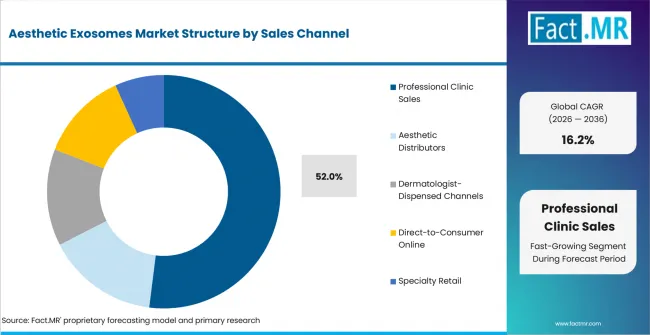
Professional clinic sales lead because provider recommendation improves trust in high-price topical products. Online channels are growing through premium skin care brands. Professional clinic sales account for 52.0% share in 2026 as physician-dispensed products support credibility and repeat purchase.
- Clinic Sales: Professional clinic sales build patient confidence through provider recommendation and protocol-based product use.
- Online Channels: Online channels support repeat purchases after initial clinic recommendation and patient education.
- Aesthetic Distributors: Aesthetic distributors help brands reach medspas, dermatology offices and regional clinic chains.
Aesthetic Exosomes Market Drivers, Restraints, and Opportunities

Rising interest in non-surgical aesthetic procedures is the main driver for this market. ISAPS reported close to 38.0 million surgical and non-surgical aesthetic procedures in 2024. [2] These signals support demand for premium post-procedure skin care products.
Regulatory caution is the main restraint. FDA states that exosome products are regulated and that no FDA-approved exosome products currently exist. FDA also warned in 2026 that unapproved human cell or tissue products may pose safety risks. [3] Clinics and suppliers must avoid disease treatment claims.
Opportunities in the Aesthetic Exosomes Market
- Post-Procedure Protocols: Suppliers can build clinic programs around laser, microneedling and resurfacing aftercare.
- Plant-Derived Products: Brands can use plant-derived vesicle positioning to support cosmetic acceptance and formulation scalability.
- Provider Education: Training programs can help clinics explain realistic outcomes and responsible product use.
Regional Analysis
Based on regional analysis, the aesthetic exosomes market is segmented into North America, Europe, East Asia, South Asia and Pacific, Latin America, and Middle East and Africa.
.webp)
| Country | CAGR 2026 to 2036 |
|---|---|
| South Korea | 19.8% |
| India | 19.1% |
| China | 18.6% |
| United States | 16.7% |
| Japan | 15.2% |

East Asia Aesthetic Exosomes Market Analysis

East Asia demand is supported by K-beauty influence and procedure-led skin care. South Korea leads the selected country set because clinics test new skin care formats early. China supports growth through private aesthetic centers. Japan adds steady demand through premium dermatology clinics and aging-linked skin concerns.
- South Korea: South Korea is likely to record 19.8% CAGR through 2036 as K-beauty clinics expand exosome-based skin protocols. Clinics use topical exosome products after microneedling and resurfacing treatments. Demand is strongest in Seoul and other beauty-focused urban centers. Patients often accept premium skin care when products are tied to procedure outcomes. Suppliers need strong training materials and source documentation because clinics must avoid unsafe claims. Korean brands can support export programs by combining formulation quality and careful regulatory language.
- China: China is forecast to advance at 18.6% CAGR over the forecast period because private aesthetic clinics are adding advanced topical protocols. Premium clinics need products with clear ingredient documentation and stable supply. Demand is supported by skin rejuvenation and post-laser care. Larger clinic chains can test exosome products faster because patient volume improves product turnover. Regional adoption outside major cities will need distributor training and cautious claim control.
- Japan: Japan is set to record 15.2% CAGR by 2036 as premium dermatology clinics focus on aging-linked skin-quality support. Japanese clinics often prefer conservative product adoption and strong documentation. Exosome products can gain use in post-procedure skin care and premium facial programs. Patients value safety and subtle outcomes. Compact product formats can perform well because many clinics operate with limited treatment rooms

South Asia and Pacific Aesthetic Exosomes Market Analysis
South Asia demand is led by India through urban aesthetic clinics and medical spa expansion. Procedure-linked skin care is gaining attention in metro markets. Clinics need products that improve patient experience after laser or microneedling sessions.
- India: India is projected to post 19.1% CAGR through 2036 as urban clinics and premium medspas add post-procedure skin care products. Demand is rising in metro cities through laser and facial treatment packages. Aesthetic clinics need products that support patient comfort and visible skin-quality improvement. Premium consumers are willing to try advanced skin care when guided by dermatologists. Smaller clinics may need distributor financing and training support.
North America Aesthetic Exosomes Market Analysis

North America demand is led by the United States through physician-dispensed skin care and medical spa adoption. The region also faces strong regulatory scrutiny. Product claims and source documentation are central to supplier selection.
- United States: Physician-dispensed skin care and medspa adoption support U.S. demand. The United States is expected to register 16.7% CAGR through 2036 as providers add topical exosome products to post-procedure care. RION Aesthetics opened a 14,000 sq. ft. manufacturing facility in Rochester, Minnesota in 2025 to scale platelet-derived exosome production. [4] FDA scrutiny makes documentation, claim control and provider education central to market access.
Competitive Aligners for Market Suppliers

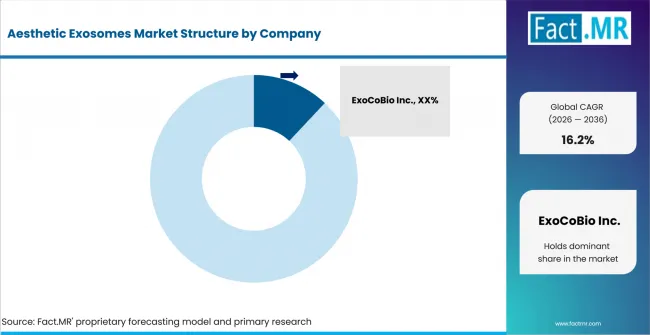
The aesthetic exosomes market includes professional skin care brands and clinic-dispensed product suppliers. ExoCoBio Inc., BENEV Company Inc., Kimera Labs Inc. and DP Dermaceuticals compete through formulation quality, source documentation, clinical education and post-procedure use support.
Competition is centered on product stability and clinic trust. Aesthetic practices compare application protocols and training support before adopting exosome-based products. Suppliers with clear usage guidance can reduce misuse and limit overpromising in professional skin care settings.
Supplier choice will rely on safety positioning through 2036. Clinics need products that fit cosmetic use and post-procedure protocols. Regulatory caution around cell-derived materials makes documentation more important. Companies with clear sourcing and responsible communication can protect premium clinic relationships.
Key Companies in Aesthetic Exosomes Market
- ExoCoBio Inc.
- BENEV Company Inc.
- Kimera Labs Inc.
- DP Dermaceuticals
Bibliography
- [1] Moorhouse, V. (2025, October 1). You’ve been had by the exosome product boom. Allure.
- [2] International Society of Aesthetic Plastic Surgery. (2025). Aesthetic/cosmetic procedures performed in 2024.
- [3] U.S. Food and Drug Administration. (2026, May 11). Patient and consumer warning about potential serious risks of harm following use of unapproved products from human cells or tissues.
- [4] (plated) Skin Science. (2025, June 10). Rapidly growing (plated)® Skin Science expands U.S. manufacturing with state-of-the-art facility to meet surging demand.
This Report Addresses
- Strategic intelligence on aesthetic exosome demand across product type, source type, application, end user and sales channel.
- Forecast mapping from USD 0.4 billion in 2026 to USD 1.8 billion by 2036.
- Segment analysis covering topical serums, plant-derived vesicles, skin rejuvenation, dermatology clinics and professional clinic sales.
- Regional outlook covering South Korea, India, China, the United States and Japan for focused country demand analysis.
- Competitive analysis of ExoCoBio Inc., BENEV Company Inc., Kimera Labs Inc., DP Dermaceuticals.
- Product assessment covering source documentation, topical positioning, post-procedure protocol fit, claim control and provider education.
- Primary interviews, supplier checks, official source review and regulatory validation support the market forecast.
Aesthetic Exosomes Market Definition
The aesthetic exosomes market covers topical and professional-use products positioned for skin-quality support and appearance-focused applications. The scope includes exosome-based serums and clinic-use ampoules. It excludes disease treatment claims and injectable regenerative products.
Aesthetic Exosomes Market Inclusions
The scope includes professional topical serums and hair-focused exosome products. It includes plant-derived and exosome-mimetic products used in aesthetic settings.
Aesthetic Exosomes Market Exclusions
The scope excludes injectable exosome products marketed for disease treatment. It excludes stem cell therapies and prescription biologics. It excludes general anti-aging creams without exosome or exosome-like positioning. It excludes unapproved claims for healing or disease treatment.
Aesthetic Exosomes Market Research Methodology
- Primary Research
- Primary research includes interviews with dermatology clinics and medical spa operators. It includes input from aesthetic product distributors and training providers. Clinic protocol managers are reviewed to assess post-procedure product use.
- Desk Research
- Desk research reviews regulator alerts and professional aesthetic association data. It covers cosmetic claim guidance and procedure adoption signals. Supplier disclosures support source-type and channel mapping.
- Market-Sizing and Forecasting
- Forecasting uses professional skin care demand and procedure-linked product adoption as the baseline. Segment values are reviewed by product type and application. Country forecasts are tested against clinic density and regulatory caution.
- Data Validation and Update Cycle
- Forecasts are validated through supplier checks and clinic feedback. Product adoption is reviewed by topical use and post-procedure protocol fit. Official regulatory sources help confirm the final forecast direction.
Scope of the Report

| Attribute | Details |
|---|---|
| Quantitative Units | USD 0.4 billion in 2026 to USD 1.8 billion by 2036 at 16.2% CAGR |
| Market Definition | Topical and professional-use exosome-positioned products used in aesthetic skin care and post-procedure protocols |
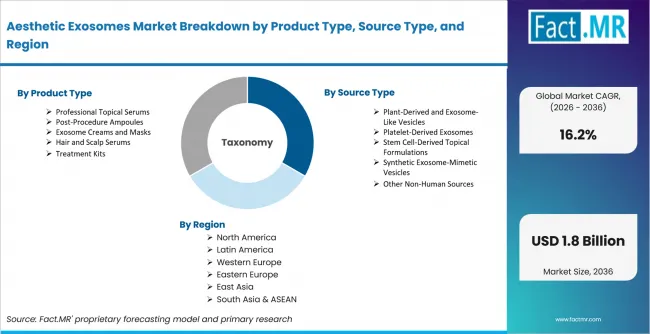
| Product Type | Professional Topical Serums, Post-Procedure Ampoules, Exosome Creams and Masks, Hair and Scalp Serums, Treatment Kits |
| Source Type | Plant-Derived and Exosome-Like Vesicles, Platelet-Derived Exosomes, Stem Cell-Derived Topical Formulations, Synthetic Exosome-Mimetic Vesicles, Other Non-Human Sources |
| Application | Skin Rejuvenation, Post-Laser and Microneedling Recovery, Hair and Scalp Care, Scar and Texture Support, Pigmentation and Radiance Support |
| End User | Dermatology Clinics, Medical Spas, Plastic Surgery Centers, Beauty Clinics, Premium Home-Use Consumers |
| Sales Channel | Professional Clinic Sales, Aesthetic Distributors, Dermatologist-Dispensed Channels, Direct-to-Consumer Online, Specialty Retail |
| Regions Covered | North America, Europe, East Asia, South Asia and Pacific, Latin America, Middle East and Africa |
| Countries Covered | South Korea, India, China, United States, Japan |
| Key Companies Profiled | ExoCoBio Inc., BENEV Company Inc., Kimera Labs Inc., DP Dermaceuticals |
| Forecast Period | 2026 to 2036 |
| Approach | Hybrid top-down and bottom-up approach using clinic adoption, source type demand, application use and regional validation |
Aesthetic Exosomes Market Analysis by Segments
-
By Product Type:
- Professional Topical Serums
- Post-Procedure Ampoules
- Exosome Creams and Masks
- Hair and Scalp Serums
- Treatment Kits
-
By Source Type:
- Plant-Derived and Exosome-Like Vesicles
- Platelet-Derived Exosomes
- Stem Cell-Derived Topical Formulations
- Synthetic Exosome-Mimetic Vesicles
- Other Non-Human Sources
-
By Application:
- Skin Rejuvenation
- Post-Laser and Microneedling Recovery
- Hair and Scalp Care
- Scar and Texture Support
- Pigmentation and Radiance Support
-
By End User:
- Dermatology Clinics
- Medical Spas
- Plastic Surgery Centers
- Beauty Clinics
- Premium Home-Use Consumers
-
By Sales Channel:
- Professional Clinic Sales
- Aesthetic Distributors
- Dermatologist-Dispensed Channels
- Direct-to-Consumer Online
- Specialty Retail
-
By Region:
- North America
- United States
- Canada
- Europe
- Germany
- United Kingdom
- France
- Italy
- Spain
- East Asia
- China
- Japan
- South Korea
- South Asia and Pacific
- India
- ASEAN
- Australia and New Zealand
- Latin America
- Brazil
- Mexico
- Middle East and Africa
- GCC Countries
- South Africa
- North America
- Frequently Asked Questions -
What is the Aesthetic Exosomes Market size in 2026?
The Aesthetic Exosomes Market is estimated at USD 0.4 billion in 2026.
What will the Aesthetic Exosomes Market be worth by 2036?
The Aesthetic Exosomes Market is projected to reach USD 1.8 billion by 2036 as professional skin care adoption expands.
What CAGR is projected for the Aesthetic Exosomes Market?
The Aesthetic Exosomes Market is forecast to record 16.2% CAGR from 2026 to 2036 through clinic-led adoption.
Which product type leads the Aesthetic Exosomes Market?
Professional topical serums lead with 40.0% share in 2026 because clinics need simple post-procedure application formats.
Which end user leads the Aesthetic Exosomes Market?
Dermatology clinics lead with 39.0% share in 2026 because physician-led settings control post-procedure protocols.
Which sales channel leads the Aesthetic Exosomes Market?
Professional clinic sales lead with 52.0% share in 2026 because provider recommendation builds trust.
Which country grows fastest in the Aesthetic Exosomes Market?
South Korea records the fastest outlook at 19.8% CAGR through 2036 as K-beauty clinics expand exosome protocols.
How does India perform in the Aesthetic Exosomes Market?
India is projected to post 19.1% CAGR through 2036 as urban clinics add post-procedure skin care products.
How does China perform in the Aesthetic Exosomes Market?
China is forecast to advance at 18.6% CAGR by 2036 as private aesthetic clinics add advanced topical protocols.
How does the United States perform in the Aesthetic Exosomes Market?
The United States is expected to register 16.7% CAGR through 2036 as physician-dispensed exosome skin care gains interest.
How does Japan perform in the Aesthetic Exosomes Market?
Japan is set to record 15.2% CAGR by 2036 as premium dermatology clinics focus on skin-quality support.
What is the main driver in the Aesthetic Exosomes Market?
The main driver is rising demand for premium post-procedure skin care after laser and microneedling treatments.
What is the main restraint in the Aesthetic Exosomes Market?
The main restraint is regulatory caution because exosome products face strict scrutiny and claim-control requirements.
Why do topical serums lead the Aesthetic Exosomes Market?
Topical serums lead because clinics need simple application formats for post-procedure and follow-up skin care.
Why are plant-derived vesicles gaining demand in the Aesthetic Exosomes Market?
Plant-derived vesicles are gaining demand because non-human sourcing supports safer cosmetic positioning and wider formulation acceptance.
Why is skin rejuvenation the leading application?
Skin rejuvenation leads because patients seek smoother-looking skin and premium appearance support.
Why are dermatology clinics important in the Aesthetic Exosomes Market?
Dermatology clinics are important because providers guide product use and manage post-procedure patient expectations.
Why is claim control important in the Aesthetic Exosomes Market?
Claim control is important because suppliers must avoid unapproved therapeutic positioning and support responsible cosmetic use.
Table of Content
- Executive Summary
- Global Market Outlook
- Demand to side Trends
- Supply to side Trends
- Technology Roadmap Analysis
- Analysis and Recommendations
- Market Overview
- Market Coverage / Taxonomy
- Market Definition / Scope / Limitations
- Research Methodology
- Chapter Orientation
- Analytical Lens and Working Hypotheses
- Market Structure, Signals, and Trend Drivers
- Benchmarking and Cross-market Comparability
- Market Sizing, Forecasting, and Opportunity Mapping
- Research Design and Evidence Framework
- Desk Research Programme (Secondary Evidence)
- Company Annual and Sustainability Reports
- Peer-reviewed Journals and Academic Literature
- Corporate Websites, Product Literature, and Technical Notes
- Earnings Decks and Investor Briefings
- Statutory Filings and Regulatory Disclosures
- Technical White Papers and Standards Notes
- Trade Journals, Industry Magazines, and Analyst Briefs
- Conference Proceedings, Webinars, and Seminar Materials
- Government Statistics Portals and Public Data Releases
- Press Releases and Reputable Media Coverage
- Specialist Newsletters and Curated Briefings
- Sector Databases and Reference Repositories
- Fact.MR Internal Proprietary Databases and Historical Market Datasets
- Subscription Datasets and Paid Sources
- Social Channels, Communities, and Digital Listening Inputs
- Additional Desk Sources
- Expert Input and Fieldwork (Primary Evidence)
- Primary Modes
- Qualitative Interviews and Expert Elicitation
- Quantitative Surveys and Structured Data Capture
- Blended Approach
- Why Primary Evidence is Used
- Field Techniques
- Interviews
- Surveys
- Focus Groups
- Observational and In-context Research
- Social and Community Interactions
- Stakeholder Universe Engaged
- C-suite Leaders
- Board Members
- Presidents and Vice Presidents
- R&D and Innovation Heads
- Technical Specialists
- Domain Subject-matter Experts
- Scientists
- Physicians and Other Healthcare Professionals
- Governance, Ethics, and Data Stewardship
- Research Ethics
- Data Integrity and Handling
- Primary Modes
- Tooling, Models, and Reference Databases
- Desk Research Programme (Secondary Evidence)
- Data Engineering and Model Build
- Data Acquisition and Ingestion
- Cleaning, Normalisation, and Verification
- Synthesis, Triangulation, and Analysis
- Quality Assurance and Audit Trail
- Market Background
- Market Dynamics
- Drivers
- Restraints
- Opportunity
- Trends
- Scenario Forecast
- Demand in Optimistic Scenario
- Demand in Likely Scenario
- Demand in Conservative Scenario
- Opportunity Map Analysis
- Product Life Cycle Analysis
- Supply Chain Analysis
- Investment Feasibility Matrix
- Value Chain Analysis
- PESTLE and Porter’s Analysis
- Regulatory Landscape
- Regional Parent Market Outlook
- Production and Consumption Statistics
- Import and Export Statistics
- Market Dynamics
- Global Market Analysis 2021 to 2025 and Forecast, 2026 to 2036
- Historical Market Size Value (USD Million) Analysis, 2021 to 2025
- Current and Future Market Size Value (USD Million) Projections, 2026 to 2036
- Y to o to Y Growth Trend Analysis
- Absolute $ Opportunity Analysis
- Global Market Pricing Analysis 2021 to 2025 and Forecast 2026 to 2036
- Global Market Analysis 2021 to 2025 and Forecast 2026 to 2036, By Product Type
- Introduction / Key Findings
- Historical Market Size Value (USD Million) Analysis By Product Type , 2021 to 2025
- Current and Future Market Size Value (USD Million) Analysis and Forecast By Product Type , 2026 to 2036
- Professional Topical Serums
- Post-Procedure Ampoules
- Exosome Creams and Masks
- Hair and Scalp Serums
- Treatment Kits
- Professional Topical Serums
- Y to o to Y Growth Trend Analysis By Product Type , 2021 to 2025
- Absolute $ Opportunity Analysis By Product Type , 2026 to 2036
- Global Market Analysis 2021 to 2025 and Forecast 2026 to 2036, By Source Type
- Introduction / Key Findings
- Historical Market Size Value (USD Million) Analysis By Source Type, 2021 to 2025
- Current and Future Market Size Value (USD Million) Analysis and Forecast By Source Type, 2026 to 2036
- Plant-Derived and Exosome-Like Vesicles
- Platelet-Derived Exosomes
- Stem Cell-Derived Topical Formulations
- Synthetic Exosome-Mimetic Vesicles
- Other Non-Human Sources
- Plant-Derived and Exosome-Like Vesicles
- Y to o to Y Growth Trend Analysis By Source Type, 2021 to 2025
- Absolute $ Opportunity Analysis By Source Type, 2026 to 2036
- Global Market Analysis 2021 to 2025 and Forecast 2026 to 2036, By Application
- Introduction / Key Findings
- Historical Market Size Value (USD Million) Analysis By Application, 2021 to 2025
- Current and Future Market Size Value (USD Million) Analysis and Forecast By Application, 2026 to 2036
- Skin Rejuvenation
- Post-Laser and Microneedling Recovery
- Hair and Scalp Care
- Scar and Texture Support
- Pigmentation and Radiance Support
- Skin Rejuvenation
- Y to o to Y Growth Trend Analysis By Application, 2021 to 2025
- Absolute $ Opportunity Analysis By Application, 2026 to 2036
- Global Market Analysis 2021 to 2025 and Forecast 2026 to 2036, By End User
- Introduction / Key Findings
- Historical Market Size Value (USD Million) Analysis By End User, 2021 to 2025
- Current and Future Market Size Value (USD Million) Analysis and Forecast By End User, 2026 to 2036
- Dermatology Clinics
- Medical Spas
- Plastic Surgery Centers
- Beauty Clinics
- Premium Home-Use Consumers
- Dermatology Clinics
- Y to o to Y Growth Trend Analysis By End User, 2021 to 2025
- Absolute $ Opportunity Analysis By End User, 2026 to 2036
- Global Market Analysis 2021 to 2025 and Forecast 2026 to 2036, By Sales Channel
- Introduction / Key Findings
- Historical Market Size Value (USD Million) Analysis By Sales Channel, 2021 to 2025
- Current and Future Market Size Value (USD Million) Analysis and Forecast By Sales Channel, 2026 to 2036
- Professional Clinic Sales
- Aesthetic Distributors
- Dermatologist-Dispensed Channels
- Direct-to-Consumer Online
- Specialty Retail
- Professional Clinic Sales
- Y to o to Y Growth Trend Analysis By Sales Channel, 2021 to 2025
- Absolute $ Opportunity Analysis By Sales Channel, 2026 to 2036
- Global Market Analysis 2021 to 2025 and Forecast 2026 to 2036, By Region
- Introduction
- Historical Market Size Value (USD Million) Analysis By Region, 2021 to 2025
- Current Market Size Value (USD Million) Analysis and Forecast By Region, 2026 to 2036
- North America
- Latin America
- Western Europe
- Eastern Europe
- East Asia
- South Asia and Pacific
- Middle East & Africa
- Market Attractiveness Analysis By Region
- North America Market Analysis 2021 to 2025 and Forecast 2026 to 2036, By Country
- Historical Market Size Value (USD Million) Trend Analysis By Market Taxonomy, 2021 to 2025
- Market Size Value (USD Million) Forecast By Market Taxonomy, 2026 to 2036
- By Country
- USA
- Canada
- Mexico
- By Product Type
- By Source Type
- By Application
- By End User
- By Sales Channel
- By Country
- Market Attractiveness Analysis
- By Country
- By Product Type
- By Source Type
- By Application
- By End User
- By Sales Channel
- Key Takeaways
- Latin America Market Analysis 2021 to 2025 and Forecast 2026 to 2036, By Country
- Historical Market Size Value (USD Million) Trend Analysis By Market Taxonomy, 2021 to 2025
- Market Size Value (USD Million) Forecast By Market Taxonomy, 2026 to 2036
- By Country
- Brazil
- Chile
- Rest of Latin America
- By Product Type
- By Source Type
- By Application
- By End User
- By Sales Channel
- By Country
- Market Attractiveness Analysis
- By Country
- By Product Type
- By Source Type
- By Application
- By End User
- By Sales Channel
- Key Takeaways
- Western Europe Market Analysis 2021 to 2025 and Forecast 2026 to 2036, By Country
- Historical Market Size Value (USD Million) Trend Analysis By Market Taxonomy, 2021 to 2025
- Market Size Value (USD Million) Forecast By Market Taxonomy, 2026 to 2036
- By Country
- Germany
- UK
- Italy
- Spain
- France
- Nordic
- BENELUX
- Rest of Western Europe
- By Product Type
- By Source Type
- By Application
- By End User
- By Sales Channel
- By Country
- Market Attractiveness Analysis
- By Country
- By Product Type
- By Source Type
- By Application
- By End User
- By Sales Channel
- Key Takeaways
- Eastern Europe Market Analysis 2021 to 2025 and Forecast 2026 to 2036, By Country
- Historical Market Size Value (USD Million) Trend Analysis By Market Taxonomy, 2021 to 2025
- Market Size Value (USD Million) Forecast By Market Taxonomy, 2026 to 2036
- By Country
- Russia
- Poland
- Hungary
- Balkan & Baltic
- Rest of Eastern Europe
- By Product Type
- By Source Type
- By Application
- By End User
- By Sales Channel
- By Country
- Market Attractiveness Analysis
- By Country
- By Product Type
- By Source Type
- By Application
- By End User
- By Sales Channel
- Key Takeaways
- East Asia Market Analysis 2021 to 2025 and Forecast 2026 to 2036, By Country
- Historical Market Size Value (USD Million) Trend Analysis By Market Taxonomy, 2021 to 2025
- Market Size Value (USD Million) Forecast By Market Taxonomy, 2026 to 2036
- By Country
- China
- Japan
- South Korea
- By Product Type
- By Source Type
- By Application
- By End User
- By Sales Channel
- By Country
- Market Attractiveness Analysis
- By Country
- By Product Type
- By Source Type
- By Application
- By End User
- By Sales Channel
- Key Takeaways
- South Asia and Pacific Market Analysis 2021 to 2025 and Forecast 2026 to 2036, By Country
- Historical Market Size Value (USD Million) Trend Analysis By Market Taxonomy, 2021 to 2025
- Market Size Value (USD Million) Forecast By Market Taxonomy, 2026 to 2036
- By Country
- India
- ASEAN
- Australia & New Zealand
- Rest of South Asia and Pacific
- By Product Type
- By Source Type
- By Application
- By End User
- By Sales Channel
- By Country
- Market Attractiveness Analysis
- By Country
- By Product Type
- By Source Type
- By Application
- By End User
- By Sales Channel
- Key Takeaways
- Middle East & Africa Market Analysis 2021 to 2025 and Forecast 2026 to 2036, By Country
- Historical Market Size Value (USD Million) Trend Analysis By Market Taxonomy, 2021 to 2025
- Market Size Value (USD Million) Forecast By Market Taxonomy, 2026 to 2036
- By Country
- Kingdom of Saudi Arabia
- Other GCC Countries
- Turkiye
- South Africa
- Other African Union
- Rest of Middle East & Africa
- By Product Type
- By Source Type
- By Application
- By End User
- By Sales Channel
- By Country
- Market Attractiveness Analysis
- By Country
- By Product Type
- By Source Type
- By Application
- By End User
- By Sales Channel
- Key Takeaways
- Key Countries Market Analysis
- USA
- Pricing Analysis
- Market Share Analysis, 2025
- By Product Type
- By Source Type
- By Application
- By End User
- By Sales Channel
- Canada
- Pricing Analysis
- Market Share Analysis, 2025
- By Product Type
- By Source Type
- By Application
- By End User
- By Sales Channel
- Mexico
- Pricing Analysis
- Market Share Analysis, 2025
- By Product Type
- By Source Type
- By Application
- By End User
- By Sales Channel
- Brazil
- Pricing Analysis
- Market Share Analysis, 2025
- By Product Type
- By Source Type
- By Application
- By End User
- By Sales Channel
- Chile
- Pricing Analysis
- Market Share Analysis, 2025
- By Product Type
- By Source Type
- By Application
- By End User
- By Sales Channel
- Germany
- Pricing Analysis
- Market Share Analysis, 2025
- By Product Type
- By Source Type
- By Application
- By End User
- By Sales Channel
- UK
- Pricing Analysis
- Market Share Analysis, 2025
- By Product Type
- By Source Type
- By Application
- By End User
- By Sales Channel
- Italy
- Pricing Analysis
- Market Share Analysis, 2025
- By Product Type
- By Source Type
- By Application
- By End User
- By Sales Channel
- Spain
- Pricing Analysis
- Market Share Analysis, 2025
- By Product Type
- By Source Type
- By Application
- By End User
- By Sales Channel
- France
- Pricing Analysis
- Market Share Analysis, 2025
- By Product Type
- By Source Type
- By Application
- By End User
- By Sales Channel
- India
- Pricing Analysis
- Market Share Analysis, 2025
- By Product Type
- By Source Type
- By Application
- By End User
- By Sales Channel
- ASEAN
- Pricing Analysis
- Market Share Analysis, 2025
- By Product Type
- By Source Type
- By Application
- By End User
- By Sales Channel
- Australia & New Zealand
- Pricing Analysis
- Market Share Analysis, 2025
- By Product Type
- By Source Type
- By Application
- By End User
- By Sales Channel
- China
- Pricing Analysis
- Market Share Analysis, 2025
- By Product Type
- By Source Type
- By Application
- By End User
- By Sales Channel
- Japan
- Pricing Analysis
- Market Share Analysis, 2025
- By Product Type
- By Source Type
- By Application
- By End User
- By Sales Channel
- South Korea
- Pricing Analysis
- Market Share Analysis, 2025
- By Product Type
- By Source Type
- By Application
- By End User
- By Sales Channel
- Russia
- Pricing Analysis
- Market Share Analysis, 2025
- By Product Type
- By Source Type
- By Application
- By End User
- By Sales Channel
- Poland
- Pricing Analysis
- Market Share Analysis, 2025
- By Product Type
- By Source Type
- By Application
- By End User
- By Sales Channel
- Hungary
- Pricing Analysis
- Market Share Analysis, 2025
- By Product Type
- By Source Type
- By Application
- By End User
- By Sales Channel
- Kingdom of Saudi Arabia
- Pricing Analysis
- Market Share Analysis, 2025
- By Product Type
- By Source Type
- By Application
- By End User
- By Sales Channel
- Turkiye
- Pricing Analysis
- Market Share Analysis, 2025
- By Product Type
- By Source Type
- By Application
- By End User
- By Sales Channel
- South Africa
- Pricing Analysis
- Market Share Analysis, 2025
- By Product Type
- By Source Type
- By Application
- By End User
- By Sales Channel
- USA
- Market Structure Analysis
- Competition Dashboard
- Competition Benchmarking
- Market Share Analysis of Top Players
- By Regional
- By Product Type
- By Source Type
- By Application
- By End User
- By Sales Channel
- Competition Analysis
- Competition Deep Dive
- ExoCoBio Inc.
- Overview
- Product Portfolio
- Profitability by Market Segments (Product/Age /Sales Channel/Region)
- Sales Footprint
- Strategy Overview
- Marketing Strategy
- Product Strategy
- Channel Strategy
- BENEV Company Inc.
- Kimera Labs Inc.
- DP Dermaceuticals
- ExoCoBio Inc.
- Competition Deep Dive
- Assumptions & Acronyms Used
List Of Table
- Table 1: Global Market Value (USD Million) Forecast by Region, 2021 to 2036
- Table 2: Global Market Value (USD Million) Forecast by Product Type , 2021 to 2036
- Table 3: Global Market Value (USD Million) Forecast by Source Type, 2021 to 2036
- Table 4: Global Market Value (USD Million) Forecast by Application, 2021 to 2036
- Table 5: Global Market Value (USD Million) Forecast by End User, 2021 to 2036
- Table 6: Global Market Value (USD Million) Forecast by Sales Channel, 2021 to 2036
- Table 7: North America Market Value (USD Million) Forecast by Country, 2021 to 2036
- Table 8: North America Market Value (USD Million) Forecast by Product Type , 2021 to 2036
- Table 9: North America Market Value (USD Million) Forecast by Source Type, 2021 to 2036
- Table 10: North America Market Value (USD Million) Forecast by Application, 2021 to 2036
- Table 11: North America Market Value (USD Million) Forecast by End User, 2021 to 2036
- Table 12: North America Market Value (USD Million) Forecast by Sales Channel, 2021 to 2036
- Table 13: Latin America Market Value (USD Million) Forecast by Country, 2021 to 2036
- Table 14: Latin America Market Value (USD Million) Forecast by Product Type , 2021 to 2036
- Table 15: Latin America Market Value (USD Million) Forecast by Source Type, 2021 to 2036
- Table 16: Latin America Market Value (USD Million) Forecast by Application, 2021 to 2036
- Table 17: Latin America Market Value (USD Million) Forecast by End User, 2021 to 2036
- Table 18: Latin America Market Value (USD Million) Forecast by Sales Channel, 2021 to 2036
- Table 19: Western Europe Market Value (USD Million) Forecast by Country, 2021 to 2036
- Table 20: Western Europe Market Value (USD Million) Forecast by Product Type , 2021 to 2036
- Table 21: Western Europe Market Value (USD Million) Forecast by Source Type, 2021 to 2036
- Table 22: Western Europe Market Value (USD Million) Forecast by Application, 2021 to 2036
- Table 23: Western Europe Market Value (USD Million) Forecast by End User, 2021 to 2036
- Table 24: Western Europe Market Value (USD Million) Forecast by Sales Channel, 2021 to 2036
- Table 25: Eastern Europe Market Value (USD Million) Forecast by Country, 2021 to 2036
- Table 26: Eastern Europe Market Value (USD Million) Forecast by Product Type , 2021 to 2036
- Table 27: Eastern Europe Market Value (USD Million) Forecast by Source Type, 2021 to 2036
- Table 28: Eastern Europe Market Value (USD Million) Forecast by Application, 2021 to 2036
- Table 29: Eastern Europe Market Value (USD Million) Forecast by End User, 2021 to 2036
- Table 30: Eastern Europe Market Value (USD Million) Forecast by Sales Channel, 2021 to 2036
- Table 31: East Asia Market Value (USD Million) Forecast by Country, 2021 to 2036
- Table 32: East Asia Market Value (USD Million) Forecast by Product Type , 2021 to 2036
- Table 33: East Asia Market Value (USD Million) Forecast by Source Type, 2021 to 2036
- Table 34: East Asia Market Value (USD Million) Forecast by Application, 2021 to 2036
- Table 35: East Asia Market Value (USD Million) Forecast by End User, 2021 to 2036
- Table 36: East Asia Market Value (USD Million) Forecast by Sales Channel, 2021 to 2036
- Table 37: South Asia and Pacific Market Value (USD Million) Forecast by Country, 2021 to 2036
- Table 38: South Asia and Pacific Market Value (USD Million) Forecast by Product Type , 2021 to 2036
- Table 39: South Asia and Pacific Market Value (USD Million) Forecast by Source Type, 2021 to 2036
- Table 40: South Asia and Pacific Market Value (USD Million) Forecast by Application, 2021 to 2036
- Table 41: South Asia and Pacific Market Value (USD Million) Forecast by End User, 2021 to 2036
- Table 42: South Asia and Pacific Market Value (USD Million) Forecast by Sales Channel, 2021 to 2036
- Table 43: Middle East & Africa Market Value (USD Million) Forecast by Country, 2021 to 2036
- Table 44: Middle East & Africa Market Value (USD Million) Forecast by Product Type , 2021 to 2036
- Table 45: Middle East & Africa Market Value (USD Million) Forecast by Source Type, 2021 to 2036
- Table 46: Middle East & Africa Market Value (USD Million) Forecast by Application, 2021 to 2036
- Table 47: Middle East & Africa Market Value (USD Million) Forecast by End User, 2021 to 2036
- Table 48: Middle East & Africa Market Value (USD Million) Forecast by Sales Channel, 2021 to 2036
List Of Figures
- Figure 1: Global Market Pricing Analysis
- Figure 2: Global Market Value (USD Million) Forecast 2021-2036
- Figure 3: Global Market Value Share and BPS Analysis by Product Type , 2026 and 2036
- Figure 4: Global Market Y-o-Y Growth Comparison by Product Type , 2026-2036
- Figure 5: Global Market Attractiveness Analysis by Product Type
- Figure 6: Global Market Value Share and BPS Analysis by Source Type, 2026 and 2036
- Figure 7: Global Market Y-o-Y Growth Comparison by Source Type, 2026-2036
- Figure 8: Global Market Attractiveness Analysis by Source Type
- Figure 9: Global Market Value Share and BPS Analysis by Application, 2026 and 2036
- Figure 10: Global Market Y-o-Y Growth Comparison by Application, 2026-2036
- Figure 11: Global Market Attractiveness Analysis by Application
- Figure 12: Global Market Value Share and BPS Analysis by End User, 2026 and 2036
- Figure 13: Global Market Y-o-Y Growth Comparison by End User, 2026-2036
- Figure 14: Global Market Attractiveness Analysis by End User
- Figure 15: Global Market Value Share and BPS Analysis by Sales Channel, 2026 and 2036
- Figure 16: Global Market Y-o-Y Growth Comparison by Sales Channel, 2026-2036
- Figure 17: Global Market Attractiveness Analysis by Sales Channel
- Figure 18: Global Market Value (USD Million) Share and BPS Analysis by Region, 2026 and 2036
- Figure 19: Global Market Y-o-Y Growth Comparison by Region, 2026-2036
- Figure 20: Global Market Attractiveness Analysis by Region
- Figure 21: North America Market Incremental Dollar Opportunity, 2026-2036
- Figure 22: Latin America Market Incremental Dollar Opportunity, 2026-2036
- Figure 23: Western Europe Market Incremental Dollar Opportunity, 2026-2036
- Figure 24: Eastern Europe Market Incremental Dollar Opportunity, 2026-2036
- Figure 25: East Asia Market Incremental Dollar Opportunity, 2026-2036
- Figure 26: South Asia and Pacific Market Incremental Dollar Opportunity, 2026-2036
- Figure 27: Middle East & Africa Market Incremental Dollar Opportunity, 2026-2036
- Figure 28: North America Market Value Share and BPS Analysis by Country, 2026 and 2036
- Figure 29: North America Market Value Share and BPS Analysis by Product Type , 2026 and 2036
- Figure 30: North America Market Y-o-Y Growth Comparison by Product Type , 2026-2036
- Figure 31: North America Market Attractiveness Analysis by Product Type
- Figure 32: North America Market Value Share and BPS Analysis by Source Type, 2026 and 2036
- Figure 33: North America Market Y-o-Y Growth Comparison by Source Type, 2026-2036
- Figure 34: North America Market Attractiveness Analysis by Source Type
- Figure 35: North America Market Value Share and BPS Analysis by Application, 2026 and 2036
- Figure 36: North America Market Y-o-Y Growth Comparison by Application, 2026-2036
- Figure 37: North America Market Attractiveness Analysis by Application
- Figure 38: North America Market Value Share and BPS Analysis by End User, 2026 and 2036
- Figure 39: North America Market Y-o-Y Growth Comparison by End User, 2026-2036
- Figure 40: North America Market Attractiveness Analysis by End User
- Figure 41: North America Market Value Share and BPS Analysis by Sales Channel, 2026 and 2036
- Figure 42: North America Market Y-o-Y Growth Comparison by Sales Channel, 2026-2036
- Figure 43: North America Market Attractiveness Analysis by Sales Channel
- Figure 44: Latin America Market Value Share and BPS Analysis by Country, 2026 and 2036
- Figure 45: Latin America Market Value Share and BPS Analysis by Product Type , 2026 and 2036
- Figure 46: Latin America Market Y-o-Y Growth Comparison by Product Type , 2026-2036
- Figure 47: Latin America Market Attractiveness Analysis by Product Type
- Figure 48: Latin America Market Value Share and BPS Analysis by Source Type, 2026 and 2036
- Figure 49: Latin America Market Y-o-Y Growth Comparison by Source Type, 2026-2036
- Figure 50: Latin America Market Attractiveness Analysis by Source Type
- Figure 51: Latin America Market Value Share and BPS Analysis by Application, 2026 and 2036
- Figure 52: Latin America Market Y-o-Y Growth Comparison by Application, 2026-2036
- Figure 53: Latin America Market Attractiveness Analysis by Application
- Figure 54: Latin America Market Value Share and BPS Analysis by End User, 2026 and 2036
- Figure 55: Latin America Market Y-o-Y Growth Comparison by End User, 2026-2036
- Figure 56: Latin America Market Attractiveness Analysis by End User
- Figure 57: Latin America Market Value Share and BPS Analysis by Sales Channel, 2026 and 2036
- Figure 58: Latin America Market Y-o-Y Growth Comparison by Sales Channel, 2026-2036
- Figure 59: Latin America Market Attractiveness Analysis by Sales Channel
- Figure 60: Western Europe Market Value Share and BPS Analysis by Country, 2026 and 2036
- Figure 61: Western Europe Market Value Share and BPS Analysis by Product Type , 2026 and 2036
- Figure 62: Western Europe Market Y-o-Y Growth Comparison by Product Type , 2026-2036
- Figure 63: Western Europe Market Attractiveness Analysis by Product Type
- Figure 64: Western Europe Market Value Share and BPS Analysis by Source Type, 2026 and 2036
- Figure 65: Western Europe Market Y-o-Y Growth Comparison by Source Type, 2026-2036
- Figure 66: Western Europe Market Attractiveness Analysis by Source Type
- Figure 67: Western Europe Market Value Share and BPS Analysis by Application, 2026 and 2036
- Figure 68: Western Europe Market Y-o-Y Growth Comparison by Application, 2026-2036
- Figure 69: Western Europe Market Attractiveness Analysis by Application
- Figure 70: Western Europe Market Value Share and BPS Analysis by End User, 2026 and 2036
- Figure 71: Western Europe Market Y-o-Y Growth Comparison by End User, 2026-2036
- Figure 72: Western Europe Market Attractiveness Analysis by End User
- Figure 73: Western Europe Market Value Share and BPS Analysis by Sales Channel, 2026 and 2036
- Figure 74: Western Europe Market Y-o-Y Growth Comparison by Sales Channel, 2026-2036
- Figure 75: Western Europe Market Attractiveness Analysis by Sales Channel
- Figure 76: Eastern Europe Market Value Share and BPS Analysis by Country, 2026 and 2036
- Figure 77: Eastern Europe Market Value Share and BPS Analysis by Product Type , 2026 and 2036
- Figure 78: Eastern Europe Market Y-o-Y Growth Comparison by Product Type , 2026-2036
- Figure 79: Eastern Europe Market Attractiveness Analysis by Product Type
- Figure 80: Eastern Europe Market Value Share and BPS Analysis by Source Type, 2026 and 2036
- Figure 81: Eastern Europe Market Y-o-Y Growth Comparison by Source Type, 2026-2036
- Figure 82: Eastern Europe Market Attractiveness Analysis by Source Type
- Figure 83: Eastern Europe Market Value Share and BPS Analysis by Application, 2026 and 2036
- Figure 84: Eastern Europe Market Y-o-Y Growth Comparison by Application, 2026-2036
- Figure 85: Eastern Europe Market Attractiveness Analysis by Application
- Figure 86: Eastern Europe Market Value Share and BPS Analysis by End User, 2026 and 2036
- Figure 87: Eastern Europe Market Y-o-Y Growth Comparison by End User, 2026-2036
- Figure 88: Eastern Europe Market Attractiveness Analysis by End User
- Figure 89: Eastern Europe Market Value Share and BPS Analysis by Sales Channel, 2026 and 2036
- Figure 90: Eastern Europe Market Y-o-Y Growth Comparison by Sales Channel, 2026-2036
- Figure 91: Eastern Europe Market Attractiveness Analysis by Sales Channel
- Figure 92: East Asia Market Value Share and BPS Analysis by Country, 2026 and 2036
- Figure 93: East Asia Market Value Share and BPS Analysis by Product Type , 2026 and 2036
- Figure 94: East Asia Market Y-o-Y Growth Comparison by Product Type , 2026-2036
- Figure 95: East Asia Market Attractiveness Analysis by Product Type
- Figure 96: East Asia Market Value Share and BPS Analysis by Source Type, 2026 and 2036
- Figure 97: East Asia Market Y-o-Y Growth Comparison by Source Type, 2026-2036
- Figure 98: East Asia Market Attractiveness Analysis by Source Type
- Figure 99: East Asia Market Value Share and BPS Analysis by Application, 2026 and 2036
- Figure 100: East Asia Market Y-o-Y Growth Comparison by Application, 2026-2036
- Figure 101: East Asia Market Attractiveness Analysis by Application
- Figure 102: East Asia Market Value Share and BPS Analysis by End User, 2026 and 2036
- Figure 103: East Asia Market Y-o-Y Growth Comparison by End User, 2026-2036
- Figure 104: East Asia Market Attractiveness Analysis by End User
- Figure 105: East Asia Market Value Share and BPS Analysis by Sales Channel, 2026 and 2036
- Figure 106: East Asia Market Y-o-Y Growth Comparison by Sales Channel, 2026-2036
- Figure 107: East Asia Market Attractiveness Analysis by Sales Channel
- Figure 108: South Asia and Pacific Market Value Share and BPS Analysis by Country, 2026 and 2036
- Figure 109: South Asia and Pacific Market Value Share and BPS Analysis by Product Type , 2026 and 2036
- Figure 110: South Asia and Pacific Market Y-o-Y Growth Comparison by Product Type , 2026-2036
- Figure 111: South Asia and Pacific Market Attractiveness Analysis by Product Type
- Figure 112: South Asia and Pacific Market Value Share and BPS Analysis by Source Type, 2026 and 2036
- Figure 113: South Asia and Pacific Market Y-o-Y Growth Comparison by Source Type, 2026-2036
- Figure 114: South Asia and Pacific Market Attractiveness Analysis by Source Type
- Figure 115: South Asia and Pacific Market Value Share and BPS Analysis by Application, 2026 and 2036
- Figure 116: South Asia and Pacific Market Y-o-Y Growth Comparison by Application, 2026-2036
- Figure 117: South Asia and Pacific Market Attractiveness Analysis by Application
- Figure 118: South Asia and Pacific Market Value Share and BPS Analysis by End User, 2026 and 2036
- Figure 119: South Asia and Pacific Market Y-o-Y Growth Comparison by End User, 2026-2036
- Figure 120: South Asia and Pacific Market Attractiveness Analysis by End User
- Figure 121: South Asia and Pacific Market Value Share and BPS Analysis by Sales Channel, 2026 and 2036
- Figure 122: South Asia and Pacific Market Y-o-Y Growth Comparison by Sales Channel, 2026-2036
- Figure 123: South Asia and Pacific Market Attractiveness Analysis by Sales Channel
- Figure 124: Middle East & Africa Market Value Share and BPS Analysis by Country, 2026 and 2036
- Figure 125: Middle East & Africa Market Value Share and BPS Analysis by Product Type , 2026 and 2036
- Figure 126: Middle East & Africa Market Y-o-Y Growth Comparison by Product Type , 2026-2036
- Figure 127: Middle East & Africa Market Attractiveness Analysis by Product Type
- Figure 128: Middle East & Africa Market Value Share and BPS Analysis by Source Type, 2026 and 2036
- Figure 129: Middle East & Africa Market Y-o-Y Growth Comparison by Source Type, 2026-2036
- Figure 130: Middle East & Africa Market Attractiveness Analysis by Source Type
- Figure 131: Middle East & Africa Market Value Share and BPS Analysis by Application, 2026 and 2036
- Figure 132: Middle East & Africa Market Y-o-Y Growth Comparison by Application, 2026-2036
- Figure 133: Middle East & Africa Market Attractiveness Analysis by Application
- Figure 134: Middle East & Africa Market Value Share and BPS Analysis by End User, 2026 and 2036
- Figure 135: Middle East & Africa Market Y-o-Y Growth Comparison by End User, 2026-2036
- Figure 136: Middle East & Africa Market Attractiveness Analysis by End User
- Figure 137: Middle East & Africa Market Value Share and BPS Analysis by Sales Channel, 2026 and 2036
- Figure 138: Middle East & Africa Market Y-o-Y Growth Comparison by Sales Channel, 2026-2036
- Figure 139: Middle East & Africa Market Attractiveness Analysis by Sales Channel
- Figure 140: Global Market - Tier Structure Analysis
- Figure 141: Global Market - Company Share Analysis