- Forecast Value (2036): 1.3 Bn
- CAGR (2036): 8.0%
What is the aesthetic needles and cannulas market forecast to be worth by 2036?
- The aesthetic needles and cannulas market surpassed a valuation of USD 0.5 billion in 2025. Demand is set to rise from USD 0.6 billion in 2026 to USD 1.3 billion by 2036.
- The market is forecast to record 8.0% CAGR from 2026 to 2036 as injectable aesthetic procedures expand across clinics and medical spas.
- Aesthetic needles and cannulas demand is becoming more injector-safety-led. Dermatology clinics need devices that support controlled filler placement and safe injection handling.
- Merz Aesthetics stated on March 15, 2024 that improper needle or cannula assembly may cause syringe separation or product leakage, and that the injection needle or cannula must be tightened securely before use [1].
- Medical spas need compatible needles and cannulas for dermal filler procedures.
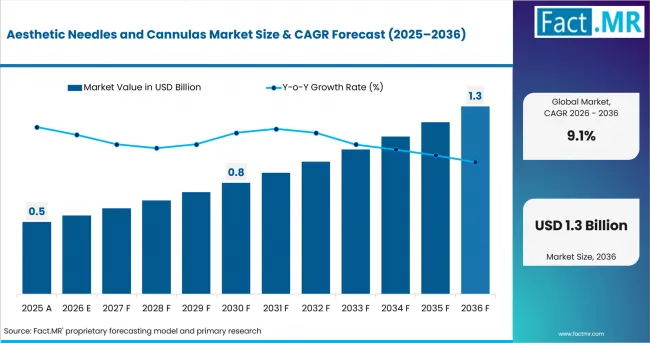
Aesthetic Needles And Cannulas Market Value Analysis | Source: Fact.MR
Summary of Aesthetic needles and cannulas market
- Demand Drivers in the Market
- Dermatology clinics need precision injection tools that support filler placement and patient comfort across repeat aesthetic procedure sessions.
- Medical spas use specialty needles and cannulas to improve treatment control and support premium injectable service menus.
- Injectable aesthetic demand supports steady device replacement because needles and cannulas are single-use products in professional treatment settings.
- Key Segments Analyzed
- By Product Type: Aesthetic needles hold 56.0% share in 2026 because toxin and filler injections create high unit demand.
- By Gauge Size: 26G to 30G products account for 38.0% share in 2026 as injectors need balanced flow control.
- By Application: Dermal filler injection captures 49.0% share in 2026 because filler treatments use needles and cannulas.
- By End User: Dermatology clinics hold 43.0% share in 2026 since physician-led settings manage complex injection procedures.
- By Sales Channel: Distributor sales account for 46.0% share in 2026 as clinics need reliable professional device access.
- By Geography: South Korea records 11.2% CAGR through 2036 as aesthetic clinics expand filler and skin booster procedures.
- Analyst Opinion at Fact.MR
- Shambhu Nath Jha, Principal Consultant at Fact.MR, notes, “Aesthetic needles and cannulas are becoming important safety and precision tools in injectable care. Clinics compare gauge options, filler compatibility and handling control before selecting devices.”
- Strategic Implications
- Device suppliers need gauge-specific product education that helps injectors select suitable tools for filler viscosity and treatment depth.
- Clinics should standardize needle and cannula choices because consistent device handling can improve procedure confidence across injector teams.
- Distributors need stable inventory programs that support single-use device demand across high-volume injectable aesthetic clinics.
| Metric | Details |
|---|---|
| Industry Size 2026 | USD 0.6 billion |
| Industry Value 2036 | USD 1.3 billion |
| CAGR 2026 to 2036 | 8.0% |
Source: Fact.MR analysis. Updated Jun 18, 2026
South Korea is likely to record 11.2% CAGR from 2026 to 2036 as aesthetic clinics expand filler and skin booster procedures. India is projected to post 10.8% CAGR because urban clinics and medical tourism support injectable aesthetics. China is forecast to advance at 10.5% CAGR by 2036 as private aesthetic clinics expand regulated injectable services. The United States is expected to register 8.9% CAGR as dermatology practices add precision injection tools. Germany is set to record 8.2% CAGR because specialist clinics focus on safe filler and toxin delivery.
How does the aesthetic needles and cannulas market break down by segment?
Aesthetic Needles and Cannulas Market Analysis by Product Type
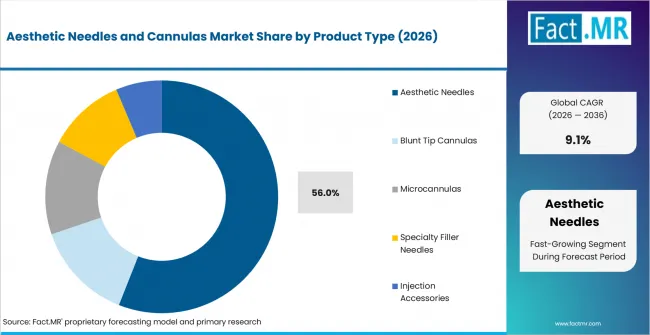
Aesthetic Needles And Cannulas Market Analysis By Product Type | Source: Fact.MR
Aesthetic needles lead because toxin and filler procedures need high-volume disposable injection tools. Cannulas are gaining use in filler placement. Aesthetic needles hold 56.0% share in 2026 because clinics use them across toxin and skin booster treatments.
- Aesthetic Needles: Aesthetic needles support toxin, filler and skin booster delivery across high-volume professional treatment sessions.
- Blunt Tip Cannulas: Blunt tip cannulas support filler placement with broader reach and fewer entry points in selected facial areas.
- Specialty Filler Needles: Specialty filler needles improve flow control for viscous formulations and reduce syringe pop-off risk during injection.
Aesthetic Needles and Cannulas Market Analysis by Gauge Size
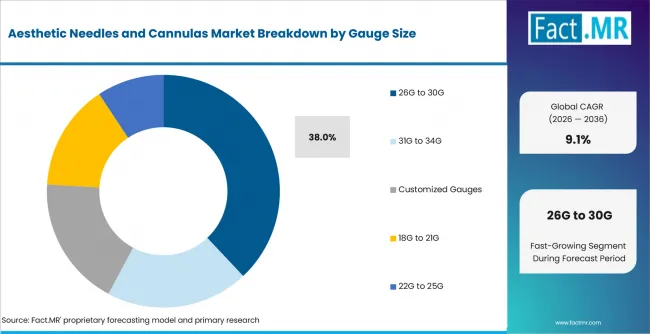
Aesthetic Needles And Cannulas Market Analysis By Gauge Size | Source: Fact.MR
26G to 30G products lead because injectors need balanced control for filler and skin booster delivery. Fine gauges support toxin procedures. 26G to 30G products account for 38.0% share in 2026 as clinics prioritize comfort and product flow.
- 26G to 30G Products: 26G to 30G devices balance patient comfort and injector control across aesthetic procedures.
- 31G to 34G Products: 31G to 34G needles support toxin injections that require fine placement and lower patient discomfort.
- 22G to 25G Products: 22G to 25G cannulas support thicker filler delivery and deeper facial contouring procedures.
Aesthetic Needles and Cannulas Market Analysis by Application
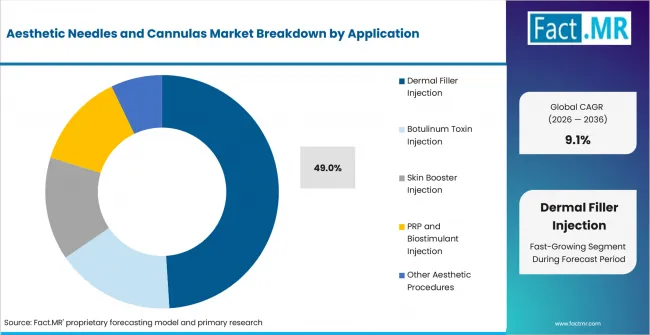
Aesthetic Needles And Cannulas Market Analysis By Application | Source: Fact.MR
Dermal filler injection leads because fillers use both needles and cannulas across facial contouring and wrinkle correction. Galderma stated on March 23, 2026 that Restylane Contour uses a dual-layer technique with both needle and cannula to support precise, customized and safe product placement [2]. Botulinum toxin injection supports high unit demand. Dermal filler injection captures 49.0% share in 2026 because device selection affects placement control.
- Dermal Filler Injection: Dermal filler injection uses needles and cannulas for volume correction, contouring and wrinkle-focused procedures.
- Botulinum Toxin Injection: Botulinum toxin injection creates repeat demand for fine needles across facial expression-line treatments.
- Skin Booster Injection: Skin booster injection supports fine-gauge demand through hydration-focused and texture-focused treatment protocols.
Aesthetic Needles and Cannulas Market Analysis by End User
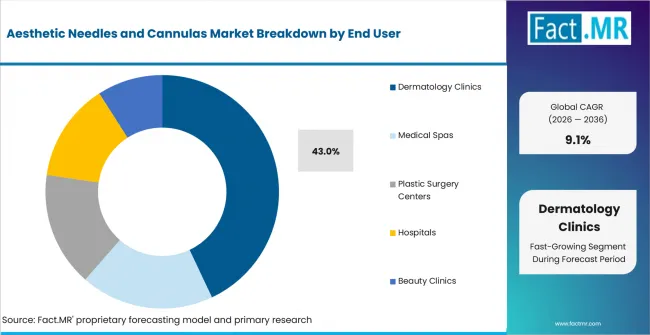
Aesthetic Needles And Cannulas Market Analysis By End User | Source: Fact.MR
Dermatology clinics hold 43.0% share in 2026 because physician-led settings manage complex filler and toxin procedures. It leads because professional injectables require patient screening and anatomical knowledge. The American Academy of Dermatology stated on January 9, 2024 that cosmetic treatment results depend largely on the skill and knowledge of the person performing the treatment, and that common options include botulinum toxin and fillers [3]. Medical spas support strong recurring use.
- Dermatology Clinics: Dermatology clinics use injection devices with medical oversight and post-treatment care support.
- Medical Spas: Medical spas use aesthetic needles and cannulas to expand injectable service menus for repeat clients.
- Plastic Surgery Centers: Plastic surgery centers use injection tools for facial contouring and post-surgical appearance refinement services.
Aesthetic Needles and Cannulas Market Analysis by Sales Channel
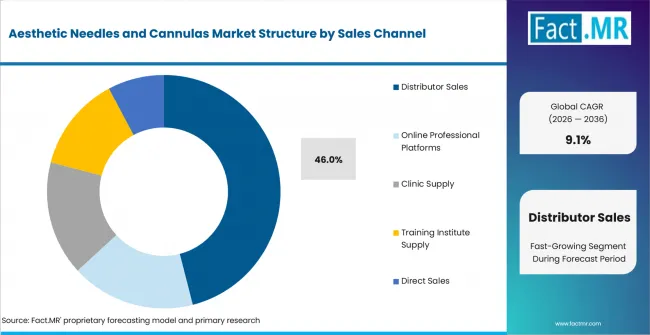
Aesthetic Needles And Cannulas Market Analysis By Sales Channel | Source: Fact.MR
Distributor sales lead because clinics need reliable access to sterile, single-use products. Direct sales support larger clinic chains. Distributor sales account for 46.0% share in 2026 as suppliers depend on local availability and repeat ordering.
- Distributor Sales: Distributor sales support reliable access to sterile injection devices across clinics and regional aesthetic centers.
- Direct Sales: Direct sales help manufacturers serve larger clinic groups with standardized product supply and training support.
- Online Professional Platforms: Online professional platforms support repeat ordering for licensed clinics and trained aesthetic injectors.
What is accelerating aesthetic needles and cannulas adoption, and what is holding it back?
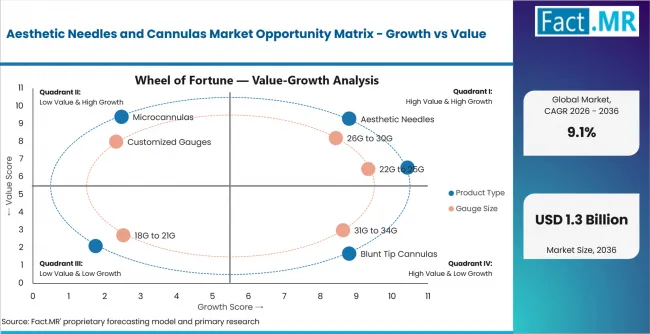
Aesthetic Needles And Cannulas Market Opportunity Matrix Growth Vs Value | Source: Fact.MR
Rising injectable aesthetic demand is the main driver for this market. ISAPS reported close to 38.0 million surgical and non-surgical aesthetic procedures in 2024. Hyaluronic acid filler procedures increased by 5.2% to 6.3 million worldwide. [2]
Training requirements can restrain market adoption. FDA advises providers not to inject dermal fillers without appropriate training or experience. Poor injection technique can increase safety risk and damage clinic trust.
Opportunities in the Aesthetic Needles and Cannulas Market
- Blunt Tip Cannulas: Suppliers can target filler injectors seeking fewer entry points and improved patient comfort.
- Fine-Gauge Needles: Fine-gauge products can gain through toxin procedures and microinjection protocols.
- Training Partnerships: Device brands can build injector education programs around and product compatibility.
Which countries are scaling aesthetic needles and cannulas demand fastest?
Based on regional analysis, the aesthetic needles and cannulas market is segmented into North America, Europe, East Asia, South Asia and Pacific, Latin America, and Middle East and Africa.
.webp "Top Country Growth Comparison Aesthetic Needles And Cannulas Market Cagr (2026 2036)")
Top Country Growth Comparison Aesthetic Needles And Cannulas Market Cagr (2026 2036) | Source: Fact.MR
| Country | CAGR 2026 to 2036 |
|---|---|
| South Korea | 11.2% |
| India | 10.8% |
| China | 10.5% |
| United States | 8.9% |
| Germany | 8.2% |
Source: Fact.MR analysis. Updated Jun 18, 2026
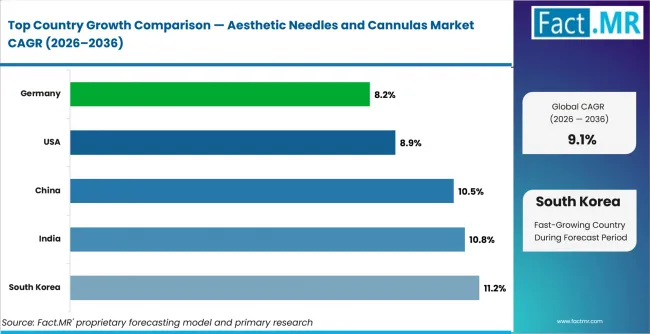
Aesthetic Needles And Cannulas Market Cagr Analysis By Country | Source: Fact.MR
East Asia Aesthetic Needles and Cannulas Market Analysis
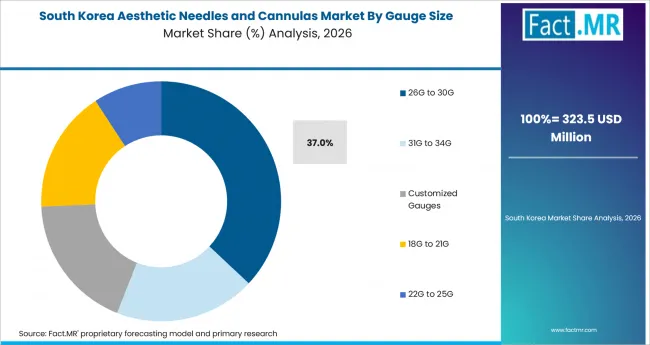
Aesthetic Needles And Cannulas Market South Korea Market Share Analysis By Gauge Size | Source: Fact.MR
East Asia demand is supported by aesthetic clinic density and high procedure acceptance. South Korea leads the selected country set through advanced injector training and strong skin-care culture. China supports rising demand through private clinic expansion and regulated injectable services.
- South Korea: Skin-care focused clinics are expanding filler, toxin and skin booster treatment menus across Seoul and other beauty hubs. South Korea is likely to record 11.2% CAGR through 2036 as injectable aesthetics gain wider social acceptance. Clinics need needles and cannulas that support patient comfort and repeat procedure quality. Injectors compare gauge size, glide performance and filler compatibility before selecting products. Premium cannulas can support facial contouring demand because fewer entry points improve patient experience.
- China: Private aesthetic clinics are expanding injectable treatment services across major cities. Premium providers need sterile devices with clear labeling, stable supply and professional training support. China is forecast to advance at 10.5% CAGR by 2036 as filler and skin booster demand grows. Wider adoption outside tier-one cities will need distributor education and stronger service access. Clinics compare device handling and needle flow performance before use.
South Asia and Pacific Aesthetic Needles and Cannulas Market Analysis
South Asia demand is led by India through urban clinics and medical tourism. Injectable aesthetics are gaining acceptance in metro markets. Clinics need lower-trauma tools and consistent device quality for repeat procedures.
- India: India is projected to post 10.8% CAGR from 2026 to 2036 because urban clinics and medical tourism support injectable aesthetics. Demand is rising in metro cities through filler, toxin and skin booster packages. Dermatology clinics need needles and cannulas that improve comfort and allow controlled placement. Smaller clinics often rely on distributors because product access and price affect purchase timing. Training will remain important because injectable procedures need anatomical knowledge and complication management.
North America Aesthetic Needles and Cannulas Market Analysis
North America demand is led by the United States through dermatology practices, injectors and medical spas. Professional filler use supports steady device replacement. Safety guidance and approved product use influence supplier selection.
- United States: The United States is expected to register 8.9% CAGR through 2036 as dermatology practices add precision injection tools. ASDS reported that 70.0% of survey respondents were considering a cosmetic procedure in 2025. [5] Clinics need sterile devices with predictable handling and low product waste. Larger injector practices can standardize gauge selection across treatment areas.
Europe Aesthetic Needles and Cannulas Market Analysis
Europe demand is guided by specialist dermatology clinics and regulated aesthetic practice. Germany leads the selected European country set through premium clinic demand and strong device quality expectations.
- Germany: Germany is set to record 8.2% CAGR through 2036 because specialist clinics focus on safe filler and toxin delivery. Patients value trained injectors and professional treatment environments. Clinics need needles and cannulas that support controlled placement with dependable sterile packaging. Filler and toxin procedures create repeat demand for single-use devices. German providers often evaluate device consistency, hub stability and distributor reliability before adoption.
Who leads the aesthetic needles and cannulas market landscape?
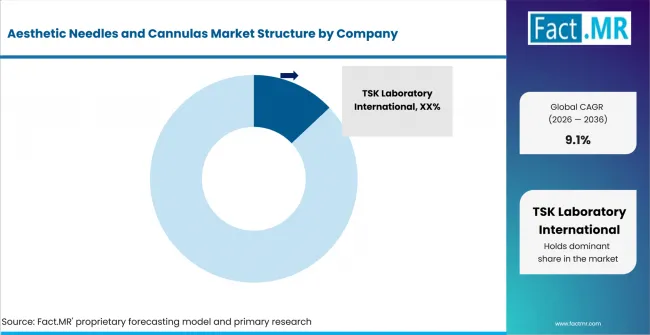
Aesthetic Needles And Cannulas Market Analysis By Company | Source: Fact.MR
The aesthetic needles and cannulas market includes specialty needle makers. It also includes cannula suppliers and aesthetic device distributors. TSK Laboratory International is active in specialty aesthetic cannulas. SoftFil and Aesthetic Group compete through filler focused cannula designs and practitioner support. B. Braun SE and Becton Dickinson and Company support sterile needle quality and reliable injection device supply.
Competition is centered on handling control and procedure safety. TSK states that its aesthetic cannulas with blunt tips are developed for hyaluronic acid and non-hyaluronic acid dermal fillers. Clinics compare glide control tip design flexibility and product consistency before selecting needles or cannulas for filler procedures.
Supplier choice will rely on consistent sterile quality over the forecast period. Clinics need devices that fit filler viscosity injection depth and practitioner technique. Training support can reduce misuse and support safer outcomes. Companies that combine device reliability education and steady supply can protect professional aesthetic accounts.
Which companies are the key players?
- TSK Laboratory International
- SoftFil
- Aesthetic Group
- B. Braun SE
- Becton, Dickinson and Company
Bibliography
- [1] Merz Aesthetics GmbH. (2024, March 15). Belotero® Volume Lidocaine: Instructions for use.
- [2] Galderma. (2026, March 23). Galderma receives U.S. FDA approval for Restylane® Contour™ for the correction of temple hollowing.
- [3] American Academy of Dermatology Association. (2024, January 9). Start the new year off with a fresh start (and skin).
- [4] International Society of Aesthetic Plastic Surgery. (2025, June 19). Global Survey 2024: Full report and press releases.
- [5] American Society for Dermatologic Surgery. (2025, July 28). Dermatologists top the list as key influencers in patients’ cosmetic procedure decisions.
This Report Addresses
- Strategic intelligence on aesthetic needle and cannula demand across product type, gauge size, application, end user and sales channel.
- Forecast mapping from USD 0.6 billion in 2026 to USD 1.3 billion by 2036.
- Segment analysis covering aesthetic needles, 26G to 30G products, dermal filler injection and dermatology clinics.
- Regional outlook covering South Korea, India, China, the United States and Germany for focused country demand analysis.
- Competitive analysis of TSK Laboratory International, SoftFil, Aesthetic Group, B. Braun SE, Becton, Dickinson and Company.
- Product assessment covering gauge selection, cannula flexibility, hub stability, product flow, sterile quality and injector training.
- Primary interviews, supplier checks, official source review and regulatory validation support the market forecast.
What does the aesthetic needles and cannulas market cover?
The aesthetic needles and cannulas market covers single-use and specialty injection devices used in aesthetic medicine. The scope includes needles and filler injection accessories. These products support dermal filler and biostimulant delivery in professional settings.
Aesthetic Needles and Cannulas Market Inclusions
The scope includes aesthetic needles and cannulas designed for dermal filler and toxin injection. It includes specialty hubs and gauge-specific devices.
Aesthetic Needles and Cannulas Market Exclusions
The scope excludes general hospital cannulas used for infusion or vascular access. It excludes surgical sutures and non-aesthetic injection devices. It excludes filler products and skin booster formulations sold without injection devices. It excludes consumer needle-free filler devices.
Aesthetic Needles and Cannulas Market Research Methodology
- Primary Research
- Primary research includes interviews with dermatologists and aesthetic injectors. It includes input from medical spa operators and device distributors. Training providers are reviewed to assess product selection and injection safety needs.
- Desk Research
- Desk research reviews regulator guidance and professional association data. It covers injectable procedure demand and device compatibility signals. Supplier disclosures support product type and gauge-size mapping.
- Market-Sizing and Forecasting
- Forecasting uses injectable aesthetic procedure demand and professional device replacement as the baseline. Segment values are reviewed by product type and application. Country forecasts are tested against clinic density and injector training activity.
- Data Validation and Update Cycle
- Forecasts are validated through supplier checks and clinic feedback. Device use is reviewed across fillers and skin boosters. Official regulatory sources help confirm the final forecast direction.
Segmentation
What is the report’s scope and coverage?
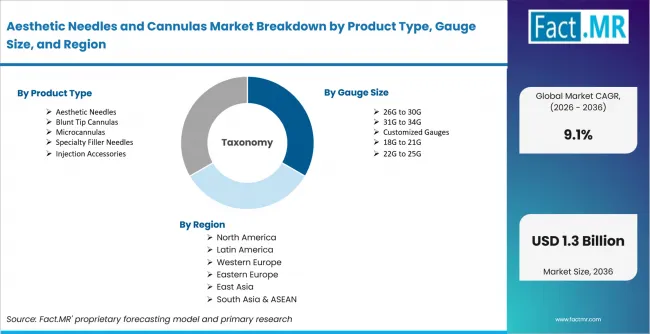
Aesthetic Needles And Cannulas Market Breakdown By Product Type, Gauge Size, And Region | Source: Fact.MR
| Attribute | Details |
|---|---|
| Quantitative Units | USD 0.6 billion in 2026 to USD 1.3 billion by 2036 at 8.0% CAGR |
| Market Definition | Specialty needles and cannulas used for professional aesthetic injection procedures |
| Product Type | Aesthetic Needles, Blunt Tip Cannulas, Microcannulas, Specialty Filler Needles, Injection Accessories |
| Gauge Size | 18G to 21G, 22G to 25G, 26G to 30G, 31G to 34G, Customized Gauges |
| Application | Dermal Filler Injection, Botulinum Toxin Injection, Skin Booster Injection, PRP and Biostimulant Injection, Other Aesthetic Procedures |
| End User | Dermatology Clinics, Medical Spas, Plastic Surgery Centers, Hospitals, Beauty Clinics |
| Sales Channel | Direct Sales, Distributor Sales, Online Professional Platforms, Clinic Supply, Training Institute Supply |
| Regions Covered | North America, Europe, East Asia, South Asia and Pacific, Latin America, Middle East and Africa |
| Countries Covered | South Korea, India, China, United States, Germany |
| Key Companies Profiled | TSK Laboratory International, SoftFil, Aesthetic Group, B. Braun SE, Becton, Dickinson and Company |
| Forecast Period | 2026 to 2036 |
| Approach | Hybrid top-down and bottom-up approach using injectable procedure demand, device replacement, gauge mix and regional validation |
Source: Fact.MR analysis. Updated Jun 18, 2026
How is the market segmented?
-
By Product Type:
- Aesthetic Needles
- Blunt Tip Cannulas
- Microcannulas
- Specialty Filler Needles
- Injection Accessories
-
By Gauge Size:
- 18G to 21G
- 22G to 25G
- 26G to 30G
- 31G to 34G
- Customized Gauges
-
By Application:
- Dermal Filler Injection
- Botulinum Toxin Injection
- Skin Booster Injection
- PRP and Biostimulant Injection
- Other Aesthetic Procedures
-
By End User:
- Dermatology Clinics
- Medical Spas
- Plastic Surgery Centers
- Hospitals
- Beauty Clinics
-
By Sales Channel:
- Direct Sales
- Distributor Sales
- Online Professional Platforms
- Clinic Supply
- Training Institute Supply
-
By Region:
- North America
- United States
- Canada
- Europe
- Germany
- United Kingdom
- France
- Italy
- Spain
- East Asia
- China
- Japan
- South Korea
- South Asia and Pacific
- India
- ASEAN
- Australia and New Zealand
- Latin America
- Brazil
- Mexico
- Middle East and Africa
- GCC Countries
- South Africa
- North America
Frequently Asked Questions
What is the Aesthetic Needles and Cannulas Market size in 2026?
What will the Aesthetic Needles and Cannulas Market be worth by 2036?
What CAGR is projected for the Aesthetic Needles and Cannulas Market?
Which product type leads the Aesthetic Needles and Cannulas Market?
Which country grows fastest in the Aesthetic Needles and Cannulas Market?
How does India perform in the Aesthetic Needles and Cannulas Market?
How does China perform in the Aesthetic Needles and Cannulas Market?
How does the United States perform in the Aesthetic Needles and Cannulas Market?
How does Germany perform in the Aesthetic Needles and Cannulas Market?
What is the main driver in the Aesthetic Needles and Cannulas Market?
What is the main restraint in the Aesthetic Needles and Cannulas Market?
Why do aesthetic needles lead the Aesthetic Needles and Cannulas Market?
Why are cannulas gaining demand in the Aesthetic Needles and Cannulas Market?
Why does dermal filler injection lead application demand?
Why are dermatology clinics important in the Aesthetic Needles and Cannulas Market?
Why is gauge selection important in the Aesthetic Needles and Cannulas Market?
Who worked on this report


Preview the report firsthand - request a free sample
Free SampleGet the brochure for pricing and purchase details
Download PDF