Anti-Fouling Chemicals for Membrane Bioreactors Market

Anti-Fouling Chemicals for Membrane Bioreactors Market Size and Share Forecast Outlook 2026 to 2036

Anti-fouling chemicals for membrane bioreactors market is projected to grow from USD 0.5 billion in 2026 to USD 1.1 billion by 2036, at a CAGR of 9.1%. Biocide-Based Anti-Fouling Chemicals will dominate with a 30.0% market share, while hollow fiber membranes will lead the membrane type segment with a 34.0% share.

Anti-Fouling Chemicals for Membrane Bioreactors Market Forecast and Outlook 2026 to 2036

The global market for anti-fouling chemicals in membrane bioreactors is positioned for substantial growth, driven by the expanding adoption of MBR technology and the critical need to maintain membrane performance. Projected to increase from USD 0.45 billion in 2026 to USD 1.08 billion by 2036, the market is set to advance at a CAGR of 9.1%.

Key Takeaways from the Anti-Fouling Chemicals for Membrane Bioreactors Market

  • Market Value for 2026: USD 0.45 Billion
  • Market Value for 2036: USD 1.08 Billion
  • Forecast CAGR (2026-2036): 9.1%
  • Leading Chemical Type Share (2026): Biocide-Based Anti-Fouling Chemicals (30%)
  • Leading Membrane Type Share (2026): Hollow Fiber Membranes (34%)
  • Leading Application Area Share (2026): Municipal Wastewater Treatment (38%)
  • Key Players in the Market: Veolia Water Technologies, Kemira, Kurita Water Industries, Ecolab, Solenis

Anti Fouling Chemicals For Membrane Bioreactors Market Market Value Analysis

Biocide-based anti-fouling chemicals represent the dominant product type, holding a 30% market share. Hollow fiber membranes are the most prevalent membrane type, accounting for 34% of demand. Municipal wastewater treatment remains the primary application area, with a 38% share, underscoring the technology's role in delivering high-quality effluent for reuse and discharge.

This growth is anchored in the widespread deployment of MBR systems, which combine biological treatment with membrane filtration to produce superior effluent in a compact footprint. Membrane fouling is the principal operational challenge, leading to increased energy consumption, frequent cleaning, and reduced membrane life. Anti-fouling chemicals are essential for mitigating this issue, enhancing system reliability, and lowering the total cost of ownership for MBR operations.

Innovation focuses on developing targeted chemistries that prevent or reverse fouling with minimal ecological impact and compatibility with biological processes. The progression of these formulations is vital for supporting the long-term operational sustainability and economic viability of MBR systems across water-stressed regions and stringent regulatory environments.

Metric

Metric Value
Market Value (2026) USD 0.45 Billion
Market Forecast Value (2036) USD 1.08 Billion
Forecast CAGR (2026-2036) 9.1%

Category

Category Segments
Chemical Type Biocide-Based Anti-Fouling Chemicals, Enzymatic & Bio-Based Anti-Foulants, Scale & Organic Fouling Inhibitors, Surfactant-Based Cleaning Agents, Other Specialty Anti-Fouling Chemicals
Membrane Type Hollow Fiber Membranes, Flat Sheet Membranes, Tubular Membranes, Multi-Layer Composite Membranes, Others
Application Area Municipal Wastewater Treatment, Industrial Effluent Treatment, Decentralized & On-Site MBR Systems, Commercial & Institutional Facilities, Sludge & Biogas Treatment Plants
Region North America, Latin America, Western Europe, Eastern Europe, East Asia, South Asia & Pacific, MEA

Segmental Analysis

By Chemical Type, Which Segment Addresses the Most Critical Fouling Mechanism?

Anti Fouling Chemicals For Membrane Bioreactors Market Analysis By Chemical Type

Biocide-based anti-fouling chemicals lead the market with a 30% share. Their prominence is due to the primary role of biological fouling (biofouling) in MBR systems, where bacteria and their extracellular polymeric substances (EPS) clog membrane pores.

Biocides, including oxidants like sodium hypochlorite and specialty non-oxidizing agents, effectively control microbial growth on membrane surfaces. This direct intervention is essential for maintaining permeability and extending intervals between intensive cleanings, establishing biocides as a core component of most MBR maintenance regimens.

By Membrane Type, Which Configuration Demands the Most Intensive Fouling Control?

Anti Fouling Chemicals For Membrane Bioreactors Market Analysis By Membrane Type

Hollow fiber membranes represent the largest membrane segment, accounting for a 34% share. Their high packing density and extensive surface area make them highly efficient but also particularly susceptible to fouling.

The narrow channels between fibers are easily blocked, making consistent anti-fouling chemical programs absolutely critical for sustained operation. The widespread use of hollow fiber modules in municipal and large industrial MBRs drives correspondingly high demand for effective chemical treatments.

By Application Area, Where is Operational Continuity Most Valued?

Anti Fouling Chemicals For Membrane Bioreactors Market Analysis By Application Area

Municipal wastewater treatment is the leading application area, commanding a 38% share. Municipal MBR plants are often critical infrastructure, requiring near-constant operation to handle large, continuous flows. Unexpected membrane fouling can compromise treatment capacity and effluent quality. Therefore, robust, preventative anti-fouling chemical programs are viewed as a necessary operational insurance policy. The scale of these facilities and their focus on lifecycle cost optimization solidify this sector as the largest and most consistent consumer of anti-fouling chemistries.

What are the Drivers, Restraints, and Key Trends of the Anti-Fouling Chemicals for MBR Market?

The primary market driver is the global increase in water scarcity and stringent discharge/reuse regulations, which favor advanced treatment technologies like MBRs. As MBR adoption grows, so does the inherent need to manage fouling. Operational cost pressures to reduce energy consumption associated with fouling and to extend membrane replacement cycles create a direct economic incentive for effective anti-fouling strategies. The expansion of decentralized water reuse systems in urban and industrial settings further propels demand for chemicals that ensure reliable, low-maintenance MBR performance.

A significant market restraint is the potential for chemical cleaners to damage delicate membrane materials or adversely affect the biology of the bioreactor if not properly selected and dosed. Environmental and health concerns regarding the discharge of biocidal residues in membrane cleaning waste streams are prompting stricter regulations. The high cost of some specialty enzymatic or green chemistries can also be a barrier, despite their benefits, particularly in cost-sensitive markets.

Key trends include a shift toward enzymatic and bio-based anti-foulants that break down organic foulants like EPS with greater specificity and lower environmental impact. There is growing adoption of predictive and condition-based cleaning protocols that use real-time trans-membrane pressure data to trigger chemical cleaning only when needed, optimizing chemical use. The market is also seeing the development of multifunctional chemical blends that combine scale inhibition, bio-dispersion, and cleaning in a single product to simplify inventory and dosing complexity for plant operators.

Analysis of the Anti-Fouling Chemicals for MBR Market by Key Countries
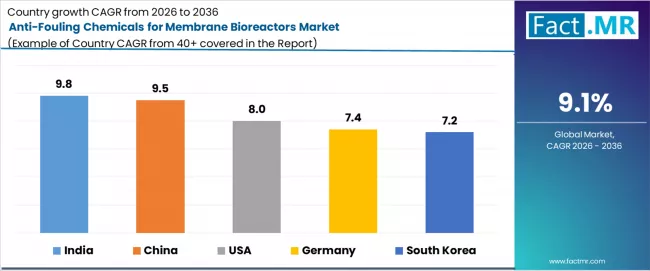
Anti Fouling Chemicals For Membrane Bioreactors Market Cagr Analysis By Country

Country CAGR (2026-2036)
India 9.80%
China 9.50%
USA 8.00%
Germany 7.40%
South Korea 7.20%

How do India’s Water Reuse Imperatives and Infrastructure Growth Drive Demand?

India’s leading CAGR of 9.80% is propelled by acute water stress and massive investments in new wastewater treatment infrastructure. MBR technology is increasingly selected for large municipal and industrial projects due to its compact footprint and high-quality output suitable for reuse.

The need to ensure these new, capital-intensive systems operate reliably in challenging conditions creates immediate and growing demand for effective anti-fouling chemical programs, supported by a burgeoning service and chemical supply sector.

What is the Impact of China’s High Rate of MBR Adoption and Environmental Standards?

China’s 9.50% growth is linked to its position as the world's largest market for MBR systems, driven by strict environmental standards and ambitious water quality goals. Thousands of MBR installations across municipal and industrial sectors require consistent chemical maintenance.

The scale of operation fosters a competitive market for both generic and high-performance specialty anti-fouling chemicals, with a strong emphasis on solutions that reduce operational downtime and chemical consumption.

How does the USA’s Focus on Water Reuse and Decentralized Systems Influence the Market?
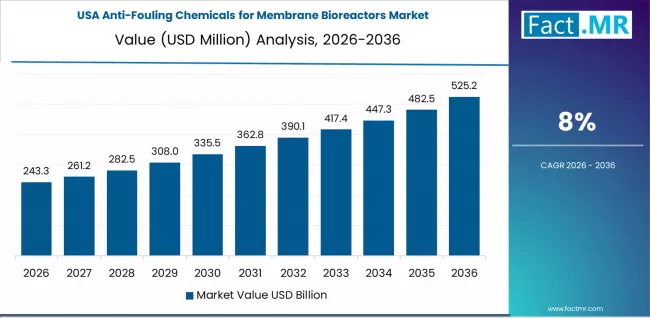
Anti Fouling Chemicals For Membrane Bioreactors Market Country Value Analysis

The USA’s 8.00% CAGR is supported by increasing adoption of MBRs for direct potable reuse projects, industrial zero-liquid discharge, and decentralized treatment for communities and campuses.

The high value of water in these applications makes membrane reliability paramount, justifying investment in premium anti-fouling chemistries and sophisticated dosing control systems. The market is characterized by demand for proven, reliable products and comprehensive technical support from suppliers.

Why is Germany a Key Market for Precision and Sustainable Chemical Solutions?

Germany’s 7.40% growth reflects its leadership in advanced water engineering and stringent chemical discharge regulations. German MBR operators seek highly effective anti-fouling strategies that minimize overall chemical usage and environmental impact.

This drives innovation and adoption of enzymatic cleaners, optimized CIP protocols, and smart dosing systems, creating a sophisticated market for precision chemical management and environmentally preferable products.

What Role does South Korea’s Technology Integration and Urban Redevelopment Play?

South Korea’s 7.20% growth is anchored in its advanced technological integration and major urban redevelopment projects that incorporate water recycling. South Korean MBR installations, often in space-constrained urban settings, prioritize automated, low-maintenance operation. This drives demand for integrated chemical dosing systems linked to process controllers and for high-efficiency anti-foulants that ensure stable operation with minimal manual intervention.

Competitive Landscape of the Anti-Fouling Chemicals for MBR Market
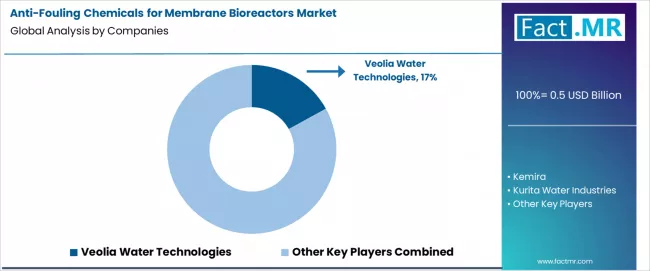
Anti Fouling Chemicals For Membrane Bioreactors Market Analysis By Company

The competitive landscape features global water technology and specialty chemical companies offering integrated chemical and service solutions. Leaders like Veolia Water Technologies and Kemira compete based on their deep understanding of MBR process biology and membrane science, providing tailored chemical programs.

Competition centers on demonstrating measurable reductions in cleaning frequency and energy consumption, offering validated CIP procedures, and providing 24/7 technical support. A key differentiator is the ability to deliver a complete "membrane care" program that includes chemical supply, dosing equipment, performance monitoring, and membrane autopsy services to diagnose fouling causes.

Key Players in the Anti-Fouling Chemicals for Membrane Bioreactors Market

  • Veolia Water Technologies
  • Kemira Oyj.
  • Kurita Water Industries
  • Ecolab
  • Solenis

Scope of Report

Items Values
Quantitative Units USD Billion
Chemical Type Biocides, Enzymatic/Bio-Based, Scale Inhibitors, Surfactants, Specialty Chemicals
Membrane Type Hollow Fiber, Flat Sheet, Tubular, Composite
Application Area Municipal WWT, Industrial Effluent, Decentralized Systems, Commercial Facilities, Sludge/Biogas Plants
Key Countries India, China, USA, Germany, South Korea
Key Companies Veolia Water Technologies, Kemira, Kurita Water Industries, Ecolab, Solenis
Additional Analysis Analysis of foulant composition (organic, inorganic, biological); chemical-membrane material compatibility; impact on sludge activity and rheology; optimization of cleaning-in-place (CIP) protocols; total cost of ownership models for different anti-fouling strategies.

Market by Segments

  • Chemical Type :

    • Biocide-Based Anti-Fouling Chemicals
    • Enzymatic & Bio-Based Anti-Foulants
    • Scale & Organic Fouling Inhibitors
    • Surfactant-Based Cleaning Agents
    • Other Specialty Anti-Fouling Chemicals
  • Membrane Type :

    • Hollow Fiber Membranes
    • Flat Sheet Membranes
    • Tubular Membranes
    • Multi-Layer Composite Membranes
    • Others
  • Application Area :

    • Municipal Wastewater Treatment
    • Industrial Effluent Treatment
    • Decentralized & On-Site MBR Systems
    • Commercial & Institutional Facilities
    • Sludge & Biogas Treatment Plants
  • Region :

    • North America

      • USA
      • Canada
    • Latin America

      • Brazil
      • Mexico
      • Argentina
      • Rest of Latin America
    • Western Europe

      • Germany
      • UK
      • France
      • Spain
      • Italy
      • BENELUX
      • Rest of Western Europe
    • Eastern Europe

      • Russia
      • Poland
      • Czech Republic
      • Rest of Eastern Europe
    • East Asia

      • China
      • Japan
      • South Korea
      • Rest of East Asia
    • South Asia & Pacific

      • India
      • ASEAN
      • Australia
      • Rest of South Asia & Pacific
    • MEA

      • Saudi Arabia
      • UAE
      • Turkiye
      • Rest of MEA

Table of Content

  1. Executive Summary
    • Global Market Outlook
    • Demand to side Trends
    • Supply to side Trends
    • Technology Roadmap Analysis
    • Analysis and Recommendations
  2. Market Overview
    • Market Coverage / Taxonomy
    • Market Definition / Scope / Limitations
  3. Market Background
    • Market Dynamics
      • Drivers
      • Restraints
      • Opportunity
      • Trends
    • Scenario Forecast
      • Demand in Optimistic Scenario
      • Demand in Likely Scenario
      • Demand in Conservative Scenario
    • Opportunity Map Analysis
    • Product Life Cycle Analysis
    • Supply Chain Analysis
    • Investment Feasibility Matrix
    • Value Chain Analysis
    • PESTLE and Porter’s Analysis
    • Regulatory Landscape
    • Regional Parent Market Outlook
    • Production and Consumption Statistics
    • Import and Export Statistics
  4. Global Market Analysis 2021 to 2025 and Forecast, 2026 to 2036
    • Historical Market Size Value (USD Million) Analysis, 2021 to 2025
    • Current and Future Market Size Value (USD Million) Projections, 2026 to 2036
      • Y to o to Y Growth Trend Analysis
      • Absolute $ Opportunity Analysis
  5. Global Market Pricing Analysis 2021 to 2025 and Forecast 2026 to 2036
  6. Global Market Analysis 2021 to 2025 and Forecast 2026 to 2036, By Chemical Type
    • Introduction / Key Findings
    • Historical Market Size Value (USD Million) Analysis By Chemical Type, 2021 to 2025
    • Current and Future Market Size Value (USD Million) Analysis and Forecast By Chemical Type, 2026 to 2036
      • Biocide-Based Anti-Fouling Chemicals
      • Enzymatic & Bio-Based Anti-Foulants
      • Scale & Organic Fouling Inhibitors
      • Surfactant-Based Cleaning Agents
      • Other Specialty Anti-Fouling Chemicals
    • Y to o to Y Growth Trend Analysis By Chemical Type, 2021 to 2025
    • Absolute $ Opportunity Analysis By Chemical Type, 2026 to 2036
  7. Global Market Analysis 2021 to 2025 and Forecast 2026 to 2036, By Membrane Type
    • Introduction / Key Findings
    • Historical Market Size Value (USD Million) Analysis By Membrane Type, 2021 to 2025
    • Current and Future Market Size Value (USD Million) Analysis and Forecast By Membrane Type, 2026 to 2036
      • Hollow Fiber Membranes
      • Flat Sheet Membranes
      • Tubular Membranes
      • Multi-Layer Composite Membranes
      • Others
    • Y to o to Y Growth Trend Analysis By Membrane Type, 2021 to 2025
    • Absolute $ Opportunity Analysis By Membrane Type, 2026 to 2036
  8. Global Market Analysis 2021 to 2025 and Forecast 2026 to 2036, By Application Area
    • Introduction / Key Findings
    • Historical Market Size Value (USD Million) Analysis By Application Area, 2021 to 2025
    • Current and Future Market Size Value (USD Million) Analysis and Forecast By Application Area, 2026 to 2036
      • Municipal Wastewater Treatment
      • Industrial Effluent Treatment
      • Decentralized & On-Site MBR Systems
      • Commercial & Institutional Facilities
      • Sludge & Biogas Treatment Plants
    • Y to o to Y Growth Trend Analysis By Application Area, 2021 to 2025
    • Absolute $ Opportunity Analysis By Application Area, 2026 to 2036
  9. Global Market Analysis 2021 to 2025 and Forecast 2026 to 2036, By Region
    • Introduction
    • Historical Market Size Value (USD Million) Analysis By Region, 2021 to 2025
    • Current Market Size Value (USD Million) Analysis and Forecast By Region, 2026 to 2036
      • North America
      • Latin America
      • Western Europe
      • Eastern Europe
      • East Asia
      • South Asia and Pacific
      • Middle East & Africa
    • Market Attractiveness Analysis By Region
  10. North America Market Analysis 2021 to 2025 and Forecast 2026 to 2036, By Country
    • Historical Market Size Value (USD Million) Trend Analysis By Market Taxonomy, 2021 to 2025
    • Market Size Value (USD Million) Forecast By Market Taxonomy, 2026 to 2036
      • By Country
        • USA
        • Canada
        • Mexico
      • By Chemical Type
      • By Membrane Type
      • By Application Area
    • Market Attractiveness Analysis
      • By Country
      • By Chemical Type
      • By Membrane Type
      • By Application Area
    • Key Takeaways
  11. Latin America Market Analysis 2021 to 2025 and Forecast 2026 to 2036, By Country
    • Historical Market Size Value (USD Million) Trend Analysis By Market Taxonomy, 2021 to 2025
    • Market Size Value (USD Million) Forecast By Market Taxonomy, 2026 to 2036
      • By Country
        • Brazil
        • Chile
        • Rest of Latin America
      • By Chemical Type
      • By Membrane Type
      • By Application Area
    • Market Attractiveness Analysis
      • By Country
      • By Chemical Type
      • By Membrane Type
      • By Application Area
    • Key Takeaways
  12. Western Europe Market Analysis 2021 to 2025 and Forecast 2026 to 2036, By Country
    • Historical Market Size Value (USD Million) Trend Analysis By Market Taxonomy, 2021 to 2025
    • Market Size Value (USD Million) Forecast By Market Taxonomy, 2026 to 2036
      • By Country
        • Germany
        • UK
        • Italy
        • Spain
        • France
        • Nordic
        • BENELUX
        • Rest of Western Europe
      • By Chemical Type
      • By Membrane Type
      • By Application Area
    • Market Attractiveness Analysis
      • By Country
      • By Chemical Type
      • By Membrane Type
      • By Application Area
    • Key Takeaways
  13. Eastern Europe Market Analysis 2021 to 2025 and Forecast 2026 to 2036, By Country
    • Historical Market Size Value (USD Million) Trend Analysis By Market Taxonomy, 2021 to 2025
    • Market Size Value (USD Million) Forecast By Market Taxonomy, 2026 to 2036
      • By Country
        • Russia
        • Poland
        • Hungary
        • Balkan & Baltic
        • Rest of Eastern Europe
      • By Chemical Type
      • By Membrane Type
      • By Application Area
    • Market Attractiveness Analysis
      • By Country
      • By Chemical Type
      • By Membrane Type
      • By Application Area
    • Key Takeaways
  14. East Asia Market Analysis 2021 to 2025 and Forecast 2026 to 2036, By Country
    • Historical Market Size Value (USD Million) Trend Analysis By Market Taxonomy, 2021 to 2025
    • Market Size Value (USD Million) Forecast By Market Taxonomy, 2026 to 2036
      • By Country
        • China
        • Japan
        • South Korea
      • By Chemical Type
      • By Membrane Type
      • By Application Area
    • Market Attractiveness Analysis
      • By Country
      • By Chemical Type
      • By Membrane Type
      • By Application Area
    • Key Takeaways
  15. South Asia and Pacific Market Analysis 2021 to 2025 and Forecast 2026 to 2036, By Country
    • Historical Market Size Value (USD Million) Trend Analysis By Market Taxonomy, 2021 to 2025
    • Market Size Value (USD Million) Forecast By Market Taxonomy, 2026 to 2036
      • By Country
        • India
        • ASEAN
        • Australia & New Zealand
        • Rest of South Asia and Pacific
      • By Chemical Type
      • By Membrane Type
      • By Application Area
    • Market Attractiveness Analysis
      • By Country
      • By Chemical Type
      • By Membrane Type
      • By Application Area
    • Key Takeaways
  16. Middle East & Africa Market Analysis 2021 to 2025 and Forecast 2026 to 2036, By Country
    • Historical Market Size Value (USD Million) Trend Analysis By Market Taxonomy, 2021 to 2025
    • Market Size Value (USD Million) Forecast By Market Taxonomy, 2026 to 2036
      • By Country
        • Kingdom of Saudi Arabia
        • Other GCC Countries
        • Turkiye
        • South Africa
        • Other African Union
        • Rest of Middle East & Africa
      • By Chemical Type
      • By Membrane Type
      • By Application Area
    • Market Attractiveness Analysis
      • By Country
      • By Chemical Type
      • By Membrane Type
      • By Application Area
    • Key Takeaways
  17. Key Countries Market Analysis
    • USA
      • Pricing Analysis
      • Market Share Analysis, 2025
        • By Chemical Type
        • By Membrane Type
        • By Application Area
    • Canada
      • Pricing Analysis
      • Market Share Analysis, 2025
        • By Chemical Type
        • By Membrane Type
        • By Application Area
    • Mexico
      • Pricing Analysis
      • Market Share Analysis, 2025
        • By Chemical Type
        • By Membrane Type
        • By Application Area
    • Brazil
      • Pricing Analysis
      • Market Share Analysis, 2025
        • By Chemical Type
        • By Membrane Type
        • By Application Area
    • Chile
      • Pricing Analysis
      • Market Share Analysis, 2025
        • By Chemical Type
        • By Membrane Type
        • By Application Area
    • Germany
      • Pricing Analysis
      • Market Share Analysis, 2025
        • By Chemical Type
        • By Membrane Type
        • By Application Area
    • UK
      • Pricing Analysis
      • Market Share Analysis, 2025
        • By Chemical Type
        • By Membrane Type
        • By Application Area
    • Italy
      • Pricing Analysis
      • Market Share Analysis, 2025
        • By Chemical Type
        • By Membrane Type
        • By Application Area
    • Spain
      • Pricing Analysis
      • Market Share Analysis, 2025
        • By Chemical Type
        • By Membrane Type
        • By Application Area
    • France
      • Pricing Analysis
      • Market Share Analysis, 2025
        • By Chemical Type
        • By Membrane Type
        • By Application Area
    • India
      • Pricing Analysis
      • Market Share Analysis, 2025
        • By Chemical Type
        • By Membrane Type
        • By Application Area
    • ASEAN
      • Pricing Analysis
      • Market Share Analysis, 2025
        • By Chemical Type
        • By Membrane Type
        • By Application Area
    • Australia & New Zealand
      • Pricing Analysis
      • Market Share Analysis, 2025
        • By Chemical Type
        • By Membrane Type
        • By Application Area
    • China
      • Pricing Analysis
      • Market Share Analysis, 2025
        • By Chemical Type
        • By Membrane Type
        • By Application Area
    • Japan
      • Pricing Analysis
      • Market Share Analysis, 2025
        • By Chemical Type
        • By Membrane Type
        • By Application Area
    • South Korea
      • Pricing Analysis
      • Market Share Analysis, 2025
        • By Chemical Type
        • By Membrane Type
        • By Application Area
    • Russia
      • Pricing Analysis
      • Market Share Analysis, 2025
        • By Chemical Type
        • By Membrane Type
        • By Application Area
    • Poland
      • Pricing Analysis
      • Market Share Analysis, 2025
        • By Chemical Type
        • By Membrane Type
        • By Application Area
    • Hungary
      • Pricing Analysis
      • Market Share Analysis, 2025
        • By Chemical Type
        • By Membrane Type
        • By Application Area
    • Kingdom of Saudi Arabia
      • Pricing Analysis
      • Market Share Analysis, 2025
        • By Chemical Type
        • By Membrane Type
        • By Application Area
    • Turkiye
      • Pricing Analysis
      • Market Share Analysis, 2025
        • By Chemical Type
        • By Membrane Type
        • By Application Area
    • South Africa
      • Pricing Analysis
      • Market Share Analysis, 2025
        • By Chemical Type
        • By Membrane Type
        • By Application Area
  18. Market Structure Analysis
    • Competition Dashboard
    • Competition Benchmarking
    • Market Share Analysis of Top Players
      • By Regional
      • By Chemical Type
      • By Membrane Type
      • By Application Area
  19. Competition Analysis
    • Competition Deep Dive
      • Veolia Water Technologies
        • Overview
        • Product Portfolio
        • Profitability by Market Segments (Product/Age /Sales Channel/Region)
        • Sales Footprint
        • Strategy Overview
          • Marketing Strategy
          • Product Strategy
          • Channel Strategy
      • Kemira
      • Kurita Water Industries
      • Ecolab
      • Solenis
  20. Assumptions & Acronyms Used
  21. Research Methodology

List Of Table

  • Table 1: Global Market Value (USD Million) Forecast by Region, 2021 to 2036
  • Table 2: Global Market Value (USD Million) Forecast by Chemical Type, 2021 to 2036
  • Table 3: Global Market Value (USD Million) Forecast by Membrane Type, 2021 to 2036
  • Table 4: Global Market Value (USD Million) Forecast by Application Area, 2021 to 2036
  • Table 5: North America Market Value (USD Million) Forecast by Country, 2021 to 2036
  • Table 6: North America Market Value (USD Million) Forecast by Chemical Type, 2021 to 2036
  • Table 7: North America Market Value (USD Million) Forecast by Membrane Type, 2021 to 2036
  • Table 8: North America Market Value (USD Million) Forecast by Application Area, 2021 to 2036
  • Table 9: Latin America Market Value (USD Million) Forecast by Country, 2021 to 2036
  • Table 10: Latin America Market Value (USD Million) Forecast by Chemical Type, 2021 to 2036
  • Table 11: Latin America Market Value (USD Million) Forecast by Membrane Type, 2021 to 2036
  • Table 12: Latin America Market Value (USD Million) Forecast by Application Area, 2021 to 2036
  • Table 13: Western Europe Market Value (USD Million) Forecast by Country, 2021 to 2036
  • Table 14: Western Europe Market Value (USD Million) Forecast by Chemical Type, 2021 to 2036
  • Table 15: Western Europe Market Value (USD Million) Forecast by Membrane Type, 2021 to 2036
  • Table 16: Western Europe Market Value (USD Million) Forecast by Application Area, 2021 to 2036
  • Table 17: Eastern Europe Market Value (USD Million) Forecast by Country, 2021 to 2036
  • Table 18: Eastern Europe Market Value (USD Million) Forecast by Chemical Type, 2021 to 2036
  • Table 19: Eastern Europe Market Value (USD Million) Forecast by Membrane Type, 2021 to 2036
  • Table 20: Eastern Europe Market Value (USD Million) Forecast by Application Area, 2021 to 2036
  • Table 21: East Asia Market Value (USD Million) Forecast by Country, 2021 to 2036
  • Table 22: East Asia Market Value (USD Million) Forecast by Chemical Type, 2021 to 2036
  • Table 23: East Asia Market Value (USD Million) Forecast by Membrane Type, 2021 to 2036
  • Table 24: East Asia Market Value (USD Million) Forecast by Application Area, 2021 to 2036
  • Table 25: South Asia and Pacific Market Value (USD Million) Forecast by Country, 2021 to 2036
  • Table 26: South Asia and Pacific Market Value (USD Million) Forecast by Chemical Type, 2021 to 2036
  • Table 27: South Asia and Pacific Market Value (USD Million) Forecast by Membrane Type, 2021 to 2036
  • Table 28: South Asia and Pacific Market Value (USD Million) Forecast by Application Area, 2021 to 2036
  • Table 29: Middle East & Africa Market Value (USD Million) Forecast by Country, 2021 to 2036
  • Table 30: Middle East & Africa Market Value (USD Million) Forecast by Chemical Type, 2021 to 2036
  • Table 31: Middle East & Africa Market Value (USD Million) Forecast by Membrane Type, 2021 to 2036
  • Table 32: Middle East & Africa Market Value (USD Million) Forecast by Application Area, 2021 to 2036

List Of Figures

  • Figure 1: Global Market Pricing Analysis
  • Figure 2: Global Market Value (USD Million) Forecast 2021 to 2036
  • Figure 3: Global Market Value Share and BPS Analysis by Chemical Type, 2026 and 2036
  • Figure 4: Global Market Y to o to Y Growth Comparison by Chemical Type, 2026 to 2036
  • Figure 5: Global Market Attractiveness Analysis by Chemical Type
  • Figure 6: Global Market Value Share and BPS Analysis by Membrane Type, 2026 and 2036
  • Figure 7: Global Market Y to o to Y Growth Comparison by Membrane Type, 2026 to 2036
  • Figure 8: Global Market Attractiveness Analysis by Membrane Type
  • Figure 9: Global Market Value Share and BPS Analysis by Application Area, 2026 and 2036
  • Figure 10: Global Market Y to o to Y Growth Comparison by Application Area, 2026 to 2036
  • Figure 11: Global Market Attractiveness Analysis by Application Area
  • Figure 12: Global Market Value (USD Million) Share and BPS Analysis by Region, 2026 and 2036
  • Figure 13: Global Market Y to o to Y Growth Comparison by Region, 2026 to 2036
  • Figure 14: Global Market Attractiveness Analysis by Region
  • Figure 15: North America Market Incremental Dollar Opportunity, 2026 to 2036
  • Figure 16: Latin America Market Incremental Dollar Opportunity, 2026 to 2036
  • Figure 17: Western Europe Market Incremental Dollar Opportunity, 2026 to 2036
  • Figure 18: Eastern Europe Market Incremental Dollar Opportunity, 2026 to 2036
  • Figure 19: East Asia Market Incremental Dollar Opportunity, 2026 to 2036
  • Figure 20: South Asia and Pacific Market Incremental Dollar Opportunity, 2026 to 2036
  • Figure 21: Middle East & Africa Market Incremental Dollar Opportunity, 2026 to 2036
  • Figure 22: North America Market Value Share and BPS Analysis by Country, 2026 and 2036
  • Figure 23: North America Market Value Share and BPS Analysis by Chemical Type, 2026 and 2036
  • Figure 24: North America Market Y to o to Y Growth Comparison by Chemical Type, 2026 to 2036
  • Figure 25: North America Market Attractiveness Analysis by Chemical Type
  • Figure 26: North America Market Value Share and BPS Analysis by Membrane Type, 2026 and 2036
  • Figure 27: North America Market Y to o to Y Growth Comparison by Membrane Type, 2026 to 2036
  • Figure 28: North America Market Attractiveness Analysis by Membrane Type
  • Figure 29: North America Market Value Share and BPS Analysis by Application Area, 2026 and 2036
  • Figure 30: North America Market Y to o to Y Growth Comparison by Application Area, 2026 to 2036
  • Figure 31: North America Market Attractiveness Analysis by Application Area
  • Figure 32: Latin America Market Value Share and BPS Analysis by Country, 2026 and 2036
  • Figure 33: Latin America Market Value Share and BPS Analysis by Chemical Type, 2026 and 2036
  • Figure 34: Latin America Market Y to o to Y Growth Comparison by Chemical Type, 2026 to 2036
  • Figure 35: Latin America Market Attractiveness Analysis by Chemical Type
  • Figure 36: Latin America Market Value Share and BPS Analysis by Membrane Type, 2026 and 2036
  • Figure 37: Latin America Market Y to o to Y Growth Comparison by Membrane Type, 2026 to 2036
  • Figure 38: Latin America Market Attractiveness Analysis by Membrane Type
  • Figure 39: Latin America Market Value Share and BPS Analysis by Application Area, 2026 and 2036
  • Figure 40: Latin America Market Y to o to Y Growth Comparison by Application Area, 2026 to 2036
  • Figure 41: Latin America Market Attractiveness Analysis by Application Area
  • Figure 42: Western Europe Market Value Share and BPS Analysis by Country, 2026 and 2036
  • Figure 43: Western Europe Market Value Share and BPS Analysis by Chemical Type, 2026 and 2036
  • Figure 44: Western Europe Market Y to o to Y Growth Comparison by Chemical Type, 2026 to 2036
  • Figure 45: Western Europe Market Attractiveness Analysis by Chemical Type
  • Figure 46: Western Europe Market Value Share and BPS Analysis by Membrane Type, 2026 and 2036
  • Figure 47: Western Europe Market Y to o to Y Growth Comparison by Membrane Type, 2026 to 2036
  • Figure 48: Western Europe Market Attractiveness Analysis by Membrane Type
  • Figure 49: Western Europe Market Value Share and BPS Analysis by Application Area, 2026 and 2036
  • Figure 50: Western Europe Market Y to o to Y Growth Comparison by Application Area, 2026 to 2036
  • Figure 51: Western Europe Market Attractiveness Analysis by Application Area
  • Figure 52: Eastern Europe Market Value Share and BPS Analysis by Country, 2026 and 2036
  • Figure 53: Eastern Europe Market Value Share and BPS Analysis by Chemical Type, 2026 and 2036
  • Figure 54: Eastern Europe Market Y to o to Y Growth Comparison by Chemical Type, 2026 to 2036
  • Figure 55: Eastern Europe Market Attractiveness Analysis by Chemical Type
  • Figure 56: Eastern Europe Market Value Share and BPS Analysis by Membrane Type, 2026 and 2036
  • Figure 57: Eastern Europe Market Y to o to Y Growth Comparison by Membrane Type, 2026 to 2036
  • Figure 58: Eastern Europe Market Attractiveness Analysis by Membrane Type
  • Figure 59: Eastern Europe Market Value Share and BPS Analysis by Application Area, 2026 and 2036
  • Figure 60: Eastern Europe Market Y to o to Y Growth Comparison by Application Area, 2026 to 2036
  • Figure 61: Eastern Europe Market Attractiveness Analysis by Application Area
  • Figure 62: East Asia Market Value Share and BPS Analysis by Country, 2026 and 2036
  • Figure 63: East Asia Market Value Share and BPS Analysis by Chemical Type, 2026 and 2036
  • Figure 64: East Asia Market Y to o to Y Growth Comparison by Chemical Type, 2026 to 2036
  • Figure 65: East Asia Market Attractiveness Analysis by Chemical Type
  • Figure 66: East Asia Market Value Share and BPS Analysis by Membrane Type, 2026 and 2036
  • Figure 67: East Asia Market Y to o to Y Growth Comparison by Membrane Type, 2026 to 2036
  • Figure 68: East Asia Market Attractiveness Analysis by Membrane Type
  • Figure 69: East Asia Market Value Share and BPS Analysis by Application Area, 2026 and 2036
  • Figure 70: East Asia Market Y to o to Y Growth Comparison by Application Area, 2026 to 2036
  • Figure 71: East Asia Market Attractiveness Analysis by Application Area
  • Figure 72: South Asia and Pacific Market Value Share and BPS Analysis by Country, 2026 and 2036
  • Figure 73: South Asia and Pacific Market Value Share and BPS Analysis by Chemical Type, 2026 and 2036
  • Figure 74: South Asia and Pacific Market Y to o to Y Growth Comparison by Chemical Type, 2026 to 2036
  • Figure 75: South Asia and Pacific Market Attractiveness Analysis by Chemical Type
  • Figure 76: South Asia and Pacific Market Value Share and BPS Analysis by Membrane Type, 2026 and 2036
  • Figure 77: South Asia and Pacific Market Y to o to Y Growth Comparison by Membrane Type, 2026 to 2036
  • Figure 78: South Asia and Pacific Market Attractiveness Analysis by Membrane Type
  • Figure 79: South Asia and Pacific Market Value Share and BPS Analysis by Application Area, 2026 and 2036
  • Figure 80: South Asia and Pacific Market Y to o to Y Growth Comparison by Application Area, 2026 to 2036
  • Figure 81: South Asia and Pacific Market Attractiveness Analysis by Application Area
  • Figure 82: Middle East & Africa Market Value Share and BPS Analysis by Country, 2026 and 2036
  • Figure 83: Middle East & Africa Market Value Share and BPS Analysis by Chemical Type, 2026 and 2036
  • Figure 84: Middle East & Africa Market Y to o to Y Growth Comparison by Chemical Type, 2026 to 2036
  • Figure 85: Middle East & Africa Market Attractiveness Analysis by Chemical Type
  • Figure 86: Middle East & Africa Market Value Share and BPS Analysis by Membrane Type, 2026 and 2036
  • Figure 87: Middle East & Africa Market Y to o to Y Growth Comparison by Membrane Type, 2026 to 2036
  • Figure 88: Middle East & Africa Market Attractiveness Analysis by Membrane Type
  • Figure 89: Middle East & Africa Market Value Share and BPS Analysis by Application Area, 2026 and 2036
  • Figure 90: Middle East & Africa Market Y to o to Y Growth Comparison by Application Area, 2026 to 2036
  • Figure 91: Middle East & Africa Market Attractiveness Analysis by Application Area
  • Figure 92: Global Market - Tier Structure Analysis
  • Figure 93: Global Market - Company Share Analysis

- FAQs -

How big is the anti-fouling chemicals for membrane bioreactors market in 2026?

The global anti-fouling chemicals for membrane bioreactors market is estimated to be valued at USD 0.5 billion in 2026.

What will be the size of anti-fouling chemicals for membrane bioreactors market in 2036?

The market size for the anti-fouling chemicals for membrane bioreactors market is projected to reach USD 1.1 billion by 2036.

How much will be the anti-fouling chemicals for membrane bioreactors market growth between 2026 and 2036?

The anti-fouling chemicals for membrane bioreactors market is expected to grow at a 9.1% CAGR between 2026 and 2036.

What are the key product types in the anti-fouling chemicals for membrane bioreactors market?

The key product types in anti-fouling chemicals for membrane bioreactors market are biocide-based anti-fouling chemicals, enzymatic & bio-based anti-foulants, scale & organic fouling inhibitors, surfactant-based cleaning agents and other specialty anti-fouling chemicals.

Which membrane type segment to contribute significant share in the anti-fouling chemicals for membrane bioreactors market in 2026?

In terms of membrane type, hollow fiber membranes segment to command 34.0% share in the anti-fouling chemicals for membrane bioreactors market in 2026.

Anti-Fouling Chemicals for Membrane Bioreactors Market