- Forecast Value (2036): 8.1 Bn
- CAGR (2036): 13.4%
Anti-Glare Film Market Forecast and Outlook 2026 to 2036
Global demand for anti-glare film market is projected to rise sharply from USD 2.3 billion in 2026 to approximately USD 8.1 billion by 2036, advancing at a CAGR of 13.4%.
Key Takeaways from the Anti-Glare Film Market
- Anti-Glare Film Market Value (2026): USD 2.3 billion
- Anti-Glare Film Market Forecast Value (2036): USD 8.1 billion
- Anti-Glare Film Market Forecast CAGR (2026-2036): 13.4%
- Leading Application Segment: Display Protection (48%)
- Key Market Participants: 3M, Mitsubishi Chemical, Covestro, Nitto Denko
- Key Growth Regions: Asia Pacific, North America, Europe, Latin America, Middle East & Africa
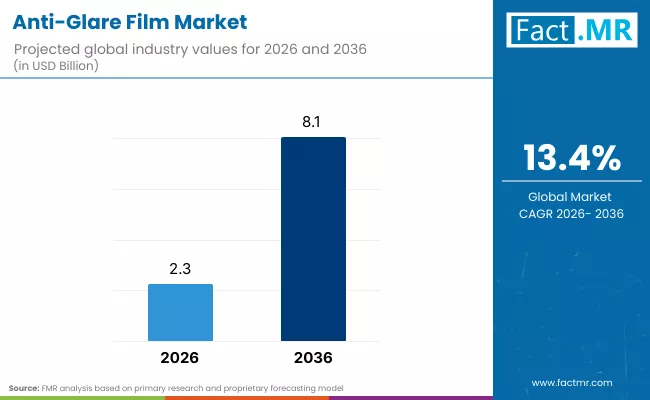
Anti Glare Film Market By Industry | Source: Fact.MR
This expansion is closely tied to rising screen time across consumer electronics, automotive display proliferation, and workplace ergonomic standards addressing digital eye strain. Anti-glare film formulations are closing a long-standing gap in optical materials. They provide effective reflection control while maintaining display clarity, touch sensitivity, and compatibility with existing device architectures. This makes them especially valuable for premium smartphones, automotive instrument clusters, and professional computing environments where visual comfort directly impacts user experience and productivity.
The importance of this category is often described by industry leaders as the optical clarity revolution. Speaking at the 2026 Society for Information Display conference, Dr. Thomas Geelhaar, Head of Display Technologies at 3M Company, explained that Modern anti-glare films now integrate nano-structured surfaces with precision light diffusion. These films eliminate surface reflections while preserving pixel sharpness at 4K and 8K resolutions. This approach reflects how the market is adapting to higher display densities and the growing need to reduce blue light exposure without compromising color accuracy.
Manufacturers that apply advanced surface engineering to address specific viewing conditions are well positioned to gain market share. By integrating moth-eye nanostructures, multilayer optical coatings, and hybrid anti-reflection systems, anti-glare film producers are aligning closely with today's display performance and eye health requirements.
Anti-Glare Film Market
| Metric | Value |
|---|---|
| Estimated. Value in (2026) | USD 2.3 billion |
| Forecast Value in (2036) | USD 8.1 billion |
| Forecast CAGR (2026 to 2036) | 13.4 % |
Source: Fact.MR analysis. Updated Feb 6, 2026
Category
| Category | Segments |
|---|---|
| Application Segment | Display Protection, Automotive Glass, Mobile Devices, Optical Displays |
| Coating Technology | Matte Coatings, Nano Coatings, Light Diffusion Coatings, Anti-Reflection Coatings |
| Base Film | PET Films, Polycarbonate, Acrylic Films, PET / PC Films |
| Region | North America; Europe; Asia Pacific; Latin America; Middle East & Africa |
Source: Fact.MR analysis. Updated Feb 6, 2026
Segmental Analysis
How is digital eye strain awareness positioning display protection as the leading application in the anti-glare film market?
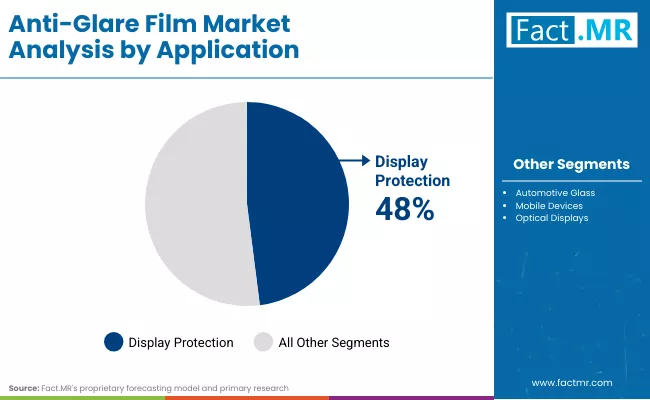
Anti Glare Film Market By Application | Source: Fact.MR
Display protection accounts for 48% of the anti-glare film market because it directly improves viewing comfort during long screen use. Screen exposure continues to rise across work, education, and entertainment. Many users now spend most of their day in front of digital displays. Medical studies link prolonged screen time to eye strain, headaches, and sleep disruption. Anti-glare films help reduce these effects. Matte coatings, nano-structured surfaces, and light-diffusing layers minimize reflections while preserving brightness and color accuracy. These films perform well in different lighting conditions without forcing users to increase screen brightness. They also remain compatible with touchscreens and protective glass, delivering comfort without affecting usability or image quality.
Why does matte coating technology dominance reshape optical preferences in anti-glare films?
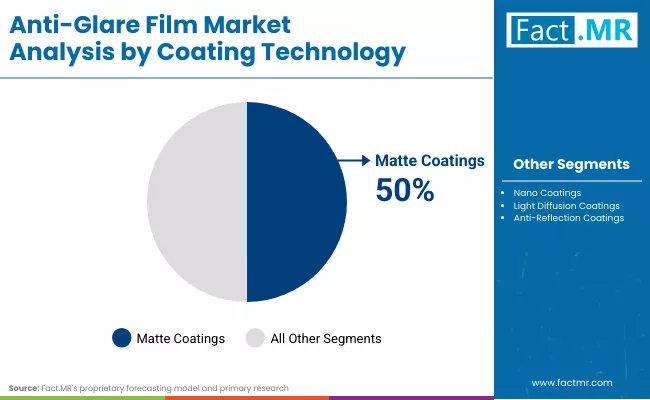
Anti Glare Film Market By Coating Technology | Source: Fact.MR
Matte coatings hold 50% market share because they offer a reliable and affordable way to reduce glare. Surface texturing diffuses reflected light and removes mirror-like reflections from overhead lighting and windows. Manufacturers favor matte coatings because they provide immediate glare reduction with minimal complexity. Image sharpness remains acceptable for standard-resolution displays. Matte treatments integrate easily into existing film production lines and work well with common adhesive lamination processes. This balance of performance, scalability, and cost makes matte coatings the default solution for consumer electronics, automotive displays, and industrial screens where glare control is needed without premium optical requirements.
Anti-Glare Film Market-Drivers, Restraints & Trends
- Drivers: The strongest driver of the anti-glare film market is the global increase in screen time. Remote work and digital learning have made prolonged display use unavoidable. This has intensified concerns around visual fatigue and eye health. Workplace regulations also play a role. Standards such as Germany’s DGUV V3 require glare control on professional monitors and industrial displays. These rules create steady demand in offices, factories, and control rooms. At the same time, advances in nano-imprinting and bio-inspired surface designs allow better glare reduction without sacrificing image quality. These technologies support adoption in high-resolution displays, including 4K and 8K screens.
- Restraints: Despite strong demand, technical tradeoffs remain. Traditional matte coatings scatter light, which can soften image clarity on high-resolution displays. This limits adoption in premium devices where sharpness is critical. Combining anti-glare features with other functions adds complexity. Films that also provide fingerprint resistance, blue light filtering, or anti-reflection layers require precise optical tuning. Manufacturing costs increase as production processes become more complex. As a result, some electronics brands hesitate to adopt advanced anti-glare films that require specialized equipment and longer production cycles.
- Trend: Nano-Structured Surface Engineering Nano-structured surfaces inspired by moth eyes are moving from research to commercial use. These patterns reduce reflections by gradually shifting refractive index rather than scattering light. The result is strong glare reduction without loss of clarity. Manufacturers investing in nano-imprint lithography gain an advantage in premium applications. These films support ultra-high-resolution displays while improving viewing comfort, making them attractive for professional visualization and high-end consumer electronics.
- Trend: Hybrid Blue Light and Anti-Glare Systems Hybrid films that combine blue light reduction with glare control are gaining attention. These products absorb harmful blue wavelengths while also reducing surface reflections. By combining functions into a single film, manufacturers reduce assembly complexity. These solutions appeal to professional users, medical displays, and long-duration computing environments where eye comfort and circadian health are priorities.
Anti-Glare Film Market Analysis by Key Country
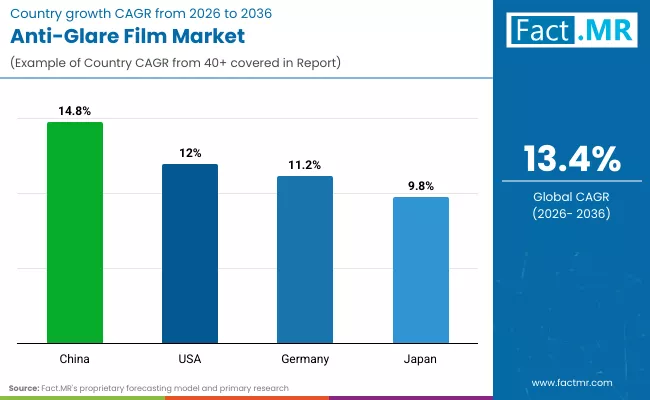
Anti Glare Film Market By Country | Source: Fact.MR
| Country | CAGR (2026-2036) |
|---|---|
| China | 14.8% |
| USA | 12.0% |
| Germany | 11.2% |
| Japan | 9.8% |
Source: Fact.MR analysis. Updated Feb 6, 2026
How is electric vehicle cockpit evolution influencing anti-glare film growth in China?
China’s anti-glare film market is growing at 14.8% CAGR, driven by rapid changes in electric vehicle cockpit design. Domestic automakers now treat digital interiors as a key differentiator. Triple-screen dashboards and panoramic head-up displays are becoming standard features. Brands such as BYD and NIO rely on large, curved displays that are highly sensitive to glare. Sunlight entering from multiple angles creates reflection challenges inside the cabin. To address this, BenQ Materials launched automotive polarizers with integrated anti-glare and anti-reflection properties in early 2026. These films maintain ultra-high resolution clarity while minimizing sparkle and windshield reflections. Demand reflects the convergence of advanced driver assistance systems and premium interior design expectations.
How is computer vision syndrome driving anti-glare film demand in the United States?
The United States market is expanding at 12.0% CAGR, fueled by rising cases of computer vision syndrome among remote and hybrid workers. Long hours in front of screens are causing chronic eye strain, headaches, and visual fatigue. Medical professionals increasingly recommend screen modifications before prescribing vision correction. Anti-glare films are often the first solution. This has accelerated demand for hybrid films that combine glare reduction with blue light filtering. 3M expanded production of high-clarity anti-glare and privacy films to support the 2026 corporate laptop refresh cycle. Employers now view screen ergonomics as part of workplace wellness, not optional accessories.
How is workplace safety regulation reshaping anti-glare film adoption in Germany?
Germany’s market is growing at 11.2% CAGR, driven by strict workplace safety regulations. DGUV V3 standards require documented control of screen reflections and visual fatigue. Compliance has pushed adoption of advanced optical solutions. Moth-eye nano-structured films are replacing traditional matte coatings because they reduce glare without sacrificing clarity. These films perform well under bright industrial lighting. Mondi Group deployed nano-etched anti-glare films in industrial control panels and medical monitors. In Germany, glare reduction is no longer a design choice. It is a documented safety requirement in factories and healthcare facilities.
How is outdoor device readability driving anti-glare film innovation in Japan?
Japan’s anti-glare film market grows at 9.8% CAGR, supported by logistics efficiency initiatives and an aging workforce. Warehouses increasingly rely on rugged tablets used outdoors and near loading bays. These devices must remain readable in direct sunlight while preserving touch sensitivity. Standard films often fail under 100,000-lux lighting conditions. Nitto Denko introduced hybrid antiviral and anti-glare films in early 2026. The products extend its Virus weeper technology to public kiosks and transport touchscreens. The solution addresses both hygiene and outdoor readability, reflecting Japan’s focus on multi-functional material innovation.
Competitive Landscape
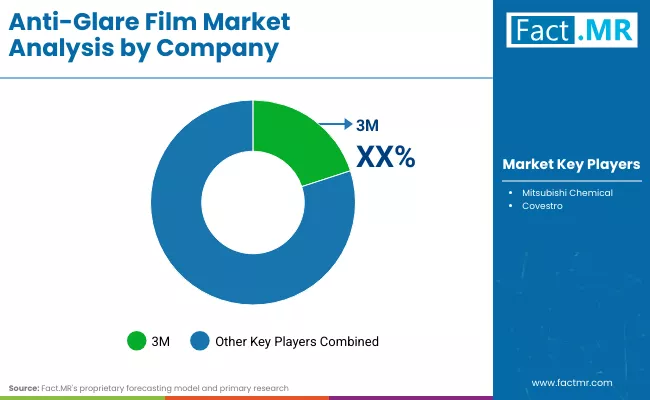
Anti Glare Film Market By Company | Source: Fact.MR
The competitive landscape of the anti-glare film market shifted noticeably as customer expectations moved beyond basic reflection reduction toward multi-functional and application-specific solutions. In 2024, competition was largely centered on optical performance and manufacturing scale. Companies such as 3M led the market with proven micro-replication technologies and broad consumer electronics reach, while Mitsubishi Chemical focused on low-haze films for premium smartphone displays. Covestro played a more supporting role through polycarbonate substrates for automotive glazing, and Nitto Denko served niche medical and public touchscreen applications.
By 2026, differentiation became much deeper. Anti-glare films evolved into integrated optical systems addressing eye health, workplace safety, and electric vehicle cockpit design. 3M expanded into hybrid blue-light and anti-glare solutions for enterprise laptops, reflecting growing focus on employee wellness. Mitsubishi Chemical strengthened its position in ultra-premium displays by adopting nano-structured surface technologies. Covestro moved closer to automotive OEMs by supporting large curved and head-up display programs. Nitto Denko gained traction through multi-functional films combining anti-glare with antimicrobial and antiviral properties. Overall, leadership in 2026 increasingly depends on surface engineering expertise, multi-function integration, and the ability to tailor glare control to specific environments rather than one-size-fits-all display protection.
Recent Developments
- In August 2025, Dexerials Corporation announced that its anti-reflection films produced using advanced sputtering technology have captured the largest global market share for the sixth consecutive year, driven by growing demand for high-visibility displays in automotive and consumer electronics applications where glare reduction and durability are critical.
- In September 2025, industry analysis reported significant investment by Xinmei in large-scale production lines for polarizer surface treatment films, reflecting rising global demand for optical films that enhance display clarity and reduce glare across devices ranging from smartphones to automotive head-up displays, as companies seek to balance high performance with supply-chain capacity scaling.
Key Players in Anti-Glare Film Market
- 3M
- Mitsubishi Chemical
- Covestro
- Nitto Denko
Bibliography
- Society for Information Display. 2026. Display technology advances: Anti-reflective coatings and nano-structured surfaces. Journal of the Society for Information Display 34(2): 89-106.
- Deutsche Gesetzliche Unfallversicherung. 2025. DGUV V3 workplace display standards: Requirements for reflection control and ergonomic viewing conditions. Berlin: DGUV.
- American Optometric Association. 2024. Computer vision syndrome: Clinical guidelines for digital eye strain diagnosis and management. St. Louis: AOA.
- Society of Automotive Engineers. 2025. SAE J1757 recommended practice for automotive instrument panel reflectivity. Warrendale: SAE International.
- International Commission on Illumination. 2024. CIE S 017 glare evaluation system for display screens and electronic devices. Vienna: CIE.
- BenQ Materials Corporation. 2026. Automotive display polarizers: Technical specifications for curved large-scale cockpit applications. Investor Relations Disclosures. Taipei: BenQ Materials.
Segmentation
Scope of Report
| Items | Values |
|---|---|
| Quantitative Units (2026) | USD 2.3 Billion |
| Application Segment | Display Protection, Automotive Glass, Mobile Devices, Optical Displays |
| Coating Technology | Matte Coatings, Nano Coatings, Light Diffusion Coatings, Anti-Reflection Coatings |
| Base Film | PET Films, Polycarbonate, Acrylic Films, PET / PC Films |
| Regions Covered | North America, Europe, Asia Pacific, Latin America, Middle East & Africa |
| Countries Covered | U.S., Canada, Germany, Italy, UK, France, Japan, Australia, and other countries |
| Key Companies Profiled | 3M, Mitsubishi Chemical, Covestro, Nitto Denko |
| Additional Attributes | Dollar revenue in the anti-glare film market is segmented by application segment (display protection, automotive glass, mobile devices, optical displays), coating technology (matte coatings, nano coatings, light diffusion coatings, anti-reflection coatings), base film (PET films, polycarbonate, acrylic films, PET/PC films), and region. Regional demand patterns are shaped by rising screen time, automotive display integration, workplace ergonomic standards, and digital eye strain awareness across consumer electronics applications. |
Source: Fact.MR analysis. Updated Feb 6, 2026
Anti-Glare Film Market by Segments
-
Application Segment :
- Display Protection
- Automotive Glass
- Mobile Devices
- Optical Displays
-
Coating Technology :
- Matte Coatings
- Nano Coatings
- Light Diffusion Coatings
- Anti-Reflection Coatings
-
Base Film :
- PET Films
- Polycarbonate
- Acrylic Films
- PET / PC Films
-
Region :
- Asia Pacific
- China
- India
- Japan
- South Korea
- Australia
- Rest of Asia Pacific
- North America
- United States
- Canada
- Mexico
- Europe
- Germany
- France
- UK
- Italy
- Spain
- Rest of Europe
- Latin America
- Brazil
- Mexico
- Argentina
- Rest of Latin America
- Asia Pacific
Frequently Asked Questions
How big is the global anti-glare film market in 2026?
What will be the size of the anti-glare film market in 2036?
How fast will the anti-glare film market grow between 2026 and 2036?
Which application segment dominates the anti-glare film market?
Which coating technology holds the largest share in anti-glare films?
Who worked on this report


Preview the report firsthand - request a free sample
Free SampleGet the brochure for pricing and purchase details
Download PDF